
- Home
- »
- Water & Sludge Treatment
- »
-
Sodium Chlorate Market Size & Share Report, 2026-2033GVR Report cover
![Sodium Chlorate Market (2026 - 2033)Report]()
Sodium Chlorate Market (2026 - 2033)
Size, Share & Trends Analysis Report By Form (Crystalline, Aqueous Solution), By Application (Pulp & Paper Bleaching, Water Treatment, Chemical Intermediate), By Region (North America, Europe, Asia Pacific), And Segment Forecasts
Market Size, 2025
$3.0BMarket Estimate, 2026
$3.1BMarket Forecast, 2033
$4.1BCAGR, 2026–2033
4.0%Sodium Chlorate Market Summary
The global sodium chlorate market size was valued at USD 3.0 billion in 2025 and is projected to grow from USD 3.1 billion in 2026 to reach USD 4.1 billion by 2033, at a CAGR of 4.0% from 2026 to 2033. Asia Pacific dominated the market, accounting for the largest revenue share of 35.8% in 2025. The market growth is supported by the rising demand for packaged foods, carbonated beverages, sauces, and pharmaceutical formulations, where sodium chlorate is widely used as a preservative to extend shelf life and maintain product quality.

Key Market Trends & Insights
- By form: Crystalline segment held the largest revenue share of 85.9% in 2025.
- By application: Chemical intermediate segment is expected to grow at the fastest CAGR of 4.1% from 2026 to 2033.
Regional Highlights
- Largest regional market: Asia Pacific (35.8%, revenue share, 2025)
- Fastest-growing regional market: Latin America (highest CAGR, 2026-2033)
- By country: China dominated the APAC market in 2025.
Market Size & Forecast
- Market size in 2025: USD 3.0 Billion
- Estimated market size in 2026: USD 3.1 Billion
- Projected market size by 2033: USD 4.1 Billion
- CAGR (2026-2033): 4.0%
Increasing demand for pulp and paper products, coupled with the expansion of the water treatment and chemical manufacturing industries, is driving the adoption of sodium chlorate. Sodium chlorate is primarily used as a precursor for generating chlorine dioxide, an essential bleaching agent in the pulp and paper industry due to its high efficiency and reduced environmental impact compared to elemental chlorine bleaching. It is also utilized in chemical synthesis and selects industrial oxidation processes. Rising paper and packaging consumption, driven by e-commerce growth, hygiene products, and sustainable packaging trends, along with ongoing investments in modern pulp mills and industrial infrastructure.
Market Dynamics
The sodium chlorate market is driven by increasing demand from the pulp and paper industry, where it serves as the primary raw material for on-site generation of chlorine dioxide for Elemental Chlorine Free (ECF) bleaching processes. Growing global consumption of packaging paper, tissue products, and hygiene papers, supported by e-commerce expansion and rising hygiene awareness, continues to fuel market demand. Investments in modern pulp mills, capacity expansions, and sustainable bleaching technologies are further supporting sodium chlorate consumption. Its use in water treatment and chemical manufacturing applications contributes to steady market growth. Manufacturers are focusing on production efficiency, energy optimization, capacity expansion, and strategic partnerships with pulp producers to strengthen their market position.
The increasing production of pulp and paper remains the primary growth driver for the sodium chlorate market. Sodium chlorate is an essential raw material for on-site chlorine dioxide generation, which is widely used in ECF bleaching to produce high-brightness pulp while minimizing the formation of harmful chlorinated compounds. Growing demand for corrugated packaging, tissue paper, and specialty paper from the packaging, healthcare, and consumer goods sectors continues to increase sodium chlorate consumption.
Investments in new pulp manufacturing facilities and modernization of existing mills are supporting higher chlorine dioxide production worldwide. Paper manufacturers are adopting cleaner bleaching technologies to comply with environmental regulations while maintaining product quality and operational efficiency. These industry developments are expected to sustain demand for sodium chlorate throughout the forecast period.
Sodium chlorate production requires significant amounts of electricity through the electrolysis process, making manufacturing costs highly sensitive to fluctuations in power prices. Rising energy costs and stricter environmental regulations on industrial emissions can reduce profit margins for manufacturers and limit capacity expansion in regions with expensive electricity.
The market is also closely linked to the performance of the pulp and paper industry, making demand vulnerable to changes in paper production and investment cycles. Declining demand for certain paper grades, temporary mill shutdowns, or delays in capacity expansion projects can directly affect sodium chlorate consumption. These factors create uncertainty for producers operating in highly competitive markets.
Growing investments in sustainable pulp production are creating significant opportunities for sodium chlorate manufacturers. Many pulp producers are expanding ECF bleaching capacity to improve environmental performance while maintaining high-quality pulp output. Rapid industrialization and rising paper production in Asia-Pacific and Latin America are supporting new investments in chlorine dioxide generation systems, resulting in higher demand for sodium chlorate.
Industrial and municipal water treatment is emerging as another important growth area as governments invest in improved water infrastructure and stricter wastewater treatment standards. Manufacturers are introducing energy-efficient production technologies, expanding regional manufacturing capacity, and strengthening supply partnerships with pulp producers to capture opportunities in both established and emerging markets.
Market Concentration & Characteristics
The sodium chlorate market is moderately consolidated, with a limited number of global manufacturers accounting for a significant share of production capacity. Competition is based on production efficiency, product quality, pricing, supply reliability, and the ability to maintain long-term contracts with pulp and paper companies. Large producers benefit from integrated manufacturing operations, established distribution networks, and proximity to major pulp-producing regions.
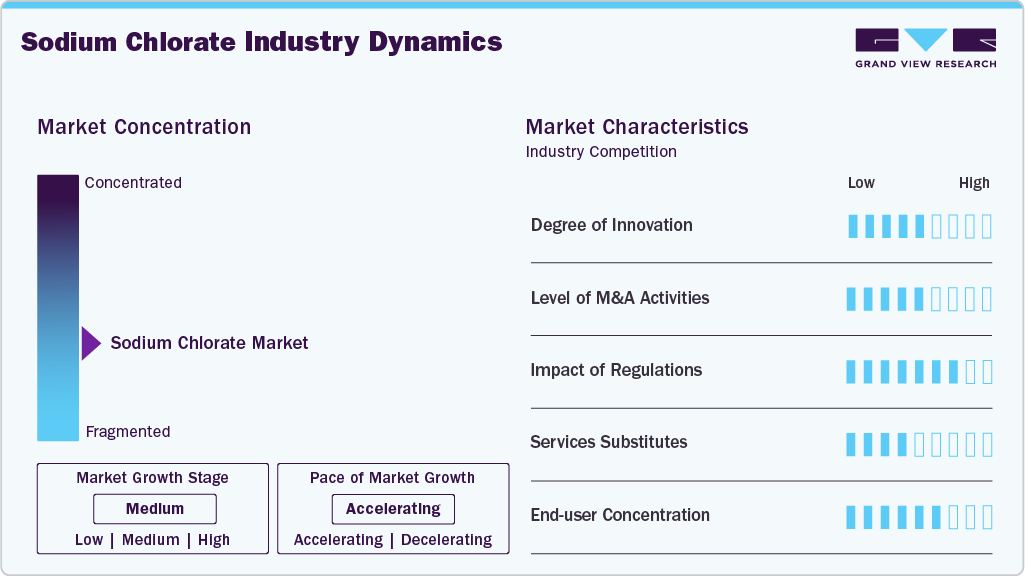
Participants are strengthening their market position through strategic capacity expansions, long-term supply agreements, and investments in energy-efficient manufacturing technologies. Companies are collaborating with pulp and paper producers to ensure a reliable supply of sodium chlorate for chlorine dioxide generation while improving production efficiency and reducing operating costs. Investments in process optimization, regional manufacturing facilities, and logistics infrastructure are helping manufacturers improve supply reliability and support growing demand from key pulp-producing regions.
Analyst Perspective
The sodium chlorate market is driven by the growing demand for chlorine dioxide in pulp bleaching and the expansion of sustainable paper production worldwide. Rising consumption of packaging paper, tissue products, and specialty paper is encouraging investments in modern pulp manufacturing facilities, increasing the need for sodium chlorate. Improvements in electrolysis technologies and process efficiency are enhancing production performance while supporting cost optimization and environmental compliance.
Form Insights
The crystalline segment held the largest revenue share of 82.4% in 2025. Its strong market position is linked to widespread use in chlorine dioxide production for pulp and paper bleaching, where crystalline sodium chlorate serves as a convenient feedstock. The solid form offers advantages in storage, transportation, and inventory management, making it suitable for large-scale industrial operations. Established production infrastructure and extensive distribution networks across major pulp-producing regions continue to reinforce demand for crystalline sodium chlorate.
The aqueous solution segment is the fastest-growing form segment, with a CAGR of 4.2% from 2026 to 2033.Demand is supported by the operational convenience of liquid sodium chlorate, which can be integrated directly into chlorine dioxide generation and other industrial processes. Reduced requirements for solid handling and easier dosing can improve process efficiency for end users. Growing investments in automated chemical handling systems and modernization of pulp and paper facilities are expected to create favorable conditions for the adoption of aqueous solutions.
Application Insights
The pulp & paper bleaching segment dominated the application segment with a revenue share of 67.0 % in 2025.Sodium chlorate is primarily consumed in this application to generate chlorine dioxide for Elemental Chlorine Free (ECF) bleaching, a widely adopted process for producing high-quality bleached pulp. Rising demand for packaging materials, tissue, hygiene products, and specialty paper is supporting expansion of pulp manufacturing capacity. Investments in new mills and upgrades to existing bleaching systems are expected to sustain sodium chlorate consumption across this application.

The chemical intermediate segment is expected to grow at a CAGR of 4.1% from 2026 to 2033. Sodium chlorate serves as an oxidizing agent and chemical feedstock in selected industrial processes, creating demand from specialty and general chemical manufacturing. Expansion of chemical processing activities and increasing utilization of oxidation-based production routes are supporting consumption in this segment. Investments in higher-efficiency chemical processes and the development of specialized industrial compounds are likely to open new avenues for sodium chlorate suppliers.
Regional Insights
Asia Pacific dominated the global sodium chlorate market, accounting for 35.8% of revenue in 2025. The region's leadership is supported by its large pulp and paper manufacturing base, expanding packaging industry, and increasing consumption of tissue and hygiene products. Rapid industrialization, rising e-commerce activity, and growing demand for sustainable paper packaging are encouraging investments in new pulp production facilities and modernization of existing mills. Countries across the region are increasingly adopting Elemental Chlorine Free (ECF) bleaching technologies, driving consistent demand for sodium chlorate used in chlorine dioxide generation.

China Sodium Chlorate Market Trends
Sodium chlorate market in China accounted for the largest share of the Asia Pacific market due to its extensive paper production capacity and well-developed chemical manufacturing industry. Significant investments in pulp mill expansion, increasing domestic demand for packaging materials, and continuous improvements in industrial efficiency continue to support market growth. India and Southeast Asian countries are also emerging as important growth markets, supported by rising paper consumption, expanding industrial infrastructure, and increasing investments in sustainable pulp production. Manufacturers are strengthening regional production capabilities and supply networks to meet growing customer demand and improve supply reliability.
North America Sodium Chlorate Market Trends
North America represents a mature and technologically advanced sodium chlorate market, supported by a well-established pulp and paper industry and widespread adoption of Elemental Chlorine Free (ECF) bleaching technologies. The region benefits from the presence of integrated pulp mills, advanced chlorine dioxide generation systems, and reliable sodium chlorate production facilities. Growing demand for packaging paper, tissue products, and hygiene paper, driven by e-commerce, consumer goods, and healthcare applications, continues to support sodium chlorate consumption. Manufacturers are focusing on production efficiency, long-term supply agreements, and investments in sustainable manufacturing technologies to strengthen supply reliability and reduce environmental impact.
The U.S. accounts for the largest share of the North American sodium chlorate market due to its extensive pulp and paper manufacturing base and well-developed chemical industry. Rising demand for corrugated packaging, specialty paper, and tissue products is encouraging pulp producers to optimize bleaching operations, increasing the consumption of sodium chlorate for chlorine dioxide generation. Industrial and municipal investments in water treatment infrastructure are also supporting market growth. Manufacturers are investing in plant modernization, energy-efficient electrolysis technologies, and process automation to improve operational performance while ensuring compliance with stringent environmental and workplace safety regulations.
Europe Sodium Chlorate Market Trends
Europe remains a key market for sodium chlorate, supported by strict environmental regulations, advanced pulp bleaching technologies, and a strong focus on sustainable paper production. Paper manufacturers across the region continue to adopt energy-efficient and environmentally responsible bleaching processes, driving consistent demand for chlorine dioxide and sodium chlorate. Investments in reducing greenhouse gas emissions, improving electricity efficiency, and upgrading manufacturing facilities are reshaping the competitive landscape. Companies are also strengthening regional supply networks and implementing circular economy initiatives to improve resource efficiency and meet ambitious sustainability targets established across the European Union.
Latin America Sodium Chlorate Market Trends
Sodium chlorate market in Latin America is witnessing the fastest CAGR from 2026 to 2033, primarily driven by expanding eucalyptus pulp production and large-scale investments in new pulp mills, particularly in Brazil and Chile. The region has become an important global supplier of market pulp, creating sustained demand for sodium chlorate used in chlorine dioxide generation for ECF bleaching. Global chemical manufacturers are expanding regional production capacity and entering long-term supply agreements with major pulp producers to support increasing demand. Favorable availability of forestry resources, competitive production costs, and continued investment in export-oriented pulp manufacturing are expected to strengthen the region's importance in the global sodium chlorate market.
Middle East Sodium Chlorate Market Trends
The Middle East sodium chlorate market is experiencing steady growth, supported by increasing industrialization, expansion of chemical manufacturing, and rising investments in water treatment infrastructure. Governments across the region are investing in industrial wastewater treatment, desalination projects, and sustainable water management systems, creating opportunities for chlorine dioxide-based disinfection technologies. Although the region has a relatively limited pulp and paper manufacturing base, demand from industrial processing, chemical synthesis, and water treatment applications continues to expand. Manufacturers are strengthening regional distribution networks and collaborating with industrial customers to support the growing adoption of sodium chlorate across diverse industrial sectors.
Key Sodium Chlorate Company Insights
Companies operating in the sodium chlorate market are adopting strategies centered on production capacity expansion, process optimization, and energy-efficient manufacturing to strengthen their competitive position. Leading manufacturers are investing in advanced electrolysis technologies, sustainable production processes, and regional manufacturing facilities to improve operational efficiency and ensure reliable supply to the pulp and paper industry. They are also strengthening long-term partnerships with pulp producers and enhancing logistics capabilities to support the growing demand for chlorine dioxide generation used in Elemental Chlorine Free (ECF) bleaching.
-
Nouryon is a leading global producer of sodium chlorate, offering high-purity products that support chlorine dioxide generation for sustainable pulp bleaching applications. The company leverages advanced electrolysis technologies, an extensive manufacturing footprint, and technical expertise to deliver reliable sodium chlorate solutions with consistent quality. Nouryon continues to strengthen its market position through investments in production efficiency, sustainable manufacturing practices, and strategic collaborations with pulp and paper producers to improve operational performance and supply reliability.
-
ERCO Worldwide is a leading manufacturer of sodium chlorate and chlorine dioxide technologies, providing integrated chemical solutions for the global pulp and paper industry. The company combines sodium chlorate production with expertise in on-site chlorine dioxide generation systems, enabling customers to improve bleaching efficiency and environmental performance. ERCO Worldwide continues to enhance its competitive position through investments in process optimization, manufacturing capacity, and customer-focused technical services while supporting sustainable pulp production through reliable chemical supply and operational excellence.
Key Sodium Chlorate Companies
The following key companies have been profiled for the study on the sodium chlorate market.
-
Nouryon
-
ERCO Worldwide
-
Kemira
-
Arkema
-
Ercros S.A
-
OSAKA SODA
-
Shree Chlorates
-
CNSIG Inner Mongolia Chemical Industry Co., Ltd.
-
GFS Chemicals, Inc.
-
American Elements
Competitive Benchmarking
Operating Strategies
Competitive Edge
Weaknesses
Mature Players:Nouryon, ERCO Worldwide, Kemira, Arkema, Ercros S.A., OSAKA SODA
- Invest in production capacity expansion and energy-efficient electrolysis technologies to improve manufacturing efficiency.
- Strengthen long-term supply agreements with pulp and paper producers for reliable sodium chlorate supply.
- Expand regional manufacturing and logistics infrastructure to serve major pulp-producing regions.
- Focus on process optimization, sustainability initiatives, and low-carbon manufacturing to meet evolving environmental regulations.
- Established manufacturing footprint ensures reliable supply and economies of scale.
- Strong relationships with global pulp and paper companies support long-term business stability.
- Advanced production technologies and technical expertise improve product quality and operational efficiency.
- Extensive distribution networks and integrated chemical operations enhance global market presence.
- High capital and electricity requirements increase production costs.
- Heavy dependence on the pulp and paper industry exposes companies to cyclical demand.
- Compliance with stringent environmental and emission regulations increases operating expenses.
- Large manufacturing operations reduce flexibility in responding to regional market changes.
Emerging Players: Shree Chlorates, CNSIG Inner Mongolia Chemical Industry Co., Ltd., GFS Chemicals, Inc., American Elements
- Focus on expanding regional production capacity and strengthening domestic distribution networks.
- Target niche industrial applications alongside pulp and paper customers through customized product offerings.
- Invest in manufacturing efficiency and product quality improvements to compete with global producers.
- Develop strategic partnerships with regional industrial customers and distributors to strengthen market presence.
- Strong regional presence enables faster response to local customer requirements.
- Competitive pricing and operational flexibility support growth in domestic markets.
- Ability to serve specialized industrial and laboratory-grade chemical requirements in addition to bulk applications.
- Lean organizational structures enable quicker operational decisions and customer support.
- Limited global manufacturing footprint and distribution capabilities restrict international expansion.
- Smaller production capacity limits competitiveness against multinational manufacturers.
- Lower investment in advanced production technologies compared to established market leaders.
- Greater exposure to raw material availability, electricity price fluctuations, and regional market demand.
Recent Developments
-
In August 2025, Nouryon signed a long-term agreement with Arauco to construct integrated sodium chlorate and chlorine dioxide manufacturing facilities in Mato Grosso do Sul, Brazil. The investment likely to increase Nouryon's sodium chlorate production capacity in Brazil by 20% and its global capacity by nearly 10%, strengthening its position as a leading supplier to the South American pulp and paper industry.
-
In July 2024, Kemira announced an investment to expand the sodium chlorate production capacity at its Ortigueira facility in Brazil by more than 10%. The expansion, completed in the fourth quarter of 2024, was undertaken to support the growing South American pulp and paper industry and strengthen Kemira's ability to supply bleaching chemicals for chlorine dioxide production used in kraft pulp manufacturing.
Sodium Chlorate Market Report Scope
Report Attribute
Details
Market size in 2025
USD 3.0 billion
Estimated market size in 2026
USD 3.1 billion
Projected market size by 2033
USD 4.1 billion
Growth rate
CAGR of 4.0% from 2026 to 2033
Base year for estimation
2025
Historical data
2021 - 2024
Forecast period
2026 - 2033
Quantitative units
Revenue in USD billion, volume in kilotons, and CAGR from 2026 to 2033
Report coverage
Revenue forecast, volume forecast, company ranking, competitive landscape, growth factors, and trends
Segments covered
Form, application, region
Regional scope
North America; Europe; Asia Pacific; Latin America; MEA
Country scope
U.S.; Canada; Mexico; Germany; UK; France; Italy; Spain; China; India; Japan; South Korea; Brazil; Argentina; Saudi Arabia; South Africa
Key companies profiled
Nouryon; ERCO Worldwide; Kemira; Arkema; Ercros S.A; OSAKA SODA; Shree Chlorates; CNSIG Inner Mongolia Chemical Industry Co. Ltd.; GFS Chemicals, Inc.; American Elements
Customization scope
Free report customization (equivalent up to 8 analysts’ working days) with purchase. Addition or alteration to country, regional & segment scope.
Pricing and purchase options
Avail customized purchase options to meet your exact research needs. Explore purchase options
Global Sodium Chlorate Market Report Segmentation
This report forecasts volume & revenue growth at regional levels and provides an analysis of the latest industry trends in each of the sub-segments from 2021 to 2033. For this study, Grand View Research has segmented the global sodium chlorate market report based on form, application, and region:

-
Form Outlook (Volume, Kilotons; Revenue, USD Billion, 2021 - 2033)
-
Crystalline
-
Aqueous Solution
-
-
Application Outlook (Volume, Kilotons; Revenue, USD Billion, 2021 - 2033)
-
Pulp & Paper Bleaching
-
Water Treatment
-
Chemical intermediate
-
Other Applications
-
-
Region Outlook (Volume, Kilotons; Revenue, USD Billion, 2021 - 2033)
-
North America
-
U.S.
-
Canada
-
Mexico
-
-
Europe
-
Germany
-
UK
-
France
-
Italy
-
Spain
-
-
Asia Pacific
-
China
-
India
-
Japan
-
South Korea
-
-
Latin America
-
Brazil
-
Argentina
-
-
Middle East & Africa
-
Saudi Arabia
-
South Africa
-
-
Research Methodology
The sodium chlorate market figures in this report are based on a proven research process that combines executive interviews with secondary research from proprietary databases, company filings, and recognized regulatory and institutional sources. Market size is built through value-chain sizing-reconciling supply-side and demand-side estimates-and triangulated with bottom-up and top-down approaches. Every estimate passes multiple levels of expert validation before publication, with each sodium chlorate segment quantified using the revenue-capture definitions in the table below.
Segment Definition
Segment - Form
Revenue capture definition
Crystalline
Market revenue is generated through the sale of solid sodium chlorate crystals supplied to pulp and paper mills and industrial users for chlorine dioxide generation and chemical processing. The product's ease of storage, transportation, and long shelf life supports widespread commercial use.
Aqueous Solution
Revenue comes from supplying sodium chlorate in liquid form, which enables direct integration into chlorine dioxide generation systems and other industrial processes. Its ready-to-use nature reduces handling requirements and improves operational efficiency for end users.
Segment - Application
Revenue capture definition
Pulp & Paper Bleaching
Sales are primarily driven by sodium chlorate consumption for on-site chlorine dioxide production used in Elemental Chlorine Free (ECF) pulp bleaching. Expansion of pulp manufacturing and increasing demand for sustainable paper production continue to support this segment.
Water Treatment
Market value is derived from the use of sodium chlorate in chlorine dioxide generation for municipal and industrial water treatment applications. Its role in effective disinfection and microbial control contributes to steady demand across water infrastructure projects.
Chemical intermediate
Demand in this segment is supported by the use of sodium chlorate as an oxidizing agent and intermediate in the manufacture of specialty chemicals and industrial compounds. Growth in chemical processing activities continues to generate revenue opportunities.
Other Applications
Revenue is captured from sodium chlorate supplied for specialized industrial uses, including mining, laboratory chemicals, and selected oxidation processes. Consistent demand from niche industrial applications contributes to the overall market value.
Estimation Model
Layer Name
Key Question
Description
Raw Material & Production Layer
What forms the supply base?
Identify the sourcing and production of sodium chlorate using raw materials such as sodium chloride (brine), water, and electricity through the electrolysis process. Assess manufacturing technologies, production capacities, energy consumption, supply chain dynamics, and major production hubs supporting commercial availability. Evaluate the availability of low-cost electricity and integrated chlor-alkali operations, which significantly influence production economics.
Application Adoption Layer
Where is sodium chlorate utilized?
Assess the adoption of sodium chlorate across key end-use industries, including pulp and paper bleaching, water treatment, chemical manufacturing, mining, and other industrial applications. Demand is primarily driven by chlorine dioxide generation for Elemental Chlorine Free (ECF) pulp bleaching, supported by increasing paper and packaging production, industrial water treatment requirements, and growth in chemical processing activities.
Consumption Intensity Layer
How much sodium chlorate is consumed?
Analyze consumption by evaluating sodium chlorate usage across pulp mills, chlorine dioxide generation systems, water treatment facilities, and industrial chemical operations. The assessment considers pulp production volumes, bleaching chemical requirements, industrial output, capacity utilization, and expansion of paper manufacturing facilities to estimate annual sodium chlorate demand.
Revenue Layer
How is market revenue generated?
Market revenue is generated through the production and commercial supply of sodium chlorate for chlorine dioxide generation, chemical processing, water treatment, and other industrial applications. Revenue growth is supported by expanding pulp and paper production, investments in sustainable bleaching technologies, capacity expansions, long-term supply agreements, and increasing demand for efficient industrial oxidation and disinfection solutions.
Delivered Customizations
This report has been delivered with the following In-depth customizations
Client Request
Customization Delivered
Value Adds
Regional segmentation
The assessment includes region level market size and forecasts; demand patterns by application including pulp & paper bleaching, water treatment, chemical intermediates, and other industrial uses; production capacities; sodium chlorate consumption trends; domestic production and import-export dynamics; regulatory developments; competitive landscape; supply chain analysis; and investments in pulp manufacturing and chlorine dioxide generation across each region.
Supports production planning, regional expansion, and supply chain optimization by providing insights into production hubs, electricity cost competitiveness, raw material availability, and demand trends. Helps identify high-growth markets, improve procurement strategies, and strengthen long-term customer relationships with pulp and paper producers.
Opportunity Assessment
Detailed evaluation of growth opportunities across expanding pulp production, sustainable Elemental Chlorine Free (ECF) bleaching technologies, industrial and municipal water treatment, and specialty chemical manufacturing. The assessment covers investments in new pulp mills, modernization of existing facilities, energy-efficient electrolysis technologies, regional capacity expansions, and evolving environmental regulations influencing sodium chlorate demand.
Enables identification of high-growth investment opportunities across the sodium chlorate value chain. Supports strategic capacity expansion, customer acquisition, technology investments, and market entry decisions through insights into regional industrial development, sustainability initiatives, and long-term demand drivers.
Competitive Benchmarking
Comparative assessment of leading sodium chlorate manufacturers based on production capacity, manufacturing footprint, energy efficiency, product quality, regional presence, customer relationships, technological capabilities, sustainability initiatives, long-term supply agreements, and expansion strategies. The benchmarking also evaluates operational efficiency, supply reliability, and integration with chlorine dioxide generation technologies.
Supports benchmarking against key competitors while identifying opportunities to improve production efficiency, strengthen supply chain resilience, expand regional presence, and enhance customer partnerships. Enables informed decisions regarding capacity investments, technology upgrades, strategic collaborations, and long-term competitive positioning within the sodium chlorate market.
Frequently Asked Questions About This Report
The global sodium chlorate market size was valued at USD 3.0 billion in 2025 and is expected to reach USD 4.1 billion in 2026.
The global sodium chlorate market, in terms of revenue, is projected to grow at a CAGR of 4.0% from 2026 to 2033, reaching USD 4.1 billion by 2033.
The Crystalline segment dominated the market, accounting for 85.9% of the global revenue in 2025.
The Aqueous Solution segment is expected to register the fastest growth, with a CAGR of 4.2% during the forecast period.
The Pulp & Paper Bleaching segment dominated the market, accounting for 67.0% of the global revenue in 2025.
The Chemical Intermediate segment is expected to grow at the fastest rate, registering a CAGR of 4.1% during the forecast period.
Asia Pacific dominated the global sodium chlorate market in 2025, accounting for 35.8% of the total revenue share.
The market is driven by increasing demand from the pulp and paper industry for chlorine dioxide-based bleaching, growing consumption of paper packaging and tissue products, expansion of water treatment and chemical manufacturing industries, and rising investments in efficient and environmentally compliant bleaching technologies.
Key players include Ercros S.A., Kemira Oyj, Nouryon, Chemtrade Logistics Inc., Arkema S.A., ERCO Worldwide, Shree Chlorates, Inner Mongolia Lantai Industrial Co., Ltd., Tronox Holdings plc, and Vizag Chemical International.
About the Author(s)
Water & Sludge Treatment Research Team
Bulk Chemicals · Water & Sludge TreatmentThis report was authored by the water & sludge treatment research team at Grand View Research - comprising two research analysts, one senior research analyst, and one industry expert - with specialized expertise in the water & sludge treatment segment of the bulk chemicals industry. All findings are based on proprietary bulk chemicals databases, executive interviews, and regulatory analysis, subject to internal peer review prior to publication.
Last Updated:
Speak to Analyst


Customize this report to your needs — add regions, segments, or data points, with 20% free customization.
Or view our licence options:


ISO 9001:2015 & 27001:2022 Certified
We are GDPR and CCPA compliant! Your transaction & personal information is safe and secure. For more details, please read our privacy policy.


