
- Home
- »
- Next Generation Technologies
- »
-
SoftPOS Market Size, Share And Growth Report, 2026-2033GVR Report cover

SoftPOS Market (2026 - 2033)
Size, Share & Trends Analysis Report By Enterprise Size (Micro & Small Business, Medium & Large Business), By Operating System, By End Use (Retail, Restaurants, Public Transport, Hospitality, Others), By Region, And Segment Forecasts
Market Size, 2025
$439.9MMarket Estimate, 2026
$534.1MMarket Forecast, 2033
$2,464.8MCAGR, 2026–2033
24.4%SoftPOS Market Summary
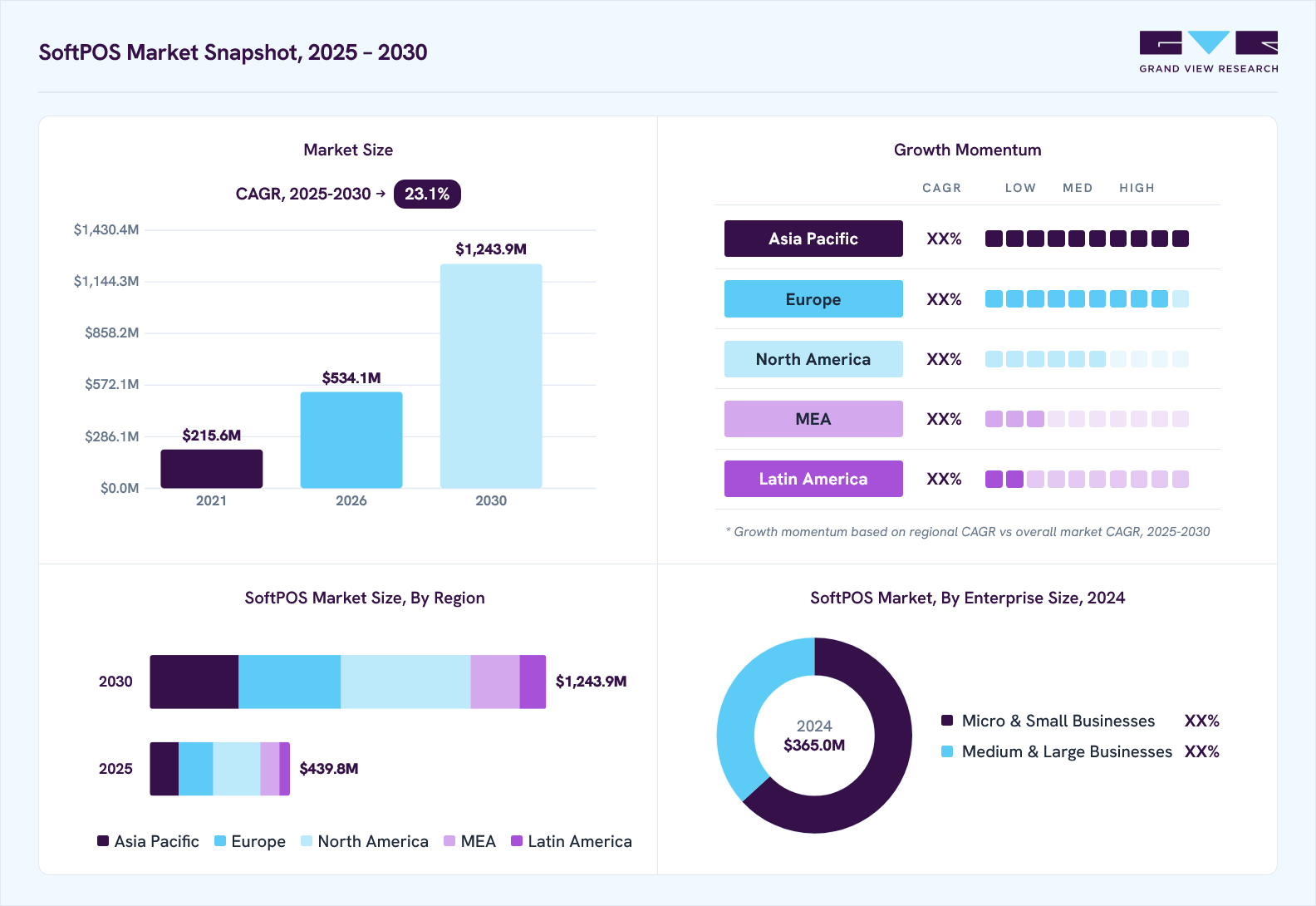
The global SoftPOS market size was valued at USD 439.9 million in 2025 and is projected to grow from USD 534.1 million in 2026 to USD 2,464.8 million by 2033, at a CAGR of 24.4% from 2026 to 2033. The market in North America dominated with a revenue share of 33.5% in 2025. A software point of sales (SoftPOS) is a type of software-based payment system that enables merchants to accept debit and credit card payments using a tablet or smartphone.
 Source: Grand View Research, IR Documents, Primary Interviews, Paid DatabasesTo learn more about this report,
 Download Free Sample Report
 Key Market Trends & Insights
- By enterprise size: Micro & small businesses segment held the largest market share of 63.6% in 2025.
- By operating system: Android segment held the largest market share of 58.4% in 2025.
- By end use: Retail segment held the largest market share of 26.3% in 2025.
Regional Highlights
- Largest regional market: North America (33.5% revenue share, 2025)
- Fastest-growing regional market: Asia Pacific (highest CAGR, 2026-2033)
- By country: The U.S. held the largest market share in 2025.
Market Size & Forecast
- Market size in 2025: USD 439.9 Million
- Estimated market size in 2026: USD 534.1 Million
- Projected market size by 2033: USD 2,464.8 Million
- CAGR (2026-2033): 24.4%
Three ways to get this report
Buy it, customize it, or ask a question.Ask an Analyst
Analyst response in 1 business day
- AccessReport author, directly
- Reply timeWithin 1 working day
- No sales callDirect answer only
- FormatEmail reply
- CostFree, no cost
Get the Full Report
What the study covers
- FormatsPDF · Excel · Dashboard
- Timeline2026–2033 annual, 2025 base
- Coverage20+ countries, 5 regions
- Companies10+ key players profiled
Customize the Report
20% free customization
- IncludeCountries, segments, points
- TailorTo your product definition
- ExtendDeeper competitor detail
- OrA fully bespoke study
- Turnaround5–10 working days
Increasing adoption of SoftPOS solutions by small and medium businesses and merchants owing to it, such as cost savings, increased flexibility, improved security, and easy integration is a major driving factor behind the growth of the market. The growing number of smartphone users across the globe and increasing government initiatives regarding digital payments are further driving the market growth.The SoftPOS systems offer cost savings to merchants by eliminating the need to invest in physical hardware such as card readers and traditional POS terminals. This feature makes this system an optimal solution for small businesses and emerging merchants. These systems are highly flexible and are used on a variety of devices, including tablets and smartphones. This enables merchants to accept payments anytime, anywhere, making it a perfect solution for merchants on-the-go or pop-up or temporary stores. Furthermore, this system offers improved security by using tokenization and encryption to protect sensitive information and reduce the risk of fraud. This helps to ensure that both consumers and merchants are protected during transactions.
 To learn more about this report, Download Free Sample Report
 A rapid technological advancement in payment technology is further contributing to the growth of the SoftPOS industry. The SoftPOS solution depends on Near-Field Communication (NFC) technology. By using the built-in capabilities of mobile devices, such as QR code scanning and NFC, SoftPOS securely processes transactions. This reduces the need for additional hardware, minimizing costs and streamlining the payment process for businesses. Lower costs, minimal hardware requirements, and an easy payment process are contributing to the market’s growth over the forecast period.
Increasing development of SoftPOS systems by various major market players is further contributing to the market’s growth. In February 2023, Qatar’s leading digital bank, Qatar Islamic Bank (QIB), partnered with Mastercard, a global payment-processing corporation, to launch its new smart payment solution for merchants. The QIB SoftPOS application transforms an Android smartphone into a Point-of-Sale terminal, facilitating the secure acceptance of contactless payments through the device's embedded Near-Field Communication (NFC) functionality. With the QIB SoftPOS solution, supported by Mastercard, merchants could utilize their Android smartphones to process contactless transactions from all EMV contactless cards, as well as NFC-enabled phones equipped with digital wallets such as Google Pay and Apple Pay, and other NFC-enabled wearable devices such as Garmin Pay, Apple Watch, or Android smartwatches.
Despite the myriad advantages and promising prospects associated with the SoftPOS systems, there are specific challenges and limitations that could hamper the growth of the market. Existing SoftPOS solutions exhibit certain limitations, including exclusive compatibility with international card schemes, restricted support for cardholder verification methods, and limited use in markets with offline PIN validations. However, the increased number of contactless transactions post-COVID-19 pandemic is driving the demand for advanced payment solutions in the market. This, in turn, is propelling the SoftPos industry growth.
Market Dynamics
The SoftPoS market is witnessing significant growth as businesses increasingly adopt software-based payment acceptance solutions that eliminate the need for dedicated point-of-sale hardware. Rising contactless payment adoption, expanding smartphone penetration, and rapid digitalization of merchant payment ecosystems are driving market demand. Financial institutions and payment service providers are introducing SoftPoS solutions to improve payment accessibility for small and medium-sized businesses. In addition, the expansion of tap-to-phone technology and increasing digital payment adoption in emerging markets are creating substantial opportunities for industry participants. However, cybersecurity concerns and device compatibility challenges continue to restrain market growth.
The increasing preference for contactless and digital payment methods is one of the primary drivers of the SoftPoS market. Consumers and businesses are increasingly shifting away from cash transactions in favor of faster and more secure payment methods. SoftPoS solutions enable merchants to accept contactless card and mobile wallet payments using NFC-enabled smartphones without requiring dedicated payment terminals. This reduces infrastructure costs while improving payment convenience for both merchants and customers. Payment service providers and financial institutions are actively promoting contactless payment acceptance to support digital commerce. Growing adoption of NFC-enabled payment cards and mobile wallets is further accelerating demand. These factors continue to drive market growth.
Digital payment ecosystems are expanding rapidly across retail, hospitality, transportation, and service industries. Consumers increasingly expect seamless and touch-free payment experiences. Businesses are investing in flexible payment technologies to improve customer satisfaction. Continued growth in contactless transactions is expected to sustain market expansion.
Security concerns is a major restraint affecting the SoftPoS market. Payment applications process sensitive financial and customer information, making them potential targets for cyberattacks and fraud. Businesses must ensure compliance with payment security standards and data protection regulations. Concerns regarding malware, unauthorized access, and payment fraud may discourage some merchants from adopting smartphone-based payment solutions. Continuous software updates and security enhancements are necessary to protect transaction integrity. Maintaining customer trust remains critical for successful market adoption. These challenges continue to restrain market growth.
The widespread availability of NFC-enabled smartphones is significantly driving the SoftPoS market. Modern smartphones provide merchants with an affordable platform for accepting digital payments without investing in traditional POS hardware. Small businesses, independent retailers, delivery services, and mobile merchants are increasingly adopting SoftPoS applications to expand payment acceptance capabilities. Growing mobile commerce and digital entrepreneurship are further increasing demand for cost-effective payment solutions. Technology providers continue to enhance mobile payment applications with improved security, analytics, and transaction management features. Smartphone adoption continues to rise across both developed and emerging economies. These developments are driving market growth.
Mobile devices have become an essential part of commercial transactions. Businesses seek flexible payment solutions that support mobility and operational efficiency. Smartphone-based payment acceptance helps reduce upfront costs while expanding digital payment access. This trend remains a key market driver.
Analyst Perspective
The SoftPOS market is transitioning from early adoption toward broader commercial deployment, supported by structural shifts toward contactless payments and mobile-first commerce. Android-led ecosystems continue to dominate, while iOS-based solutions are gaining traction in enterprise and premium merchant segments. Security certification advancements and cloud-native architecture are reshaping vendor differentiation strategies. Investment is increasingly directed toward emerging markets and transit-oriented use cases. Competitive dynamics are shifting as payment processors and fintech providers expand SoftPOS portfolios to strengthen merchant acquisition and retention.
Enterprise Size Insights
Based on enterprise size, the micro & small business segment led the market with the largest revenue share of 63.6% in 2025. Increasing adoption of SoftPOS solutions by micro and small businesses across the world owing to its several benefits is a major factor behind the segment’s growth. These benefits include low cost, ease of use, and fast payment process. For instance, the SoftPOS solution allows small businesses to process payments more quickly compared to traditional payment methods, potentially leading to higher turnover and enhanced convenience, thus driving the market’s demand amongst small businesses. In addition, the growing number of micro and small businesses across the globe is fueling the growth of the market.
The medium and large business segment is expected to grow at a moderate CAGR during the forecast period. For medium and large businesses, the SoftPOS solution is gaining traction as a feasible alternative to using dedicated hardware, which offers versatility and accessibility. As a result, the growing popularity of SoftPOS solutions in medium and large-sized businesses, owing to its above-mentioned benefits, is fueling the segment’s growth.
Operating System Insights
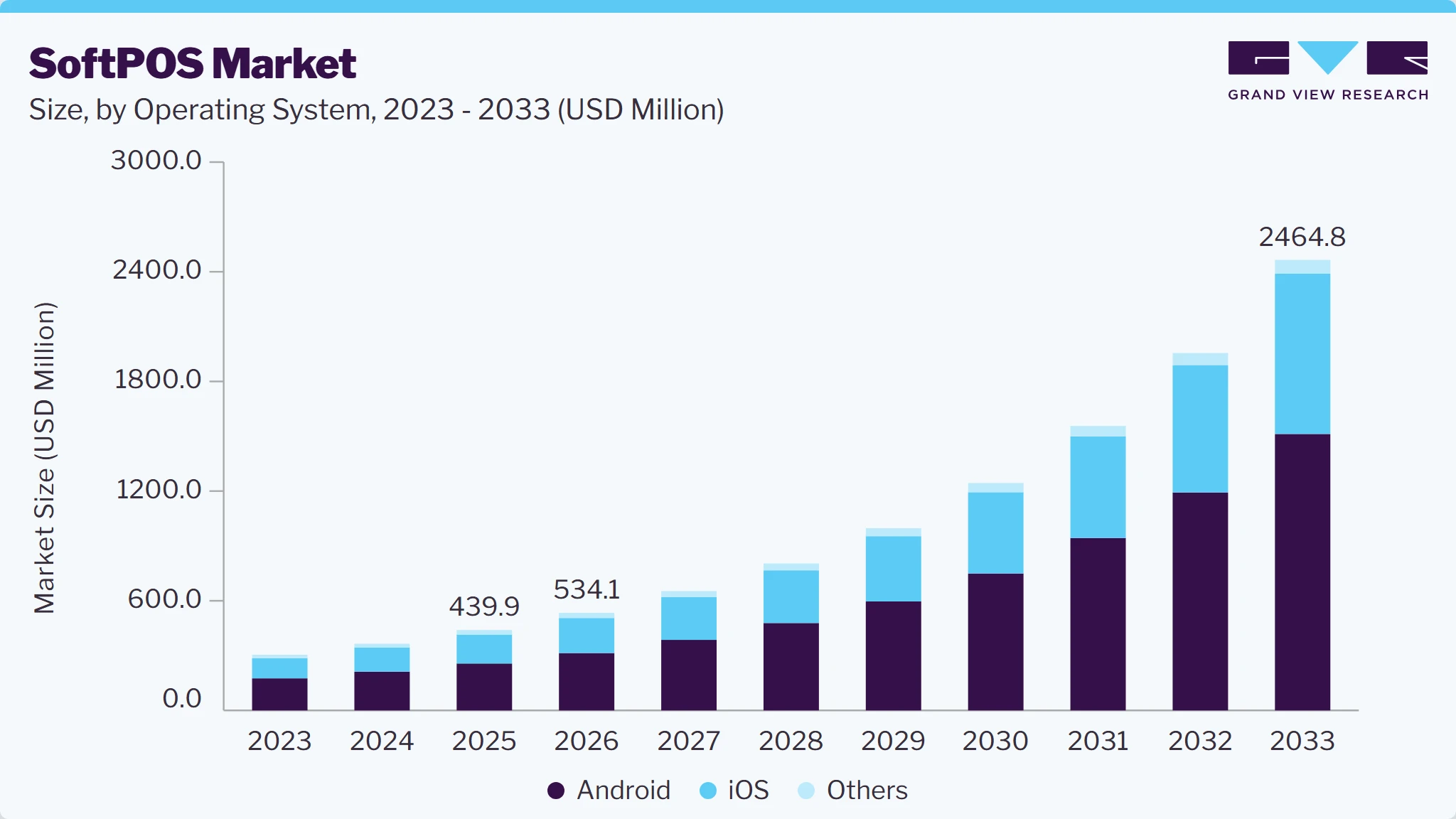
Based on operating system, the android segment led the market with the largest revenue share of 58.4% in 2025. Android-based tablets and smartphones are the main platforms supported by SoftPOS systems. Android is the most widely used operating system in the world. According to StatCounter, a web traffic analysis website’s latest data, the Android operating system (OS) has a 73.49% mobile operating system market share as of December 2024. Thus, the increasing number of android smartphone or mobile users across the world is a major factor driving the segment’s growth.
The iOS segment is expected to register a notable CAGR during the forecast period. Initially, a significant barrier to the adoption of SoftPOS was its lack of support on iOS. However, Apple’s February 2022 announcement of Tap to Pay on iPhone is expected to be a key driver of growth in this segment. This feature is expected to enable millions of merchants worldwide, ranging from small businesses to large enterprises, to securely and effortlessly accept Apple Pay, contactless debit and credit cards, and other mobile wallets by simply tapping them on an iPhone, eliminating the need for additional hardware.
End Use Insights
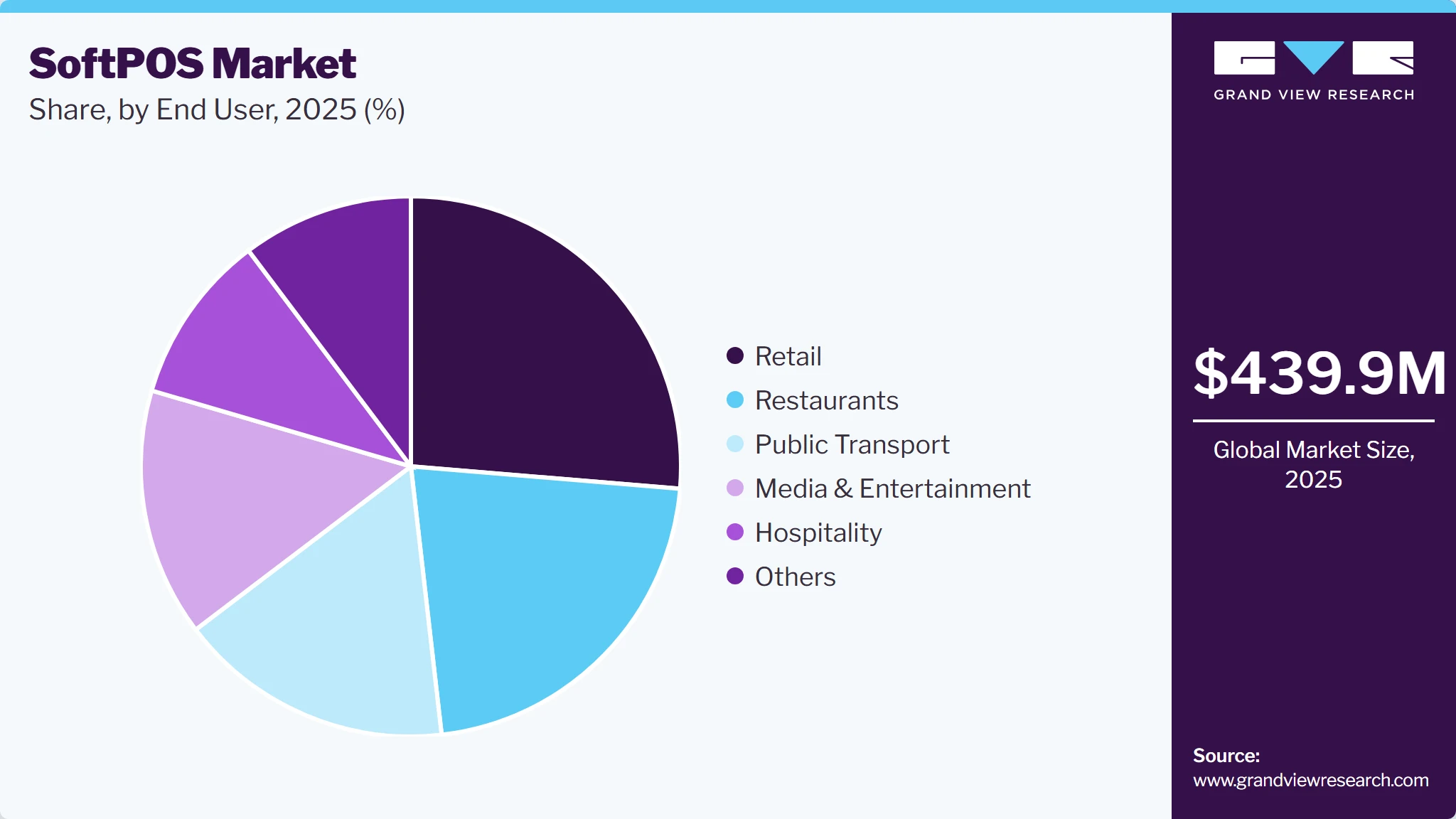
Based on end use, the retail segment led the market with the largest revenue share of 26.3% in 2025. Rapid growth in the global economic retail industry and several benefits of SoftPOS for retailers are driving the segment growth. It allows retailers to accept payments using smartphones and tablets. It's a modern alternative to traditional POS systems, which require expensive hardware. In addition, the increasing adoption of digital payment processing solutions by various retailers is further improving the market’s growth.
 To learn more about this report, Download Free Sample Report
 The restaurants segment is expected to grow at a notable CAGR during the forecast period. Contactless payment has gained significant popularity in the restaurants and hospitality industry. The SoftPOS technology can be seamlessly integrated with the restaurant's core business application, such as order collection. This technology provides benefits to both restaurant managers and customers, enhancing the efficiency of the check-in and checkout process, thereby boosting staff’s productivity, and improving the overall customer experience simultaneously. The expected growth of this technology is owing to the substantial increase in contactless payments in recent years, which offer a seamless, convenient, reliable, and secure payment method.
Regional Insights
North America dominated the global SoftPOS market with the largest revenue share of 33.5% in 2025. Increasing adoption of contactless payment and rising adoption of advanced digital technologies are major factors behind the growth of the market in the North American region. In addition, the push for cashless transactions in retail, hospitality, and small businesses, coupled with rising cybersecurity measures, is fueling adoption across the region.
 To learn more about this report, Download Free Sample Report
 U.S. SoftPOS Market Trends
The SoftPOS market in the U.S. held the largest share in the North America region in 2025. The market is benefiting from Apple’s Tap to Pay on iPhone launch and growing partnerships between payment processors and financial institutions. Businesses across sectors, from small merchants to enterprise retailers, are increasingly adopting SoftPOS solutions to eliminate hardware costs and streamline payments, thereby driving the market’s growth.
Europe SoftPOS Market Trends
The Europe SoftPOS industry was identified as a lucrative region in 2025. The market is expanding due to strong regulatory support for digital payments, increasing fintech innovations, and widespread NFC-enabled smartphone penetration. In addition, the growing demand for cost-effective payment solutions among small and medium-sized enterprises (SMEs) and the rise of mobile-first banking solutions are accelerating the adoption of SoftPOS across European markets.
The Germany SoftPOS market is expected to register a moderate CAGR during the forecast period. The market is growing steadily as businesses shift from traditional cash-based transactions to digital payments. SMEs and independent retailers are a key growth segment, as they look for cost-effective, hardware-free payment solutions to enhance customer convenience.
SoftPOS market in the UK held a substantial market share in 2025, driven by a highly digital banking ecosystem, high smartphone penetration, and increasing merchant demand for low-cost payment acceptance solutions.
Asia Pacific SoftPOS Market Trends
The Asia Pacific SoftPOS market is anticipated to grow at a highest CAGR of 26.4% during the forecast period. This is owing to the rising digitalization, government initiatives for cashless economies, and the booming e-commerce sector. Countries such as China, India, and Japan are witnessing a surge in QR code-based and NFC payments, making SoftPOS an attractive solution for small merchants, street vendors, and large retail chains. In addition, rising smartphone penetration, affordable internet access, and fintech innovations are accelerating adoption across urban and rural markets.
India’s SoftPOS market is expected to grow at the highest growth rate during the forecast period. The growth is driven by the government’s push for a cashless economy, UPI integration, and rapid fintech growth. With the rise of digital wallets and increased acceptance of NFC-based payments, SoftPOS solutions are becoming vital for small businesses, grocery stores, and delivery services.
SoftPOS market in China held a substantial market share in 2025. China is one of the most advanced digital payment markets. While QR code-based payments are the most prevalent, SoftPOS adoption is increasing as businesses look for alternative, low-cost contactless solutions. In addition, China’s focus on cashless infrastructure and AI-driven financial services is expected to further accelerate SoftPOS adoption.
Key SoftPOS Company Insights
Some of the key companies in the SoftPOS industry include Worldline, Tidypay, Alcinéo and others. The key companies often engage in mergers and acquisitions, product launch, strategic partnerships, and collaborations to expand their market share and enhance their offerings.
-
Tidypay is a payment solutions provider that offers a SoftPOS solution, enabling businesses to accept contactless payments directly through smartphones and tablets without additional hardware. The company’s SoftPOS technology is designed to serve small businesses, merchants, and mobile service providers looking for a cost-effective, flexible, and secure way to process transactions.
-
Worldline, a prominent company in payment and transaction services, has expanded into the SoftPOS market, offering businesses a secure, hardware-free contactless payment solution. With the rise of Tap-to-Pay technology, the company’s SoftPOS solution enables merchants to accept contactless card payments, digital wallets and NFC-enabled transactions directly on Android and iOS smartphones and tablets.
Key SoftPOS Companies
The following key companies have been profiled for this study on the SoftPOS market.
-
Tidypay
-
Worldline
-
Alcinéo
-
Wizzit (Pty) Ltd
-
Bindo Labs Group Limited
-
Fairbit
-
Yazara
-
Asseco South Eastern Europe
-
CM.com
-
Fime SAS
Competitive Benchmarking
Category
Operating Strategies
Competitive Edge
Weakness
Established Players (Worldline, Asseco South Eastern Europe, CM.com, Fime SAS)
- These companies focus on expanding SoftPOS deployments through partnerships with banks, payment service providers, and merchants. They continuously invest in NFC-based payment technologies, payment security certifications, cloud-based payment infrastructure, and value-added merchant services to strengthen their market position.
- Strong payment technology expertise, established customer relationships, broad geographic presence, regulatory compliance capabilities, and comprehensive payment solution portfolios provide significant competitive advantages.
- Dependence on evolving payment regulations, intense competition from FinTech companies, and the need for continuous security upgrades may affect profitability and market expansion.
Emerging Players (BrandCrock GmbH, Alcinéo, Wizzit (Pty) Ltd, Bindo Labs Group Limited)
- These companies focus on cloud-native SoftPOS platforms, tap-to-phone solutions, rapid merchant onboarding, and mobile-first payment acceptance. They emphasize innovation, cost-effective deployments, and serving SMEs and underserved merchant segments through flexible software-based payment solutions.
- Agile product development, innovative mobile payment technologies, simplified deployment models, and the ability to quickly address evolving merchant requirements help these companies compete effectively.
- Compared to larger payment technology providers, these companies generally have smaller customer bases, limited global presence, lower brand recognition, and fewer financial resources for large-scale expansion and product development.
Recent Developments
-
In May 2024, Fleksa, a pioneer in restaurant technology, introduced its cutting-edge SoftPOS solution for both Android and iOS platforms, developed in partnership with fintech giant Stripe. This innovative solution empowers Fleksa’s partner restaurants to accept payments directly on their smartphones, whether using iPhones or Android devices, representing a major advancement in the digital transformation of the restaurant industry.
-
In March 2023, PAYM8, a South African financial gateway service provider, in collaboration with a global innovative payment solution provider, Wizzit (Pty) Ltd, launched its Tap-on-Phone SoftPOS solution. The solution provides an advanced alternative to conventional point-of-sale devices. It is expected to offer customers of PAYM8 an easy, safe method to pay that is usable in any location. The solution meets EMV (Europay, MasterCard, and Visa) and PCI (Payment Card Industry) requirements.
-
In March 2023, Verve, the prominent digital token and payment card brand in Africa, announced a partnership with Alcineo, a prominent provider of payment software and services. This collaboration aims to deploy a Software Point-of-Sale (SoftPOS) SDK solution, which offers a cost-effective way for merchants to accept contactless payments from customers using their mobile phones or mobile devices.
SoftPOS Market Report Scope
Report Attribute
Details
Market size in 2025
USD 439.9 million
Estimated market size in 2026
USD 534.1 million
Projected market size by 2033
USD 2,464.8 million
Growth rate
CAGR of 24.4% from 2026 to 2033
Base year for estimation
2025
Historical data
2021 - 2024
Forecast period
2026 - 2033
Quantitative units
Revenue in USD million and CAGR from 2026 to 2033
Report coverage
Revenue forecast, company market share, competitive landscape, growth factors, and trends
Segments covered
Enterprise size, operating system, end use, region
Regional scope
North America; Europe; Asia Pacific; Latin America; MEA
Country scope
U.S.; Canada; Mexico; Germany; U.K.; France; China; Japan; India; South Korea; Australia; Brazil; Saudi Arabia; UAE; and South Africa
Key companies profiled
BrandCrock GmbH; Worldline; Alcinéo; Wizzit (Pty) Ltd; Bindo Labs Group Limited; Fairbit; Yazara; Asseco South Eastern Europe; CM.com; Fime SAS
Customization scope
Free report customization (equivalent up to 8 analysts' working days) with purchase. Addition or alteration to country, regional & segment scope.
Pricing and purchase options
Avail customized purchase options to meet your exact research needs. Explore purchase options
Global SoftPOS Market Report Segmentation
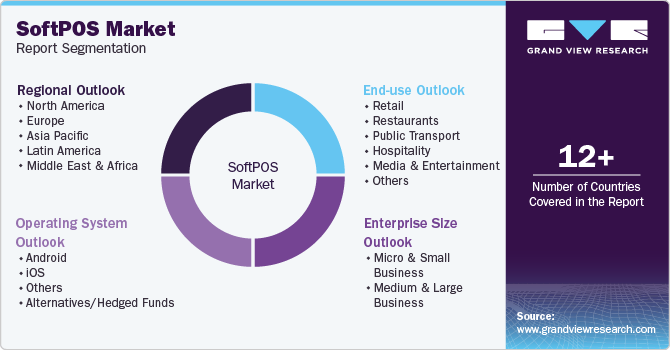
This report forecasts revenue growth at global, regional, and country levels and provides an analysis of the latest industry trends in each of the sub-segments from 2021 to 2033. For this study, Grand View Research has segmented the global SoftPOS market report based on enterprise size, operating system, end use, and region:
 To learn more about this report, Download Free Sample Report
 -
Enterprise Size Outlook (Revenue, USD Million, 2021 - 2033)
-
Micro & Small Business
-
Medium & Large Business
-
-
Operating System Outlook (Revenue, USD Million, 2021 - 2033)
-
Android
-
iOS
-
Others
-
Alternatives/Hedged Funds
-
-
End Use Outlook (Revenue, USD Million, 2021 - 2033)
-
Retail
-
Restaurants
-
Public Transport
-
Hospitality
-
Media and Entertainment
-
Others
-
-
Regional Outlook (Revenue, USD Million, 2021 - 2033)
-
North America
-
U.S.
-
Canada
-
Mexico
-
-
Europe
-
Germany
-
U.K.
-
France
-
-
Asia Pacific
-
China
-
Japan
-
India
-
South Korea
-
Australia
-
-
Latin America
-
Brazil
-
-
Middle East and Africa (MEA)
-
KSA
-
UAE
-
South Africa
-
-
Research Methodology
The SoftPOS market figures in this report are based on a proven research process that combines executive interviews with secondary research from proprietary databases, company filings, and recognized regulatory and institutional sources. Market size is built through value-chain sizing - reconciling supply-side and demand-side estimates - and triangulated with bottom-up and top-down approaches. Every estimate passes multiple levels of expert validation before publication, with each SoftPOS segment quantified using the revenue-capture definitions in the table below.
Segment Definition
Segment - Enterprise Size
Revenue capture definition
Micro & Small Businesses
This segment captures revenue generated from SoftPOS solutions adopted by micro and small businesses, including small retailers, independent merchants, restaurants, delivery service providers, freelancers, and local service businesses.
Medium & Large Businesses
This segment captures revenue generated from SoftPOS solutions deployed by medium-sized and large enterprises operating across multiple locations or serving high transaction volumes.
Segment - Operating System
Revenue capture definition
Android
This segment captures revenue generated from SoftPOS applications developed for Android-based smartphones and tablets.
iOS
This segment captures revenue generated from SoftPOS applications operating on Apple iPhones and other iOS devices.
Others
This segment captures revenue generated from SoftPOS solutions operating on other mobile operating systems or specialized enterprise mobile platforms not specifically covered above.
Segment - End User
Revenue capture definition
Retail
This segment captures revenue generated from SoftPOS solutions used by retail businesses, including supermarkets, convenience stores, specialty retailers, fashion outlets, pharmacies, and independent merchants.
Restaurants
This segment captures revenue generated from SoftPOS solutions deployed by restaurants, cafés, food trucks, quick-service restaurants (QSRs), bars, and catering businesses.
Public Transport
This segment captures revenue generated from SoftPOS solutions used by public transportation operators, including buses, taxis, railways, metro systems, ferries, and ride-sharing services.
Hospitality
This segment captures revenue generated from SoftPOS solutions used by hotels, resorts, travel operators, event venues, and tourism service providers.
Media & Entertainment
This segment captures revenue generated from SoftPOS solutions used by cinemas, stadiums, amusement parks, concert venues, gaming centers, exhibition organizers, and other entertainment businesses.
Others
This segment captures revenue generated from SoftPOS solutions adopted across additional industries, including healthcare, education, field services, logistics, personal care, professional services, government agencies, and nonprofit organizations.
Estimation Model
Layer Name
Key Question
Description
Merchant Payment Acceptance Base Layer
Which businesses require digital payment acceptance solutions?
This layer establishes the total potential demand base by identifying merchants that accept or plan to accept electronic payments. It includes retailers, restaurants, hospitality businesses, transportation providers, service providers, SMEs, and large enterprises. The analysis considers merchant population, card payment penetration, smartphone adoption, and the overall shift toward cashless transactions.
Addressable SoftPOS Market Layer
Which merchants can realistically adopt SoftPOS solutions?
This layer refines the merchant ecosystem into the serviceable SoftPOS market by considering factors such as NFC-enabled smartphone availability, digital payment infrastructure, contactless payment adoption, regulatory support, payment network certification, and merchant readiness for mobile payment acceptance. It determines the share of businesses that can potentially deploy SoftPOS solutions.
SoftPOS Adoption Layer
Who is actively deploying SoftPOS solutions?
This layer estimates annual demand generation by analyzing adoption among micro and small businesses, medium and large enterprises, retailers, restaurants, hospitality providers, public transport operators, and other merchants. It converts the addressable market into measurable software deployments, merchant subscriptions, active devices, and payment-enabled smartphones.
Revenue Realization
How does SoftPOS adoption translate into market revenue?
This layer converts adoption into market revenue through software subscriptions, transaction processing fees, licensing, implementation services, integration services, maintenance, technical support, and managed services. Revenue is generated by applying pricing models across enterprise sizes, operating systems, and end-use industries.
Delivered Customizations
This report has been delivered with the following In-depth customizations
Client Request
Customization Delivered
Value Adds
Regional SoftPOS Market Opportunity Assessment
Country/region-wise market sizing and forecasts
Analysis of demand, adoption trends, and regulatory landscape
Identification of high-growth regions and investment hotspots
Identified region-specific growth opportunities
Supported expansion and go-to-market strategy
Enabled informed regional investment decisions
Cross-Segmentation Analysis for the SoftPOS Market
Criss-cross market analysis by enterprise size and end use
demand and adoption assessment across key segments
Segment attractiveness and growth potential benchmarking
Identified high-potential market segments
Supported targeted product positioning and marketing strategy
Improved customer and segment prioritization
Competitive Benchmarking and Strategic Positioning in the SoftPOS Market
Benchmarking of key competitors across products, pricing, partnerships, and innovation
Comparative assessment of market share, capabilities, and strategies
Analysis of competitive strengths, gaps, and differentiation areas
Identified competitive white spaces and growth gaps
Supported strategic positioning and differentiation
Enabled data-driven competitive strategy development
Frequently Asked Questions About This Report
The global SoftPOS market size was valued at USD 439.9 million in 2025 and is expected to reach USD 534.1 million in 2026.
The global SoftPOS market is expected to grow at a compound annual growth rate of 24.4% from 2026 to 2033, reaching USD 2,464.8 million by 2033.
Micro & Small Business segment dominated the market, with a revenue share of 63.6% in 2025.
Some key players operating in the SoftPOS market include BrandCrock GmbH; Worldline; Alcinéo; Wizzit (Pty) Ltd; Bindo Labs Group Limited; Fairbit; Yazara; Asseco South Eastern Europe; CM.com; Fime SAS
The growing number of smartphone users across the globe and increasing government initiatives regarding digital payments are further driving the market growth.
North America dominated the global market with the largest revenue share of 33.5% in 2025. Increasing adoption of contactless payment and rising adoption of advanced digital technologies are major factors behind the growth of the market in the North American region.
Asia Pacific is the fastest-growing region over the forecast period.
Android segment held the largest market share of 58.4% in 2025 and is the fastest-growing segment over the forecast period.
Retail segment accounted for the largest revenue share of 26.3% in 2025 and is the fastest-growing segment over the forecast period.
About the Author(s)
Next Generation Technologies Research Team
Technology · Next Generation TechnologiesThis report was authored by the next generation technologies research team at Grand View Research - comprising two research analysts, one senior research analyst, and one industry expert - with specialized expertise in the next generation technologies segment of the technology industry. All findings are based on proprietary technology databases, executive interviews, and regulatory analysis, subject to internal peer review prior to publication.
Last Updated:
Speak to Analyst

Customize this report to your needs - add regions, segments, or data points, with 20% free customization.
Or view our licence options:


ISO 9001:2015 & 27001:2022 Certified
We are GDPR and CCPA compliant! Your transaction & personal information is safe and secure. For more details, please read our privacy policy.


