
- Home
- »
- HVAC & Construction
- »
-
Soil Monitoring Market Size, Growth Report, 2026-2033GVR Report cover

Soil Monitoring Market (2026 - 2033)
Size, Share & Trends Analysis Report By Offering (Hardware, Software, Services), By Type (Sensing & Imagery, Ground-based Sensing), By Application(Agricultural, Non-agricultural), And Segment Forecasts
Market Size, 2025
$861.8MMarket Estimate, 2026
$980.7MMarket Forecast, 2033
$2,559.2MCAGR, 2026–2033
14.7%Soil Monitoring Market Summary
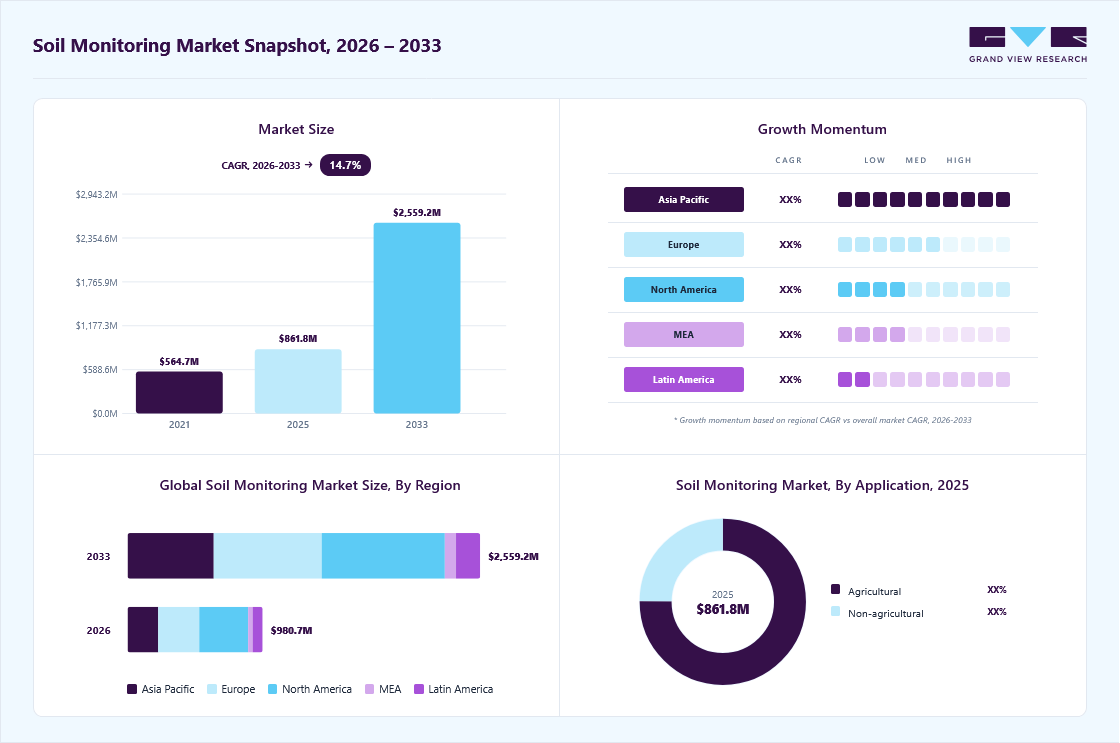
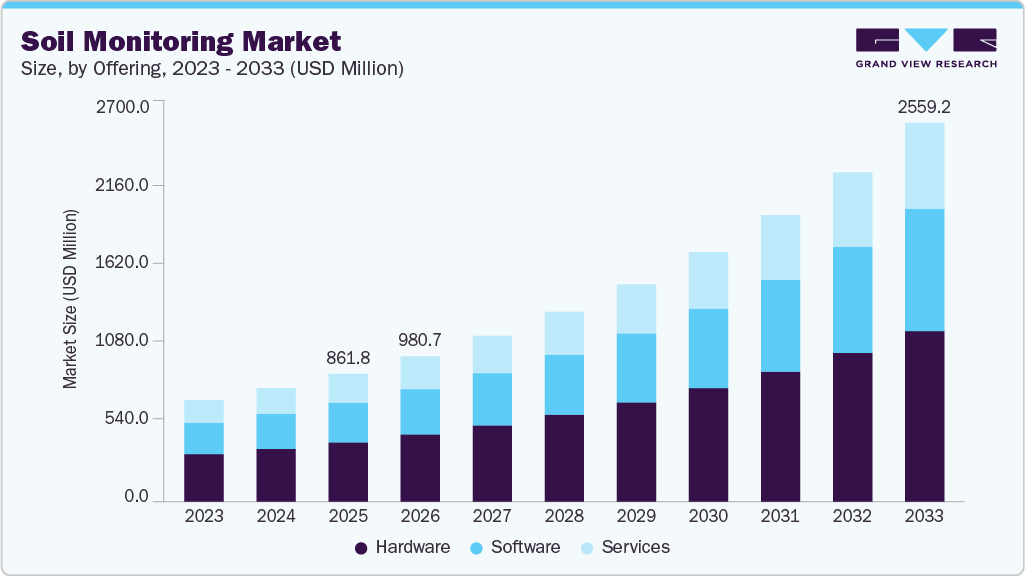
The global soil monitoring market size was valued at USD 861.8 million in 2025 and is projected to grow from USD 980.7 million in 2026 to USD 2,559.2 million by 2033, at a CAGR of 14.7% from 2026 to 2033. North America dominated the global market, accounting for the largest revenue share of 36.3% in 2025. The growing emphasis on precision agriculture is driving market growth. Precision agriculture focuses on using technology to optimize field-level crop management.
 Source: Grand View Research, IR Documents, Primary Interviews, Paid DatabasesTo learn more about this report,
 Download Free Sample Report
Key Market Trends & Insights
- By offering: Hardware held the largest revenue share of 46.4% in 2025.
- By type: Ground-based sensing held the largest revenue share in 2025.
- By application: Agriculture held the largest revenue share in 2025.
Regional Highlights
- Largest regional market: North America (36.3% revenue share, 2025)
- Fastest-growing regional market: Asia Pacific (highest CAGR, 2026-2033)
- By country: The U.S pet longevity therapeutics industry is a major contributor to the global market.
Market Size & Forecast
- Market size in 2025: USD 861.8 Million
- Estimated market size in 2026: USD 980.7 Million
- Projected market size by 2033: USD 2,559.2 Million
- CAGR (2026-2033): 14.7%
Three ways to get this report
Buy it, customize it, or ask a question.Ask an Analyst
Analyst response in 1 business day
- AccessReport author, directly
- Reply timeWithin 1 working day
- No sales callDirect answer only
- FormatEmail reply
- CostFree, no cost
Get the Full Report
What the study covers
- FormatsPDF · Excel · Dashboard
- Timeline2026–2033 annual, 2025 base
- Coverage20+ countries, 5 regions
- Companies10+ key players profiled
Customize the Report
20% free customization
- IncludeCountries, segments, points
- TailorTo your product definition
- ExtendDeeper competitor detail
- OrA fully bespoke study
- Turnaround5–10 working days
Soil monitoring is a key offering of this approach because it provides crucial information about the variability of soil properties across different parts of fields. Farmers can apply water, fertilizers, and pesticides more precisely by using soil sensors and data analytics, minimizing waste and reducing costs. This targeted approach enhances crop yield and quality and supports sustainable farming practices by reducing agriculture's environmental impact. As the adoption of precision agriculture techniques spreads globally, the demand for advanced soil monitoring systems is expected to rise significantly.
The increased focus on climate change adaptation is further supporting market growth. Climate change poses significant threats to agricultural productivity through changes in rainfall patterns, temperature fluctuations, and extreme weather events. Soil monitoring systems enable farmers to better understand and adapt to these changes by providing continuous updates on soil conditions. This data is crucial for making adaptive decisions, such as adjusting irrigation schedules or selecting suitable crops for changing soil and weather conditions. As climate risks to agriculture grow, soil monitoring becomes an even more critical tool for ensuring resilience and sustainability in farming practices.
 To learn more about this report, Download Free Sample Report
In addition, the expanding use of soil monitoring beyond agriculture is opening new opportunities for market growth. Soil monitoring technologies are increasingly being utilized in sectors such as landscaping, turf management, urban green space management, and environmental research. In these areas, maintaining optimal soil health is important for plant health, ecosystem sustainability, and aesthetic purposes. Governments and municipalities are using soil monitoring systems to manage public parks, green roofs, and urban forests, supporting broader environmental goals and boosting the demand for soil monitoring technologies across diverse types.
Moreover, the growing trend toward farm data management and integration with other agricultural systems is enhancing the role of soil monitoring solutions. Farmers are increasingly seeking integrated farm management platforms that bring together data from soil sensors, weather stations, drones, and other sources into a unified dashboard. This integration enables better analysis, forecasting, and strategic planning. Soil monitoring solutions that can seamlessly integrate with broader farm management systems are in high demand, as they help create a comprehensive view of farm operations and enhance decision-making efficiency.
Offering Insights
The hardware segment accounted for the largest market share of over 46.4% in 2025. The growing concerns about water conservation are also propelling the hardware segment within the market. Efficient water management is crucial, especially in regions facing water scarcity and drought conditions. Soil moisture sensors are pivotal in optimizing irrigation by providing precise data about when and how much water is needed, preventing over-irrigation, and minimizing water waste. Governments and environmental organizations are increasingly advocating for the adoption of water-efficient technologies, encouraging farmers to invest in soil moisture monitoring hardware. Consequently, the need for water conservation and efficient irrigation practices significantly boosts the demand for soil monitoring devices.
The software segment is anticipated to grow at the highest CAGR during the forecast period. The integration of soil monitoring software with broader farm management systems drives market growth. Farmers and agricultural enterprises increasingly seek holistic farm management platforms that combine soil health data with information on crop growth, weather forecasts, machinery usage, and financial performance. Soil monitoring software that integrates seamlessly into these broader systems enables more comprehensive farm planning and resource optimization. By offering compatibility with precision farming tools, irrigation management platforms, and yield prediction applications, soil monitoring software becomes a critical element of the connected farm ecosystem, driving its adoption across various offerings of agricultural operations.
Type Insights
The ground-based sensing segment dominated the market and accounted for a revenue share in 2025. The rising demand for high-value crop production is supporting the adoption of ground-based sensing solutions. Crops such as fruits, vegetables, vineyards, and specialty grains require precise soil and irrigation management to achieve optimal yields and quality. Ground-based sensors offer the necessary precision to maintain ideal soil conditions for these sensitive crops, protecting investments and maximizing profitability. As the market for high-value crops expands, driven by changing consumer preferences and global trade, the need for advanced soil monitoring systems using ground-based sensors will continue to grow.
The robotic & telematics segment is anticipated to grow at a significant CAGR during the forecast period. The growing need for sustainable and climate-resilient farming practices is another important driver. Monitoring soil health continuously and responding quickly to soil degradation signs are essential for building resilient agricultural systems. Robotic soil monitoring enables proactive soil management by identifying issues like erosion, nutrient depletion, or salinity buildup early on. Telematics enhances this capability by providing real-time alerts and actionable insights to farmers. As climate change challenges agricultural productivity, technologies that offer continuous soil surveillance and enable rapid response will see growing demand.
Application Insights
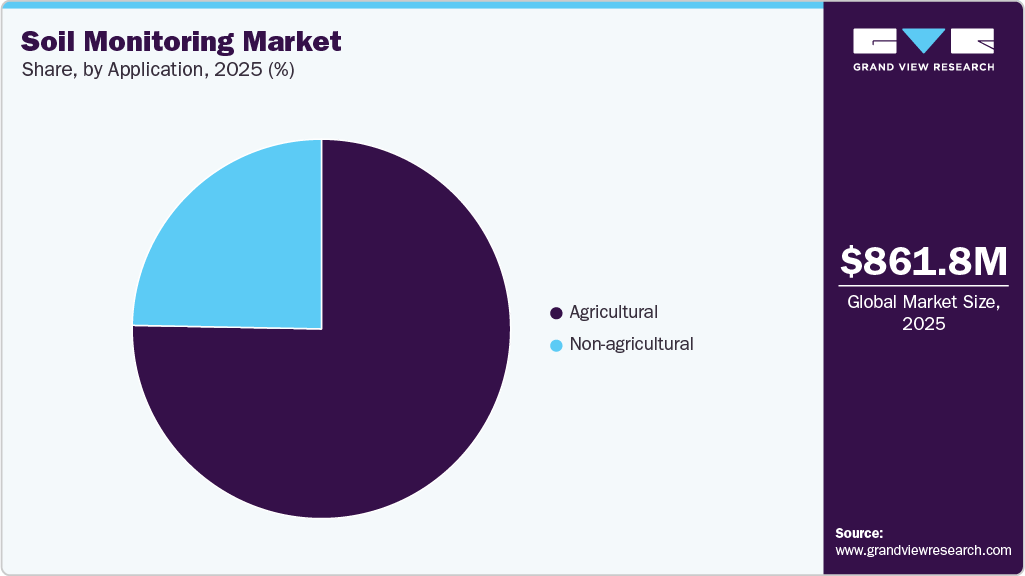
The agricultural segment accounted for the largest market share in 2025. The rise of agro-tech and innovation hubs is driving market adoption. As agricultural technology (agro-tech) continues to innovate, companies and startups are developing new solutions that integrate soil monitoring systems with other cutting-edge technologies, such as robotics, AI, and drones. These innovations provide farmers with more advanced tools for monitoring soil conditions and managing agricultural operations efficiently. The development of these integrated, multi-functional technologies is creating more opportunities for farmers to adopt advanced soil monitoring solutions, particularly in regions that are focusing on agricultural innovation to boost productivity.
 To learn more about this report, Download Free Sample Report
The non-agricultural segment is anticipated to grow at the fastest CAGR during the forecast period. The growing concern about soil contamination and pollution is driving market growth. Industrial activities, including chemical manufacturing, waste disposal, and mining, can lead to the contamination of soil with harmful substances such as heavy metals, pesticides, and petroleum products. Soil contamination not only affects local ecosystems but can also pose serious risks to human health and wildlife. As a result, regulatory bodies are increasing their scrutiny of soil quality and requiring industries to monitor and manage the impact of their operations on soil health. Soil monitoring systems, which provide real-time data on soil composition and pollution levels, are becoming essential for industries seeking to detect contamination early, mitigate risks, and comply with stringent environmental standards.
Regional Insights
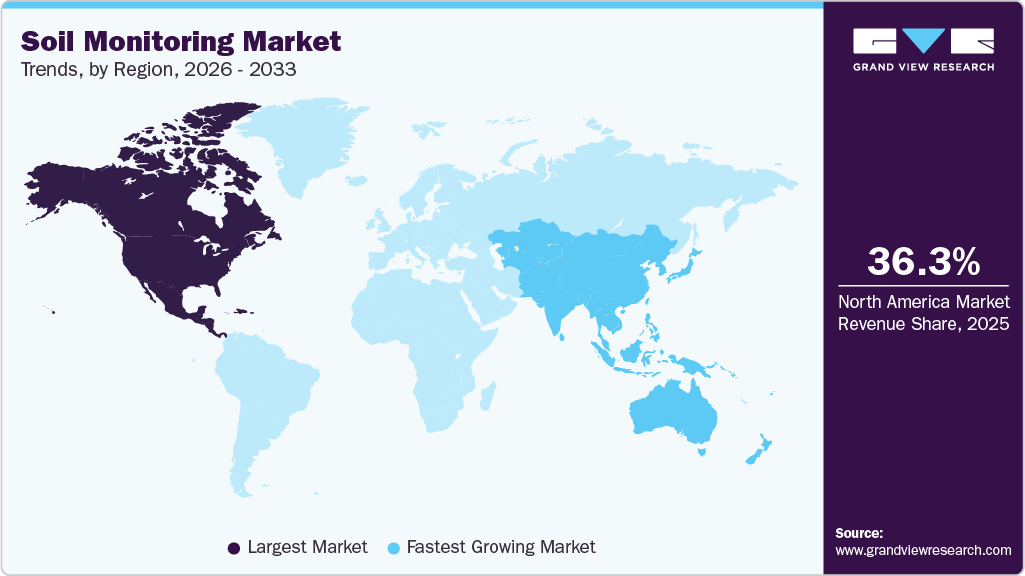
North America held the major share of 36.3% of the soil monitoring industry in 2025. The rise of smart agriculture and precision farming in North America is driving market growth. The adoption of technologies like drones, autonomous machinery, and GPS-based systems has transformed how farming operations are conducted, with a clear shift toward data-driven decision-making. Soil monitoring systems are integral to precision farming, providing crucial data that informs every aspect of farm management, from planting to harvest. By continuously monitoring soil conditions, farmers can optimize irrigation schedules, adjust fertilization practices, and assess nutrient levels to improve crop yields. The use of soil monitoring technologies allows farmers to make targeted interventions, reducing waste and increasing efficiency. This transition toward smarter, more efficient farming practices is a key factor driving the demand for soil monitoring solutions in North America.
 To learn more about this report, Download Free Sample Report
U.S. Soil Monitoring Market Trends
The soil monitoring market in the U.S. is projected to grow significantly during the forecast period. The advancements in soil monitoring technology are also playing a significant role in driving market growth in the U.S. Innovations in sensor technology, data analytics, and the Internet of Things (IoT) are making soil monitoring more efficient and accessible. Modern soil sensors are becoming more affordable, accurate, and energy-efficient, which has made them viable for a broader range of users, from small-scale farmers to large commercial operations. In addition, the integration of soil monitoring systems with cloud-based platforms and AI-powered analytics enables farmers to collect, store, and analyze large volumes of data in real-time. This integration provides valuable insights that can help optimize soil management practices, such as identifying nutrient deficiencies or predicting soil behavior under various weather conditions.
Europe Soil Monitoring Market Trends
The soil monitoring market in Europe is growing significantly during the forecast period. The growing demand for food security in Europe is another market driver. With a population that is expected to grow steadily in the coming decades, ensuring a stable food supply is critical. However, soil degradation and climate change threaten the long-term viability of food production. In response, the EU and European governments are increasingly supporting initiatives aimed at boosting food security through sustainable farming practices. Soil monitoring technologies help farmers improve crop yields by ensuring that soil conditions are optimized for plant growth. By tracking soil fertility and health, farmers can make more informed decisions about the use of fertilizers and other inputs, reducing waste and enhancing productivity.
The UK soil monitoring market is growing significantly during the forecast period. The shift towards smart cities and urban farming is contributing to market growth. Urban agriculture, which includes community gardens, rooftop farms, and vertical farming, is gaining popularity as cities seek to become more self-sufficient in food production. Soil monitoring is critical for urban farmers to optimize growing conditions and ensure that soil remains fertile in these often challenging environments. In addition, the use of soil monitoring in green infrastructure projects, such as stormwater management systems and green roofs, is becoming more common. As cities in the UK seek to incorporate more sustainable and green practices into urban planning, the demand for soil monitoring technologies is expected to increase.
Asia Pacific Soil Monitoring Market Trends
The demand for soil monitoring market in the Asia Pacific is growing at the fastest CAGR of 15.9% from 2026 to 2033. The agricultural export potential in APAC is also a contributing factor to the region's market. Several countries in the APAC region, such as Australia, India, and Vietnam, are major exporters of agricultural products. These countries are increasingly investing in technologies that improve the quality and sustainability of their agricultural output. Soil monitoring helps ensure that crops are grown under optimal soil conditions, which enhances product quality and yield. By adopting soil monitoring technologies, farmers can improve their agricultural practices and meet international quality standards, boosting export potential and profitability.
India soil monitoring market is projected to grow at the fastest rate during the forecast period. The role of digital agriculture and mobile applications is becoming increasingly important in the market. With the rise of smartphone penetration and internet access, farmers now have greater access to digital tools and platforms that provide real-time soil data. Mobile apps and online platforms that offer soil testing services, weather forecasts, and farm management advice are making it easier for farmers to adopt soil monitoring practices. These digital solutions are particularly beneficial for smallholder farmers, who may not have access to traditional soil testing services but can use mobile apps to monitor their soil conditions. The digital shift is empowering farmers with information that helps them improve farm productivity and sustainability.
Key Soil Monitoring Company Insights
Some of the key companies operating in the market, such as SGS Group, METER Group, and The Toro Company, among others, are some of the leading participants in the market.
-
SGS Group is a Testing, Inspection, and Certification (TIC) company. SGS operates a global network of over 2,500 laboratories and business facilities across 115 countries. The company provides a comprehensive range of services that support the development and implementation of standards for quality, safety, and sustainability across various industries. SGS offers a wide array of soil monitoring services designed to assess and manage soil health, contamination, and compliance with environmental regulations. These services cater to sectors such as agriculture, construction, environmental management, and land development.
-
The Toro Company is a global provider of innovative solutions for turf, landscape, rental, and agricultural markets. Toro designs and manufactures equipment and irrigation systems that enhance productivity and environmental stewardship. Toro's diverse product portfolio includes mowers, irrigation controllers, and soil monitoring systems. Toro is at the forefront of advancing soil monitoring technology, offering systems that help optimize irrigation practices, improve water conservation, and enhance soil health. Two of its prominent solutions in soil monitoring include the Turf Guard Wireless Soil Monitoring System and the Precision Soil Sensor.
Cropx Technologies and Irromotor are some of the emerging market participants.
-
CropX Technologies is an ag-tech company specializing in precision agriculture solutions. The company has expanded its operations to over 70 countries, deploying its technologies across all arable continents. CropX offers a comprehensive agronomic farm management system that integrates data from soil sensors, weather stations, and satellite imagery to provide real-time insights and recommendations for optimizing irrigation, crop nutrition, and overall farm productivity.
-
Nutanix is an American enterprise cloud computing company. Nutanix has evolved into a comprehensive provider of hybrid and multi-cloud solutions. The company's platform integrates computing, storage, networking, and virtualization into a unified software-defined architecture, enabling organizations to run types and manage data seamlessly across on-premises data centers, public clouds, and edge environments. As enterprises increasingly adopt cloud technologies, ensuring compliance with various regulatory standards becomes paramount. Nutanix addresses this need through its robust soil monitoring framework, which encompasses a range of certifications and adherence to industry best practices.
Key Soil Monitoring Companies:
The following key companies have been profiled for this study on the soil monitoring market.
- Campbell Scientific
- Cropx Technologies
- Element Material Technology
- Irromotor
- METER Group
- SGS Group
- Sontok Technologies
- Spectrum Technologies
- Stevens Water Monitoring Systems
- The Toro Company
Recent Developments
-
In February 2025, Toro Company partnered with TerraRad to introduce an innovative software solution for precise irrigation control. The new Spatial Adjust software, designed to work seamlessly with the Toro Lynx Central Control platform, aims to transform irrigation management. This software leverages TerraRad’s turfRad smart sensors, which are integrated into Toro equipment to monitor soil moisture levels during mowing.
-
In May 2024, Stevens Water Monitoring Systems, Inc. acquired Dyacon's weather instrument products. This acquisition enhances Stevens' existing portfolio, expanding its capabilities in meteorological applications for research, golf/sports turf management, climatological monitoring, soil analysis, agriculture, fire weather monitoring, and emerging small airport markets. This strategic move supports Stevens' mission to deliver early warning solutions in the fields of meteorology and environmental hydrology monitoring.
-
In February 2024, CropX Technologies partnered with Syngenta, a company specializing in seeds and crop protection products, to enhance the sustainability and yield performance of Syngenta’s seed suppliers in the American Midwest. The CropX agronomic collects real-time data from various sources, including soil sensors and on-farm machinery. This data is then transmitted to the cloud, where advanced agronomic analytics provide growers with insights and visualizations on soil and crop health.
Soil Monitoring Market Report Scope
Report Attribute
Details
Market size in 2025
USD 861.8 million
Estimated Market size in 2026
USD 980.7 million
Projected Market size by 2033
USD 2,559.2 million
Growth rate
CAGR of 14.7% from 2026 to 2033
Actual data
2021 - 2025
Forecast period
2026 - 2033
Quantitative units
Revenue in USD million/billion and CAGR from 2026 to 2033
Report coverage
Revenue forecast, company share, competitive landscape, growth factors, and trends
Segments covered
Offering, type, application, region
Regional scope
North America; Europe; Asia Pacific; Latin America; MEA
Country scope
U.S.; Canada; Mexico; UK; Germany; France; China; India; Japan; Australia; South Korea; Brazil; UAE; Saudi Arabia; South Africa
Key companies profiled
Stevens Water Monitoring Systems, Inc.; SGS Group; METER Group; Element Material Technology; The Toro Company; Campbell Scientific; Sontok Technologies; Irromotor; Cropx Technologies
Customization scope
Free report customization (equivalent to 8 analysts working days) with purchase. Addition or alteration to country, regional & segment scope.
Pricing and purchase options
Avail customized purchase options to meet your exact research needs. Explore purchase options
Global Soil Monitoring Market Report Segmentation
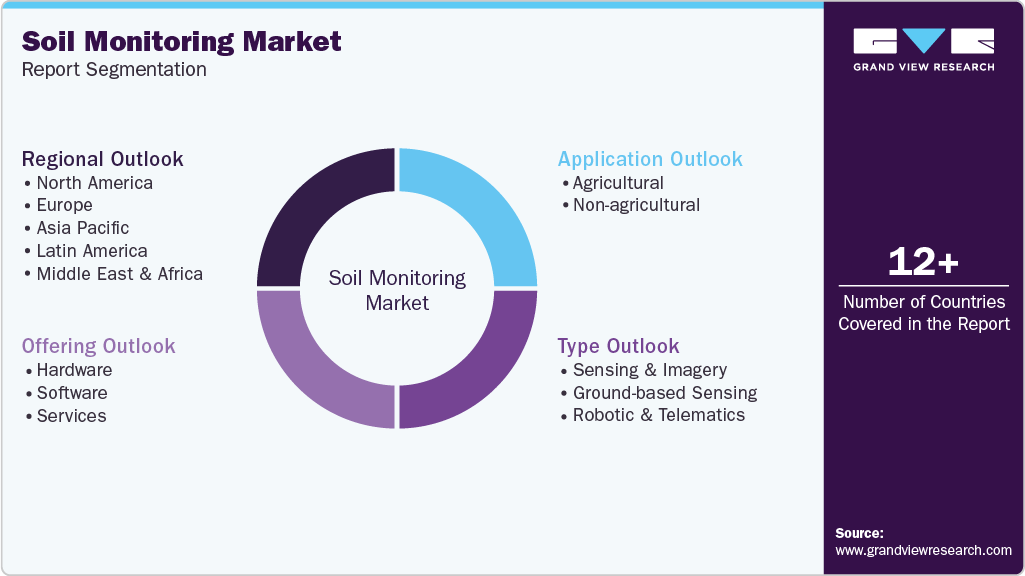
This report forecasts revenue growth at global, regional, and country levels and provides an analysis of the latest industry trends in each of the sub-segments from 2021 to 2033. For this study, Grand View Research has segmented the global soil monitoring market report based on offering, type, application, and region:
 To learn more about this report, Download Free Sample Report
-
Offering Outlook (Revenue, USD Million, 2021 - 2033)
-
Hardware
-
Software
-
Services
-
-
Type Outlook (Revenue, USD Million, 2021 - 2033)
-
Sensing & Imagery
-
Ground-based Sensing
-
Robotic & Telematics
-
-
Application Outlook (Revenue, USD Million, 2021 - 2033)
-
Agricultural
-
Non-agricultural
-
-
Regional Outlook (Revenue, USD Million, 2021 - 2033)
-
North America
-
U.S.
-
Canada
-
Mexico
-
-
Europe
-
Germany
-
UK
-
France
-
-
Asia Pacific
-
China
-
India
-
Japan
-
South Korea
-
Australia
-
-
Latin America
-
Brazil
-
-
Middle East & Africa
-
UAE
-
Saudi Arabia
-
South Africa
-
-
Frequently Asked Questions About This Report
The global soil monitoring market size was valued at USD 861.8 million in 2025 and is estimated at USD 980.7 million for 2026.
Some key players operating in the market include Stevens Water Monitoring Systems, Inc., SGS Group, METER Group, Element Material Technology, The Toro Company, Campbell Scientific , Sontok Technologies, Irromotor, Cropx Technologies
The growing emphasis on precision agriculture, the increased focus on climate change adaptation and the growing trend toward farm data management and integration with other agricultural systems is driving market growth
Asia Pacific is the fastest-growing region over the forecast period.
The hardware segment led with a 46.4% revenue share in 2025 while software segment is the fastest growing.
The ground-based sensing segment held the largest revenue share in 2025.The rising demand for high-value crop production is supporting the adoption of ground-based sensing solutions.
The agricultural segment held the largest revenue share in 2025.
The global soil monitoring market is expected to grow at a CAGR of 14.7% from 2026 to 2033, reaching USD 2,559.2 million by 2033.
North America dominated with a 36.3% revenue share in 2025.
About the Author(s)
HVAC & Construction Research Team
Technology · HVAC & ConstructionThis report was authored by the hvac & construction research team at Grand View Research - comprising two research analysts, one senior research analyst, and one industry expert - with specialized expertise in the hvac & construction segment of the technology industry. All findings are based on proprietary technology databases, executive interviews, and regulatory analysis, subject to internal peer review prior to publication.
Last Updated:
Speak to Analyst

Customize this report to your needs - add regions, segments, or data points, with 20% free customization.
Or view our licence options:


ISO 9001:2015 & 27001:2022 Certified
We are GDPR and CCPA compliant! Your transaction & personal information is safe and secure. For more details, please read our privacy policy.


