
- Home
- »
- Organic Chemicals
- »
-
Soil Treatment Market Size, Share & Trends Report, 2033GVR Report cover

Soil Treatment Market (2026 - 2033)
Size, Share & Trends Analysis Report By Technology (Biological Treatment, Chemical Treatment, Physical Treatment, Thermal Treatment), By End-use (Agriculture, Landscaping & Turf Management, Brownfield Redevelopment), By Region, And Segment Forecasts
Market Size, 2025
$43.6BMarket Estimate, 2026
$45.1BMarket Forecast, 2033
$62.8BCAGR, 2026–2033
4.8%Soil Treatment Market Summary
The global soil treatment market size was valued at USD 43.6 billion in 2025 and is projected to grow from USD 45.1 billion in 2026 to USD 62.8 billion by 2033, at a CAGR of 4.8% from 2026 to 2033. Asia Pacific dominated the market, accounting for the largest revenue share of 38.0% in 2025. The market growth is driven by the increasing need to restore soil fertility, improve nutrient availability, and address soil degradation across agricultural and non-agricultural land.
 Source: Grand View Research, IR Documents, Primary Interviews, Paid DatabasesTo learn more about this report,
 Download Free Sample Report
 Key Market Trends & Insights
- By technology: Chemical treatment segment dominated the market, accounting for the largest revenue share of 39.3% in 2025.
- By end-use: Agriculture segment held the largest revenue share of 56.9% 2025
Regional Highlights
- Largest regional market: Asia Pacific (38.0% revenue share, 2025)
- By country: China held the largest market share in 2025.
Market Size & Forecast
- Market Size in 2025: USD 43.6 Billion
- Estimated market Size in 2026: USD 45.1 Billion
- Projected Market Size by 2033: USD 62.8 Billion
- CAGR (2026-2033): 4.8%
Three ways to get this report
Buy it, customize it, or ask a question.Ask an Analyst
Analyst response in 1 business day
- AccessReport author, directly
- Reply timeWithin 1 working day
- No sales callDirect answer only
- FormatEmail reply
- CostFree, no cost
Get the Full Report
What the study covers
- FormatsPDF · Excel · Dashboard
- Timeline2026–2033 annual, 2025 base
- Coverage20+ countries, 5 regions
- Companies10+ key players profiled
Customize the Report
20% free customization
- IncludeCountries, segments, points
- TailorTo your product definition
- ExtendDeeper competitor detail
- OrA fully bespoke study
- Turnaround5–10 working days
Growing adoption of biological soil amendments, chemical conditioners, and remediation solutions to enhance crop productivity and rehabilitate contaminated sites is strengthening market demand. Regulatory emphasis on sustainable land management, coupled with advancements in soil treatment formulations and precision application technologies, is further accelerating adoption across farming, industrial, and environmental remediation applications. To learn more about this report, Download Free Sample Report
 Increasing emphasis on soil health, sustainable land management, and agricultural productivity is accelerating the adoption of soil treatment solutions worldwide. Regulatory initiatives promoting contaminated land remediation and responsible soil management, along with growing use of biological soil amendments and advanced soil conditioning technologies, are expanding applications across agriculture, mining, and industrial sites. Continued investments in precision agriculture and environmentally sustainable farming practices are further reinforcing long-term demand for soil treatment products and services.
Market Dynamics
The global soil treatment market is evolving with a growing emphasis on improving soil health, restoring degraded land, and enhancing agricultural productivity through integrated soil management practices. Market participants are expanding their portfolios to include biological formulations, microbial technologies, soil conditioners, and specialized nutrient management products that improve soil function while reducing reliance on conventional chemical inputs. Innovation is increasingly focused on bio-based solutions, precision application technologies, and data-driven soil analysis to optimize treatment efficiency across diverse soil conditions.
The global soil treatment market is driven by the increasing need to restore soil fertility, improve nutrient availability, and enhance long-term agricultural productivity. Declining soil quality, driven by intensive cultivation, erosion, salinity, and contamination, has accelerated the adoption of soil conditioners, biological amendments, pH adjusters, and remediation solutions. The expanding implementation of precision agriculture, government programs supporting sustainable land management, and the growing demand for higher crop productivity are further contributing to market expansion. The increasing rehabilitation of contaminated land for agricultural, industrial, and infrastructure applications also supports demand for soil treatment technologies.
The relatively high cost of advanced biological soil treatment products and specialized soil remediation technologies continues to limit adoption, particularly among small and medium-scale farmers. Treatment effectiveness varies according to soil composition, climatic conditions, and crop type, making standardized application challenging and increasing the need for site-specific recommendations. Limited access to soil testing services in developing regions, coupled with lower awareness of long-term soil health management, further restricts market penetration.
The increasing shift toward sustainable agriculture and regenerative farming practices presents significant growth opportunities for the global soil treatment market. Rising demand for biological soil treatments, organic amendments, and microbial-based products is encouraging the adoption of solutions that improve soil fertility, enhance nutrient availability, and restore long-term soil health. Expanding precision agriculture practices, government initiatives promoting sustainable land management, and growing investments in environmentally friendly agricultural inputs are further creating opportunities for innovation and market expansion.
Market Concentration & Characteristics
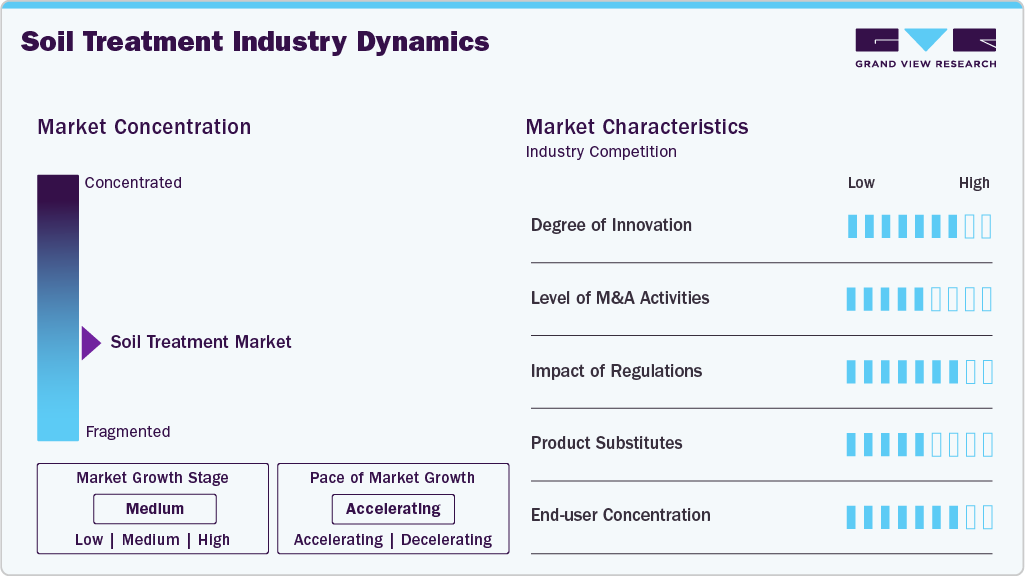
The global soil treatment market is moderately fragmented, with multinational agrochemical companies, biological input manufacturers, specialty soil amendment producers, and regional suppliers competing across agricultural and environmental applications. Established companies benefit from broad product portfolios, global distribution networks, and strong research capabilities, while regional manufacturers strengthen their position by offering crop-specific and region-specific soil treatment solutions. Variations in soil conditions, cropping patterns, and regulatory requirements create a competitive landscape across different geographies.
Innovation is a defining characteristic of the soil treatment industry, with manufacturers focusing on advanced biological soil treatments, microbial inoculants, soil conditioners, and integrated nutrient management products. Research efforts are directed toward improving nutrient availability, enhancing soil microbial activity, restoring soil fertility, and increasing treatment efficiency. The growing adoption of precision agriculture and digital soil analysis technologies is also enabling more targeted and effective soil treatment practices.
 To learn more about this report, Download Free Sample Report
 Merger and acquisition activity is steadily increasing as companies expand their biological product portfolios, strengthen technological capabilities, and enhance their regional presence. Strategic collaborations with biotechnology firms, agricultural research institutes, and local distribution partners are supporting product development, accelerating commercialization, and improving market penetration. Portfolio diversification has become an important strategy for addressing the growing demand for sustainable soil management solutions.
Regulatory policies play an important role in shaping the soil treatment market by promoting sustainable agriculture, responsible fertilizer use, and soil conservation practices. Governments and regulatory agencies are implementing standards that encourage soil restoration, reduce environmental impacts from agricultural inputs, and support the adoption of eco-friendly soil treatment products. Compliance with evolving environmental and agricultural regulations continues to influence product development, investment priorities, and competitive strategies across the global market.
Analyst Perspective
The global soil treatment market is being shaped by increasing emphasis on soil health restoration, sustainable agriculture, and improving crop productivity. Growing concerns over soil degradation, nutrient depletion, and declining arable land quality are encouraging the adoption of soil conditioners, biological soil treatments, organic amendments, and remediation solutions. Advances in microbial technologies, precision agriculture, and integrated soil management practices are further strengthening product adoption across agricultural applications. Government initiatives promoting sustainable farming and efficient land management, along with increasing awareness of long-term soil fertility, are creating favorable market conditions. Looking ahead, continued investment in biological soil solutions and regenerative agriculture practices is expected to support sustained market growth and drive innovation across the global soil treatment industry.
Technology Insights
The chemical treatment segment dominated the global soil treatment market, accounting for the largest revenue share of 39.3% in 2025. Its leading position is attributed to the widespread use of chemical soil amendments, pH regulators, and nutrient-correction products to improve soil fertility, optimize nutrient availability, and manage soil salinity and acidity. Rapid application, consistent performance, and broad compatibility across diverse crop types and soil conditions continue to support the adoption of chemical treatment solutions in commercial agriculture and land restoration projects.
The biological treatment segment is projected to register the fastest CAGR during the forecast period. Growth is driven by the increasing adoption of microbial inoculants, biofertilizers, and other biologically derived soil enhancement products that improve soil biodiversity and long-term soil health. Expanding sustainable agricultural practices, increasing preference for environmentally compatible inputs, and regulatory support to reduce dependence on synthetic chemicals are encouraging the adoption of biological soil treatment technologies across both conventional and organic farming systems.
End-use Insights
The agriculture segment dominated the global soil treatment industry in 2025, accounting for the largest revenue share of 56.9%. The segment's leadership is attributed to the extensive use of soil treatment solutions to restore soil health, improve nutrient availability, correct soil pH, and enhance long-term crop performance. Increasing adoption of integrated soil management practices, coupled with the need to maintain agricultural land productivity under intensive cultivation, continues to sustain demand across major farming regions.
 To learn more about this report, Download Free Sample Report
 The brownfield redevelopment segment is projected to register the fastest CAGR of 5.4% during the forecast period. The segment is expanding as governments and private developers accelerate the rehabilitation of contaminated industrial and urban land for productive reuse. Increasing environmental remediation requirements, stricter land restoration regulations, and investments in site redevelopment are driving the adoption of soil treatment technologies that improve soil quality and enable safe land utilization.
Regional Insights
Asia Pacific dominated the global soil treatment market with the largest revenue share of 38.0% in 2025. Asia Pacific represents a significant market for soil treatment solutions, supported by the region's extensive agricultural base and increasing focus on improving soil productivity. Greater adoption of scientific farming practices, balanced nutrient management, and precision agriculture is driving demand for products that enhance soil structure, nutrient availability, and overall soil performance. Government initiatives promoting sustainable land use and efficient resource management continue to reinforce market development across the region.
 To learn more about this report, Download Free Sample Report
 China Soil Treatment Market Trends
The China soil treatment market is expected to grow during the forecast period. China is strengthening its soil treatment landscape through investments in agricultural modernization and soil quality improvement programs. Demand for biological amendments, soil conditioners, and remediation products is supported by efforts to restore degraded farmland, optimize nutrient utilization, and improve land productivity. The integration of advanced agronomic technologies and soil monitoring systems is further contributing to the adoption of innovative soil treatment solutions.
The soil treatment market in India is characterized by increasing emphasis on sustainable soil management to support agricultural productivity across diverse cropping systems. Growing use of biofertilizers, soil conditioners, and integrated nutrient management practices reflects the need to improve soil fertility and maintain long-term crop performance. Expanding soil health awareness, supported by government-led soil testing and nutrient management initiatives, continues to accelerate the adoption of soil treatment products.
North America Soil Treatment Market Trends
The North America soil treatment market is characterized by increasing adoption of integrated soil management practices aimed at improving soil quality, nutrient efficiency, and long-term land productivity. Demand for biological soil amendments, chemical conditioners, and soil remediation products is supported by the growing emphasis on sustainable agriculture, precision farming, and responsible land management. Continued advancements in soil analysis and treatment technologies are further strengthening product adoption across agricultural and environmental applications.
The U.S. soil treatment market growth is driven by the increasing adoption of advanced soil health management solutions across commercial agriculture. Growing utilization of microbial formulations, soil conditioners, and nutrient optimization products reflects the industry's focus on enhancing soil functionality and improving crop performance. Ongoing investment in precision agriculture technologies and sustainable farming practices continues to support the adoption of soil treatment solutions.
The soil treatment market in Mexico is supported by the increasing implementation of modern soil management practices to improve soil fertility and agricultural productivity. Demand for soil treatment solutions is expanding as producers adopt products that enhance nutrient availability, improve soil structure, and address land degradation. Greater focus on sustainable cultivation methods and efficient resource management is contributing to broader adoption across the agricultural sector.
Europe Soil Treatment Market Trends
The growth of the Europe soil treatment market is supported by a well-established regulatory framework focused on soil conservation, sustainable agriculture, and environmental protection. The region is steadily adopting biological soil amendments, soil conditioners, and nutrient management solutions to improve soil functionality and maintain long-term land productivity. Increasing integration of precision agriculture technologies and scientific soil assessment practices is encouraging the use of targeted soil treatment products across diverse farming systems.
The soil treatment market in Germany is characterized by a strong focus on improving soil quality through advanced nutrient management and sustainable cultivation practices. Adoption of biological soil treatments, microbial formulations, and precision soil management technologies is expanding as agricultural producers seek to enhance resource efficiency and maintain soil fertility.
The UK soil treatment market is expected to grow during the forecast period. The UK is strengthening the adoption of soil treatment solutions by placing greater emphasis on regenerative agriculture, soil conservation, and efficient land management. Farmers are incorporating biological amendments, soil conditioners, and integrated soil health practices to improve soil structure, nutrient availability, and crop resilience. Greater use of precision farming technologies and soil monitoring systems is further supporting the transition toward sustainable agricultural production.
Middle East & Africa Soil Treatment Market Trends
The Middle East & Africa continue to strengthen the adoption of soil treatment solutions as governments and agricultural producers focus on improving land productivity and sustainable resource management. Growing use of soil conditioners, biological amendments, and nutrient management products supports efforts to enhance soil fertility, improve water-use efficiency, and address challenges associated with degraded and low-fertility soils.
The Saudi Arabia soil treatment market is projected to grow during the forecast period. Saudi Arabia is increasing the application of soil treatment products to improve cultivation under arid climatic conditions and limited arable land availability. Greater adoption of soil conditioners, biological inputs, and integrated nutrient management practices is helping improve soil quality, nutrient availability, and crop performance. Government initiatives promoting sustainable agriculture, efficient irrigation, and agricultural diversification continue to support the use of advanced soil treatment solutions across the country.
Latin America Soil Treatment Market Trends
Latin America benefits from extensive agricultural production and an increasing focus on maintaining long-term soil fertility across major crop-growing areas. Greater use of precision agriculture, balanced nutrient management, and soil monitoring practices is encouraging the application of advanced soil treatment products. Investments in agricultural modernization and efficient land management continue to strengthen demand for technologies that enhance soil performance and resource efficiency.
The soil treatment market in Brazil remains significant in Latin America, supported by large-scale cultivation of soybean, corn, sugarcane, and coffee. Producers are increasingly adopting pH correction products, microbial inputs, and nutrient optimization solutions to improve crop performance and address the limitations of highly weathered tropical soils. Ongoing advances in agricultural technology and broader implementation of scientific soil management practices continue to reinforce demand for innovative soil treatment solutions.
Key Soil Treatment Market Company Insights
Some of the key players operating in the market include Bayer Crop Science AG, BASF SE, Syngenta AG, UPL Limited Holding A/S, and Rallis India Limited
-
Bayer Crop Science AG is a global agricultural company engaged in the development and commercialization of crop protection products, seeds, biological solutions, and digital farming technologies. The company operates through an extensive global network and emphasizes innovation, research and development, and sustainable agricultural practices to support modern farming systems.
-
BASF SE is a leading global chemical company with a diversified portfolio spanning agricultural solutions, industrial chemicals, materials, and performance products. Through its Agricultural Solutions business, the company develops crop protection products, biologicals, seed treatments, and digital agriculture technologies, supported by a strong global manufacturing presence and continuous investment in research and product innovation.
Key Soil Treatment Companies:
The following key companies have been profiled for this study of the soil treatment market.
-
Bayer Crop Science AG
-
BASF SE
-
Syngenta AG
-
Corteva Agriscience
-
UPL Limited
-
FMC Corporation
-
ADAMA Ltd.
-
American Vanguard Corporation
-
Novonesis A/S
-
Valent BioSciences LLC
-
Soil Technologies Corp.
-
Rallis India Limited
-
Dowa Eco-System Co., Ltd.
-
ISAGRO S.p.A.
-
Kanesho Soil Treatment SRL/BV
Competitive Benchmarking
Operating strategies
Competitive Edge
Weakness
Mature Players: Bayer CropScience AG; BASF SE; Syngenta AG; Corteva Agriscience; UPL Limited; FMC Corporation; ADAMA Ltd.
- Focus on broad soil treatment portfolios, including biological soil enhancers, soil fumigants, crop protection solutions, and integrated soil health management products.
- Leverage global manufacturing capabilities, extensive agricultural distribution networks, and R&D investments to develop sustainable and high-performance soil treatment solutions.
- Strong global presence, established farmer relationships, and diversified agricultural product portfolios provide competitive advantages.
- Advanced research capabilities and integrated crop management offerings enable these companies to address diverse soil health and productivity challenges.
- Large-scale operations and complex regulatory requirements can increase product development timelines and operational costs.
- Dependence on agricultural cycles and regional farming conditions may impact demand stability.
Emerging Players: American Vanguard Corporation; Novonesis A/S; Valent BioSciences LLC; Soil Technologies Corp.; Rallis India Limited; Dowa Eco-System Co., Ltd.; ISAGRO S.p.A.; Kanesho Soil Treatment SRL/BV
- Focus on specialized soil treatment solutions, including biological amendments, microbial-based products, soil remediation technologies, and application-specific treatments.
- Expand through regional partnerships, distributor networks, and the development of sustainable solutions aligned with organic farming and soil restoration practices.
- Strong expertise in niche soil treatment segments, biological solutions, and environmentally sustainable products provides differentiation.
- Greater flexibility enables faster adaptation to regional soil conditions, regulatory changes, and evolving agricultural practices.
- Limited global reach and smaller product portfolios compared with multinational agricultural companies.
- Lower brand awareness and distribution capabilities may restrict adoption across large-scale agricultural markets.
Recent Developments
-
In July 2025, Kemin Industries launched RevoCURB™, an OMRI-listed, botanical oil-based soil treatment designed as a sustainable alternative to conventional soil fumigants. The FIFRA 25(b)-exempt formulation provides nematicidal, fungicidal/bactericidal, and herbicidal activity for pre-plant and post-harvest soil treatment. Developed using a proprietary blend of botanical oils, RevoCURB™ targets soil-borne pathogens, plant-parasitic nematodes, and pre-emergent weed seeds while supporting soil health across organic and conventional farming systems. The launch strengthens Kemin's sustainable agriculture portfolio and reflects the growing industry focus on environmentally compatible soil treatment solutions.
-
In May 2025, Syngenta acquired Intrinsyx Bio, a U.S.-based developer of biological nutrient-use efficiency technologies, to strengthen its biological solutions portfolio. The acquisition expands Syngenta's capabilities in microbial technologies that enhance nutrient uptake, improve soil health, and support sustainable crop production. By integrating Intrinsyx Bio's research platform with its global innovation and commercial capabilities, Syngenta aims to accelerate the development and commercialization of next-generation biological solutions for soil and crop management.
Soil Treatment Market Report Scope
Report Attribute
Details
Market size in 2025
USD 43.6 billion
Estimated market size in 2026
USD 45.1 billion
Projected market size by 2033
USD 62.8 billion
Growth Rate
CAGR of 4.8% from 2026 to 2033
Historical data
2021 - 2024
Forecast period
2026 - 2033
Quantitative units
Revenue in USD billion and CAGR from 2026 to 2033
Report coverage
Revenue forecast, company ranking, competitive landscape, growth factors, and trends
Segments covered
Technology, end-use, region
Regional scope
North America; Europe; Asia Pacific; Latin America; Middle East & Africa
Country scope
U.S.; Canada; Mexico; UK; Germany; France; Italy; Spain; China; Japan; India; Australia; South Korea; Brazil; Argentina; UAE; Saudi Arabia; South Africa
Key companies profiled
Bayer Crop Science AG; BASF SE; Syngenta AG; Corteva Agriscience; UPL Limited; FMC Corporation; ADAMA Ltd.; American Vanguard Corporation; Novonesis A/S; Valent BioSciences LLC; Soil Technologies Corp.; Rallis India Limited; Dowa Eco-System Co., Ltd.; ISAGRO S.p.A.; Kanesho Soil Treatment SRL/BV
Customization scope
Free report customization (equivalent up to 8 analysts working days) with purchase. Addition or alteration to country, regional & segment scope.
Pricing and purchase options
Avail customized purchase options to meet your exact research needs. Explore purchase options
Global Soil Treatment Market Report Segmentation
This report forecasts revenue growth at the global, regional, and country levels and provides an analysis of the latest industry trends in each of the sub-segments from 2021 to 2033. For this study, Grand View Research has segmented the global soil treatment market report based on technology, end-use, and region:
 To learn more about this report, Download Free Sample Report
 -
Technology Outlook (Revenue, USD Billion, 2021 - 2033)
-
Biological Treatment
-
Chemical Treatment
-
Physical Treatment
-
Thermal Treatment
-
-
End-use Outlook (Revenue, USD Billion, 2021 - 2033)
-
Agriculture
-
Landscaping & Turf Management
-
Brownfield Redevelopment
-
Industrial Site Remediation
-
Landfill Remediation
-
Other
-
-
Regional Outlook (Revenue, USD Billion, 2021 - 2033)
-
North America
-
U.S.
-
Canada
-
Mexico
-
-
Europe
-
Germany
-
Spain
-
France
-
Italy
-
UK
-
-
Asia PacificChina
-
India
-
Japan
-
Australia
-
South Korea
-
-
Latin America
-
Brazil
-
Argentina
-
-
Middle East and Africa
-
Saudi Arabia
-
UAE
-
South Africa
-
-
Research Methodology
The soil treatment market figures in this report are based on a proven research process that combines executive interviews with secondary research from proprietary databases, company filings, and recognized regulatory and institutional sources. Market size is built through value-chain sizing-reconciling supply-side and demand-side estimates-and triangulated with bottom-up and top-down approaches. Every estimate passes multiple levels of expert validation before publication, with each soil treatment segment quantified using the revenue-capture definitions in the table below.
Segment Definition
Segment - Technology
Revenue Capture Definition
Biological Treatment
Revenue is generated through the sale of biological soil treatment products, including microbial inoculants, biofertilizers, biostimulants, and other bio-based formulations.
Chemical Treatment
Revenue is generated through the sale of chemical soil treatment products, including soil fumigants, chemical amendments, pH regulators, and soil conditioners.
Physical Treatment
Revenue is generated through the sale of physical soil treatment solutions, equipment, and materials used for soil stabilization, aeration, and contaminant management.
Thermal Treatment
Revenue is generated through the sale of thermal soil treatment systems, equipment, and heat-based soil remediation services.
Segment-End Use
Revenue Capture Definition
Agriculture
Revenue is generated through the sale of soil treatment products and solutions to agricultural producers and farming enterprises.
Landscaping & Turf Management
Revenue is generated through the sale of soil treatment products for landscaping, turf care, parks, golf courses, and recreational grounds.
Brownfield Redevelopment
Revenue is generated through the sale of soil treatment products and remediation solutions for brownfield restoration projects.
Industrial Site Remediation
Revenue is generated through the sale of soil treatment technologies and remediation solutions for industrial site cleanup.
Landfill Remediation
Revenue is generated through the sale of soil treatment products and remediation solutions for landfill rehabilitation and environmental restoration.
Other
Revenue is generated through the sale of soil treatment products and solutions for forestry, mining reclamation, infrastructure, and other environmental applications.
Estimation Model
Layer Name
Key Question
Description
Contaminated Site Remediation Demand Layer
Where is soil treatment required?
Analyze demand across industrial sites, mining areas, oil & gas facilities, agricultural land, brownfield redevelopment projects, landfills, and contaminated commercial and municipal sites. Assess soil contamination levels, remediation requirements, land restoration activities, and environmental regulations to establish the addressable demand for soil treatment technologies.
Environmental Compliance & Infrastructure Investment Layer
Where is new treatment demand being created?
Evaluate investments in environmental remediation programs, industrial site rehabilitation, brownfield redevelopment, mining reclamation, waste management projects, and government-funded environmental restoration initiatives.
Technology Adoption Layer
Which soil treatment technologies are being deployed?
Segment demand by treatment technology, application, contaminant type, and end use. Apply adoption rates based on contamination severity, soil characteristics, treatment efficiency, project economics, regulatory compliance, and environmental impact.
Revenue Generation Layer
How much market revenue is generated?
Estimate annual revenues generated from soil treatment projects by technology, application, end use, and region. Quantify revenues generated from the implementation of soil treatment technologies and remediation solutions across industrial, commercial, municipal, and environmental restoration projects.
Delivered Customizations
This report has been delivered with the following In-depth customizations
Client Request
Customization Delivered
Value Adds
Competitive Benchmarking
A comprehensive competitive benchmarking analysis was conducted by evaluating leading soil treatment manufacturers based on product portfolio, treatment technologies (biological, chemical, and physical), soil health solutions, research & development capabilities, geographic presence, strategic initiatives, and market positioning.
The benchmarking provided insights into product differentiation, technology capabilities, competitive positioning, and innovation strategies, enabling stakeholders to evaluate competitors and strengthen strategic decision-making.
Regional Segmentation
A detailed regional assessment was conducted across North America, Europe, Asia Pacific, Latin America, and the Middle East & Africa by analyzing demand for soil treatment products across agriculture, brownfield redevelopment, and landscaping & turf management. The analysis considered soil degradation trends, sustainable land management initiatives, regulatory developments, and adoption of advanced soil treatment technologies.
The regional assessment enabled stakeholders to identify high-potential markets, evaluate regional demand patterns, prioritize expansion opportunities, and align business strategies with evolving soil management requirements.
Opportunity Assessment
A comprehensive opportunity assessment was conducted by evaluating developments in biological soil treatments, microbial technologies, soil remediation solutions, precision soil management, and regenerative agriculture. The analysis identified opportunities associated with sustainable soil health management, restoration of degraded land, and innovation in environmentally compatible soil treatment products.
The assessment enabled stakeholders to identify emerging growth opportunities, support investment planning, prioritize product innovation, and strengthen long-term competitive positioning in the global soil treatment market.
Frequently Asked Questions About This Report
The global soil treatment market is projected to grow at a CAGR of 4.8% from 2026 to 2033, reaching USD 62.8 billion by 2033.
Major companies operating in the global soil treatment market include Bayer Crop Science AG, BASF SE, Syngenta AG, Corteva Agriscience, UPL Limited, FMC Corporation, ADAMA Ltd., American Vanguard Corporation, Novonesis A/S, Valent BioSciences LLC, Soil Technologies Corp., Rallis India Limited, Dowa Eco-System Co., Ltd., ISAGRO S.p.A., and Kanesho Soil Treatment SRL/B.
The chemical treatment segment dominated with the largest revenue share of 39.3% in 2025, while biological treatment segment is fastest growing technology.
The agriculture segment dominated with largest revenue share of 56.9% in , while brownfield redevelopment segment is the fastest growing end-use.
The global soil treatment market size was valued at USD 43.6 billion in 2025 and is estimated to reach USD 45.1 billion in 2026.
The market is driven by increasing adoption of sustainable agricultural practices, growing concerns over declining soil fertility, rising demand for higher crop productivity, expanding environmental remediation activities, and increasing government initiatives promoting soil health management and land restoration.
Asia Pacific dominated the global soil treatment market with the largest revenue share of 38.0% in 2025.
About the Author(s)
Organic Chemicals Research Team
Bulk Chemicals · Organic ChemicalsThis report was authored by the organic chemicals research team at Grand View Research - comprising two research analysts, one senior research analyst, and one industry expert - with specialized expertise in the organic chemicals segment of the bulk chemicals industry. All findings are based on proprietary bulk chemicals databases, executive interviews, and regulatory analysis, subject to internal peer review prior to publication.
Last Updated:
Speak to Analyst

Customize this report to your needs - add regions, segments, or data points, with 20% free customization.
Or view our licence options:


ISO 9001:2015 & 27001:2022 Certified
We are GDPR and CCPA compliant! Your transaction & personal information is safe and secure. For more details, please read our privacy policy.


