
- Home
- »
- Next Generation Technologies
- »
-
Solar AI Market Size, Share & Growth Report, 2025-2030GVR Report cover

Solar AI Market (2025 - 2030) Size, Share & Trends Analysis Report By Technology (Natural Language Processing, Machine Learning), By Application (Smart Grid Management, Demand Forecasting), By End Use, By Region, And Segment Forecasts
Market Size, 2024
$5.9BMarket Estimate, 2026
$8.6BMarket Forecast, 2030
$17.4BCAGR, 2025–2030
20.8%Solar AI Market Summary
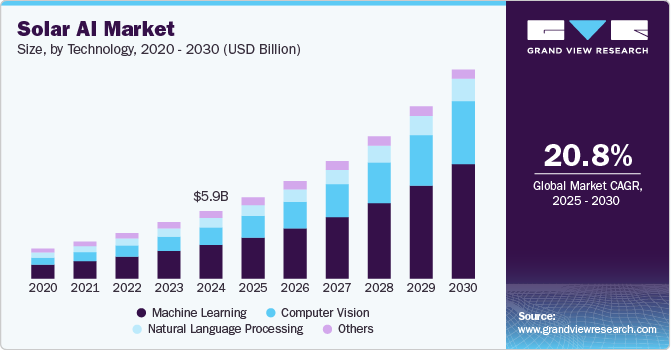
The global solar AI market size was valued at USD 5.9 billion in 2024 and is projected to grow from USD 8.6 billion in 2026 to USD 18.4 billion by 2030, at a CAGR of 20.8% from 2025 to 2030. North America dominated the market, accounting for a revenue share of 36.8% in 2024. AI integration into solar design platforms is accelerating as companies work to automate and enhance the solar project lifecycle. With AI, design platforms can instantly analyze satellite imagery, shading, roof geometry, and energy consumption patterns to create highly customized system proposals.
 Source: Grand View Research, IR Documents, Primary Interviews, Paid DatabasesTo learn more about this report,
 Download Free Sample Report
 Key Market Trends & Insights
- Based on technology, the machine learning segment dominated the industry and held a 49.9% share in 2024.
- Based on application, the Smart Grid Management segment held the largest revenue share in 2024.
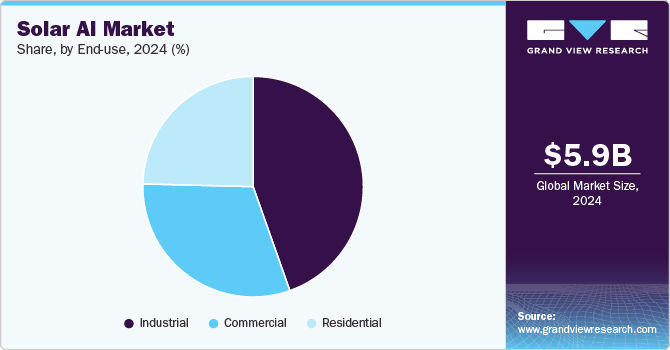
- Based on end use, the industrial segment held the largest revenue share in 2024.
Market Size & Forecast
- 2024 Market Size: USD 5.9 Billion
- 2030 Projected Market Size: USD 18.4 Billion
- CAGR (2025-2030): 20.8%
- North America: Largest market in 2024
- Asia Pacific: Fastest growing market
Three ways to get this report
Buy it, customize it, or ask a question.Ask an Analyst
Analyst response in 1 business day
- AccessReport author, directly
- Reply timeWithin 1 working day
- No sales callDirect answer only
- FormatEmail reply
- CostFree, no cost
Get the Full Report
What the study covers
- FormatsPDF · Excel · Dashboard
- Timeline2025–2030 annual, 2024 base
- Coverage20+ countries, 5 regions
- Companies10+ key players profiled
Customize the Report
20% free customization
- IncludeCountries, segments, points
- TailorTo your product definition
- ExtendDeeper competitor detail
- OrA fully bespoke study
- Turnaround5–10 working days
This integration reduces the time needed for manual surveys and engineering work, making project initiation much faster. It improves accuracy, helping installers minimize errors in system sizing, equipment selection, and installation planning.Companies adopting AI-driven design tools are positioning themselves to handle higher project volumes with fewer resources. For instance, in February 2025, Sunnova Energy International, Inc., a U.S.-based company, partnered with OpenSolar to integrate AI-powered design into its Catalyst dealer platform, enabling faster, more accurate solar system proposals across the U.S. The partnership aims to improve efficiency, meet growing market demand, and set a new standard for speed and precision in solar deployments.
 To learn more about this report, Download Free Sample Report
 AI models are significantly transforming the solar energy industry by improving forecasting accuracy, which is crucial for optimizing energy production and consumption. By integrating real-time weather data with historical energy trends, these models provide more precise predictions about solar energy generation. This enhanced forecasting allows grid operators to better manage the distribution and storage of energy, ensuring that supply meets demand efficiently. As solar energy is intermittent, having accurate predictions helps prevent imbalances and reduces the risk of grid instability or blackouts. AI-driven solutions also enable more effective use of energy storage systems, ensuring that excess energy produced during peak sunlight hours is stored and used during low-generation periods.
The integration of solar energy, battery storage, and artificial intelligence (AI) is becoming important in the renewable energy market, especially for grid decarbonization. For instance, Amazon.com, Inc.’s Baldy Mesa solar-plus-storage farm shows how AI-driven solutions are enabling better energy forecasting, storage optimization, and grid stability, which are essential as renewable energy production is often intermittent. This trend shows a broader push to enhance energy system reliability, reducing dependence on fossil fuels while promoting cleaner alternatives. Furthermore, AI models help optimize when and how energy should be stored or distributed, ensuring a consistent flow of carbon-free power, even during non-peak production hours. With growing investments in energy storage and AI capabilities, the solar sector is evolving into a more efficient, responsive, and sustainable energy market. This trend signifies a shift toward more advanced grid integration technologies that will drive the next wave of clean energy innovation.
Technology Insights
Based on technology, the machine learning segment dominated the industry and held a 49.9% share in 2024 due to its ability to enhance prediction accuracy and optimize system performance. It processes large datasets, including weather patterns and energy output, to improve efficiency. Machine learning algorithms predict energy generation, identify potential failures, and optimize operations. These technologies learn from historical data, offering valuable insights for long-term planning and real-time decision-making. This capability is key to maximizing the performance of solar energy systems.
The computer vision segment is expected to grow at the fastest CAGR over the forecast period. It enhances real-time monitoring of solar panels and systems by analyzing visual data, enabling early detection of faults. This technology aids in identifying performance issues, allowing for quicker intervention and minimizing downtime. The ability to automate inspections and detect anomalies in solar installations results in improved operational efficiency. Moreover, computer vision helps optimize the performance of solar assets, ensuring that they operate at their full potential. It also allows for predictive maintenance, reducing the frequency of costly repairs. As a result, the integration of computer vision in solar AI systems is becoming a key factor driving the sector’s expansion.
Application Insights
Based on application, the Smart Grid Management segment held the largest revenue share in 2024. AI-driven grid management platforms monitor and control energy flows in real time. These systems balance supply and demand by dynamically adjusting solar input, storage, and distribution. Advanced analytics detect anomalies and prevent congestion, improving overall network reliability. Integration with demand-response programs helps utilities respond to grid fluctuations more effectively. As a result, utilities can maintain grid stability while integrating higher levels of solar generation. This technology is instrumental in optimizing the overall efficiency of grid operations and ensuring uninterrupted power supply.
The energy storage segment is expected to grow at the fastest CAGR over the forecast period. AI algorithms analyze historical and real-time data to optimize battery charge and discharge schedules. This ensures maximum use of stored solar energy during peak demand periods. Predictive models forecast grid conditions and adjust storage operations accordingly. These capabilities reduce energy waste and enhance grid resilience. Investors and operators are increasingly adopting AI-driven storage solutions to improve system performance and reduce costs. Utilizing this technology, energy storage systems can operate more efficiently, contributing to lower operational expenses and higher returns on investment.
End Use Insights
Based on end use, the industrial segment held the largest revenue share in 2024. The segment leads due to the scale and complexity of large solar installations. AI technologies such as predictive maintenance and performance monitoring help optimize operations and reduce unplanned downtime. Through machine learning, AI systems can analyze data from sensors to predict equipment failures, minimizing maintenance costs. Moreover, AI-driven energy management systems enhance grid stability by forecasting energy production and consumption. The industrial sector also benefits from AI’s ability to manage vast amounts of data from diverse sources, such as weather patterns and system performance. As industrial demand for solar power grows, AI adoption continues to streamline operations and increase efficiency.
 To learn more about this report, Download Free Sample Report
 The commercial segment is expected to grow at the fastest CAGR over the forecast period as businesses adopt more advanced solutions. AI tools help optimize energy usage, manage solar production, and integrate with building management systems for better control. With the increasing need for energy efficiency, commercial solar installations are leveraging AI to monitor energy flow, reduce waste, and lower operational costs. Predictive analytics in AI allow businesses to forecast energy production and demand more accurately, minimizing costs and boosting profitability. AI also enhances energy storage management, ensuring optimal storage and distribution of solar power. As more commercial properties invest in renewable energy, AI solutions are becoming integral to achieving sustainability goals and reducing carbon footprints.
Regional Insights
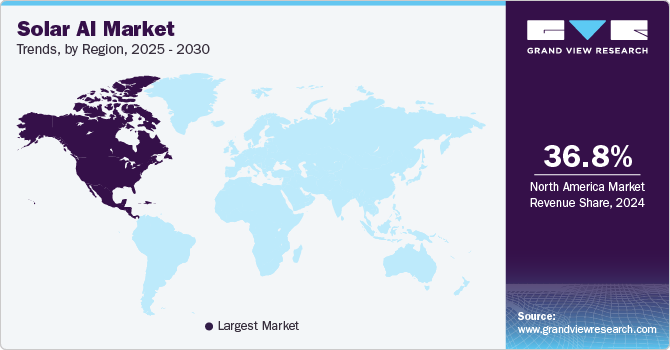
North America solar AI market dominated the global industry and accounted for a 36.8% share in 2024. The solar AI market in North America is experiencing rapid growth, driven by an increasing focus on clean energy solutions and grid modernization. The integration of AI with solar and battery storage technologies is helping optimize energy management and ensure a stable supply of power. With strong government incentives and a growing renewable energy infrastructure, the market is expected to expand significantly.
 To learn more about this report, Download Free Sample Report
 U.S. Solar AI Market Trends
The solar AI industry in the U.S. is particularly active, with companies utilizing AI to enhance energy storage systems and optimize grid operations. The country’s commitment to reducing carbon emissions and transitioning to renewable energy sources has led to the widespread adoption of AI-driven solutions in solar projects. As the largest market in North America, the U.S. is a key player in advancing AI technologies that improve solar efficiency and contribute to decarbonizing the grid.
Europe Solar AI Market Trends
The solar AI industry in Europe is at the forefront of integrating AI with solar energy, with countries such as Germany and Spain making significant strides in solar AI adoption. AI technologies are being used to enhance grid stability, optimize solar power generation, and reduce reliance on fossil fuels. The European Union's green energy policies and ambitious climate targets are accelerating the deployment of solar AI solutions. As the region continues to prioritize renewable energy, the market for solar AI technologies is set for substantial growth.
Asia Pacific Solar AI Market Trends
The solar AI industry in Asia Pacific is growing as countries such as China, India, and Japan are increasingly adopting AI in the solar energy sector to tackle energy demand challenges and improve grid reliability. AI-driven technologies are being deployed to optimize solar power generation, energy storage, and forecasting, particularly in areas with high solar potential. The region's rapid industrialization and growing emphasis on sustainability are fueling the demand for smarter, more efficient solar solutions.
Key Solar AI Company Insights
Key players operating in the solar AI market are undertaking various initiatives to strengthen their presence and increase the reach of their products and services. Strategies such as expansion activities and partnerships are key in propelling the market growth.
Key Solar AI Companies:
The following are the leading companies in the solar AI market. These companies collectively hold the largest market share and dictate industry trends.
- AES Corporation
- ENFOR
- Goldi Solar, Inc.
- Heliogen, Inc.
- Scopito
- Solar Infra Pvt. Ltd.
- Solavio
- Smart Helio
- Suncast
- Tespack
Recent Developments
-
In March 2025, Goldi Solar, Inc. launched India's first AI-powered solar manufacturing facility in Surat, designed to enhance the speed, efficiency, and precision of solar panel production. The facility features advanced AI systems such as high-speed stringers, automated optical inspection, and AI-driven visual inspection, which will help reduce errors, minimize material wastage, and improve production quality, supporting India's clean energy future.
-
In September 2024, SmartHelio, a Swiss solar software developer, launched an AI-powered suite, helping to de-risk solar investments. The Suite includes predictive analytics, a Climate Risk Assessment (CRA) tool, and an Autopilot solution, enabling solar plant operators to optimize resource allocation, reduce costs, and improve overall system performance.
-
In July 2024, AES Corporation introduced Maximo, an innovative AI-powered robot designed to revolutionize solar panel installation. The robot can complete installations in half the time and at half the cost, working alongside construction teams to enhance speed, safety, and scalability. Maximo's AI features, including computer vision and continuous learning, ensure precise panel placement and improve overall installation efficiency.
Solar AI Market Report Scope
Report Attribute
Details
Market size value in 2024
USD 5.9 billion
Estimated market size in 2026
USD 8.6 billion
Projected Market size by 2030
USD 18.4 billion
Growth rate
CAGR of 20.8% from 2025 to 2030
Base year for estimation
2024
Historical data
2018 - 2023
Forecast period
2025 - 2030
Quantitative units
Revenue in USD million/billion and CAGR from 2025 to 2030
Report coverage
Revenue forecast, company ranking, competitive landscape, growth factors, and trends
Segments covered
Technology, application, end use, region
Regional scope
North America; Europe; Asia Pacific; Latin America; Middle East & Africa
Country scope
U.S.; Canada; Mexico; Germany; UK; France; China; Japan; India; Australia; South Korea; Brazil; KSA; UAE; South Africa
Key companies profiled
AES Corporation; ENFOR; Goldi Solar, Inc.; Heliogen, Inc.; Scopito; Solar Infra Pvt. Ltd.; Solavio; Smart Helio; Suncast; Tespack
Customization scope
Free report customization (equivalent up to 8 analysts’ working days) with purchase. Addition or alteration to country, regional & segment scope
Pricing and purchase options
Avail customized purchase options to meet your exact research needs. Explore purchase options
Global Solar AI Market Report Segmentation
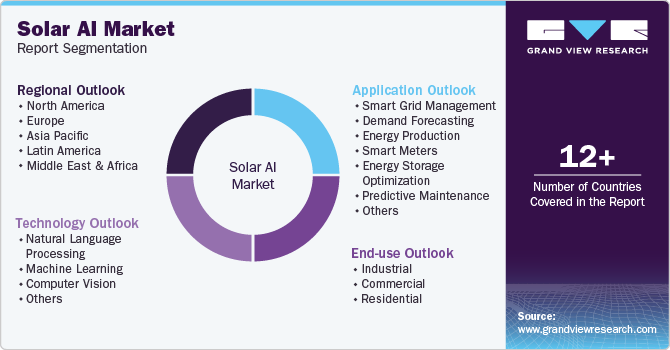
This report forecasts revenue growth at the global, regional, and country levels and provides an analysis of the latest industry trends and opportunities in each of the sub-segments from 2018 to 2030. For this study, Grand View Research has segmented the global solar AI market report based on technology, application, end use, and region:
 To learn more about this report, Download Free Sample Report
 -
Technology Outlook (Revenue, USD Million, 2018 - 2030)
-
Natural Language Processing
-
Machine Learning
-
Computer Vision
-
Others
-
-
Application Outlook (Revenue, USD Million, 2018 - 2030)
-
Smart Grid Management
-
Demand Forecasting
-
Energy Production
-
Smart Meters
-
Energy Storage Optimization
-
Predictive Maintenance
-
Solar Panel Design
-
Weather Forecasting
-
Solar Farm Operations
-
Others
-
-
End Use Outlook (Revenue, USD Million, 2018 - 2030)
-
Industrial
-
Commercial
-
Residential
-
-
Regional Outlook (Revenue, USD Million, 2018 - 2030)
-
North America
-
U.S.
-
Canada
-
Mexico
-
-
Europe
-
U.K.
-
Germany
-
France
-
-
Asia Pacific
-
China
-
Japan
-
India
-
Australia
-
South Korea
-
-
Latin America
-
Brazil
-
-
Middle East & Africa (MEA)
-
KSA
-
UAE
-
South Africa
-
-
Frequently Asked Questions About This Report
North America dominated the solar AI market with a share of 36.8% in 2024. This is attributable to the early adoption of advanced technologies and strong investments in renewable energy.
Some key players operating in the solar AI market include AES Corporation, ENFOR, Goldi Solar, Inc., Heliogen, Inc., Scopito, Solar Infra Pvt. Ltd., Solavio, Smart Helio, Suncast, and Tespack.
Key factors driving the market growth include increasing demand for efficient energy solutions, advancements in AI technology, and supportive government policies.
The global solar AI market size was valued at USD 5.9 billion in 2024 and is estimated at USD 8.6 billion for 2026.
The global solar AI market is expected to grow at a CAGR of 20.8% from 2025 to 2030, reaching USD 18.4 billion by 2030.
About the Author(s)
Next Generation Technologies Research Team
Technology · Next Generation TechnologiesThis report was authored by the next generation technologies research team at Grand View Research - comprising two research analysts, one senior research analyst, and one industry expert - with specialized expertise in the next generation technologies segment of the technology industry. All findings are based on proprietary technology databases, executive interviews, and regulatory analysis, subject to internal peer review prior to publication.
Last Updated:
Speak to Analyst

Customize this report to your needs - add regions, segments, or data points, with 20% free customization.
Or view our licence options:


ISO 9001:2015 & 27001:2022 Certified
We are GDPR and CCPA compliant! Your transaction & personal information is safe and secure. For more details, please read our privacy policy.


