
- Home
- »
- Electronic Security
- »
-
Solar-powered Security Camera Market Report, 2026-2033GVR Report cover

Solar-powered Security Camera Market (2026 - 2033)
Size, Share & Trends Analysis Report By Product (Fixed Cameras, Bullet Cameras), By Connectivity (Wi-Fi, Cellular), By Distribution Channel (Online, Offline), By Application (Residential), By Region, And Segment Forecasts
Market Size, 2025
$2.7BMarket Estimate, 2026
$3.0BMarket Forecast, 2033
$8.9BCAGR, 2026–2033
16.7%Solar-powered Security Camera Market Summary
The global solar-powered security camera market size was valued at USD 2.7 billion in 2025 and is projected to grow from USD 3.0 billion in 2026 to USD 8.9 billion by 2033, at a CAGR of 16.7% from 2026 to 2033. The market in Asia Pacific dominated with a revenue share of 38.3% in 2025. A solar-powered security camera is an intelligent surveillance system that operates on solar energy rather than traditional grid electricity.
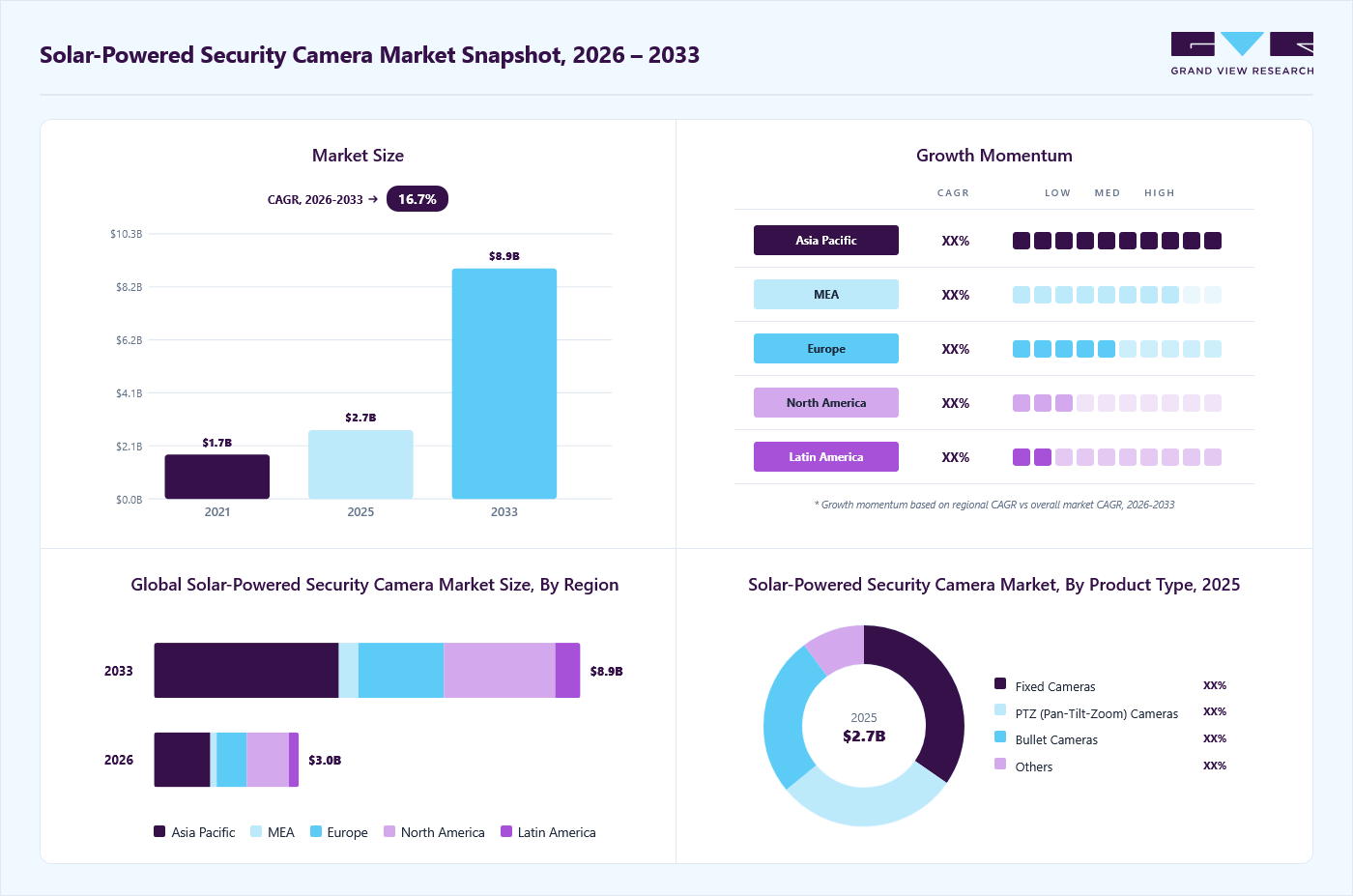 Source: Grand View Research, IR Documents, Primary Interviews, Paid DatabasesTo learn more about this report,
 Download Free Sample Report
 Key Market Trends & Insights
- By product: Fixed cameras segment held the largest market share of 34.6% in 2025.
- By connectivity: Wi-Fi segment held the largest market share in 2025.
- By distribution channel: Online segment held the largest market share in 2025.
- By application: Residential segment held the largest market share in 2025.
Regional Highlights
- Largest regional market: Asia Pacific (38.3% revenue share, 2025)
- By country: China held the largest market share in 2025
Market Size & Forecast
- Market size in 2025: USD 2.7 Billion
- Estimated market size in 2026: USD 3.0 Billion
- Projected market size by 2033: USD 8.9 Billion
- CAGR (2026-2033): 16.7%
Three ways to get this report
Buy it, customize it, or ask a question.Ask an Analyst
A direct answer, usually in 1 working day
- AccessReport author, directly
- Reply timeWithin 1 working day
- No sales callDirect answer only
- FormatEmail reply
- CostFree, no cost
Get the Full Report
What the study covers
- FormatsPDF · Excel · Dashboard
- Timeline2026–2033 annual, 2025 base
- Coverage20+ countries, 5 regions
- Companies10+ key players profiled
Customize the Report
20% free customization
- IncludeCountries, segments, points
- TailorTo your product definition
- ExtendDeeper competitor detail
- OrA fully bespoke study
- Turnaround5–10 working days
It integrates a solar panel, a rechargeable battery, and a wireless camera unit, enabling continuous monitoring without the need for complex wiring or external power sources. The growing shift toward sustainable, energy-efficient solutions is a major driver behind the growth of the solar-powered security camera market. Growing awareness among homeowners and businesses of environmental impact, combined with the need for reliable, cost-effective surveillance, is driving the adoption of security cameras. These cameras are preferred solutions for areas with limited or impractical access to conventional power infrastructure, such as remote locations, construction sites, and outdoor environments. In addition, their ability to operate continuously using solar energy reduces dependence on manual charging and battery replacement, further enhancing their appeal and driving market growth.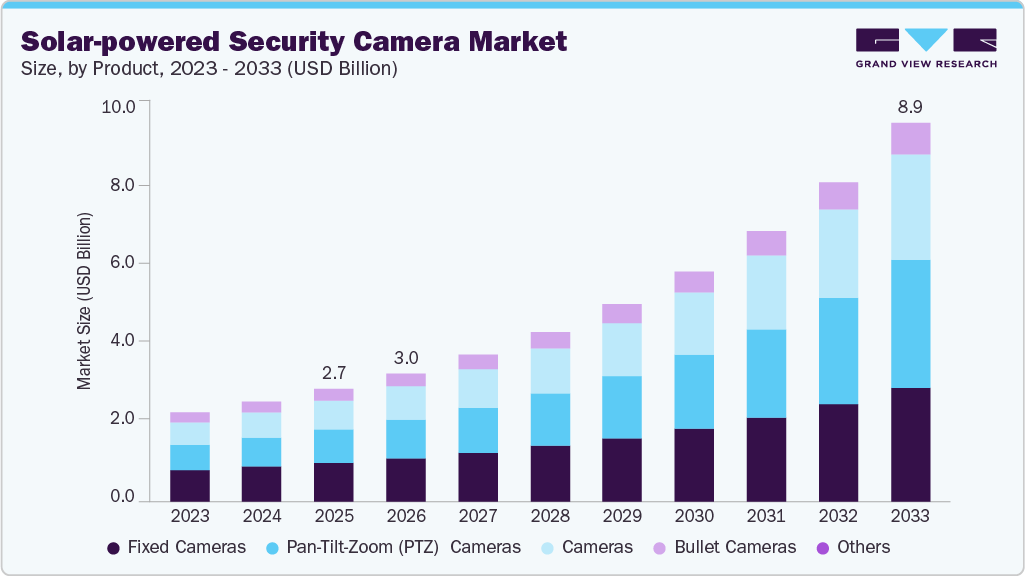 To learn more about this report, Download Free Sample Report
 Technological improvements in battery storage and solar panel efficiency are significantly enhancing the performance of solar-powered security cameras, thereby driving the market’s growth. Rechargeable lithium batteries in solar-powered security cameras store energy generated by the solar panels, enabling consistent and uninterrupted surveillance. This ensures reliable round-the-clock operation in any location with sufficient sunlight. In addition, enhanced energy management systems and low-power components are enabling reliable 24/7 operation, making these cameras suitable for a wider range of environments and climatic conditions.
The growing adoption of solar-powered security cameras in smart city initiatives, driven by the need for sustainable and intelligent surveillance solutions, is expected to further support market growth. In addition, the adoption of solar-powered security cameras is increasing in public safety and infrastructure applications. Governments and municipalities are deploying these systems for traffic monitoring, perimeter security, and public surveillance, especially in areas with limited or costly grid connectivity. The combination of sustainability goals and the need for scalable surveillance solutions is driving the integration of solar cameras into large-scale infrastructure projects, which in turn is driving the growth of the market.
The increasing integration of artificial intelligence (AI) and advanced analytics into solar-powered security cameras is further expected to contribute to the market’s growth. Features such as motion detection, facial recognition, object classification, and real-time alerts are being embedded to enhance surveillance efficiency. These capabilities reduce false alarms and enable proactive security management, making such systems more attractive for both residential and commercial users. In addition, AI enables solar-powered security cameras to operate more independently by learning and adapting over time. These systems distinguish between humans, animals, and vehicles, helping minimize false alarms and enhancing overall security effectiveness.
The solar-powered security camera market faces several challenges, primarily due to its reliance on sunlight, which can affect performance in regions with low solar exposure or prolonged adverse weather conditions. High initial installation costs, including solar panels and battery systems, are also expected to limit adoption among price-sensitive consumers. In addition, concerns around battery efficiency and long-term durability can affect reliability, especially in extreme climates. Limited awareness and technical challenges in integrating these systems with existing infrastructure are expected to further hinder widespread deployment of these cameras.
Product Insights
The fixed cameras segment dominated the market in 2025, accounting for 34.6% of the market share. The growth of fixed cameras is driven by their cost-effectiveness and ease of deployment, making them highly suitable for residential and small commercial applications. These cameras require minimal technical expertise to install and operate, which aligns well with the growing DIY home security trend. In addition, their lower power consumption makes them more efficient in solar-based systems, ensuring consistent performance even in limited sunlight conditions. The increasing need for basic, reliable surveillance in homes, small shops, and remote properties continues to support the steady adoption of fixed cameras.
The Pan-Tilt-Zoom (PTZ) cameras segment is expected to grow at the fastest CAGR over the forecast period. The adoption of PTZ solar-powered cameras is driven by the rising demand for advanced surveillance capabilities and wide-area coverage, particularly in commercial and infrastructure applications. These cameras offer remote-controlled movement, zoom functionality, and enhanced monitoring efficiency, reducing the need for multiple fixed cameras. Growing investments in smart cities, construction sites, and industrial security are further accelerating demand for PTZ systems. Moreover, advancements in battery efficiency and solar power management are enabling PTZ cameras to operate reliably in off-grid environments, supporting their rapid market growth.
Connectivity Insights
The Wi-Fi segment dominated the market in 2025. The growth of the segment is driven by the widespread availability of residential and commercial internet infrastructure, making deployment simple and cost-effective. The increasing adoption of smart home ecosystems and mobile-based monitoring solutions is further driving demand, as users seek seamless integration with existing networks and devices. Wi-Fi cameras also enable real-time video streaming and cloud storage at lower operational costs than cellular alternatives. In addition, the rising popularity of DIY security systems and e-commerce distribution channels is accelerating the uptake of Wi-Fi-based solutions, particularly in urban and semi-urban areas.
The cellular segment is expected to witness the fastest CAGR over the forecast period. The demand for cellular (4G/5G)-enabled solar cameras is growing rapidly, particularly in remote and off-grid locations where Wi-Fi or wired networks are unavailable. These cameras provide independent connectivity through 4G/5G networks, enabling continuous monitoring in applications such as construction sites, agriculture, infrastructure, and public safety. Increasing expansion of mobile network coverage and improvements in data transmission technologies are further enhancing their reliability and performance. Moreover, the growing focus on flexible, scalable, and temporary surveillance solutions is accelerating the adoption of cellular-connected cameras across commercial and industrial segments.
Distribution Channel Insights
The online segment dominated the market in 2025. The increasing penetration of e-commerce platforms and the rising preference for direct-to-consumer purchasing are driving the segment’s growth. Consumers are increasingly opting for online channels due to greater product availability, competitive pricing, and easier feature and specification comparisons. The expansion of DIY security solutions has further accelerated online sales, as users seek convenient, plug-and-play products that can be installed without professional assistance. In addition, digital marketing, customer reviews, and fast delivery services are enhancing buyer confidence, thereby supporting the rapid growth of online distribution.
The offline segment is expected to witness a notable CAGR over the forecast period. The growth of the offline distribution channel continues to be driven by demand for professional installation, technical support, and customized security solutions, particularly among commercial and industrial users. System integrators, specialty security stores, and authorized dealers play a crucial role in providing end-to-end solutions, including consultation, installation, and after-sales services. This channel is especially important for large-scale deployments such as infrastructure and public safety projects, where reliability and system integration are critical. Furthermore, customer preference for physical product inspection and personalized assistance continues to sustain the relevance of offline sales channels.
Application Insights
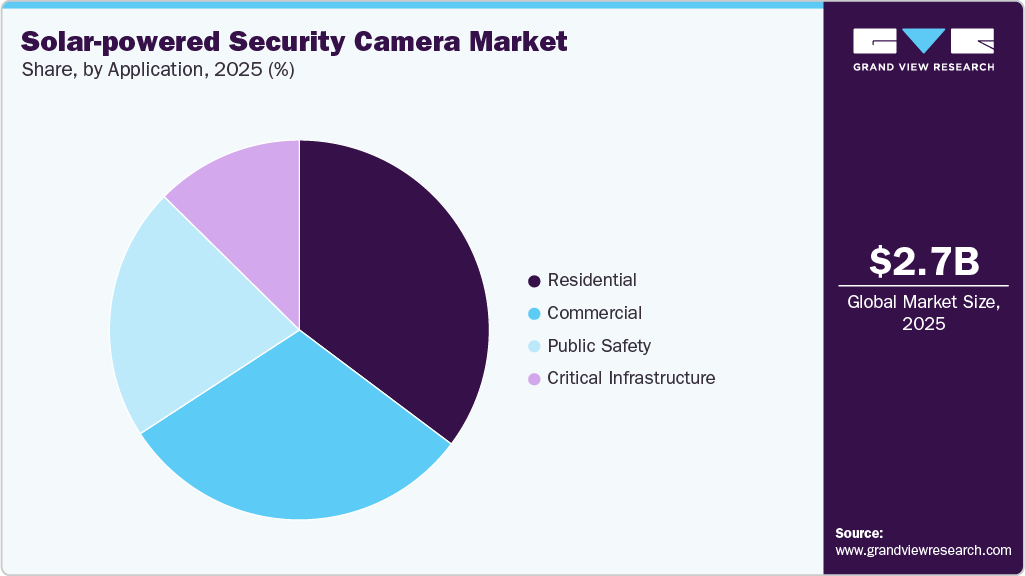
The residential segment dominated the market in 2025. The segment’s growth is driven by the increasing need for affordable, easy-to-install home security solutions, particularly in urban and semi-urban areas. The rising adoption of smart home technologies and mobile-based monitoring systems is encouraging homeowners to invest in solar-powered cameras that offer remote access and real-time alerts. In addition, the ability to operate without complex wiring makes these systems highly attractive for independent houses, vacation homes, and rural properties.
 To learn more about this report, Download Free Sample Report
 The critical infrastructure segment is expected to grow at the fastest CAGR during the forecast period. The adoption of solar-powered security cameras in critical infrastructure is driven by the need for reliable surveillance in remote and high-risk environments. Facilities such as power grids, oil & gas sites, pipelines, and solar farms often lack consistent access to grid electricity, making solar-powered systems a practical solution. These cameras enable continuous monitoring with minimal operational disruption, reducing dependency on manual surveillance and improving overall security efficiency. Furthermore, increasing investments in infrastructure protection and the growing emphasis on energy-efficient solutions are supporting the expansion of solar-powered surveillance in this segment.
Regional Insights
The Asia Pacific solar-powered security camera industry dominated the global market with a share of 38.3% in 2025, driven by rapid urbanization, expanding infrastructure, and strong demand for cost-effective surveillance solutions. The region benefits from a large manufacturing base and increasing adoption of solar technologies, particularly in developing economies where grid connectivity is inconsistent. In addition, government-led smart city initiatives and rising security concerns are accelerating deployment across residential, commercial, and public sectors.
 To learn more about this report, Download Free Sample Report
 China Solar-powered Security Camera Market Trends
The solar-powered security camera industry in China held a substantial market share in 2025, supported by its strong manufacturing ecosystem and widespread deployment of surveillance technologies. The country benefits from large-scale production capabilities, enabling cost-effective solutions and high export volumes, while domestic demand is driven by smart city initiatives and expanding infrastructure projects.
The India solar-powered security camera industry is expected to grow at the fastest CAGR from 2026 to 2033. India represents a high-growth market, supported by increasing demand for surveillance in rural and semi-urban areas where reliable electricity supply remains a challenge. Government initiatives focused on smart cities and digital infrastructure, along with rising security awareness among homeowners and small businesses, are driving adoption.
Europe Solar-powered Security Camera Market Trends
The solar-powered security camera industry in Europe is expected to register a robust CAGR from 2026 to 2033. The region’s market growth is driven by stringent environmental regulations and a strong emphasis on sustainability. The adoption of renewable energy solutions, combined with increasing investments in public safety and smart infrastructure, is supporting market expansion.
The UK solar-powered security camera industry is expected to grow at a significant CAGR from 2026 to 2033. The country’s growth is supported by rising demand for energy-efficient surveillance systems and increasing security concerns. Solar-powered cameras are gaining traction in residential and commercial applications, particularly for outdoor and remote monitoring. Government initiatives to reduce carbon emissions are also encouraging the adoption of solar technologies.
The solar-powered security camera industry in Germany held a substantial market share in 2025, driven by its strong focus on renewable energy and advanced infrastructure development. The adoption of solar-powered security cameras is supported by stringent environmental policies and the increasing demand for sustainable security solutions across the industrial and public sectors.
North America Solar-powered Security Camera Market Trends
The solar-powered security camera industry in North America is expected to grow at a notable CAGR during the forecast period, driven by high adoption of smart home security systems and advanced surveillance technologies. The demand for solar-powered cameras is driven by the growing preference for wireless, easy-to-install solutions and the need to monitor remote assets, such as construction sites and farms.
The solar-powered security camera industry in the U.S. held a dominant position in 2025, driven by strong consumer demand for DIY security systems and widespread availability of high-speed connectivity. Solar-powered cameras are increasingly being adopted for residential, commercial, and outdoor applications, particularly in remote and off-grid locations. Continuous innovation and the presence of leading security technology providers further support market growth.
Key Solar-powered Security Camera Company Insights
Some of the key companies in the solar-powered security camera industry include Hangzhou Hikvision Digital Technology Co., Ltd., TP-Link Systems Inc., and Fantasia Trading LLC (eufy), among others. These companies focus on product innovation, R&D, and strategic initiatives such as new product launches, business expansions, partnerships, collaborations, and mergers and acquisitions.
-
Hangzhou Hikvision Digital Technology Co., Ltd. is one of the major players in the global surveillance industry, with a strong presence across residential, commercial, and critical infrastructure applications. The company focuses on AI-powered Internet of Things (AIoT) technologies and offers a comprehensive portfolio of security products, including advanced network cameras, thermal imaging systems, and smart surveillance solutions. It operates in over 180 countries and continues to invest heavily in R&D to enhance imaging, analytics, and automation capabilities. Its strong manufacturing base and scalable solutions make it a key player in large-scale deployments, including smart cities and infrastructure monitoring.
-
TP-Link Systems Inc. is one of the significant players in the consumer and residential segment of the solar-powered security camera market. The company leverages its strong global distribution network and expertise in networking technologies to offer affordable, Wi-Fi-enabled security cameras with easy installation and app-based control. Its focus on plug-and-play solutions aligns well with the growing DIY security trend, particularly in urban households.
Key Solar-powered Security Camera Companies:
The following key companies have been profiled for this study on the solar-powered security camera market.
- TP-Link Systems Inc.
- Hangzhou Hikvision Digital Technology Co., Ltd.
- Maizic
- Shenzhen LS VISION Technology Co., Ltd.
- Innotronik
- Shenzhen LOYALTY-SECU Technology Co., LTD
- Milesight
- Fantasia Trading LLC (eufy)
- Toucan Solution
- Swann
Recent Developments
-
In January 2026, TP-Link Systems Inc. introduced the Tapo C660 KIT, a solar-powered outdoor security camera designed to provide continuous 24/7 surveillance with advanced 360° AI tracking and 4K resolution. The system operates without the need for wiring, frequent recharging, or complex installation, enhancing user convenience. Designed for modern households and the demanding environmental conditions in Australia, the Tapo C660 KIT integrates high-definition video, intelligent detection features, and flexible solar-powered deployment, offering a low-maintenance solution for round-the-clock home monitoring.
-
In November 2025, Hangzhou Hikvision Digital Technology Co., Ltd. introduced its AOV 4G Solar Camera Series. This new range is designed to provide reliable and continuous video surveillance in remote and off-grid environments. The series is tailored for a wide range of applications, including agricultural sites such as farms, orchards, ranches, and plantations, as well as residential backyards and temporary construction sites, offering effective monitoring in locations without access to power or network infrastructure.
Solar-powered Security Camera Market Report Scope
Report Attribute
Details
Market size in 2025
USD 2.7 billion
Estimated market size in 2026
USD 3.0 billion
Projected market size by 2033
USD 8.9 billion
Growth rate
CAGR of 16.7% from 2026 to 2033
Base year for estimation
2025
Historical data
2021 - 2024
Forecast period
2026 - 2033
Quantitative units
Revenue in USD million/billion and CAGR from 2026 to 2033
Report coverage
Revenue forecast, company market share, competitive landscape, growth factors, and trends
Segments covered
Product, connectivity, distribution channel, application, region
Regional scope
North America; Europe; Asia Pacific; Latin America; MEA
Country scope
U.S.; Canada; Mexico; UK; Germany; France; China; India; Japan; Australia; South Korea; Brazil; UAE; Saudi Arabia; South Africa
Key companies profiled
TP-Link Systems Inc.; Hangzhou Hikvision Digital Technology Co., Ltd.; Maizic, Shenzhen LS VISION Technology Co., Ltd.; Innotronik; Shenzhen LOYALTY-SECU Technology Co., LTD; Milesight; Fantasia Trading LLC (eufy); Toucan Solution; Swann
Customization scope
Free report customization (equivalent up to 8 analysts working days) with purchase. Addition or alteration to country, regional & segment scope.
Pricing and purchase options
Avail customized purchase options to meet your exact research needs. Explore purchase options
Global Solar-powered Security Camera Market Report Segmentation
This report forecasts revenue growth at global, regional, and country levels and provides an analysis of the latest industry trends in each of the sub-segments from 2021 to 2033. For this study, Grand View Research has segmented the global solar-powered security camera market report based on product, connectivity, distribution channel, application, and region:
-
Product Outlook (Revenue, USD Million, 2021 - 2033)
-
Fixed Cameras
-
Pan-Tilt-Zoom (PTZ) Cameras
-
Bullet Cameras
-
Others
-
-
Connectivity Outlook (Revenue, USD Million, 2021 - 2033)
-
Wi-Fi
-
Cellular
-
-
Distribution Channel Outlook (Revenue, USD Million, 2021 - 2033)
-
Online
-
Offline
-
-
Application Outlook (Revenue, USD Million, 2021 - 2033)
-
Residential
-
Commercial
-
Public Safety
-
Critical Infrastructure
-
-
Regional Outlook (Revenue, USD Million, 2021 - 2033)
-
North America
-
U.S.
-
Canada
-
Mexico
-
-
Europe
-
UK
-
Germany
-
France
-
-
Asia Pacific
-
China
-
India
-
Japan
-
Australia
-
South Korea
-
-
Latin America
-
Brazil
-
-
Middle East & Africa (MEA)
-
UAE
-
Kingdom of Saudi Arabia (KSA)
-
South Africa
-
-
Frequently Asked Questions About This Report
The fixed cameras segment led with a 34.6% revenue share in 2025, while Pan-Tilt-Zoom (PTZ) cameras is the fastest-growing product.
Wi-Fi segment held the largest revenue share in 2025, while cellular is the fastest-growing connectivity.
The online segment held the largest revenue share in 2025.
Residential segment held the largest share in 2025, while critical infrastructure is the fastest-growing application.
The global solar-powered security camera market size was valued at USD 2.7 billion in 2025 and is estimated at USD 3.0 billion for 2026.
The global solar-powered security camera market is expected to grow at a CAGR of 16.7% from 2026 to 2033, reaching USD 8.9 billion by 2033.
Asia Pacific dominated the solar-powered security camera industry and accounted for a share of 38.3% in 2025, driven by rapid urbanization, expanding infrastructure, and strong demand for cost-effective surveillance solutions.
Key players include TP-Link Systems Inc.; Hangzhou Hikvision Digital Technology Co., Ltd.; Maizic, Shenzhen LS VISION Technology Co., Ltd.; Innotronik; Shenzhen LOYALTY-SECU Technology Co., LTD; Milesight; Fantasia Trading LLC (eufy); Toucan Solution; Swann.
The growing shift toward sustainable, energy-efficient solutions is a major driver behind the growth of the solar-powered security camera market. Growing awareness among homeowners and businesses of environmental impact, combined with the need for reliable, cost-effective surveillance, is driving adoption of security cameras.
About the Author(s)
Electronic Security Research Team
Semiconductors & Electronics · Electronic SecurityThis report was authored by the electronic security research team at Grand View Research - comprising two research analysts, one senior research analyst, and one industry expert - with specialized expertise in the electronic security segment of the semiconductors & electronics industry. All findings are based on proprietary semiconductors & electronics databases, executive interviews, and regulatory analysis, subject to internal peer review prior to publication.
Last Updated:
Speak to Analyst

Customize this report to your needs - add regions, segments, or data points, with 20% free customization.
Or view our licence options:


ISO 9001:2015 & 27001:2022 Certified
We are GDPR and CCPA compliant! Your transaction & personal information is safe and secure. For more details, please read our privacy policy.


