
- Home
- »
- Consumer F&B
- »
-
Soy Flour Market Size, Share & Trends Report, 2026-2033GVR Report cover

Soy Flour Market (2026 - 2033)
Size, Share & Trends Analysis Report By Product (Full-fat, Defatted), By Application (Bakery & Confectionery, Meat Substitute, Meat & Poultry, Others), By Region, And Segment Forecasts
Market Size, 2025
$4.0BMarket Estimate, 2026
$4.3BMarket Forecast, 2033
$6.3BCAGR, 2026–2033
5.8%Soy Flour Market Summary
The global soy flour market size was valued at USD 4.0 billion in 2025 and is projected to grow from USD 4.3 billion in 2026 to USD 6.3 billion in 2033, at a CAGR of 5.8% from 2026 to 2033. Asia Pacific dominated the market, accounting for the largest revenue share of 35.5% in 2025. This growth is driven by increasing awareness of the health benefits of soy flour, such as its high protein content and ability to improve insulin sensitivity, which is encouraging its adoption across various food products.
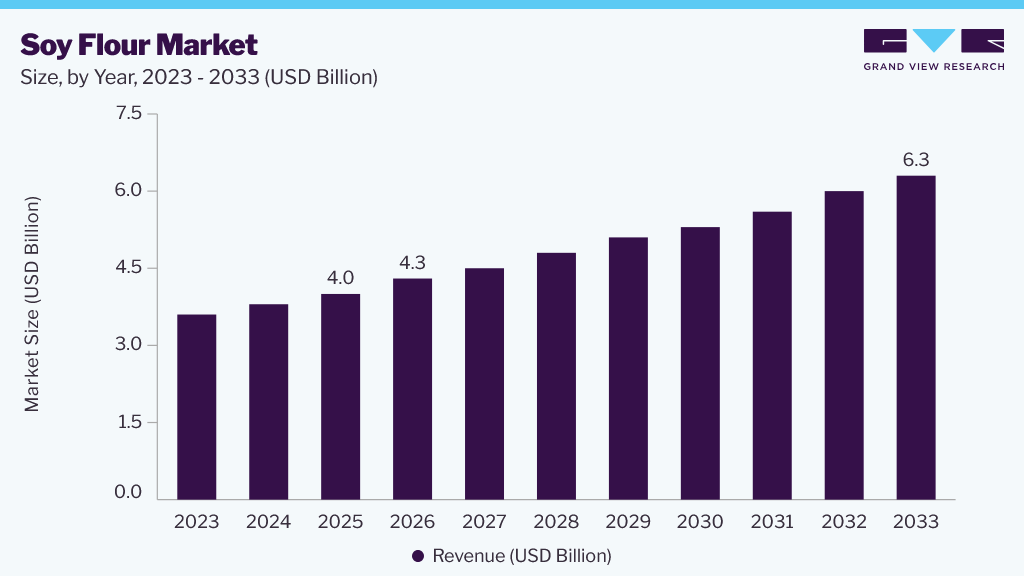 Source: Grand View Research, IR Documents, Primary Interviews, Paid DatabasesTo learn more about this report,
 Download Free Sample Report
Key Market Trends & Insights
- By product: The defatted soy flour segment held the largest market share of over 66.0% in 2025.
- By application: The bakery & confectionery segment held the largest market share of over 35.0% in 2025.
Regional Highlights
- Largest regional market: Asia Pacific (35.5% revenue share, 2025)
- Fastest-growing regional market: Europe (highest CAGR, 2026-2033)
Market Size & Forecast
- Market size in 2025: USD 4.0 Billion
- Estimated market size in 2026: USD 4.3 Billion
- Projected market size by 2033: USD 6.3 Billion
- CAGR (2026-2033): 5.8%
Prism AI by Grand View Research Free to tryAsk a question about the soy flour marketTry asking✓Every figure cited from GVR research Prefer the report? Download free sample →
In addition, the rising prevalence of chronic diseases is pushing consumers towards healthier dietary choices, further boosting the demand for soy flour. Moreover, the expanding use of soy flour in bakery and confectionery products, as well as in dairy alternatives for its creamy texture, is contributing to market growth. The growing popularity of plant-based and vegan diets is a significant market driver. Growing consumer preference for plant-based foods continues to support demand for soy flour across bakery, meat alternatives, and functional food applications. These trends boost the demand for soy flour, valued for its high protein content and nutritional benefits. It is a popular choice among health-conscious consumers and those with dietary restrictions.The growing demand for functional foods and expanding distribution channels are also anticipated to create new opportunities for market players. Rising consumer preference for clean label, protein-fortified, and minimally processed food products is further supporting the adoption of soy flour across the food and beverage industry. However, challenges such as soy allergies, concerns regarding genetically modified soybeans in certain regions, and increasing competition from alternative plant protein sources may hinder market growth.
Analyst Perspective
The market is evolving as manufacturers increasingly position soy ingredients as functional components for protein enrichment, texture improvement, and clean-label food formulations. Product innovation is centered on developing higher-value soy ingredients that meet changing consumer preferences for minimally processed and plant-based foods while improving formulation performance across bakery, meat alternatives, and nutritional products. At the same time, sourcing transparency, identity-preserved soybeans, and sustainability initiatives are becoming important competitive differentiators. Market participants that combine product innovation with reliable ingredient quality and traceable supply chains are expected to strengthen their position in the global soy ingredient industry.
Product Insights
The defatted soy flour segment held the largest market share of over 66.0% in 2025, owing to its extensive use across various food applications for its high protein content and low fat properties. Defatted soy flour is particularly favored in producing bakery products, meat substitutes, and health foods, where a high protein-to-fat ratio is desirable. Its ability to enhance the texture and nutritional profile of food products makes it a popular choice among manufacturers. In addition, defatted soy flour is often used as a functional ingredient in processed foods, contributing to its widespread adoption. The growing consumer awareness of health and wellness, along with the increasing demand for high-protein, low-fat food products. In addition, the industry's growing emphasis on sustainable soy products is driving more companies to develop their soy flour product lines. For instance, in July 2024, ADM announced the commercial availability of fully verified, segregated, and traceable soybean products for European customers through its resource soybean program, reinforcing the company's capability to supply high-quality soy ingredients for use across food applications, including soy flour-based formulations.
The full fat soy flour segment is expected to grow steadily during the forecast period, driven by the rising demand for natural and minimally processed food ingredients. Full fat soy flour retains the natural oils in soybeans, offering a richer flavor and higher nutritional value than its defatted counterpart. It is increasingly used in applications where natural fats are beneficial, such as in producing certain bakery products, snacks, and meat substitutes. The trend towards clean label products and the growing popularity of plant-based diets also contribute to the steady growth of the full fat soy flour segment. As consumers continue seeking wholesome and nutritious food options, the demand for full fat soy flour is expected to rise, supporting its market expansion over the forecast period.
Application Insights
The bakery & confectionery segment held the largest market share of over 35.0% in 2025, attributed to increasing consumer demand for healthier, protein-enriched bakery products. Soy flour is widely used in baking due to its high protein content, which enhances the nutritional profile of baked goods. In addition, it improves product texture and shelf life, making it a preferred ingredient among bakers and confectioners. The versatility of soy flour enables its use in various products, including bread, cakes, cookies, and pastries, catering to the growing health-conscious consumer base. The trend towards clean label and plant-based ingredients further boosts the adoption of soy flour in this segment, as consumers seek products with recognizable, wholesome ingredients.
The meat substitute segment is expected to register the fastest CAGR over the forecast period, driven by the rising popularity of plant-based diets and the increasing awareness of the environmental and health benefits of reducing meat consumption. Soy flour is crucial in formulating meat substitutes, providing protein content and texture that mimic traditional meat products. Innovations in food technology have enabled the development of soy-based products that closely resemble the taste and texture of meat, appealing to both vegetarians and flexitarians. Furthermore, continuous product innovation in plant-based protein ingredients is helping manufacturers develop meat alternatives with improved nutritional value and functionality. For instance, in February 2024, Amfora Inc. launched its Ultra High Protein Soy Flour Alongside Texturized Vegetable Protein, specifically targeting alternative meat applications by providing naturally high-protein soy ingredients with minimal processing.
Regional Insights
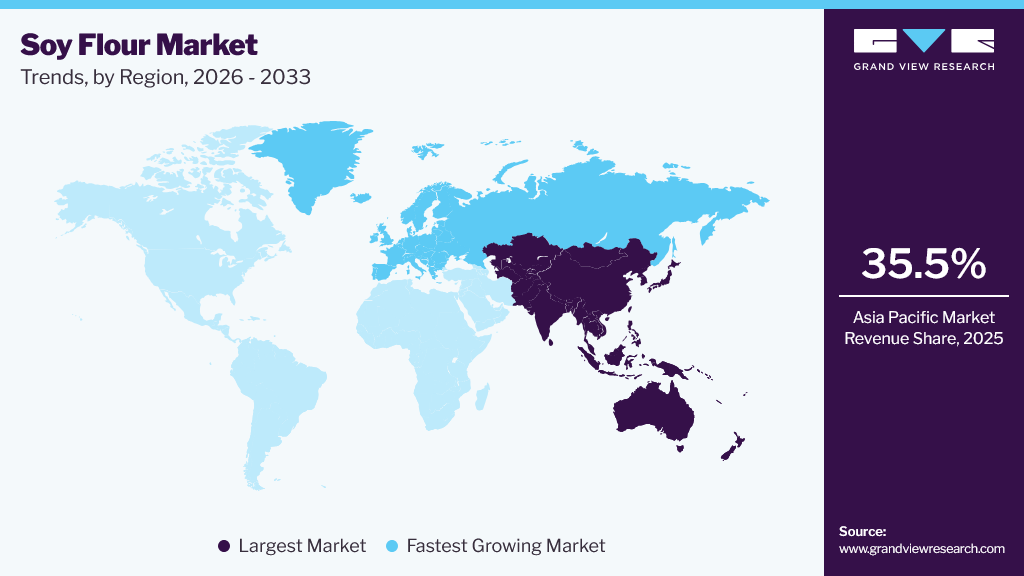
The soy flour market in the Asia Pacific dominated with a revenue share of approximately 35.5% in 2025, driven by high consumption in countries such as China, Japan, and India. The region’s dominance is attributed to the widespread use of soy flour in traditional cuisines and the growing demand for plant-based protein sources. Furthermore, there is a growing trend among research organizations and government-backed bodies to develop new, unique soy flour products to increase their use in the convenience food industry. This ensures that soy flour finds increased acceptance within the region. In 2025, the ICAR National Soybean Research Institute (NSRI), Indore, collaborated with the ICAR Indian Institute of Millets Research (IIMR), Hyderabad, to develop a range of ready-to-eat food products using soybean flour and millet flour, including halwa mix, upma, and cookies.
 To learn more about this report, Download Free Sample Report
China Soy Flour Market Trends
The soy flour market in China accounted for a considerable revenue share of the Asia Pacific in 2025. The country’s large population and the growing awareness of the health benefits of soy products have led to increased consumption. Moreover, the expansion of the food processing industry and the incorporation of soy flour in various food products, such as bakery items and meat substitutes, have contributed to the market’s growth in China.
North America Soy Flour Market Trends
The soy flour market in North America held a significant revenue share in the global market in 2025. The increasing demand for gluten-free and high-protein food products drives the region’s market. The growing trend toward plant-based diets and the rising awareness of soy flour's health benefits are also contributing to the market’s growth. The presence of major food manufacturers and the development of innovative soy-based products further support the market in North America.
The U.S. soy flour market is expected to grow substantially over the forecast period. The increasing consumer preference for healthy and sustainable food options fuels this growth. The rising popularity of vegan and vegetarian diets, along with the demand for high-protein and gluten-free products, is driving the adoption of soy flour across various food applications. Moreover, the ongoing research and development activities to enhance soy flour's nutritional profile and functionality are expected to create new growth opportunities in the U.S. market.
Europe Soy Flour Market Trends
The soy flour market in Europe is expected to grow at the fastest CAGR from 2026 to 2033, driven by the increasing demand for plant-based and gluten-free food products across the region. Consumers are becoming more health-conscious and seeking high-protein, low-fat alternatives, thereby boosting the adoption of soy flour across various food applications. In addition, the rising popularity of vegan and vegetarian diets contributes to the market’s expansion. Countries such as Germany, France, and the UK are leading this growth due to their large consumer base and the presence of major food manufacturers. The trend towards clean label and natural ingredients is also expected to support the steady market growth in Europe over the forecast period.
Key Soy Flour Company Insights
Leading companies are focusing on capacity expansion, product innovation, strategic partnerships, acquisitions, and sustainable sourcing initiatives to strengthen their position in the global soy ingredient market.
Key Soy Flour Companies
The following key companies have been profiled for this study on the soy flour market:
-
Archer Daniels Midland Company (ADM)
-
Cargill, Incorporated
-
Bunge Global SA
-
CHS Inc.
-
Sonic Biochem Extractions Limited
-
Devansoy Inc.
-
Linyi Shansong Biological Products Co., Ltd.
-
Shandong Yuwang Ecological Food Industry Co., Ltd.
Recent Developments
- In February 2024, White River Soy Processing, LLC acquired Benson Hill, Inc.'s soy processing facility in Creston, Iowa. The facility produces food-grade soy ingredients, including soy white flake, soy flour, soy grits, soybean meal, and soybean oil, expanding White River's processing capabilities in value-added soy products.
- In January 2024, ADM announced the expansion of its verified and fully traceable soybean program across additional North American locations following the successful delivery of traceable U.S. soybeans to Europe. The initiative strengthens the company's supply of traceable soybean ingredients for food applications, including soy flour and other value-added soy products.
Soy Flour Market Report Scope
Report Attribute
Details
Market size in 2025
USD 4.0 billion
Estimated market size in 2026
USD 4.3 billion
Projected market size by 2033
USD 6.3 billion
Growth rate
CAGR of 5.8% from 2026 to 2033
Actual data
2021 - 2025
Forecast period
2026 - 2033
Quantitative units
Revenue in USD billion, and CAGR from 2026 to 2033
Report coverage
Revenue forecast, company ranking, competitive landscape, growth factors, and trends
Segments covered
Product, application, region
Regional scope
North America; Europe; Asia Pacific; Latin America; MEA
Country scope
U.S.; Canada; Mexico; UK; Germany; France; Italy; Spain; China; India; Japan; Australia; South Korea; Brazil; UAE
Key companies profiled
Archer Daniels Midland Company (ADM); Cargill, Incorporated; Bunge Global SA; CHS Inc.; Sonic Biochem Extractions Limited; Devansoy Inc.; Linyi Shansong Biological Products Co., Ltd.; Shandong Yuwang Ecological Food Industry Co., Ltd.
Customization scope
Free report customization (equivalent up to 8 analysts working days) with purchase. Addition or alteration to country, regional & segment scope.
Pricing and purchase options
Avail of customized purchase options to meet your exact research needs. Explore purchase options
Global Soy Flour Market Report Segmentation
This report forecasts revenue growth at global, regional, and country levels and provides an analysis of the latest industry trends and opportunities in each of the sub-segments from 2021 to 2033. For this study, Grand View Research has segmented the global soy flour market report based on application, product, and region:
- Product Outlook (Revenue, USD Billion, 2021 - 2033)
- Full-fat
- Defatted
- Application Outlook (Revenue, USD Billion, 2021 - 2033)
- Non-Residential Construction
- Residential Construction
- Industrial
- Others
- Regional Outlook (Revenue, USD Billion, 2021 - 2033)
- North America
- U.S.
- Canada
- Mexico
- Europe
- Germany
- UK
- France
- Italy
- Spain
- Asia Pacific
- China
- India
- Japan
- Australia
- South Korea
- Latin America
- Brazil
- Middle East and Africa (MEA)
- UAE
- North America
Frequently Asked Questions About This Report
The global soy flour market size was valued at USD 4.0 billion in 2025 and is estimated at USD 4.3 billion for 2026.
The global soy flour market is expected to grow at a CAGR of 5.8% from 2026 to 2033, reaching USD 6.3 billion.
Asia Pacific dominated with an approximately 35.5% revenue share in 2025.
The defatted soy flour segment accounted for the largest revenue share of over 66.0% in 2025.
Key players in the market include Archer Daniels Midland Company (ADM), Cargill, Incorporated, Bunge Global SA, CHS Inc., Sonic Biochem Extractions Limited, Devansoy Inc., Linyi Shansong Biological Products Co., Ltd., Shandong Yuwang Ecological Food Industry Co., Ltd., and others.
About the Author(s)
Consumer F&B Research Team
Consumer Goods · Consumer F&BThis report was authored by the consumer f&b research team at Grand View Research - comprising two research analysts, one senior research analyst, and one industry expert - with specialized expertise in the consumer f&b segment of the consumer goods industry. All findings are based on proprietary consumer goods databases, executive interviews, and regulatory analysis, subject to internal peer review prior to publication.
Last Updated:
Speak to Analyst

Customize this report to your needs - add regions, segments, or data points, with 20% free customization.
Or view our licence options:


ISO 9001:2015 & 27001:2022 Certified
We are GDPR and CCPA compliant! Your transaction & personal information is safe and secure. For more details, please read our privacy policy.


