
- Home
- »
- Automotive & Transportation
- »
-
Space Logistics Market Size & Share Report, 2027-2035GVR Report cover

Space Logistics Market (2027 - 2035)
Size, Share & Trends Analysis Report By Operation (On-Orbit Servicing, Assembly & Manufacturing (OSAM)) By Orbit (Low Earth Orbit (LEO), MEO / GEO, Cislunar & Deep Space), By Service Type, By End User, By Region, And Segment Forecasts
Market Size, 2026
$4.2BMarket Estimate, 2027
$5.0BMarket Forecast, 2035
$19.6BCAGR, 2027–2035
18.7%Space Logistics Market Summary
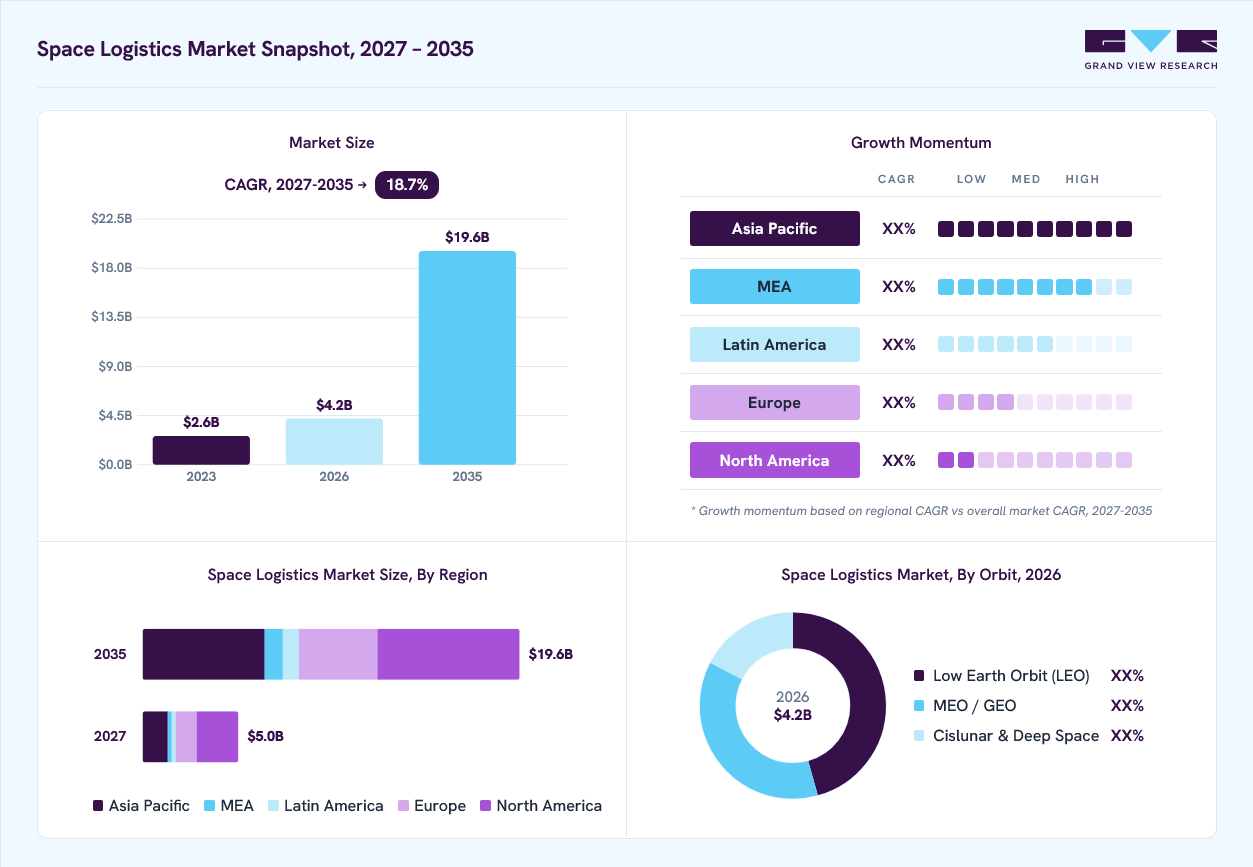
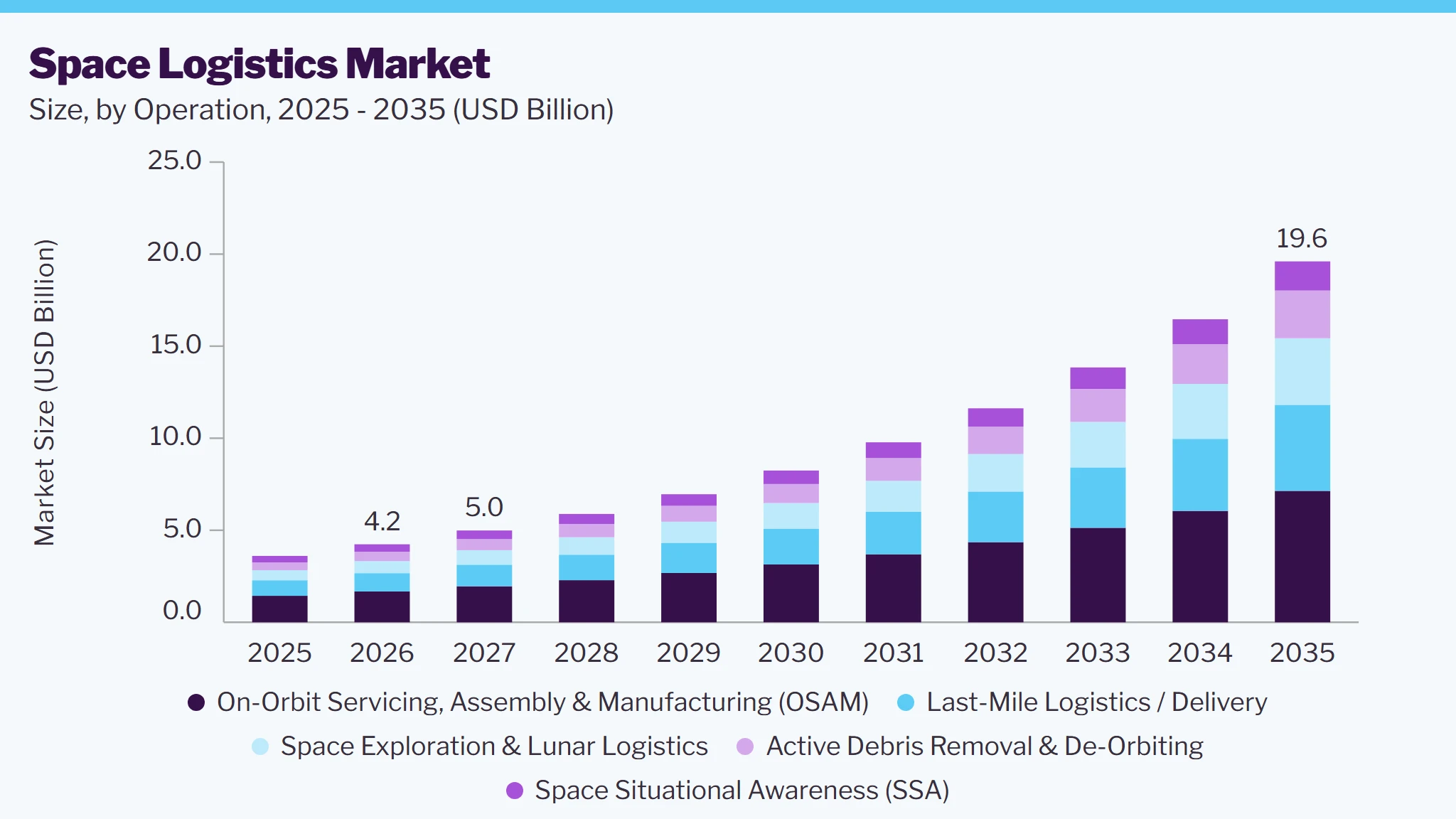
The global space logistics market size was valued at USD 4.2 billion in 2026 and is projected to grow from USD 5.0 billion in 2027 to USD 19.6 billion by 2035, at a CAGR of 18.7% from 2027 to 2035. North America dominated the market, accounting for a revenue share of 44.3% in 2026. The increasing demand for satellite transportation is driving the growth of the market.
 Source: Grand View Research, IR Documents, Primary Interviews, Paid DatabasesTo learn more about this report,
 Download Free Sample Report
Key Market Trends & Insights
- By operation: On-orbit Servicing, Assembly & Manufacturing (OSAM) segment led the market and accounted for 39.5% of the global revenue in 2026
- By orbit: Low Earth Orbit (LEO) segment led the market and accounted for 45.6% of the global revenue in 2026.
- By service type: Launch-Site Logistics segment accounted for the largest share of global revenue in 2026.
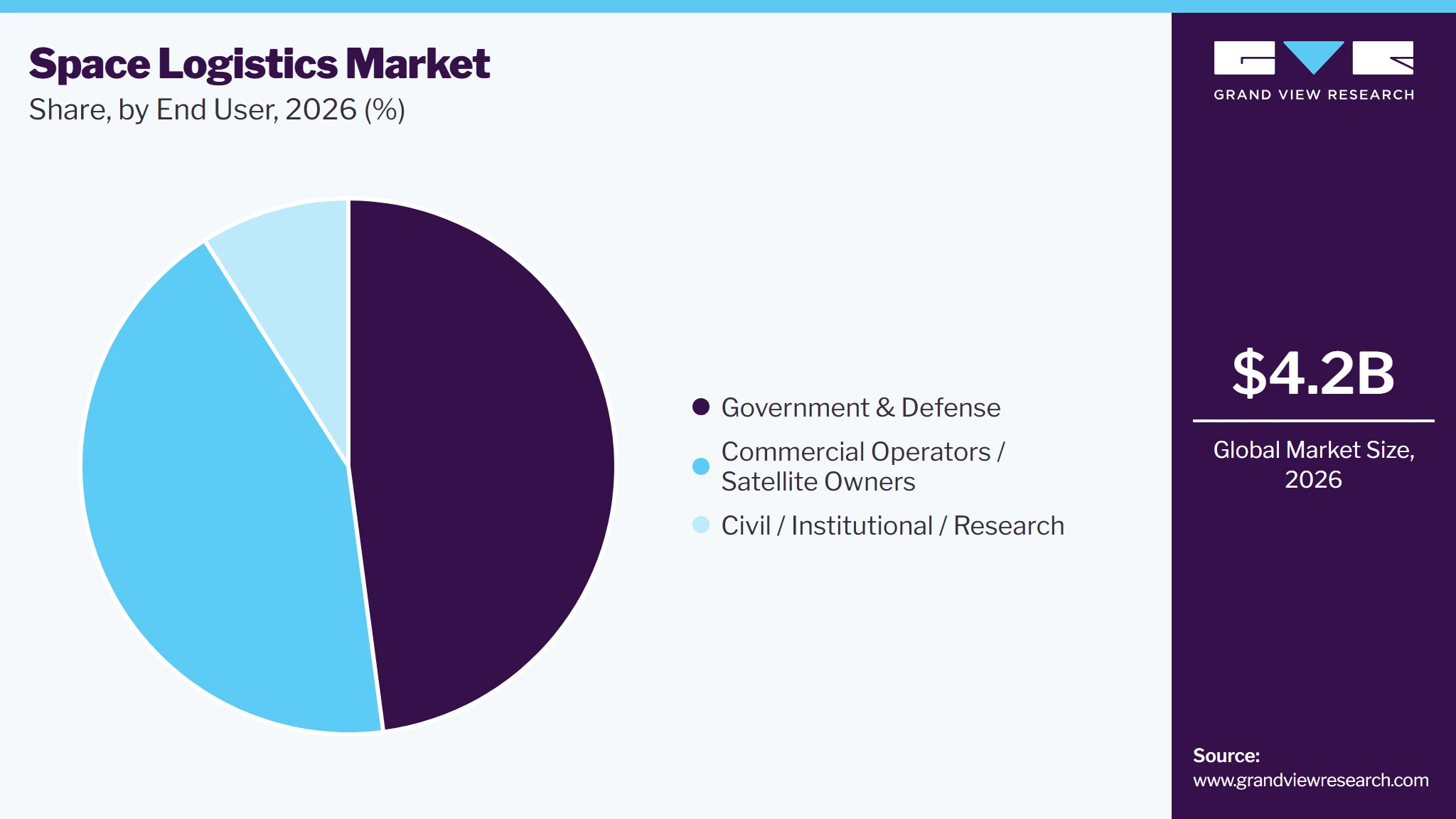
- By end user: Government & Defense segment accounted for the largest market revenue share in 2026.
Regional Highlights
- Largest regional market: North America (44.3% revenue share, 2026)
- Fastest growing region: Asia Pacific (highest CAGR, 2027-2035)
- By country: U.S. held the largest market share in 2026.
Market Size & Forecast
- Market Size in 2026: USD 4.2 Billion
- Estimated Market Size in 2027: 5.0 Billion
- Projected Market Size by 2035: USD 19.6 Billion
- CAGR (2027-2035): 18.7%
Prism AI by Grand View Research Free to tryAsk a question about the space logistics marketTry asking✓Every figure cited from GVR research Prefer the report? Download free sample →The rising deployment of commercial and government satellites is increasing the demand for space logistics services, including satellite transportation, cargo delivery, orbital transfer, and in-space servicing. According to the OECD's Space Economy at a Glance 2026, approximately 329 space launches were conducted in 2025, carrying around 4,900 objects into space, while more than 14,000 active operational satellites were in orbit by the end of the year. The expansion of low Earth orbit (LEO) satellite constellations for broadband connectivity, communication, and Earth observation is increasing the requirement for reliable transportation and deployment services. This growing orbital activity is creating business opportunities for commercial launch providers and specialized space logistics companies.
 To learn more about this report, Download Free Sample Report
The space logistics industry is witnessing a shift toward in-orbit servicing, satellite life extension, orbital refuelling, and reusable transportation systems. For instance, in September 2026, the European Space Agency (ESA) highlighted the commercial potential of in-orbit servicing through its RISE mission, developed by D-Orbit, which is designed to demonstrate satellite life-extension services through rendezvous and docking with a geostationary satellite. These developments are encouraging the adoption of services that extend spacecraft operational lifetimes and reduce dependence on launching replacement satellites. Furthermore, ESA's In-Space Proof-of-Concepts programme is supporting technologies for orbital transportation, refuelling, and spacecraft docking, creating opportunities for an integrated space logistics infrastructure.
Government authorities are introducing regulatory frameworks to establish standardized requirements for authorization, safety, and operations in commercial space activities. These regulations are shaping the compliance environment for space logistics providers and supporting the development of commercial in-space services. For instance, in August 2025, the U.S. government issued Executive Order 14335, Enabling Competition in the Commercial Space Industry, directing the Department of Commerce to develop a streamlined authorization process for emerging commercial space activities, including satellite servicing, in-space manufacturing, and commercial space stations. The initiative aims to simplify approval procedures and facilitate private-sector participation in commercial space operations.
High mission development costs, complex operating requirements, and limited technological maturity are restricting the commercial expansion of space logistics services. In-space transportation, satellite docking, robotic servicing, and orbital refuelling require specialized spacecraft, advanced navigation capabilities, and extensive mission testing, increasing investment requirements for service providers. In July 2025, the U.S. Government Accountability Office (GAO) reported that robotic in-space servicing technologies remained largely unproven, limiting investment from companies and government agencies. The lack of established infrastructure and uncertain customer demand continue to restrict the commercial adoption of space logistics services.
Market Dynamics
The market is evolving with the increasing deployment of satellites, expansion of commercial space activities, and rising investments in space exploration. Growing satellite constellations are creating demand for reliable transportation, orbital positioning, maintenance, refuelling, and end-of-life disposal services. Advancements in autonomous spacecraft, robotic servicing, reusable launch vehicles, and in-orbit transportation systems are expanding the range of commercial logistics capabilities. Furthermore, increasing concerns regarding orbital congestion and space debris are strengthening the need for space situational awareness (SSA), traffic management, and debris removal solutions. These developments are gradually shifting the industry from conventional launch-focused operations towards an integrated space logistics ecosystem.
The increasing deployment of satellites for communication, Earth observation, navigation, defence, and broadband connectivity is creating demand for specialized space logistics services. The expansion of large satellite constellations and commercial space programmes is increasing the requirement for reliable payload transportation, orbital positioning, satellite deployment, and maintenance services. According to the European Space Agency (ESA), more than 300 launches took place in 2025, placing over 4,000 new payloads into orbit. The increasing number of spacecraft operating across different orbital altitudes is also creating operational requirements beyond conventional launch transportation, particularly for orbital transfers, satellite servicing, and space traffic coordination.
Space logistics solutions support orbital transportation through dedicated transfer vehicles, payload deployment systems, and satellite servicing capabilities. These services enable satellite operators to position spacecraft in designated orbits and extend their operational lifetimes. For instance, in May 2026, SpaceX's Commercial Resupply Services mission delivered approximately USD 7,934.8 (6,000 pounds) of scientific investigations, supplies, and equipment to the International Space Station, demonstrating the role of commercial providers in supporting orbital cargo transportation.
The high cost of spacecraft development, specialized transportation vehicles, launch operations, and orbital servicing infrastructure remains a significant restraint for the market. Space logistics missions require advanced propulsion systems, autonomous navigation, precise spacecraft positioning, communication infrastructure, and specialized equipment capable of operating in extreme space conditions. In addition, rendezvous, docking, refuelling, and robotic servicing operations involve considerable technical complexity because spacecraft must operate safely while travelling at high orbital velocities. The development and qualification of these technologies require substantial investment, extensive testing, and specialized engineering capabilities, increasing the financial requirements for service providers and customers.
High operational costs affect the adoption of space logistics services, particularly among small satellite operators, emerging commercial companies, and organizations operating with limited mission budgets. The requirement for compatible docking interfaces and servicing-ready spacecraft also restricts the number of satellites eligible for certain in-orbit services. These challenges particularly affect advanced services such as satellite refuelling, active debris removal, and on-orbit assembly, where dedicated infrastructure and mission-specific technologies are required. Furthermore, developing economies and smaller commercial operators face additional financial limitations in accessing specialized orbital transportation and servicing solutions. Consequently, high initial investment requirements and limited service standardization slow the commercial adoption of advanced space logistics solutions.
The increasing focus on satellite life extension, orbital sustainability, and future lunar exploration is creating significant opportunities for specialized space logistics providers. Satellite operators are increasingly exploring alternatives to replacing spacecraft that have limited fuel or require operational upgrades. At the same time, rising orbital congestion is strengthening the requirement for debris inspection, removal, and end-of-life disposal services. According to ESA's 2026 Space Environment Report, approximately 47,270 space objects were regularly tracked and maintained in catalogues as of November 2026, while statistical models estimated approximately 68,450 objects larger than 10 cm in orbit. These developments are increasing the importance of satellite servicing, refuelling, debris removal, and orbital monitoring infrastructure.
The development of commercial servicing spacecraft and refuelling technologies is creating opportunities for integrated space logistics services. For instance, in July 2026, Northrop Grumman's Mission Robotic Vehicle launched, is designed to support satellite inspection, repair, upgrades, relocation, and servicing operations. These capabilities are expanding commercial opportunities in satellite maintenance and in-orbit transportation.
Market Concentration & Characteristics
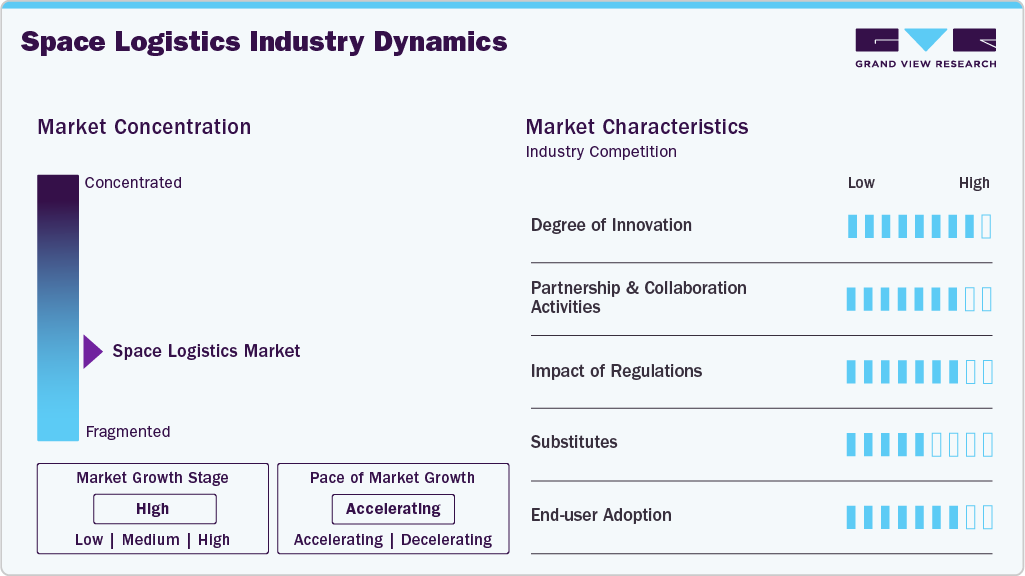
The market is moderately fragmented, characterized by the presence of established aerospace and defense companies and specialized commercial space service providers. Established participants benefit from advanced technological capabilities, launch infrastructure, substantial capital resources, and long-standing relationships with government agencies. Meanwhile, specialized companies focus on services such as orbital transportation, satellite life extension, in-orbit servicing, refueling, and space debris removal. High initial investment requirements, regulatory compliance, and technological complexity create significant entry barriers for new participants. Nevertheless, increasing private-sector participation and strategic collaborations are expanding the competitive landscape. The presence of companies with different service capabilities and areas of specialization indicates a moderately fragmented market structure.
 To learn more about this report, Download Free Sample Report
The market exhibits a high degree of innovation, driven by continuous advancements in satellite transportation, orbital transfer vehicles, in-orbit servicing, space debris removal, and reusable launch technologies. Partnerships & Collaborations Activities are supported by collaborations among aerospace manufacturers, satellite operators, government space agencies, and commercial service providers to strengthen space transportation and servicing capabilities. Impact of Regulations is owing to stringent regulatory requirements related to launch authorization, satellite operations, orbital debris mitigation, space traffic management, and international space agreements. Substitutes are as alternative launch systems and satellite deployment methods provide limited alternatives, while specialized services such as in-orbit refueling and satellite servicing have fewer direct substitutes. End-user Adoption is supported by demand from commercial satellite operators, defense organizations, government agencies, and private aerospace companies.
Analyst Perspective
The market is transitioning from conventional launch transportation towards an integrated ecosystem encompassing orbital mobility, satellite servicing, refuelling, debris removal, and lunar cargo delivery. Increasing satellite deployment, orbital congestion, and government investments in commercial space infrastructure are strengthening demand for specialized logistics services. Advancements in autonomous spacecraft, robotic servicing, reusable orbital transfer vehicles, and standardized refuelling interfaces are reshaping service delivery capabilities. The market is expected to attract investments in in-orbit infrastructure, satellite life-extension technologies, and commercial lunar transportation systems. Strategic collaborations between government agencies, defence organizations, satellite manufacturers, and private logistics providers are also strengthening commercialization opportunities and competitive positioning.
Operation Insights
Based on operation, the On-Orbit Servicing, Assembly & Manufacturing (OSAM) segment accounted for 39.5% of the largest share of global revenue in 2026, driven by increasing demand for satellite maintenance, component replacement, orbital refuelling, and spacecraft life extension. Growing investments in robotic servicing systems and in-space assembly technologies are supporting the development of commercial maintenance capabilities. These services help satellite operators improve asset utilization and reduce dependence on replacement launches. For instance, in July 2026, Northrop Grumman's Mission Robotic Vehicle was launched with three Mission Extension Pods to support satellite inspection, repair, upgrades, and life-extension operations.
The Active Debris Removal & De-Orbiting segment is projected to grow at the fastest CAGR over the forecast period. The segment is increasing accumulation of inactive satellites and discarded rocket components in Earth's orbit. Rising collision risks are encouraging government agencies and commercial operators to invest in debris inspection, capture, and controlled disposal technologies. Advancements in robotic capture systems and autonomous spacecraft operations are supporting orbital sustainability initiatives. For instance, in March 2026, Astroscale Japan completed its ADRAS-J mission operations after demonstrating close-range inspection of a large piece of orbital debris.
Orbit Insights
Based on orbit, the Low Earth Orbit (LEO) segment accounted for 45.6% of the largest share of global revenue in 2026. This segment dominance in the market due to deployment of communication, Earth observation, and remote sensing satellite constellations. The rising number of satellite launches is creating demand for payload deployment, orbital transportation, satellite relocation, and maintenance services. Frequent constellation replenishment is further supporting commercial requirements for specialized orbital logistics infrastructure. For instance, in February 2026, the U.S. Federal Communications Commission (FCC) approved Amazon's application to deploy an additional 4,500 LEO satellites, bringing its total authorized Kuiper constellation to approximately 7,700 satellites. This expansion is supporting demand for satellite deployment and associated orbital transportation services.
The Cislunar & Deep Space segment is projected to grow at the fastest CAGR over the forecast period, driven by increasing investments in lunar exploration, scientific missions, and deep-space infrastructure development. Government agencies are collaborating with commercial providers to transport scientific instruments, exploration equipment, and other payloads beyond Earth's orbit. Growing lunar exploration programmes are creating opportunities for specialized cargo delivery and spacecraft transportation services. For instance, in March 2026, NASA awarded Intuitive Machines a USD 180.4 million contract to deliver seven scientific and technological payloads to the lunar surface under its Commercial Lunar Payload Services initiative.
Service Type Insights
Based on service type, the Launch-Site Logistics segment accounted for the largest share of global revenue in 2026. The segment is witnessing by increasing satellite launch frequency and the requirement for efficient payload preparation, storage, handling, and integration. Commercial launch providers are increasingly relying on specialized ground infrastructure to manage spacecraft processing activities before launch. The expansion of small satellite and rideshare missions is further increasing demand for coordinated payload handling services. For instance, in August 2026, NASA selected four companies, including Blue Origin and Firefly Aerospace, under a spacecraft processing contract with an aggregate ceiling value of USD 100 million.
The In-Orbit Transportation / Orbital Transfer segment is expected to grow at a fastest CAGR over the forecast period. The segment growth can be attributed to the increasing demand for dedicated orbital transfer vehicles and satellite relocation services. These vehicles support the movement of spacecraft from initial deployment orbits to designated operational positions. Advancements in reusable propulsion systems and orbital mobility technologies are expanding commercial transportation capabilities. For instance, in August 2025, NASA selected Impulse Space to conduct orbital transfer vehicle service studies involving its Mira and Helios vehicles for transportation to specialized orbital destinations.
End User Insights
Based on end user, the Government & Defense segment accounted for the largest market revenue share in 2026. The Government & Defense segment is supported by increasing requirements for secure satellite communication, surveillance, intelligence gathering, and national security infrastructure. Government agencies are investing in satellite servicing, orbital transportation, and debris management to improve the resilience of space-based assets. Partnerships with private aerospace companies are further supporting the development of advanced servicing and logistics capabilities. For instance, in July 2026, DARPA partnered with SpaceLogistics on the Mission Robotic Vehicle programme to demonstrate robotic satellite servicing capabilities in geostationary orbit.
 To learn more about this report, Download Free Sample Report
The Commercial Operators / Satellite Owners segment is projected to grow at the fastest CAGR over the forecast period. The segment is driven by increasing investments in communication, broadcasting, navigation, and Earth observation satellite constellations. Satellite owners require transportation, orbital positioning, maintenance, and life-extension services to improve spacecraft utilization and operational continuity. The growing availability of commercial servicing vehicles is encouraging operators to outsource specialized in-orbit logistics activities. For instance, in September 2026, Eutelsat announced plans to procure 229 additional OneWeb LEO satellites from Airbus Defence and Space to strengthen its satellite connectivity infrastructure.
Regional Insights
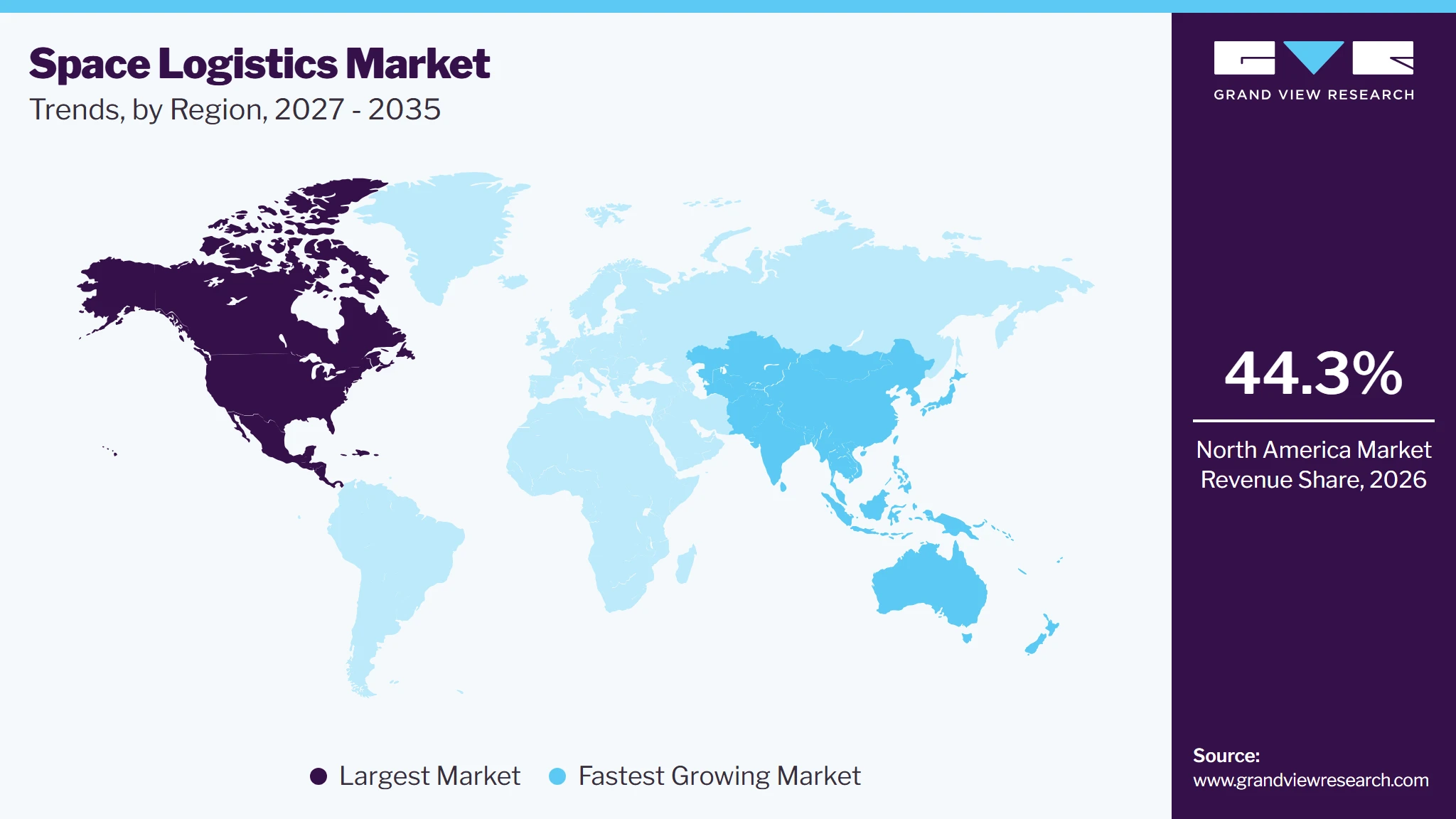
North America space logistics market led the global market and accounted for 44.3% of the global revenue in 2026, supported by established aerospace manufacturers, commercial launch providers, and government-funded space programmes. According to the OECD's Space Economy at a Glance 2026, the U.S. accounted for 55% of global orbital launches in 2025, reflecting the region's strong launch infrastructure and commercial space transportation capabilities. The expansion of satellite constellations, orbital servicing programmes, and defense-related space investments is supporting demand for payload transportation, satellite maintenance, and in-orbit logistics services.
 To learn more about this report, Download Free Sample Report
U.S. Space Logistics Market Trends
The U.S. market is held the largest market share. The U.S. space logistics industry benefits from its strong launch infrastructure, high commercial participation, and substantial government investment. In September 2026, the country accounted for 55% of global orbital launches and 87% of objects launched into orbit. By early 2026, SpaceX had completed more than 600 Falcon 9 booster recoveries, while the U.S. space budget reached an estimated USD 53.3 billion in 2025, excluding classified activities.
Asia Pacific Space Logistics Market Trends
The Asia Pacific market is projected to grow at the fastest CAGR over the forecast period. Asia Pacific is witnessing increasing space logistics activity due to expanding national space programmes, commercial satellite deployment, and investments in reusable launch vehicles. China and Japan are strengthening regional capabilities through satellite transportation, cargo delivery, and spacecraft development programmes. According to the OECD's 2026 report, China conducted 92 orbital launch missions in 2025, while Japan continued advancing cargo transportation and space infrastructure capabilities through its next-generation resupply spacecraft. These developments are supporting demand for launch-site services, orbital transportation, and specialized payload delivery solutions.
China held a dominant share in the Asia Pacific space logistics market. China's space logistics industry is supported by government-backed space exploration programmes, expanding commercial launch providers, and large-scale satellite constellation deployment. According to the China National Space Administration (CNSA), the country completed 50 commercial space launches in 2025, placing 311 commercial satellites into orbit, representing 84% of all Chinese satellites launched during the year. For instance, China's Hainan commercial spacecraft launch site conducted nine launches in 2025, demonstrating the expansion of dedicated launch infrastructure and commercial payload transportation capabilities.
Japan space logistics market is expected to grow at a significant CAGR over the forecast period. Japan's space logistics industry is driven by investments in cargo transportation, satellite servicing technologies, and advanced space exploration programmes. The Japan Aerospace Exploration Agency (JAXA) is strengthening orbital transportation capabilities through its next-generation HTV-X cargo spacecraft, which offers an improved cargo capacity of 5.85 tonnes, approximately 45% higher than its predecessor. For instance, in October 2025, JAXA's HTV-X1 successfully docked with the International Space Station, delivering supplies and equipment while also providing a platform for in-orbit technology demonstrations.
Europe Space Logistics Market Trends
The Europe market held a significant share of the market in 2026. Europe's space logistics industry is supported by government-backed space programmes, commercial launch infrastructure, and cross-border collaboration through the European Space Agency (ESA). According to ESA's 2026 Space Economy Report, European public space budgets increased by 12% to USD 15.4 billion (EUR 13.5 billion) in 2025, primarily supported by higher national defense spending. The restoration of independent launch capabilities through Ariane 6 and Vega-C is strengthening regional access to space and supporting requirements for satellite transportation, payload deployment, and associated logistics services.
The U.K. space logistics market is benefits from established satellite manufacturing capabilities, commercial space operators, and investments in orbital sustainability. According to the UK government's August 2025 space sector factsheet, the country had 1,907 space organisations and 55,550 employees, while the UK Space Agency allocated up to USD 818.7 million (Euro 75.6 million) for its first mission to remove defunct satellites from orbit. This initiative is supporting the development of commercial debris-removal capabilities and creating opportunities for companies involved in satellite servicing, orbital transportation, and space infrastructure management.
The Germany held a largest share in the Europe space logistics market, supported by its aerospace manufacturing base, satellite systems expertise, and contributions to ESA programmes. According to the OECD's 2026 report, Germany had 65 active satellites as of June 2026, while its civilian government space budget reached approximately USD 2.78 billion in 2025. Furthermore, the country announced a USD 40.3 billion (EUR 35 billion) military space investment package through 2030, covering satellite constellations, secure communications, and space infrastructure resilience, creating opportunities for specialized transportation and servicing providers.
Key Space Logistics Company Insights
Key players operating in the space logistics market include Northrop Grumman., SpaceX, Rocket Lab USA, ASTROSCALE, D-ORBIT, IMPULSE SPACE Inc., ClearSpace, Exotrail, Orbit Fab, Inc. and Sierra Space Corporation. Key players in the space logistics market are expanding their space logistics portfolios through investments in launch services, orbital transportation, satellite servicing, in-orbit refueling, debris removal, and reusable space transportation technologies. Their strategic focus on partnerships, technological development, and dedicated mission capabilities is strengthening commercial space operations and supporting the increasing demand for satellite deployment, maintenance, and end-of-life management.
-
Northrop Grumman.is an aerospace and defense technology company that provides satellite servicing, life-extension, and in-orbit support solutions through its SpaceLogistics business. Its services support the extension of satellite operational life through propulsion and positioning assistance. The company also offers in-orbit capabilities for satellite inspection, repair, relocation, upgrades, and maintenance.
-
SpaceX is a space technology company that provides launch, orbital transportation, and cargo delivery services for commercial and government customers. Its services include transporting satellites and other payloads into orbit, delivering cargo and crew to the International Space Station, and returning cargo to Earth. The company is also developing reusable space transportation systems to carry crew and cargo to Earth orbit, the Moon, and Mars. These capabilities support satellite deployment, orbital cargo transportation, and future space logistics activities.
Key Space Logistics Companies
The following key companies have been profiled for this study on the space logistics market.
-
Northrop Grumman.
-
SpaceX
-
Rocket Lab USA
-
ASTROSCALE
-
D-ORBIT
-
IMPULSE SPACE Inc.
-
ClearSpace
-
Exotrail
-
Orbit Fab, Inc.
-
Sierra Space Corporation
Competitive Benchmarking
Operating Strategies
Competitive Edge
Weaknesses
Mature Players: Northrop Grumman, SpaceX, Rocket Lab USA, D-Orbit
- Mature players in the space logistics market are focus on expanding integrated space transportation, payload deployment, satellite servicing, and orbital mobility capabilities. These companies pursue government contracts, commercial partnerships, and investments in reusable launch systems and specialized spacecraft.
- Mature players gain a competitive advantage through launch and spacecraft infrastructure, operational mission experience, diversified customer relationships, and the ability to support multiple stages of space logistics operations.
- These companies often face challenges related to high development costs and capital requirements create financial pressure, while infrastructure dependence and limited service portfolios restrict operational expansion and competitiveness.
Emerging Players: Astroscale, Impulse Space, Orbit Fab
- Emerging players in the space logistics market are focusing on specialized space logistics technologies, including active debris removal, orbital transportation, satellite refuelling, and in-orbit servicing. These companies emphasize technology demonstrations, strategic partnerships, government contracts, and the commercialization of specialized services.
- Emerging players gain market traction through specialized technology capabilities, focused service offerings, growing government engagement, and opportunities to establish early positions in emerging logistics categories.
- Emerging players face limitations due to limited mission heritage and the need to scale operational capabilities affect commercial adoption, while dependence on spacecraft compatibility and the development of a commercially viable refuelling network restrict the expansion of specialized logistics services.
Recent Developments
-
In January 2026, Exotrail and Astroscale, aerospace and satellite services company, announced a strategic partnership to develop controlled satellite deorbiting capabilities in Low Earth Orbit (LEO). The collaboration combines their expertise to demonstrate satellite deorbiting before 2030, supporting orbital debris reduction and sustainable space operations.
-
In September 2026, Rocket Lab USA signed a multi-year agreement with Japan-based Synspective for 20 dedicated satellite launches between 2028 and 2031. The contract will support the deployment of Earth observation satellites into sun-synchronous orbit and increase the total number of contracted missions for Synspective to 47. This agreement represents Rocket Lab’s largest commercial launch contract to date and strengthens its role in supporting satellite constellation deployment.
Space Logistics Market Report Scope
Report Attribute
Details
Market size in 2026
USD 4.2 billion
Estimated Market Size in 2027
USD 5.0 billion
Revenue forecast in 2035
USD 19.6 billion
Growth Rate
CAGR of 18.7% from 2027 to 2035
Base year for estimation
2026
Historical data
2023 - 2025
Forecast period
2027 - 2035
Quantitative units
Revenue in USD billion and CAGR from 2027 to 2035
Report coverage
Revenue forecast, company ranking, competitive landscape, growth factors, and trends
Segments covered
Operation, orbit, service type, end user, region
Regional scope
North America; Europe; Asia Pacific; Latin America; MEA
Country scope
U.S.; Canada; Mexico; Germany; U.K.; France; China; Japan; India; South Korea; Australia; Brazil; KSA; UAE; South Africa
Key companies profiled
Northrop Grumman.; SpaceX; Rocket Lab USA; ASTROSCALE; D-ORBIT; IMPULSE SPACE Inc.; ClearSpace; Exotrail; Orbit Fab, Inc.; Sierra Space Corporation
Customization scope
Free report customization (equivalent up to 8 analysts working days) with purchase. Addition or alteration to country, regional & segment scope.
Pricing and purchase options
Avail customized purchase options to meet your exact research needs. Explore purchase options
Global Space Logistics Market Report Segmentation
The report forecasts revenue growth at global, regional, and country levels and provides an analysis of the latest industry trends in each of the sub-segments from 2023 to 2035. For the purpose of this study, Grand View Research has segmented the global space logistics market report based on operation, orbit, service type, end user, and region:
-
Operation Outlook (Revenue, USD Billion, 2023 - 2035)
-
On-Orbit Servicing, Assembly & Manufacturing (OSAM)
-
Last-Mile Logistics / Delivery
-
Active Debris Removal & De-Orbiting
-
Space Situational Awareness (SSA)
-
Space Exploration & Lunar Logistics
-
-
Orbit Outlook (Revenue, USD Billion, 2023 - 2035)
-
Low Earth Orbit (LEO)
-
MEO / GEO
-
Cislunar & Deep Space
-
-
Service Type Outlook (Revenue, USD Billion, 2023 - 2035)
-
Launch-Site Logistics
-
Pre-Launch / Payload Integration Logistics
-
In-Orbit Transportation / Orbital Transfer
-
Cargo And Last-Mile Delivery
-
OSAM, Refuelling & Life Extension
-
Active Debris Removal / De-Orbiting
-
SSA, Space Traffic & Infrastructure Logistics
-
-
End User Outlook (Revenue, USD Billion, 2023 - 2035)
-
Government & Defense
-
Commercial Operators / Satellite Owners
-
Civil / Institutional / Research
-
-
Regional Outlook (Revenue, USD Billion, 2023 - 2035)
-
North America
-
U.S.
-
Canada
-
Mexico
-
-
Europe
-
Germany
-
U.K.
-
France
-
-
Asia Pacific
-
China
-
India
-
Japan
-
South Korea
-
Australia
-
-
Latin America
-
Brazil
-
-
Middle East & Africa (MEA)
-
UAE
-
Kingdom of Saudi Arabia (KSA)
-
South Africa
-
-
Research Methodology
The space logistics market figures in this report are based on a proven research process that combines executive interviews with secondary research from proprietary databases, company filings, and recognized regulatory and institutional sources. Market size is built through value-chain sizing-reconciling supply-side and demand-side estimates-and triangulated with bottom-up and top-down approaches. Every estimate passes multiple levels of expert validation before publication, with each space logistics segment quantified using the revenue-capture definitions in the table below.
Segment Definition
Segment - Operation
Revenue capture definition
On-Orbit Servicing, Assembly
& Manufacturing (OSAM)
The segment revenue is generated from satellite inspection, repair, component replacement, robotic manipulation, spacecraft upgrades, orbital assembly, and manufacturing services. It also includes revenue from servicing spacecraft, robotic arms, specialized tools, and mission execution contracts for maintaining and modifying space infrastructure.
Last-Mile Logistics
/ Delivery
The segment revenue is generated from the final transportation and delivery of satellites, cargo, equipment, and payloads from designated orbital transfer points to their target orbital positions or destination spacecraft. It includes revenue from precision payload deployment, dedicated delivery missions, orbital positioning, and final-stage transportation services.
Active Debris Removal
& De-Orbiting
The segment revenue is generated from spacecraft missions designed to capture, relocate, remove, or safely de-orbit non-functional satellites, rocket bodies, and other orbital debris. It also includes revenue from debris capture equipment, removal spacecraft, disposal manoeuvres, and end-of-life de-orbiting contracts.
Space Situational Awareness (SSA)
The segment revenue is generated from orbital tracking, space object identification, collision-risk assessment, space weather monitoring, and space traffic monitoring services. It also includes subscription fees, data access charges, analytics, tracking support, and customized orbital monitoring contracts.
Space Exploration
& Lunar Logistics
The segment revenue is generated from transporting scientific instruments, exploration equipment, supplies, infrastructure components, and other payloads to the Moon and deep-space destinations. It also includes lunar cargo delivery, payload integration, surface transportation support, mission planning, and logistics coordination contracts.
Segment - Orbit
Revenue capture definition
Low Earth Orbit (LEO)
The segment revenue is generated from transporting, deploying, repositioning, servicing, refuelling, and de-orbiting satellites operating in Low Earth Orbit. It includes revenue from orbital transfer vehicles, satellite deployment, cargo transportation, space station resupply, debris removal, and SSA services supporting LEO operations.
MEO / GEO
The segment revenue is generated from transportation, positioning, servicing, refuelling, inspection, and life-extension activities involving spacecraft operating in Medium Earth Orbit and Geostationary Earth Orbit. It includes revenue from satellite relocation, orbital maintenance, robotic servicing, communication satellite life extension, and specialized transportation missions.
Cislunar & Deep Space
The segment revenue is generated from transporting payloads, scientific equipment, spacecraft, cargo, and exploration infrastructure between Earth orbit, lunar orbit, the Moon, and other deep-space destinations. It includes revenue from lunar cargo delivery, deep-space transportation, orbital transfer systems, surface logistics, and mission-specific infrastructure support.
Segment - Service Type
Revenue capture definition
Launch-Site Logistics
The segment revenue is generated from ground-based transportation, handling, storage, and movement of spacecraft, launch vehicles, payloads, and associated equipment within launch facilities. It includes payload transportation, specialized handling, warehousing, launch-site coordination, and pre-launch material management services.
Pre-Launch / Payload
Integration Logistics
The segment revenue is generated from payload preparation, integration, inspection, testing, packaging, and transportation-related services before launch. It includes spacecraft-to-launch-vehicle integration, payload accommodation, handling equipment, mission documentation, and coordination services associated with launch readiness.
In-Orbit Transportation /
Orbital Transfer
The segment revenue is generated from transporting satellites, spacecraft, and payloads between different orbital positions using orbital transfer vehicles, space tugs, and propulsion-based transportation systems. It includes dedicated orbital transfer missions, payload relocation, deployment, and spacecraft positioning services.
Cargo And Last-Mile Delivery
The segment revenue is generated from transporting and delivering cargo, scientific equipment, supplies, and spacecraft components to space stations, orbiting platforms, lunar destinations, and designated orbital locations. It includes cargo transportation contracts, payload deployment, final-stage delivery, and specialized resupply services.
OSAM, Refuelling &
Life Extension
The segment revenue is generated from satellite maintenance, robotic servicing, in-orbit refuelling, component replacement, spacecraft upgrades, and life-extension operations. It also includes revenue from refuelling interfaces, fuel storage infrastructure, servicing vehicles, robotic equipment, and recurring satellite maintenance contracts.
Active Debris Removal
/ De-Orbiting
The segment revenue is generated from debris identification support, capture missions, removal spacecraft operations, satellite disposal, and controlled de-orbiting services. It includes contracts for removing defunct satellites, relocating hazardous orbital objects, and safely disposing of spacecraft at the end of their operational lives.
SSA, Space Traffic
& Infrastructure Logistics
The segment revenue is generated from satellite tracking, orbital monitoring, collision avoidance support, space traffic coordination, and space infrastructure monitoring. It includes subscription-based tracking data, orbital analytics, monitoring software, risk assessment services, and customized operational support for satellite operators and government agencies.
Segment - End User
Revenue capture definition
Government & Defense
The segment revenue is generated from government and defence contracts for satellite transportation, military spacecraft deployment, orbital servicing, space surveillance, debris removal, and mission support. It also includes revenue from secure cargo delivery, satellite maintenance, orbital monitoring, and specialized logistics services for national space and defence programmes.
Commercial Operators /
Satellite Owners
The segment revenue is generated from commercial satellite transportation, payload deployment, orbital repositioning, refuelling, maintenance, and satellite life-extension services. It includes payments from telecommunications companies, satellite operators, commercial space infrastructure providers, and private spacecraft owners for logistics and operational support.
Civil / Institutional /
Research
The segment revenue is generated from space logistics services procured by civil, institutional, and research customers, including revenue from space agency missions, scientific programs, exploration logistics, and research-driven services.
Estimation Model
Layer Name
Key Question
Description
Addressable Space Infrastructure & Activity
What space infrastructure and activities create logistics demand?
This layer identifies the installed and planned space infrastructure requiring logistics support. It covers operational satellites, space stations, commercial constellations, government spacecraft, lunar exploration programmes, and deep-space missions. Satellite deployment volumes, orbital distribution, launch frequency, and spacecraft replacement requirements are assessed to determine the addressable demand for logistics services.
Serviceable Logistics Requirements
Which logistics activities require specialized services?
This layer evaluates the specific operational requirements of satellite operators, government agencies, and commercial space organizations. It includes payload transportation, orbital transfers, last-mile delivery, satellite servicing, refuelling, debris removal, and space situational awareness. Each activity is assessed based on mission requirements, operational frequency, spacecraft compatibility, and the availability of specialized service providers.
Service Provider & Revenue Mapping
Which companies provide these services and how do they generate revenue?
This layer identifies the companies participating in different space logistics activities and evaluates their service portfolios. Revenue-generating activities include launch-site handling, payload integration, orbital transportation, satellite maintenance, robotic servicing, and debris removal contracts. Revenue is mapped across service providers based on their commercial offerings, government contracts, mission execution capabilities, and customer relationships.
Revenue Estimation & Market Validation
What is the total revenue generated across the market?
This layer consolidates revenue generated across the identified logistics services, orbit categories, and end-user groups. Company-level revenues, publicly disclosed contracts, service agreements, mission-based payments, and estimated service revenues are evaluated to determine the overall market opportunity. The estimates are cross-checked against company disclosures, government procurement information, launch activity, and the operational status of commercial logistics programmes to minimize double counting.
Delivered Customizations
This report has been delivered with the following In-depth customizations
Client Request
Customization Delivered
Value Adds
Regional Space Logistics Market Opportunity Assessment
Country/region-wise market sizing and forecasts
Analysis of demand, adoption trends, and regulatory landscape
Identification of high-growth regions and investment hotspots
Identified region-specific growth opportunities
Supported expansion and go-to-market strategy
Enabled informed regional investment decisions
Cross-Segmentation Analysis for the Space Logistics Market
Criss-cross market analysis by operation, orbit, service type, end user
Demand and adoption assessment across key segments
Segment attractiveness and growth potential benchmarking
Identified high-potential market segments
Supported targeted service positioning and marketing strategy
Improved customer and segment prioritization
Competitive Benchmarking and Strategic Positioning in the Space Logistics Market
Benchmarking of key competitors across service types, pricing, partnerships, and innovation
Comparative assessment of market share, capabilities, and strategies
Analysis of competitive strengths, gaps, and differentiation areas
Identified competitive white spaces and growth gaps
Supported strategic positioning and differentiation
Enabled data-driven competitive strategy development
Frequently Asked Questions About This Report
The increasing demand for satellite transportation is driving the growth of the space logistics market.
Some key players operating in the space logistics market include Northrop Grumman., SpaceX, Rocket Lab USA, ASTROSCALE, D-ORBIT, IMPULSE SPACE Inc., ClearSpace, Exotrail, Orbit Fab, Inc., and Sierra Space Corporation
The global space logistics market is expected to grow at a compound annual growth rate of 18.7% from 2027 to 2035 to reach USD 19.6 billion by 2035.
On-Orbit Servicing, Assembly & Manufacturing (OSAM) segment led the market and accounted for 39.5% of the global revenue in 2026, driven by increasing demand for satellite maintenance, component replacement, orbital refuelling, and spacecraft life extension.
North America market led the global market and accounted for 44.3% of the global revenue in 2026, supported by established aerospace manufacturers, commercial launch providers, and government-funded space programmes.
Low Earth Orbit (LEO) segment accounted for 45.6% of the largest share of global revenue in 2026, while cislunar & deep space segment is projected to grow at the fastest CAGR over the forecast period.
Launch-site logistics segment accounted for the largest share of global revenue in 2026, while in-orbit transportation / orbital transfer segment is expected to grow at a fastest CAGR over the forecast period.
Government & Defense segment accounted for the largest market revenue share in 2026, while commercial operators / satellite owners segment is projected to grow at the fastest CAGR over the forecast period.
The global space logistics market size was estimated at USD 4.2 billion in 2026 and is expected to reach USD 5.0 billion in 2026.
About the Author(s)
Automotive & Transportation Research Team
Technology · Automotive & TransportationThis report was authored by the automotive & transportation research team at Grand View Research - comprising two research analysts, one senior research analyst, and one industry expert - with specialized expertise in the automotive & transportation segment of the technology industry. All findings are based on proprietary technology databases, executive interviews, and regulatory analysis, subject to internal peer review prior to publication.
Last Updated:
Speak to Analyst

Customize this report to your needs - add regions, segments, or data points, with 20% free customization.
Or view our licence options:


ISO 9001:2015 & 27001:2022 Certified
We are GDPR and CCPA compliant! Your transaction & personal information is safe and secure. For more details, please read our privacy policy.


