
- Home
- »
- Distribution & Utilities
- »
-
Surge Arrester Market Size, Share & Trends Report, 2033GVR Report cover

Surge Arrester Market (2026 - 2033)
Size, Share & Trend Analysis Report By Voltage Rating (Low & Medium, High), By Application (Industrial, Utility, Commercial, Residential), By Region (North America, Europe, APAC), And Segment Forecasts
Market Size, 2025
$1.9BMarket Estimate, 2026
$2.1BMarket Forecast, 2033
$3.1BCAGR, 2026–2033
6.1%Surge Arrester Market Summary
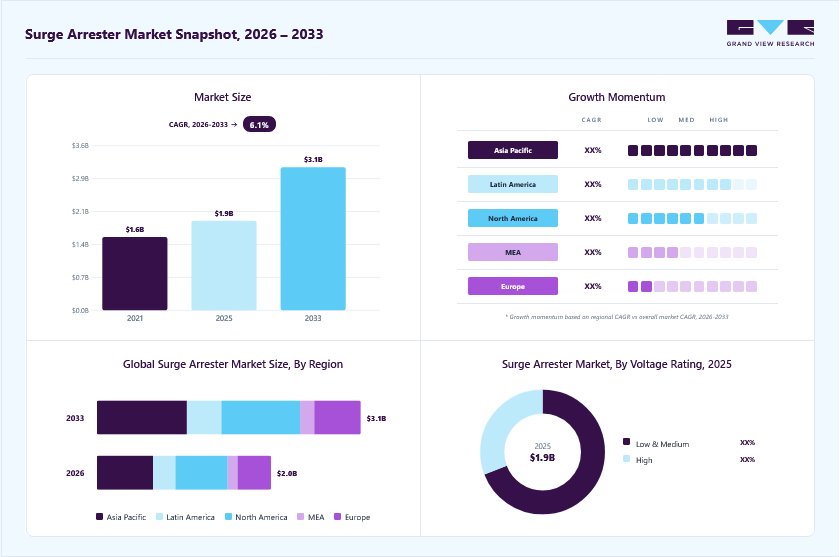
The global surge arrester market size was valued at USD 1.9 billion in 2025 and is projected to grow from USD 2.1 billion in 2026 to USD 3.1 billion by 2033, growing at a CAGR of 6.1% from 2026 to 2033. Asia Pacific dominated the market, accounting for the largest global share of 32.0% in 2025. Growing global demand for electricity, coupled with increasing grid complexity, is driving the adoption of surge arresters.
 Source: Grand View Research, IR Documents, Primary Interviews, Paid DatabasesTo learn more about this report,
 Download Free Sample Report
Key Market Trends & Insights
- By voltage rating: Low & medium segment held the largest share of 69.1% in 2025.
- By application: Industrial segment held the largest revenue share of 41.4% in 2025.
Regional Highlights
- Largest regional market: Asia Pacific (32.0% revenue share, 2025)
- By country: China held the largest share of Asia Pacific in 2025.
Market Size & Forecast
- Market size in 2025: USD 1.9 Billion
- Estimated market size in 2026: USD 2.1 Billion
- Projected market size by 2033: USD 3.1 Billion
- CAGR (2026-2033): 6.1%
Three ways to get this report
Buy it, customize it, or ask a question.Ask an Analyst
Analyst response in 1 business day
- AccessReport author, directly
- Reply timeWithin 1 working day
- No sales callDirect answer only
- FormatEmail reply
- CostFree, no cost
Get the Full Report
What the study covers
- FormatsPDF · Excel · Dashboard
- Timeline2026–2033 annual, 2025 base
- Coverage20+ countries, 5 regions
- Companies10+ key players profiled
Customize the Report
20% free customization
- IncludeCountries, segments, points
- TailorTo your product definition
- ExtendDeeper competitor detail
- OrA fully bespoke study
- Turnaround5–10 working days
Utilities and industrial facilities are investing in power quality enhancement solutions, further fueling market growth. In addition, governments and regulatory bodies are mandating grid modernization projects, integrating renewable energy sources, and promoting energy efficiency measures, all of which boost the demand for surge arresters.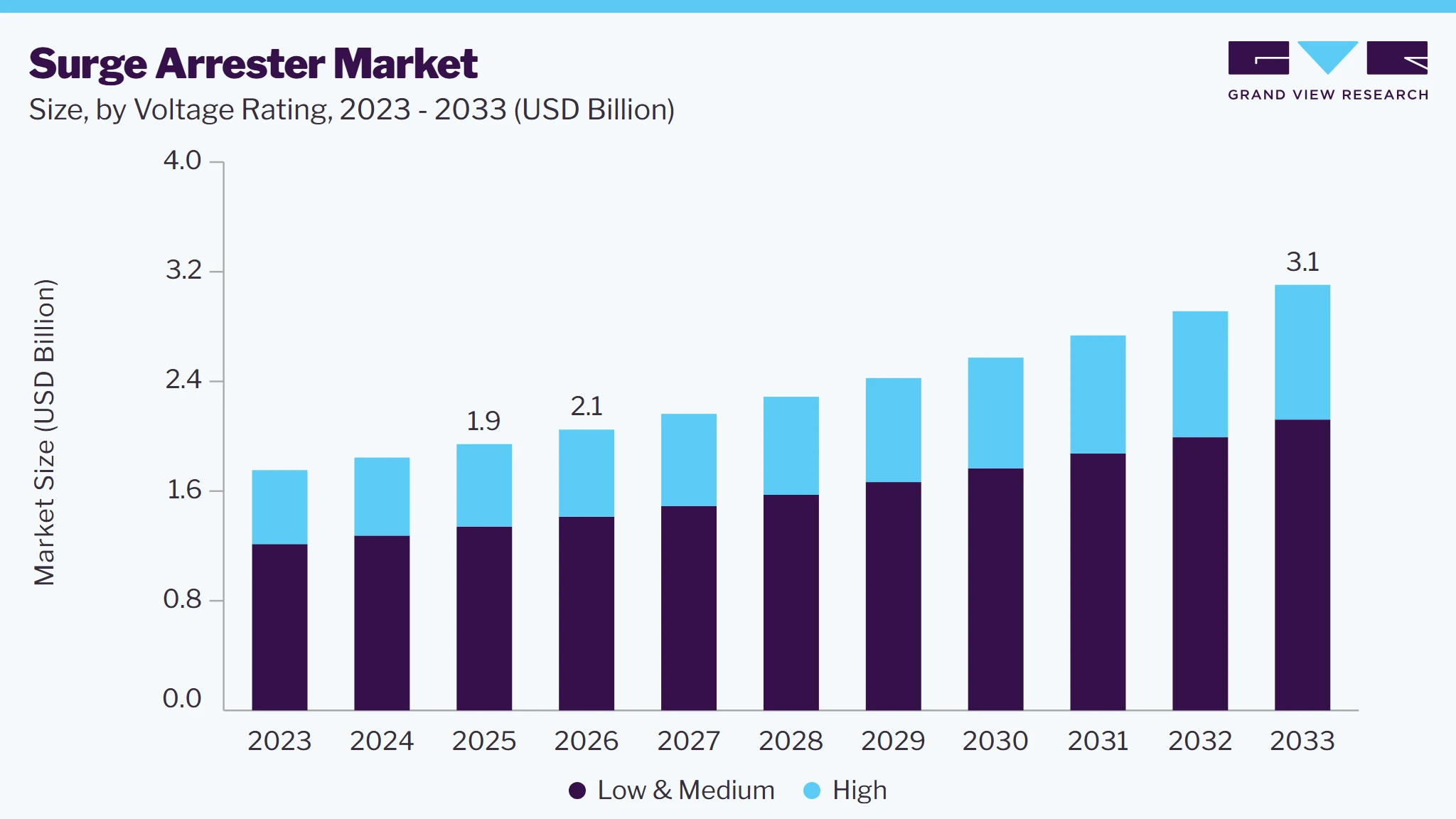 To learn more about this report, Download Free Sample Report
Market Dynamics
The surge arrester market is driven by the increasing need to protect electrical infrastructure from transient overvoltage caused by lightning strikes, switching operations, and grid disturbances. Surge arresters are widely deployed across transmission lines, substations, transformers, renewable energy installations, and industrial facilities to enhance equipment reliability and reduce operational disruptions. Growing investments in grid modernization, the expansion of transmission and distribution networks, and rising integration of renewable energy are driving the adoption of surge protection solutions globally.
The expansion of power transmission and distribution infrastructure is a major driver for the surge arrester market. Rising electricity demand, urbanization, and industrial development are prompting utilities to invest in new substations, transmission corridors, and distribution networks. Surge arresters are essential components in these systems, protecting high-value electrical equipment from voltage surges and ensuring an uninterrupted power supply. The increasing deployment of high-voltage and extra-high-voltage transmission projects across emerging and developed economies is further strengthening market demand.
The rapid growth of renewable energy capacity is also accelerating the adoption of surge arresters. For instance, in 2026, Hitachi Energy secured multiple grid expansion and substation modernization projects across Europe and the Middle East to support the integration of renewable energy and enhance transmission network reliability. Such projects require surge-protection equipment for transformers, switchgear, substations, and grid-interconnection assets to minimize the risk of overvoltage damage. As investments in renewable power generation and grid modernization continue to increase, demand for surge arresters is expected to grow steadily over the forecast period.
High installation, maintenance, and replacement costs associated with surge protection systems can restrain market growth, particularly in cost-sensitive regions. Utilities and industrial operators often face budget constraints when upgrading aging electrical infrastructure with advanced surge-protection equipment. Additionally, periodic monitoring and replacement requirements to maintain operational reliability increase lifecycle costs, creating adoption challenges for some end users.
The increasing deployment of smart grids, digital substations, and automated power networks presents significant opportunities for the surge arrester market. Utilities are increasingly investing in intelligent grid infrastructure to improve system reliability, reduce outages, and support the integration of renewable energy resources. These advanced electrical networks require robust surge-protection solutions to safeguard sensitive equipment, communication systems, and control technologies, creating substantial growth potential for surge-arrester manufacturers.
Analyst Perspective
The secondary battery market is growing rapidly due to rising electrification across transportation, consumer electronics, industrial applications, and energy storage. Increasing electric vehicle adoption, renewable energy storage deployment, and demand for rechargeable devices are driving market growth. Government initiatives supporting clean energy and emissions reduction are further strengthening demand. Despite challenges such as raw material price volatility, supply chain disruptions, and recycling concerns, advancements in battery chemistry, energy density, and manufacturing are improving performance and cost efficiency. Companies investing in critical material security, manufacturing scale, battery innovation, and sustainable recycling are likely to gain a competitive advantage.
Voltage Rating Insights
Based on voltage rating, the low & medium segment led the market with the largest revenue share of 69.1% in 2025. The low and medium voltage surge arresters market is driven by the increasing demand for energy efficiency, power factor correction, and grid stability across industrial, commercial, and utility sectors. Growing electricity consumption, aging grid infrastructure, and government initiatives promoting energy conservation and smart grids further fuel market growth. In addition, the expansion of renewable energy integration, which requires power quality management solutions, and rising industrial automation contribute to the increasing adoption of surge arresters. Regulatory mandates on power factor correction and incentives for reducing reactive power losses also support market expansion.
Key trends in the market include the shift toward smart surge arresters with advanced monitoring and control features, enabling real-time power quality management. The adoption of eco-friendly dielectric materials to enhance capacitor lifespan and reduce environmental impact is gaining traction. Increased investments in smart grids and industrial automation are driving demand for more compact and efficient capacitor solutions. In addition, digitalization and IoT-based capacitor management systems are emerging to enhance operational efficiency and predictive maintenance, ensuring grid reliability and reducing downtime.
Application Insights
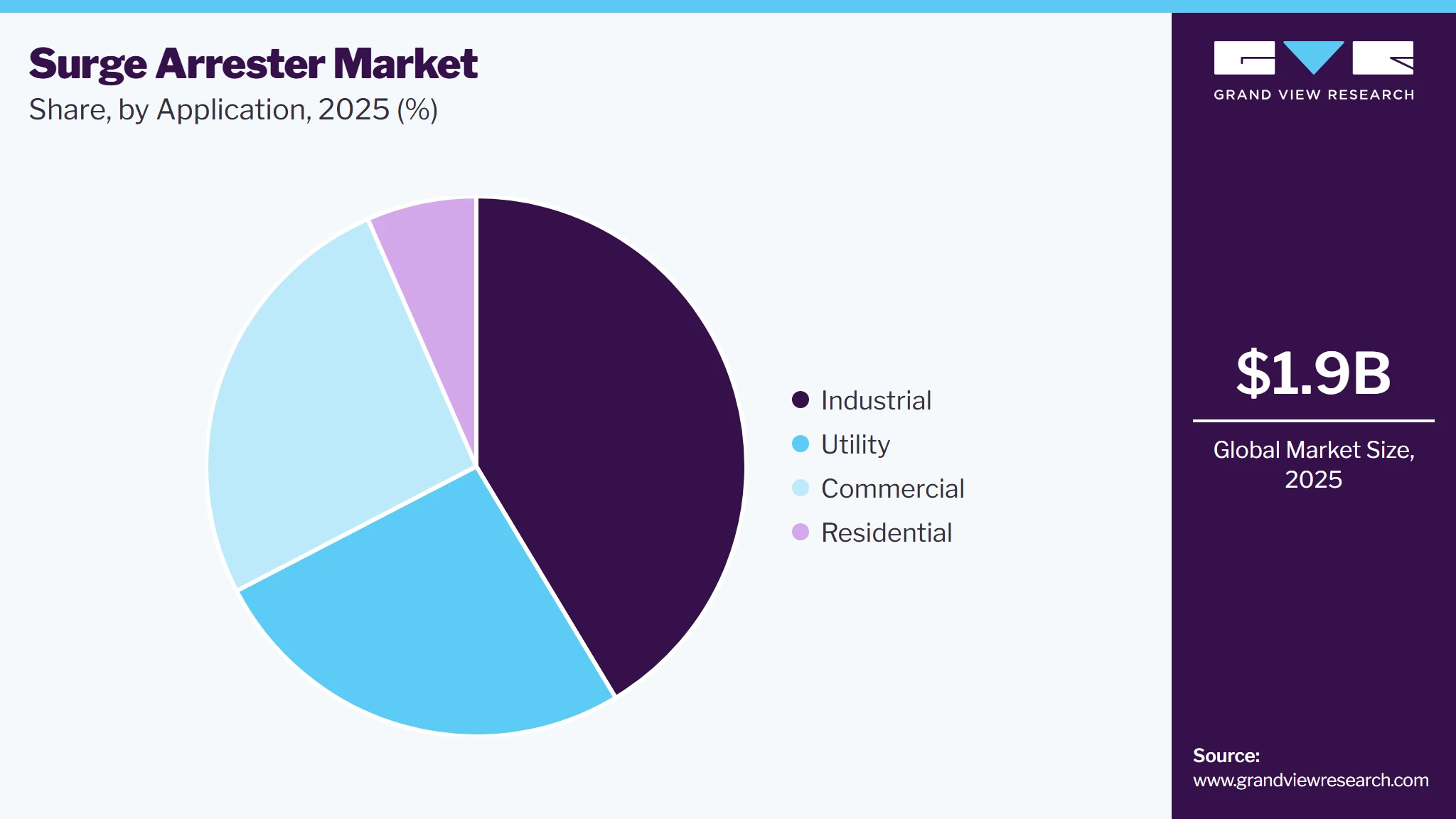
Based on applications, the industrial segment led the market with the largest revenue share of 41.4% in 2025. The increasing industrialization and expansion of Commercial facilities drive the demand for surge arresters, as industries rely on sensitive electrical equipment that requires protection from voltage surges and transient overvoltage. The growing adoption of automation, robotics, and high-power machinery in sectors such as oil & gas, mining, steel, and chemical processing necessitates reliable surge protection to prevent equipment failures and downtime. In addition, the rise of Industry 4.0 and smart factories, which integrate IoT-enabled systems and advanced control mechanisms, further amplifies the need for surge arresters to ensure operational continuity and safeguard critical infrastructure.
 To learn more about this report, Download Free Sample Report
In utility segment, rising investments in smart grids, coupled with regulatory mandates for energy efficiency and power quality improvements, further boost market demand. In addition, aging power infrastructure and the need to accommodate fluctuating loads due to renewables are driving the adoption of surge arresters to enhance grid reliability and operational performance.
Regional Insights
The North America surge arresters market is primarily driven by the increasing demand for efficient power management solutions and the modernization of aging power infrastructure. The region's focus on renewable energy integration, such as solar and wind power, necessitates the use of surge arresters to stabilize grid voltage and improve power quality. In addition, stringent government regulations and policies aimed at reducing energy losses and enhancing grid reliability are pushing utilities and industries to adopt advanced capacitor technologies. The growing adoption of electric vehicles (EVs) and the need for robust charging infrastructure further contribute to the demand for surge arresters in the region.
U.S. Surge Arrester Market Trends
The U.S. surge arresters market is driven by the growing demand for grid reliability, energy efficiency, and power factor correction amid rising electricity consumption. Aging power infrastructure and the need for modernization, including smart grids and high-voltage transmission systems, are accelerating capacitor deployment. In addition, the increasing integration of renewable energy sources, such as wind and solar, necessitates voltage regulation and reactive power compensation, further boosting demand. Supportive government policies, investments in grid resilience, and the push for industrial energy optimization also contribute to market growth.
Asia Pacific Surge Arrester Market Trends
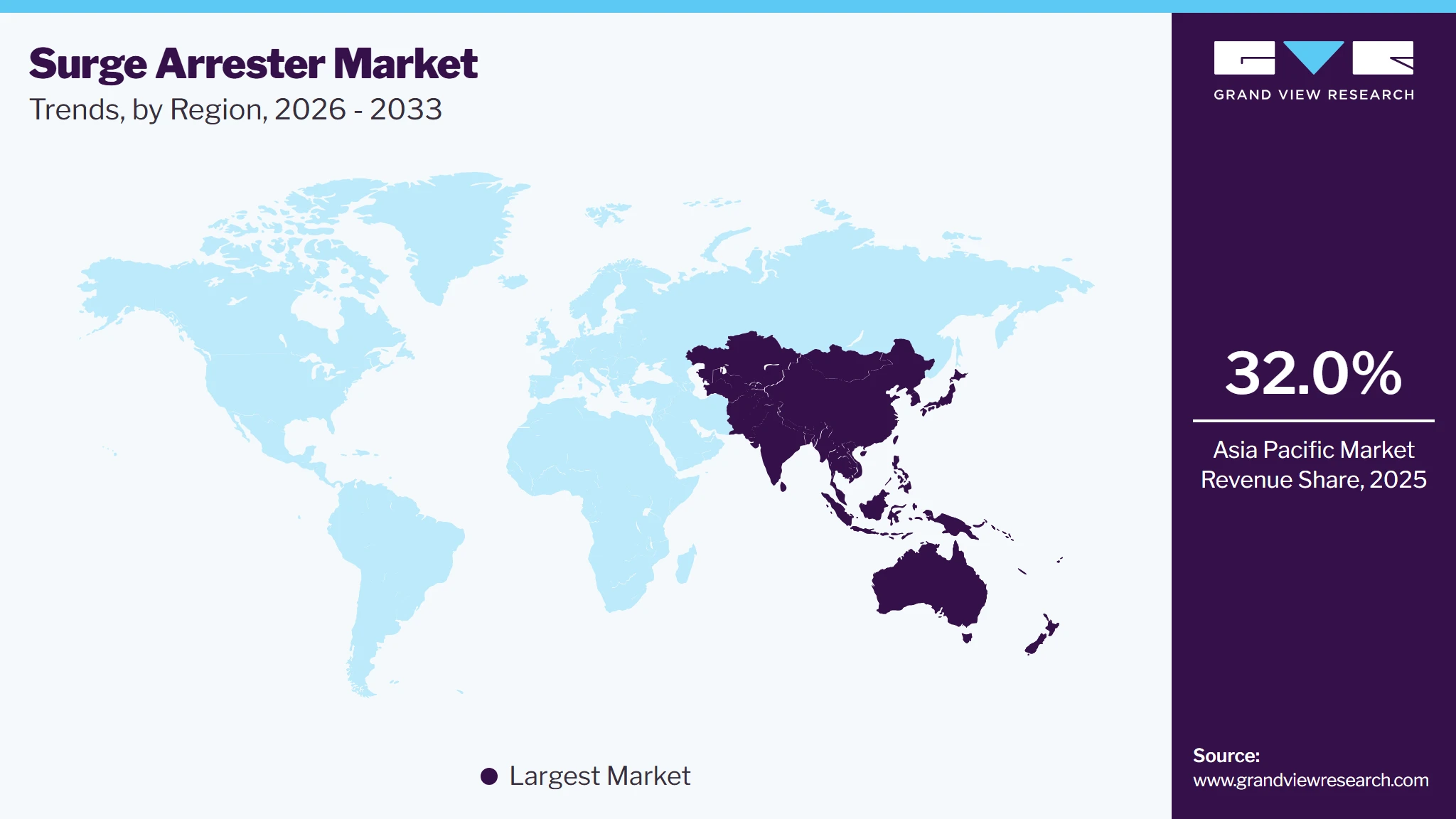
Asia Pacific dominated the surge arrester market with the largest revenue share of 32.0% in 2025. The Asia Pacific surge arresters market is driven by the region’s rapid industrialization, expanding power transmission and distribution infrastructure, and growing investments in renewable energy projects. Increasing electricity demand, particularly in emerging economies such as India and China, is pushing utilities to enhance power factor correction and grid stability, boosting the demand for surge arresters.
 To learn more about this report, Download Free Sample Report
The surge arrester market in China held the largest share in the Asia Pacific region in 2025. Key trends in the China Surge Arresters market include the adoption of smart grid technologies, integration of IoT-based monitoring systems, and advancements in capacitor design to enhance efficiency and durability. The shift towards ultra-high-voltage (UHV) transmission projects and increasing investments in renewable energy are pushing demand for high-performance capacitors. In addition, domestic manufacturers are strengthening their R&D capabilities and expanding production capacity to cater to both domestic and export markets, responding to the global rise in power infrastructure development.
Europe Surge Arrester Market Trends
The Europe surge arresters market is driven by the increasing focus on energy efficiency, grid stability, and the integration of renewable energy sources such as wind and solar power. The European Union’s stringent regulations on power quality and carbon emissions encourage utilities and industries to adopt power factor correction solutions. In addition, the modernization of aging electrical infrastructure, rising electrification of transportation, and investments in smart grid projects further boost demand for surge arresters across the region.
Key Surge Arrester Company Insights
Some of the key players operating in the market include Siemens AG, ABB, GE, Schneider Electric SE, Eaton Corporation, Hubbell Incorporated. Leading manufacturers are investing in R&D to develop high-performance arresters with improved lifespan, reliability, and smart monitoring capabilities, leveraging IoT and AI-driven predictive maintenance. Market competition is also influenced by economies of scale, with major players expanding their production capacities to cater to global demand while maintaining cost competitiveness.
- In March 2024, Solar Power Systems, a leading provider of clean energy product analysis and recommendations in the U.S., launched an extensive database of solar installers, including reviews and insights. This initiative aims to assist users in identifying the most suitable solar company based on their location, ensuring informed decision-making for their solar energy needs.
Key Surge Arrester Companies
The following key companies have been profiled for this study on the surge arrester market.
-
Hitachi Energy Ltd.
-
ABB Ltd.
-
Siemens AG
-
GE Vernova Inc.
-
Hubbell Incorporated
-
Eaton Corporation plc
-
Mitsubishi Electric Corporation
-
TE Connectivity Ltd.
-
Toshiba Energy Systems & Solutions Corporation
-
CG Power and Industrial Solutions Limited
Competitive Benchmarking
Category
Operating Strategies
Competitive Edge
Weakness
Established Players (e.g., Hitachi Energy Ltd., ABB Ltd., Siemens AG, GE Vernova Inc., Mitsubishi Electric Corporation, Toshiba Energy Systems & Solutions Corporation)
- Focus on manufacturing high-, medium-, and low-voltage surge arresters integrated with broader transmission and distribution equipment portfolios.
- Emphasize grid modernization projects, utility partnerships, renewable energy integration, product innovation, and global expansion strategies.
- Benefit from strong brand recognition, advanced R&D capabilities, extensive manufacturing infrastructure, and established relationships with utilities and grid operators.
- Broad product portfolios and global service networks support large-scale project execution and long-term customer engagement.
- Face high capital expenditure requirements associated with manufacturing facilities, technology development, and regulatory compliance.
- Business performance may be affected by utility investment cycles, project delays, and fluctuations in power infrastructure spending.
Emerging & Specialized Players (e.g., Hubbell Incorporated, Eaton Corporation plc, TE Connectivity Ltd., CG Power and Industrial Solutions Limited)
- Focus on specialized surge protection solutions, utility distribution applications, industrial power protection systems, and region-specific market opportunities.
- Emphasize product customization, application expertise, customer support, and expansion within growing power infrastructure markets.
- Benefit from operational flexibility, strong technical expertise, and the ability to address specific utility, industrial, and commercial customer requirements.
- Agile business models support faster responses to evolving grid reliability and equipment protection needs.
- Limited global presence and narrower product portfolios compared to large multinational competitors.
- Expansion often requires significant investments in manufacturing capacity, distribution networks, and utility customer acquisition efforts.
Surge Arrester Market Report Scope
Report Attribute
Details
Market definition
The global surge arrester market refers to revenue generated from the sale of surge protection devices, including low & medium voltage and high-voltage surge arresters, used to protect electrical equipment from lightning-induced and switching overvoltage across transmission, distribution, industrial, commercial, and residential power systems.
Market size value in 2025
USD 1.9 billion
Market size value in 2026
USD 2.1 billion
Revenue forecast in 2033
USD 3.1 billion
Growth rate
CAGR of 6.1% from 2026 to 2033
Base year for estimation
2025
Historical data
2021 - 2024
Forecast period
2026 - 2033
Quantitative units
Revenue in USD million/billion, and CAGR from 2026 to 2033
Report coverage
Revenue forecast, company ranking, competitive landscape, growth factors, and trends
Segments covered
Voltage rating, application, region.
Regional scope
North America; Europe; Asia Pacific; Latin America; Middle East & Africa
Country scope
U.S, Canada, Mexico, Germany, UK, Spain, France, Italy, India, China, Japan, South Korea, Brazil, Argentina, South Africa, Saudi Arabia, UAE
Key companies profiled
Hitachi Energy Ltd., ABB Ltd., Siemens AG, GE Vernova Inc., Hubbell Incorporated, Eaton Corporation plc, Mitsubishi Electric Corporation, TE Connectivity Ltd., Toshiba Energy Systems & Solutions Corporation, CG Power and Industrial Solutions Limited
Customization scope
Free report customization (equivalent up to 8 analysts' working days) with purchase. Addition or alteration to country, regional & segment scope.
Pricing and purchase options
Avail customized purchase options to meet your exact research needs. Explore purchase options
Global Surge Arrester Market Report Segmentation
This report forecasts revenue growth at global, country, and regional levels and provides an analysis of the latest trends in each of the sub-segments from 2021 to 2033. For this study, Grand View Research has segmented the global surge arrester market report on the basis of voltage rating, application, and region.
 To learn more about this report, Download Free Sample Report
-
Voltage Rating Outlook (Revenue, USD Million, 2021 - 2033)
-
Low & Medium
-
High
-
-
Application Outlook (Revenue, USD Million, 2021 - 2033)
-
Industrial
-
Utility
-
Commercial
-
Residential
-
-
Regional Outlook (Revenue, USD Million, 2021 - 2033)
-
North America
-
U.S.
-
Canada
-
Mexico
-
-
Europe
-
Germany
-
UK
-
Spain
-
Italy
-
France
-
-
Asia Pacific
-
China
-
India
-
Japan
-
South Korea
-
-
Central & South America
-
Brazil
-
Argentina
-
-
Middle East & Africa
-
South Africa
-
Saudi Arabia
- UAE
-
-
Research Methodology
The surge arrester market figures in this report are based on a proven research process that combines executive interviews with secondary research from proprietary databases, company filings, and recognized regulatory and institutional sources. Market size is built through value-chain sizing - reconciling supply-side and demand-side estimates - and triangulated with bottom-up and top-down approaches. Every estimate passes multiple levels of expert validation before publication, with each surge arrester segment quantified using the revenue-capture definitions in the table below.
Segment Definition
Voltage Rating
Revenue Capture Definition
Low & Medium
Low and medium-voltage surge arresters are used in commercial buildings, residential infrastructure, industrial facilities, distribution networks, renewable energy systems, and EV charging infrastructure. These products protect electrical equipment from lightning-induced and switching overvoltage. Market revenue is attributed to the manufacturing, supply, installation, replacement, and maintenance of surge arresters, as well as related monitoring and protection solutions, across distribution-level power systems.
High
High-voltage surge arresters are used in transmission networks, substations, power generation facilities, utility-scale renewable energy projects, and industrial power systems. These arresters protect transformers, switchgear, circuit breakers, and other critical electrical assets from transient overvoltage. Revenue is generated through the production and sale of surge arresters, utility procurement contracts, grid modernization projects, substation expansions, transmission infrastructure investments, and associated engineering services.
Application
Revenue Capture Definition
Industrial
The industrial segment utilizes surge arresters to protect motors, drives, transformers, switchgear, automation systems, and process control infrastructure from voltage surges. Industries such as manufacturing, oil & gas, mining, chemicals, and metals increasingly deploy surge protection solutions to minimize equipment failures and downtime. Revenue capture includes surge-arrester sales, installation services, maintenance contracts, retrofit projects, and industrial power-protection solutions.
Utility
Utilities represent one of the major application segments due to extensive deployment across transmission lines, substations, transformers, distribution networks, and renewable energy interconnection facilities.
Revenue is generated through utility procurement programs, grid expansion projects, transmission and distribution upgrades, substation modernization initiatives, renewable energy integration projects, and asset replacement programs designed to improve network reliability.
Commercial
Commercial applications include office buildings, hospitals, airports, shopping centers, educational institutions, and telecommunications facilities requiring a reliable power supply. Surge arresters are deployed to protect electrical distribution systems and sensitive electronic equipment from voltage fluctuations and lightning-related disturbances. Revenue is derived from product sales, electrical infrastructure upgrades, building protection systems, facility maintenance programs, and commercial power quality projects.
Residential
In residential applications, surge arresters are installed to protect household electrical systems, appliances, smart home devices, rooftop solar installations, and consumer electronics from transient overvoltage. Growing awareness regarding electrical safety and increasing residential electrification are supporting demand. Revenue capture includes product sales through distribution channels, residential electrical installations, retrofit activities, and home energy protection solutions.
Estimation Model
Layer Name
Key Question
Description
Power Infrastructure Demand Base Layer
What forms the demand base?
Identify global demand for surge arresters across transmission and distribution networks, substations, renewable energy facilities, industrial plants, commercial buildings, and residential infrastructure. Assess investments in grid expansion, power generation additions, renewable energy integration, and electrification initiatives to establish the addressable market opportunity.
Surge Arrester Manufacturing & Supply Layer
Where are surge arresters produced and supplied?
Estimate the production capacity of low-medium, and high-voltage surge arresters across key regions. Analyze manufacturing facilities, raw material availability, component supply chains, procurement channels, distribution networks, and service infrastructure to assess market accessibility and supply dynamics.
Application Adoption Layer
How extensively are surge arresters utilized?
Analyze the deployment of surge arresters across utility, industrial, commercial, and residential applications. Evaluate grid reliability requirements, substation installations, transmission and distribution projects, renewable energy deployments, protection standards, and asset replacement cycles influencing surge arrester adoption.
Revenue Layer
How is market revenue generated?
Expenditures on surge arresters, installation services, maintenance activities, replacement programs, and protection solutions quantify market revenue. Product pricing, utility investments, grid modernization spending, renewable energy infrastructure development, and electrical equipment protection requirements drive the overall market value.
Customization Table
Client Request
Customization Delivered
Value Adds
Surge Arrester Competitive Landscape Assessment
Detailed competitive landscape analysis covering manufacturers and suppliers of low-medium and high-voltage surge arresters and related power protection solutions. The study profiled key market participants based on geographic presence, organizational structure, product portfolio, manufacturing capabilities, distribution networks, customer base, strategic initiatives, and investments in grid modernization, transmission infrastructure, and product innovation.
Enabled evaluation of competitive positioning, manufacturing strengths, distribution capabilities, customer engagement strategies, and market participation across the surge arrester value chain.
Application & Technology Assessment
Evaluation of global surge arrester demand across utility, industrial, commercial, and residential applications. Included assessment of voltage ratings, surge protection technologies, substation deployments, transmission and distribution infrastructure, renewable energy integration, grid modernization trends, regulatory considerations, and regional power infrastructure developments across major markets.
Highlighted application trends, technology adoption patterns, and regional demand opportunities. Supported strategic planning, product portfolio optimization, market entry evaluation, and investment prioritization decisions.
Opportunity Assessment
Identification of high-growth opportunities associated with smart grid deployment, digital substations, renewable energy expansion, electric vehicle charging infrastructure, and transmission network modernization. Assessed emerging opportunities arising from increasing electricity demand, grid reliability requirements, utility investments, and growing adoption of advanced surge protection technologies across developed and emerging markets.
Enabled prioritization of high-value growth opportunities and emerging application segments. Supported long-term business planning, product development strategies, capacity expansion initiatives, and investment decisions aligned with evolving power infrastructure requirements.
Frequently Asked Questions About This Report
The surge arrester market size was valued at USD 1.9 billion in 2025 and is estimated at USD 2.1 billion in 2026.
The surge arrester market is expected to grow at a compound annual growth rate of 6.1% from 2026 to 2033 to reach USD 3.1 billion by 2033.
Based on voltage rating, low & medium accounted for largest revenue share of 69.1% in 2025, while high voltage surge arrester is anticipated to register the fastest CAGR over the forecast period.
Asia Pacific dominated the market with revenue share of 32.0% in 2025.
China dominated the Asia Pacific market with a revenue share of 40.8% in 2025.
Asia Pacific is anticipated to register the fastest CAGR of 7.0% over the forecast period.
Based on applications, industrial accounted for largest revenue share of 41.4% in 2025.
The key players operating in the surge arrester market include Hitachi Energy Ltd., ABB Ltd., Siemens AG, GE Vernova Inc., Hubbell Incorporated, Eaton Corporation plc, Mitsubishi Electric Corporation, TE Connectivity Ltd., Toshiba Energy Systems & Solutions Corporation, and CG Power and Industrial Solutions Limited.
The key driver of the global surge arrester market is the increasing investment in power transmission and distribution infrastructure, grid modernization programs, and renewable energy integration projects. Rising electricity demand and expanding substation networks are driving the adoption of surge arresters to protect critical electrical equipment from lightning-induced and switching overvoltage.
About the Author(s)
Distribution & Utilities Research Team
Energy & Power · Distribution & UtilitiesThis report was authored by the distribution & utilities research team at Grand View Research - comprising two research analysts, one senior research analyst, and one industry expert - with specialized expertise in the distribution & utilities segment of the energy & power industry. All findings are based on proprietary energy & power databases, executive interviews, and regulatory analysis, subject to internal peer review prior to publication.
Last Updated:
Speak to Analyst

Customize this report to your needs - add regions, segments, or data points, with 20% free customization.
Or view our licence options:


ISO 9001:2015 & 27001:2022 Certified
We are GDPR and CCPA compliant! Your transaction & personal information is safe and secure. For more details, please read our privacy policy.


