
- Home
- »
- Next Generation Technologies
- »
-
Sustainability Management Software Market Report, 2026-2033GVR Report cover

Sustainability Management Software Market (2026 - 2033)
Size, Share & Trends Analysis Report By Software (Carbon Management Software, Resource Management, Waste Management), By Deployment, By Vertical, By Region, And Segment Forecasts
Market Size, 2025
$3.7BMarket Estimate, 2026
$4.3BMarket Forecast, 2033
$13.3BCAGR, 2026–2033
17.6%Sustainability Management Software Market Summary
The global sustainability management software market size was valued at USD 3.7 billion in 2025 and is projected to grow from USD 4.3 billion in 2026 to USD 13.3 billion by 2033, at a CAGR of 17.6% from 2026 to 2033. North America dominated the market, accounting for the largest revenue share of 35.0% in 2025. The market is witnessing strong growth owing to the increasing integration of AI-powered ESG analytics, cloud-based sustainability platforms, automated carbon accounting, and real-time regulatory reporting capabilities, enabling organizations to enhance sustainability performance, ensure compliance, and support enterprise-wide decarbonization initiatives.
 Source: Grand View Research, IR Documents, Primary Interviews, Paid DatabasesTo learn more about this report,
 Download Free Sample Report
 Key Market Trends & Insights
- By software: Carbon management software segment dominated the market, with a revenue share of over 32.0% in 2025.
- By deployment: Cloud segment held the largest market share of over 72.0% in 2025.
- By vertical: Energy and utilities segment held the largest revenue share in 2025.
Regional Highlights
- Largest regional market: North America (over 35% revenue share, 2025)
- Fastest growing regional market: Asia Pacific (highest CAGR, 2026-2033)
- By country: The U.S. held the largest market share in 2025.
Market Size & Forecast
- Market size in 2025: USD 3.7 Billion
- Estimated market size in 2026: USD 4.3 Billion
- Projected market size by 2033: USD 13.3 Billion
- CAGR (2026-2033): 17.6%
GVR research-powered AIAsk Prism AI about the sustainability management software marketGet cited answers from GVR research on market growth, segments, regulations and forecasts.Start with✓ Source-linked answers ✓ Market-specific context ✓ Traceable figuresExplore Prism AI ↗
The market's expansion is further fueled by advancements in technology, such as Artificial Intelligence (AI) and big data analytics, which enhance the capabilities of these platforms. Companies across various sectors, from manufacturing to finance, are integrating sustainability software to not only mitigate risks but also capitalize on new business opportunities and improve their competitive edge. As more industries adopt these solutions, the market is projected to continue its upward trajectory, driven by the increasing need for transparency and accountability in sustainability efforts. To learn more about this report, Download Free Sample Report
 The adoption of sustainability management software is also being driven by the increasing integration of ESG metrics into financial reporting and strategic planning. As more organizations recognize the value of managing their environmental impact and enhancing their social governance, the demand for comprehensive and user-friendly software solutions is expected to continue to grow, shaping the future landscape of corporate sustainability. With ongoing innovations and a growing emphasis on corporate responsibility, the sustainability management software market is set to play a pivotal role in shaping a more sustainable future. These tools offer a range of functionalities, including carbon footprint analysis, resource optimization, and compliance reporting, enabling companies to enhance their environmental performance and meet regulatory requirements more efficiently.
Cloud-based solutions are gaining traction in the market for sustainability management software due to their scalability and flexibility. These solutions allow companies to customize their software to meet specific needs and are generally more cost-effective than on-premises alternatives, providing significant savings while ensuring robust environmental compliance. In addition, cloud-based systems are typically easier to deploy and manage compared to traditional on-premise setups, making them a more appealing choice for organizations seeking a quick and efficient implementation of sustainability management solutions.
Market Dynamics
The sustainability management software market is expanding steadily as enterprises prioritize digital solutions to strengthen environmental governance, corporate responsibility, and long-term operational resilience. Growing adoption of ESG management software is enabling organizations to streamline sustainability reporting, improve data accuracy, and meet evolving regulatory disclosure requirements across global markets. Increasing investments in carbon management software, climate risk assessment, and emissions tracking platforms are supporting organizations in achieving decarbonization goals while optimizing resource utilization. The rising deployment of environmental management software, energy monitoring systems, and supply chain sustainability solutions is enhancing operational visibility and enabling proactive sustainability decision-making. Furthermore, continuous advancements in AI, cloud computing, predictive analytics, and automation are accelerating innovation across the sustainability management software market, creating significant opportunities for solution providers and enterprise users over the forecast period.
The sustainability management software market is witnessing strong momentum as governments and regulatory authorities introduce stricter ESG disclosure and climate reporting requirements across industries. The growing adoption of ESG management software enables organizations to automate sustainability reporting, improve data transparency, and maintain compliance with evolving regulatory frameworks. Increasing implementation of carbon management software is helping enterprises measure greenhouse gas emissions, monitor decarbonization progress, and support net-zero commitments with greater accuracy. Businesses are also investing in environmental management software to centralize sustainability data, strengthen governance practices, and improve enterprise-wide environmental performance. These regulatory and corporate sustainability initiatives continue to drive long-term demand across the sustainability management software market.
In addition, rising investor expectations for transparent ESG performance and standardized sustainability disclosures are encouraging organizations to modernize their reporting infrastructure. Enterprises are deploying sustainability reporting software to simplify compliance with multiple reporting standards while improving the consistency and reliability of sustainability data. The integration of AI, cloud computing, and advanced analytics is further enhancing the capabilities of sustainability platforms by enabling real-time monitoring and predictive insights. Large enterprises and SMEs alike are increasingly adopting digital sustainability solutions to strengthen stakeholder confidence and improve strategic decision-making. As sustainability becomes a core business priority, regulatory compliance and ESG transparency will remain key growth drivers for the sustainability management software market.
The sustainability management software market faces challenges associated with complex implementation processes and enterprise-wide system integration. Many organizations operate across multiple business units with fragmented sustainability data stored in disconnected legacy systems, making data consolidation difficult. Deploying ESG management software often requires integration with ERP, financial, operational, and supply chain platforms, increasing project complexity and implementation timelines. Organizations also face difficulties in maintaining consistent data quality, standardization, and governance across global operations. These challenges can delay software deployment and reduce the effectiveness of sustainability initiatives.
The high initial investment required for software licensing, customization, employee training, and ongoing maintenance presents an additional barrier, particularly for small and medium-sized enterprises. Implementing carbon management software and environmental management software often requires specialized technical expertise and dedicated sustainability teams to maximize value. Differences in regional reporting standards and evolving regulatory requirements further increase operational complexity for multinational organizations. Limited availability of skilled sustainability professionals capable of managing ESG data and digital reporting platforms also affects adoption rates. Consequently, implementation complexity and integration challenges continue to restrain broader adoption within the sustainability management software market.
The sustainability management software market creates significant opportunities through the rapid adoption of artificial intelligence, predictive analytics, and digital sustainability intelligence. Organizations are increasingly investing in AI-powered sustainability management software to automate ESG data collection, identify operational inefficiencies, and generate real-time sustainability insights. The growing demand for supply chain sustainability software is enabling enterprises to monitor supplier emissions, assess climate-related risks, and improve transparency throughout global value chains. Increasing corporate focus on Scope 3 emissions management is further expanding opportunities for advanced sustainability platforms. These innovations are strengthening enterprise sustainability strategies while supporting long-term environmental goals.
Growing investments in cloud-based sustainability platforms are also enabling organizations to scale sustainability initiatives across geographically distributed operations. Advanced sustainability reporting software supports automated regulatory compliance, stakeholder reporting, and continuous ESG performance monitoring through integrated digital dashboards. The convergence of IoT, machine learning, digital twins, and real-time environmental monitoring is creating new value-added capabilities for sustainability solution providers. Emerging economies are witnessing increasing adoption of digital ESG solutions as sustainability regulations become more comprehensive and corporate climate commitments continue to expand. These technological advancements and evolving business priorities are expected to generate substantial growth opportunities for the sustainability management software market throughout the forecast period.
Market Concentration & Characteristics
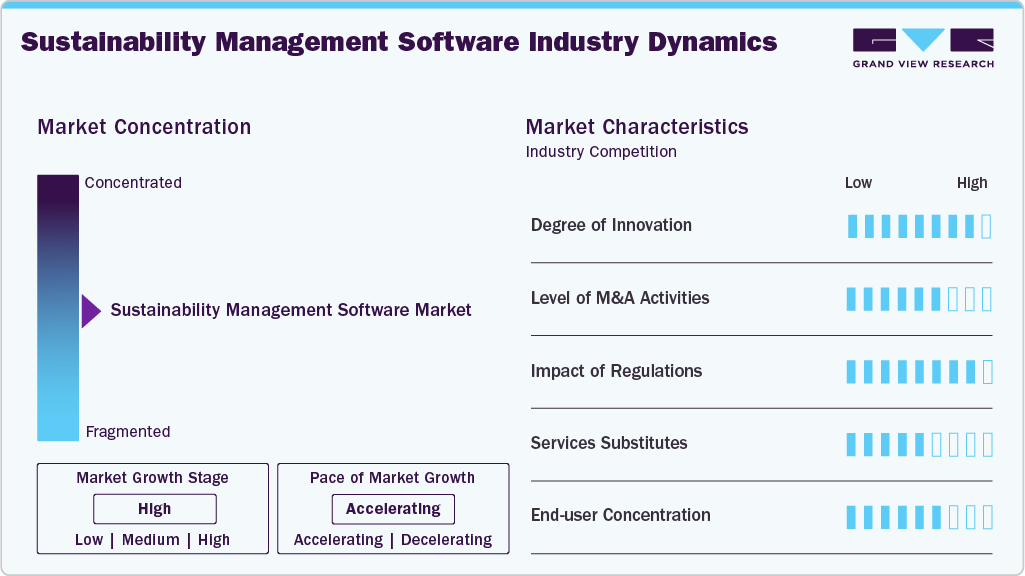
The sustainability management software market is moderately concentrated, with established global technology providers competing alongside specialized ESG and sustainability solution vendors. Leading companies differentiate their offerings through sustainability management software, ESG management software, and carbon management software by integrating AI, cloud computing, predictive analytics, and automation capabilities. Market participants are increasingly expanding their product portfolios through strategic acquisitions, partnerships, and continuous platform innovation to strengthen their competitive positioning. The growing demand for end-to-end sustainability solutions is encouraging vendors to deliver integrated platforms that support environmental compliance, climate risk management, and enterprise sustainability reporting.
 To learn more about this report, Download Free Sample Report
 The market is characterized by rapid technological innovation, evolving regulatory requirements, and increasing enterprise investments in digital sustainability transformation. Vendors are enhancing environmental management software, sustainability reporting software, and supply chain sustainability capabilities to address changing customer requirements across multiple industries. Subscription-based SaaS deployment models, scalable cloud infrastructure, and configurable analytics dashboards have become key differentiating factors influencing customer adoption. Furthermore, increasing demand for real-time ESG data management, automated disclosure processes, and enterprise-wide sustainability intelligence continues to shape the competitive landscape of the sustainability management software market.
Analyst Perspective
The sustainability management software market is expected to experience robust growth as organizations integrate sustainability into strategic planning and day-to-day operations. Increasing demand for ESG reporting, climate risk management, carbon accounting, and sustainability performance management is driving the adoption of advanced software platforms. AI-powered analytics, automation, and cloud-based solutions are enabling businesses to streamline data collection, monitor environmental performance, and improve regulatory compliance. Rising emphasis on Scope 3 emissions tracking, supply chain transparency, and sustainability assurance is further expanding market opportunities. As global sustainability regulations become more stringent and investors demand greater transparency, vendors offering scalable, interoperable, and data-driven solutions are expected to strengthen their competitive position in the sustainability management software market.
Software Insights
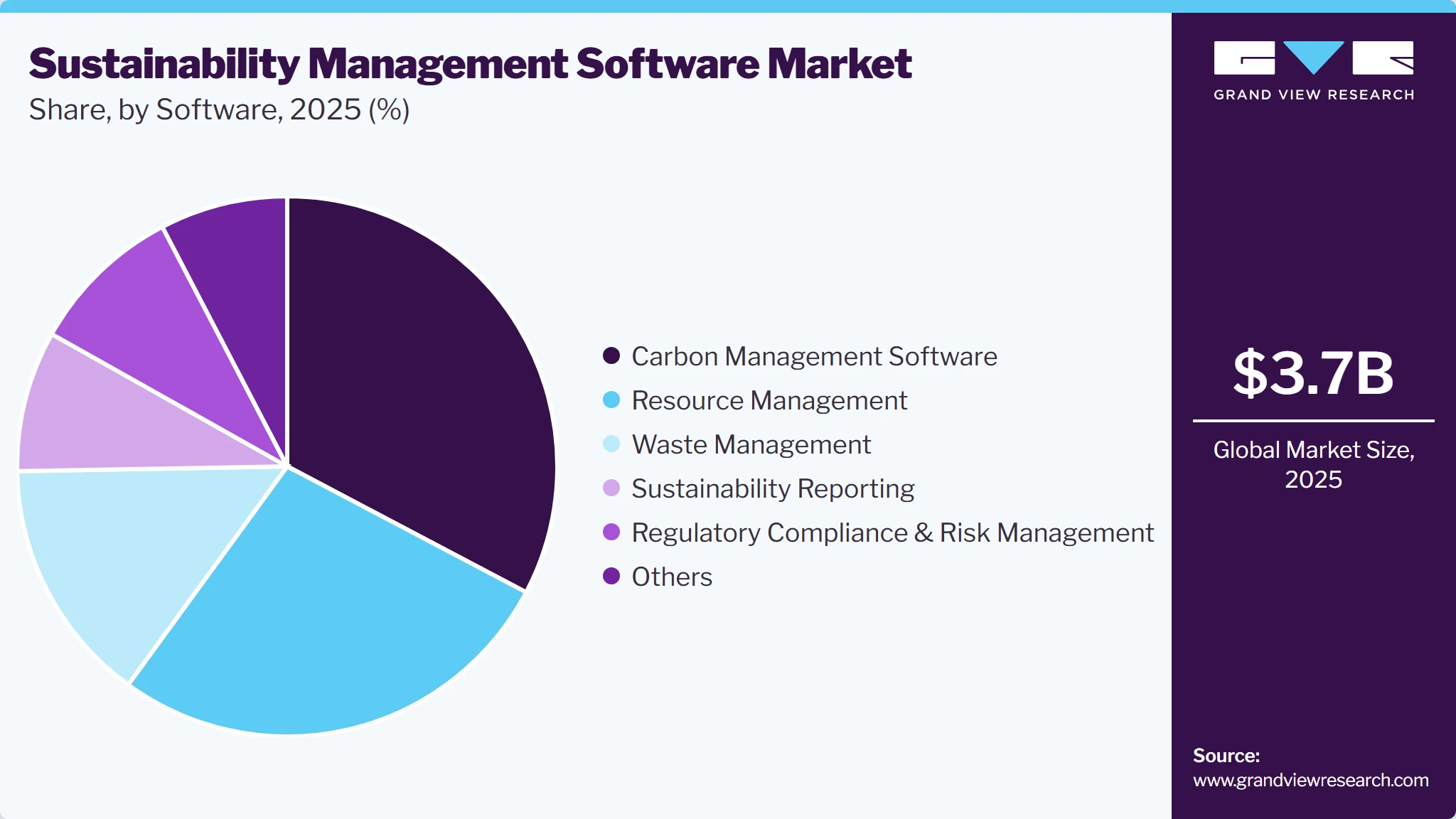
Based on software, the carbon management software segment led the market with the largest revenue share of over 32.0% in 2025. This high share is attributed to a heightened global focus on carbon reduction amid increasing regulatory pressures and climate commitments. As governments and organizations set ambitious carbon neutrality goals, companies are investing heavily in tools that enable accurate measurement, tracking, and reduction of their carbon footprints. Carbon management software provides essential capabilities for calculating emissions, setting reduction targets, and ensuring compliance with evolving regulations. In addition, it supports corporate sustainability strategies and reporting, meeting both regulatory demands and stakeholder expectations.
 To learn more about this report, Download Free Sample Report
 The resource management segment is predicted to foresee significant growth in the coming years. As organizations increasingly focus on improving operational efficiency and sustainability, effective management of resources such as energy, water, and raw materials has become essential. This segment’s high growth is also attributed to its ability to help companies meet regulatory requirements, reduce costs, and enhance their environmental performance. The growing emphasis on sustainability goals and the need for accurate data to drive decision-making have further boosted the adoption of resource management software, making it a key component in the broader sustainability management landscape.
Deployment Insights
Based on deployment, the cloud segment led the market with the largest revenue share of over 72.0% in 2025. This high share is primarily attributed to the scalability, flexibility, and cost-effectiveness offered by cloud solutions. Cloud-based platforms allow organizations to easily scale their sustainability management tools to match their specific needs and growth while also reducing the upfront costs associated with on-premises deployments. In addition, cloud solutions facilitate seamless integration with other systems and enable real-time data access and collaboration from any location, enhancing efficiency and responsiveness. The reduced need for on-site hardware and IT maintenance further contributes to lower overall costs, making cloud deployment an attractive choice for companies looking to implement and manage their sustainability initiatives effectively.
The on-premises segment is predicted to foresee significant growth in the coming years, driven by the growing demand for enhanced security, data control, and customization. Organizations with stringent data protection requirements and regulatory compliance needs often prefer on-premises solutions to maintain complete control over their data and infrastructure. In addition, on-premises deployments offer greater customization options and integration capabilities with existing IT systems, which can be crucial for complex and highly regulated industries.
Vertical Insights
Based on vertical, the energy and utilities segment has a significant revenue share of over 30.0% in 2025. This industry is under significant pressure to reduce carbon emissions and optimize resource use, driving substantial investment in sustainability management solutions. Energy and utility companies rely on advanced software to monitor energy consumption, manage emissions, and integrate renewable energy sources effectively. The need for compliance with stringent environmental regulations and the pursuit of cost savings through improved energy management further fuel the sector's demand for specialized sustainability software.
The transportation & logistics segment is anticipated to exhibit the highest CAGR over the forecast period. This sector faces substantial pressure to reduce its carbon footprint and improve operational efficiency due to environmental regulations and consumer expectations for greener practices. Advanced sustainability management software helps transportation and logistics companies optimize routes, reduce fuel consumption, and enhance overall supply chain transparency. In addition, the integration of technologies such as IoT and AI in logistics operations supports real-time data analysis and decision-making, further boosting the demand for advanced sustainability solutions. The sector's focus on reducing emissions and improving sustainability aligns with the growing adoption of these software solutions, contributing to its rapid growth.
Regional Insights
North America dominated the sustainability management software market with the largest revenue share of over 35.0% in 2025. The region boasts a high concentration of major corporations and early adopters of sustainability technologies driven by stringent environmental regulations and corporate sustainability goals. In addition, significant investments in green technology and infrastructure, coupled with a well-established tech industry, have fostered rapid innovation and adoption of sustainability management solutions. Moreover, governmental incentives and support for sustainability initiatives have further accelerated market growth.
 To learn more about this report, Download Free Sample Report
 U.S. Sustainability Management Software Market Trends
The sustainability management software market in the U.S. held the largest share in the North America region in 2025. The country's leadership in technological innovation and its robust corporate sector have accelerated the adoption of advanced sustainability management solutions. Stringent environmental regulations and ambitious corporate sustainability goals have spurred significant demand for these software tools.
Europe Sustainability Management Software Market Trends
The sustainability management software market in the European region is expected to witness significant growth over the forecast period. Stringent environmental regulations and ambitious climate targets set by the European Union, such as the Green Deal and various sustainability directives, have created a strong demand for advanced sustainability management tools. European companies are increasingly committed to integrating sustainability into their business models, influenced by both regulatory requirements and consumer expectations. In addition, significant investments in green technology and a supportive policy environment have fostered market growth.
Asia Pacific Sustainability Management Software Market Trends
The sustainability management software market in the Asia Pacific region is anticipated to register rapid growth over the forecast period, driven by rapid industrialization and increasing environmental awareness across the region. The significant growth in the manufacturing and energy sectors has heightened the need for effective sustainability management solutions to meet stringent regulations and enhance operational efficiency. In addition, many governments in the Asia Pacific are implementing policies and incentives to promote green practices and reduce carbon footprints, further driving demand.
Key Sustainability Management Software Company Insights
Key sustainability management software companies include Benchmark Digital Partners LLC, ICONICS, Inc., Urjanet, Inc., and SAP SE Companies active in the sustainability management software market are focusing aggressively on expanding their customer base and gaining a competitive edge over their rivals. Hence, they pursue various strategic initiatives, including partnerships, mergers & acquisitions, collaborations, and new product/ Pattern Type development. For instance, in July 2024, Vodafone Business, the digital communications division of Vodafone Limited, unveiled the Vodafone Business ESG Navigator. This innovative software solution is tailored to help companies meet their sustainability reporting requirements, with a particular focus on the EU's Corporate Sustainability Reporting Directive (CSRD). Developed in partnership with sustainability reporting software provider (Envoria) Financial Software Architects GmbH, the new tool is designed to streamline and enhance sustainability reporting processes.
Key Sustainability Management Software Companies
The following key companies have been profiled for this study on the sustainability management software market.
-
Benchmark Digital Partners LLC
-
ICONICS, Inc.
-
Urjanet, Inc.
-
SAP SE
-
FigBytes
-
HELLA GmbH & Co. KGaA
-
Schneider Electric
-
General Electric Company
-
Microsoft
-
Salesforce, Inc.
Competitive Benchmarking
Operating Strategies
Competitive Edge
Weaknesses
Mature Players: SAP SE, Schneider Electric, Microsoft, Salesforce, Inc., General Electric Company
- Mature players focus on expanding ESG management software, carbon management software, cloud-based sustainability platforms, and AI-powered analytics to strengthen their enterprise sustainability offerings.
- Their competitive advantage lies in strong global presence, comprehensive sustainability portfolios, established enterprise customer base, and continuous investments in AI, cloud, and ESG technologies.
- These companies may face challenges related to complex implementation, legacy system integration, and longer product innovation cycles.
Emerging Players: Benchmark Digital Partners LLC, FigBytes, Urjanet, Inc., ICONICS, Inc., HELLA GmbH & Co. KGa
- Emerging players focus on developing innovative carbon accounting, sustainability reporting, climate risk management, and emissions tracking solutions tailored to evolving ESG requirements.
- Their strength comes from specialized sustainability expertise, agile product development, cloud-native platforms, and faster innovation in ESG and carbon management capabilities.
- Limited global presence, smaller customer base, and comparatively lower financial resources may restrict large-scale market expansion.
Recent Developments
-
In August 2024, Microsoft unveiled a new ESG reporting tool designed to simplify, streamline, and accelerate the reporting process as sustainability disclosure requirements expand. The Project ESG Reporting (preview) platform includes a variety of framework templates and pre-synced ESG standards, which can be filled in and reused for future reports. In addition, the tool allows companies to develop and utilize their own custom templates.
-
In July 2024, Schneider Electric, a prominent player in energy and automation digital solutions, introduced several enhancements to its EcoStruxure Resource Advisor platform. This updated energy and sustainability data and reporting tool features a suite of new solutions designed to help companies meet emerging sustainability reporting regulations. The enhancements come as corporate sustainability initiatives gain momentum, addressing key challenges such as implementing sustainability programs, streamlining ESG reporting, reducing carbon footprints, managing renewable energy projects, optimizing energy procurement, and improving operational efficiency through targeted energy-saving measures.
-
In March 2024, Oracle introduced Oracle Cloud EPM for Sustainability, a groundbreaking addition to Oracle Fusion Cloud EPM (Enterprise Performance Management). This new solution empowers organizations to measure and manage their sustainability initiatives effectively. It enables business leaders to strengthen their sustainability efforts by analyzing and connecting targets, data, and plans throughout their organizations, and by creating various scenarios to optimize outcomes.
Sustainability Management Software Market Report Scope
Report Attribute
Details
Market size in 2025
USD 3.7 billion
Estimated Market size in 2026
USD 4.3 billion
Projected Market size by 2033
USD 13.3 billion
Growth rate
CAGR of 17.6% from 2026 to 2033
Base year for estimation
2025
Historical data
2021 - 2024
Forecast period
2026 - 2033
Quantitative units
Revenue in USD million/billion and CAGR from 2026 to 2033
Report coverage
Revenue forecast, company ranking, competitive landscape, growth factors, and trends
Segments covered
Software, deployment, vertical, region
Regional scope
North America; Europe; Asia Pacific; Latin America; MEA
Country scope
U.S.; Canada; Mexico; Germany; UK; France; China; Japan; India; South Korea; Australia; Brazil; Saudi Arabia; South Africa; UAE
Key companies profiled
Benchmark Digital Partners LLC; ICONICS, Inc.; Urjanet, Inc.; SAP SE; HELLA GmbH & Co. KGa; Schneider Electric; FigBytes; Schneider Electric; General Electric Company; Microsoft; Salesforce, Inc.
Customization scope
Free report customization (equivalent up to 8 analysts' working days) with purchase. Addition or alteration to country, regional & segment scope.
Pricing and purchase options
Avail customized purchase options to meet your exact research needs. Explore purchase options
Global Sustainability Management Software Market Report Segmentation
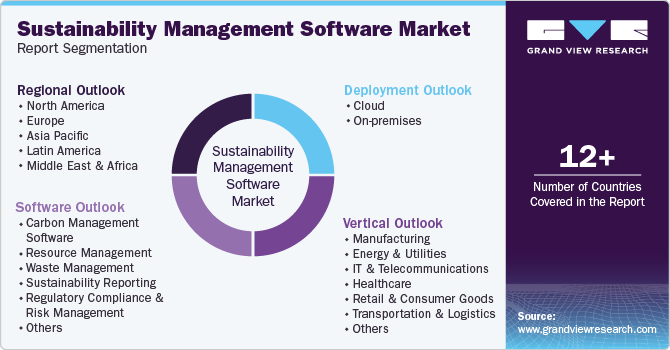
This report forecasts revenue growth at global, regional, and country levels and provides an analysis of the latest industry trends in each of the sub-segments from 2021 to 2033. For this study, Grand View Research has segmented the global sustainability management software market report based on software, deployment, vertical, and region.
 To learn more about this report, Download Free Sample Report
 -
Software Outlook (Revenue, USD Billion, 2021 - 2033)
-
Carbon Management Software
-
Resource Management
-
Waste Management
-
Sustainability Reporting
-
Regulatory Compliance and Risk Management
-
Others
-
-
Deployment Outlook (Revenue, USD Billion, 2021 - 2033)
-
Cloud
-
On-premises
-
-
Vertical Outlook (Revenue, USD Billion, 2021 - 2033)
-
Manufacturing
-
Energy & Utilities
-
IT & Telecommunications
-
Healthcare
-
Retail & Consumer Goods
-
Transportation & Logistics
-
BFSI
-
Others
-
-
Regional Outlook (Revenue, USD Billion, 2021 - 2033)
-
North America
-
U.S.
-
Canada
-
-
Mexico
-
Europe
-
UK
-
Germany
-
France
-
-
Asia Pacific
-
China
-
India
-
Japan
-
Australia
-
South Korea
-
-
Latin America
-
Brazil
-
-
MEA
-
UAE
-
South Africa
-
KSA
-
-
Research Methodology
Segment Definition
Segment - Software
Revenue capture definition
Carbon Management Software
Carbon management software enables organizations to measure, monitor, analyze, and reduce greenhouse gas emissions across business operations and value chains. It supports carbon accounting, emissions reporting, target tracking, and compliance with climate-related regulations and sustainability frameworks.
Resource Management
Resource management software helps organizations optimize the utilization of energy, water, raw materials, and other operational resources to improve efficiency and sustainability. It provides visibility into resource consumption through monitoring, analytics, and performance management capabilities.
Waste Management
Waste management software is designed to track, manage, and optimize waste generation, collection, recycling, and disposal activities across facilities. It enables organizations to improve waste reduction initiatives, ensure regulatory compliance, and support circular economy objectives.
Sustainability Reporting
Sustainability reporting software enables organizations to collect, consolidate, and disclose environmental, social, and governance (ESG) data in accordance with recognized reporting standards. It automates reporting workflows while improving data accuracy, transparency, and audit readiness.
Regulatory Compliance and Risk Management
Regulatory compliance and risk management software assists organizations in identifying, monitoring, and managing sustainability-related regulatory obligations and operational risks. It supports policy management, compliance tracking, risk assessments, and continuous governance activities.
Others
This segment includes sustainability software solutions designed for specialized applications such as biodiversity management, climate risk assessment, supplier sustainability, environmental health and safety, and sustainability planning. These solutions address industry-specific sustainability requirements beyond core software functionalities.
Segment - Deployment
Revenue capture definition
Cloud
The segment delivers sustainability management software through internet-based infrastructure hosted by third-party service providers. It offers scalable access, remote connectivity, automatic updates, and flexible subscription-based deployment models.
On-premises
This segment installs sustainability management software within an organization's own IT infrastructure and data centers. It provides greater control over system configuration, security, data management, and regulatory compliance requirements.
Segment - Vertical
Revenue capture definition
Manufacturing
The manufacturing vertical utilizes sustainability management software to monitor emissions, optimize resource consumption, improve production efficiency, and ensure environmental compliance. It supports sustainable manufacturing practices across production facilities and supply chains.
Energy & Utilities
The energy & utilities sector deploys sustainability management software to manage energy efficiency, carbon emissions, renewable energy performance, and environmental reporting. It enables utilities to monitor sustainability metrics while supporting regulatory compliance and decarbonization initiatives.
IT & Telecommunications
The IT & telecommunications industry uses sustainability management software to measure environmental performance, improve data center efficiency, and manage enterprise-wide ESG initiatives. It supports sustainability reporting and operational optimization across digital infrastructure.
Healthcare
Healthcare organizations implement sustainability management software to monitor energy usage, waste generation, water consumption, and environmental compliance across medical facilities. It supports sustainable healthcare operations while enhancing regulatory reporting and resource efficiency.
Retail & Consumer Goods
Retail and consumer goods companies use sustainability management software to improve supply chain transparency, reduce operational emissions, and manage sustainability reporting. It facilitates responsible sourcing, resource optimization, and ESG performance monitoring across business operations.
Transportation & Logistics
The transportation & logistics sector utilizes sustainability management software to monitor fleet emissions, fuel consumption, route efficiency, and environmental performance. It supports sustainable logistics operations through carbon tracking and regulatory compliance management.
BFSI
Banking, financial services, and insurance organizations use sustainability management software to manage ESG reporting, climate-related financial disclosures, and sustainability risk assessments. It enables institutions to evaluate environmental performance while supporting governance and regulatory compliance.
Others
This segment includes government organizations, educational institutions, construction companies, hospitality providers, agriculture enterprises, and other industries adopting sustainability management software. These organizations utilize the software to manage environmental performance, regulatory compliance, and corporate sustainability initiatives according to their operational requirements.
Estimation Model
Layer Name
Key Questions
Description
Enterprise Sustainability & ESG Adoption Layer
Who creates demand for Sustainability Management Software solutions?
Identify enterprises, government organizations, and industry verticals implementing ESG initiatives, carbon reduction programs, and sustainability strategies. This layer establishes the demand base by assessing regulatory compliance requirements, corporate sustainability goals, and digital transformation investments.
Sustainability Data & Digital Infrastructure Layer
Who invests in sustainability data infrastructure?
Apply adoption rates of cloud platforms, IoT sensors, ERP integration, environmental monitoring systems, and analytics solutions. This layer measures investments supporting sustainability data collection, integration, monitoring, and reporting.
Sustainability Software Deployment Layer
Who deploys Sustainability Management Software technologies and services?
Apply penetration rates of ESG management software, carbon management software, sustainability reporting software, environmental management software, and compliance solutions across industries. This layer captures enterprise adoption of digital sustainability platforms for ESG reporting, emissions tracking, and performance management.
Sustainability Management Software Market Revenue Realization Layer
How much revenue is generated through Sustainability Management Software adoption?
Estimate market revenue by combining software deployments with spending on subscriptions, implementation, consulting, integration, maintenance, and support services. This layer captures total revenue generated from sustainability management software across end-use industries.
Delivered Customizations
This report has been delivered with the following In-depth customizations
Client Request
Customization Delivered
Value Adds
Sustainability Management Software Technology Adoption & Growth Assessment
Performed a comprehensive analysis of Sustainability Management Software market trends, including artificial intelligence (AI), cloud computing, IoT, predictive analytics, ESG management, carbon accounting, sustainability reporting, automation, and environmental data management across major industry verticals.
This assessment enables stakeholders to identify high-growth sustainability technology segments, evaluate digital ESG adoption trends, prioritize investment opportunities, and strengthen competitive positioning within the rapidly evolving sustainability management software market.
Industry-Specific Sustainability Management Software Deployment Analysis
Assessed demand for sustainability management software across manufacturing, energy & utilities, BFSI, healthcare, IT & telecommunications, retail & consumer goods, transportation & logistics, and government sectors, including ESG reporting, carbon emissions management, resource optimization, regulatory compliance, and sustainability performance monitoring applications.
Provides strategic insights into industry-specific sustainability adoption patterns, deployment requirements, regulatory compliance initiatives, and long-term revenue opportunities, supporting market expansion planning and targeted growth strategies.
Carbon Management, ESG Reporting & Sustainability Intelligence Opportunity Assessment
Evaluated adoption trends for carbon management software, sustainability reporting platforms, environmental management systems, climate risk management, AI-powered ESG analytics, supply chain sustainability, cloud-based sustainability platforms, and real-time sustainability intelligence across global markets.
Supports investment and product development strategies by identifying emerging sustainability opportunities, accelerating innovation roadmaps, enabling solution differentiation, and facilitating business expansion across high-growth segments of the sustainability management software market.
Frequently Asked Questions About This Report
Asia Pacific is the fastest-growing region over the forecast period.
The carbon management software segment led with a 32.7% revenue share in 2025, while resource management is the fastest-growing segment.
The cloud segment led with a 72.9% revenue share in 2025, while on-premises is the fastest-growing segment.
The energy and utilities segment led with a 30.7% revenue share in 2025, while transportation and logistics is the fastest-growing segment.
The global sustainability management software market size was estimated at USD 3.7 billion in 2025 and is expected to reach USD 4.3 billion in 2026.
The global sustainability management software market is expected to grow at a compound annual growth rate of 17.6% from 2026 to 2033, reaching USD 13.3 billion by 2033.
North America dominated the sustainability management software market, accounting for 35.4% of the market in 2025. The region boasts a high concentration of major corporations and early adopters of sustainability technologies driven by stringent environmental regulations and corporate sustainability goals.
Some key players operating in the sustainability management software market include Benchmark Digital Partners LLC, ICONICS, Inc., Urjanet, Inc., SAP SE, HELLA GmbH & Co. KGa, Schneider Electric, FigBytes, Schneider Electric, General Electric Company, Microsoft, Salesforce, Inc.
Key factors that are driving the sustainability management software market growth include increasing stringent regulations and compliance requirements related to environmental sustainability, and corporate social responsibility, and technological advancements.
About the Author(s)
Next Generation Technologies Research Team
Technology · Next Generation TechnologiesThis report was authored by the next generation technologies research team at Grand View Research - comprising two research analysts, one senior research analyst, and one industry expert - with specialized expertise in the next generation technologies segment of the technology industry. All findings are based on proprietary technology databases, executive interviews, and regulatory analysis, subject to internal peer review prior to publication.
Last Updated:
Speak to Analyst

Customize this report to your needs - add regions, segments, or data points, with 20% free customization.
Or view our licence options:


ISO 9001:2015 & 27001:2022 Certified
We are GDPR and CCPA compliant! Your transaction & personal information is safe and secure. For more details, please read our privacy policy.


