
- Home
- »
- Personal Care & Cosmetic Ingredients
- »
-
Synthetic Cosmetic Ingredients Market Size Report, 2033GVR Report cover

Synthetic Cosmetic Ingredients Market (2026 - 2033)
Size, Share & Trends Analysis Report By Product (Silicone, Emollients, Surfactants, Polymers), By Application (Skin Care, Hair Care, Oral Care), By Region, And Segment Forecasts
Market Size, 2025
$19.8BMarket Estimate, 2026
$20.6BMarket Forecast, 2033
$27.5BCAGR, 2026–2033
4.2%Synthetic Cosmetic Ingredients Market Summary
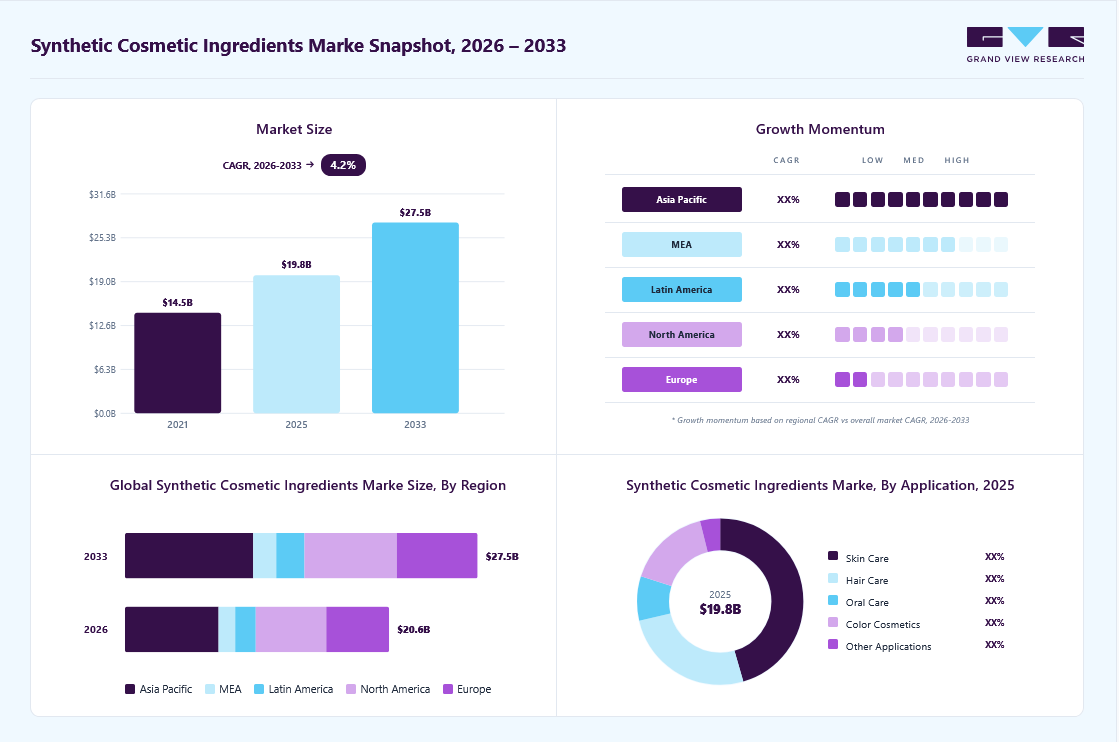
The global synthetic cosmetic ingredients market size was valued at USD 19.8 billion in 2025 and is projected to grow from USD 20.6 billion in 2026 to USD 27.5 billion by 2033, at a CAGR of 4.2% from 2026 to 2033. Asia Pacific dominated the market, accounting for a revenue share of 35.1% in 2025. Demand for synthetic cosmetic ingredients is supported by the need for consistent product performance, reliable ingredient quality, and scalable manufacturing across personal care formulations. Synthetic ingredients enable formulators to achieve defined functional properties while maintaining production efficiency.
 Source: Grand View Research, IR Documents, Primary Interviews, Paid DatabasesTo learn more about this report,
 Download Free Sample Report
Key Market Trends & Insights
- By product: Surfactants segment held the dominant revenue share of 21.0% in 2025.
- By application: Skin care segment represented the largest share of 45.3% in 2025.
Regional Highlights
- Largest Regional Market: Asia Pacific (35.1% revenue share, 2025)
- Fastest-growing Regional Market: Asia Pacific (fastest CAGR, 2026-2033)
- By country: China held the largest share in 2025
Market Size & Forecast
- Market size in 2025: USD 19.8 billion
- Estimated market size in 2026: USD 20.6 billion
- Projected market size by 2033: USD 27.5 billion
- CAGR (2026-2033): 4.2%
Three ways to get this report
Buy it, customize it, or ask a question.Ask an Analyst
Analyst response in 1 business day
- AccessReport author, directly
- Reply timeWithin 1 working day
- No sales callDirect answer only
- FormatEmail reply
- CostFree, no cost
Get the Full Report
What the study covers
- FormatsPDF · Excel · Dashboard
- Timeline2026–2033 annual, 2025 base
- Coverage20+ countries, 5 regions
- Companies10+ key players profiled
Customize the Report
20% free customization
- IncludeCountries, segments, points
- TailorTo your product definition
- ExtendDeeper competitor detail
- OrA fully bespoke study
- Turnaround5–10 working days
Their versatility across cleansing, conditioning, texture modification, preservation, and appearance enhancement strengthens their commercial relevance. Established chemical production capabilities also support dependable supply for high-volume cosmetic applications.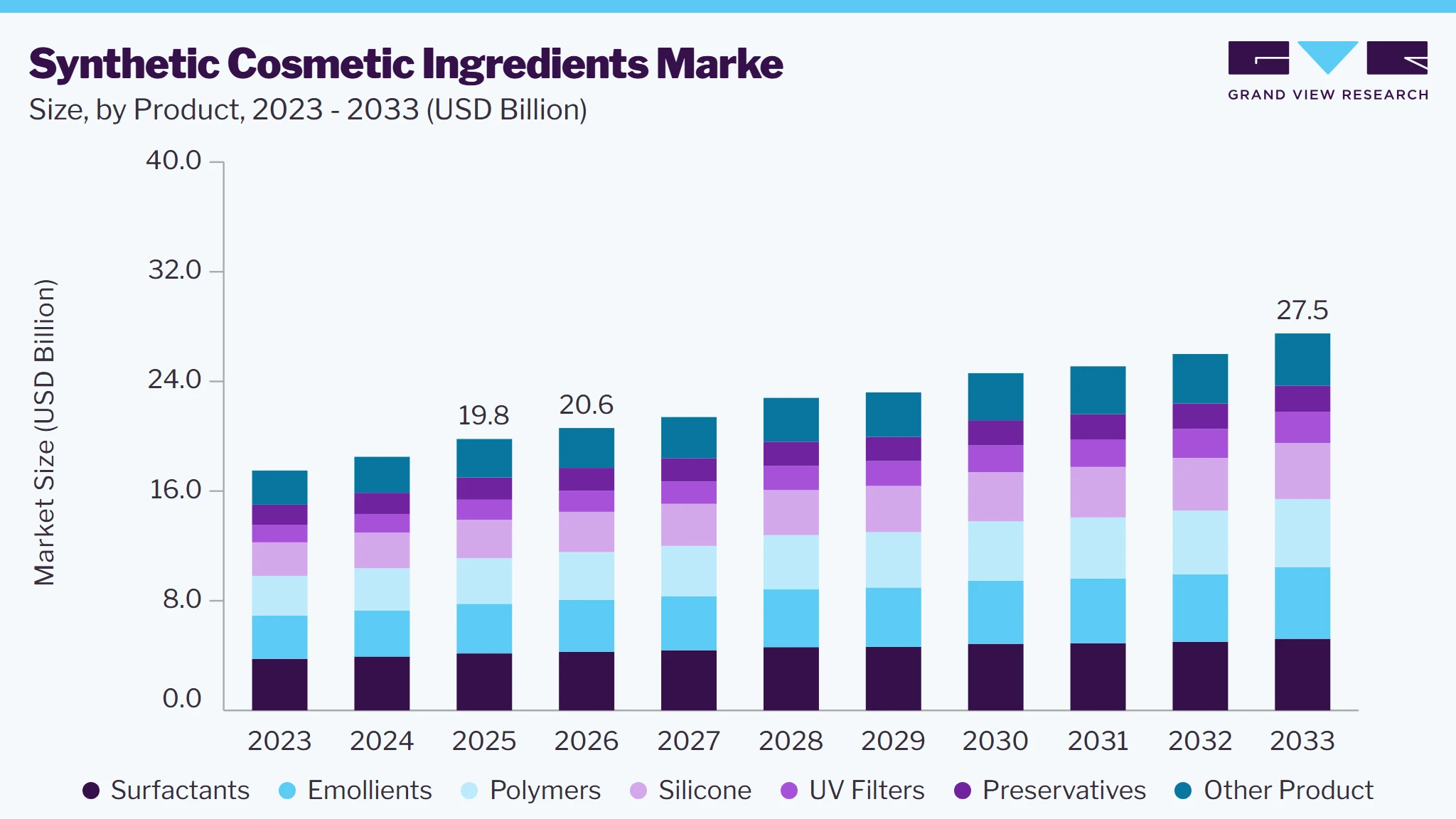 To learn more about this report, Download Free Sample Report
The development of multifunctional synthetic ingredients creates opportunities for suppliers to address evolving formulation requirements across premium and mass-market cosmetics. Ingredients that combine several performance benefits can help manufacturers simplify formulations and improve product differentiation.
Market Dynamics
The market is shaped by formulation performance, ingredient economics, compatibility requirements, and changing product-development priorities. Suppliers compete through technical expertise, product consistency, and the ability to meet manufacturers’ specifications. Regulatory compliance and consumer scrutiny of ingredient lists influence formulation choices. Innovation in ingredient functionality continues to create opportunities for differentiated product portfolios.
Cosmetic manufacturers require ingredients that deliver precise characteristics, including spreadability, emulsification, stability, and controlled viscosity. Synthetic ingredients offer formulators flexibility in adjusting these properties to suit different product formats and performance targets. The ability to customize molecular structures and functional characteristics supports the development of formulations with specific textures, application experiences, and shelf-life requirements. This technical flexibility strengthens demand among manufacturers seeking predictable results across product batches.
Consumer interest in plant-derived and naturally positioned beauty products can constrain the adoption of certain synthetic ingredients, particularly when brands emphasize clean-label positioning. This preference may encourage reformulation or reduce the inclusion of synthetic components in selected product lines. Ingredient suppliers may also face additional costs when responding to evolving customer specifications, substantiating safety profiles, and maintaining compliance across different jurisdictions. These requirements can increase development timelines and limit the commercial attractiveness of some formulations.
The expansion of targeted skin treatments, long-wear makeup, and performance-oriented hair and skin products creates scope for application-specific synthetic ingredients. Manufacturers can differentiate their offerings through ingredients engineered for stability, adhesion, sensory, or delivery characteristics. Suppliers with application laboratories and collaborative formulation capabilities are well positioned to develop tailored solutions with cosmetic brands. Technical partnerships can support faster product development, stronger customer retention, and higher-value ingredient portfolios.
Market Concentration & Characteristics
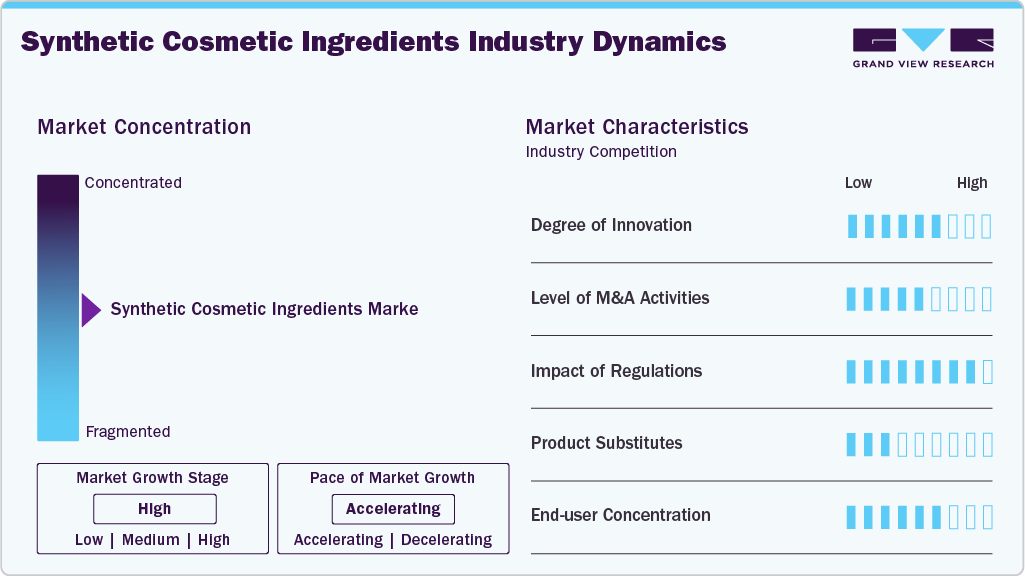
The industry includes multinational specialty chemical producers, diversified chemical manufacturers, and specialized ingredient suppliers. Competitive positioning varies according to technical capabilities, breadth of product offerings, manufacturing scale, and established relationships with cosmetic formulators.
 To learn more about this report, Download Free Sample Report
Product differentiation depends on functional performance, formulation compatibility, quality consistency, and regulatory documentation. Customer qualification requirements and the need for technical support can create switching barriers, while competition from alternative ingredient chemistries continues to influence pricing and product selection.
Analyst Perspective
The market's outlook depends on suppliers' ability to align chemical innovation with practical formulation needs and evolving cosmetic product strategies. Manufacturers combining reliable production with specialized technical support can strengthen customer relationships. Growth prospects are likely to vary by ingredient chemistry and application. Product differentiation and compliance capabilities will remain important competitive factors.
Product Insights
The surfactants segment accounted for 21.0% of market revenue in 2025 because they perform essential functions in cleansing, wetting, emulsification, and foam generation. Their broad incorporation into shampoos, facial cleansers, body washes, and other personal care formulations supports recurring industrial demand.
The UV filters are the fastest growing segment, with a CAGR of 5.6% from 2026 to 2033. Rising demand for sun protection and multifunctional skin care products is driving the adoption of synthetic UV filters. Their ability to provide targeted ultraviolet protection, formulation stability, and compatibility with sunscreens and daily-use cosmetics supports segment growth.
Application Insights
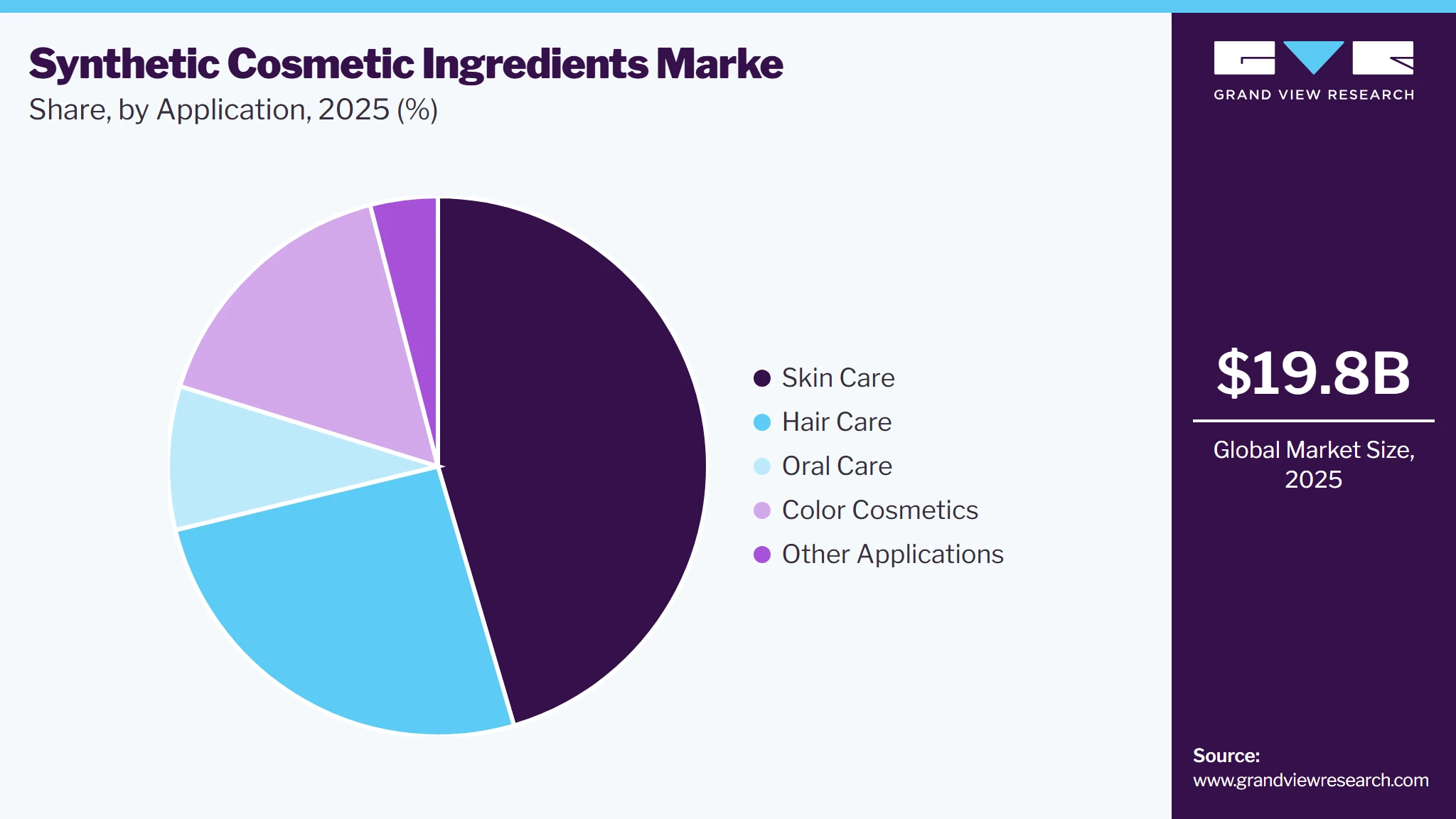
The skin care segment held the largest revenue share of 45.3% in 2025, due to the extensive use of synthetic emollients, surfactants, polymers, preservatives, and formulation aids. The diversity of moisturizers, cleansers, sunscreens, and treatment products sustains demand for ingredients that deliver stability and consistent application properties.
 To learn more about this report, Download Free Sample Report
The color cosmetics segment is projected to grow with a CAGR of 5.2% from 2026 to 2033. Color cosmetics offer growth potential through demand for long-wear, transfer-resistant, lightweight, and high-performance makeup products. Synthetic film formers, silicones, and texture-enhancing ingredients help achieve uniform coverage, improved adhesion, and desirable finish characteristics.
Regional Insights
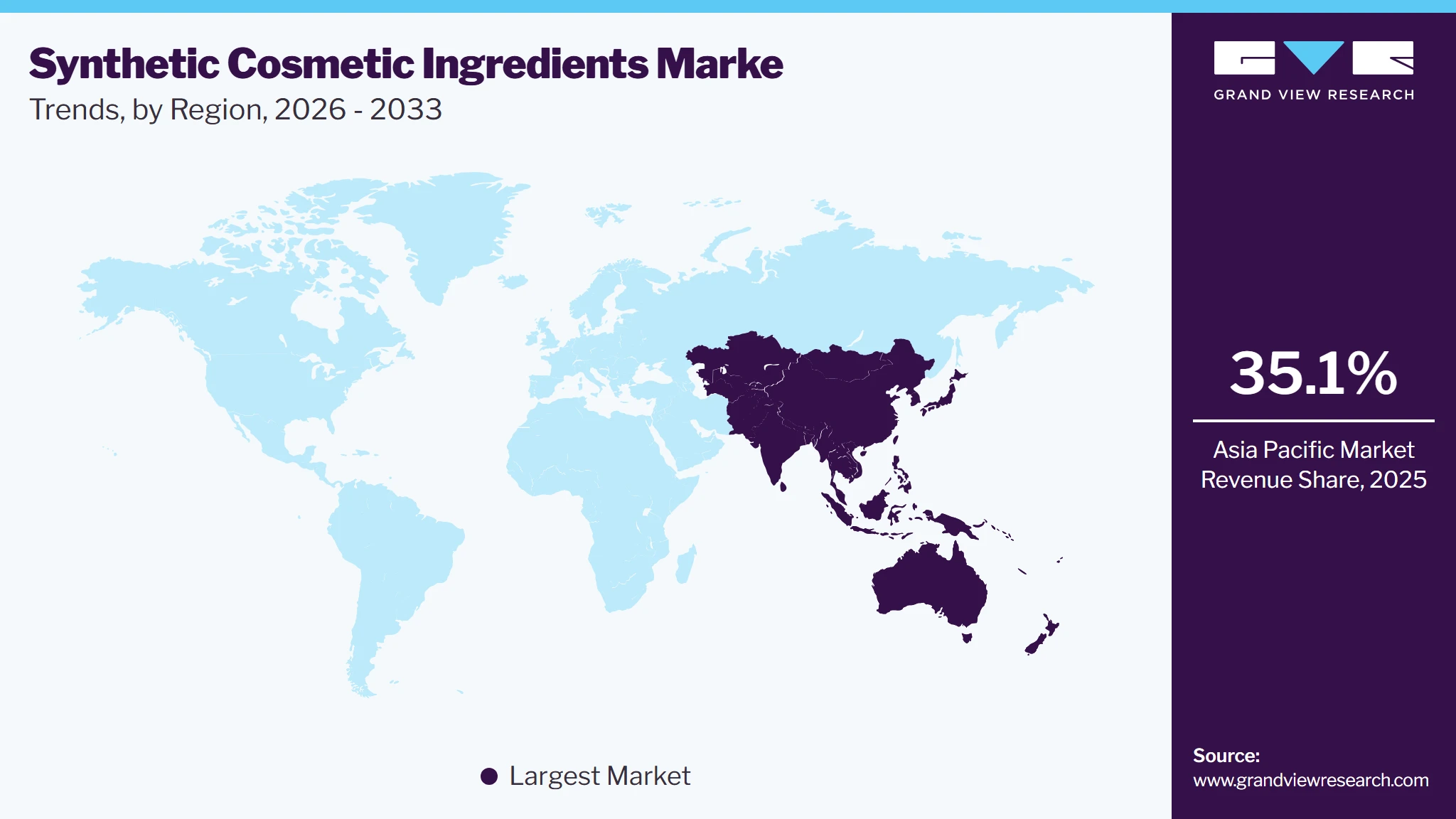
The Asia Pacific synthetic cosmetic ingredients market held the largest revenue share of 35.1% in 2025 and is also expected to witness the fastest CAGR from 2026 to 2033. Asia Pacific benefits from extensive cosmetics manufacturing networks, a large consumer base, and established ingredient-processing capabilities. Strong production ecosystems across personal care categories support substantial procurement of synthetic formulation inputs.
 To learn more about this report, Download Free Sample Report
The synthetic cosmetic ingredients market in China led Asia Pacific, supported by its domestic cosmetics manufacturing base and integrated chemical supply chains. Local ingredient development and production capabilities can improve responsiveness to brand requirements and shorten supply lead times. Growth in local beauty brands and product development is increasing demand for customized ingredients that deliver consistent performance, product stability, and improved sensory properties. Investments in domestic ingredient development also create opportunities for suppliers offering specialized solutions aligned with evolving formulation requirements.
North America Synthetic Cosmetic Ingredients Market Trends
The synthetic cosmetic ingredients market in North America is supported by established beauty brands, specialty formulation expertise, and a developed ecosystem of ingredient suppliers. Commercial emphasis on product performance and technical validation sustains demand for advanced cosmetic chemicals. The region's focus on product quality, formulation reliability, and consumer-driven innovation sustains demand for technically advanced cosmetic ingredients.
U.S. Synthetic Cosmetic Ingredients Market Trends
The synthetic cosmetic ingredients market in the U.S. is expected to grow at a CAGR of 4.0% during 2026 to 2033. The U.S. benefits from a mature cosmetics industry and strong capabilities in product development, specialty chemistry, and formulation testing. Brand innovation and demand for differentiated beauty products create opportunities for suppliers offering technically supported ingredients.
Europe Synthetic Cosmetic Ingredients Market Trends
The synthetic cosmetic ingredients market in Europe is influenced by stringent product-safety expectations, sophisticated formulation capabilities, and established specialty chemical producers. Suppliers that maintain comprehensive technical documentation and meet applicable regulatory requirements can strengthen their market position.
Latin America Synthetic Cosmetic Ingredients Market Trends
The synthetic cosmetic ingredients market in Latin America is supported by demand for personal care products adapted to local consumer preferences and climatic conditions. Regional beauty brands and contract manufacturers provide opportunities for ingredients suited to hair care, skin care, and color cosmetics.
Middle East & Africa Synthetic Cosmetic Ingredients Market Trends
The synthetic cosmetic ingredients market in the Middle East & Africa is linked to expanding personal care consumption, the growth of beauty retail, and increasing product diversification. Suppliers can pursue opportunities through regional distribution partnerships and formulations designed for local climatic and consumer requirements.
Key Synthetic Cosmetic Ingredients Company Insights
The global synthetic cosmetic ingredients market features established specialty chemical manufacturers and diversified ingredient suppliers competing through product innovation, technical expertise, and formulation capabilities. Key players focus on developing high-performance surfactants, silicones, polymers, emollients, and functional additives to address evolving cosmetic formulation requirements. Investments in research and development, product customization, and regulatory compliance remain central to strengthening market positioning and expanding customer relationships worldwide.
-
Wacker Chemie AG is a global chemical manufacturer with a strong portfolio of silicone-based solutions relevant to the synthetic cosmetic ingredients market. Its silicone technologies support skin care, hair care, and color cosmetic formulations by enhancing texture, spreadability, conditioning performance, and product stability. The company’s expertise in silicone chemistry and specialty materials supports cosmetic manufacturers seeking consistent ingredient quality and tailored formulation performance.
-
Elkem ASA is a global materials manufacturer specializing in silicon-based materials and silicone solutions, including ingredients for cosmetic and personal care formulations. Through its silicone portfolio, including the MIRASIL and PURESIL ranges, the company serves applications across skin care, hair care, sun care, and color cosmetics. Its focus on specialty silicone development and formulation support strengthens its position in performance-oriented cosmetic ingredients.
Key Synthetic Cosmetic Ingredients Companies
The following key companies have been profiled for the study on the global synthetic cosmetic ingredients market.
-
Wacker Chemie AG
-
Elkem ASA
-
Shin-Etsu Chemical Co., Ltd.
-
Dow
-
Siltech Corporation
-
BASF SE
-
Evonik Industries AG
-
Clariant AG
-
Ashland Inc.
-
Croda International
Company Categorization
Operating Strategies
Competitive Edge
Weaknesses
Mature Players: Wacker Chemie AG, Shin-Etsu Chemical Co., Ltd., Dow, BASF SE, Evonik Industries AG, Clariant AG, Ashland Inc., Croda International
- Mature players leverage broad ingredient portfolios, global manufacturing and distribution networks, research and development capabilities, and long-standing relationships with cosmetic manufacturers. Their strategies focus on portfolio expansion, formulation support, regulatory compliance, and developing differentiated ingredients for skin care, hair care, and color cosmetics.
- These companies benefit from established customer relationships, technical resources, manufacturing scale, and the ability to supply multiple ingredient categories. Their diversified portfolios and global reach support cross-selling opportunities and reliable service to multinational cosmetics brands.
- Large organizational structures and complex product portfolios may slow responses to niche customer requirements. Exposure to multiple chemical markets, production costs, and the need to maintain compliance across jurisdictions can also affect investment flexibility and pricing competitiveness.
Emerging Players: Elkem ASA, Siltech Corporation
- Specialized players concentrate on differentiated ingredient technologies, targeted cosmetic applications, and customer-specific formulation development. Their strategies emphasize technical collaboration, proprietary chemistries, and faster adaptation to specialized performance requirements.
- Focused product portfolios can enable deeper expertise in selected ingredient categories and more tailored technical support. Close collaboration with formulators can help these companies address specific performance challenges and build relationships in high-value cosmetic applications.
- Compared with diversified chemical groups, specialized suppliers may have narrower product coverage and fewer opportunities to bundle ingredients across categories. Their competitive position can also be affected by customer concentration, limited scale in certain markets, and dependence on particular ingredient technologies.
Recent Developments
-
In April 2026, Elkem introduced three PURESIL innovations for beauty formulations: ORG 0415, ORG 0515, and ESG 03. The products target sensory enhancement, moisture retention, pigment dispersion, and formulation stability across skin care, sun care, and color cosmetics.
-
In March 2026, WACKER announced the completion of the second phase of its expansion at Panagarh, India, bringing a new production complex for silicone emulsions into operation. The GMP-certified facility will increase supply capacity for cosmetic and personal care ingredients, strengthening the company's ability to serve regional demand.
Synthetic Cosmetic Ingredients Market Report Scope
Report Attribute
Details
Market Definition
The Synthetic Cosmetic Ingredients Market comprises the production and supply of chemically synthesized ingredients used in skin care, hair care, color cosmetics, and other personal care formulations. These ingredients include surfactants, silicones, polymers, emollients, UV filters, and other functional compounds that enhance product stability, texture, cleansing, conditioning, preservation, and overall performance. The market covers ingredients supplied to cosmetic manufacturers for incorporation into finished formulations, excluding finished cosmetic products and ingredients derived exclusively from natural sources..
Market size in 2025
USD 19.8 billion
Estimated market size in 2026
USD 20.6 billion
Projected market size by 2033
USD 27.5 billion
Growth rate
CAGR of 4.2% from 2026 to 2033
Base year for estimation
2025
Historical data
2021 – 2024
Forecast period
2026 – 2033
Quantitative units
Revenue in USD billion, and CAGR from 2026 to 2033
Report coverage
Revenue forecast, company ranking, competitive landscape, growth factors, and trends
Segments covered
Product, application, region
Regional scope
North America; Asia Pacific; Europe; Latin America; Middle East & Africa
Country scope
U.S.; Canada; Mexico; Germany; UK; France; Italy; Spain; China; India; Japan; South Korea; Brazil; Argentina; Saudi Arabia; South Africa
Key companies profiled
Wacker Chemie AG; Elkem ASA; Shin-Etsu Chemical Co., Ltd.; Dow; Siltech Corporation; BASF SE; Evonik Industries AG; Clariant AG Ltd; Ashland Inc.; Croda International
Customization scope
Free report customization (equivalent up to 8 analysts’ working days) with purchase. Addition or alteration to country, regional & segment scope.
Pricing and purchase options
Avail customized purchase options to meet your exact research needs. Explore purchase options
Global Synthetic Cosmetic Ingredients Market Report Segmentation
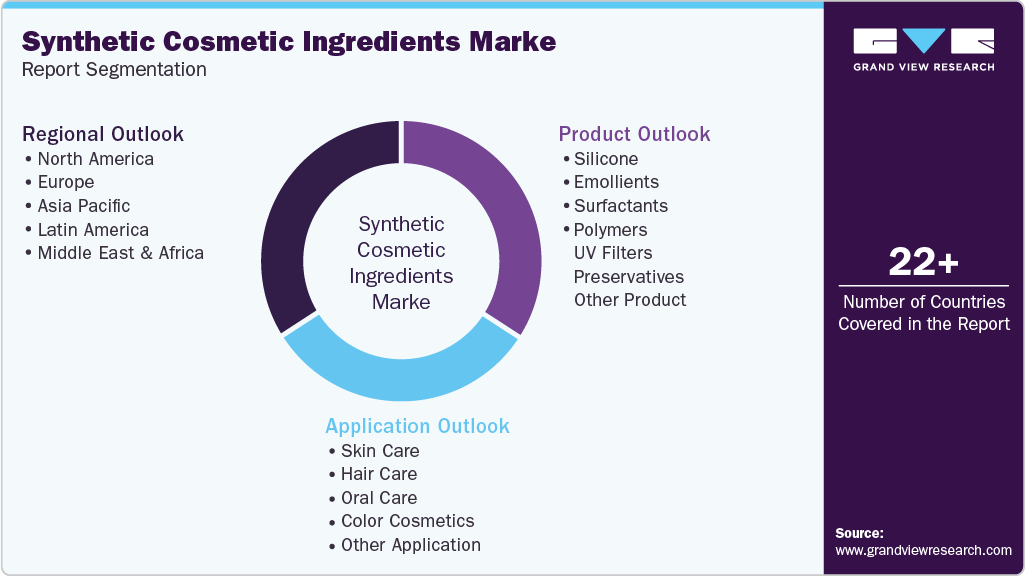
This report forecasts revenue growth at the global, regional and country levels and provides an analysis of the latest industry trends in each of the sub-segments from 2021 to 2033. For this study, Grand View Research has segmented the global synthetic cosmetic ingredients market report based on product, application and region:
 To learn more about this report, Download Free Sample Report
-
Product Outlook (Revenue, USD Billion, 2021 - 2033)
-
Silicone
-
Emollients
-
Surfactants
-
Polymers
-
UV Filters
-
Preservatives
-
Other Product
-
-
Application Outlook (Revenue, USD Billion, 2021 - 2033)
-
Skin Care
-
Hair Care
-
Oral Care
-
Color Cosmetics
-
Other Application
-
-
Regional Outlook (Revenue, USD Billion, 2021 - 2033)
-
North America
-
U.S.
-
Canada
-
Mexico
-
-
Europe
-
Germany
-
UK
-
France
-
Italy
-
Spain
-
-
Asia Pacific
-
China
-
India
-
Japan
-
South Korea
-
-
Latin America
-
Brazil
-
Argentina
-
-
Middle East & Africa
-
Saudi Arabia
-
South Africa
-
-
Research Methodology
The synthetic cosmetic ingredients market figures in this report are based on a proven research process that combines executive interviews with secondary research from proprietary databases, company filings, and recognized regulatory and institutional sources. Market size is built through value-chain sizing—reconciling supply-side and demand-side estimates—and triangulated with bottom-up and top-down approaches. Every estimate passes multiple levels of expert validation before publication, with each synthetic cosmetic ingredients segment quantified using the revenue-capture definitions in the table below.
Segment Definition
Segment – Product
Revenue capture definition
Silicone
Revenue generated from the sale of synthetically produced silicone-based ingredients used to improve spreadability, texture, conditioning, smoothness, and water resistance in cosmetic formulations.
Emollients
Revenue generated from the sale of synthetic non-silicone emollient ingredients used to soften, smooth, and condition the skin and improve the sensory properties of cosmetic products.
Surfactants
Revenue generated from the sale of synthetic surfactants used for cleansing, foaming, wetting, emulsification, and dispersion in cosmetic and personal care formulations.
Polymers
Revenue generated from the sale of synthetic polymers used as film formers, thickeners, conditioning agents, binders, and rheology modifiers in cosmetic formulations.
UV Filters
Revenue generated from the sale of synthetically produced ultraviolet filters incorporated into sunscreen and other cosmetic formulations to provide protection against UV radiation.
Preservatives
Revenue generated from the sale of synthetic preservative ingredients used to inhibit microbial growth and maintain the safety and shelf life of cosmetic products.
Other Product
Revenue generated from the sale of synthetic cosmetic ingredients not covered by the specified product categories, including synthetic fragrance chemicals, colorants, humectants, solvents, and other functional ingredients.
Segment – Application
Revenue capture definition
Skin Care
Revenue generated from the sale of synthetic cosmetic ingredients incorporated into skincare products, including moisturizers, facial cleansers, serums, lotions, creams, and anti-aging formulations.
Hair Care
Revenue generated from the sale of synthetic cosmetic ingredients used in shampoos, conditioners, hair styling products, hair treatments, and other hair care formulations.
Oral Care
Revenue generated from the sale of synthetic ingredients used in cosmetic oral care products, including toothpastes, mouthwashes, and breath-freshening formulations, within the defined market scope.
Color Cosmetics
Revenue generated from the sale of synthetic cosmetic ingredients used in makeup products, including foundations, lipsticks, mascaras, eyeliners, and other decorative cosmetics.
Other Application
Revenue generated from the sale of synthetic cosmetic ingredients used in applications outside the specified categories, including fragrances, nail care, sun care products not allocated to Skin Care, and personal hygiene formulations.
Estimation Model
Layer No.
Layer Name
Key Question
Description
01
Global Production Baseline
What is the global revenue generated by synthetic cosmetic ingredients?
Establishes the 2025 global market baseline in USD, covering revenues generated from the sale of synthetically produced cosmetic ingredients supplied for use in skincare, hair care, oral care, color cosmetics, and other cosmetic applications. The baseline is developed using ingredient manufacturers' revenues and disclosures, production capacities, product portfolios, manufacturing investments, product launches, company financial reports, trade data, cosmetic industry production indicators, and other relevant primary industry sources. The scope excludes finished cosmetic product sales and ingredients outside the defined synthetic cosmetic ingredients market.
02
Country-Level Market Assessment
How is synthetic cosmetic ingredients revenue distributed across countries?
Develops country-level market estimates by assessing cosmetic and personal care manufacturing activity, synthetic ingredient production capacity, ingredient consumption, finished-product manufacturing volumes, import and export flows, local supplier revenues, industry investments, and company presence. Country-level estimates are calibrated against regional market baselines and relevant national cosmetic and personal care industry indicators to establish a consistent distribution of synthetic cosmetic ingredients revenue across countries.
03
Product Allocation
How is synthetic cosmetic ingredients revenue distributed across ingredient categories?
Allocates the global market across Silicone; Emollients; Surfactants; Polymers; UV Filters; Preservatives; and Other Products. Allocation is based on the revenue generated by ingredient manufacturers within each category, product portfolio contributions, ingredient demand across cosmetic formulations, production and supply capacity, pricing trends, supplier disclosures, and the adoption of specific ingredient types across end-use applications. Silicone ingredients are classified separately from non-silicone emollients, while Other Products captures synthetic cosmetic ingredients not included in the specified categories, such as eligible synthetic fragrance chemicals, colorants, humectants, and solvents.
04
Application Allocation
How is synthetic cosmetic ingredients revenue distributed across end-use applications?
Allocates synthetic cosmetic ingredients revenue across Skin Care; Hair Care; Oral Care; Color Cosmetics; and Other Applications. The allocation considers ingredient consumption across finished-product formulations, cosmetic and personal care product manufacturing volumes, application-specific formulation requirements, ingredient usage intensity, average ingredient prices, product launches, and demand trends. Other Applications includes eligible uses in fragrances, nail care, personal hygiene, and other cosmetic applications not captured in the specified categories. Revenue is attributed to the primary end-use application of the formulation to prevent double counting across applications.
Delivered Customizations
This report has been delivered with the following In-depth customizations
Client Request
Customization Delivered
Value Adds
Cross-Segmentation Analysis
The analysis evaluates the relationship between Silicone; Emollients; Surfactants; Polymers; UV Filters; Preservatives; and Other Products across Skin Care, Hair Care, Oral Care, Color Cosmetics, and Other Applications.
Provides visibility into high-value ingredient–application combinations, highlighting ingredient demand patterns and application-specific growth opportunities. Supports ingredient portfolio prioritization, customer targeting, product development, and identification of attractive market segments.
Competitive Benchmarking
Leading synthetic cosmetic ingredient manufacturers are benchmarked based on product portfolios, ingredient manufacturing capabilities, production footprint, geographic presence, end-use application coverage, research and development activities, product innovations, strategic partnerships, capacity expansions, sustainability initiatives, and recent corporate developments.
Identifies competitive strengths, portfolio gaps, product differentiation, geographic positioning, innovation capabilities, and strategic expansion priorities. Supports competitor assessment, market-entry planning, product portfolio development, partnership evaluation, and investment decisions.
Opportunity Assessment
Growth opportunities are assessed across the seven product categories silicone; emollients; surfactants; polymers; UV filters; preservatives; and other products and five application categories skin care, hair care, oral care, color cosmetics, and other applications. The assessment considers ingredient demand trends, formulation innovations, evolving consumer preferences, regulatory requirements, manufacturing developments, and expansion opportunities across geographic markets.
Supports the identification of priority ingredient categories, high-growth applications, emerging formulation requirements, underserved customer needs, and attractive investment opportunities. Enables informed decisions on product innovation, manufacturing capacity expansion, customer targeting, strategic partnerships, and geographic expansion.
About the Author(s)
Personal Care & Cosmetic Ingredients Research Team
Specialty & Fine Chemicals · Personal Care & Cosmetic IngredientsThis report was authored by the personal care & cosmetic ingredients research team at Grand View Research - comprising two research analysts, one senior research analyst, and one industry expert - with specialized expertise in the personal care & cosmetic ingredients segment of the specialty & fine chemicals industry. All findings are based on proprietary specialty & fine chemicals databases, executive interviews, and regulatory analysis, subject to internal peer review prior to publication.
Last Updated:
Speak to Analyst

Customize this report to your needs - add regions, segments, or data points, with 20% free customization.
Or view our licence options:


ISO 9001:2015 & 27001:2022 Certified
We are GDPR and CCPA compliant! Your transaction & personal information is safe and secure. For more details, please read our privacy policy.


