
- Home
- »
- Advanced Interior Materials
- »
-
Talc Market Size, Share, Trends, Growth Report, 2026 - 2033GVR Report cover

Talc Market (2026 - 2033)
Size, Share & Trends Analysis Report By Product (Talc Carbonate, Talc Chlorite), By Application (Plastics, Pulp & Paper), By Region (North America, Europe, Asia Pacific, Latin America, Middle East & Africa), And Segment Forecasts
Market Size, 2025
$2.0BMarket Estimate, 2026
$2.1BMarket Forecast, 2033
$2.7BCAGR, 2026–2033
3.8%Talc Market Summary
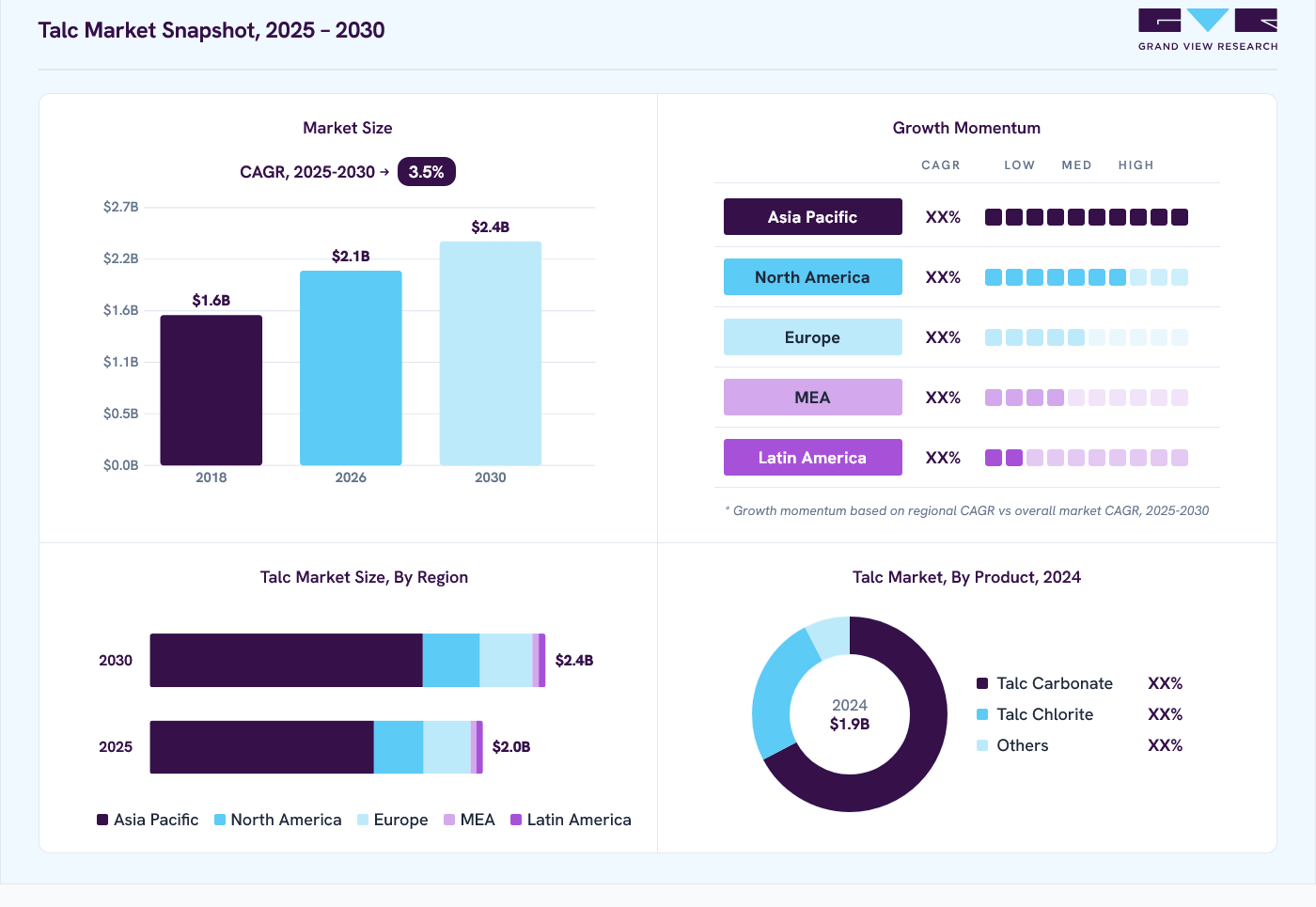
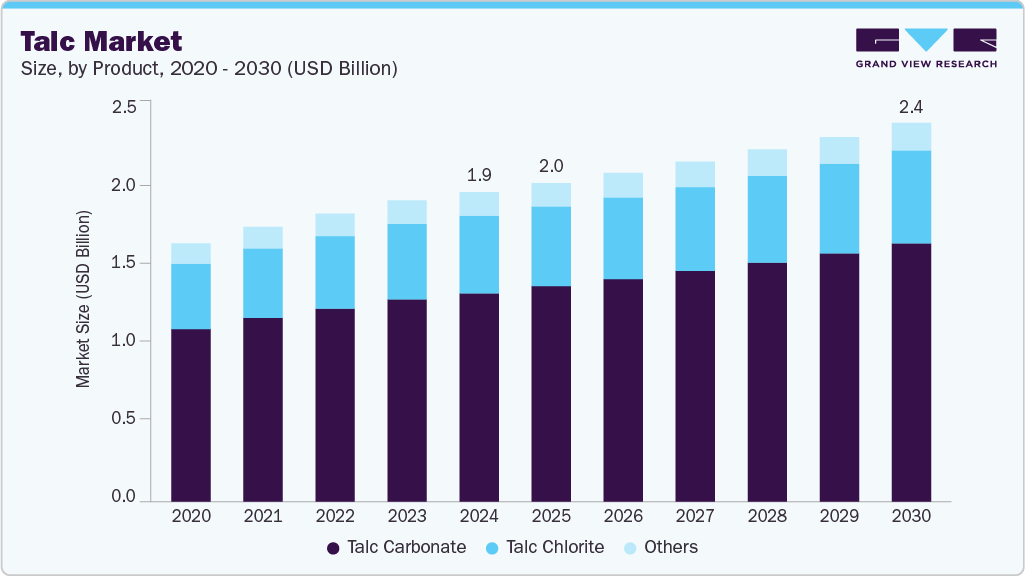
The global talc market size was valued at USD 2.0 billion in 2025 and is projected to grow from USD 2.1 billion in 2026 to USD 2.7 billion by 2033, growing at a CAGR of 3.8% from 2026 to 2033. Asia Pacific dominated the market, accounting for the largest global share of 67.3% in 2025. Talc acts as a filler and reinforcing agent, significantly enhancing the mechanical properties of plastics such as polypropylene, polyethylene, and polyamide.
 Source: Grand View Research, IR Documents, Primary Interviews, Paid DatabasesTo learn more about this report,
 Download Free Sample Report
 Key Market Trends & Insights
- By product: Talc carbonate segment held the revenue share of 67.4% in 2025.
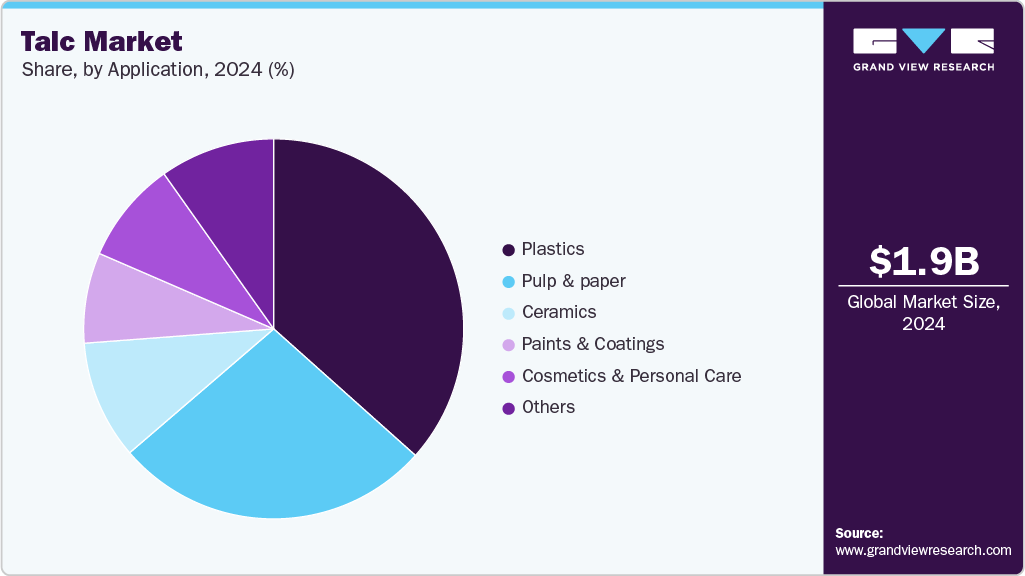
- By application: Plastics segment held the largest revenue share of 36.9% in 2025.
Regional Highlights
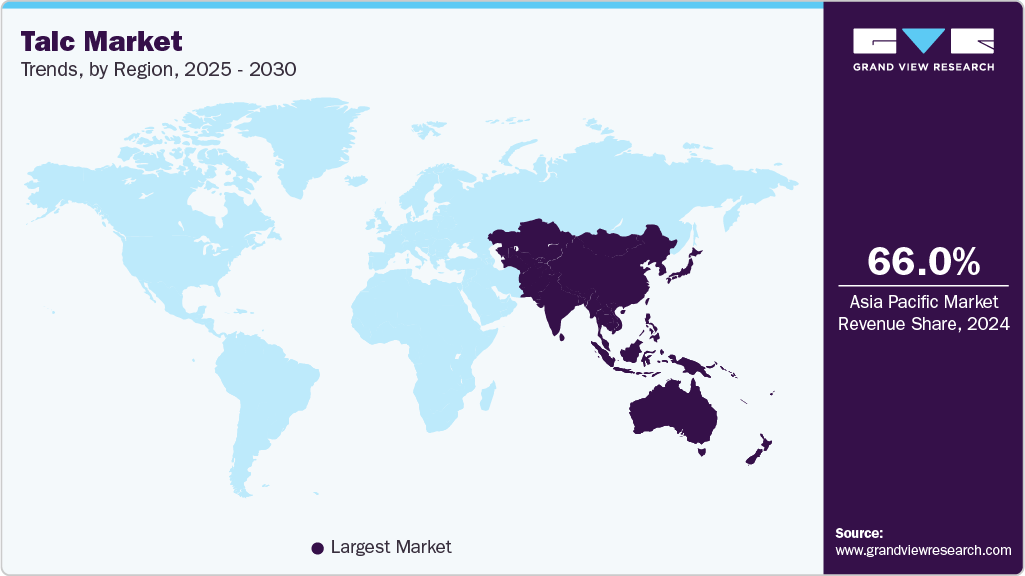
- Largest regional market: Asia Pacific (67.3% revenue share, 2025)
- By country: China held the largest share of Asia Pacific in 2025.
Market Size & Forecast
- Market size in 2025: USD 2.0 billion
- Estimated market size in 2026: USD 2.1 billion
- Projected market size by 2033: USD 2.7 billion
- CAGR (2026-2033): 3.8%
Three ways to get this report
Buy it, customize it, or ask a question.Ask an Analyst
Analyst response in 1 business day
- AccessReport author, directly
- Reply timeWithin 1 working day
- No sales callDirect answer only
- FormatEmail reply
- CostFree, no cost
Get the Full Report
What the study covers
- FormatsPDF · Excel · Dashboard
- Timeline2026–2033 annual, 2025 base
- Coverage20+ countries, 5 regions
- Companies10+ key players profiled
Customize the Report
20% free customization
- IncludeCountries, segments, points
- TailorTo your product definition
- ExtendDeeper competitor detail
- OrA fully bespoke study
- Turnaround5–10 working days
The increasing demand for lightweight automotive components to improve fuel efficiency has boosted the consumption of talc-reinforced plastics. Moreover, the growing use of talc-filled polypropylene in packaging, automotive parts, and consumer goods contributes to the market's expansion. As the automotive and packaging sectors continue to grow globally, particularly in emerging economies, the demand for talc as a key additive in polymer compounds is projected to rise steadily.The paints and coatings industry is another significant driver of the talc market. Talc is widely used as an extender pigment in paints due to its high dispersion and opacity properties and ability to improve weather resistance and corrosion protection. With the robust growth of the construction sector worldwide, especially in regions like Asia Pacific and the Middle East, the demand for decorative and protective coatings has surged. Additionally, talc is utilized to enhance the rheological properties of coatings, making them more durable and resistant to environmental factors. As infrastructure projects and residential construction continue to rise, the demand for paints and coatings industry talc is expected to grow consistently.
 To learn more about this report, Download Free Sample Report
 The pulp and paper industry remains a vital application segment for talc, as it is used as a pitch control agent and filler to improve paper brightness, opacity, and printability. The steady rise in the production of specialty papers, packaging materials, and tissue products fueled the demand for talc. Additionally, the increasing consumer preference for high-quality, eco-friendly paper products has prompted manufacturers to enhance their production processes, where talc is a cost-effective and efficient additive.
The cosmetics and personal care industry contributes to the growth of the talc market. Talc is a crucial ingredient in a wide range of cosmetic products, including face, body, and skin care formulations, due to its ability to absorb moisture and provide a smooth, silky texture. The increasing awareness of personal grooming and hygiene, particularly in emerging economies, has spurred the demand for talc-based products. Furthermore, the trend toward natural and mineral-based cosmetics has bolstered talc's relevance, as manufacturers opt for talc in formulations to offer safe and skin-friendly products.
Government policies promoting mineral resource development and favorable mining activity regulations have positively impacted the talc market. Countries such as China, India, and the U.S. are key talc producers and have introduced policies to streamline mining operations and encourage investments in mineral processing industries. Moreover, strategic collaborations between governments and mining companies have enhanced the production and export capacities, stabilizing supply chains.
Market Dynamics
The growth of the talc market is being driven by increasing demand from plastics, paints & coatings, ceramics, paper, and personal care industries. Talc is widely used as a functional filler, reinforcing agent, anti-caking additive, and performance enhancer due to its excellent chemical inertness, softness, thermal stability, and platy particle structure. Rapid industrialization, rising automotive production, expanding construction activities, and growth in consumer goods manufacturing across emerging economies are significantly boosting talc consumption. In addition, increasing demand for lightweight polymer composites and high-performance coatings is further supporting market expansion.
The increasing use of talc in plastics, particularly polypropylene compounds, is one of the primary drivers of the global talc market. Talc enhances stiffness, dimensional stability, heat resistance, and impact strength in plastic components, making it highly suitable for automotive, packaging, consumer goods, and electrical applications. Automotive manufacturers are increasingly utilizing talc-filled plastics to reduce vehicle weight, improve fuel efficiency, and support electric vehicle (EV) production. As global vehicle production continues to grow, particularly in Asia-Pacific markets such as China and India, demand for talc-reinforced polymers is rising steadily.
Beyond automotive applications, talc is extensively used in packaging materials, household appliances, and industrial products. The growing shift toward lightweight and durable plastic materials across multiple industries is creating sustained demand for talc. Furthermore, advancements in polymer compounding technologies are expanding talc's application scope in engineering plastics and specialty compounds. As manufacturers continue to seek cost-effective solutions that improve material performance, talc remains a preferred mineral filler in the global plastics industry.
Health and regulatory concerns associated with talc represent a key challenge for market growth. In recent years, talc used in cosmetic and personal care applications has faced increased scrutiny regarding potential contamination with asbestos and related health risks. Regulatory agencies across several countries have strengthened quality control requirements, testing standards, and compliance regulations for talc producers. Legal disputes and product recalls involving talc-containing consumer products have also affected market sentiment and increased operational risks for manufacturers. These concerns have encouraged some end users to explore alternative mineral fillers such as calcium carbonate, kaolin, and silica in selected applications. Compliance with stringent safety regulations often increases production costs due to additional testing, certification, and quality assurance requirements. Consequently, regulatory uncertainty and evolving safety standards continue to pose challenges for talc suppliers operating in cosmetics, pharmaceuticals, and consumer product segments.
The expansion of global construction and infrastructure activities presents a significant opportunity for the talc market. Talc is widely used in paints and coatings as a functional extender pigment that improves weather resistance, corrosion protection, suspension properties, and coating durability. Growing investments in residential, commercial, and industrial construction projects are increasing demand for architectural and protective coatings, thereby supporting talc consumption. In addition, infrastructure development across Asia-Pacific, the Middle East, and Africa is generating substantial demand for industrial coatings used in bridges, transportation networks, energy facilities, and public infrastructure. Talc's ability to enhance coating performance while reducing formulation costs makes it an attractive material for manufacturers. As governments continue investing in urbanization, smart cities, renewable energy facilities, and transportation infrastructure, the demand for high-performance paints and coatings is expected to create long-term growth opportunities for the global talc market.
Analyst Perspective
The talc market is increasingly becoming a value-driven rather than volume-driven industry. While traditional demand from paper and ceramics remains stable, the real growth is coming from plastics, where manufacturers are using talc to reduce costs, improve stiffness, and lightweight automotive components. The industry's competitive edge is shifting toward producers that can supply high-purity, finely processed talc grades capable of meeting stringent performance and regulatory requirements. In the coming years, success will depend less on access to mineral reserves and more on beneficiation technology, product consistency, and the ability to serve specialty applications where margins are significantly higher than those of conventional industrial talc.
Drivers, Opportunities & Restraints
The talc market is primarily driven by its versatile applications across various industries, including plastics, paints and coatings, pulp and paper, and personal care. In the plastics industry, talc acts as a reinforcing filler, improving polymers' stiffness, impact resistance, and dimensional stability, particularly in automotive applications. Additionally, the demand for lightweight automotive components has propelled the consumption of talc-filled polypropylene. The paints and coatings sector also significantly contributes to market growth, as talc enhances the product's weather resistance and smooth texture. Furthermore, the cosmetics industry relies on talc for its moisture-absorbing and skin-friendly properties, while the pulp and paper sector uses it to improve printability and opacity. The consistent demand from these end-use industries forms the backbone of the talc market's expansion.
The increasing focus on sustainable and eco-friendly materials presents substantial opportunities for the talc market. As industries like automotive and packaging strive for lightweight and recyclable materials, talc-based composites are gaining traction as a cost-effective and durable solution. Moreover, the rapid growth of emerging economies, particularly in Asia-Pacific, where construction and automotive industries are booming, creates new avenues for talc demand. Given the growing consumer preference for non-toxic and natural ingredients, the cosmetics sector's shift towards natural and mineral-based formulations also bodes well for the talc market. Additionally, advancements in mining technologies and the exploration of high-purity talc products can enhance supply efficiency and reduce production costs, further boosting market potential.
Despite its wide applications, the talc market faces challenges that could hinder its growth. Health concerns related to the use of talc, particularly in cosmetics and personal care products, have led to increased regulatory scrutiny and lawsuits, affecting market sentiment. Allegations of asbestos contamination in talc-based products have prompted companies to invest in rigorous quality testing and certification processes, increasing operational costs.
Product Insights
Based on product, the talc carbonate segment held the revenue share of 67.4% in 2025. The talc carbonate segment is the dominant deposit type in the global talc market, attributed to its superior purity and physical properties. Talc carbonate ores, primarily composed of talc and carbonates like magnesite or dolomite, are typically found in metamorphosed ultramafic rocks. These deposits yield talc with a specific gravity of up to 2.86 and a density of up to 2.8 g/cm³, making them highly desirable for industrial applications. The processing of these ores involves removing associated minerals to produce a pure talc concentrate, which is extensively utilized across various industries due to its softness, chemical inertness, and hydrophobic nature.
Talc chlorite is anticipated to register the significant CAGR over the forecast period. Talc chlorite deposits, comprising a mixture of talc and chlorite minerals, are known for their softness and organophilic nature. These properties make talc chlorite particularly valuable in ceramics, paints, cosmetics, pharmaceuticals, and food processing industries. For instance, talc chlorite enhances thermal shock resistance in ceramics, making it suitable for refractory applications. The paints and coatings industry benefits from its ability to provide corrosion protection, solvent reduction, and good adhesion.
Application Insights
Based on application segment, the plastics segment led the market with the largest revenue share of 36.9% in 2025. Talc serves as a functional filler in plastics, improving properties such as stiffness, heat resistance, and dimensional stability. These enhancements are particularly valuable in industries like automotive manufacturing, where talc-filled polypropylene produces lightweight components that contribute to fuel efficiency and reduced emissions. Additionally, talc's incorporation into plastic formulations can lower production costs by allowing for the substitution of more expensive resins without compromising product quality.
 To learn more about this report, Download Free Sample Report
 Cosmetics & personal care is anticipated to register the fastest CAGR over the forecast period owing to talc's desirable properties such as moisture absorption, smooth texture, and ability to prevent caking. Talc is extensively utilized in products like baby powders, body powders, deodorants, foundations, and various makeup items. Its application enhances product feel and performance, making it a preferred ingredient in personal care formulations.
Regional Insights
Asia Pacific dominated the talc market with the largest revenue share of 67.3% in 2025, driven by significant demand across key industries such as plastics, automotive, construction, and personal care. In the plastics sector, talc's role as a reinforcing filler enhances the mechanical properties of materials, making it indispensable in manufacturing lightweight automotive components and durable construction materials. The automotive industry, particularly in China and India, saw increased production of electric vehicles (EVs), which utilize talc-filled plastics to reduce vehicle weight and improve fuel efficiency.
 To learn more about this report, Download Free Sample Report
 China Talc Market Trends
China held the largest share in the Asia Pacific talc market in 2025.
North America Talc Market Trends
In North America, especially the U.S. and Canada, the automotive industry significantly influences the talc market. Talc is extensively used as a filler and reinforcement agent in automotive plastics to enhance mechanical properties such as stiffness, impact resistance, and dimensional stability. The push towards lightweight vehicles to improve fuel efficiency and reduce emissions has led to increased adoption of talc-reinforced polypropylene in automotive parts, including dashboards, bumpers, and interior components. As EVs and fuel-efficient cars gain traction, the demand for talc-based composites continues to rise, thereby boosting the talc market in the region. In 2024, the U.S. and Canada achieved around 9.0% growth in EV sales, with 1.8 million units sold.
U.S. Talc Market Trends
The U.S. market is witnessing a shift toward stricter safety and quality standards. In April 2024, the U.S. Food and Drug Administration (FDA) proposed mandatory asbestos testing for all cosmetic products containing talc, a move supported by leading companies such as Estée Lauder and Johnson & Johnson to reinforce consumer trust. This regulatory momentum has encouraged pharmaceutical-grade, asbestos-free talc, particularly in baby powders, setting powders, and facial makeup. As companies emphasize transparency and compliance, demand for high-purity talc is increasing, helping the segment maintain its relevance and drive growth within the U.S. personal care industry.
Europe Talc Market Trends
Europe has a well-established plastics and polymer industry that extensively uses talc as a cost-effective filler and performance enhancer. Talc's use in plastic production helps improve thermal resistance, rigidity, and process ability, making it an essential component in various industrial applications. The increasing adoption of engineered plastics in packaging, automotive, consumer electronics, and construction sectors drives the demand for talc-filled polymer.
Latin America Talc Market Trends
Latin America’s automotive industry, particularly in countries like Brazil, Mexico, and Argentina, is a major growth driver for the talc market. Talc is extensively used as a reinforcing filler in automotive plastics, enhancing their stiffness, impact resistance, and thermal stability. The rising demand for lightweight automotive components, driven by fuel efficiency regulations and consumer preferences for eco-friendly vehicles, has bolstered the use of talc-filled polypropylene and other plastic composites.
Middle East & Africa Talc Market Trends
The personal care and cosmetics industry in the Middle East and Africa is growing rapidly, driven by increased disposable incomes and a strong cultural emphasis on grooming and hygiene. Talc, recognized for its superior moisture-absorbing and smoothing qualities, is a vital component in numerous cosmetic products, including body powders, face powders, and skincare formulations. The rise of mineral-based and natural cosmetics, coupled with consumer awareness about product safety, promotes the use of high-purity, asbestos-free talc. Countries like Saudi Arabia, South Africa, and Nigeria are witnessing a surge in demand for talc-based personal care products, boosting the overall market growth.
Key Talc Company Insights
Some of the key players operating in the market include American Talc Company, Beihai Group, and others
-
American Talc Company (ATC), formerly known as Wold Talc Co., is a prominent talc producer based in Texas. ATC specializes in producing various grades of talc, catering to industries such as ceramics, paints, plastics, and rubber. Their talc products are known for their high purity and consistent quality, making them suitable for applications that require fine particle size and brightness. The company's strategic location and control over regional talc resources enable it to effectively meet the specific needs of its diverse clientele.
-
Beihai Group, officially known as Liaoning Beihai Industry (Group) Co., Ltd., is a leading Chinese mining and powder processing enterprise. The company operates the Yangjiadian Talc Mine, among others, and produces a wide range of talc products in various industries, including rubber, ceramics, plastics, and cosmetics. Beihai Group's talc is known for its high purity and fine particle size, making it suitable for applications that demand superior quality.
Key Talc Companies:
The following are the leading companies in the talc market.
- American Talc Company
- Beihai Group
- Golcha Associated
- Himalaya International
- Magris Talc
- Minerals Technologies Inc.
- Specialty Minerals Inc.
- Talc de Luzenac
- Wollastonite
- Xinyu Talc
Competitive Benchmarking
Category
Operating Strategies
Competitive Edge
Weakness
Established Players (e.g., Beihai Group, Golcha Associated, Magris Talc, Minerals Technologies Inc., Specialty Minerals Inc., Talc de Luzenac)
- Mature participants in the talc market focus on large-scale mining operations, mineral processing, product innovation, and long-term supply agreements with plastics, ceramics, paints & coatings, paper, pharmaceuticals, and personal care manufacturers.
- These companies typically operate integrated value chains covering mining, beneficiation, micronization, surface treatment, and specialty mineral processing to serve diverse industrial applications globally.
- Established players benefit from extensive mineral reserves, advanced processing technologies, diversified product portfolios, and strong global distribution networks.
- Their scale enables consistent product quality, secure raw material availability, regulatory compliance, and the ability to serve multinational customers across multiple end-use industries.
- Despite their strong market position, established companies face challenges related to environmental regulations, mine permitting requirements, sustainability compliance costs, and fluctuations in industrial demand.
- Exposure to legal and regulatory scrutiny, particularly in cosmetic and pharmaceutical talc applications, can also impact operational costs and market growth.
Emerging & Regional Players (e.g., American Talc Company, Himalaya International, Xinyu Talc)
- Emerging participants generally focus on regional market expansion, niche talc grades, customized mineral solutions, and cost-competitive production strategies.
- These companies often target specific applications such as plastics, rubber, ceramics, paints, agriculture, and local industrial manufacturing sectors where tailored products and customer responsiveness provide competitive advantages.
- Regional producers benefit from proximity to local customers, lower logistics costs, operational flexibility, and the ability to quickly adapt products to specific customer requirements.
- Their focused market approach enables strong relationships with regional distributors and industrial users.
- Emerging participants often face limitations related to production capacity, geographic reach, financial resources, and access to advanced processing technologies.
- Competition from globally integrated mineral producers can create pricing pressure and restrict expansion into high-value specialty talc segments.
Recent Development
-
In December 2024, APEX-VN officially launched its new premium talc powder product, designed to serve various industrial applications, including plastics, rubber, coatings, paper, and inks. Sourced from natural talc mines in the Middle East and China, this finely milled talc powder boasts high purity, is free from harmful impurities, and is eco-friendly.
Talc Market Report Scope
Report Attribute
Details
Market definition
The talc market size represents the apparent consumption of talc across key applications, including plastics, pulp & paper, ceramics, paints & coatings, food, and other industrial end-use sectors.
Market size value in 2025
USD 2.0 billion
Market size value in 2026
USD 2.1 billion
Revenue forecast in 2033
USD 2.7 billion
Growth rate
CAGR of 3.8% from 2026 to 2033
Base year for estimation
2025
Historical data
2021 - 2024
Forecast period
2026 - 2033
Quantitative units
Revenue in USD million, volume in kilotons, and CAGR from 2026 to 2033
Report coverage
Revenue forecast, volume forecast, company ranking, competitive landscape, growth factors, and trends
Segments covered
Application, product, region
Regional scope
North America; Europe; Asia Pacific; Latin America; Middle East & Africa
Country scope
U.S., Canada, Mexico, Germany, UK, France, Italy, India, China, Japan, Brazil
Key companies profiled
American Talc Company; Beihai Group; Golcha Associated; Himalaya International; Magris Talc; Minerals Technologies Inc.; Specialty Minerals Inc.; Talc de Luzenac; Wollastonite; Xinyu Talc.
Customization scope
Free report customization (equivalent up to 8 analysts' working days) with purchase. Addition or alteration to country, regional & segment scope.
Pricing and purchase options
Avail customized purchase options to meet your exact research needs. Explore purchase options
Global Talc Market Report Segmentation
This report forecasts revenue and volume growth at global, regional, and country levels and provides an analysis of the latest industry trends in each of the sub-segments from 2021 to 2033. For this study, Grand View Research has segmented the global talc market report on the basis of product, application, and region.
 To learn more about this report, Download Free Sample Report
 -
Product Outlook (Volume, Kilotons; Revenue, USD Million, 2021 - 2033)
-
Talc Carbonate
-
Talc Chlorite
-
Others
-
-
Application Outlook (Volume, Kilotons; Revenue, USD Million, 2021 - 2033)
-
Plastics
-
Pulp & Paper
-
Ceramics
-
Paints & Coatings
-
Cosmetics & Personal Care
-
Others
-
-
Regional Outlook (Volume, Kilotons; Revenue, USD Million, 2021 - 2033)
-
North America
-
U.S.
-
Canada
-
Mexico
-
-
Europe
-
Germany
-
France
-
Italy
-
UK
-
-
Asia Pacific
-
China
-
India
-
Japan
-
-
Latin America
-
Brazil
-
-
Middle East & Africa
-
Research Methodology
The talc market figures in this report are based on a proven research process that combines executive interviews with secondary research from proprietary databases, company filings, and recognized regulatory and institutional sources. Market size is built through value-chain sizing - reconciling supply-side and demand-side estimates - and triangulated with bottom-up and top-down approaches. Every estimate passes multiple levels of expert validation before publication, with each talc segment quantified using the revenue-capture definitions in the table below.
Segment Definition
Product
Revenue Capture Definition
Talc Carbonate
This segment includes talc grades containing varying levels of carbonate minerals, primarily used in plastics, paint & coatings, paper, rubber, and construction materials. These products are valued for their reinforcement properties, dimensional stability, and cost-effectiveness in industrial formulations.
Talc Chlorite
This segment covers chlorite-rich talc grades used in ceramics, refractories, paints, coatings, and industrial applications requiring enhanced thermal stability, chemical resistance, and mechanical performance.
Others
This segment includes specialty talc grades such as high-purity talc, cosmetic-grade talc, pharmaceutical-grade talc, food-grade talc, and micronized talc products used across personal care, healthcare, agriculture, and niche industrial applications.
Application
Revenue Capture Definition
Plastics
This segment covers talc used as a functional filler and reinforcing agent in polypropylene, polyethylene, engineering plastics, automotive components, packaging materials, electrical appliances, and consumer goods to improve stiffness, dimensional stability, and heat resistance.
Pulp & paper
This segment includes talc utilized as a pitch control agent, filler, and coating material in paper manufacturing. Talc improves paper quality, printability, brightness, smoothness, and machine efficiency during production.
Ceramics
This segment covers talc products used in ceramic tiles, sanitaryware, tableware, electrical ceramics, and technical ceramics. Talc enhances thermal resistance, strength, glaze properties, and dimensional stability during firing processes.
Paints & Coatings
This segment includes talc used as an extender pigment and functional additive in architectural, industrial, automotive, marine, and protective coatings. Talc improves corrosion resistance, suspension properties, weatherability, and coating durability.
Cosmetics & Personal Care
This segment covers talc used in body powders, facial powders, cosmetics, skincare products, personal hygiene products, and other formulations where softness, absorbency, smooth texture, and moisture control are required.
Others
This segment includes pharmaceuticals, rubber, food processing, agriculture, animal feed, adhesives, sealants, and other specialized industrial applications where talc serves as a lubricant, anti-caking agent, processing aid, or performance-enhancing additive.
Estimation Model
Layer Name
Key Question
Description
End-Use Industry Demand Base Layer
What forms the demand base?
Identify global demand across major talc-consuming industries, including plastics, paints & coatings, ceramics, pulp & paper, cosmetics & personal care, pharmaceuticals, rubber, and construction materials. Assess production volumes and consumption trends within these industries to establish the total addressable demand for talc products.
Talc Application Penetration Layer
Where is talc utilized?
Estimate the penetration of talc across key applications, including plastic compounding, ceramic manufacturing, paper processing, paints & coatings, personal care products, pharmaceuticals, rubber products, and specialty industrial applications. Evaluate usage patterns across developed and emerging economies based on industrial development, consumer spending, and manufacturing activity.
Talc Consumption Intensity Layer
How much talc is consumed?
Analyze talc consumption intensity by application, considering formulation requirements, product specifications, performance characteristics, and end-use industry standards. Assess the utilization of talc carbonate, talc chlorite, and specialty talc grades across various applications. Factors such as lightweight plastics adoption, coating performance requirements, ceramic production volumes, and personal care product demand influence consumption intensity.
Revenue Layer
How is market revenue generated?
Market revenue is quantified through the production and sale of talc products, including industrial-grade, cosmetic-grade, pharmaceutical-grade, food-grade, micronized, and specialty talc. Revenue generation is driven by demand from plastics, ceramics, paints & coatings, paper, personal care, pharmaceuticals, and other industrial sectors, with pricing influenced by ore quality, purity levels, particle size distribution, processing technology, and value-added product formulations.
Delivered Customizations
This report has been delivered with the following In-depth customizations
Client Request
Customization Delivered
Value Adds
Mine & Resource Assessment
Analysis of major talc reserves, mining locations, ore quality, reserve life, production capacities, and ownership structures globally.
Help assess long-term supply security, sourcing risks, and investment opportunities in mining assets.
Pricing Analysis
Historical and forecast analysis of talc prices by grade, purity, particle size, and region, along with key pricing drivers and margin trends.
Supports procurement planning, contract negotiations, and profitability assessments.
Opportunity Assessment
Identification of high-growth opportunities across engineering plastics, automotive lightweighting, paints & coatings, ceramics manufacturing, personal care products, pharmaceuticals, construction materials, and specialty industrial applications.
Enabled prioritization of high-potential growth segments and emerging regional markets. Supported long-term investment planning, product portfolio expansion, capacity enhancement decisions, and business development initiatives aligned with evolving end-use industry requirements.
Frequently Asked Questions About This Report
Asia Pacific is expected to register the fastest CAGR of 4.3% over the forecast period.
Based on product, the talc carbonate segment held the revenue share of 67.4% in 2025.
Based on applications, the plastics segment led the market with the largest revenue share of 36.9% in 2025.
The key players operating in the talc market are American Talc Company, Beihai Group, Golcha Associated, Himalaya International, Magris Talc, Minerals Technologies Inc., Specialty Minerals Inc., Talc de Luzenac, Wollastonite, Xinyu Talc, and others.
The talc market is expected to grow at a CAGR of 3.8% from 2026 to 2033 to reach USD 2.7 billion by 2033.
The global talc market size was valued at USD 2.0 billion in 2025 and is estimated at USD 2.1 billion in 2026.
The key factor driving the growth of the global talc market is the increasing demand for talc as a performance-enhancing filler in plastics, particularly in automotive lightweighting, packaging, and consumer goods applications.
Asia Pacific dominated the market with a revenue share of 67.3% in 2025.
China dominated the Asian market with a revenue share of 57.3% in 2025.
About the Author(s)
Advanced Interior Materials Research Team
Advanced Materials · Advanced Interior MaterialsThis report was authored by the advanced interior materials research team at Grand View Research - comprising two research analysts, one senior research analyst, and one industry expert - with specialized expertise in the advanced interior materials segment of the advanced materials industry. All findings are based on proprietary advanced materials databases, executive interviews, and regulatory analysis, subject to internal peer review prior to publication.
Last Updated:
Speak to Analyst

Customize this report to your needs - add regions, segments, or data points, with 20% free customization.
Or view our licence options:


ISO 9001:2015 & 27001:2022 Certified
We are GDPR and CCPA compliant! Your transaction & personal information is safe and secure. For more details, please read our privacy policy.


