
- Home
- »
- Next Generation Technologies
- »
-
Textile Printing Market Size, Share, Trends Report 2026-2033GVR Report cover

Textile Printing Market (2026 - 2033)
Size, Share & Trends Analysis Report By Printing Technology (Digital Printing (Direct to Fabric (Roll to Roll Printing)), Screen Printing, Heat Transfer Printing), By Application (Home Decor, Clothing/Apparel), By Region , And Segment Forecasts
Market Size, 2025
$27.9BMarket Estimate, 2026
$30.3BMarket Forecast, 2033
$56.7BCAGR, 2026–2033
9.4%Textile Printing Market Summary
The global textile printing market size was valued at USD 27.9 billion in 2025 and is projected to grow from USD 30.3 billion in 2026 to USD 56.7 billion by 2033, growing at a CAGR of 9.4% from 2026 to 2033. Asia Pacific dominated the market with the largest revenue share of 37.8% in 2025. The rising demand for customized and sustainable textile designs and the rapid adoption of digital printing technologies drive market growth.
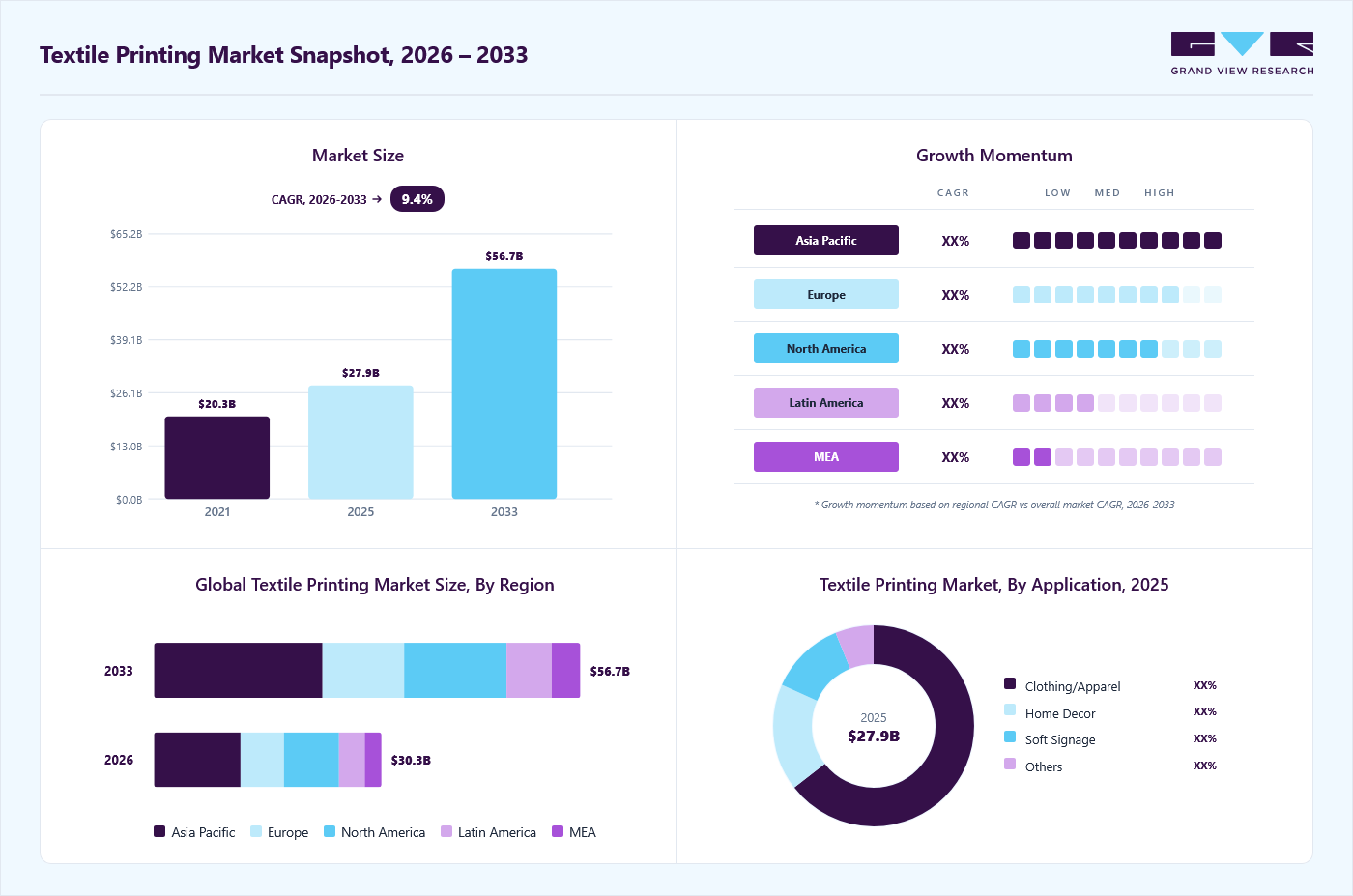 Source: Grand View Research, IR Documents, Primary Interviews, Paid DatabasesTo learn more about this report,
 Download Free Sample Report
 Key Market Trends & Insights
- By printing technology: Screen printing segment led the market with the largest revenue share of 46.7% in 2025.
- By application: Clothing/apparel segment led the market with the largest revenue share of 64.5% in 2025.
Regional Highlights
- Largest regional market: Asia Pacific (37.8% revenue share, 2025)
- By country: The China held the largest market share in 2025
Market Size & Forecast
- Market size in 2025: USD 27.9 Billion
- Estimated market size in 2026: 30.3 Billion
- Projected market size by 2033: USD 56.7 Billion
- CAGR (2026-2033): 9.4%
Three ways to get this report
Buy it, customize it, or ask a question.Ask an Analyst
A direct answer, usually in 1 working day
- AccessReport author, directly
- Reply timeWithin 1 working day
- No sales callDirect answer only
- FormatEmail reply
- CostFree, no cost
Get the Full Report
What the study covers
- FormatsPDF · Excel · Dashboard
- Timeline2026–2033 annual, 2025 base
- Coverage20+ countries, 5 regions
- Companies10+ key players profiled
Customize the Report
20% free customization
- IncludeCountries, segments, points
- TailorTo your product definition
- ExtendDeeper competitor detail
- OrA fully bespoke study
- Turnaround5–10 working days
Consumers’ increasing preference for personalized apparel, home décor, and fashion products encourages manufacturers to shift from traditional screen printing to digital and sublimation printing methods that offer faster turnaround times, reduced waste, and enhanced color precision. In addition, expanding e-commerce platforms and advancements in textile inks and printing machinery further propel market growth. The textile printing industry is witnessing a strong shift toward digitalization, with manufacturers increasingly replacing traditional screen-printing techniques with advanced inkjet and direct-to-garment (DTG) methods. The need for shorter production cycles, on-demand manufacturing, and enhanced design flexibility propels this transition. According to the United Nations Industrial Development Organization (UNIDO), digital production technologies are helping textile enterprises, especially small and medium-sized ones, respond faster to changing consumer tastes while improving operational efficiency. The ability to print complex patterns without multiple setups and achieve consistent quality significantly propels market growth toward digitally enabled textile manufacturing.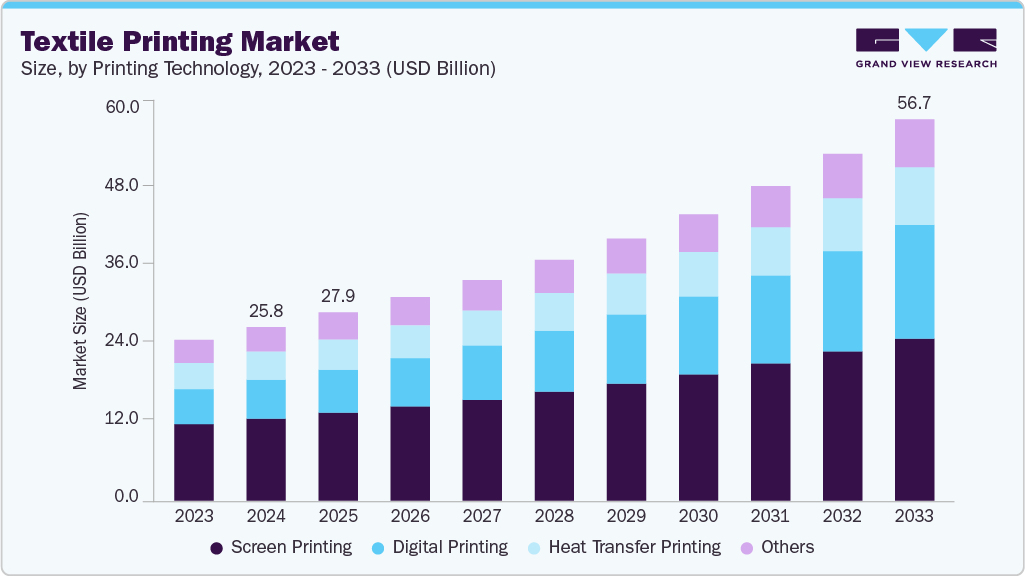 To learn more about this report, Download Free Sample Report
 Growing environmental awareness and stricter government regulations on wastewater discharge and chemical use are pushing textile printers to adopt sustainable production methods. The U.S. Environmental Protection Agency (EPA) has highlighted the presence of PFAS and other hazardous compounds in textile effluents, emphasizing the need for cleaner manufacturing practices. This has led to increased investments in water-efficient digital printing systems, eco-friendly pigment inks, and closed-loop dyeing processes that reduce resource consumption and pollution. As manufacturers aim to meet evolving compliance standards and sustainability goals, adopting green printing technologies is rapidly boosting market expansion.
The global textile industry is increasingly moving toward regionalized production models to reduce lead times and enhance supply chain resilience. Organizations such as the Organization for Economic Co-operation and Development (OECD) have noted a growing emphasis on shortening production cycles and establishing near-market facilities. This shift favors digital textile printing, which supports localized, small-batch production that can swiftly respond to customer demand. Localized printing hubs minimize logistics costs and carbon emissions and empower brands to deliver limited-edition, customized collections faster, propelling market growth across developed and emerging regions.
The rapid expansion of e-commerce platforms and the rising consumer preference for personalized products transform how textiles are designed and printed. According to OECD’s analysis of digital trade, online retail has opened up new revenue streams for on-demand textile printing, enabling smaller designers and start-ups to offer customized apparel, décor, and fashion accessories without large inventory risks. Digital printing allows these businesses to fulfill real-time orders, produce unique patterns, and deliver vibrant, durable prints. This trend toward mass customization and direct-to-consumer sales significantly boosts market growth, as brands increasingly rely on digital textile printing for agility and creative flexibility.
Continuous innovation in textile inks, print heads, and post-processing technologies is elevating the quality and sustainability of textile printing. Initiatives from bodies such as the EPA’s Design for the Environment program and UNIDO’s guidance on green manufacturing encourage using low-impact pigments, biodegradable binders, and water-recycling systems. These technological upgrades enhance colorfastness, reduce energy consumption, and minimize waste generation, aligning with global sustainability priorities. The combination of improved performance and eco-efficiency propels widespread adoption of advanced textile printing technologies and boosts overall market growth.
Market Dynamics
Rising demand for customized textile products, short production runs, and rapid fashion cycles is accelerating growth in the global textile printing market. The industry is shifting toward digital textile printing technologies, which offer high-quality prints and greater operational efficiency. Increased adoption of sustainable printing practices is also driving market expansion as manufacturers aim to reduce water use and material waste. However, strict environmental regulations and compliance requirements for chemical use and wastewater management remain key challenges. Despite these issues, advances in digital printing and growing demand for on-demand textile production are expected to create significant growth opportunities during the forecast period.
Rising demand for personalized textile products and flexible short-run production capabilities is significantly contributing to the expansion of the global textile printing market. Consumers are increasingly seeking personalized apparel, home furnishings, and fashion products that reflect individual preferences and unique designs. This trend has encouraged brands and manufacturers to adopt flexible printing solutions that can produce small batches with high design accuracy and reduced lead times.
In addition, the rapid evolution of fashion trends and the rise of e-commerce platforms have increased the need for on-demand production and faster product launches. Textile manufacturers are leveraging advanced printing technologies to efficiently manage shorter production runs while minimizing inventory costs and material waste. Thus, demand for modern textile printing solutions continues to grow across the fashion, home décor, and promotional textiles sectors.
Environmental concerns and increasingly stringent regulatory requirements represent a significant challenge for the global textile printing market. Traditional textile printing processes often involve substantial water consumption, chemical use, energy-intensive operations, and wastewater generation, leading to heightened scrutiny from regulatory authorities worldwide. Various environmental compliance frameworks and chemical management regulations have been implemented globally. For instance, manufacturers are required to comply with standards and certifications such as ZDHC (Zero Discharge of Hazardous Chemicals), OEKO-TEX Standard 100, REACH (Registration, Evaluation, Authorization and Restriction of Chemicals) in Europe, and various national wastewater discharge and emissions regulations. These compliance-related expenditures can increase operational costs and pose financial challenges, particularly for small and medium-sized textile printing enterprises.
Digital printing technology enables high-precision printing, faster turnaround times, and cost-effective production for small and customized print runs, thus makes it highly preferred by textile manufacturers and fashion brands. In addition, digital textile printing supports on-demand production, reducing excess inventory and material waste while improving supply chain efficiency. The technology also offers sustainability advantages through lower water and energy consumption, the use of eco-friendly water-based inks, and reduced post-processing requirements, thereby positioning it as a preferred solution amid growing environmental concerns and stricter sustainability standards.
Analyst Perspective
Rising demand for personalized apparel, home furnishings, and innovative textile designs is driving growth in the global textile printing market. Companies are investing in advanced printing technologies to increase production flexibility and improve print quality. A stronger focus on sustainable and resource-efficient manufacturing is also transforming the industry. The growth of e-commerce and print-on-demand models is creating new revenue streams for textile printers. As brands emphasize customization, speed-to-market, and sustainability, the textile printing market is expected to continue its positive growth over the forecast period.
Printing Technology Insights
Based on printing technology, the screen printing segment led the market with the largest revenue share of 46.7% in 2025. Despite the textile sector's accelerating digital transformation, screen printing maintains a solid foothold, driven by its unmatched color vibrancy, ink penetration, and durability. These qualities remain vital for high-volume industrial applications. Continuous technological refinements in mesh materials, emulsions, and automated carousel systems enable manufacturers to achieve better precision and lower waste. Adopting water-based and phthalate-free inks, in line with environmental guidelines from agencies such as the U.S. Environmental Protection Agency (EPA), also allows traditional screen printing to align with sustainability goals. This balance between legacy strength and modernization propels the continued demand for screen printing across segments that value tactile quality and long-lasting prints, such as workwear, sportswear, and promotional textiles.
Digital printing is projected to grow at the fastest CAGR over the forecast period. Digital textile printing is rapidly emerging as a market growth engine, fueled by rising demand for short-run, customized, and sustainable production. The technology enables high-resolution, on-demand printing without the need for screens or plates, drastically reducing setup times and water consumption. Reports from intergovernmental organizations like UNIDO emphasize how digitalization enhances textile manufacturing competitiveness through flexible production and minimal resource usage. Moreover, the growing adoption of pigment-based digital inks, which require less post-treatment, further reduces operational costs and environmental footprints. These advantages boost the widespread shift toward digital printing, especially among brands targeting fast fashion, e-commerce, and sustainable apparel lines.
Application Insights
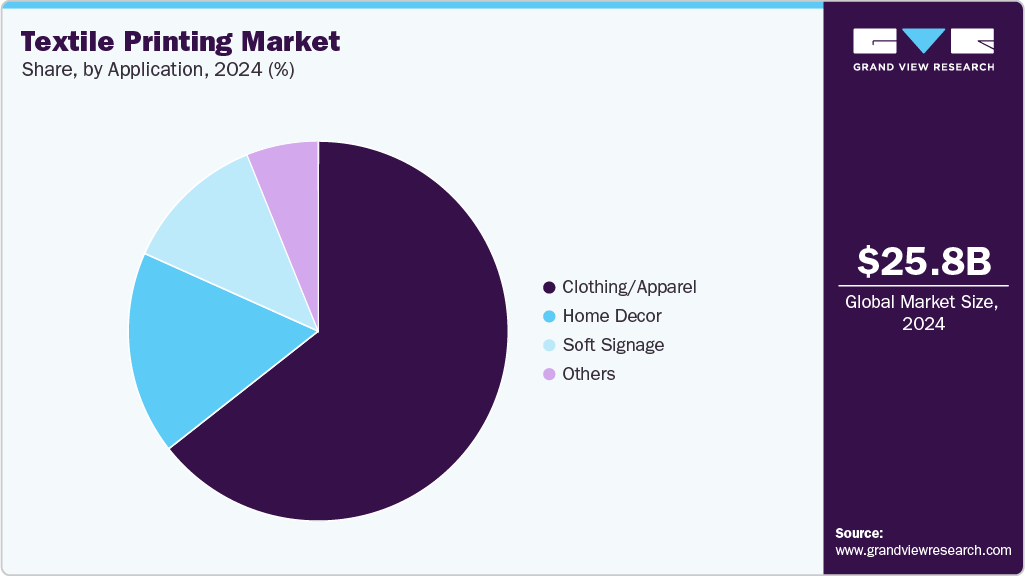
Based on application, the clothing/apparel segment led the market with the largest revenue share of 64.5% in 2025. The clothing and apparel segment continues to dominate the market, propelled by evolving consumer preferences toward personalized and expressive fashion. The rise of online retail and print-on-demand business models has made small-batch customization both profitable and scalable. Digital textile printing plays a crucial role in meeting the fast fashion industry’s need for rapid design changes, minimal inventory, and high-quality prints. Supportive government and industry initiatives encouraging local production and sustainable practices, such as cleaner dyeing programs promoted by the U.S. Department of Commerce’s Office of Textiles and Apparel (OTEXA), also foster innovation in apparel printing. This convergence of sustainability, digital agility, and fashion creativity drives robust growth in textile printing for the clothing segment globally.
 To learn more about this report, Download Free Sample Report
 Soft signage is projected to grow significantly over the forecast period. Soft signage has evolved into a high-growth application area, driven by the transition from PVC-based rigid signage to fabric-based alternatives that are lightweight, reusable, and eco-friendly. Advancements in sublimation and direct-to-fabric printing technologies are allowing businesses to produce vivid, wrinkle-resistant graphics suitable for indoor and outdoor environments. As public and corporate sectors increasingly adopt sustainable advertising practices, fabric signage aligns with environmental guidelines and waste reduction goals outlined by the U.S. EPA and other sustainability-driven organizations. The expanding use of soft signage across trade shows, retail environments, and sports venues propels strong demand for textile-based visual communication solutions, further boosting the market’s overall growth momentum.
Regional Insights
The North America textile printing market accounted for a 24.2% share of the overall market in 2025. The market is undergoing a major transformation, led by the rapid integration of digital printing technologies and sustainability-driven manufacturing practices. Rising adoption of pigment-based inks and water-efficient printing systems aligns production with the region’s stricter environmental regulations. Government-backed programs supporting domestic textile innovation and circularity, such as the U.S. Department of Energy’s initiatives on advanced manufacturing and recycling, reinforce the move toward cleaner, digitally enabled processes. In addition, the region’s thriving e-commerce ecosystem and demand for fast-turnaround fashion and décor are propelling the market’s growth through localized, on-demand print production hubs.
U.S. Textile Printing Market Trends
The textile printing market in the U.S. held a dominant position in 2025. In the U.S., digital textile printing is gaining remarkable traction as brands emphasize sustainability and supply chain agility. The Office of Textiles and Apparel (OTEXA) under the U.S. Department of Commerce reports a steady rise in domestic textile production supported by nearshoring strategies and the reshoring of fashion supply chains. American print houses increasingly adopt pigment ink systems and direct-to-garment technologies to minimize water use and chemical discharge, responding to EPA-led environmental standards. The growth of print-on-demand apparel platforms, particularly for customized t-shirts and sportswear, is boosting market demand, positioning the U.S. as a leading adopter of high-speed, eco-conscious textile printing.
Europe Textile Printing Market Trends
The textile printing market in Europe holds a substantial share of the global market. The European Commission’s Circular Economy Action Plan and REACH regulations motivate manufacturers to invest in non-toxic inks, biodegradable materials, and low-emission print technologies. Countries across the continent are embracing waterless printing and UV-curable inks to meet green compliance standards. Furthermore, partnerships between textile clusters and technology developers, such as those supported by the European Textile Technology Platform (ETTP), foster digital innovation. These coordinated sustainability efforts propel the region’s transition toward next-generation digital printing solutions.
Germany textile printing market is defined by engineering precision, automation, and a commitment to sustainability. The Federal Ministry for Economic Affairs and Climate Action (BMWK) supports textile innovation under Industry 4.0 frameworks, encouraging automation, robotics, and smart production integration. German companies are leading in developing advanced pigment inks, energy-efficient dryers, and fully automated digital print lines that optimize fabric throughput and quality. With its strong technical base and emphasis on resource-efficient processes, Germany is boosting the regional market, setting high standards for performance and environmental responsibility.
The textile printing market in the UK benefits from a dynamic blend of creative design capabilities and strong sustainability commitments. Government-supported programs under the Innovate UK initiative are helping small and mid-sized textile businesses adopt digital printing technologies to reduce waste and increase customization. The country’s vibrant fashion sector, coupled with growing consumer preference for ethically produced garments, is fueling the adoption of eco-friendly printing methods and locally sourced production. The rapid rise of independent designers using digital platforms to sell customized prints and apparel propels the market’s momentum, particularly in digitally printed fashion and décor textiles.
Asia Pacific Textile Printing Market Trends
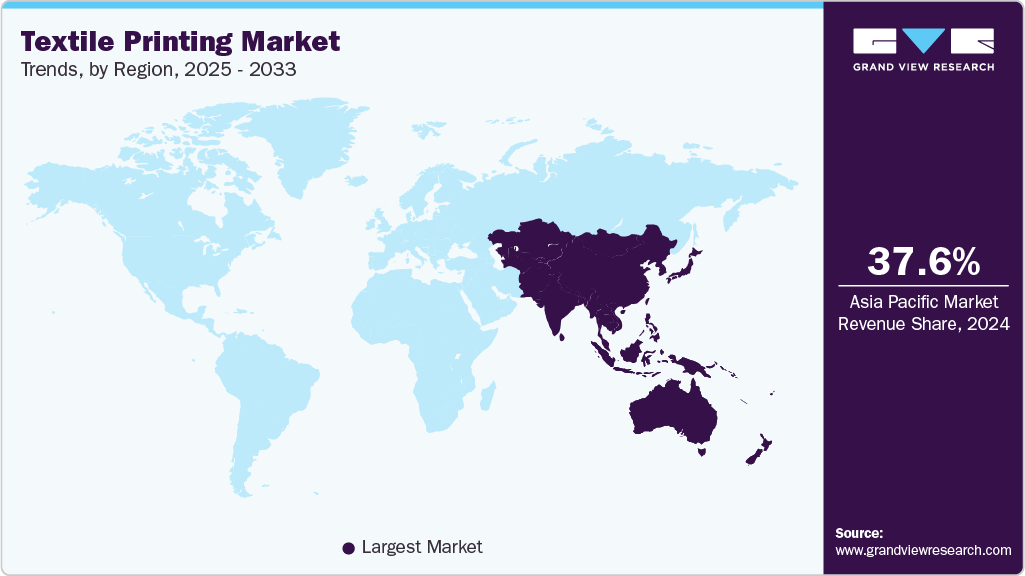
Asia Pacific dominated the textile printing market with the largest revenue share of 37.8% in 2025. The Asia-Pacific region represents the manufacturing backbone of the global textile printing industry, with a strong shift toward digitalization and sustainability in recent years. Supported by large-scale textile exports and rising domestic consumption, countries across APAC are integrating advanced digital printing machinery to improve productivity and reduce water and dye usage. Intergovernmental organizations such as UNIDO highlight the region’s growing focus on cleaner production practices and resource optimization. The combination of cost-effective labor, strong export networks, and government-led modernization efforts boosts APAC’s leadership in the global market.
 To learn more about this report, Download Free Sample Report
 The textile printing market in the China held the largest share in the Asia Pacific region in 2025. China textile printing market continues to dominate global textile printing output, driven by large-scale investments in automation, digital printing, and sustainability upgrades. Government initiatives under the Made in China 2025 strategy emphasize technological innovation and environmental compliance within the textile sector. Domestic manufacturers are rapidly replacing traditional rotary and flatbed printing with high-speed digital printers capable of handling complex designs and short production runs. With rising international demand for sustainable and custom-printed fabrics, China’s focus on high-tech textile printing and export competitiveness propels its market leadership and reshapes global supply dynamics.
The textile printing market in Japan is characterized by precision-driven innovation and a focus on high-quality outputs. The country’s government-backed Green Growth Strategy and industrial R&D programs promote sustainable manufacturing and advanced materials. Japanese companies are pioneers in inkjet head technology, high-performance dye sublimation inks, and automation systems that enhance print accuracy. The domestic demand for premium, aesthetically refined textiles, especially in fashion and interior applications, is boosting the adoption of advanced digital textile printing, allowing Japan to maintain its reputation as a hub for innovation and premium-quality production.
India textile printing market is expanding rapidly due to its vast textile manufacturing base, rising export demand, and growing preference for sustainable printing technologies. Government programs such as the Ministry of Textiles’ PM MITRA Parks scheme foster integrated textile clusters equipped with modern infrastructure and eco-friendly production systems. Indian manufacturers increasingly embrace digital printing to serve domestic fashion brands and international buyers seeking fast, flexible production. The country’s push for innovation, digital transformation initiatives, and rising disposable incomes are propelling strong market growth across apparel, home décor, and technical textile applications.
Key Textile Printing Company Insights
Some major market players include M&R Printing Equipment, MHM Industries GmbH, Anatol Equipment Manufacturing Co., Workhorse Products, Seiko Epson Corporation, Kornit Digital, Durst Group AG, MIMAKI ENGINEERING CO., LTD., Brother Industries, Ltd., and Ricoh, among others. These companies lead the market due to their advanced printing machinery portfolios, continuous investment in digital printing innovation, and strategic partnerships with textile manufacturers and apparel brands worldwide. Their technologies cater to the growing demand for sustainable, high-speed, and customizable textile printing solutions, driving the transition from traditional screen printing to digital formats. By integrating automation, eco-friendly inks, and smart printing systems, these firms are boosting production efficiency, print quality, and environmental compliance, thereby strengthening their global market presence. Furthermore, their global manufacturing footprints, strong after-sales networks, and emphasis on R&D-driven ink and print head advancements continue to enhance their competitiveness in this rapidly evolving industry.
-
M&R Printing Equipment is a leading U.S.-based manufacturer of screen-printing presses and automated equipment known for its engineering excellence and durable production systems. The company’s innovations in high-speed automatic carousel presses and eco-efficient dryers propel productivity for large-scale apparel manufacturers. M&R’s emphasis on precision, automation, and sustainability positions it as a cornerstone player in the global textile screen-printing ecosystem.
-
MHM Industries GmbH stands out as a European pioneer in textile screen printing, integrating digital automation and robotics into traditional print workflows. Based in Austria, MHM is recognized for its modular printing systems and high-throughput solutions, enabling flexible production for both large runs and short batches. Its continuous focus on quality engineering and sustainability strengthens its market footprint across Europe and North America.
Key Textile Printing Companies:
The following key companies have been profiled for this study on the textile printing market.
-
M&R Printing Equipment
-
MHM Industries GmbH
-
Anatol Equipment Manufacturing Co.
-
Workhorse Products
-
Seiko Epson Corporation
-
Kornit Digital
-
Durst Group AG
-
MIMAKI ENGINEERING CO., LTD.
-
Brother Industries, Ltd.
-
Ricoh
Competitive Benchmarking
Operating Strategies
Competitive Edge
Weaknesses
Established Players (Seiko Epson Corporation, Kornit Digital, Durst Group AG, MIMAKI ENGINEERING CO., LTD., Brother Industries, Ltd., Ricoh)
- Investments in digital textile printing technologies, automation, and sustainable printing solutions.
- Strengthen global distribution networks and expand partnerships with textile manufacturers and apparel brands.
- Focus on continuous product innovation, including high-speed printers, advanced inks, and integrated software solutions.
- Strong global brand recognition and extensive customer base.
- Advanced R&D capabilities and comprehensive digital printing technology portfolios.
- Broad geographic presence supported by established sales and service networks.
- High operating and R&D expenditures associated with continuous technological innovation.
- Greater exposure to fluctuations in global industrial and textile manufacturing activity.
Emerging Players (M&R Printing Equipment, MHM Industries GmbH, Anatol Equipment Manufacturing Co., Workhorse Products)
- Focus on niche textile-printing applications and specialized screen-printing equipment.
- Expand regional market presence through distributor partnerships and customer-focused service models.
- Develop cost-effective printing solutions targeting small and medium-sized textile manufacturers.
- Strong expertise in specific printing technologies and niche market segments.
- Greater operational flexibility and faster response to changing customer requirements.
- Competitive pricing and customized product offerings.
- Limited global presence compared to leading multinational competitors.
- Smaller R&D budgets and lower investment capacity for advanced technology development.
Recent Developments
-
In July 2025, Seiko Epson Corporation inaugurated its first manufacturing facility in India for high-capacity ink tank inkjet printers at the RIKUN Manufacturing Pvt. Ltd. plant in Chennai, with mass production slated to begin in October 2025. These printers are engineered to offer lower ink cost per milliliter and easier ink replacement relative to traditional cartridge models. This move underscores Epson’s strategy to localize production, support India’s industrial growth, and deepen ties with community stakeholders.
-
In October 2024, Ricoh announced the establishment of Ricoh Printing Solutions Europe Limited (RPSE), a new subsidiary based in Telford, UK, which began operations in April 2025. RPSE consolidates Ricoh’s industrial printing business in Europe, covering textile printers, inkjet heads, engineering support, and sales operations. This structural realignment aims to enhance Ricoh’s ability to deliver sophisticated, energy-efficient, and on-demand printing solutions across the European textile and industrial markets.
Textile Printing Market Report Scope
Report Attribute
Details
Market size in 2025
USD 27.9 billion
Estimated market size in 2026
USD 30.3 billion
Projected market size by 2033
USD 56.7 billion
Growth rate
CAGR of 9.4% from 2026 to 2033
Base year for estimation
2025
Historical data
2021 - 2024
Forecast period
2026 - 2033
Quantitative units
Revenue in USD million/billion and CAGR from 2026 to 2033
Report coverage
Revenue forecast, company ranking, competitive landscape, growth factors, and trends
Segments covered
Printing technology, application, region
Regional scope
North America; Europe; Asia Pacific; Latin America; MEA
Country scope
U.S.; Canada; Mexico; Germany; UK; France; China; Japan; India; South Korea; Australia; Brazil; KSA; UAE; South Africa
Key companies profiled
M&R Printing Equipment; MHM Industries GmbH; Anatol Equipment Manufacturing Co.; Workhorse Products; Seiko Epson Corporation; Kornit Digital; Durst Group AG; MIMAKI ENGINEERING CO., LTD.; Brother Industries, Ltd.; Ricoh
Customization scope
Free report customization (equivalent up to 8 analysts' working days) with purchase. Addition or alteration to country, regional & segment scope.
Pricing and purchase options
Avail customized purchase options to meet your exact research needs. Explore purchase options
Global Textile Printing Market Report Segmentation
This report forecasts revenue growth at the global, regional, and country levels and provides an analysis of the latest industry trends in each of the sub-segments from 2021 to 2033. For this study, Grand View Research has segmented the global textile printing market report based on printing technology, application, and region:
 To learn more about this report, Download Free Sample Report
 -
Printing Technology Outlook (Revenue, USD Million, 2021 - 2033)
-
Screen Printing
-
Digital Printing
-
Direct to Fabric (Roll to Roll Printing)
-
Sublimation
-
Pigment
-
Reactive
-
Acid
-
Others
-
-
Direct to Garment (DTG)
-
Sublimation
-
Pigment
-
Reactive
-
Acid
-
Others
-
-
-
Heat Transfer Printing
-
Others
-
-
Application Outlook (Revenue, USD Million, 2021 - 2033)
-
Clothing/Apparel
-
Home Decor
-
Soft Signage
-
Others
-
-
Regional Outlook (Revenue, USD Million, 2021 - 2033)
-
North America
-
U.S.
-
Canada
-
Mexico
-
-
Europe
-
Germany
-
UK
-
France
-
-
Asia Pacific
-
China
-
Japan
-
India
-
South Korea
-
Australia
-
-
Latin America
-
Brazil
-
-
Middle East and Africa (MEA)
-
KSA
-
UAE
-
South Africa
-
-
Research Methodology
(a) Segment Definition
Segment – Printing Technology
Revenue capture definition
Screen Printing
Revenue is generated from textile products printed using screen printing, a technology that transfers ink through mesh screens onto fabric. This segment is widely used for high-volume production due to its cost efficiency, color vibrancy, and durability.
Digital Printing
Revenue is generated from textile printing performed using digital inkjet technologies that directly print designs onto fabrics. Demand is driven by customization requirements, short production runs, and faster turnaround times.
Heat Transfer Printing
Revenue is captured from textile products printed using heat and pressure to transfer designs from transfer paper or films onto fabrics. The technology is commonly used for customized apparel, sportswear, and promotional products.
Others
Revenue is generated from alternative textile printing technologies, including sublimation, rotary, flexographic, and hybrid printing methods used across specialized textile applications.
Segment - Application
Revenue capture definition
Clothing/Apparel
Revenue is captured from printed textiles used in garments, fashion apparel, sportswear, uniforms, and accessories. This segment accounts for a significant share of market demand, driven by evolving fashion trends and rising customization requirements.
Home Decor
Revenue is generated from printed textiles used in home furnishing applications, including curtains, upholstery, cushions, bed linens, carpets, and decorative fabrics. Demand is supported by growth in residential construction and interior design activities.
Soft Signage
Revenue is captured from printed textile materials used for banners, flags, trade show displays, retail graphics, and advertising signage. The segment benefits from increasing demand for lightweight and visually appealing promotional solutions.
Others
Revenue is generated from textile printing applications across automotive interiors, industrial textiles, healthcare textiles, hospitality products, and other specialized end-use sectors.
(b) Estimation Model
Layer No.
Layer Name
Key Question
Description
01
Global Textile Production Layer
How much textile material is produced globally?
Estimate the total volume of textile and fabric production across apparel, home textiles, technical textiles, and promotional textiles. This forms the base demand pool for textile printing applications.
02
Printable Textile Demand Layer
How much of the textile output requires printing?
Refine the total textile production by identifying the share of fabrics and garments requiring printed designs, patterns, branding, graphics, and decorative applications across end-use industries.
03
Technology & Application Mix Layer
Which printing technologies and applications are utilized?
Segment demand across printing technologies such as screen printing, digital printing, direct-to-fabric (roll-to-roll), direct-to-garment (DTG), and heat transfer printing, as well as applications including clothing/apparel, home décor, soft signage, and others.
04
Revenue Monetization Layer
How much revenue is generated from textile printing activities?
Convert printed textile volumes into market revenue using average printing costs, equipment utilization rates, ink and consumable consumption, and value generated across different printing technologies and applications.
Delivered Customizations
This report has been delivered with the following In-depth customizations
Client Request
Customization Delivered
Value Adds
Digital Textile Printing Opportunity Assessment
Detailed analysis of digital textile printing adoption by region and application. Evaluation of technology trends, sustainability benefits, and competitive landscape.
Growth opportunity mapping and investment attractiveness analysis. Future technology roadmap and adoption outlook.
Application-Level Demand Analysis
In-depth assessment of textile printing demand across apparel, home décor, soft signage, and other applications. Analysis of consumption trends, purchasing behavior, and growth drivers by application.
Segment attractiveness matrix and revenue forecasting by application. Identification of high-growth end-use opportunities.
Competitive Benchmarking of Textile Printing Companies
Comparative evaluation of product offerings, printing technologies, regional presence, and strategic initiatives of key market participants. Assessment of partnerships, acquisitions, and innovation strategies.
Competitive positioning matrix and market share assessment.
Frequently Asked Questions About This Report
Asia Pacific is the fastest growing over the forecast period.
The screen printing segment led with a 47.3% revenue share in 2025, and digital printing is the fastest growing segment.
The clothing/apparel segment led with a 64.47% revenue share in 2025, and is the fastest growing segment.
The global textile printing market size was estimated at USD 27.9 billion in 2025 and is expected to reach USD 30.3 billion in 2026.
The global textile printing market size is expected to grow at a significant CAGR of 9.4% to reach 56.7 billion by 2033.
Some of the players in the market are M&R Printing Equipment, MHM Industries GmbH, Anatol Equipment Manufacturing Co., Workhorse Products, Seiko Epson Corporation, Kornit Digital, Durst Group AG, MIMAKI ENGINEERING CO., LTD., Brother Industries, Ltd., and Ricoh.
Rising demand for customized textile products, short production runs, and rapid fashion cycles is accelerating growth in the global textile printing market. The industry is shifting toward digital textile printing technologies, which offer high-quality prints and greater operational efficiency.
Asia Pacific dominated with a 37.8% revenue share in 2025.
About the Author(s)
Next Generation Technologies Research Team
Technology · Next Generation TechnologiesThis report was authored by the next generation technologies research team at Grand View Research - comprising two research analysts, one senior research analyst, and one industry expert - with specialized expertise in the next generation technologies segment of the technology industry. All findings are based on proprietary technology databases, executive interviews, and regulatory analysis, subject to internal peer review prior to publication.
Last Updated:
Speak to Analyst

Customize this report to your needs - add regions, segments, or data points, with 20% free customization.
Or view our licence options:


ISO 9001:2015 & 27001:2022 Certified
We are GDPR and CCPA compliant! Your transaction & personal information is safe and secure. For more details, please read our privacy policy.


