
- Home
- »
- Performance Chemicals
- »
-
Textile Surfactants Market Size & Share Report, 2026-2033GVR Report cover

Textile Surfactants Market (2026 - 2033)
Size, Share & Trends Analysis Report By Product (Anionic Surfactants, Non-Ionic Surfactants, Cationic Surfactants, Amphoteric Surfactants), By Source (Synthetic, Bio-based), By Application, By Region, And Segment Forecasts
Market Size, 2025
$3.1BMarket Estimate, 2026
$3.3BMarket Forecast, 2033
$4.9BCAGR, 2026–2033
5.9%Textile Surfactants Market Summary
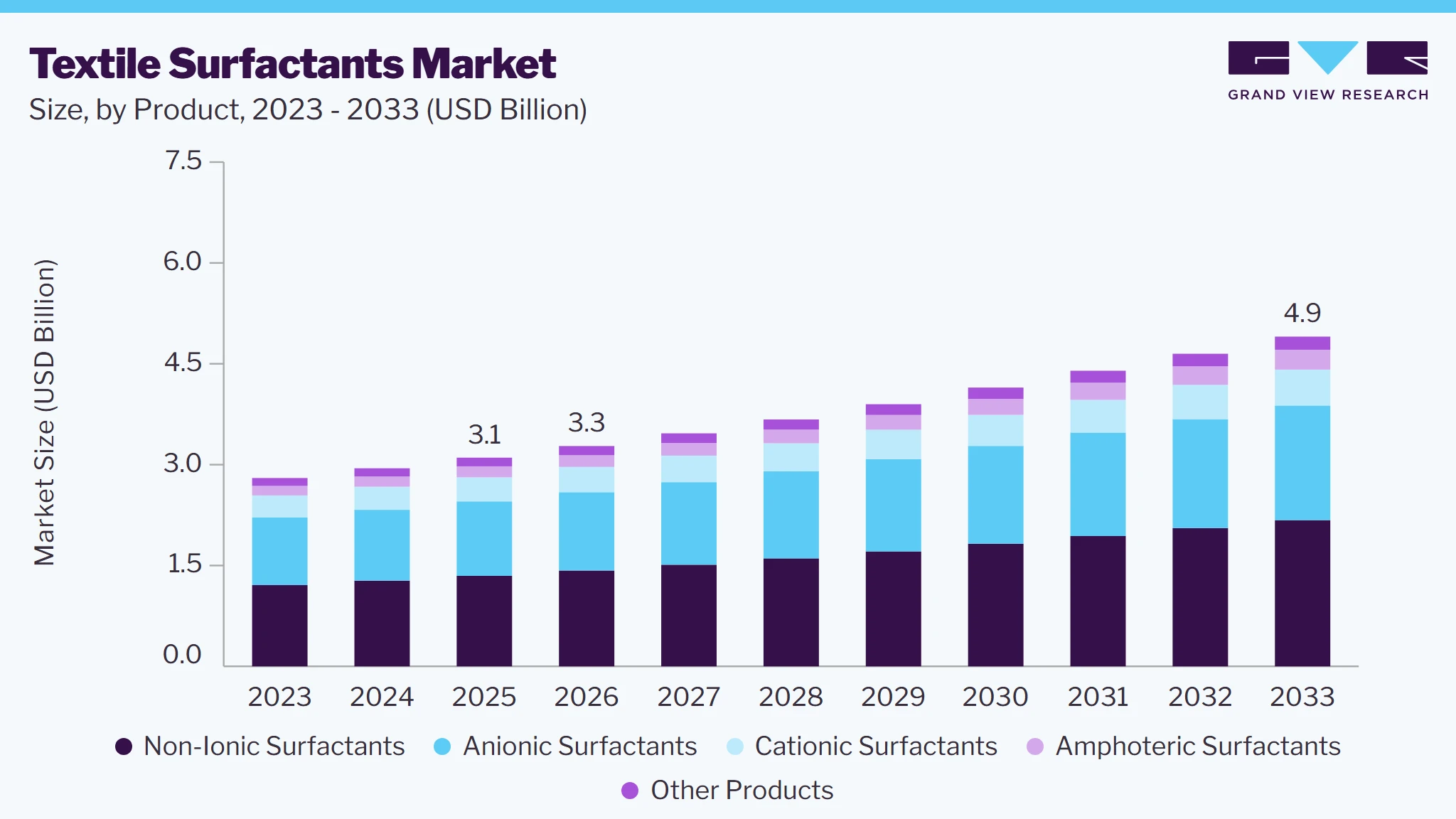
The global textile surfactants market size was valued at USD 3.1 billion in 2025 and is projected to grow from USD 3.3 billion in 2026 to USD 4.9 billion by 2033, at a CAGR of 5.9% from 2026 to 2033. Growth in the global market is driven by expanding textile manufacturing, rising demand for high-quality fabrics, and the increasing need for efficient wet-processing chemicals. Surfactants play a critical role in pre-treatment, dyeing, printing, and finishing by improving wetting, detergency, dye dispersion, and treatment uniformity.
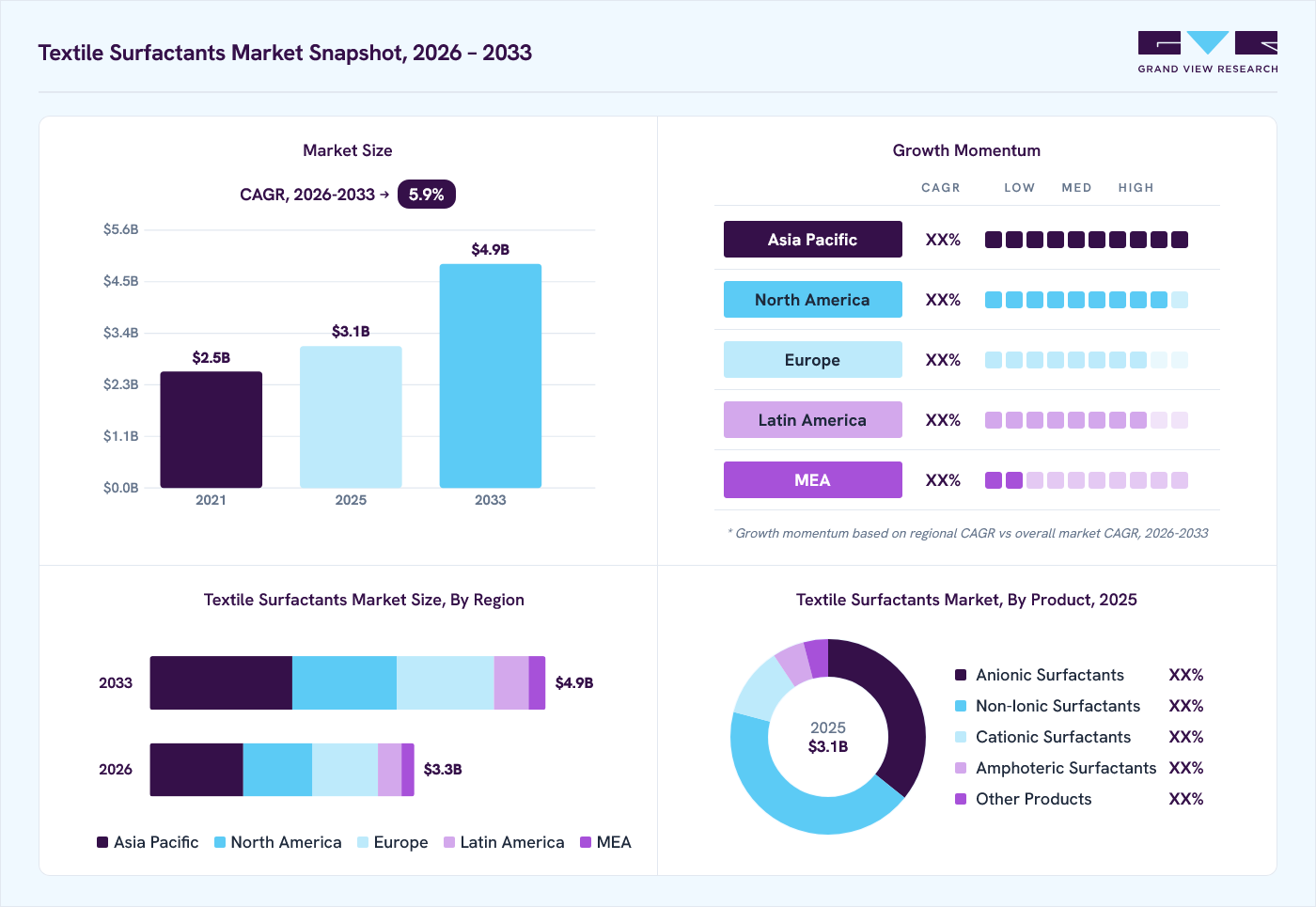 Source: Grand View Research, IR Documents, Primary Interviews, Paid DatabasesTo learn more about this report,
 Download Free Sample Report
Key Market Trends & Insights
- In terms of product, non-ionic surfactants held the largest revenue share of 43.4% in 2025.
- Based on source, the synthetic segment dominated with a share of 82.4% 2025.
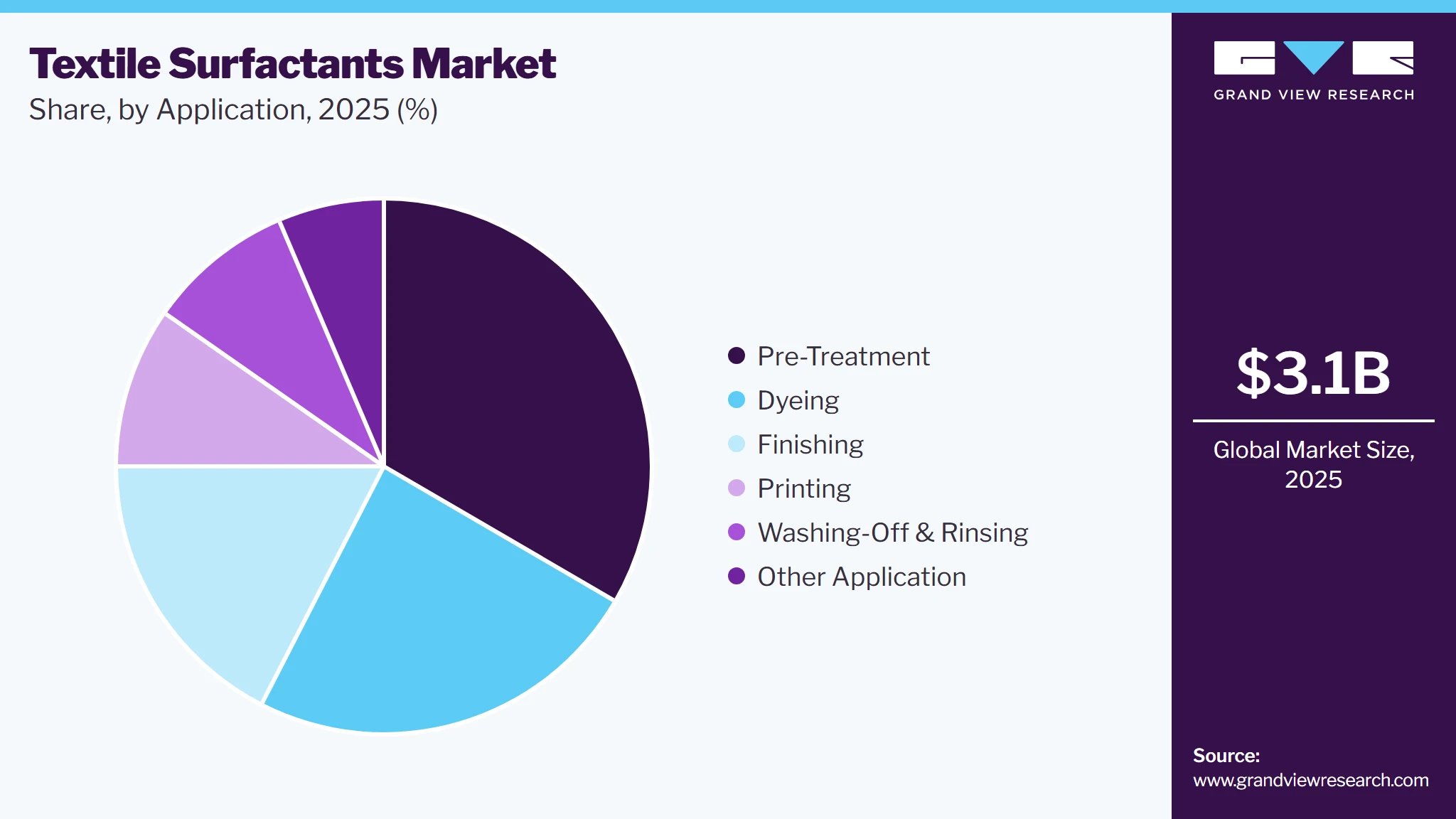
- By application, pre-treatment dominated market with a revenue share of 33.4% in 2025.
Regional Highlights
- Largest Region: Asia Pacific (35.3% revenue share, 2025)
- Fastest-growing region: Asia Pacific (fastest CAGR, 2026-2033)
Market Size & Forecast
- Market size in 2025: USD 3.1 Billion
- Estimated market size in 2026: USD 3.3 Billion
- Projected market size by 2033: USD 4.9 Billion
- CAGR (2026-2033): 5.9%
Three ways to get this report
Buy it, customize it, or ask a question.Ask an Analyst
Analyst response in 1 business day
- AccessReport author, directly
- Reply timeWithin 1 working day
- No sales callDirect answer only
- FormatEmail reply
- CostFree, no cost
Get the Full Report
What the study covers
- FormatsPDF · Excel · Dashboard
- Timeline2026–2033 annual, 2025 base
- Coverage20+ countries, 5 regions
- Companies10+ key players profiled
Customize the Report
20% free customization
- IncludeCountries, segments, points
- TailorTo your product definition
- ExtendDeeper competitor detail
- OrA fully bespoke study
- Turnaround5–10 working days
Growing emphasis on production efficiency, consistent fabric quality, and reduced water and chemical consumption is encouraging manufacturers to adopt specialized surfactant formulations. Growth in the global market is supported by the continued need for efficient chemical processing across pre-treatment, dyeing, printing, and finishing operations. Surfactants play an important role in improving wetting, removing impurities, dispersing dyes, controlling foam, and ensuring uniform treatment of textile materials. Increasing requirements for consistent fabric quality, processing efficiency, and reduced production defects are encouraging textile manufacturers to optimize the chemical formulations used in wet processing. At the same time, greater attention to wastewater management, water consumption, and environmental compliance is creating demand for surfactant solutions that balance processing performance with resource efficiency. These requirements support the use of both conventional and specialized surfactant formulations across established and emerging textile manufacturing markets.
 To learn more about this report, Download Free Sample Report
Significant opportunities exist in the development of bio-based surfactants, application-specific formulations, and technologies that improve textile-processing efficiency. Manufacturers can expand their portfolios with surfactants designed for particular fibers, dyeing systems, and finishing requirements, while developing alternatives that reduce dependence on conventional fossil-based feedstocks where technically and economically feasible. Further potential lies in formulations that support lower-temperature processing, improved chemical utilization, reduced foaming, and more efficient washing-off operations. Suppliers can also strengthen their market positions through partnerships with textile mills, dye manufacturers, textile auxiliary formulators, and chemical distributors. Expanding product production in Asia Pacific, combined with increasing demand for differentiated fabrics and greater attention to environmental performance, provides additional opportunities for suppliers capable of delivering consistent quality, competitive pricing, and application-specific technical support.
Market Dynamics
The textile surfactants market is shaped by textile production volumes, demand for consistent fabric quality, and the need for effective chemical processing across pre-treatment, dyeing, printing, and finishing. Surfactants support wetting, detergency, emulsification, dye dispersion, and foam management, making them important inputs in textile wet processing. Manufacturers are increasingly focused on improving chemical efficiency, reducing processing defects, and meeting customer requirements for product consistency and cost control. Interest in bio-based raw materials and lower-impact formulations is also influencing product development, while fluctuations in feedstock prices, environmental compliance costs, and competition from regional suppliers affect commercial performance. Demand patterns vary by textile fiber, processing method, and the level of technical specialization required by textile mills.
The need to achieve uniform fabric treatment, reliable coloration, and consistent finishing performance is supporting demand for textile surfactants. During pre-treatment, surfactants help remove oils, waxes, dirt, and other impurities, while their functions in dyeing and printing include improving wetting, supporting dye dispersion, and promoting more uniform treatment. In finishing operations, selected surfactants facilitate the distribution of treatment chemicals across fabric surfaces. As textile manufacturers seek to reduce reprocessing, material waste, and quality defects, the selection of suitable surfactant formulations becomes increasingly important.
This trend creates opportunities for suppliers that offer application-specific formulations and technical support. Close collaboration with textile mills can help chemical suppliers optimize dosage, improve process compatibility, and address challenges associated with different fibers and processing conditions. Suppliers that combine consistent product quality with reliable supply and competitive pricing are better positioned to establish long-term customer relationships.
The textile surfactants market faces cost pressures arising from fluctuations in the prices of petrochemical intermediates, fatty alcohols, fatty acids, ethylene oxide, and other formulation inputs. Changes in feedstock availability, energy costs, and transportation expenses can affect manufacturing margins and create uncertainty in pricing agreements with textile chemical buyers. At the same time, requirements concerning wastewater quality, chemical discharge, biodegradability, and restricted substances can increase the cost of product development, testing, and regulatory compliance. These pressures are particularly challenging for suppliers competing in price-sensitive textile-processing markets, where customers may be reluctant to accept higher prices unless new formulations demonstrate clear performance or operational benefits.
An important opportunity lies in developing surfactants derived from renewable feedstocks and formulations designed to improve the environmental performance of textile wet processing. Manufacturers are exploring alternatives based on vegetable oils, sugars, and microbial processes, alongside conventional chemistries that offer improved biodegradability or lower environmental impact. Opportunities also exist for products that deliver effective wetting, detergency, and dye dispersion at optimized dosages or under less resource-intensive processing conditions. However, commercial adoption depends on consistent performance, competitive pricing, production scalability, and compatibility with existing textile-processing systems. Suppliers that can demonstrate measurable benefits while maintaining fabric quality and process reliability may be better positioned to secure adoption among textile mills seeking to improve their environmental performance
Market Concentration & Characteristics
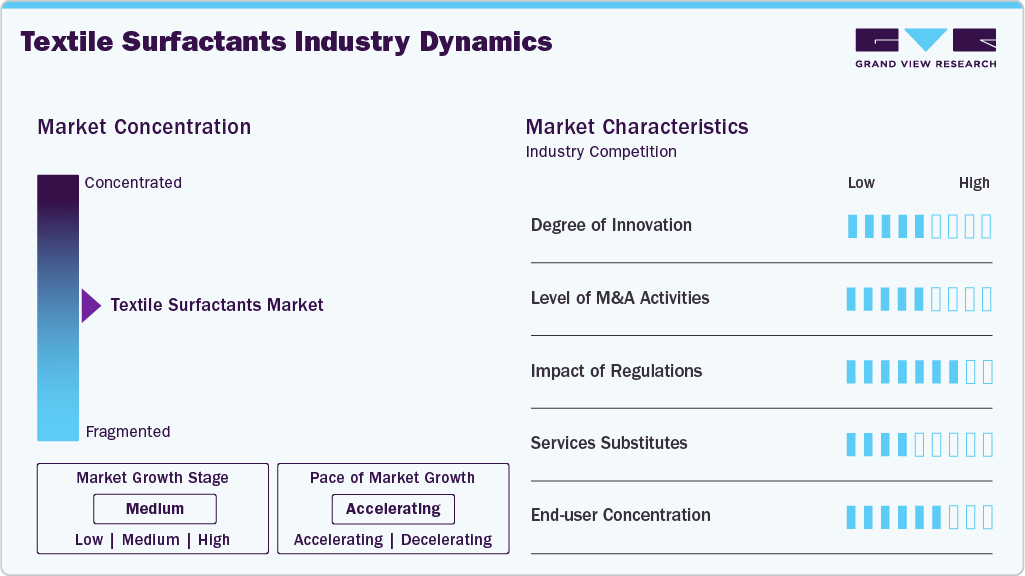
The textile surfactants market comprises diversified chemical manufacturers, specialty surfactant producers, and regional suppliers of textile auxiliaries. Companies such as BASF, Dow, Stepan, Clariant, Croda, Evonik, Kao, and Sasol participate in broader surfactant or specialty chemical markets, with relevance to textile applications varying by product portfolio. Competitive differentiation is based on surfactant chemistry, formulation performance, application expertise, manufacturing scale, supply reliability, and the ability to meet customer-specific requirements. The market also includes regional suppliers that compete through localized distribution, application support, and pricing flexibility.
 To learn more about this report, Download Free Sample Report
Competition varies across product categories and applications, with established manufacturers benefiting from broad portfolios and technical resources, while smaller suppliers may focus on selected chemistries or regional customer groups. Customer qualification requirements and the need for reliable performance in textile processing can support long-standing supplier relationships. At the same time, raw material cost fluctuations and competition from alternative formulations place pressure on margins. Product development, technical collaboration with textile mills, distribution expansion, and the development of lower-impact surfactants are important competitive strategies
Analyst Perspective
The market is closely linked to the scale and technical requirements of textile wet processing, where chemical performance directly affects cleaning, coloration, finishing quality, and production efficiency. Demand is likely to remain differentiated by surfactant type, application, and the processing needs of individual fiber categories. While conventional surfactants are expected to remain important because of established production systems and cost considerations, interest in renewable feedstocks and resource-efficient formulations is creating opportunities for product development. Suppliers that combine consistent quality, competitive pricing, technical service, and dependable supply are well positioned to strengthen customer relationships. For market participants, the central challenge is to balance environmental improvements with the cost, compatibility, and performance requirements of commercial manufacturing.
Product Insights
Non-Ionic segment dominated the market with a revenue share of 43.4% in 2025, due to their versatility across textile pre-treatment, dyeing, and finishing processes. Their ability to provide wetting, emulsification, detergency, and dispersion, often with compatibility across different formulation systems, makes them suitable for a wide range of fibers and processing conditions. Their use in removing impurities, improving chemical penetration, and supporting uniform fabric treatment reinforces their importance in fabric manufacturing.
Amphoteric surfactant segment is expected to grow the fastest with a CAGR of 7.8%, supported by demand for specialized formulations that offer performance across varying pH conditions and compatibility with other processing chemicals. Their use in selected wetting, cleaning, and finishing applications provides opportunities where formulation flexibility and substrate compatibility are important. Further growth may be supported by the development of specialty textile auxiliaries tailored to specific processing requirements and fabric-performance objectives.
Source Insights
Synthetic segment dominated the market with a revenue share of 82.4% in 2025, due to their established manufacturing infrastructure, broad commercial availability, and suitability for diverse processing requirements. Their use across cleaning, wetting, emulsification, dye dispersion, and finishing enables suppliers to serve multiple stages of fabric production. Established supply chains, consistent product specifications, and competitive economics support their continued adoption by textile manufacturers
Bio-based is expected to grow the fastest with a CAGR of 8.2% from 2026 to 2033. This is due to Growing attention to chemical discharge, biodegradability, and supply-chain sustainability is encouraging the development of surfactants derived from vegetable oils, sugars, and other renewable resources. Further adoption will depend on their ability to deliver consistent processing performance, reliable availability, and competitive costs relative to conventional alternatives.
Application Insights
Pre-treatment dominated the segment with a revenue share of 33.4%, in 2025. The surfactants are widely used to prepare textile materials before dyeing, printing, and finishing. Processes such as desizing, scouring, and bleaching require effective wetting, detergency, and emulsification to remove sizing agents, natural impurities, oils, and other residues. Effective pre-treatment improves fabric absorbency and helps achieve uniform results in subsequent processing stages, supporting consistent demand for surfactants across manufacturing operations.
 To learn more about this report, Download Free Sample Report
Finishing segment is expected to grow the fastest with a CAGR of 6.8% seek to deliver fabrics with differentiated functional and aesthetic properties. Surfactants support the application and uniform distribution of finishing chemicals used to impart characteristics such as softness, water repellency, antistatic performance, and other surface-related properties. Demand for functional textiles, performance-oriented apparel, and specialized home and industrial fabrics may create additional opportunities for finishing formulations. Growth will depend on the adoption of new fabric treatments, formulation compatibility, and the ability to meet performance and environmental requirements.
Region Insights
North America Textile Surfactants Market Trends
North America is expected to grow with a CAGR of 6.0% during the forecast period. The Demand for product market in North America is supported by technical textile manufacturing, industrial fabric processing, and demand for high-performance textile treatments. The region's established automotive, healthcare, construction, and industrial sectors create requirements for fabrics with consistent quality and specialized functional properties. Manufacturers also emphasize processing efficiency, chemical compliance, and wastewater management when selecting textile auxiliaries. These factors support demand for surfactants used in pre-treatment, dyeing, and finishing, particularly in specialized applications
U.S. Textile Surfactants Market Trends
The U.S. represents one of the most developed markets within North America expected to grow at a CAGR of 6.1% during the forecast period. The U.S. market benefits from demand across technical textiles, nonwovens, specialty fabrics, and domestic textile finishing operations. Applications in healthcare, transportation, protective clothing, and industrial materials create requirements for reliable wetting, cleaning, and finishing performance. The focus on production quality, operational efficiency, and environmental compliance also encourages textile processors to optimize chemical formulations. Specialty surfactants that support differentiated fabric properties and consistent processing offer opportunities for suppliers serving U.S. manufacturers.
Asia Pacific Textile Surfactants Market Trends
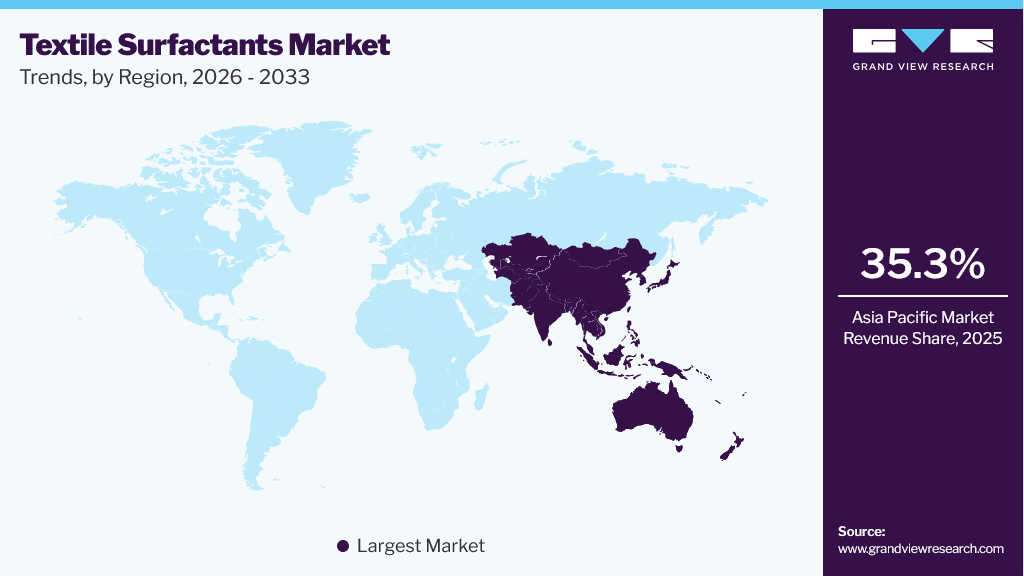
Asia Pacific dominated the market with a revenue share of 35.3%, during the forecast period. The growth is supported of its extensive fabric production and concentration of textile wet-processing operations. China, India, and Southeast Asian manufacturing centers consume surfactants across apparel, household textiles, and technical fabric production. The region's integrated textile supply chains and established chemical manufacturing base support broad product availability and competitive sourcing. Ongoing textile production and the need for consistent fabric quality continue to underpin demand for surfactants across the region.
 To learn more about this report, Download Free Sample Report
China Textile Surfactants Market Trends
China's market is supported by its well-established textile manufacturing base, extensive fabric-processing operations, and strong domestic chemical supply network. Demand is generated across fabric preparation, dyeing, printing, and finishing, where surfactants help achieve effective cleaning, uniform treatment, and consistent product quality. The need to improve production efficiency and manage chemical discharge is also influencing the selection of textile processing agents.
Europe Textile Surfactants Market Trends
Demand for product market in Europe is linked to the region's production of specialized fabrics, technical textiles, and finished textile products. Textile processors require chemicals that deliver reliable results across fabric preparation, coloration, and finishing while meeting relevant environmental and chemical safety requirements. Increasing attention to wastewater treatment and the environmental footprint of textile production is encouraging the evaluation of biodegradable and alternative surfactant formulations. However, higher operating expenses and compliance requirements can influence procurement strategies and product selection.
Germany Textile Surfactants Market Trends
Germany's demand is influenced by its specialization in industrial and performance-oriented textiles, including materials used in automotive components, healthcare products, filtration, and technical applications. These products require carefully controlled processing to achieve the desired surface characteristics, cleanliness, and functional performance. Textile chemical buyers also consider formulation reliability, traceability, and resource efficiency when selecting suppliers. This creates opportunities for manufacturers that provide application-specific surfactants alongside technical guidance and consistent product quality
Middle East & Africa Textile Surfactants Market Trends
Demand for product market across the Middle East and Africa varies according to the scale of local textile manufacturing and the availability of processing infrastructure. North African countries with established textile industries contribute to demand for chemicals used in fabric preparation, dyeing, and finishing, while other markets offer opportunities as textile production develops. Reliance on imported processing chemicals, distribution capabilities, and local manufacturing investment influence market accessibility. Expansion of textile facilities and improvements in processing technology could create further demand for textile surfactants in selected countries
Latin America Textile Surfactants Market Trends
The Latin American market draws demand from apparel production, home textile manufacturing, and fabric-processing activities, particularly in Brazil and other regional textile centers. Surfactants are used at different production stages to clean textile materials, improve wetting, support dye application, and facilitate finishing treatments. Market development is influenced by domestic textile output, imported chemical availability, manufacturing investment, and export-oriented production. Suppliers that offer dependable delivery, competitive pricing, and formulations suited to local processing requirements may benefit as textile producers seek to improve operational efficiency
Key Textile Surfactants Company Insights
Companies are strengthening their market positions by broadening portfolios with combination formulas, sprays, topical applications, and specialized preparations to capture diverse consumer needs. They are also expanding through direct-to-consumer e-commerce, international distributor networks, practitioner partnerships, and educational initiatives, while emphasizing botanical provenance and product authenticity to reinforce brand differentiation.
-
BASF SE operates through five business segments, namely performance products, chemicals, agricultural solutions, functional materials & solutions, and oil & gas. The company also operates through its subsidiaries and joint ventures in over 80 countries, with more than 353 production sites spread across the globe. Furthermore, it has 13 operating divisions and around 84 sub-business units worldwide. The product portfolio of its chemicals segment includes intermediates, monomers, petrochemicals, and catalysts. The company specializes in the manufacturing of surfactants, for textile, and several other sectors.
-
Dow is a global chemical and materials science company that develops specialty chemical solutions for a wide range of industrial applications. In the textile surfactants market, the company offers surfactant technologies, silicone-based materials, and processing chemicals used in wet processing and fabric treatment. Its product portfolio supports functions such as wetting, penetration, foam management, dyeing, printing, and finishing, helping manufacturers improve processing consistency and fabric performance. Dow also provides solutions for fabric softening, water repellency, and resource-efficient processing, aligning its offerings with the evolving performance and environmental requirements of the industry.
Key Textile Surfactants Companies
The following key companies have been profiled for this study on the textile surfactants market.
-
BASF SE
-
Dow
-
DuPont
-
Stepan Company
-
Huntsman Corporation
-
Clariant AG
-
Evonik Industries AG
-
Croda International Plc
-
Solvay S.A.
-
Kao Corporation
-
Procter & Gamble Co.,
-
Sasol Limited
-
Arkema S.A.
-
Ashland Inc.
-
Indorama Ventures
-
Wacker Chemie AG
-
Galaxy Surfactants Ltd.
-
Nouryon
-
Vizag Chemicals International
-
HANKOOKTRADE CO., LTD
Competitive Benchmarking
Operating Strategies
Competitive Edge
Weaknesses
Mature Players: BASF SE, Dow, Stepan Company, Clariant AG, Evonik Industries AG, Croda International Plc, Solvay S.A., Kao Corporation, Sasol Limited, Nouryon, Huntsman Corporation, Ashland Inc., Arkema S.A., Wacker Chemie AG, and DuPont
- Maintain diversified portfolios of surfactants, emulsifiers, wetting agents, dispersants, foam-control agents, and -processing chemicals.
- Supply chemical solutions for pre-treatment, dyeing, printing, and finishing through established industrial customer relationships.
- Invest in formulation development, application testing, and products designed to improve processing efficiency and environmental performance.
- Leverage international manufacturing facilities, technical service teams, and distributor networks to serve fabric producing regions.
- Established brand recognition and long-standing relationships with chemical formulators and manufacturers.
- Broad product portfolios enable suppliers to serve multiple processing stages and related industrial applications.
- Technical expertise supports customized formulations, process optimization, and customer-specific performance requirements.
- Established supply chains and geographic reach support service to large customers across multiple markets.
- Large-scale operations and broad product portfolios can create higher operating and compliance costs.
- Exposure to fluctuations in feedstock, energy, logistics, and manufacturing costs can affect margins.
- Existing production infrastructure and product portfolios may require significant investment to accommodate new chemistries or changing environmental requirements.
- Competition from regional suppliers offering lower-cost alternatives may put pressure on pricing, particularly for standardized surfactant grades
Emerging Players: Galaxy Surfactants Ltd., Vizag Chemicals International, and HANKOOKTRADE Co., Ltd
- Focus on selected surfactant chemistries, specialty ingredients, or regional customer requirements rather than competing across every chemical category.
- Develop customer relationships through distributors, direct sales, technical assistance, and application-specific product recommendations.
- Target opportunities in wetting, detergency, emulsification, and other processing functions where cost and formulation compatibility influence purchasing decisions.
- Expand product availability and geographic reach through partnerships and distribution arrangements
- Greater flexibility in addressing specific customer needs and regional market requirements.
- Potential cost advantages in selected product categories through focused manufacturing and sourcing strategies.
- Regional market knowledge and distributor relationships can support responsiveness and customer service.
- Specialized portfolios may allow suppliers to address applications that receive less attention from larger diversified manufacturers.
- Smaller or more focused portfolios may limit the ability to provide integrated solutions across multiple processing stages.
- International expansion may require additional investment in technical service, distribution, and regulatory compliance.
- Limited public information on specific sales, capacity, and market share can make competitive positioning difficult to quantify.
- Price competition and dependence on key customers or distributors may affect profitability and growth
Recent Developments
-
In March 2025, BASF collaborated with Agmatix to develop a digital tool for detecting and predicting soybean cyst nematode presence using artificial intelligence and agronomic data. The initiative focuses on improving identification of infestation risks and supporting more targeted management decisions for soybean growers.
Textile Surfactants Market Report Scope
Report Attribute
Details
Market size value in 2026
USD 3.1 billion
Revenue forecast in 2033
USD 4.9 billion
Growth rate
CAGR of 5.9% from 2026 to 2033
Base year for estimation
2025
Historical data
2021 - 2024
Forecast period
2026 - 2033
Quantitative units
Volume, Kilotons; Revenue in USD million, and CAGR from 2026 to 2033
Report coverage
Revenue forecast, volume forecast, company ranking, competitive landscape, growth factors, and trends
Segments covered
Source, Product, Application, and Region
Regional Scope
North America; Europe; Asia Pacific; Latin America; Middle East & Africa
Country scope
U.S.; Canada; Mexico; Germany; UK; France; Italy; Spain; China; India; Japan; South Korea; Brazil; Argentina; Saudi Arabia; South Africa.
Key companies profiled
BASF SE, Dow, DuPont, Stepan Company, Huntsman Corporation, Clariant AG, Evonik Industries AG, Croda International Plc, Solvay S.A., Kao Corporation, Procter & Gamble Co., Sasol Limited, Arkema S.A., Ashland Inc., Indorama Ventures, Wacker Chemie AG, Galaxy Surfactants Ltd, Nouryon, Vizag Chemicals International, and HANKOOKTRADE CO., LTD
Customization scope
Free report customization (equivalent up to 8 analysts’ working days) with purchase. Addition or alteration to country, regional & segment scope.
Pricing and purchase options
Avail customized purchase options to meet your exact research needs. Explore purchase options
Global Textile Surfactants Market Report Segmentation
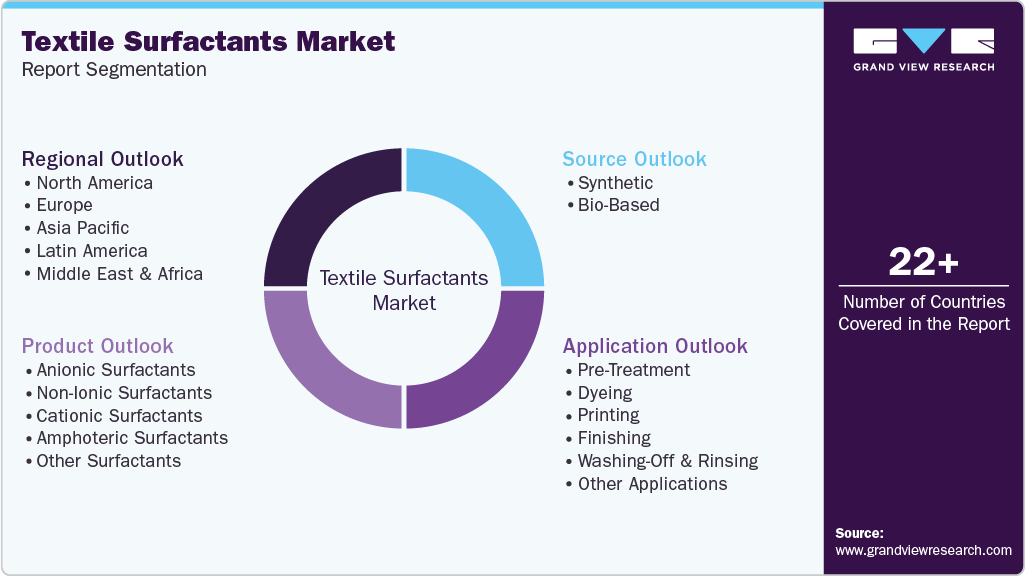
This report forecasts volume & revenue growth at regional, and country levels and provides an analysis of the latest industry trends in each of the sub-segments from 2021 to 2033. For this study, Grand View Research has segmented the textile surfactants market report based on product, source, application, and region:
 To learn more about this report, Download Free Sample Report
-
Product Outlook (Revenue, USD Million, Volume, Kilotons, 2021 - 2033)
-
Anionic Surfactants
-
Non-Ionic Surfactants
-
Cationic Surfactants
-
Amphoteric Surfactants
-
Other Surfactants
-
-
Source Outlook (Revenue, USD Million, Volume, Kilotons, 2021 - 2033)
-
Synthetic
-
Bio-Based
-
-
Application Outlook (Revenue, USD Million, Volume, Kilotons, 2021 - 2033)
-
Pre-Treatment
-
Dyeing
-
Printing
-
Finishing
-
Washing-Off and Rinsing
-
Other Applications
-
-
Regional Outlook (Revenue, USD Million, Volume, Kilotons, 2021 - 2033)
-
North America
-
U.S.
-
Canada
-
Mexico
-
-
Europe
-
UK
-
Germany
-
France
-
Italy
-
Spain
-
-
Asia Pacific
-
China
-
Japan
-
India
-
South Korea
-
-
Latin America
-
Brazil
-
Argentina
-
-
Middle East and Africa (MEA)
-
South Africa
-
Saudi Arabia
-
-
Research Methodology
The textile surfactants market figures in this report are based on a proven research process that combines executive interviews with secondary research from proprietary databases, company filings, and recognized regulatory and institutional sources. Market size is built through value-chain sizing - reconciling supply-side and demand-side estimates - and triangulated with bottom-up and top-down approaches. Every estimate passes multiple levels of expert validation before publication, with each textile surfactants segment quantified using the revenue-capture definitions in the table below.
Segment Definition
Segment - Product
Revenue capture definition
Anionic Surfactants
Revenue is generated from anionic surfactants used in textile wet processing, particularly for detergency, wetting, scouring, emulsification, and dispersing applications. Demand is influenced by their cleaning efficiency, compatibility with processing formulations, cost-effectiveness, and use in removing oils, impurities, and processing residues from textile materials.
Non-Ionic Surfactants
Revenue arises from non-ionic surfactants used as wetting agents, emulsifiers, detergents, and leveling agents during textile pre-treatment, dyeing, and finishing. Their market contribution is supported by versatility across different processing conditions, compatibility with other chemicals, and effectiveness in improving uniform wetting and treatment performance.
Cationic Surfactants
Revenue is associated with cationic surfactants used primarily in textile finishing, including fabric softening, antistatic treatment, and selected specialty applications. Demand depends on requirements for fabric feel, surface properties, static control, and compatibility with textile substrates and finishing formulations
Amphoteric Surfactants
Revenue is generated from amphoteric surfactants used in specialized textile-processing formulations requiring compatibility across different pH conditions, mild processing characteristics, wetting, or foam control. Demand is influenced by formulation requirements, substrate compatibility, and the need for surfactants that perform effectively under varying processing conditions
Other Products
Revenue includes surfactants and related specialty chemistries that do not fall within the defined anionic, non-ionic, cationic, or amphoteric categories. Demand is linked to niche textile-processing requirements, specialized finishing treatments, and applications requiring particular wetting, emulsification, or surface-modification properties
Segment - Source
Revenue capture definition
Synthetic
Revenue is generated from surfactants manufactured using conventional chemical feedstocks and synthesis processes, including petroleum-derived and other chemically processed raw materials. Demand is supported by established manufacturing capacity, consistent product performance, broad availability, and competitive pricing across textile pre-treatment, dyeing, printing, and finishing operations.
Bio-Based
Revenue is derived from surfactants produced partly or predominantly from renewable biological feedstocks, such as vegetable oils, sugars, and other biomass-derived materials, according to the study's classification criteria. Market demand is influenced by sustainability objectives, customer sourcing policies, environmental considerations, formulation performance, and the ability to achieve competitive costs and consistent supply
Segment - Application
Revenue capture definition
Pre-Treatment
Revenue is generated from surfactants used to remove sizing agents, oils, waxes, dirt, and other impurities before subsequent textile processing. Demand is driven by the need for effective cleaning, uniform wetting, improved absorbency, and consistent preparation of fabrics for dyeing, printing, and finishing
Dyeing
Revenue arises from surfactants used during dyeing to support wetting, dye dispersion, leveling, penetration, and uniform color development. Consumption depends on textile fiber type, dyeing technology, processing conditions, dye chemistry, and the need to minimize uneven coloration and processing defects.
Printing
Revenue is associated with surfactants used in textile printing formulations to improve wetting, pigment or dye dispersion, paste uniformity, and interaction between the formulation and fabric surface. Demand is influenced by printing technology, substrate characteristics, formulation requirements, and the need for consistent print definition and color quality
Finishing
Revenue is generated from surfactants used in textile finishing formulations to facilitate emulsification, wetting, and uniform distribution of functional treatment chemicals. Demand is supported by applications involving softening, water repellency, antistatic performance, and other fabric-property modifications, depending on the surfactant's role in the formulation
Washing-Off and Rinsing
Revenue arises from surfactants used after dyeing and printing to remove unfixed dyes, residual chemicals, and processing impurities from textile materials. Demand is influenced by washing efficiency, fabric type, dye chemistry, wastewater considerations, and the need to achieve appropriate colorfastness and final fabric quality
Other Application
Revenue includes surfactant consumption in textile-processing activities not covered by the preceding categories, including specialized auxiliary treatments and selected process-support applications. Demand depends on specific manufacturing requirements, fabric characteristics, specialty treatment formulations, and the need to improve processing efficiency or finished textile performance
Estimation Model
Layer Name
Key Question
Description
Raw Material & Production Layer
What forms the supply base?
Assess the key raw materials used in textile surfactant manufacturing, including fatty alcohols, fatty acids, vegetable oils, petrochemical derivatives, ethylene oxide, propylene oxide, amines, and other chemical intermediates. Examine feedstock sourcing, production technologies, chemical synthesis, formulation, blending, quality control, packaging, and distribution readiness. The assessment also considers raw material price fluctuations, renewable feedstock availability, manufacturing capacity, supplier concentration, production efficiency, and environmental and regulatory requirements affecting surfactant manufacturing.
Application Adoption Layer
Where are textile surfactants utilized?
Evaluate the use of surfactants across textile pre-treatment, dyeing, printing, finishing, washing-off, and rinsing processes. Adoption varies according to textile fiber type, processing technology, fabric characteristics, chemical formulation requirements, and desired treatment outcomes. The analysis considers demand from textile mills, dyeing and printing units, finishing facilities, and integrated textile manufacturers, alongside the influence of water and energy efficiency, wastewater management, product performance, and environmental compliance on surfactant selection.
Consumption Intensity Layer
How extensively are textile surfactants consumed?
Analyze surfactant consumption by product type, source, application, textile-processing method, and end-use textile category. Consumption intensity depends on the quantity of fabric processed, surfactant dosage per unit of textile material, fiber composition, processing conditions, bath concentration, treatment stages, and the number of processing cycles. Additional considerations include production capacity utilization, process optimization, chemical recovery or reuse where applicable, fabric quality requirements, and the gradual adoption of formulations designed to reduce chemical, water, and energy consumption
Revenue Layer
How is market revenue generated?
Market revenue is generated through the sale of anionic, non-ionic, cationic, amphoteric, and other surfactants supplied for textile-processing applications. Sales occur through direct manufacturer relationships, specialty chemical distributors, textile auxiliary suppliers, and formulation partners. Revenue is influenced by surfactant consumption volume, product grade, formulation complexity, feedstock costs, selling prices, customer specifications, and the proportion of specialty versus standard products. Additional value opportunities arise from application-specific formulations, technical support, lower-impact chemistries, and products designed to improve processing efficiency and fabric performance
Delivered Customizations
This report has been delivered with the following In-depth customizations
Client Request
Customization Delivered
Value Adds
Regional segmentation
The assessment provides country-level market sizing and forecasts by evaluating textile manufacturing output, wet-processing activity, surfactant consumption patterns, industrial capacity, trade flows, and the presence of textile chemical manufacturers and suppliers. Coverage examines major textile-producing economies, including China, India, Japan, South Korea, Southeast Asian countries, Europe, North America, and other relevant markets. It also evaluates regional differences in raw material availability, manufacturing capabilities, environmental regulations, and distribution networks
Supports geographic prioritization, market-entry planning, supplier selection, and resource allocation by identifying markets with substantial textile-processing activity, established chemical supply chains, and potential demand for specialty surfactants. The analysis helps assess regional growth opportunities and competitive conditions.
Opportunity Assessment
A comprehensive evaluation of growth opportunities across anionic, non-ionic, cationic, amphoteric, and other surfactants, as well as synthetic and bio-based sources. The assessment examines demand across pre-treatment, dyeing, printing, finishing, washing-off, and rinsing applications. It also evaluates opportunities arising from specialty formulations, improved processing efficiency, lower-impact chemistries, water and energy conservation, and changing textile manufacturer requirements.
Helps identify attractive product categories, applications, and customer segments by examining surfactant consumption patterns, processing requirements, formulation gaps, and evolving environmental expectations. Findings support product development, R&D prioritization, portfolio expansion, customer targeting, and the identification of opportunities in specialty and bio-based surfactants
Competitive Benchmarking
Comparative assessment of key textile surfactant manufacturers and suppliers based on product portfolios, surfactant chemistry, application expertise, manufacturing capabilities, geographic presence, distribution networks, and customer relationships. The analysis also reviews product launches, capacity developments, sustainability initiatives, technological advancements, strategic partnerships, and expansion into specialized textile-processing applications
Enables companies to assess competitive positioning, portfolio strengths, technology capabilities, and potential gaps in market coverage. The findings support decisions concerning product differentiation, formulation development, customer acquisition, distribution expansion, strategic partnerships, and investment in emerging surfactant technologies
About the Author(s)
Performance Chemicals Research Team
Specialty & Fine Chemicals · Performance ChemicalsThis report was authored by the performance chemicals research team at Grand View Research - comprising two research analysts, one senior research analyst, and one industry expert - with specialized expertise in the performance chemicals segment of the specialty & fine chemicals industry. All findings are based on proprietary specialty & fine chemicals databases, executive interviews, and regulatory analysis, subject to internal peer review prior to publication.
Last Updated:
Speak to Analyst

Customize this report to your needs - add regions, segments, or data points, with 20% free customization.
Or view our licence options:


ISO 9001:2015 & 27001:2022 Certified
We are GDPR and CCPA compliant! Your transaction & personal information is safe and secure. For more details, please read our privacy policy.


