
- Home
- »
- Paints, Coatings & Printing Inks
- »
-
Thermal Insulation Coating Market Size Report, 2026-2033GVR Report cover
![Thermal Insulation Coating Market (2026 - 2033)Report]()
Thermal Insulation Coating Market (2026 - 2033)
Size, Share & Trends Analysis Report By Product (Acrylic, Epoxy, Polyurethane, YSZ, Mullite), By Application (Building & Construction, Manufacturing), By Region, And Segment Forecasts
Market Size, 2025
$11.8BMarket Estimate, 2026
$12.4BMarket Forecast, 2033
$17.1BCAGR, 2026–2033
4.7%Thermal Insulation Coating Market Summary
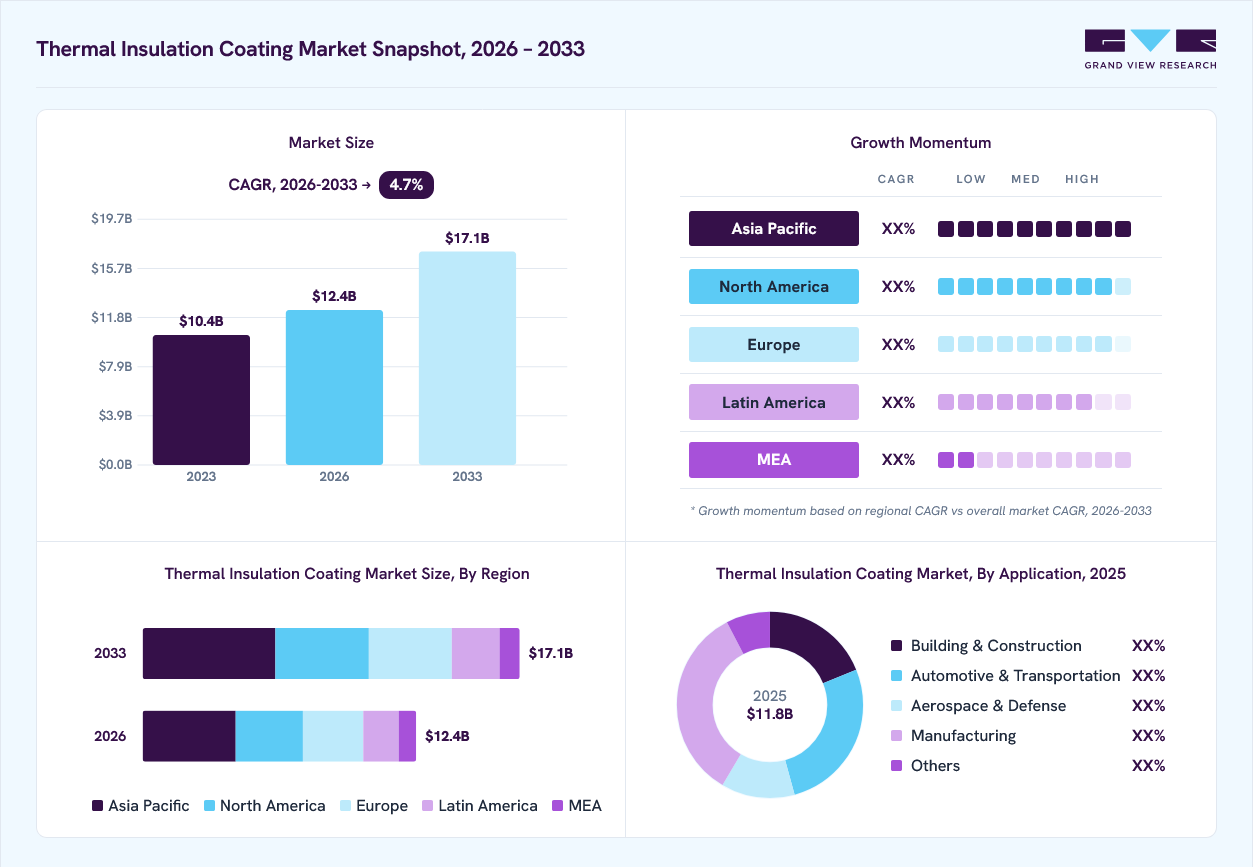
The global thermal insulation coating market size was valued at USD 11.8 billion in 2025 and is projected to grow from USD 12.4 billion in 2026 to USD 17.1 billion by 2033, growing at a CAGR of 4.7% from 2026 to 2033. Asia Pacific dominated the market, accounting for a revenue share of 33.9% in 2025. As governmental regulations become more stringent, directives such as the revised Energy Efficiency Directive by the European Union (EU/2023/1791) underscore the imperative of energy savings.
Key Market Trends & Insights
- By product: YSZ segment dominated the market, with a revenue share of 34.5% in 2025.
- By application: Manufacturing segment held the largest market share of 33.8% in 2025.
Regional Highlights
- Largest regional market: Asia Pacific (33.9% revenue share, 2025)
- By country: China held the largest market share in 2025.
Market Size & Forecast
- Market size in 2025: USD 11.8 Billion
- Estimated market size in 2026: USD 12.4 Billion
- Projected market size by 2033: USD 17.1 Billion
- CAGR (2026-2033): 4.7%
Three ways to get this report
Buy it, customize it, or ask a question.Get the Full Report
What the study covers
- FormatsPDF · Excel · Dashboard
- Timeline2026–2033 annual, 2025 base
- Coverage20+ countries, 5 regions
- Companies10+ key players profiled
Customize the Report
20% free customization
- IncludeCountries, segments, points
- TailorTo your product definition
- ExtendDeeper competitor detail
- OrA fully bespoke study
- Turnaround5–10 working days
Ask an Analyst
A direct answer, usually in 1 working day
- AccessReport author, directly
- Reply timeWithin 1 working day
- No sales callDirect answer only
- FormatEmail reply
- CostFree, no cost
With targets for cumulative end-use energy savings projected to rise from 0.8% to 1.3% in the near term and further to 1.9% by 2028 - 2030, a compelling mandate exists for adopting thermal insulation coatings in buildings and industrial applications. Rapid urbanization necessitates a surge in commercial and residential projects, further amplifying the need for advanced thermal insulation coatings. As new infrastructure developments take shape, such as refineries and industrial facilities, integrating these coatings will be essential for enhancing energy efficiency and reducing operational costs, making them indispensable in modern construction strategies.
Technological advancements are also paving the way for innovation in thermal insulation materials. Research from the Universiti Putra Malaysia has yielded promising results regarding incorporating aerogel powder in paint solutions, showing a notable 7% improvement in thermal insulation properties with just 5% aerogel content. Similarly, the Institute of Packaging Industry (IPI) Singapore has developed silica aerogel-based insulation paint that can lower surface temperatures by up to 12°C, enhancing energy efficiency and acoustic properties. These advancements improve insulation performance and align with eco-friendly building standards, further driving market adoption.
Moreover, the automotive industry is increasingly adopting thermal insulation coatings to comply with stringent fuel efficiency regulations and environmental standards. The integration of innovative materials, including phase-change materials and infrared-reflective coatings, offers enhanced performance and positions thermal insulation solutions at the forefront of sustainable technology. As governments continue to support initiatives to reduce carbon emissions and promote energy-efficient products, demand for increased innovations in thermal insulation coatings is guaranteed.
Market Dynamics
The thermal insulation coating market is experiencing steady growth driven by increasing demand for energy-efficient buildings, rising industrial energy conservation initiatives, and stringent regulations aimed at reducing carbon emissions. Thermal insulation coatings are widely used across construction, industrial, automotive, aerospace, and oil & gas sectors to minimize heat transfer, improve energy efficiency, prevent corrosion under insulation, and enhance equipment performance. Growing investments in sustainable infrastructure, industrial modernization, and green building projects are further supporting market expansion worldwide.
The increasing emphasis on energy conservation and sustainability is a major factor driving the thermal insulation coating market. Thermal insulation coatings help reduce heat loss and heat gain in buildings, industrial equipment, pipelines, storage tanks, and manufacturing facilities, resulting in lower energy consumption and operating costs.
Governments and regulatory agencies across various regions are implementing stricter energy-efficiency standards and building codes, encouraging the adoption of advanced insulation technologies. The rapid growth of green construction projects, coupled with rising awareness regarding carbon footprint reduction, is accelerating demand for thermal insulation coatings. Industries such as oil & gas, power generation, chemicals, and manufacturing are increasingly utilizing these coatings to improve process efficiency and equipment reliability, further supporting market growth.
The relatively high cost of thermal insulation coating compared to conventional insulation materials can limit market adoption, particularly among small and medium-sized enterprises. Application often requires specialized surface preparation, skilled labor, and multiple coating layers to achieve optimal thermal performance, increasing installation costs.
Thermal insulation coatings may not always provide the same level of insulation effectiveness as traditional bulk insulation materials in certain high-temperature or extreme operating environments. Performance can also vary depending on coating thickness, environmental conditions, and substrate compatibility. These factors may discourage adoption in cost-sensitive projects and create challenges for broader market penetration.
The growing focus on sustainable construction and energy-efficient infrastructure is creating significant opportunities for the thermal insulation coating market. Advancements in nanotechnology-based insulation coatings, ceramic coatings, and aerogel-enhanced formulations are improving thermal resistance, durability, and coating performance while reducing material thickness.
Increasing investments in smart buildings, green infrastructure projects, and industrial energy-efficiency programs are expanding the application scope of thermal insulation coatings. Opportunities are also emerging from retrofitting aging buildings and industrial assets to meet modern energy standards. As industries and governments continue to prioritize sustainability, carbon reduction, and operational efficiency, manufacturers developing innovative, high-performance, and environmentally friendly thermal insulation coating solutions are expected to gain a strong competitive advantage in the market.
Analyst Perspective
The thermal insulation coating market is positioned for sustained growth as industries increasingly prioritize energy efficiency, carbon emission reduction, and asset protection. Rising energy costs and stricter environmental regulations are encouraging the adoption of advanced thermal management solutions across building & construction, manufacturing, transportation, and industrial sectors. Thermal insulation coatings offer an attractive alternative to conventional insulation materials in applications where space constraints, complex geometries, moisture resistance, or maintenance accessibility are critical considerations. Building & construction remains a major demand center, supported by growing investments in green buildings, sustainable infrastructure, and energy-efficient renovation projects.
Product Insights
YSZ segment dominated the market with a revenue share of 34.5% in 2025, attributed to its outstanding thermal resistance and durability in extreme temperatures. YSZ coatings offer superior thermal barrier performance, making them ideal for aerospace, automotive, and power generation applications, fueled by ongoing advancements in research and development.
Epoxy coatings are expected to grow at the fastest CAGR of 5.8% over the forecast period. Epoxy coatings exhibit exceptional durability and enhanced dimensional stability, making them ideal for construction and manufacturing applications. Their VOC-free formulation aligns with the increasing demand for environmentally friendly products. This combination of resilience, energy efficiency, and adherence to green building standards has substantially driven the demand for thermal insulation coatings.
Application Insights
Manufacturing segment accounted for the largest revenue share of 33.8% in 2025. Stringent energy efficiency regulations compel industries to implement thermal insulation solutions to reduce heat loss and improve operational efficiency. Moreover, increasing focus on worker safety and regulatory compliance drives the use of these coatings in industrial environments. Enhanced process efficiency and lowered maintenance costs further elevate the demand for thermal insulation coatings.
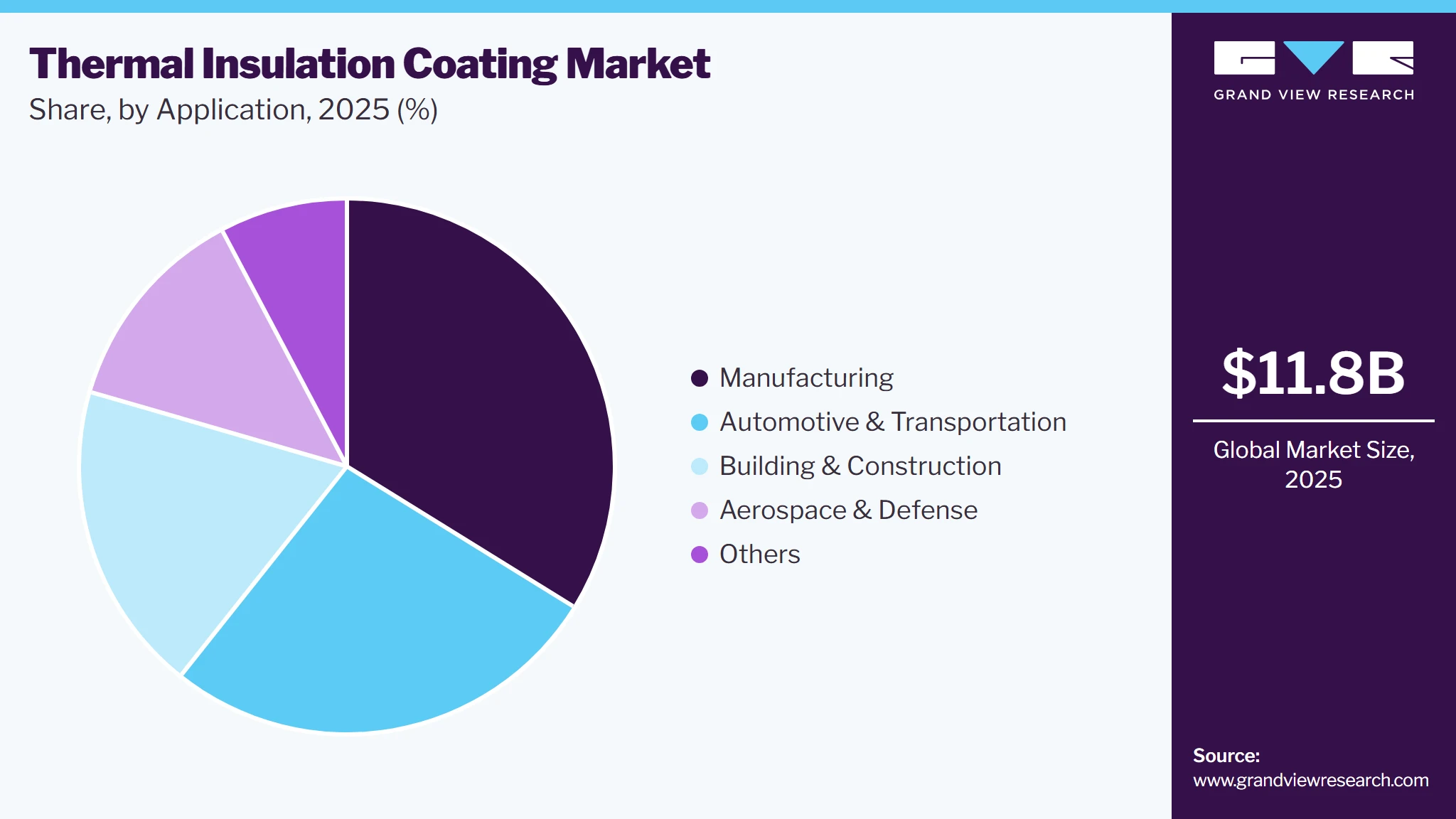
The automotive & transportation segment is projected to grow at the fastest CAGR of 5.6% over the forecast period. The transition to electric vehicles (EVs) demands effective thermal management systems to optimize battery performance and ensure passenger comfort. Thermal insulation coatings reduce heat transfer in critical areas, enhancing vehicle efficiency. Furthermore, stringent emissions and fuel efficiency regulations compel manufacturers to adopt these coatings to improve performance and minimize energy consumption.
Regional Insights
Asia Pacific accounted for 33.9% of the thermal insulation coating market revenue in 2025, making it the largest regional market. Robust investments in construction and infrastructure projects are propelling the demand for energy-efficient solutions. Furthermore, a heightened awareness of energy conservation and sustainability encourages industries to adopt advanced thermal insulation coatings. The region’s advantageous access to raw materials and the presence of key manufacturers further bolster market growth opportunities.

China Thermal Insulation Coating Market Trends
China held the largest market share in Asia Pacific in 2025. Significant infrastructure and construction investments drive the demand for energy-efficient solutions such as thermal insulation coatings. Moreover, the implementation of stringent Minimum Energy Performance Standards (MEPS) in China for buildings is mandating high-efficiency standards for heating solutions and insulation, enhancing energy efficiency and reducing carbon emissions across various sectors.
North America Thermal Insulation Coating Market Trends
North America thermal insulation coating market is expected to grow at a CAGR of 5.3% over the forecast period, owing to is stringent energy efficiency regulations and a commitment to reducing carbon emissions. Established infrastructure and continued investments in industrial applications, particularly within the oil and gas sector, significantly enhance its market share.
The thermal insulation coating market in U.S. dominated North America with the largest revenue share in 2024. The U.S. government has implemented incentives to enhance energy-efficient technologies, notably through the Inflation Reduction Act (IRA), which allocates substantial funding for initiatives such as the High-Efficiency Electric Home Rebate program, offering up to USD 14,000 per household for insulation upgrades, driving market growth and environmental awareness.
Europe Thermal Insulation Coating Market Trends
Europe thermal insulation coating market held a substantial market share in 2024 due to rising consumer purchasing power and a strong emphasis on sustainable building practices. Countries in the region are making substantial investments in energy-efficient technologies, including thermal insulation coatings, while stricter regulations further drive demand for innovation and efficiency.
The thermal insulation coating market in Germany is expected to grow significantly in the forecast period. Germany’s commitment to reducing greenhouse gas emissions has spurred significant investments in energy-efficient technologies, particularly thermal insulation coatings. The construction sector increasingly adopts these solutions to meet the Energy Saving Ordinance (EnEV) mandates.
Key Thermal Insulation Coating Company Insights
Some key companies operating in the market include Evonik Industries AG, Mascoat, Carboline, and Nippon Paint Holdings Co., Ltd. Strategic initiatives encompass technological innovations, product enhancements, and collaborative partnerships aimed at broadening market reach and enhancing overall competitiveness.
-
Mascoat specializes in thermal insulation coatings that deliver energy efficiency, condensation protection, and sound control. Their eco-friendly solutions cater to diverse industries, including commercial, industrial, marine, and automotive, while ensuring corrosion prevention and minimal maintenance.
-
Sherwin-Williams provides a comprehensive selection of thermal insulation coatings designed to enhance energy efficiency and protect surfaces across multiple applications, effectively reducing heat transfer, improving safety, and ensuring durability in demanding environments.
Key Thermal Insulation Coating Companies:
The following are the leading companies in the thermal insulation coating market. These companies collectively hold the largest market share and dictate industry trends.
- Evonik Industries AG
- Mascoat
- Carboline
- Nippon Paint Holdings Co., Ltd.
- Akzo Nobel N.V.
- PPG Industries, Inc.
- The Sherwin-Williams Company
- Kansai Paint Co., Ltd.
- Grand Polycoats Company Pvt. Ltd.
- Sika AG
Competitive Benchmarking
Category
Operating Strategies
Competitive Edge
Weakness
Established Players (Evonik Industries AG, Akzo Nobel N.V., PPG Industries, Inc., The Sherwin-Williams Company, Nippon Paint Holdings Co., Ltd., Kansai Paint Co., Ltd., Sika AG)
- Focus on developing advanced thermal insulation, heat-reflective, and energy-efficient coating technologies for construction, industrial, transportation, and infrastructure applications.
- Invest heavily in R&D, nanotechnology-based formulations, ceramic insulation coatings, and sustainable coating solutions.
- Expand global manufacturing footprints and distribution networks to serve growing demand across developed and emerging markets.
- Strengthen market position through acquisitions, strategic partnerships, and integration of digital coating technologies and sustainability initiatives.
- Strong brand recognition and extensive global distribution networks.
- Significant R&D capabilities enabling continuous product innovation and performance enhancement.
- Diversified product portfolios serving multiple industries and end-use applications.
- Established relationships with large construction firms, industrial operators, OEMs, and infrastructure developers.
- High operational and compliance costs associated with global manufacturing operations.
- Exposure to fluctuations in raw material prices such as resins, ceramic additives, and specialty fillers.
- Longer product development and commercialization cycles due to complex organizational structures.
- Increasing regulatory pressure regarding VOC emissions and environmental compliance requirements.
Emerging & Specialized Players (Mascoat, Carboline, Grand Polycoats Company Pvt. Ltd.)
- Focus on specialized thermal insulation coating solutions for industrial equipment, pipelines, storage tanks, marine assets, and commercial buildings.
- Offer customized coating systems designed for specific thermal management and energy-saving requirements.
- Expand through regional distributors, technical service partnerships, and project-based sales strategies.
- Emphasize product performance, rapid customer support, and niche market expertise.
- Strong specialization in thermal insulation and protective coating applications.
- Greater flexibility in customizing products for industry-specific requirements.
- Faster response to changing customer demands and emerging market opportunities.
- Ability to compete effectively in niche industrial and energy-efficiency projects.
- Smaller production capacities and more limited geographic reach compared to multinational coating companies.
- Lower financial resources for large-scale R&D and global expansion initiatives.
- Dependence on industrial project cycles and regional demand patterns.
- Increased vulnerability to competitive pressure from larger diversified coatings manufacturers.
Recent Developments
-
In August 2024, PPG launched PPG PITT-THERM 909 spray-on insulation coating, enhancing operational efficiency & safety in high-heat environments of gas, oil, chemical, and petrochemical industries.
-
In October 2023, Sherwin-Williams introduced the Heat-Flex 7000 thermal insulative coating system, providing personnel protection and energy efficiency in industrial applications with a single spray application, enhancing insulation against corrosion & heat.
Thermal Insulation Coating Market Report Scope
Report Attribute
Details
Market size in 2025
USD 11.8 Billion
Estimated market size in 2026
USD 12.4 Billion
Projected market size by 2033
USD 17.1 Billion
Growth rate
CAGR of 4.7% from 2026 to 2033
Base year for estimation
2025
Historical data
2021 - 2024
Forecast period
2026 - 2033
Quantitative units
Revenue in USD million/billion, volume in kilotons and CAGR from 2026 to 2033
Report coverage
Revenue forecast, company ranking, competitive landscape, growth factors, and trends
Segments covered
Product, application, region
Regional scope
North America; Europe; Asia Pacific; Latin America; MEA
Country scope
U.S.; Canada; Mexico; Germany; U.K.; France; Italy; Spain; China; India; Japan; South Korea; Brazil; Argentina; South Africa; Saudi Arabia
Key companies profiled
Evonik Industries AG; Mascoat; Carboline; Nippon Paint Holdings Co., Ltd.; Akzo Nobel N.V.; PPG Industries, Inc.; The Sherwin-Williams Company; Kansai Paint Co., Ltd.; Grand Polycoats Company Pvt. Ltd.; Sika AG
Customization scope
Free report customization (equivalent up to 8 analysts' working days) with purchase. Addition or alteration to country, regional & segment scope.
Pricing and purchase options
Avail customized purchase options to meet your exact research needs. Explore purchase options
Global Thermal Insulation Coating Market Report Segmentation
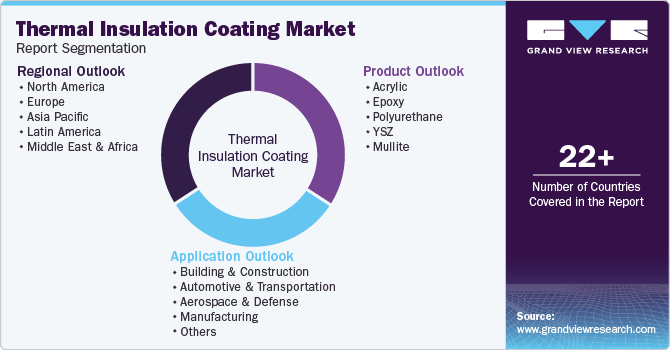
This report forecasts revenue growth at global, regional, and country levels and analyzes the latest industry trends in each sub-segment from 2021 to 2033. For this study, Grand View Research has segmented the global thermal insulation coating market report based on, product, application, and region:
-
Product Outlook (Volume, Kilotons; Revenue, USD Million, 2021 - 2033)
-
Acrylic
-
Epoxy
-
Polyurethane
-
YSZ
-
Mullite
-
-
Application Outlook (Volume, Kilotons; Revenue, USD Million, 2021 - 2033)
-
Building & Construction
-
Automotive & Transportation
-
Aerospace & Defense
-
Manufacturing
-
Others
-
-
Regional Outlook (Volume, Kilotons; Revenue, USD Million, 2021 - 2033)
-
North America
-
U.S.
-
-
Europe
-
Germany
-
France
-
UK
-
-
Asia Pacific
-
China
-
India
-
Japan
-
-
Latin America
-
Middle East and Africa
-
Research Methodology
The thermal insulation coating market figures in this report are based on a proven research process that combines executive interviews with secondary research from proprietary databases, company filings, and recognized regulatory and institutional sources. Market size is built through value-chain sizing - reconciling supply-side and demand-side estimates - and triangulated with bottom-up and top-down approaches. Every estimate passes multiple levels of expert validation before publication, with each thermal insulation coating segment quantified using the revenue-capture definitions in the table below.
Segment Definition
Segment - Product
Revenue capture definition
Acrylic
Revenue generated from thermal insulation coatings formulated with acrylic resins, widely used in building exteriors, roofs, walls, storage tanks, and industrial equipment due to their weather resistance, UV stability, and energy-saving properties.
Epoxy
Revenue derived from epoxy-based thermal insulation coatings utilized in industrial facilities, pipelines, processing equipment, and marine structures where thermal insulation, corrosion resistance, and mechanical durability are required.
Polyurethane
Revenue generated from polyurethane-based thermal insulation coatings applied across construction, transportation, and industrial sectors for superior thermal efficiency, flexibility, moisture resistance, and long-term insulation performance.
YSZ
Revenue captured from advanced ceramic thermal barrier coatings based on yttria-stabilized zirconia, primarily used in aerospace engines, gas turbines, and high-temperature industrial equipment to reduce heat transfer and improve operational efficiency.
Mullite
Revenue generated from mullite-based thermal insulation coatings used in high-temperature industrial applications, furnaces, kilns, and aerospace components requiring thermal stability, low thermal conductivity, and resistance to thermal shock.
Segment - Application
Revenue capture definition
Building & Construction
Revenue generated from thermal insulation coatings used on residential, commercial, and industrial buildings, including roofs, walls, facades, and infrastructure projects to improve energy efficiency, indoor temperature regulation, and sustainability performance.
Automotive & Transportation
Revenue derived from thermal insulation coatings applied to vehicles, rail systems, commercial transport equipment, and related components to reduce heat transfer, enhance passenger comfort, improve energy efficiency, and protect critical systems.
Aerospace & Defense
Revenue captured from thermal insulation and thermal barrier coatings used in aircraft engines, aerospace components, defense equipment, and military vehicles to withstand extreme temperatures and enhance operational performance.
Manufacturing
Revenue generated from thermal insulation coatings used in industrial machinery, processing equipment, pipelines, storage tanks, boilers, and manufacturing facilities to minimize energy loss, improve process efficiency, and reduce operating costs.
Other Applications
Revenue derived from thermal insulation coating applications across marine, oil & gas, power generation, renewable energy, chemical processing, and other specialized industries requiring thermal management and energy conservation solutions.
Estimation Model
Layer Name
Key Question
Description
Thermal Insulation Coating Production Layer
What forms is the supply base?
Identify global production capacity of thermal insulation coatings supported by raw material availability, resin manufacturing infrastructure, ceramic and insulating filler supply, coating formulation technologies, production capabilities, quality standards, and regional manufacturing facilities. This establishes the foundational supply base available for construction, industrial, transportation, aerospace, and energy-efficiency applications worldwide.
Application Adoption Layer
Where are thermal insulation coatings utilized?
Estimate the proportion of thermal insulation coating demand across building & construction, automotive & transportation, aerospace & defense, manufacturing, oil & gas, marine, and other industrial applications based on thermal management requirements, energy-efficiency objectives, operating temperatures, equipment protection needs, and industry adoption trends.
Consumption Intensity Layer
How much is thermal insulation coating used?
Analyze application-specific coating consumption rates, insulation performance requirements, substrate surface area, maintenance cycles, temperature-control needs, coating thickness specifications, and regional industrial activity to determine annual thermal insulation coating consumption across major end-use sectors.
Revenue Layer
How is market revenue generated?
Market revenue is quantified through the sale of thermal insulation coatings, thermal barrier coatings, ceramic-based insulation coatings, heat-reflective coatings, energy-saving coating systems, and customized thermal management solutions supplied to construction companies, industrial facilities, transportation manufacturers, aerospace organizations, and other end users worldwide.
Delivered Customizations
This report has been delivered with the following In-depth customizations
Client Request
Customization Delivered
Value Adds
Cross-Segmentation Analysis
Detailed cross-segmentation assessment evaluating the relationship between thermal insulation coating product types, application areas, and end-use industries. Analysis identifies thermal performance requirements, energy-saving potential, operating temperature ranges, coating adoption intensity, and revenue contribution across intersecting segments such as acrylic coatings in building & construction, epoxy coatings in manufacturing facilities, polyurethane coatings in transportation applications, and ceramic-based coatings in aerospace & defense.
Supports product portfolio optimization and market prioritization by identifying the most attractive product-application combinations, enabling improved resource allocation, sales targeting, product development strategies, and long-term growth planning across the thermal insulation coating value chain.
Competitive Benchmarking
Comparative evaluation of leading thermal insulation coating manufacturers based on product portfolio breadth, coating technology capabilities, manufacturing capacity, innovation pipeline, geographic presence, sustainability initiatives, energy-efficiency expertise, distribution networks, customer relationships, and strategic developments across key regional markets.
Assists competitive intelligence, partnership evaluation, and supplier assessment by providing deeper visibility into market positioning, technological strengths, differentiation strategies, innovation capabilities, operational efficiency, and areas of competitive advantage.
Opportunity Assessment
Comprehensive assessment of emerging opportunities associated with energy-efficient building construction, industrial energy conservation programs, advanced ceramic and nanotechnology-based insulation coatings, infrastructure modernization, sustainable manufacturing initiatives, corrosion-under-insulation prevention solutions, and growing demand for thermal management across transportation, aerospace, and industrial sectors worldwide.
Helps identify high-growth investment areas, emerging application opportunities, technology development priorities, and market expansion strategies, supporting long-term revenue growth and competitive positioning across the thermal insulation coating value chain.
Frequently Asked Questions About This Report
Some key players operating in the thermal insulation coating market include Evonik Industries AG; Mascoat; Carboline; Nippon Paint Holdings Co., Ltd.; Akzo Nobel N.V.; PPG Industries, Inc.; The Sherwin-Williams Company; Kansai Paint Co., Ltd.; Grand Polycoats Company Pvt. Ltd.; Sika AG
Key factors that are driving the market growth include rising application of heat insulation solutions in the defense, automotive, manufacturing, and aerospace sectors.
The manufacturing segment accounted for the largest market share in 2025, capturing 33.8% of the global thermal insulation coating market revenue. The segment's dominance was driven by growing adoption of thermal management solutions across industrial equipment, pipelines, storage tanks, and processing facilities to improve energy efficiency and reduce operational costs.
The YSZ segment held the largest share of the thermal insulation coating market in 2025, accounting for 34.5% of total revenue.
The global thermal insulation coating market is expected to grow at a compound annual growth rate of 4.7% from 2026 to 2033 to reach USD 17.1 billion by 2033.
Asia Pacific dominated the thermal insulation coating market with a share of 33.9% in 2025.
The global thermal insulation coating market size was estimated at USD 11.8 billion in 2025 and is expected to reach USD 12.4 billion in 2026.
About the Author(s)
Paints, Coatings & Printing Inks Research Team
Bulk Chemicals · Paints, Coatings & Printing InksThis report was authored by the paints, coatings & printing inks research team at Grand View Research - comprising two research analysts, one senior research analyst, and one industry expert - with specialized expertise in the paints, coatings & printing inks segment of the bulk chemicals industry. All findings are based on proprietary bulk chemicals databases, executive interviews, and regulatory analysis, subject to internal peer review prior to publication.
Last Updated:
Speak to Analyst


Customize this report to your needs - add regions, segments, or data points, with 20% free customization.
Or view our licence options:


ISO 9001:2015 & 27001:2022 Certified
We are GDPR and CCPA compliant! Your transaction & personal information is safe and secure. For more details, please read our privacy policy.


