
- Home
- »
- Next Generation Technologies
- »
-
Third-party Banking Software Market Size Report, 2026-2033GVR Report cover
![Third-party Banking Software Market (2026 - 2033)Report]()
Third-party Banking Software Market (2026 - 2033)
Size, Share & Trends Analysis Report By Product Type, By Deployment (On-premise, Cloud), By Application (Risk Management, Information Security), By End Use (Retail Banks, Commercial Banks), By Region, And Segment Forecasts
Market Size, 2025
$39.1BMarket Estimate, 2026
$44.3BMarket Forecast, 2033
$100.3BCAGR, 2026–2033
12.5%Third-party Banking Software Market Summary
The global third-party banking software market size was valued at USD 39.1 billion in 2025 and is projected to grow from USD 44.3 billion in 2026 to USD 100.3 billion by 2033, growing at a CAGR of 12.5% from 2026 to 2033. North America dominated the third-party banking software market in and accounted for a share of more than 30.0% of the global revenue. In 2025. The significant expansion of the banking, financial services, and insurance (BFSI) industry, driven by economic growth, is a major growth driver.
Key Market Trends & Insights
- By product: Banking software accounted for a share of more than 31.0% of the global revenue in 2025.
- By deployment: On premise segment accounted for the largest share of more than 60.0% of the global revenue in 2025.
- By application type: Risk management segment dominated the market in 2025 and accounted for a share of over 41.0% of the global revenue.
- By end use: Retail banks segment dominated the market in 2025 and accounted for a share of more than 62.0% of the global revenue.
Regional Highlights
- Largest regional market: North America (largest revenue share, 2025)
- Fastest-growing regional market: Asia Pacific (highest CAGR, 2026-2033)
Market Size & Forecast
- Market size in 2025: USD 39.1 Billion
- Estimated market size in 2026: USD 44.3 Billion
- Projected market size by 2033: USD 100.3 Billion
- CAGR (2026-2033): 12.5%
In addition, the integration of several cloud-computing services, including databases, networking, and analytics, into banking software is contributing to the industry’s growth. Customers prefer using smartphones and computers to conduct transactions and access their accounts, which is anticipated to raise demand for the adoption of third-party banking software. The growing adoption of technologically advanced analytical tools such as big data analytics is impacting the growth positively. The analytical tools help to process big chunks of data efficiently for making business decisions, identifying trends in the market, and increasing profitability. As the banking sector is a data-driven industry, the deployment of third-party software integrated with various analytical tools helps in managing the data efficiently. Moreover, a shift has been observed from conventional methods to computerized methods for tracking & recording monetary transactions and bookkeeping, which, in turn, supports the growth of the third-party banking software market. In line with this, the rising demand for process standardization and core banking systems in the BFSI sector is fueling market growth.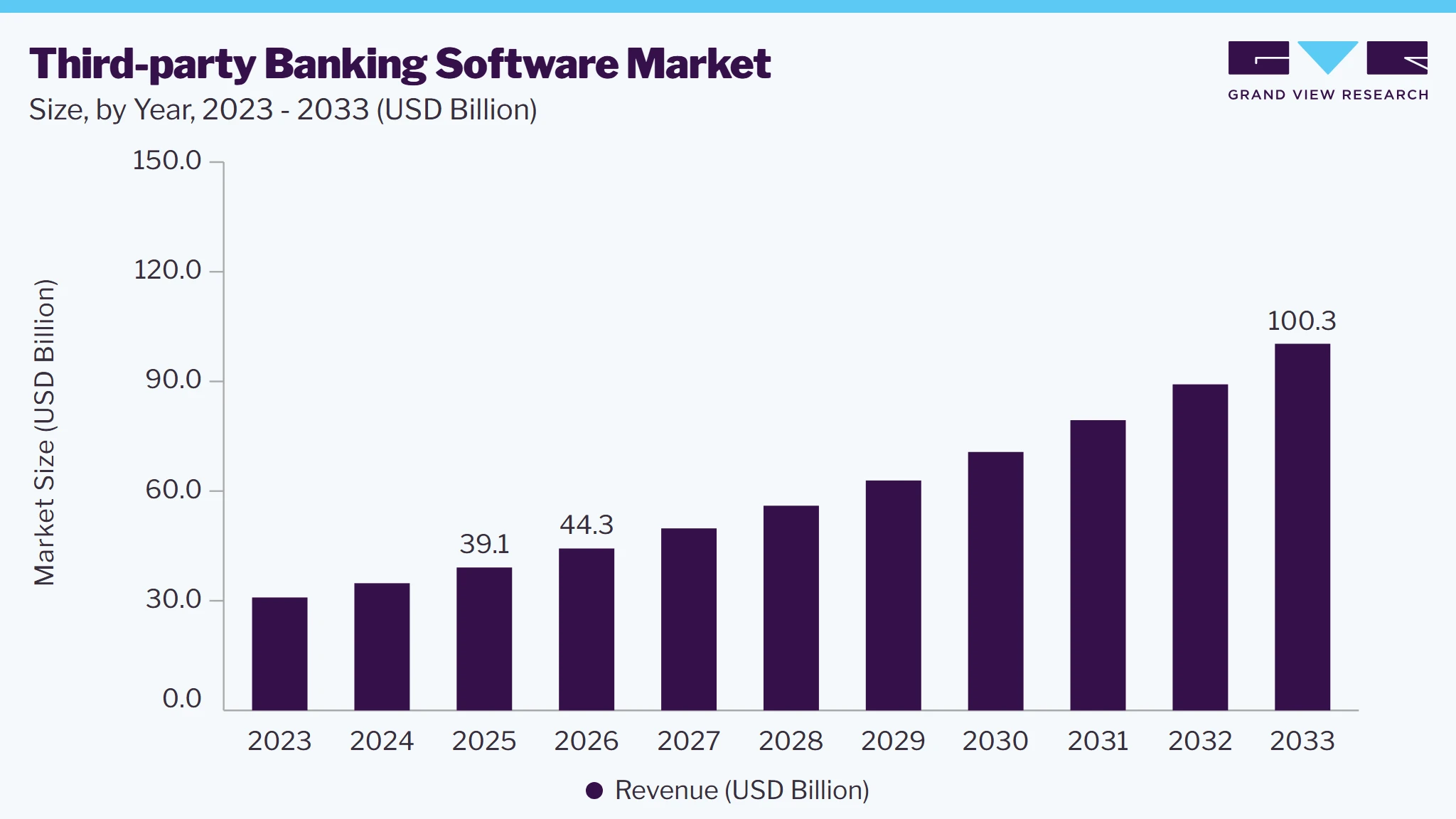
The growing need to improve the operational efficiency and productivity of the banking sector is driving the global market for third-party banking software. The banking sector has undergone a significant transformation, which has caused its operational procedures to be customized.
Due to altered client needs, diminishing revenues, and the need for operational flexibility, the banking industry has gradually shifted its focus toward third-party software over the past few years. In addition, the software helps banks gain a competitive edge over rival financial institutions by lowering operational expenses and minimizing human errors that can result in losses.
The expansion of the third-party banking software market is, however, constrained by concerns about information security. Moreover, the significant costs associated with switching from conventional to new automated systems act as one of the major obstacles to the growth of the industry. In addition, the lack of qualified professionals to utilize third-party banking software properly and safely, as the software holds extremely sensitive information, is another factor hampering the growth.
Moreover, the institutions are not hesitant and are looking forward to investing in technologies such as cloud computing and encryption to enhance their third-party software offerings. The growing emphasis on training professionals owing to the rising significance of the application of third-party banking software is expected to support the growth.
Analyst Perspective
The financial institutions are increasingly adopting AI-driven solutions to deliver personalized customer experiences and improve operational efficiency. The growing availability of third-party banking software platforms is enabling banks to rapidly deploy advanced analytics, intelligent automation, and customer engagement tools without compromising on their core objectives. As open banking and API ecosystems continue to evolve, partnerships between banks and technology providers are expected to accelerate innovation and support scalable digital transformation initiatives. Consequently, AI-powered personalization is likely to emerge as a key competitive differentiator in the banking sector over the coming years.
Product Insights
The core banking software segment dominated the market in 2025 and accounted for a share of more than 31.0% of the global revenue. The rapid changes in the banking sector carry the risk that institutions may become incompetent if they do not implement and adapt to them. Therefore, the institutions realized that there is a significant impact of digital technology on consumers and their expectations, some of which can be fulfilled by the adoption of core banking software.
The wealth management software segment is anticipated to witness the fastest growth over the forecast period. The demand for third-party wealth management software is expected to be driven by the aging population, as more people seek services to help them build sufficient retirement income. People are seeking financial advisory and wealth management services to better manage their wealth, due to longer life expectancies and rising medical costs. Thus, an increase in the adoption of wealth management software is anticipated to augment the growth.
Deployment Insights
The on-premise segment dominated the market in 2025 and accounted for a share of more than 60.0% of the global revenue. The dominance of this segment is attributed to the easy customization options, flexibility, and higher security levels as it runs on private servers. Moreover, the institutions looking for authority over their software and control over the data prefer on-premise platforms over the cloud.
The cloud segment is expected to register the fastest growth over the forecast period. The pandemic and the rapid influx of competitive & cloud-native fin-tech startups are the two fundamental causes of the current surge in interest in cloud migration. An estimated 80-91% of financial institutions globally are adopting some form of cloud service in 2025, though adoption rates vary by region and institution size Fintech companies invested USD 3.2 billion globally in 2025 to develop cloud-native applications, up 18% year over year.
Application Insights
The risk management segment dominated the market in 2025 and accounted for a share of over 41.0% of the global revenue. The application of third-party banking software for risk management enables banking institutions to improve the effectiveness of risk assessment and mitigate losses. The rising incidences of security breaches and strict regulatory compliance, also the advancements in the Internet of Things (IoT), are expected to further propel the growth of the segment.
The business intelligence segment is anticipated to grow at the fastest CAGR over the forecast period. The primary factor driving the growth is that the business intelligence application of third-party banking software supports the banks in making informed decisions based on facts related to trends and consumer behavior. In addition, the rising integration of data analytics by end-users to analyze the produced data is driving the market. Moreover, the integration of AI into software is expected to create significant growth opportunities.
End Use Insights
The retail banks segment dominated the market in 2025 and accounted for a share of over 62.0% of the global revenue. Growing demand for third-party banking software in retail banks as it reduces operational costs, is expected to fuel the growth. Moreover, the needs of the customers are better understood through the efficient and centralized system of retail banking software.
The commercial banks segment is anticipated to register the fastest CAGR over the forecast period. Commercial banks are turning the software implementation as they face regulatory and competitive pressure. Commercial banks prefer third-party banking software as it can be configured to adapt to any business process. It can interact with and integrate with any external system, enhancing compliance capabilities and data management. These are some of the factors responsible for segment growth.
RegionalInsights
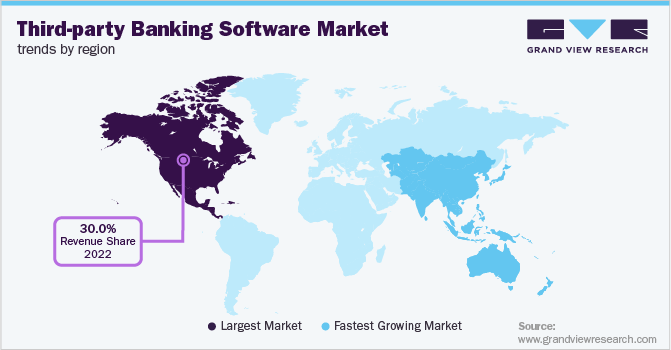
North America dominated the third-party banking software market in 2025 and accounted for a share of over 30.0% of the global revenue. The growth in the banking industry in North America and the growing acceptance of third-party software to increase operational efficiency are expected to accentuate the growth of the regional market.
In addition, the presence of several key players such as Microsoft, and IBM is expected to create a positive outlook for the growth of the industry. Moreover, another significant factor that is propelling the growth is that the North America region stands at the forefront of the digitalization of the BFSI sector which is expected to increase the demand for third-party software.
Asia Pacific Third Party Banking Software Market Trends
Asia Pacific is expected to grow at the highest CAGR over the forecast period. The growth can be attributed owing to the notable regulatory compliances, and the developing IT infrastructure in countries like such as China, India, and Japan. The aggressive efforts being pursued by various organizations across the region to promote the utilization of third-party banking software are also expected to contribute to the growth of the segment.
Key Third Party Banking Software Company Insights
The market is fragmented and can be characterized by the presence of many prominent players. Industry incumbents are pursuing various strategies, such as strategic partnerships, new product launches, geographic expansion, and others, as part of the efforts to enhance their offerings.
Key Third Party Banking Software Companies
The following key companies have been profiled for this study on the third party banking software market.
-
Microsoft Corporation
-
International Business Machines (IBM) Corporation
-
Oracle Corporation
-
SAP SE
-
Tata Consultancy Services (TCS)
-
Infosys Ltd.
-
Capgemini SE
-
Accenture plc
-
FIS, Inc.
-
Fiserv, Inc
Recent Developments
-
In May 2025, UniCredit partnered with Google Cloud to accelerate UniCredit's digital transformation. The tenure for the partnership is 10 years and includes implementation of advanced infrastructure, AI, and data analytics solutions across the its 13 core markets.
-
In August 2024, Finastra and Tech Mahindra entered into a partnership with an objective to accelerate corporate banking digitalization by deploying Finastra’s specialized cash management, trade innovation, and corporate channel solutions across North America and Europe.
Third-party Banking Software Market Report Scope
Report Attribute
Details
Market size in 2025
USD 39.1 billion
Estimated market size in 2026
USD 44.3 billion
Projected market size by 2033
USD 100.3 billion
Growth rate
CAGR of 12.5% from 2026 to 2033
Base year for estimation
2025
Historical data
2021 - 2024
Forecast period
2026 - 2033
Quantitative units
Revenue in USD Billion, and CAGR from 2026 to 2033
Report coverage
Revenue forecast, company ranking, competitive landscape, growth factors, and trends
Segments covered
Product type, deployment, application, end use, region
Regional Scope
North America; Europe; Asia Pacific; Latin America; MEA
Country Scope
U.S.; Canada; Germany; UK; China; India; Japan; Brazil
Key companies profiled
Microsoft Corporation; International Business Machines (IBM) Corporation; Oracle Corporation; SAP SE; Tata Consultancy Services (TCS); Infosys Ltd.; Capgemini SE; Accenture plc; FIS. Inc.; Fiserv, Inc.
Customization scope
Free report customization (equivalent up to 8 analysts working days) with purchase. Addition or alteration to country, regional & segment scope.
Pricing and purchase options
Avail of customized purchase options to meet your exact research needs. Explore purchase options
Global Third-party Banking Software Market Report Segmentation
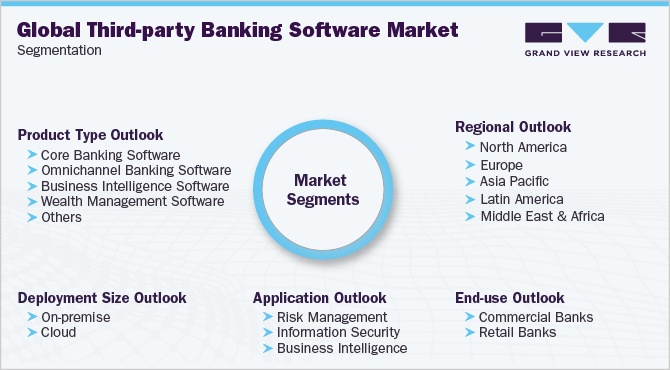
This report forecasts and estimates revenue growth at the global, regional, and country levels along with analyzes the latest market trends and opportunities in each one of the sub-segments 2021 to 2033. For this study, Grand View Research has further segmented the global sports be from third party banking software market report based on product, deployment, application, end use, and region:
-
Product Type Outlook (Revenue, USD Million, 2021 - 2033)
-
Core Banking Software
-
Omnichannel Banking Software
-
Business Intelligence Software
-
Wealth Management Software
-
Others
-
-
Deployment Size Outlook (Revenue, USD Million, 2021 - 2033)
-
On-premise
-
Cloud
-
-
Application Outlook (Revenue, USD Million, 2021 - 2033)
-
Risk Management
-
Information Security
-
Business Intelligence
-
-
End-use Outlook (Revenue, USD Million, 2021 - 2033)
-
Commercial Banks
-
Retail Banks
-
-
Regional Outlook (Revenue, USD Million, 2021 - 2033)
-
North America
-
U.S.
-
Canada
-
-
Europe
-
Germany
-
U.K.
-
-
Asia Pacific
-
China
-
India
-
Japan
-
-
Latin America
-
Brazil
-
-
Middle East & Africa
-
Frequently Asked Questions About This Report
North America dominated with the largest revenue share in 2025.
Retail banks dominated the third-party banking software market with a share of 62.0% in 2025.
The global third-party banking software market size was valued at USD 39.1 billion in 2025 and is estimated at USD 44.3 billion for 2026.
The global third-party banking software market is expected to grow at a CAGR of 12.5% from 2026 to 2033, reaching USD 100.3 billion.
Key players include Microsoft Corporation; International Business Machines (IBM) Corporation; Oracle Corporation; SAP SE; Tata Consultancy Services (TCS); Infosys Ltd.; Capgemini SE; Accenture plc; FIS. Inc.; Fiserv, Inc.
About the Author(s)
Next Generation Technologies Research Team
Technology · Next Generation TechnologiesThis report was authored by the next generation technologies research team at Grand View Research - comprising two research analysts, one senior research analyst, and one industry expert - with specialized expertise in the next generation technologies segment of the technology industry. All findings are based on proprietary technology databases, executive interviews, and regulatory analysis, subject to internal peer review prior to publication.
Last Updated:
Speak to Analyst


Customize this report to your needs — add regions, segments, or data points, with 20% free customization.
Or view our licence options:


ISO 9001:2015 & 27001:2022 Certified
We are GDPR and CCPA compliant! Your transaction & personal information is safe and secure. For more details, please read our privacy policy.


