
- Home
- »
- Clothing, Footwear & Accessories
- »
-
Trail Running Shoes Market Size & Share Report, 2026-2033GVR Report cover

Trail Running Shoes Market (2026 - 2033) Size, Share & Trends Analysis Report By Type (Light Trail Running Shoes, Rugged Trail Running Shoes, Off Trail Running Shoes), By Distribution Channel (Offline, Online), By Region, And Segment Forecasts
Market Size, 2025
$8.9BMarket Estimate, 2026
$9.3BMarket Forecast, 2033
$12.2BCAGR, 2026–2033
4.0%Trail Running Shoes Market Summary
The global trail running shoes market size was valued at USD 8.9 billion in 2025 and is projected to grow from USD 9.3 billion in 2026 to USD 12.2 billion by 2033, at a CAGR of 4.0% from 2026 to 2033. North America accounted for a share of 33.0% of the global revenue in 2025. Rising participation in outdoor fitness continues to fuel strong growth, with consumers viewing trail footwear as both a performance necessity and a lifestyle statement.
 Source: Grand View Research, IR Documents, Primary Interviews, Paid DatabasesTo learn more about this report,
 Download Free Sample Report
 Key Market Trends & Insights
- The trail running shoes industry in the U.S. accounted for a share of 79.4% in 2025
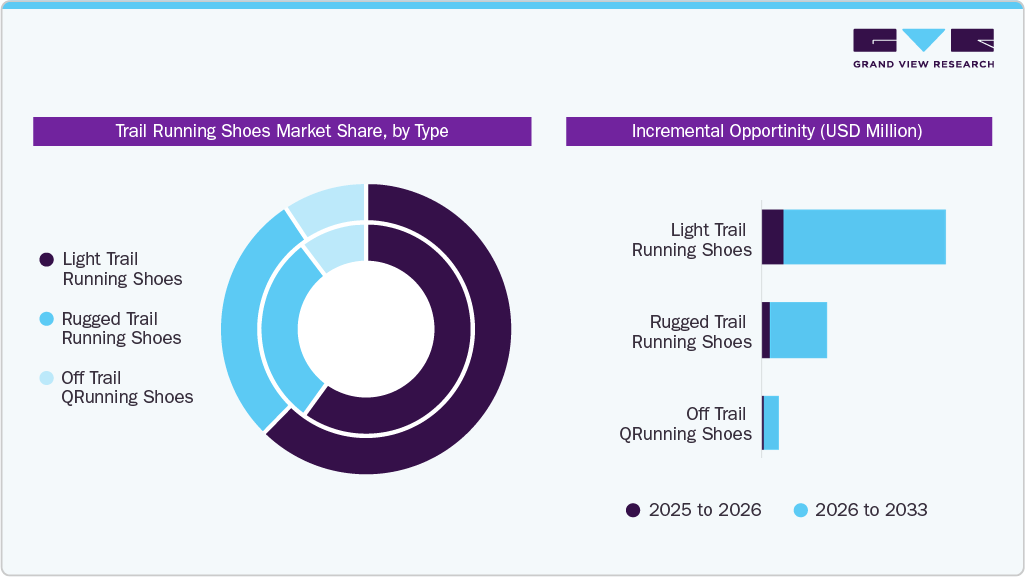
- By type, light trail running shoes accounted for a market share of 59.9% in 2025.
- By distribution channel, the offline segment accounted for a market share of 74.8% in 2025.
Market Size & Forecast
- 2025 Market Size: USD 8.9 Billion
- 2026 Market Size: USD 9.3 Billion
- 2033 Projected Market Size: USD 12.2 Billion
- CAGR (2026-2033): 4.0%
- North America: Largest market in 2025
Three ways to get this report
Buy it, customize it, or ask a question.Ask an Analyst
Analyst response in 1 business day
- AccessReport author, directly
- Reply timeWithin 1 working day
- No sales callDirect answer only
- FormatEmail reply
- CostFree, no cost
Get the Full Report
What the study covers
- FormatsPDF · Excel · Dashboard
- Timeline2026–2033 annual, 2025 base
- Coverage20+ countries, 5 regions
- Companies10+ key players profiled
Customize the Report
20% free customization
- IncludeCountries, segments, points
- TailorTo your product definition
- ExtendDeeper competitor detail
- OrA fully bespoke study
- Turnaround5–10 working days
Rising participation in outdoor fitness continues to fuel strong growth, with consumers viewing trail footwear as both a performance necessity and a lifestyle statement. Unlike standard road-running shoes, trail running models are designed specifically for rugged terrain, requiring enhanced grip, stability, and protection. Demand is rising for premium trail shoes featuring aggressive lugged outsoles, rock plates, reinforced toe guards, and responsive cushioning systems that support endurance running across uneven surfaces. Consumers are also gravitating toward high-specification, limited-edition releases and technical outdoor collections that align with broader athleisure and adventure-oriented lifestyles, positioning trail running shoes as an aspirational segment within the performance footwear industry.Market growth is being reinforced by widening usage beyond dedicated trail athletes. The athletic trail running shoes segment remains the core demand driver, supported by growing interest in mountain running, ultra-distance events, and recreational hiking-running crossover activities. At the same time, casual adoption is accelerating, as urban consumers increasingly prefer trail-inspired silhouettes for everyday wear due to their durability, traction, and outdoor running shoes. This crossover appeal has broadened the addressable market significantly, making trail shoes relevant not only for sport but also for travel, weekend recreation, and daily commuting in all-weather environments. Comfort and injury prevention are becoming key purchase criteria, with consumers prioritizing supportive midsoles, secure heel lockdown, and foot-shielding constructions for longer wear durations.
 To learn more about this report, Download Free Sample Report
 The industry is also benefiting from rapid innovation in materials and manufacturing. Leading brands are investing heavily in lightweight engineered mesh uppers, waterproof membranes, seamless overlays, and advanced adhesive bonding technologies that improve durability while reducing overall shoe weight. For instance, in August 2025, Nike introduced the ACG Ultrafly, a new trail-focused “super shoe” engineered for runners tackling demanding off-road conditions. Built through extensive athlete-led development and more than 30,000 miles of testing, the model blends Nike’s high-performance running innovation with ACG’s outdoor heritage. Key features include ZoomX foam for responsive cushioning, a carbon-fiber FlyPlate designed for agility over uneven terrain, and a Vibram Litebase outsole to improve grip and control on rugged surfaces.
Midsole developments such as energy-return foams, carbon-infused stability elements, and enhanced shock absorption are allowing manufacturers to differentiate products across terrain intensity levels, from fast trail races to technical alpine routes. Type segmentation is increasingly sophisticated, with shoes designed specifically for mud traction, rocky mountain surfaces, ultra-running comfort, and mixed road-to-trail versatility, reflecting highly specialized consumer needs.
Market Dynamics
Growing awareness regarding mental health and emotional well-being is significantly influencing consumer participation in outdoor fitness activities. Increasing levels of stress, anxiety, and burnout associated with urban lifestyles and sedentary work environments are encouraging individuals to adopt nature-based fitness routines as a form of mental relaxation and therapy. Outdoor running in natural environments such as trails, forests, and mountains is widely perceived to provide psychological benefits, including improved mood, reduced stress levels, and enhanced cognitive well-being. This shift toward nature therapy and holistic wellness is becoming an integral part of modern fitness lifestyles, thereby driving demand for trail running activities and supporting the growth of specialized footwear designed for outdoor terrain.
The relatively high cost of trail running shoes compared to conventional running and athletic footwear is a key factor restraining market growth. This price difference is primarily driven by the incorporation of advanced materials, reinforced traction outsoles, and durability-focused design elements required for performance on uneven and rugged terrains. As a result, trail running shoes are often positioned in the premium segment, limiting their affordability for price-sensitive consumers, particularly in emerging economies. This pricing constraint restricts wider adoption and leads to demand being concentrated mainly among urban populations, fitness enthusiasts, and high-income consumer groups, thereby limiting overall market penetration.
Brand Market Share Insights
The industry is characterized by the presence of established performance footwear leaders alongside a growing base of outdoor-specialist and emerging premium brands, all competing to meet evolving consumer expectations around grip, protection, comfort, and versatility in outdoor running shoes. Manufacturers are increasingly engineering trail running shoes that integrate advanced performance features such as aggressive lugged outsoles, enhanced traction compounds, lightweight stability structures, and responsive cushioning systems designed for uneven, unpredictable terrain.
 To learn more about this report, Download Free Sample Report
 Leading players such as Salomon, HOKA, Nike, Adidas, and ASICS continue to expand trail-specific portfolios by incorporating proprietary midsole foams, rock plates, reinforced toe guards, and weather-resistant uppers that improve durability and foot protection. At the same time, lifestyle crossover demand is influencing product design, with brands developing road-to-trail hybrids and visually modern silhouettes that transition seamlessly from sport to everyday wear.
Consumer Insights
Shifts in outdoor fitness participation, endurance sport culture, and lifestyle-driven performance footwear are redefining consumer engagement within the industry. Buyers are no longer purchasing trail shoes solely for competitive mountain running; instead, demand is increasingly shaped by a broader base of hikers, recreational runners, and outdoor-focused consumers who want footwear that performs across rugged terrain while remaining comfortable for longer wear durations. Younger consumers, particularly those aged 18-35, are accelerating demand for versatile trail models that combine technical trail grip with everyday styling, supporting road-to-trail use, travel wear, and casual outdoor mobility. Digital influence is especially strong in this category, with purchase decisions heavily guided by terrain-test videos, ultra-runner reviews, outsole traction comparisons, and community feedback that validates performance under real trail conditions rather than showroom claims.
Type construction and technical engineering play a decisive role in repeat buying in the trail running shoes segment. Consumers prioritize aggressive lug depth, multi-directional traction, rock plates, toe guards, and stable heel structures that protect the foot on uneven surfaces. Midsole innovation is also central, as trail runners increasingly expect responsive cushioning foams that balance shock absorption with ground feel, especially for long-distance trail efforts. Fit stability has become a baseline requirement, with demand rising for secure lockdown systems, reinforced uppers, and wider toe-box options that reduce discomfort during descent or extended mileage. Brands such as Salomon, HOKA, ASICS, Brooks, and Nike continue to compete through proprietary outsole compounds, terrain-specific cushioning platforms, and models designed for technical mountain trails versus smoother forest paths, reflecting growing segmentation within the category.
 To learn more about this report, Download Free Sample Report
 Spending behavior varies sharply by activity intensity and terrain needs. Casual consumers often gravitate toward hybrid trail shoes at mid-range price points, while dedicated trail athletes and ultra-distance runners are more willing to invest in premium models engineered for durability, weather resistance, and long-run protection. Sustainability is also emerging as a category-specific consideration, with consumers showing interest in recycled uppers, longer-lasting outsoles, and constructions that reduce replacement frequency in harsh environments. Value-added digital tools such as gait-informed fit guidance, detailed terrain filters, and easy return policies are improving e-commerce conversion, while demand spikes around spring trail seasons, summer mountain travel, and major endurance race calendars continue to position trail running shoes as one of the most innovation-intensive and fastest-growing segments in performance footwear globally.
Type Insights
Light trail running shoes accounted for a share of 59.9% of the global revenue in 2025. Light trail shoes are widely adopted not only by competitive trail runners but also by recreational athletes and outdoor enthusiasts who want agile footwear suitable for forest paths, mixed-surface routes, and everyday outdoor activity. The dominance of lightweight trail running shoes is further reinforced by growing demand for road-to-trail hybrids and multipurpose designs that transition seamlessly between running, hiking, and casual wear. Leading brands continue to innovate with engineered mesh uppers, lightweight foam midsoles, and optimized lug patterns that deliver grip without added bulk.
 To learn more about this report, Download Free Sample Report
 For instance, in August 2024, ASICS unveiled the METAFUJI TRAIL, a new pinnacle-speed trail running shoe designed for athletes seeking maximum pace and efficiency on off-road terrain. Inspired by elite trail runner Andreu Simon, the model brings ASICS’ latest racing innovations into the trail category, combining a lightweight build with advanced propulsion technologies. The shoe features a full-length carbon plate engineered specifically for trail dynamics, layered within high-performance cushioning to support faster transitions and controlled momentum across uneven surfaces.
The rugged trail running shoes segment is projected to grow at a CAGR of 3.4% from 2026 to 2033, as more consumers take part in outdoor running and adventure-focused fitness activities that require durable, protective footwear. Designed for demanding environments such as rocky trails, muddy terrain, steep slopes, and uneven ground, rugged models emphasize strong grip, reinforced construction, and long-lasting stability rather than minimal weight. Features like aggressive traction outsoles, resilient uppers, impact-shielding midsoles, and secure fit systems make these shoes especially suitable for long-distance trail efforts and challenging weather conditions.
Distribution Channel Insights
The sale of trail running shoes through offline channels accounted for a share of 74.8% of the global revenue in 2025. Consumers continue to rely on physical outlets such as branded stores, sporting goods chains, and outdoor specialty retailers because trail running shoes require high confidence in fitness, terrain grip, and underfoot comfort. In-store purchasing allows buyers to evaluate key performance attributes firsthand, including cushioning response, heel stability, toe protection, and outsole traction, which are critical for uneven and technical running environments.
Offline distribution is further supported by the presence of expert staff, gait analysis services, and personalized product recommendations, particularly in dedicated running and outdoor stores. These retailers often stock a wide range of terrain-specific models, from lightweight trail racers to rugged mountain shoes, enabling consumers to compare options side by side.
 To learn more about this report, Download Free Sample Report
 Sale of trail running shoes through online channels is projected to grow at a CAGR of 5.0% from 2026 to 2033. Online platforms provide access to a much broader assortment of trail running models than most physical stores, enabling shoppers to compare outsole traction patterns, cushioning technologies, terrain specialization, and price points across multiple brands within minutes. This convenience is particularly attractive for experienced trail runners who already know their preferred fit and performance requirements, as well as lifestyle consumers seeking versatile trail-inspired shoes for everyday outdoor wear.
Regional Insights
North America Trail Running Shoes Market Trends
The trail running shoes market in North America accounted for a share of 33.0% of the global revenue in 2025, supported by strong outdoor participation, a mature athletic footwear culture, and high consumer spending on performance gear. Demand across the U.S. and Canada is driven by widespread engagement in trail running, hiking, endurance sports, and adventure-based recreation, particularly in regions with established trail networks and national park activity. In addition, lifestyle crossover trends are expanding adoption beyond dedicated athletes, as trail running shoes are increasingly worn for everyday mobility, travel, and casual outdoor-inspired fashion. Consumers continue to seek shoes that balance rugged durability with modern styling, lightweight construction, and supportive fit features such as rock plates, toe guards, and responsive foam midsoles.
 To learn more about this report, Download Free Sample Report
 U.S. Trail Running Shoes Market Trends
The trail running shoes industry in the U.S. accounted for a share of 79.4% in 2025, supported by strong participation in outdoor fitness, expanding trail infrastructure, and rising consumer interest in performance-driven footwear. Demand is being reinforced by the growing popularity of trail running, hiking, and endurance events, as well as the broader shift toward active lifestyles and wellness-oriented recreation. U.S. consumers increasingly seek trail shoes that provide advanced traction, responsive cushioning, and protective construction for varied terrain conditions, driving innovation in outsole grip systems, lightweight stability features, and durable upper materials.
Mexico trail running shoes market is projected to grow at a CAGR of 4.2% from 2026 to 2033. Growing health awareness among urban consumers is encouraging greater involvement in running, jogging, and adventure-based exercise routines. The country is also witnessing the emergence of local running communities and fitness clubs, which are supporting awareness and adoption of trail running as a structured activity. In addition, Mexico’s diverse natural landscape, including mountains and forests, is promoting adventure tourism and hiking, indirectly boosting demand for trail running footwear. Social media influence and fitness trends are further encouraging younger consumers to adopt outdoor fitness lifestyles. Moreover, expanding availability of international sports brands through retail and e-commerce channels is improving product accessibility, supporting steady long-term growth in the market.
Europe Trail Running Shoes Market Trends
The trail running shoes industry in Europe accounted for a share of 29.6% of the global revenue in 2025. European consumers often engage in trail activity across alpine routes, coastal paths, and dense forest networks, creating consistent demand for footwear that can handle steep elevation changes, wet conditions, and technical surfaces. As a result, buyers place high emphasis on grip reliability, waterproof protection, and long-wear durability, particularly in markets with established mountain sport traditions such as the Alps and Nordic regions. Trail running is also increasingly linked with broader hiking and endurance tourism, further widening participation beyond competitive athletes.
Germany running shoes market accounted for a share of 39.1% of the revenue in 2025, supported by the country’s strong outdoor sports culture and well-established fitness infrastructure. Germany has a deeply rooted tradition of hiking, forest running, and mountain sports, particularly in regions such as the Bavarian Alps, Black Forest, and Saxon Switzerland National Park, which provide ideal terrain for trail running activities. The country hosts several organized trail running events and ultra-marathons, such as the Zugspitz Ultratrail, one of the most popular trail running competitions in Europe, attracting both professional and amateur runners. These events significantly boost demand for high-performance trail running footwear designed for durability, grip, and weather resistance.
The trail running shoes industry in Italy is projected to grow at a CAGR of 5.5% from 2026 to 2033, supported by the country’s strong outdoor sports culture and well-established network of mountain and forest trails. Italy has a long-standing tradition of hiking, trekking, and mountain running, particularly in regions such as the Alps (Dolomites) and Apennine ranges, which are popular destinations for both amateur and professional trail runners. The country also hosts several recognized running events. Growing health consciousness, increasing participation in endurance sports, and rising popularity of outdoor fitness activities are further driving market growth. Additionally, Italian consumers show a strong preference for premium, high-quality athletic footwear, encouraging brands to introduce technologically advanced trail running shoes with enhanced grip, cushioning, and durability. Expanding sports retail networks and e-commerce channels are also improving product accessibility, supporting steady market expansion.
Asia Pacific Trail Running Shoes Market Trends
The trail running shoes market in Asia Pacific accounted for a share of 28.8% of the global revenue in 2025. Countries such as China, Japan, South Korea, Australia, and India are seeing increased interest in trail running, hiking, and endurance-based outdoor activities, driven by greater health awareness and lifestyle shifts toward active recreation. Growing investment in parks, trail infrastructure, and adventure tourism is further strengthening demand for technical footwear that delivers grip, stability, and comfort across uneven natural terrain.
In addition, Asia Pacific’s strong digital commerce ecosystem is accelerating trail running shoe adoption by improving product accessibility and brand exposure. Smartphone-led shopping, social media-driven product discovery, and direct-to-consumer platforms allow consumers to explore a wide range of global and domestic trail footwear offerings, including lightweight hybrids and rugged technical models. Local brands are also gaining traction by offering competitively priced, terrain-adapted designs, while international players expand their presence through online exclusives and influencer-led outdoor campaigns.
China trail running shoes market accounted for a share of 40.6% of the regional revenue in 2025, making it the dominant country market in Asia Pacific region. Growth is strongly supported by rising health consciousness, rapid urbanization, and increasing participation in outdoor endurance sports such as trail running, hiking, and mountain racing. Consumers in China are increasingly preferring high-performance, lightweight, and technologically advanced trail running shoes with enhanced grip, waterproofing, and cushioning for rugged terrains. There is also strong demand for premium international brands such as Nike, Adidas, HOKA, and Salomon, alongside growing interest in domestic sportswear brands like Anta and Li-Ning.
The trail running shoes industry in India is projected to grow at a CAGR of 6.9% from 2026 to 2033. The trail running shoes market in India is witnessing steady growth, driven by increasing fitness awareness, rising participation in outdoor sports, and a growing preference for performance-based athletic footwear among urban consumers. Indian consumers are increasingly preferring lightweight, breathable, and multi-terrain trail running shoes that offer durability, grip, and comfort for uneven surfaces such as hills, forest trails, and trekking routes. There is also a noticeable shift from generic running shoes to specialized trail footwear, especially among young fitness enthusiasts and amateur runners. Social media-driven fitness culture and the growth of adventure tourism in regions like Himachal Pradesh, Uttarakhand, and the Western Ghats, which are popular for trekking and trail running activities. Additionally, increasing availability of global sports brands through e-commerce platforms such as Amazon and Decathlon is improving accessibility and boosting adoption.
Latin America Trail Running Shoes Market Trends
The trail running shoes market in Latin America accounted for a share of 6.3% of the global revenue in 2025, reflecting a developing yet steadily expanding regional presence driven by increasing participation in outdoor and adventure-based activities. The region is witnessing growing consumer interest in trail running, trekking, and eco-adventure tourism, particularly in countries such as Brazil, Chile, Colombia, and Argentina, where diverse terrains like mountains, forests, and coastal trails naturally support outdoor sports culture. Consumers in this region primarily prefer durable and affordable trail running shoes with strong grip and weather resistance, as many trails involve uneven and rugged surfaces. Price sensitivity remains relatively high, leading to stronger demand for mid-range performance footwear rather than premium models.
Brazil trail running shoes market accounted for a share of 56.7% of the regional revenue in 2025, making it one of the most influential markets in the region. The country’s strong performance is supported by its large base of outdoor sports enthusiasts and a well-established culture of running events, including marathons and trail-based endurance competitions. A key trend in the country is the growing popularity of community-driven running groups and organized trail events, which is encouraging consistent participation in outdoor fitness activities. Additionally, there is a noticeable shift toward premium and international sports brands, as consumers seek better cushioning technology and lightweight designs for long-distance running. Social media influence and fitness-focused lifestyles are further amplifying demand, especially among younger demographics. The expansion of sports retail chains and e-commerce platforms is also improving product accessibility, strengthening overall market growth in Brazil.
Middle East & Africa Trail Running Shoes Market Trends
The trail running shoes industry in the Middle East & Africa accounted for a share of 2.5% of the global revenue in 2025, and is gradually emerging, supported by rising fitness awareness and increasing government focus on sports and wellness initiatives. Although still a relatively small market, it is witnessing steady adoption driven by expanding participation in recreational running, desert running events, and adventure tourism activities, particularly in countries such as the UAE, South Africa, and Saudi Arabia. Consumers in the region are increasingly preferring durable, heat-resistant, and lightweight trail running shoes that can withstand extreme climatic conditions such as high temperatures and uneven desert terrains. There is also a growing inclination toward premium and international sportswear brands, especially among urban and expatriate populations.
The UAE trail running shoes market is projected to grow at a CAGR of 4.0% from 2026 to 2033. A key trend in the UAE is the expansion of structured running communities and fitness challenges, particularly in cities such as Dubai and Abu Dhabi, where government-led initiatives promoting active lifestyles are gaining momentum. Consumers in the region show a strong preference for premium and performance-oriented footwear, especially shoes offering heat resistance, lightweight construction, and enhanced breathability to suit the hot climate and rough desert terrains.
Key Trail Running Shoes Companies:
The following key companies have been profiled for this study on the trail running shoes market.
-
VF Corporation
-
New Balance
-
Wolverine Worldwide, Inc.
-
Brooks Sports, Inc
-
Adidas AG
-
Nike, Inc.
-
SKECHERS USA, Inc.
-
ASICS America Corporation
-
Deckers Brands
-
Amer Sports
Recent Developments
-
In August 2025, HOKA launched the Mafate 5, its latest long-distance trail running shoe built for durability, comfort, and control on tough terrain. The new model introduces Rocker Integrity Technology, which helps runners maintain stability and smooth transitions over uneven surfaces, alongside enhanced cushioning for sustained performance during extended trail efforts. Designed for technical trails, the Mafate 5 also features aggressive Vibram Megagrip traction lugs and an updated upper that offers added protection, making it a premium option for serious mountain and endurance runners.
-
In September 2024, Teva unveiled its Fall 2024 footwear collection, combining outdoor performance with everyday comfort for cooler-season adventures. The lineup introduces new styles such as the Trailwinder, built for traction and stability on rugged trails, and the Ellwood Mid, offering added protection for colder conditions. With this launch, Teva continues expanding beyond summer sandals into more versatile, year-round footwear.
Trail Running Shoes Market Report Scope
Report Attribute
Details
Market size value in 2025
USD 8.9 billion
Market size value in 2026
USD 9.3 billion
Revenue Forecast in 2033
USD 12.2 billion
Growth rate
CAGR of 4.0% from 2026 to 2033
Actuals
2021 - 2025
Forecast period
2026 - 2033
Quantitative units
Revenue in USD billion, and CAGR from 2026 to 2033
Report coverage
Revenue forecast, company ranking, competitive landscape, growth factors, and trends
Segments covered
Type, distribution channel, region
Regional scope
North America; Europe; Asia Pacific;Latin America; Middle East & Africa
Country scope
U.S.; Canada; Mexico; Germany; UK; France; Italy; Spain: China; Japan; India; South Korea; Australia; Brazil; South Africa
Key companies profiled
VF Corporation; New Balance; Wolverine Worldwide, Inc.; Brooks Sports, Inc; Adidas AG; Nike, Inc.; SKECHERS USA, Inc.; ASICS America Corporation; Deckers Brands; Amer Sports
Customization scope
Free report customization (equivalent up to 8 analysts’ working days) with purchase. Addition or alteration to country, regional & segment scope.
Pricing and purchase options
Avail customized purchase options to meet your exact research needs. Explore purchase options
Global Trail Running Shoes Market Report Segmentation
This report forecasts revenue growth at global, regional & country levels and provides an analysis of the latest trends and opportunities in each of the sub-segments from 2021 to 2033. For this study, Grand View Research has segmented the global trail running shoes market report on the basis of type, distribution channel, and region.
 To learn more about this report, Download Free Sample Report
 -
Type Outlook (Revenue, USD Billion, 2021 - 2033)
-
Light Trail Running Shoes
-
Rugged Trail Running Shoes
-
Off Trail Running Shoes
-
-
Distribution Channel Outlook (Revenue, USD Billion, 2021 - 2033)
-
Offline
-
Specialty Sports Stores
-
Multi brand Retail Stores
-
Brand Exclusive Stores
-
Others
-
-
Online
-
E-commerce Website
-
Brand-owned Website
-
-
-
Regional Outlook (Revenue, USD Billion, 2021 - 2033)
-
North America
-
U.S.
-
Canada
-
Mexico
-
-
Europe
-
Germany
-
UK
-
France
-
Italy
-
Spain
-
-
Asia Pacific
-
China
-
Japan
-
India
-
South Korea
-
Australia
-
-
Latin America
-
Brazil
-
-
Middle East & Africa
-
South Africa
-
-
Delivered Customizations
This report has been delivered with the following In-depth customizations
Client Request
Customization Delivered
Value Adds
Market Dynamics, Growth Drivers & Restraints Analysis
Developed a comprehensive analysis of the trail running shoes market, focusing on key growth drivers such as rising participation in trail running and outdoor sports, increasing health and fitness awareness, expansion of adventure tourism, rising popularity of athleisure footwear, and technological advancements in cushioning, traction, and lightweight materials. The study also incorporated key restraints, including high product cost and premium pricing, limited awareness of trail running in developing regions, lack of trail infrastructure, product specialization limiting everyday use, and strong competition from road running and general athletic footwear categories.
Enables stakeholders to understand demand-side and supply-side dynamics, evaluate growth opportunities across fitness and lifestyle segments, identify barriers to adoption in price-sensitive and emerging markets, and assess the impact of innovation and consumer lifestyle shifts on long-term market expansion.
Segmentation & Regional Analysis
Delivered a structured breakdown of the market by product type, by distribution channel, and by geography. The analysis highlighted the dominance of light trail running shoes and the Asia Pacific as the leading regional market, supported by rising fitness participation and an expanding consumer base.
Provides actionable insights into high-growth product categories, regional demand hotspots, and distribution channel performance, helping stakeholders optimize product positioning, retail strategy, and geographic expansion planning.
Competitive Landscape, Trends & Innovation Assessment
Assessed the competitive landscape, including major players such as Nike, Adidas, ASICS, New Balance, Brooks Sports, Skechers, VF Corporation, Deckers Brands, and Amer Sports. The analysis also covered key industry trends such as rising participation in ultra-trail events, increasing female participation in running, growth of premium performance footwear, and advancements in material innovation, including lightweight foams and high-traction outsole technologies.
Supports strategic decision-making by identifying competitive intensity, innovation priorities, brand positioning strategies, and emerging consumer trends, enabling companies to strengthen product development pipelines and expand market share in the performance footwear segment.
Frequently Asked Questions About This Report
The global trail running shoes market size was estimated at USD 8.9 billion in 2025 and is expected to reach USD 9.3 billion in 2026.
The global trail running shoes market is expected to grow at a compound annual growth rate of 4.0% from 2026 to 2033 to reach USD 12.2 billion by 2033.
North America dominated the trail running shoes market with a share of 33.0% in 2025. This is attributable to the ongoing trend of ultra-trail running in the region, most notably in the U.S. and Canada.
Some key players operating in the trail running shoes market include VF Corporation; New Balance Athletics, Inc.; Wolverine World Wide Inc.; Brooks Sports, Inc.; Adidas AG; Nike Inc.; Skechers U.S.A, Inc.; Asics Group; Deckers Outdoor Corporation; and Amer Sports.
Key factors that are driving the trail running shoes market growth include the increasing global participation in outdoor sports and the growing popularity of trail running events, including Ultra-Trail du Mont-Blanc (UTMB).
Trail running shoes are preferred by consumers over conventional running shoes as they are made specifically for handling rough and rugged terrains, and offer better traction on challenging surfaces.
Light trail running shoes segment dominated the trail running shoes market with a share of 59.9% in 2025.
The offline distribution channel led the trail running shoes market with 74.8% in 2025 and is expected to maintain its dominance through 2033, while the online segment is poised to show the fastest growth over the forecast period.
The trail running shoes are broadly classified into 3 types: light, rugged, and off-trail running shoes, with the light trail and rugged trail segments expected to show the fastest growth over the forecast period.
About the Author(s)
Clothing, Footwear & Accessories Research Team
Consumer Goods · Clothing, Footwear & AccessoriesThis report was authored by the clothing, footwear & accessories research team at Grand View Research - comprising two research analysts, one senior research analyst, and one industry expert - with specialized expertise in the clothing, footwear & accessories segment of the consumer goods industry. All findings are based on proprietary consumer goods databases, executive interviews, and regulatory analysis, subject to internal peer review prior to publication.
Last Updated:
Speak to Analyst

Customize this report to your needs - add regions, segments, or data points, with 20% free customization.
Or view our licence options:


ISO 9001:2015 & 27001:2022 Certified
We are GDPR and CCPA compliant! Your transaction & personal information is safe and secure. For more details, please read our privacy policy.


