
- Home
- »
- Power Generation & Storage
- »
-
Transformer Radiator Market Size And Share Report, 2033GVR Report cover

Transformer Radiator Market (2026 - 2033)
Size, Share & Trends Analysis Report By Transformer Type (Power Transformer, Distribution Transformer), By Cooling Type, By Transformer Rating, By End Use, By Region, And Segment Forecasts
Market Size, 2025
$798.2MMarket Estimate, 2026
$838.1MMarket Forecast, 2033
$1,310.8MCAGR, 2026–2033
6.6%Transformer Radiator Market Summary
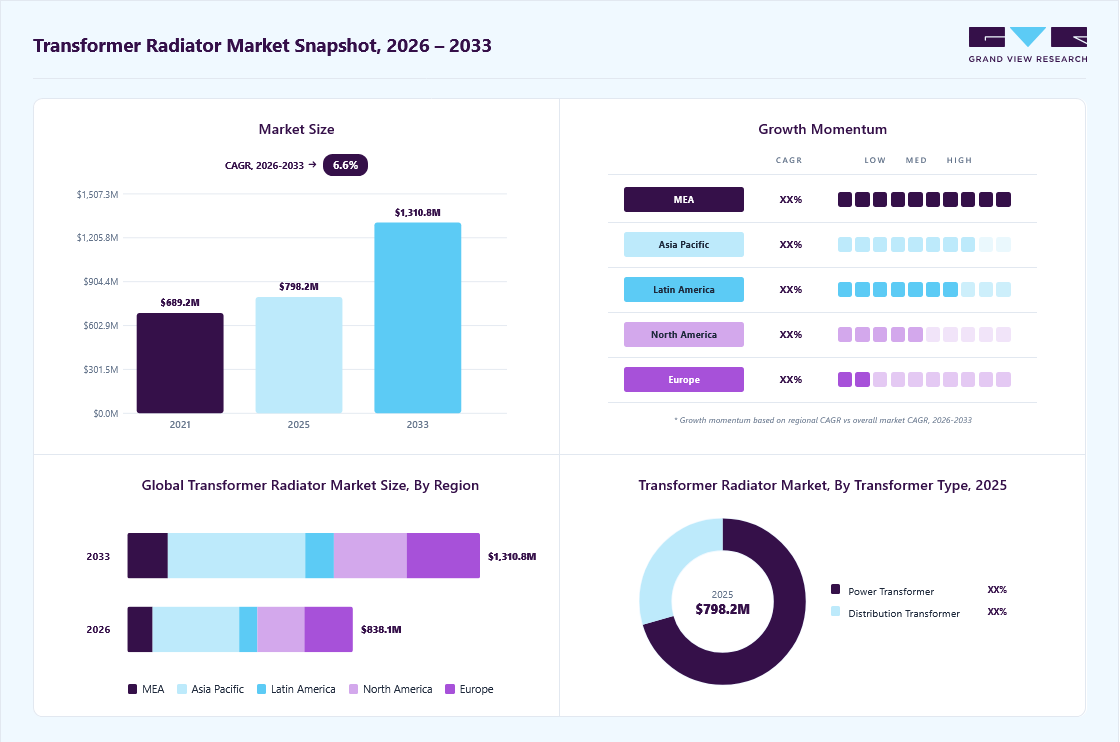
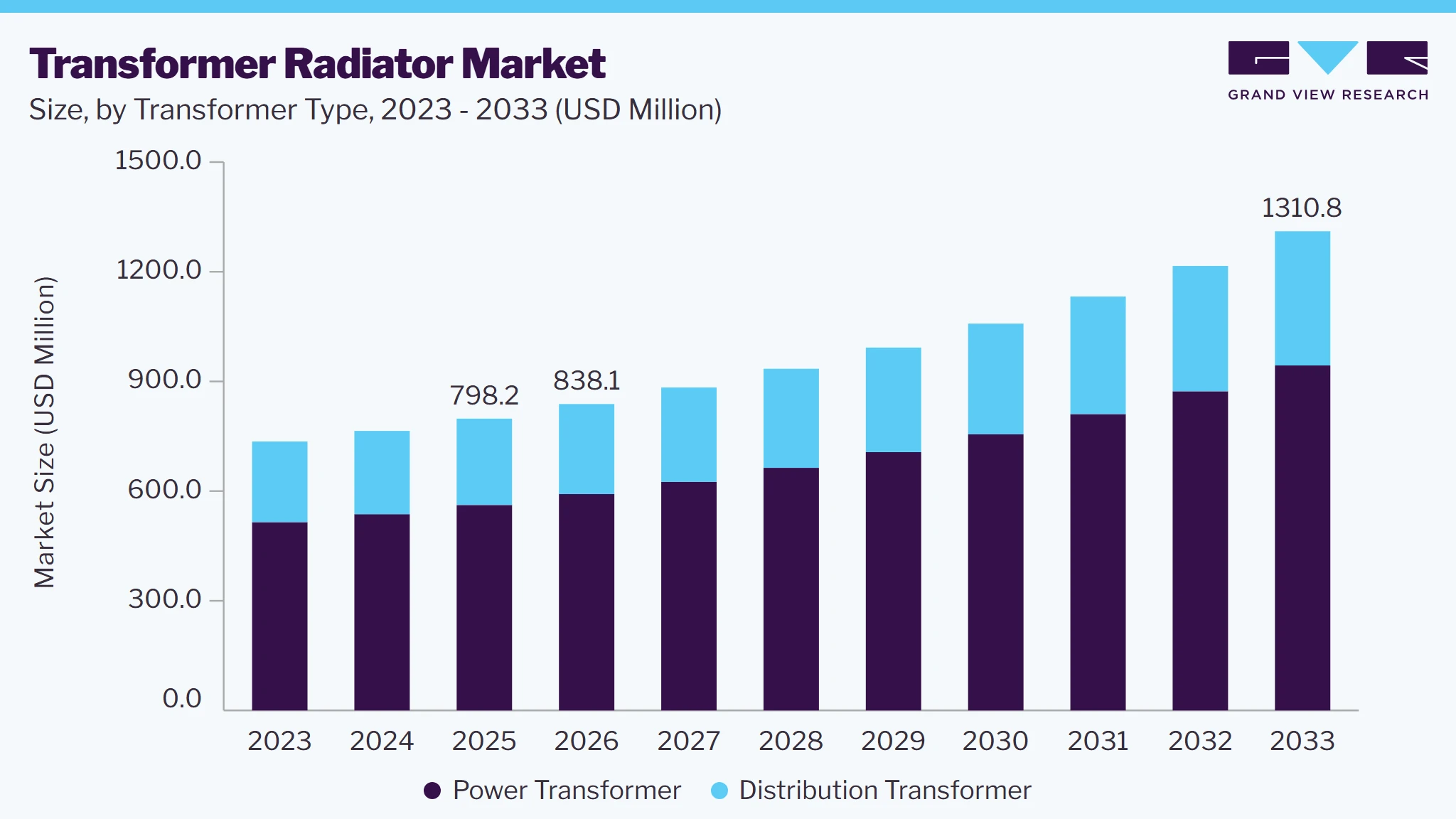
The global transformer radiator market size was valued at USD 798.2 million in 2025 and is projected to grow from USD 838.1 million in 2026 to USD 1,310.8 million by 2033, at a CAGR of 6.6% from 2026 to 2033. The Asia Pacific dominated the market, accounting for the largest revenue share of 38.3% in 2025. The market is supported by increasing investment in power generation, transmission, and distribution networks, particularly as utilities upgrade aging transformer fleets.
 Source: Grand View Research, IR Documents, Primary Interviews, Paid DatabasesTo learn more about this report,
 Download Free Sample Report
Key Market Trends & Insights
- By transformer type: The power transformer held the largest revenue share of 70.4% in 2025.
- By cooling type: The ONAN held the largest revenue share of 41.1% in 2025.
- By transformer rating: The 101-250 MVA held the largest revenue share of 21.8% in 2025.
- By end use: The utilities held the largest revenue share of 64.2% in 2025.
Regional Highlights
- Largest regional market: Asia Pacific (38.3% revenue share, 2025)
- Fastest-growing regional market: MEA (highest CAGR, 2026-2033)
- By country: India held the largest market share in 2025
Market Size & Forecast
- Market size in 2025: USD 798.2 Million
- Estimated market size in 2026: USD 838.1 Million
- Projected market size by 2033: USD 1,310.8 Million
- CAGR (2026-2033): 6.6%
Three ways to get this report
Buy it, customize it, or ask a question.Ask an Analyst
Analyst response in 1 business day
- AccessReport author, directly
- Reply timeWithin 1 working day
- No sales callDirect answer only
- FormatEmail reply
- CostFree, no cost
Get the Full Report
What the study covers
- FormatsPDF · Excel · Dashboard
- Timeline2026–2033 annual, 2025 base
- Coverage20+ countries, 5 regions
- Companies10+ key players profiled
Customize the Report
20% free customization
- IncludeCountries, segments, points
- TailorTo your product definition
- ExtendDeeper competitor detail
- OrA fully bespoke study
- Turnaround5–10 working days
Demand is further strengthened by the growing need for reliable heat dissipation in high-load and high-capacity transformers, along with the expansion of renewable power infrastructure.
 To learn more about this report, Download Free Sample Report
Market Dynamics
The market is driven by rising electricity demand, grid expansion, and the replacement of aging transformers, particularly across emerging economies. Growing deployment of high-capacity power transformers is increasing demand for efficient heat dissipation systems that maintain transformer performance and extend operating life. Demand is also shifting toward higher-efficiency and application-specific radiator designs as utilities prioritize reliability, thermal management, and reduced maintenance requirements. However, fluctuations in steel prices and energy-intensive manufacturing can pressure radiator costs and supplier margins. Overall, grid modernization and increasing transformer capacity are supporting steady market expansion.
Growing investment in transmission and distribution infrastructure is increasing the installation of power transformers across utility networks, renewable-energy projects, and industrial facilities. Higher transformer deployment directly expands the requirement for radiator systems used to dissipate heat from transformer oil and maintain operating temperatures under heavier loads. The trend is particularly relevant for high-capacity transformers, where effective thermal management is essential for reliable and continuous operation.
In June 2025, Hitachi Energy India received an order from POWERGRID to supply 30 units of 765 kV, 500 MVA single-phase transformers for India’s transmission network. The company noted that demand for power transformers in India had increased by 15% annually over the previous two years, supported by renewable-energy additions and electrification of industries and transportation. The deployment of higher-capacity transformers increases the need for effective thermal management, including radiator systems, to dissipate heat generated during continuous high-load operation.
Fluctuations in raw material prices, particularly steel and aluminum, act as a key market restraint by increasing manufacturing costs and creating uncertainty in supplier margins. Radiator production is material-intensive, while transformer manufacturers and utilities often operate under long procurement cycles and price-sensitive contracts, limiting manufacturers’ ability to fully pass higher input costs to customers. These cost pressures can encourage suppliers to optimize material usage and production processes, but may also constrain investments in capacity expansion and advanced radiator designs.
The increasing use of bio-based esters and other advanced transformer cooling fluids is creating opportunities for radiator manufacturers to develop designs optimized for different thermal characteristics and operating conditions. These fluids can require tailored heat-transfer configurations, encouraging suppliers to improve radiator surface area, fin geometry, material selection, and overall thermal performance. As utilities and transformer manufacturers adopt more environmentally preferable cooling solutions, demand could expand for application-specific radiators designed to support higher efficiency, safety, and environmental performance.
Analyst Perspective
The market is shifting toward higher-performance and application-specific cooling solutions as transformers operate under greater loads and more variable conditions. Grid expansion, transformer uprating, renewable integration, and aging transformer fleets are sustaining demand for both new radiators and replacement systems. Adoption of natural ester fluids, compact transformer designs, and improved heat-transfer configurations is influencing radiator design and material selection. Retrofit and cooling-system upgrades are also emerging as important opportunities as utilities seek to increase transformer capacity and extend asset life without full replacement. Modular radiator assemblies and improved corrosion-resistant materials are gaining relevance where longer service life and simplified maintenance are priorities. Overall, demand is increasingly tied to transformer performance optimization rather than standalone radiator replacement.
Transformer Type Insights
Power transformers held the largest revenue share of 70.4% in 2025. Their presence in the market is driven by their extensive use in power generation, transmission, and large-scale substations, where higher voltage and capacity levels require effective heat dissipation to maintain transformer efficiency and service life. Rising grid expansion, renewable power integration, replacement of aging high-capacity transformers, and increasing electricity demand are supporting investments in power transformer infrastructure, thereby sustaining demand for associated radiator systems.
Distribution transformers are expected to grow at the second-fastest CAGR of 5.9% over the forecast period. This is due to the expansion of electricity distribution networks, rising power demand from residential and commercial consumers, and increasing electrification across emerging economies. Grid modernization, integration of distributed renewable generation, and replacement of aging distribution infrastructure are also driving new transformer installations, supporting demand for radiator systems used in higher-capacity oil-filled distribution transformers.
Cooling Type Insights
The ONAN segment dominated the market with a revenue share of 41.1% in 2025. This is driven by its simple and reliable cooling arrangement, lower operating and maintenance requirements, and widespread use in distribution and lower-capacity power transformers. The absence of forced-air or forced-oil equipment also reduces auxiliary power consumption and system complexity, supporting continued adoption across utility, industrial, and commercial transformer applications.
The ODAF segment is anticipated to register the fastest CAGR of 7.8% from 2026 to 2033. The growth of this segment is supported by increasing deployment of high-capacity power transformers that require enhanced heat dissipation under heavy and variable loads. Rising investments in transmission infrastructure, renewable power integration, and grid expansion are encouraging the use of directed oil and forced-air cooling systems, thereby supporting demand for high-performance transformer radiators.
Transformer Rating Insights
The 101-250 MVA segment dominated the market with a revenue share of 21.8% in 2025. This dominance is attributed to the widespread deployment of transformers within this capacity range across transmission substations, power generation facilities, and large industrial applications. Growing grid expansion, renewable energy integration, and replacement of aging high-capacity transformers are increasing demand for transformers in this range, consequently supporting radiator requirements for effective heat dissipation.
The above 500 MVA segment is expected to register the fastest CAGR of 7.1% over the forecast period. This is driven by increasing deployment of ultra-high-capacity transformers for bulk power transmission, large-scale renewable energy integration, and expansion of high-voltage transmission networks. Growing electricity demand and the need to strengthen grid capacity are also supporting investments in large transformers, which require advanced radiator systems to manage higher thermal loads.
End Use Insights
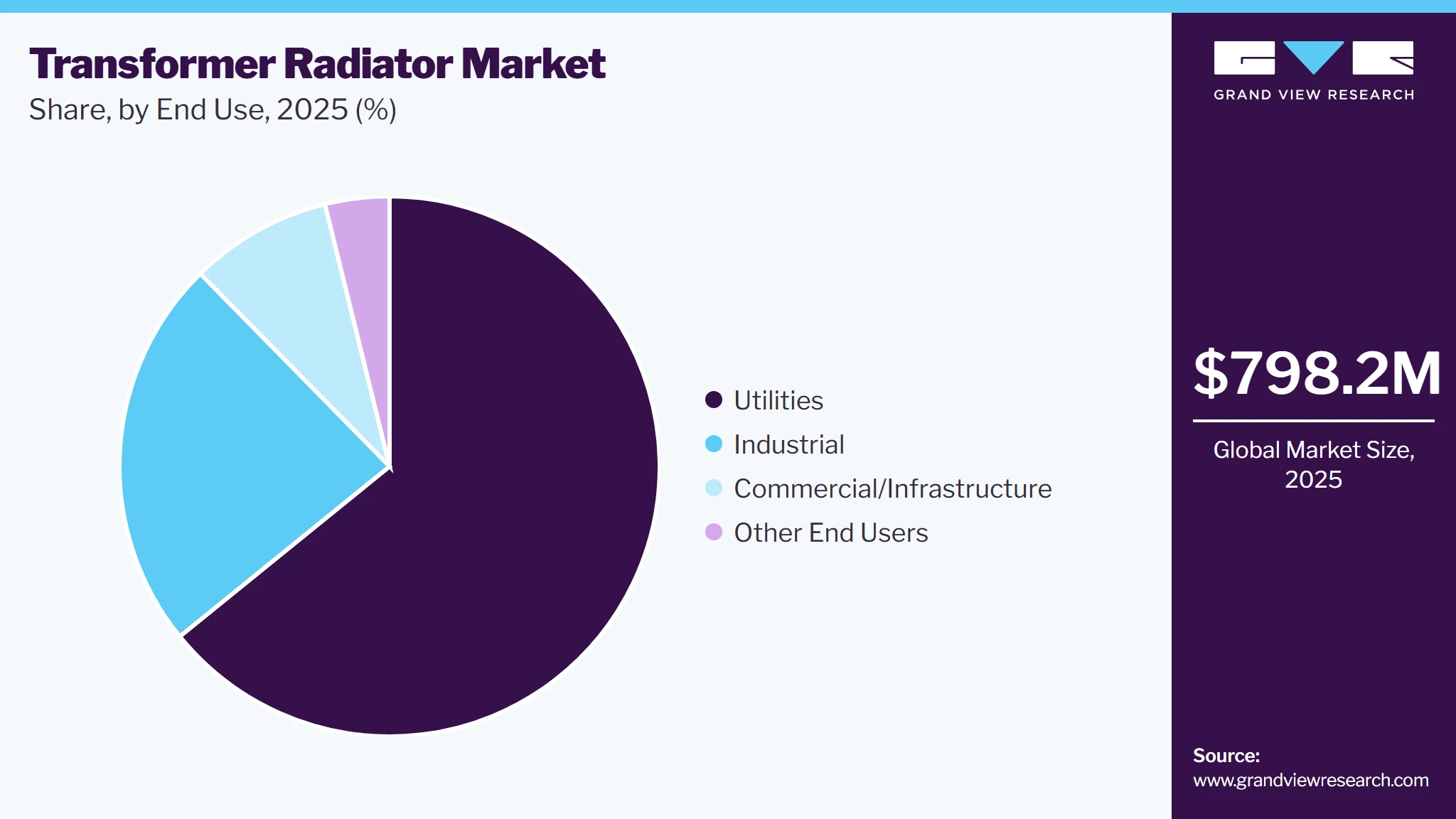
Utilities dominated the global market with a revenue share of 64.2% in 2025. This dominance is supported by continued investment in power generation, transmission, and distribution infrastructure, which drives demand for transformers and associated cooling systems. Grid expansion, replacement of aging transformer fleets, renewable energy integration, and substation modernization are further increasing radiator requirements across utility-owned transformer assets.
 To learn more about this report, Download Free Sample Report
The industrial segment is anticipated to register the fastest CAGR of 6.9% from 2026 to 2033. Rising industrial electrification, expansion of manufacturing and energy-intensive facilities, and increasing investments in mining, metals, oil & gas, and petrochemical infrastructure are driving transformer deployment across industrial sites. Higher electricity consumption and the need for reliable, high-capacity power systems are consequently increasing demand for transformer radiators in industrial applications.
Regional Insights
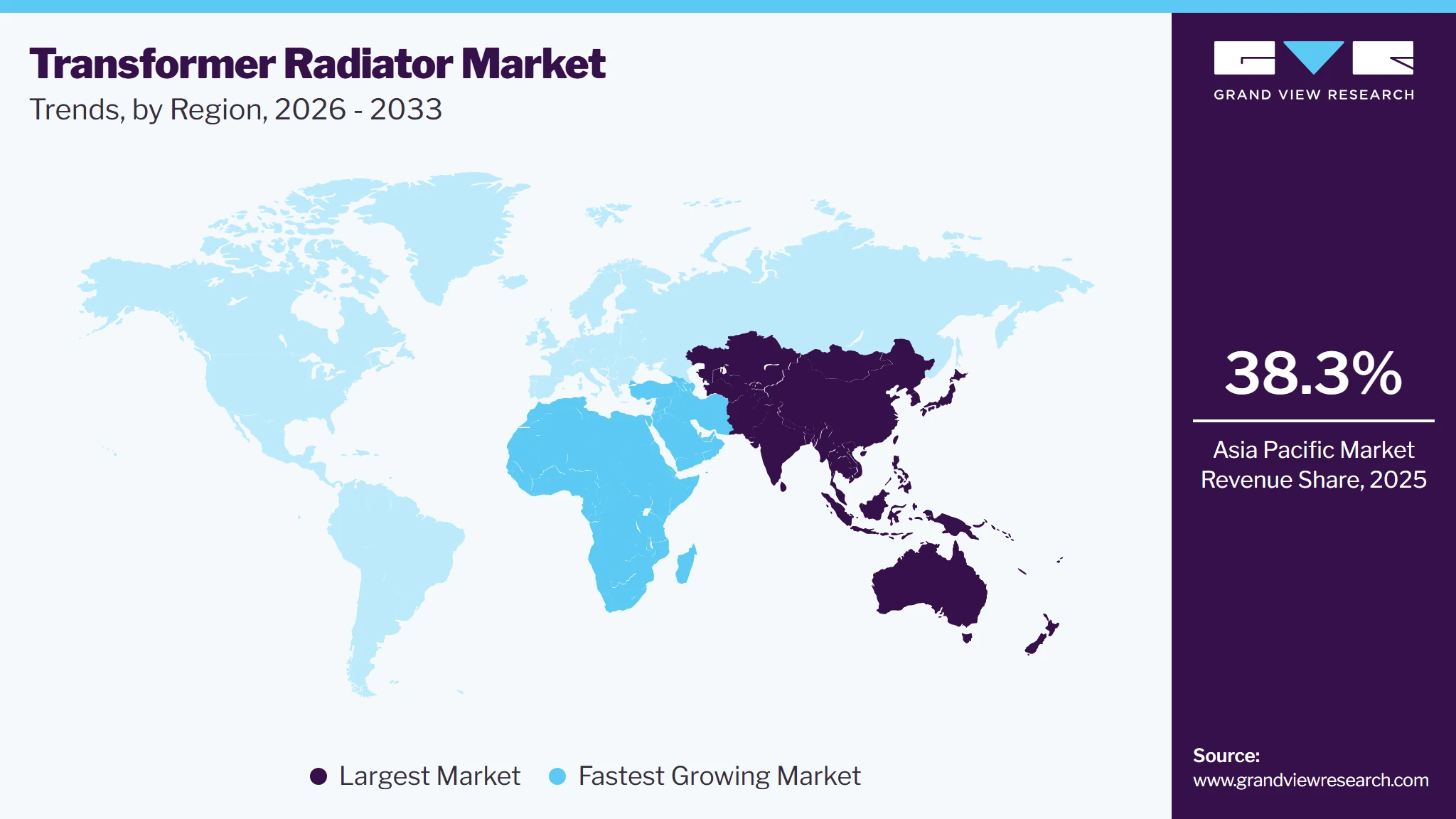
The Asia Pacific region dominated the global transformer radiator market with a revenue share of 38.3% in 2025. This region represents a major demand center due to rapid electricity consumption growth, extensive transmission and distribution expansion, renewable-energy additions, and large-scale industrial development. India, China, Japan, South Korea, and Southeast Asian countries are investing in grid capacity and higher-voltage transmission, supporting demand for radiators used in large power transformers.
 To learn more about this report, Download Free Sample Report
China Transformer Radiator Market Trends
The transformer radiator market in China is closely linked to continued investment in transmission and distribution networks, renewable integration, and replacement of older grid equipment. China’s power-grid investment reached USD 61.3 billion during the first nine months of 2025, up 9.9% year on year, while the government is promoting upgrades to substations, transmission lines, and outdated transformers. The country’s large UHV transmission buildout and rapidly expanding solar and wind capacity further support demand for high-capacity transformer cooling systems.
Middle East & Africa Transformer Radiator Market Trends
The transformer radiator market in MEA is expected to register the fastest CAGR of 7.0% from 2026 to 2033. This is supported by grid expansion, urbanization, industrial development, renewable-energy projects, and large infrastructure investments in countries such as Saudi Arabia, the UAE, and South Africa. Demand is particularly relevant for large oil-filled power transformers used in utility networks, petrochemical facilities, mining operations, and renewable-energy projects. Growing electricity consumption and new generation capacity are encouraging investment in transmission infrastructure, while the region’s harsh operating conditions increase the importance of reliable thermal-management systems and durable radiator designs.
Europe Transformer Radiator Market Trends
The transformer radiator market in Europe is being supported by extensive grid modernization, renewable-energy integration, and replacement of aging transmission assets. The European Commission estimates that USD 854.1 billion will be required for distribution grids and USD 558.1 billion for transmission networks by 2040, creating a substantial pipeline for new and upgraded transformers and associated cooling systems. Demand is also shifting toward higher-efficiency equipment as utilities accommodate more variable renewable generation and improve grid resilience.
North America Transformer Radiator Market
The transformer radiator market in North America is experiencing increasing demand for transformer cooling components as utilities expand grid capacity to accommodate data centers, electrification, renewable projects, and industrial loads. Transformer supply constraints are encouraging utilities and developers to secure equipment well ahead of project schedules, while manufacturers are expanding production capacity. This environment supports demand for radiators across new transformer installations, as well as refurbishment and capacity-upgrade projects.
The U.S. transformer radiator market is being shaped by a combination of aging grid infrastructure and rapidly rising electricity demand from data centers, manufacturing facilities, and electrification. The Department of Energy continues to address distribution-transformer supply-chain constraints, while in 2026, it reported industry collaboration to reduce production bottlenecks and improve component availability. The resulting focus on transformer availability, grid reliability, and asset life extension is creating opportunities for radiator manufacturers supplying both new and upgraded transformer units.
Latin America Transformer Radiator Market
The transformer radiator market in Latin America offers growing opportunities as utilities strengthen transmission networks, integrate large-scale renewable generation, and expand electricity access. Rising investment in grid reinforcement and renewable-energy projects is supporting demand for power transformers and associated thermal-management components. In March 2026, Hitachi Energy announced an additional USD 150 million investment to expand power-transformer manufacturing capacity in the region, reflecting increasing requirements for transformer equipment and supporting the local supply chain for components such as radiators.
Key Transformer Radiator Company Insights
Some of the key players operating in the market include Hi-Tech Radiators and STC RADIATORS, among others.
-
Hi-Tech Radiators Pvt. Ltd. specializes in transformer radiators and tanks, supplying cooling components for both power and distribution transformers. Its portfolio includes mild-steel, galvanized, and stainless-steel radiators in multiple widths and configurations, allowing the company to address different transformer cooling and environmental requirements. The company has expanded its manufacturing capabilities, including the commissioning of a fully automatic radiator manufacturing line in 2025, alongside its own hot-dip galvanizing and internal cleaning facilities. This combination of product breadth, automated production, and export capabilities supports Hi-Tech Radiators’ position as a specialized supplier to transformer manufacturers across international markets.
-
STC Radiators specializes exclusively in cooling and heat-exchange products for the oil-cooled transformer industry, serving both power and distribution transformer applications. Its pressed-steel radiator range uses CRCA steel sections in widths of 226 mm, 300 mm, 380 mm, and 520 mm, with customized section counts based on the transformer’s heat-dissipation requirements. The company also develops customized radiator configurations and designs aimed at maintaining heat dissipation and corrosion protection in tropical, coastal, and other demanding environments. Its focus on transformer-specific cooling solutions and customization enables STC Radiators to serve transformer manufacturers requiring application-specific radiator dimensions and thermal performance.
Key Transformer Radiator Companies
The following key companies have been profiled for this study on the transformer radiator market.
-
CTR Industries
-
Hi-Tech Radiators
-
Lexmark Radiators Private Limited
-
Menk USA (Prolec GE company)
-
Red Thunder Inc.
-
Shenyang Tiantong Electricity Co., Ltd.
-
STC RADIATORS
-
Thermo Engineers Pvt, Ltd.
-
Transvolt Engineering
-
Trantech Radiator Products, Inc.
Competitive Benchmarking
Category
Operating Strategies
Competitive Edge
Weakness
Established Players (Menk USA (Prolec GE company), Hi-Tech Radiators, Shenyang Tiantong Electricity Co., Ltd., Thermo Engineers Pvt Ltd, Trantech Radiator Products, Inc.)
- Maintain broad transformer radiator portfolios covering standard, customized, and replacement radiator requirements.
- Focus on long-term relationships with transformer manufacturers, utilities, EPC contractors, and power infrastructure customers.
- Expand manufacturing capacity and maintain standardized production processes to support high-volume orders and shorter delivery cycles.
- Stronger brand recognition and established relationships with major transformer manufacturers and utility customers.
- Higher production capacity and ability to handle large-volume and technically demanding projects.
- Extensive engineering experience enables customized radiator designs, retrofit solutions, and application-specific cooling systems.
- Larger manufacturing structures can create higher fixed costs compared with smaller regional manufacturers.
- Established players may have less flexibility in pricing for highly cost-sensitive, smaller-volume orders.
- Dependence on transformer industry capital expenditure makes demand sensitive to utility and grid-investment cycles.
Emerging Players (CTR Industries, Lexmark Radiators Private Limited, Red Thunder Inc., STC RADIATORS, Transvolt Engineering)
- Target specific transformer radiator applications, customer segments, or regional markets rather than competing across the entire global market.
- Emphasize customized radiator configurations, special dimensions, coatings, and retrofit/replacement requirements.
- Compete through shorter communication and decision-making cycles, flexible production, and customer-specific engineering.
- Greater flexibility in handling customized designs and relatively small production runs.
- Competitive manufacturing costs, particularly for manufacturers operating in lower-cost production regions.
- Ability to respond quickly to regional demand and customer-specific specifications.
- Smaller production capacities can limit participation in very large transformer or utility projects.
- Lower global brand recognition can create qualification challenges with major international transformer OEMs.
- More limited international sales, distribution, and service networks compared with established manufacturers.
Recent Developments
-
In June 2026, Hitachi Energy announced an investment of approximately USD 208 million to establish a new large power transformer manufacturing facility in Vadodara, India. The facility is expected to manufacture large power transformers for high-voltage transmission, HVDC, renewable energy projects, AI data centers, and industrial applications. The expansion will increase local production capacity for high-capacity transformers and support rising demand for grid infrastructure. The development is expected to drive demand for transformer radiator systems, as larger oil-filled transformers require higher-capacity cooling solutions to dissipate heat and maintain reliable operation.
Transformer Radiator Market Report Scope
Report Attribute
Details
Market definition
The market revenue represents earnings from the sale of transformer radiators across different end uses.
Market size in 2025
USD 798.2 million
Estimated market size in 2026
USD 838.1 million
Projected market size by 2033
USD 1,310.8 million
Growth rate
CAGR of 6.6% from 2026 to 2033
Historical data
2021 - 2025
Forecast period
2026 - 2033
Quantitative units
Revenue in USD million and CAGR from 2026 to 2033
Report coverage
Revenue forecast, competitive landscape, growth factors, and trends
Segments covered
Transformer type, cooling type, transformer rating, end use, region
Regional scope
North America; Europe; Asia Pacific; Latin America; MEA
Country scope
U.S.; Canada; Mexico; Germany; UK; France; Italy; China; India; Japan; South Korea; Brazil; Argentina; UAE; Saudi Arabia; South Africa
Key companies profiled
CTR Industries; Hi-Tech Radiators; Lexmark Radiators Private Limited; Menk USA (Prolec GE company); Red Thunder Inc.; Shenyang Tiantong Electricity Co., Ltd.; STC RADIATORS; Thermo Engineers Pvt, Ltd.; Transvolt Engineering; Trantech Radiator Products, Inc.
Customization scope
Free report customization (equivalent up to 8 analysts working days) with purchase. Addition or alteration to country, regional & segment scope.
Pricing and purchase options
Avail customized purchase options to meet your exact research needs. Explore purchase options
Global Transformer Radiator Market Report Segmentation
This report forecasts revenue growth at global, regional, and country levels and provides an analysis of the latest industry trends in each of the sub-segments from 2021 to 2033. For this study, Grand View Research has segmented the global transformer radiator market report based on transformer type, cooling type, transformer rating, end use, and region:
-
Transformer Type Outlook (Revenue, USD Million, 2021 - 2033)
-
Power Transformer
-
Distribution Transformer
-
-
Cooling Type Outlook (Revenue, USD Million, 2021 - 2033)
-
ONAN
-
ONAF
-
OFAF
-
ODAF
-
Others
-
-
Transformer Rating Outlook (Revenue, USD Million, 2021 - 2033)
-
Up to 10 MVA
-
10-50 MVA
-
51-100 MVA
-
101-250 MVA
-
251-500 MVA
-
Above 500 MVA
-
-
End Use Outlook (Revenue, USD Million, 2021 - 2033)
-
Utilities
-
Industrial
-
Commercial/Infrastructure
-
Other End Users
-
-
Regional Outlook (Revenue, USD Million, 2021 - 2033)
-
North America
-
U.S.
-
Canada
-
Mexico
-
-
Europe
-
Germany
-
UK
-
France
-
Italy
-
-
Asia Pacific
-
China
-
India
-
Japan
-
South Korea
-
-
Latin America
-
Brazil
-
Argentina
-
-
Middle East & Africa
-
Saudi Arabia
-
UAE
-
South Africa
-
-
Research Methodology
The transformer radiator market figures in this report are based on a proven research process that combines executive interviews with secondary research from proprietary databases, company filings, and recognized regulatory and institutional sources. Market size is built through value-chain sizing-reconciling supply-side and demand-side estimates-and triangulated with bottom-up and top-down approaches. Every estimate passes multiple levels of expert validation before publication, with each transformer radiator segment quantified using the revenue-capture definitions in the table below.
Segment Definition
Segment - Transformer Type
Revenue capture definition
Power Transformer
Covers sales of radiator systems installed on power transformers used in power generation, transmission networks, substations, and large-scale industrial facilities.
Distribution Transformer
Includes radiator sales associated with distribution transformers used to dissipate heat in utility distribution networks and commercial or industrial power systems.
Segment - Cooling Type
Revenue capture definition
ONAN
Accounts for radiator systems used in Oil Natural Air Natural cooling configurations, where natural oil circulation transfers heat to the radiator and surrounding air.
ONAF
Covers radiator sales for Oil Natural Air Forced systems, in which fans increase airflow across radiator surfaces to improve heat dissipation while oil circulation remains natural.
OFAF
Represents radiators supplied for Oil Forced Air cooling arrangements, combining mechanically assisted oil circulation with forced airflow for higher cooling performance.
ODAF
Includes radiator systems deployed in Oil Directed Air Forced configurations, where directed oil flow and forced air are used to manage heat in high-capacity transformers.
Others
Encompasses radiator sales for alternative, hybrid, or specialized transformer cooling configurations not classified under ONAN, ONAF, OFAF, or ODAF.
Segment - Transformer Rating
Revenue capture definition
Up to 10 MVA
Covers radiator systems designed for transformers with rated capacities of up to 10 MVA, generally serving smaller utility, industrial, and commercial applications.
10-50 MVA
Includes radiator products intended for transformers rated above 10 MVA and up to 50 MVA, covering medium-capacity utility and industrial installations.
51-100 MVA
Represents radiator demand from transformers with capacities exceeding 50 MVA and reaching 100 MVA, commonly used in substations and larger industrial facilities.
101-250 MVA
Captures radiator systems supplied for transformers rated above 100 MVA and up to 250 MVA, primarily supporting larger transmission, generation, and industrial applications.
251-500 MVA
Covers radiator equipment designed for transformers with ratings exceeding 250 MVA and up to 500 MVA, typically requiring higher-capacity heat dissipation systems.
Above 500 MVA
Encompasses radiator systems used with transformers exceeding 500 MVA, inc
Segment - Application
Revenue capture definition
Utilities
Includes radiator sales to electricity generation, transmission, and distribution utilities for new transformer installations, replacements, and refurbishment projects.
Industrial
Covers demand from manufacturing, mining, metals, oil & gas, petrochemical, and other energy-intensive industries operating transformer assets.
Commercial/Infrastructure
Represents radiator sales for transformers installed across data centers, hospitals, transportation facilities, commercial buildings, and other infrastructure projects.
Other End Users
Accounts for radiator demand from specialized or miscellaneous transformer applications that do not fall within utility, industrial, or commercial/infrastructure categories.
Estimation Model
Layer Name
Key Question
Description
Demand Layer
Which factors generate demand for transformer radiators?
Assess demand driven by expansion of electricity generation and transmission infrastructure, increasing renewable power integration, grid modernization, replacement of aging transformers, growth in industrial electricity demand, and rising deployment of high-capacity power and distribution transformers.
Cooling Technology Layer
Which transformer cooling configurations generate market revenue?
Evaluate radiator demand across ONAN, ONAF, OFAF, ODAF, and other cooling configurations based on transformer capacity, heat dissipation requirements, cooling performance, and deployment across utility, industrial, and infrastructure applications.
Application Layer
Which transformer types, ratings, and end users generate market revenue?
Assess revenue across power and distribution transformers, with further segmentation by transformer ratings ranging from up to 10 MVA to above 500 MVA. Revenue is analyzed across utilities, industrial facilities, commercial and infrastructure projects, and other end users.
Revenue Layer
How is market revenue generated?
Market revenue is quantified through the sales of transformer radiator systems and assemblies supplied for new transformer installations, replacement, refurbishment, and retrofit applications. Revenue varies based on radiator configuration, transformer rating, cooling technology, radiator capacity, and project requirements.
Delivered Customizations
This report has been delivered with the following In-depth customizations
Client Request
Customization Delivered
Value Adds
Transformer Capacity-Based Demand Analysis
Detailed radiator demand assessment across transformer ratings from up to 10 MVA to above 500 MVA, including the relationship between transformer capacity and radiator requirements.
Identifies high-demand transformer capacity ranges and supports product portfolio planning.
New Installation vs. Replacement Demand Analysis
Detailed assessment of transformer radiator demand from new transformer installations versus replacement of radiators in existing transformer fleets, including analysis by transformer type, rating, cooling configuration, end user, and region.
Identifies the contribution of greenfield transformer deployment and recurring replacement demand, supporting assessment of market growth opportunities across new-build and aftermarket applications.
Aftermarket & Replacement Opportunity Analysis
Detailed assessment of radiator replacement, refurbishment, repair, and retrofit opportunities across the installed base of power and distribution transformers, considering transformer age, operating conditions, replacement cycles, and cooling requirements.
Identifies regions, transformer categories, and end-user groups with higher aftermarket potential, supporting evaluation of recurring revenue opportunities beyond new transformer installations.
Frequently Asked Questions About This Report
The Middle East and Africa region is anticipated to register the fastest CAGR over the forecast period.
The transformer radiator market size was estimated at USD 798.2 million in 2025 and is expected to reach USD 838.1 million in 2026.
The transformer radiator market is expected to grow at a CAGR of 6.6% from 2026 to 2033 to reach USD 1,310.8 million by 2033.
The transformer radiator market is driven by rising electricity demand, grid modernization, and expansion of transmission and distribution infrastructure. Growing deployment of high-capacity transformers and the need for efficient thermal management also support demand for transformer radiators.
Asia Pacific region dominated the transformer radiator market with a revenue share of 38.3% in 2025.
The ONAN held the largest revenue share of 41.1% in 2025.
Based on transformer type, the power transformer segment accounted for the largest revenue share of 70.4% in 2025.
Based on end use, the utilities accounted for the largest revenue share of 64.2% in 2025.
The key players operating in the transformer radiator market are CTR Industries, Hi-Tech Radiators, Lexmark Radiators Private Limited, Menk USA (Prolec GE company), Red Thunder Inc., Shenyang Tiantong Electricity Co., Ltd., STC RADIATORS, Thermo Engineers Pvt Ltd, Transvolt Engineering, Trantech Radiator Products, Inc., and others.
About the Author(s)
Power Generation & Storage Research Team
Energy & Power · Power Generation & StorageThis report was authored by the power generation & storage research team at Grand View Research - comprising two research analysts, one senior research analyst, and one industry expert - with specialized expertise in the power generation & storage segment of the energy & power industry. All findings are based on proprietary energy & power databases, executive interviews, and regulatory analysis, subject to internal peer review prior to publication.
Last Updated:
Speak to Analyst

Customize this report to your needs - add regions, segments, or data points, with 20% free customization.
Or view our licence options:


ISO 9001:2015 & 27001:2022 Certified
We are GDPR and CCPA compliant! Your transaction & personal information is safe and secure. For more details, please read our privacy policy.


