
- Home
- »
- Advanced Interior Materials
- »
-
Translucent Concrete Market Size, Share Report, 2026-2033GVR Report cover
![Translucent Concrete Market (2026 - 2033)Report]()
Translucent Concrete Market (2026 - 2033)
Size, Share & Trends Analysis Report By Raw Material (Concrete, Fibers), By Application (Wall Cladding, Roofing, Flooring), By End Use (Residential, Non-residential), By Region, And Segment Forecasts
Market Size, 2025
$7.4MMarket Estimate, 2026
$12.2MMarket Forecast, 2033
$1,777.6MCAGR, 2026–2033
103.6%Translucent Concrete Market Summary
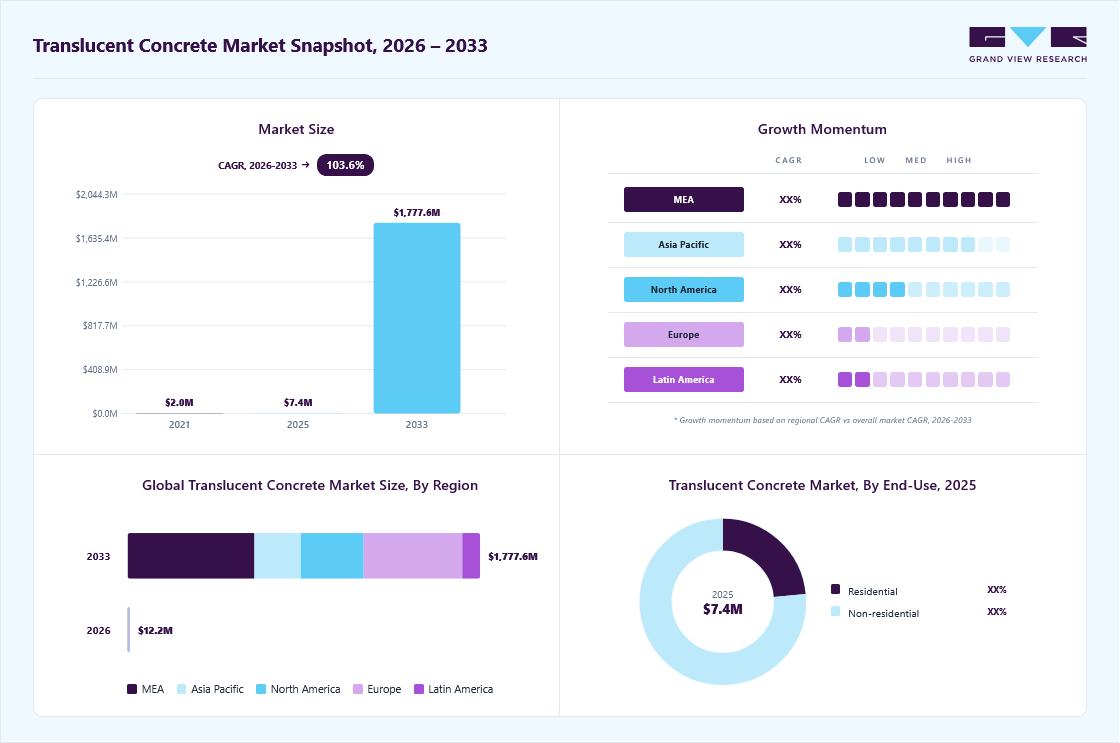
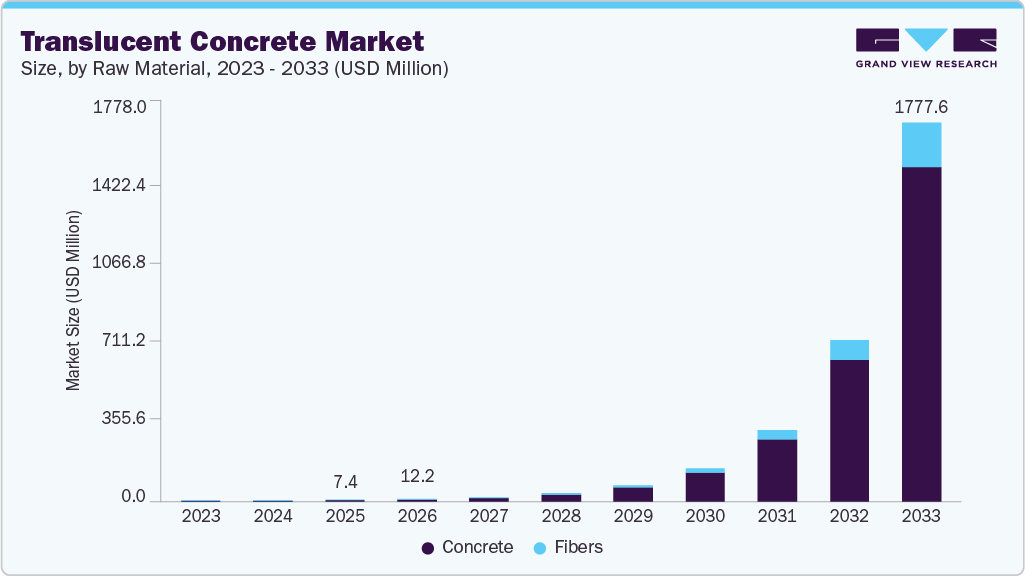
The global translucent concrete market size was estimated at USD 7.4 million in 2025 and is projected to grow from USD 12.2 million in 2026 to USD 1,777.6 million by 2033, at a CAGR of 103.6% from 2026 to 2033. The Middle East & Africa held the largest share of 31.5% of the global market in 2025. The demand for translucent concrete is rising as the emphasis on sustainable, energy-efficient construction materials grows.
Key Market Trends & Insights
- By raw material: Concrete segment held the largest market share of 84.7% in 2025.
- By application: Wall cladding segment accounted for the largest market share of 62.6% in 2025.
- By end use: Non-residential segment accounted for the largest market share of 76.5% in 2025.
Regional Highlights
- Largest regional market: Middle East & Africa (31.5% market share, 2025)
- Fastest-growing regional market: Asia Pacific (highest CAGR, 2026-2033)
- By country: Saudi Arabia held the largest market share in the Middle East & Africa in 2025.
Market Size & Forecast
- Market size in 2025: USD 7.4 Million
- Estimated market size in 2026: USD 12.2 Million
- Projected market size by 2033: USD 1,777.6 Million
- CAGR (2026-2033): 103.6%
Three ways to get this report
Buy it, customize it, or ask a question.Ask an Analyst
A direct answer, usually in 1 working day
- AccessReport author, directly
- Reply timeWithin 1 working day
- No sales callDirect answer only
- FormatEmail reply
- CostFree, no cost
Get the Full Report
What the study covers
- FormatsPDF · Excel · Dashboard
- Timeline2026–2033 annual, 2025 base
- Coverage20+ countries, 5 regions
- Companies10+ key players profiled
Customize the Report
20% free customization
- IncludeCountries, segments, points
- TailorTo your product definition
- ExtendDeeper competitor detail
- OrA fully bespoke study
- Turnaround5–10 working days
This innovative material allows natural light to pass through structures through applications such as translucent concrete blocks, translucent concrete walls, and decorative architectural panels, reducing the need for artificial lighting and thereby lowering energy consumption. Increasing urbanization and the development of smart cities are further contributing to its adoption in modern architectural designs. Additionally, the aesthetic appeal of translucent concrete is gaining traction among architects and designers seeking visually distinctive structures. The integration of advanced building materials in commercial and residential projects is also supporting market growth. Rising awareness about green building certifications is encouraging the use of such materials.Key drivers for the translucent concrete industry include advancements in construction technology and the increasing adoption of innovative building materials. The growing need for energy-efficient infrastructure is a major factor boosting the use of translucent concrete. Its ability to combine strength with light transmission makes it suitable for both functional and decorative applications, including translucent concrete wall systems, façade panels, and premium infrastructure designs using translucent cement solutions. Rising infrastructure investments, especially in emerging economies, are accelerating demand. Additionally, the expanding commercial construction sector, including offices, malls, and public spaces, is contributing to market growth. The material’s durability and low maintenance requirements also make it attractive for long-term use.
Technological advancements are playing a crucial role in the evolution of translucent concrete. Innovations in optical fiber integration, translucent cement formulations, and material composition are enhancing its light-transmitting capabilities and structural strength. The development of cost-effective production techniques is making the material more accessible for large-scale applications. Increasing use of prefabrication and modular construction methods is also boosting its adoption. Smart building integration, combining translucent concrete with lighting systems for dynamic effects, is emerging as a key trend. Additionally, research into improving thermal insulation and durability is expanding its scope of application. The growing trend of combining aesthetics with functionality in architecture is further accelerating innovation in this market.
Market Concentration & Characteristics
The translucent concrete market is relatively niche and moderately fragmented, with a mix of specialized manufacturers and construction material companies. A few key players dominate the market due to their technological expertise and patented production processes. However, the high production costs and limited awareness are barriers to entry for new players. Regional players are emerging, particularly in Europe and North America, where demand for innovative construction materials is higher. Collaborations between construction firms and material innovators are also shaping the competitive landscape. The market is gradually witnessing increased competition as more companies invest in research and commercialization.
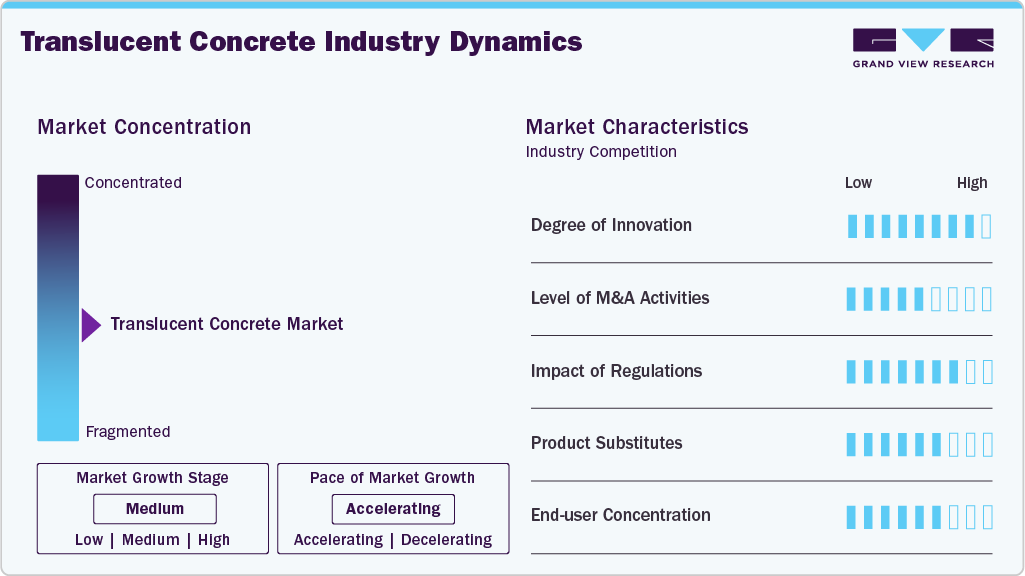
Translucent concrete faces competition from alternative materials such as glass, acrylic panels, and polycarbonate sheets, which also transmit light. These substitutes are often more cost-effective and easier to install, posing a challenge to market growth. Additionally, traditional concrete combined with innovative lighting systems can replicate similar visual effects at a lower cost. However, translucent concrete offers superior durability and structural strength compared to many substitutes. The unique combination of load-bearing capacity and light transmission provides a competitive edge. Despite this, high production costs and limited availability may encourage the use of alternatives. Continuous innovation is essential to reduce substitution threats and maintain market relevance.
Raw Material Insights
The concrete segment dominated the translucent concrete industry, accounting for the largest revenue share of 84.7% in 2025, driven by its widespread use as the primary structural material. Its superior strength, durability, and load-bearing capacity make it the preferred choice for large-scale construction projects. The integration of light-transmitting elements within traditional concrete enhances its functionality without compromising structural integrity. Additionally, its compatibility with existing construction practices and infrastructure has supported its dominance. High adoption in commercial buildings, facades, and public infrastructure further strengthens this segment. The cost-effectiveness of conventional concrete compared to advanced alternatives also contributes to its leading position.
The fibers segment is expected to grow at a CAGR of 97.1% over the forecast period, owing to advancements in optical fiber technology used in translucent concrete. These fibers enable efficient light transmission, enhancing both the aesthetic and functional properties of the material. The increasing demand for innovative architectural designs is driving the adoption of fiber-reinforced translucent concrete. Additionally, ongoing research aimed at improving fiber durability and reducing production costs is supporting market expansion. The growing trend toward smart, energy-efficient buildings further boosts demand for this segment. Fibers also allow for design customization, making them suitable for decorative applications.
Application Insights
The wall cladding segment accounted for the largest revenue share of 62.6% in 2025, driven by the increasing use of translucent concrete in building facades and exterior walls. Its ability to allow natural light penetration while maintaining privacy makes it highly suitable for cladding applications. Architects and designers are increasingly incorporating this material to create visually appealing and energy-efficient structures. The segment benefits from rising demand for modern and sustainable building designs. Additionally, wall cladding applications require lower structural strength than core construction, making translucent concrete easier to implement. Its aesthetic appeal, combined with functional benefits, has driven widespread adoption.
The flooring segment is expected to grow at a CAGR of 107.4% over the forecast period, driven by increasing demand for innovative interior design solutions. Translucent concrete flooring offers unique visual effects by allowing light to pass through surfaces, creating dynamic lighting patterns. This makes it particularly attractive for commercial spaces such as malls, hotels, and offices. Increasing adoption of luxury and high-end interior designs is further supporting growth. Additionally, improvements in material strength and durability are making translucent concrete more suitable for flooring applications. The trend of integrating lighting systems within floors is also contributing to demand.
End Use Insights
The non-residential segment dominated the translucent concrete market, accounting for the largest revenue share of 76.5% in 2025, due to extensive use in commercial and public infrastructure projects. Applications in offices, airports, museums, and retail spaces drive significant demand for translucent concrete. These projects often prioritize aesthetics and energy efficiency, making the material highly suitable. Large-scale construction budgets in the non-residential sector also support the adoption of premium materials. Additionally, the need for innovative architectural designs in public spaces boosts usage. Government investments in infrastructure and smart city projects further contribute to this segment’s dominance.
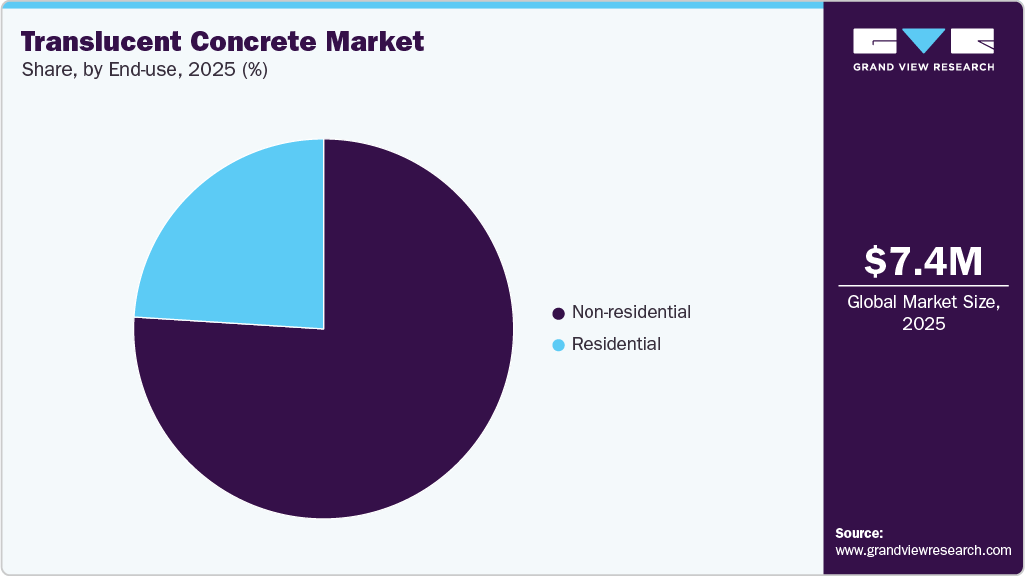
The residential segment is expected to grow at a CAGR of 104.7% over the forecast period, as homeowners increasingly seek modern, sustainable construction materials. Translucent concrete is gaining popularity in luxury housing and premium residential projects for its aesthetic appeal. The ability to enhance natural lighting within homes while maintaining privacy is a key advantage. Growing awareness of energy-efficient building solutions is also supporting adoption. Additionally, increasing disposable incomes and changing lifestyle preferences are driving demand for innovative home designs. The material is being used in applications such as decorative walls, partitions, and flooring.
Regional Insights
The Middle East & Africa dominated the global translucent concrete market, accounting for the largest revenue share of 31.5% in 2025, driven by large-scale construction projects. The focus on iconic architecture and smart city development is boosting demand. Countries in the Middle East are investing heavily in innovative building materials for high-end projects. Government initiatives promoting sustainable construction are also supporting growth. However, high costs and limited local manufacturing may pose challenges. Increasing adoption in the commercial and hospitality sectors is creating opportunities.

Europe Translucent Concrete Market Trends
Europe is a prominent market for translucent concrete, driven by strong environmental regulations and sustainability goals. Countries in the region are early adopters of innovative construction materials. The emphasis on reducing carbon emissions and energy consumption is boosting demand. Architectural innovation and design-focused construction projects are also contributing to market growth. Additionally, government incentives for green buildings are supporting adoption. The presence of leading manufacturers and research institutions enhances market development. Europe is expected to maintain a significant share in the global market.
The Germany translucent concrete market is expected to grow during the forecast period. Germany is a key market in Europe, known for its advanced construction technologies and innovation. The country’s strong focus on sustainability and energy efficiency is driving demand for translucent concrete. Increasing adoption in commercial and public infrastructure projects is supporting growth. Government regulations promoting green construction are further boosting the market. Additionally, the presence of leading material manufacturers and research facilities is enhancing innovation. Germany’s well-developed construction sector provides a strong foundation for market expansion. The country is expected to remain a major contributor in Europe.
North America Translucent Concrete Market Trends
North America is witnessing steady growth in the translucent concrete industry, driven by increasing demand for sustainable building materials. The region’s strong focus on green construction and energy efficiency is driving adoption. Advanced construction technologies and high awareness among architects are supporting market growth. Commercial construction projects, including offices and public infrastructure, are major contributors. Additionally, favorable government regulations and incentives for eco-friendly buildings are boosting demand. The presence of key market players is further enhancing innovation.
U.S. Translucent Concrete Market Trends
The growing emphasis on sustainable, energy-efficient construction practices is driving the U.S. translucent concrete industry’s growth. Increasing adoption of green building certifications is encouraging the use of translucent concrete. The material is gaining popularity in commercial and high-end residential projects for its aesthetic appeal. Technological advancements and research initiatives are supporting market development. Additionally, infrastructure modernization projects are creating new opportunities. The presence of established construction companies and material innovators is strengthening the market.
Asia Pacific Translucent Concrete Market Trends
Asia Pacific is emerging as a fast-growing market due to rapid urbanization and large-scale infrastructure development. Countries like China and India are investing heavily in smart cities and sustainable construction, driving demand. The growing construction sector and increasing awareness of green building materials are key drivers of growth. Rising disposable incomes and changing architectural preferences are also contributing to adoption. Additionally, government initiatives promoting eco-friendly construction are supporting market expansion. The presence of a large number of construction projects provides significant opportunities.
The China translucent concrete market is a major contributor, driven by its massive construction industry. The country’s focus on sustainable urban development and smart infrastructure is boosting demand. Government policies encouraging energy-efficient buildings are playing a crucial role. Increasing adoption of innovative construction materials in commercial and public infrastructure projects is also supporting growth. The presence of local manufacturers and technological advancements further strengthens the market. Additionally, rapid urbanization and high real estate investment are key factors.
Latin America Translucent Concrete Market Trends
The Latin America translucent concrete industry is experiencing gradual growth, supported by increasing infrastructure development. The region is witnessing rising adoption of modern construction materials in urban areas. Government initiatives to improve infrastructure and promote sustainable construction are driving demand. However, high costs and limited awareness may restrain market growth. Increasing investments in commercial construction projects are creating opportunities. Additionally, growing interest in innovative architectural designs is supporting adoption.
Key Translucent Concrete Company Insights
Some of the key players operating in the market include LUCEM and Fapinex LLC.
-
LUCEM GmbH is one of the leading players in the translucent concrete market, specializing in the production of light-transmitting concrete panels for architectural applications. The company offers end-to-end solutions, including design, manufacturing, and installation, making it a key contributor to commercial façade and interior applications.
-
Fapinex LLC is a niche player in the translucent concrete industry, primarily focusing on decorative and interior applications. The company specializes in integrating LED lighting with translucent concrete to create visually dynamic surfaces, including countertops, walls, and flooring. It caters mainly to premium commercial and hospitality segments where design aesthetics are a priority.
Heidelberg Materials and Litracon Ltd are among the emerging participants in the translucent concrete market.
-
Heidelberg Materials (parent of Italcementi) is a global leader in building materials and has contributed to the market through innovative cement-based solutions such as i.light. The company leverages its large-scale production capabilities and R&D strength to develop advanced construction materials that combine functionality with sustainability.
-
Litracon Ltd. is the pioneer of translucent concrete and one of the most recognized companies in the market. It developed the first commercially available light-transmitting concrete using embedded optical fibers, enabling natural light transmission through solid structures. The company focuses on high-end architectural applications, offering products such as precast blocks and panels for facades and artistic installations.
Key Translucent Concrete Companies:
The following key companies have been profiled for this study on the translucent concrete market.
- LUCEM
- Fapinex LLC
- Pan-United Corporation Ltd.
- Stepsmaterial.com
- FİBROBETON
- MATERIALSYI
- Litracon Ltd
- Heidelberg Materials
- LiCrete
- DITON
Translucent Concrete Market Report Scope
Report Attribute
Details
Market size in 2025
USD 7.4 million
Estimated market size in 2026
USD 12.2 million
Projected market size by 2033
USD 1,777.6 million
Growth Rate
CAGR of 103.6% from 2026 to 2033
Base year for estimation
2025
Actual estimates/Historical data
2021 - 2025
Forecast period
2026 - 2033
Quantitative units
Revenue in USD million and CAGR from 2023 to 2033
Report coverage
Revenue forecast, company ranking, competitive landscape, growth factors, and trends
Segments covered
Raw material, application, end use, region
Regional scope
North America; Europe; Asia Pacific; Latin America; Middle East & Africa
Country scope
U.S.; Canada; Mexico; Germany; UK; France; China; Japan; South Korea; Brazil; Saudi Arabia; UAE
Key companies profiled
LUCEM; Fapinex LLC; Pan-United Corporation Ltd.; Stepsmaterial.com; FİBROBETON; MATERIALSYI; Litracon ltd; Heidelberg Materials; LiCrete; DITON
Customization scope
Free report customization (equivalent up to 8 analysts working days) with purchase. Addition or alteration to country, regional & segment scope.
Pricing and purchase options
Avail customized purchase options to meet your exact research needs. Explore purchase options
Global Translucent Concrete Market Report Segmentation
This report forecasts revenue growth at the global, regional & country levels and provides an analysis of the industry trends in each of the sub-segments from 2021 to 2033. For this study, Grand View Research has segmented the translucent concrete market report based on raw material, application, end use, and region:
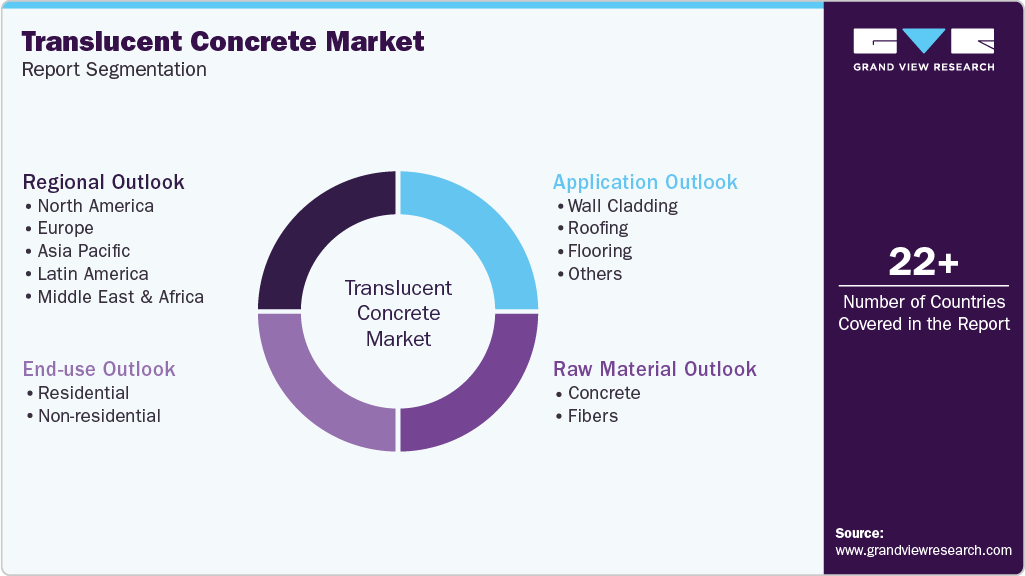
-
Raw Material Outlook (Revenue, USD Million; 2021 - 2033)
-
Concrete
-
Fibers
-
-
Application Outlook (Revenue, USD Million; 2021 - 2033)
-
Wall Cladding
-
Roofing
-
Flooring
-
Others
-
-
End Use Outlook (Revenue, USD Million; 2021 - 2033)
-
Residential
-
Non-residential
-
-
Regional Outlook (Revenue, USD Million; 2021 - 2033)
-
North America
-
U.S.
-
Canada
-
Mexico
-
-
Europe
-
UK
-
Germany
-
Italy
-
-
Asia Pacific
-
China
-
Japan
-
South Korea
-
-
Latin America
-
Brazil
-
-
Middle East and Africa
-
Saudi Arabia
-
UAE
-
-
Frequently Asked Questions About This Report
Asia Pacific is the fastest-growing regional market during the forecast period, driven by rapid urbanization, smart city projects, and sustainable construction initiatives.
The wall cladding segment held the largest market share of 62.6% in 2025 due to increasing use in facades and exterior walls, along with its ability to provide natural light transmission while maintaining privacy.
The non-residential segment accounted for the largest market share of 76.5% in 2025, supported by extensive adoption in commercial buildings, public infrastructure, airports, museums, offices, and retail spaces.
Middle East & Africa dominated the global translucent concrete market with a revenue share of 31.5% in 2025, driven by large-scale construction projects, smart city developments, and investments in iconic architecture.
Some of the key players operating in the translucent concrete market include LUCEM, Fapinex LLC, Pan-United Corporation Ltd., Stepsmaterial.com, FİBROBETON, MATERIALSYI, Litracon Ltd, Heidelberg Materials, LiCrete, and DITON.
The concrete segment led the market with a revenue share of 84.7% in 2025, owing to its superior strength, durability, load-bearing capacity, and compatibility with existing construction practices.
Key factors driving the market include growing demand for sustainable and energy-efficient construction materials, rising urbanization, increasing smart city developments, advancements in optical fiber integration technology, growing adoption of green building practices, and rising demand for aesthetically appealing architectural solutions.
The global translucent concrete market size was valued at USD 7.4 million in 2025 and is estimated at USD 12.2 million in 2026.
The global translucent concrete market is expected to grow at a CAGR of 103.6% from 2026 to 2033, reaching USD 1,777.6 million by 2033.
About the Author(s)
Advanced Interior Materials Research Team
Advanced Materials · Advanced Interior MaterialsThis report was authored by the advanced interior materials research team at Grand View Research - comprising two research analysts, one senior research analyst, and one industry expert - with specialized expertise in the advanced interior materials segment of the advanced materials industry. All findings are based on proprietary advanced materials databases, executive interviews, and regulatory analysis, subject to internal peer review prior to publication.
Last Updated:
Speak to Analyst


Customize this report to your needs - add regions, segments, or data points, with 20% free customization.
Or view our licence options:


ISO 9001:2015 & 27001:2022 Certified
We are GDPR and CCPA compliant! Your transaction & personal information is safe and secure. For more details, please read our privacy policy.


