
- Home
- »
- Automotive & Transportation
- »
-
Truck Rental Market Size, Share & Trends Report 2026-2033GVR Report cover

Truck Rental Market (2026 - 2033)
Size, Share & Trends Analysis Report By Truck, By Duration (Short Term, Long Term), By Propulsion (ICE, Electric), By Service Provider (Rental and Leasing Companies, OEM Captives, Third Party Service Providers), By Region, And Segment Forecasts
Market Size, 2025
$138.3BMarket Estimate, 2026
$148.3BMarket Forecast, 2033
$254.2BCAGR, 2026–2033
8.0%Truck Rental Market Summary
The global truck rental market size was valued at USD 138.3 billion in 2025 and is projected to grow from USD 148.3 billion in 2026 to USD 254.2 billion by 2033, at a CAGR of 8.0% from 2026 to 2033. Asia Pacific dominated the market, accounting for a revenue share of 41.4% in 2025. The booming e-commerce industry significantly contributes to the growth of the truck rental market. With the surge in online shopping, there is an increasing need for efficient last-mile delivery solutions.
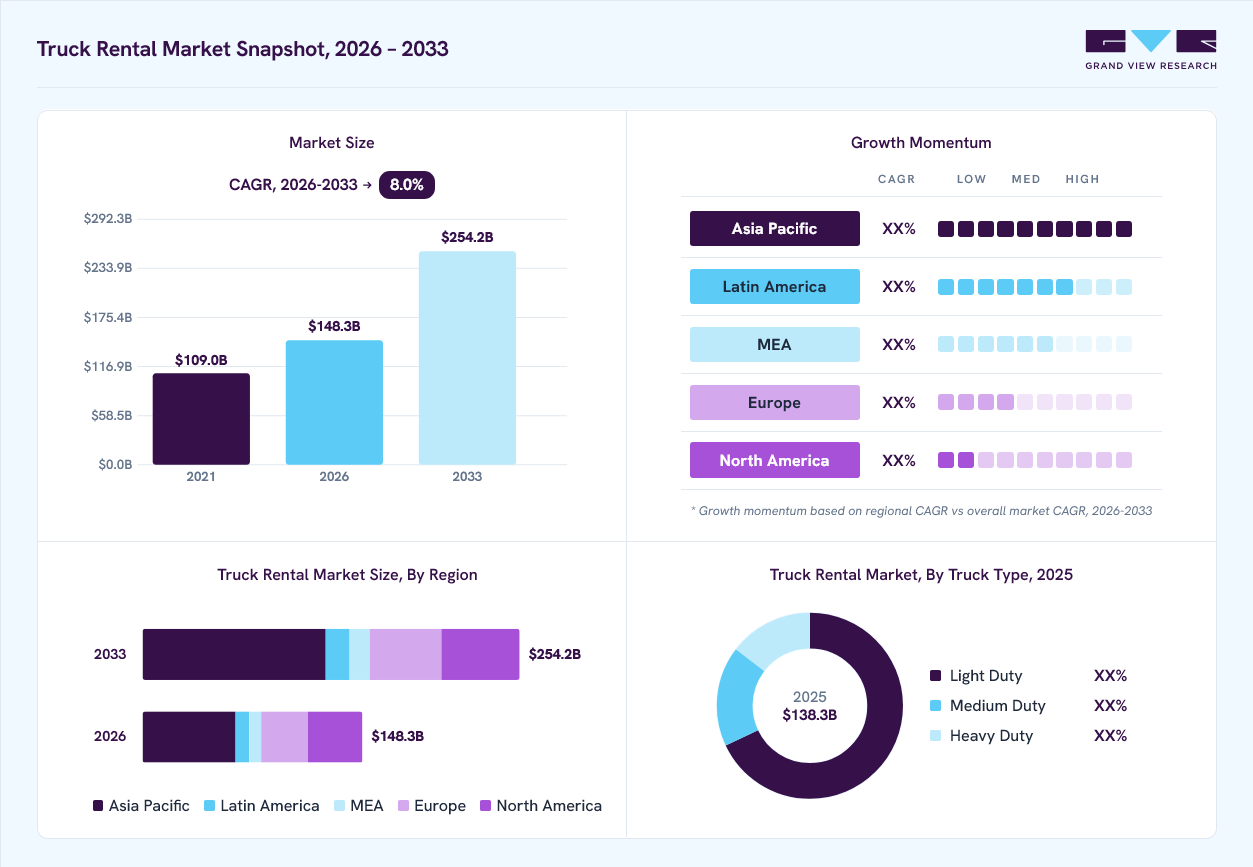 Source: Grand View Research, IR Documents, Primary Interviews, Paid DatabasesTo learn more about this report,
 Download Free Sample Report
Key Market Trends & Insights
- By truck: Light Duty segment dominated the market, with a revenue share of 67.9% in 2025.
- By duration: Short Term segment held the largest market share of 53.3% in 2025.
- By propulsion: Internal Combustion Engine (ICE) segment accounted for the largest revenue share of 67.3% in 2025.
- By service provider: Rental and Leasing Companies accounted for the largest revenue share of 42.1% in 2025.
Regional Highlights
- Largest regional market: Asia Pacific (41.4% revenue share, 2025)
- By country: China held the largest market share in 2025.
Market Size & Forecast
- Market size in 2025: USD 138.3 billion
- Estimated market size in 2026: USD 148.3 billion
- Projected market size by 2033: USD 254.2 billion
- CAGR (2026-2033): 8.0%
Prism AI by Grand View Research Free to tryAsk a question about the truck rental marketTry asking✓Every figure cited from GVR research Prefer the report? Download free sample →
Businesses, especially small and medium enterprises (SMEs), prefer renting trucks rather than investing in their fleet, as it offers flexibility and cost-effectiveness. This trend has led to a steady rise in demand for short-term and long-term truck rentals, particularly in urban areas with high delivery density.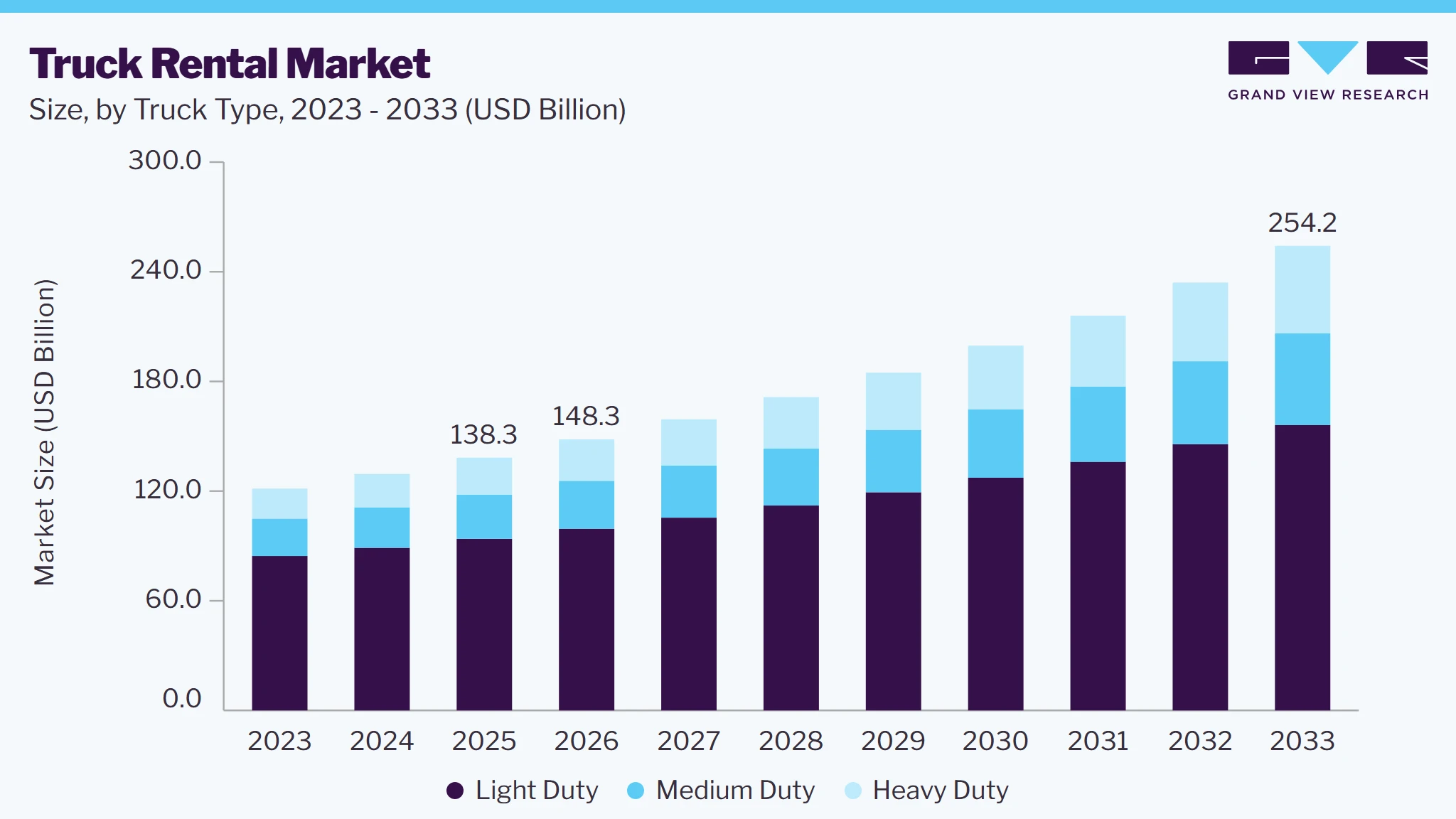 To learn more about this report, Download Free Sample Report
Ongoing infrastructure projects and rapid urbanization also drive the growth of the truck rental market. Governments invest heavily in road networks, industrial parks, and urban development in many developing regions. These projects require significant logistics and transportation support, often provided by rented trucks. The need to transport construction materials, machinery, and other goods across various sites boosts the demand for truck rentals. Moreover, urbanization increases goods movement within cities, further fueling the market's growth.
Moreover, truck rental services offer businesses the flexibility to scale their operations without the long-term commitment of purchasing and maintaining a fleet. Renting allows companies to manage fluctuating demand more efficiently, reducing the financial burden of vehicle ownership, such as maintenance, insurance, and depreciation. This cost efficiency is particularly attractive to businesses operating on tight margins or those with seasonal demand patterns, driving the adoption of truck rental services across various industries.
Advancements in technology, particularly in fleet management systems, are enhancing the appeal of truck rental services. Modern truck rental companies offer vehicles with GPS tracking, telematics, and other advanced features that provide real-time vehicle performance data and route optimization. These technologies improve operational efficiency, reduce fuel consumption, and enhance overall safety, making truck rentals an attractive option for businesses looking to leverage the latest innovations in logistics and transportation.
Despite truck rental services' advantages, high operational costs can be a significant barrier. Rental companies often face substantial vehicle maintenance, insurance, fuel, and labor expenses. These costs can be passed on to customers through higher rental rates, making the service less attractive, particularly for price-sensitive businesses. Additionally, fluctuations in fuel prices and rising maintenance costs due to aging fleets can further strain the profitability of truck rental companies, potentially leading to reduced market growth.
Market Dynamics
The truck rental market is shaped by expanding logistics demand, increasing supply chain volatility, and the growing preference for asset-light transportation models across industries. Macroeconomic uncertainty, e-commerce penetration, and infrastructure development continue to influence fleet utilization patterns, while regulatory pressure on emissions and safety is accelerating fleet modernization. Technology-led fleet management, telematics integration, and electrification are progressively redefining rental value propositions. Moreover, the market is moving toward flexible, technology-enabled, and compliance-driven rental solutions across short- and long-haul applications.
The increasing variability in freight volumes across construction, retail, manufacturing, and logistics has intensified the need for flexible transportation capacity. Seasonal demand spikes, project-based operations, and last-mile delivery expansion have made fleet ownership economically inefficient for many end users. Small and mid-sized operators, in particular, face capital constraints, maintenance burdens, and regulatory compliance challenges associated with owning trucks. These structural pressures have reinforced demand for rental-based access to commercial vehicles.
Truck rental solutions directly address this challenge by offering scalable access to diversified fleets without long-term capital commitment. Rental providers enable customers to adjust fleet size, truck class, and rental duration based on operational needs. This flexibility reduces fixed costs, improves asset utilization, and supports rapid deployment during demand surges. As a result, adoption of truck rentals continues to expand across logistics-intensive sectors, reinforcing steady market growth.
The truck rental market faces constraints from rising fleet acquisition costs, maintenance expenses, and regulatory compliance requirements. Emission norms, safety mandates, and inspection standards increase the cost of fleet ownership for rental providers. In addition, fuel price volatility and residual value risks further pressure operating margins, limiting aggressive fleet expansion in certain regions.
Furthermore, these cost pressures disproportionately affect smaller rental operators and emerging markets with limited access to financing. Heavy-duty and long-term rental segments experience slower fleet replacement cycles due to higher capital exposure. Regions with stringent emission regulations face elevated compliance costs, which can slow service expansion and delay customer adoption, thereby moderating overall market momentum.
The gradual transition toward electric commercial vehicles presents a significant opportunity for the truck rental market. Government incentives, urban emission restrictions, and corporate sustainability commitments are encouraging fleet electrification. Rental models reduce the risks associated with high upfront costs for electric trucks and uncertain resale values, making them attractive for trial-based adoption.
Electric truck rentals are expected to gain traction in urban logistics, municipal services, and short-haul distribution. Large rental providers with strong access to capital and OEM partnerships are best positioned to scale electric fleets. Light- and medium-duty segments, particularly in regulated urban regions, are likely to capture early growth from this transition.
Analyst Perspective
The truck rental market remains structurally resilient, supported by sustained logistics demand and the shift toward asset-light fleet strategies. Technology adoption in telematics, fleet optimization, and digital booking platforms is improving operational efficiency and customer experience. Electrification is gradually reshaping urban and regional rental offerings, particularly in light- and medium-duty segments. Investment activity is increasingly focused on fleet modernization, electric vehicles, and value-added services. Competitive differentiation is evolving toward service integration, regional scale, and OEM collaboration.
Truck Insights
Based on truck, the light duty segment led the market with the largest revenue share of 67.9% in 2025. The demand for efficient transportation solutions among small-scale and local businesses drives the segment's growth. Light-duty trucks are particularly advantageous for companies such as local delivery services, food vendors, and tradespeople. These businesses often require a reliable vehicle, easy to drive and suitable for transporting goods or equipment within a local area. The affordability and availability of light-duty trucks through rental services enable these businesses to operate more effectively without the financial burden of purchasing a vehicle.
The heavy duty segment is projected to grow significantly from 2026 to 2033. The expansion of the logistics and supply chain sector drives the demand for heavy-duty trucks in the rental market. As global trade increases and supply chains become more complex, there is a growing need for reliable transportation of goods over long distances. Heavy-duty trucks are crucial for hauling large volumes of cargo across various regions. Companies in the logistics sector often opt to rent heavy-duty trucks to manage peak periods, seasonal demand, or specific contracts, which contributes to the growth of this segment in the truck rental market.
Duration Insights
Based on duration, the short term segment led the market with the largest revenue share of 53.3% in 2025. The rise of the gig economy and the increasing number of independent contractors in the logistics and transportation sectors fuel short-term truck rentals' growth. Freelance drivers, moving services, and on-demand delivery providers often prefer short-term rentals to meet specific job requirements. The gig economy's emphasis on flexibility and on-demand services aligns perfectly with the short-term rental model, driving its growth in the truck rental market.
The long term segment is projected to grow significantly from 2026 to 2033. The mitigation of depreciation risk drives the growth of the segment. Vehicle depreciation is a major concern for companies that own their fleet. Trucks and other commercial vehicles lose value over time, significantly impacting on a company's balance sheet. Long-term rentals mitigate this risk by transferring the burden of depreciation to the rental company. Businesses can use the vehicles for their intended period without worrying about resale value, allowing them to focus on their core operations while maintaining a fleet that meets their needs.
Propulsion Insights
Based on propulsion, the ICE segment led the market with the largest revenue share of 67.3% in 2025. The presence of established infrastructure and support systems drives the market's growth. The infrastructure supporting ICE trucks, including refueling stations and maintenance facilities, is well-established and widely available. This extensive network provides convenience and reliability for businesses that rely on ICE trucks. As a result, companies often prefer ICE trucks due to the ease of access to support services and the familiarity of the existing infrastructure.
The electric segment is projected to grow significantly from 2026 to 2033. The rise of urbanization and the implementation of low-emission zones in many cities drive the segment's growth. Low-emission zones restrict access to areas with high pollution levels, making electric trucks ideal for operations within these zones. Rental companies can cater to businesses operating in urban areas by providing electric trucks that comply with local regulations. This alignment with urban environmental policies boosts the demand for electric truck rentals.
Service Provider Insights
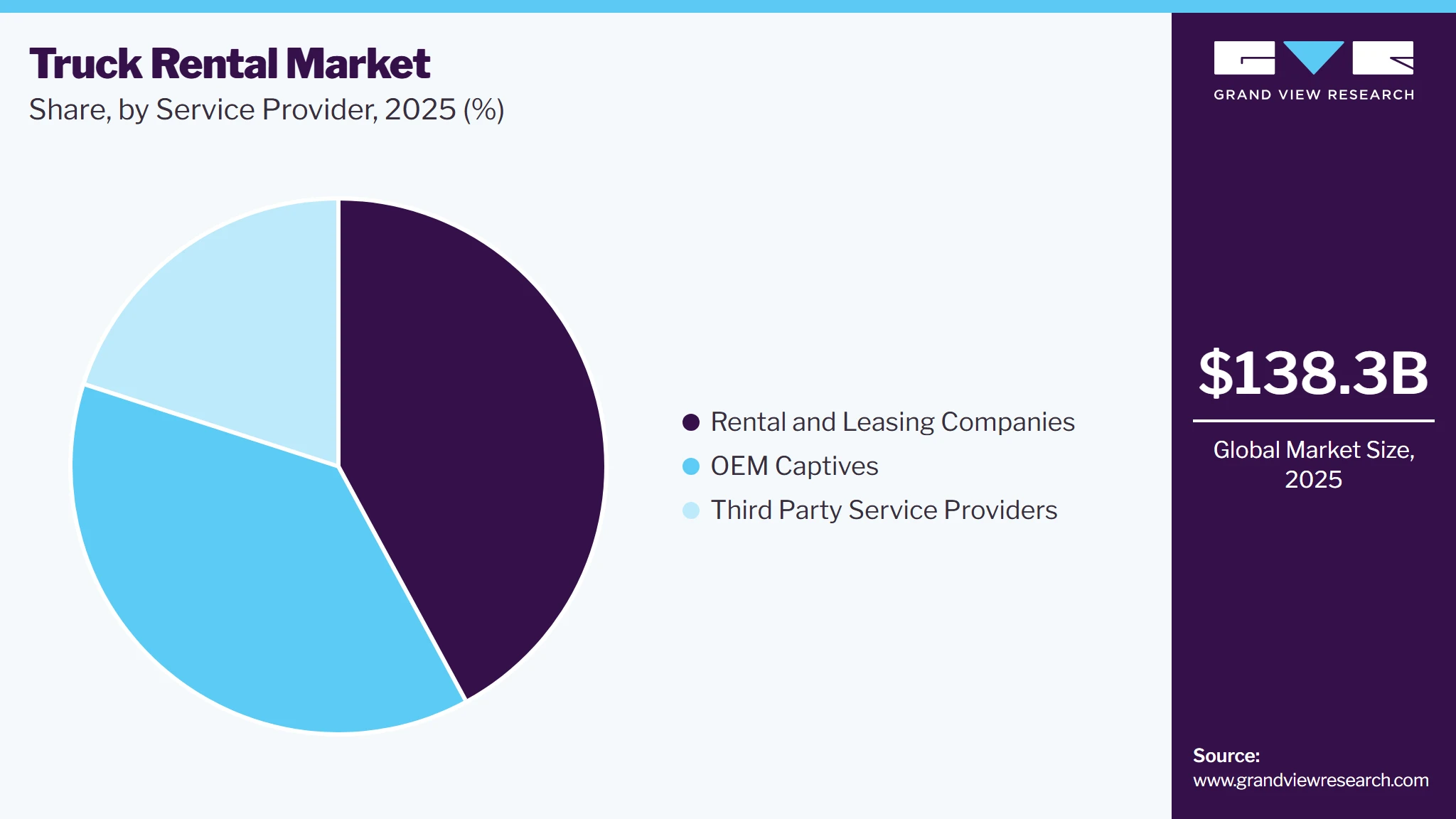
Based on service provider, the rental and leasing companies led the market with the largest revenue share of 42.1% in 2025. The improved services and customer support offered by these companies drive the market growth. Many companies offer value-added services such as 24/7 roadside assistance, comprehensive maintenance packages, and customized leasing solutions tailored to specific business needs. These improvements in service quality and customer support make rental and leasing options more attractive to businesses looking for reliable and hassle-free transportation solutions.
 To learn more about this report, Download Free Sample Report
The OEM captives segment is projected to grow significantly from 2026 to 2033. The customized financing option offered by the OEM captives can be more appealing to businesses than traditional lenders. These financing options often include favorable terms such as lower interest rates, flexible payment schedules, and tailored lease agreements that match the specific needs of different industries. This flexibility helps businesses manage their cash flow more effectively and reduces the financial burden of acquiring new trucks. OEM captives' attractive financing solutions drive their adoption in the truck rental market as businesses seek to optimize their fleet management.
Regional Insights
The North America truck rental market held a significant share of the global market in 2025. The rise of urban delivery needs, driven by the growth of online shopping and on-demand services, contributes to the growth of truck rentals. Cities in the region face increasing challenges related to congestion and regulatory restrictions on commercial vehicles. Truck rentals allow businesses to use specialized vehicles for urban deliveries, such as smaller trucks or electric vehicles, which are well-suited for navigating city environments and meeting regulatory requirements.
U.S. Truck Rental Market Trends
Truck rental market in the U.S. is expected to grow at a significant CAGR from 2026 to 2033. The expansion of rental networks and the diversification of services offered by rental companies contribute to this growth. Rental companies are increasingly providing a wider range of vehicles, including specialized trucks for various industries, and offering additional services such as maintenance and support.
Europe Truck Rental Market Trends
Truck rental market in Europe is expected to witness notable growth from 2026 to 2033. Stricter environmental regulations and policies in Europe are influencing the truck rental market. European countries are implementing stringent emission standards to combat air pollution and promote sustainability. Truck rental companies are adapting to these regulations by offering newer, cleaner vehicles that comply with environmental standards.
Asia Pacific Truck Rental Market Trends
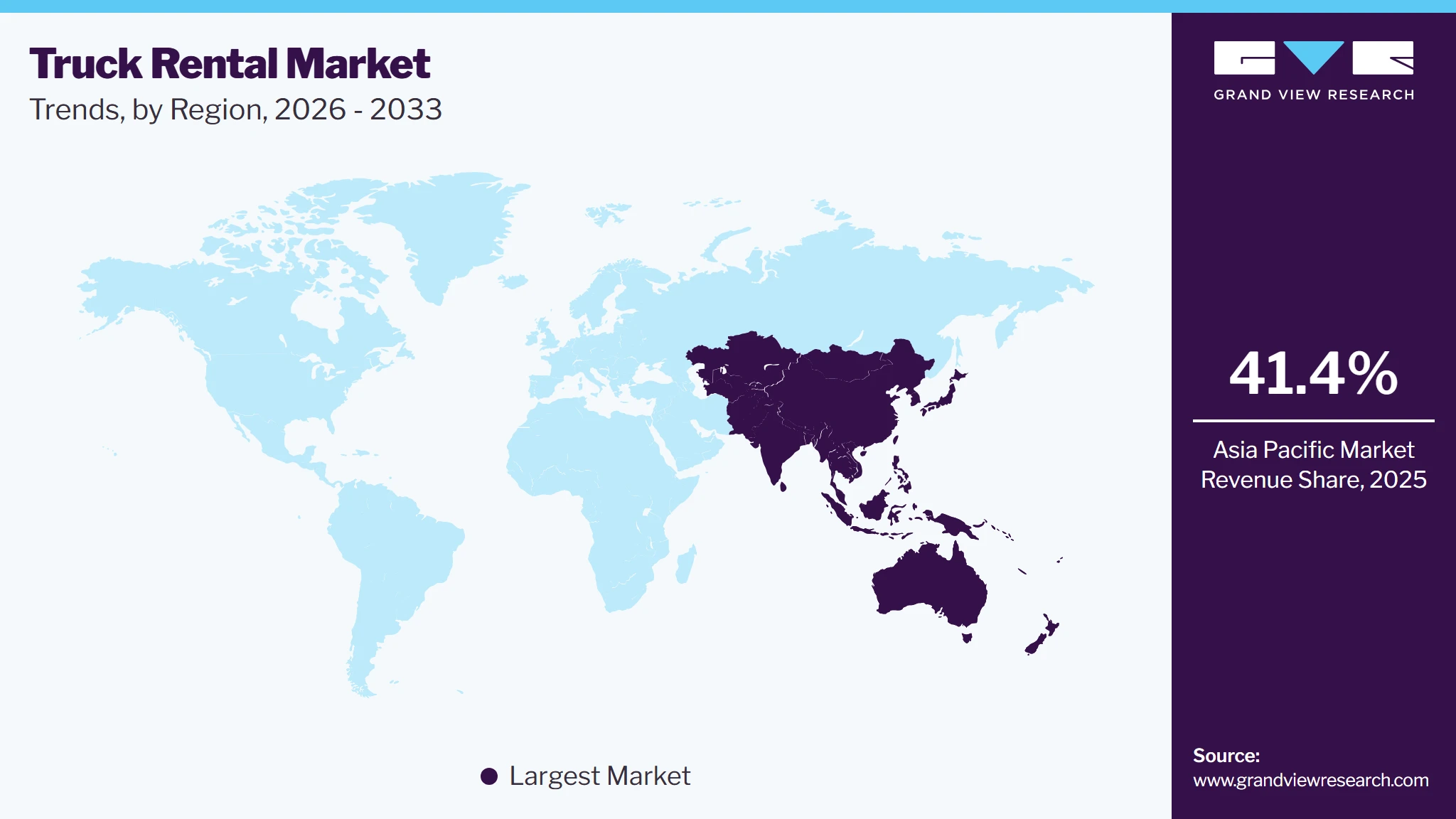
Asia Pacific dominated the global truck rental market with the largest revenue share of 41.4% in 2025. The truck rental market in the China held the largest share in the Asia Pacific region in 2025. The booming e-commerce sector in APAC is significantly driving growth of truck rental market. As online shopping expands, there is an increasing need for efficient and reliable last-mile delivery solutions. Truck rentals allow e-commerce businesses to scale their delivery operations based on demand, especially during peak periods such as holidays and promotional events.
 To learn more about this report, Download Free Sample Report
Key Truck Rental Company Insights
Key players operating in the truck rental market include Enterprise Holdings, Inc.; The Hertz Corporation.; Penske; Ryder System, Inc.; Avis Rent A Car System, LLC; NationaLease; Daimler Truck AG; United Rentals, Inc.; Bush Truck Leasing; and Kenworth Sales Company. The companies are focusing on various strategic initiatives, including partnerships & collaborations, new product development, and agreements to gain a competitive advantage over their rivals. The following are some instances of such initiatives.
-
In February 2024, Flexter, an online platform for finding and comparing real-time availability and prices of moving trucks, announced a strategic partnership with Green Motion, a rental software solutions provider. The collaboration aims to streamline the short-term truck rental reservation process worldwide, making it simpler for suppliers to showcase their fleets and for renters to find the perfect truck for their needs.
-
In July 2023, NHR Group entered a strategic partnership with Hertz to enhance its truck and van rental offerings. The collaboration aims to leverage Hertz's extensive fleet and logistical expertise alongside NHR Group's established presence in New Zealand's commercial vehicle rental sector. The partnership is expected to provide a wider range of vehicles, including cargo vans and trucks, to meet diverse customer needs, thereby improving accessibility and convenience for businesses and individuals requiring transportation solutions.
Key Truck Rental Companies:
The following key companies have been profiled for this study on the truck rental market.
-
Enterprise Holdings, Inc.;
-
The Hertz Corporation.;
-
Penske; Ryder System, Inc.;
-
Avis Rent A Car System, LLC;
-
NationaLease;
-
Daimler Truck AG;
-
United Rentals, Inc.;
-
Bush Truck Leasing;
-
Kenworth Sales Company
Competitive Benchmarking
Category
Operating Strategies
Competitive Edge
Weakness
Established Players (Enterprise Holdings, Inc., The Hertz Corporation, Penske, Ryder System, Inc.)
- These players are focused on large-scale fleet ownership, long-term leasing focus, integrated logistics services
- These players have strong brand recognition, nationwide networks, and a diversified customer base.
- High capital intensity, exposure to regulatory and residual value risks
Emerging Players (NationaLease, Bush Truck Leasing, Kenworth Sales Company)
- These players are focused on regional specialization, cooperative leasing models, and OEM-aligned rental offerings.
- Local market expertise, flexible service models, customer proximity
- Limited geographic scale, narrower fleet diversity.
Truck Rental Market Report Scope
Report Attribute
Details
Market size in 2025
USD 138.3 billion
Estimated market size in 2026
USD 148.3 billion
Projected market size by 2033
USD 254.2 billion
Growth rate
CAGR of 8.0% from 2026 to 2033
Base year for estimation
2025
Historical data
2021 - 2024
Forecast period
2026 - 2033
Quantitative units
Revenue in USD billion and CAGR from 2026 to 2033
Report coverage
Revenue forecast, company market share, competitive landscape, growth factors, and trends
Segments covered
Truck, duration, propulsion, service provider, region
Regional scope
North America; Europe; Asia Pacific; Latin America; MEA
Country scope
U.S.; Canada; Mexico; Germany; U.K.; France; China; Japan; India; South Korea; Australia; Brazil; Saudi Arabia; UAE; South Africa
Key companies profiled
Enterprise Holdings, Inc.; The Hertz Corporation.; Penske; Ryder System, Inc.; Avis Rent A Car System, LLC; NationaLease; Daimler Truck AG; United Rentals, Inc.; Bush Truck Leasing; Kenworth Sales Company.
Customization scope
Free report customization (equivalent up to 8 analysts' working days) with purchase. Addition or alteration to country, regional & segment scope.
Pricing and purchase options
Avail customized purchase options to meet your exact research needs. Explore purchase options
Global Truck Rental Market Report Segmentation
The report forecasts revenue growth at global, regional, and country levels and provides an analysis of the latest industry trends in each of the sub-segments from 2021 to 2033. For this study, Grand View Research has segmented the truck rental market based on truck, duration, propulsion, service provider, and region.
-
Truck Outlook (Revenue, USD Million, 2021 - 2033)
-
Light Duty
-
Medium Duty
-
Heavy Duty
-
-
Duration Outlook (Revenue, USD Million, 2021 - 2033)
-
Short Term
-
Long Term
-
-
Propulsion Outlook (Revenue, USD Million, 2021 - 2033)
-
ICE
-
Electric
-
-
Service Provider Outlook (Revenue, USD Million, 2021 - 2033)
-
Rental and Leasing Companies
-
OEM Captives
-
Third Party Service Providers
-
-
Regional Outlook (Revenue, USD Million, 2021 - 2033)
-
North America
-
U.S.
-
Canada
-
Mexico
-
-
Europe
-
Germany
-
UK
-
France
-
-
Asia Pacific
-
China
-
India
-
Japan
-
Australia
-
South Korea
-
-
Latin America
-
Brazil
-
-
Middle East & Africa
-
UAE
-
Kingdom of Saudi Arabia
-
South Africa
-
-
Research Methodology
The truck rental market figures in this report are based on a proven research process that combines executive interviews with secondary research from proprietary databases, company filings, and recognized regulatory and institutional sources. Market size is built through value-chain sizing - reconciling supply-side and demand-side estimates - and triangulated with bottom-up and top-down approaches. Every estimate passes multiple levels of expert validation before publication, with each truck rental segment quantified using the revenue-capture definitions in the table below.
Segment Definition
Segment - Truck
Revenue capture definition
Light Duty
Light-duty trucks include small trucks, pickup vans, and cargo vans used for city deliveries, e-commerce, and local transport; they are easy to operate, fuel-efficient, and widely rented by small businesses, generating rental income through daily, weekly, and monthly leasing for last-mile delivery, utility, and service operations.
Medium Duty
Medium-duty trucks are used for regional distribution and industrial goods movement, offering a balance between load capacity and operating costs, with revenue generated from the rental of box trucks and straight trucks for regional logistics, construction support, and industrial applications through mileage-based and duration-based charging models.
Heavy Duty
Heavy-duty trucks include large vehicles such as tractor-trailers and heavy-haul trucks used for long-distance freight movement, construction, mining, and industrial transport, with income derived from long-term leasing arrangements and premium service offerings, primarily serving large logistics and infrastructure companies.
Segment - Duration
Revenue capture definition
Short Term
Short-term rentals involve trucks hired for a few hours to several days, mainly to meet seasonal demand, urgent deliveries, or temporary transport requirements, with income generated from hourly, daily, or weekly rental arrangements for emergency replacement and short-term logistics needs.
Long Term
Long-term rentals involve trucks leased for several months to several years under leasing contracts, often bundled with maintenance, regulatory compliance, and fleet management services, and are commonly used by companies that require consistent transportation capacity without owning vehicles.
Segment - Propulsion
Revenue capture definition
ICE
ICE trucks include traditional diesel and gasoline powered vehicles, with earnings generated through base rental charges, fuel surcharges, and maintenance inclusive contracts, supported by their widespread availability and established fueling infrastructure.
Electric
Electric trucks are battery powered vehicles mainly used for urban deliveries, with revenue generated from rental agreements that may include premium pricing, charging service add-ons, and sustainability-linked contracts.
Segment - Service Provider
Revenue capture definition
Rental and Lease Companies
Rental and leasing companies are independently operated fleet providers whose core business is offering trucks for short and long term rental contracts across multiple industries.
OEM Captives
OEM captive providers are truck manufacturers that offer rental and leasing services directly using their own branded vehicles, supporting vehicle placement, utilization, and lifecycle management through captive operating arms.
Third Party Service Providers
Third-party service providers include fleet management firms, independent platforms, and logistics providers that offer outsourced truck rental, maintenance, and compliance services, often arranging vehicle access for customers without owning large fleets themselves.
Estimation Model
Layer Name
Key Question
Description
Addressable Demand Layer
Who needs rented trucks?
This layer identifies demand from logistics, construction, retail, and industrial sectors requiring flexible trucking capacity. It evaluates shipment volumes, project activity, and replacement needs. Demand variability and seasonality are key inputs.
Fleet Availability Layer
What capacity is available?
This layer assesses rental fleet size by truck class, age, and propulsion type. It considers fleet utilization rates, replacement cycles, and regional distribution. OEM supply dynamics influence this layer.
Pricing & Duration Layer
How is revenue generated?
This layer captures pricing structures across short- and long-term rentals. It includes daily rates, lease contracts, mileage charges, and service bundling. Duration significantly impacts revenue realization.
Revenue Realization Layer
What is the monetized outcome?
This layer consolidates utilization, pricing, and fleet mix to estimate realized market revenue. It reflects regional pricing differences and service penetration.
Delivered Customizations
This report has been delivered with the following In-depth customizations
Client Request
Customization Delivered
Value Adds
Regional Truck Rental Market Opportunity Assessment
- Evaluated demand patterns across developed and emerging regions
- Assessed regulatory and infrastructure-driven rental adoption
- Identified region-specific fleet deployment priorities
- Highlighted high-growth logistics and construction corridors
- Supported regional expansion and localization strategies
- Improved investment prioritization by geography
Cross-Segmentation Analysis for the Truck Rental Market
- Analyzed demand across truck, duration, propulsion, and service provider
- Benchmarked adoption intensity across segment intersections
- Assessed segment-level revenue contribution dynamics
- Identified high-potential segment combinations
- Supported targeted product and service positioning
- Enhanced customer and fleet mix prioritization
Competitive Benchmarking and Strategic Positioning in the Truck Rental Market
- Compared leading players on fleet scale, service scope, and partnerships
- Evaluated pricing, innovation, and operational capabilities
- Identified strategic differentiation gaps
- Highlighted competitive white spaces
- Supported strategic positioning and differentiation
- Enabled data-driven competitive strategy development
Frequently Asked Questions About This Report
Asia Pacific dominated the global market with the largest revenue share of 41.4% in 2025.
Short term segment held the largest market share of 53.3% in 2025, while long term is the fastest growing segment.
Internal combustion engine (ICE) segment accounted for the largest revenue share of 67.3% in 2025, while electric is the fastest growing segment.
The global truck rental market size was estimated at USD 138.3 billion in 2025 and is expected to reach USD 148.3 billion in 2026.
The global truck rental market is expected to grow at a CAGR of 8.0% from 2026 to 2033, reaching USD 254.2 billion by 2033.
Light duty segment dominated the market, with a revenue share of 67.9% in 2025. The demand for efficient transportation solutions among small-scale and local businesses drives the segment's growth.
Some key players operating in the truck rental market include Enterprise Holdings, Inc.; The Hertz Corporation.; Penske; Ryder System, Inc.; Avis Rent A Car System, LLC; NationaLease; Daimler Truck AG; United Rentals, Inc.; Bush Truck Leasing; and Kenworth Sales Company
The booming e-commerce industry significantly contributes to the growth of the truck rental market. With the surge in online shopping, there is an increasing need for efficient last-mile delivery solutions.
Rental and leasing companies accounted for the largest revenue share of 42.1% in 2025, while OEM captives is the fastest growing segment.
About the Author(s)
Automotive & Transportation Research Team
Technology · Automotive & TransportationThis report was authored by the automotive & transportation research team at Grand View Research - comprising two research analysts, one senior research analyst, and one industry expert - with specialized expertise in the automotive & transportation segment of the technology industry. All findings are based on proprietary technology databases, executive interviews, and regulatory analysis, subject to internal peer review prior to publication.
Last Updated:
Speak to Analyst

Customize this report to your needs - add regions, segments, or data points, with 20% free customization.
Or view our licence options:


ISO 9001:2015 & 27001:2022 Certified
We are GDPR and CCPA compliant! Your transaction & personal information is safe and secure. For more details, please read our privacy policy.


