
- Home
- »
- Consumer F&B
- »
-
Tuna Fish Market Size, Share & Growth Report, 2026-2033GVR Report cover
![Tuna Fish Market (2026 - 2033)Report]()
Tuna Fish Market (2026 - 2033)
Size, Share & Trends Analysis Report By Product (Canned Tuna, Fresh/Chilled Tuna, Frozen Tuna, Processed Tuna), By Distribution Channel (Supermarkets & Hypermarkets, Convenience Stores), By Region, And Segment Forecasts
Market Size, 2025
$42.2BMarket Estimate, 2026
$43.5BMarket Forecast, 2033
$57.4BCAGR, 2026–2033
4.1%Tuna Fish Market Summary
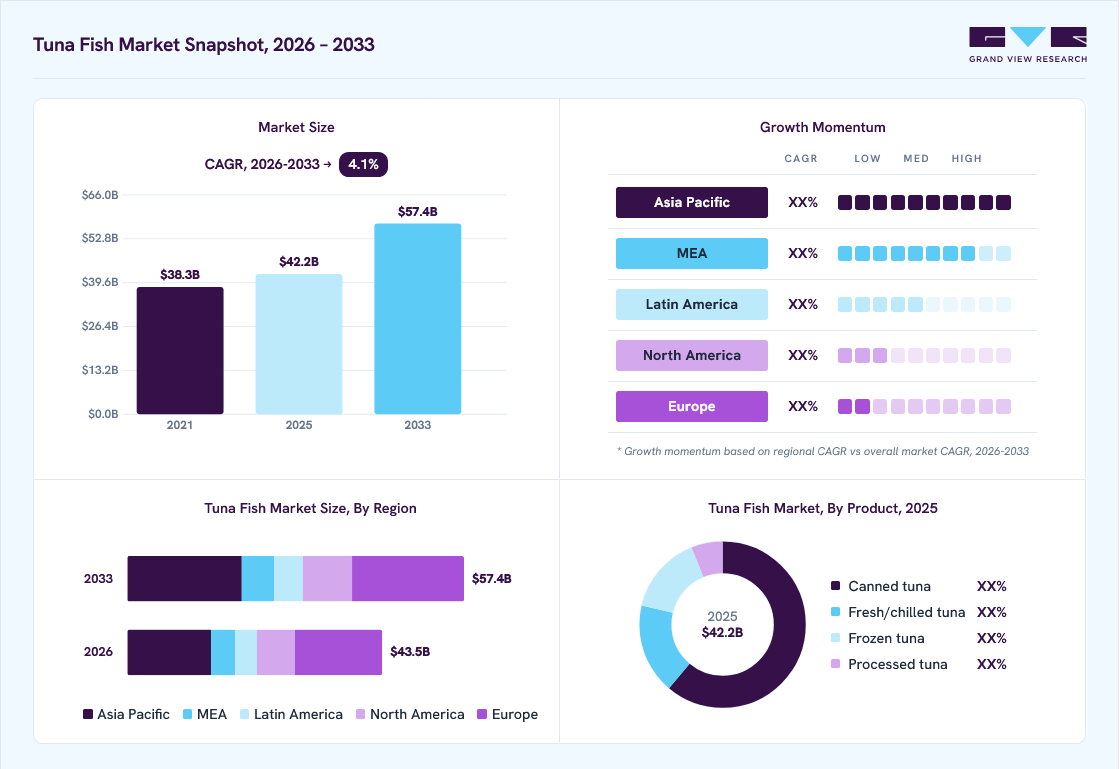
The global tuna fish market size was valued at USD 42.2 billion in 2025 and is projected to grow from USD 43.5 billion in 2026 to USD 57.4 billion by 2033, at a CAGR of 4.1% from 2026 to 2033. The market in Asia Pacific dominated with a revenue share of 32.7% in 2025. Driven by shifting dietary preferences and retail growth, the demand for tuna is steadily expanding through innovative, convenient formats like canned, sushi, frozen, and ready-to-eat options across both retail and foodservice sectors.
Key Market Trends & Insights
- By product: Canned tuna segment held the largest market share of 61.0% in 2025.
- By distribution channel: Supermarkets & hypermarkets segment held the largest market share of 56.8% in 2025.
Regional Highlights
- Largest regional market: Asia Pacific (32.7% revenue share, 2025)
- By country: China held the largest market share in 2025
Market Size & Forecast
- Market size in 2025: USD 42.2 Billion
- Estimated market size in 2026: USD 43.5 Billion
- Projected market size by 2033: USD 57.4 Billion
- CAGR (2026-2033): 4.1%
Three ways to get this report
Buy it, customize it, or ask a question.Get the Full Report
What the study covers
- FormatsPDF · Excel · Dashboard
- Timeline2026–2033 annual, 2025 base
- Coverage20+ countries, 5 regions
- Companies10+ key players profiled
Customize the Report
20% free customization
- IncludeCountries, segments, points
- TailorTo your product definition
- ExtendDeeper competitor detail
- OrA fully bespoke study
- Turnaround5–10 working days
Ask Prism AI
A cited answer in seconds
- Corpus30K studies, 1.2M points
- ScopeAll markets, not just this
- CitationTraced to report & table
- HonestySays "not covered" if so
- SpeedSeconds, not days
The market is influenced by technological advancements in fishing and processing methods, which improve efficiency and product quality. According to the data published in April 2025, a Japanese company developed an AI-powered ultrasound system that can assess a tuna’s fat content without cutting it open. The technology can evaluate a tuna in about 12 seconds, making quality grading faster and non-invasive. Sustainability concerns and responsible fishing practices are becoming increasingly important for producers and consumers. Additionally, investments in cold-chain infrastructure and distribution networks help expand tuna products into new markets.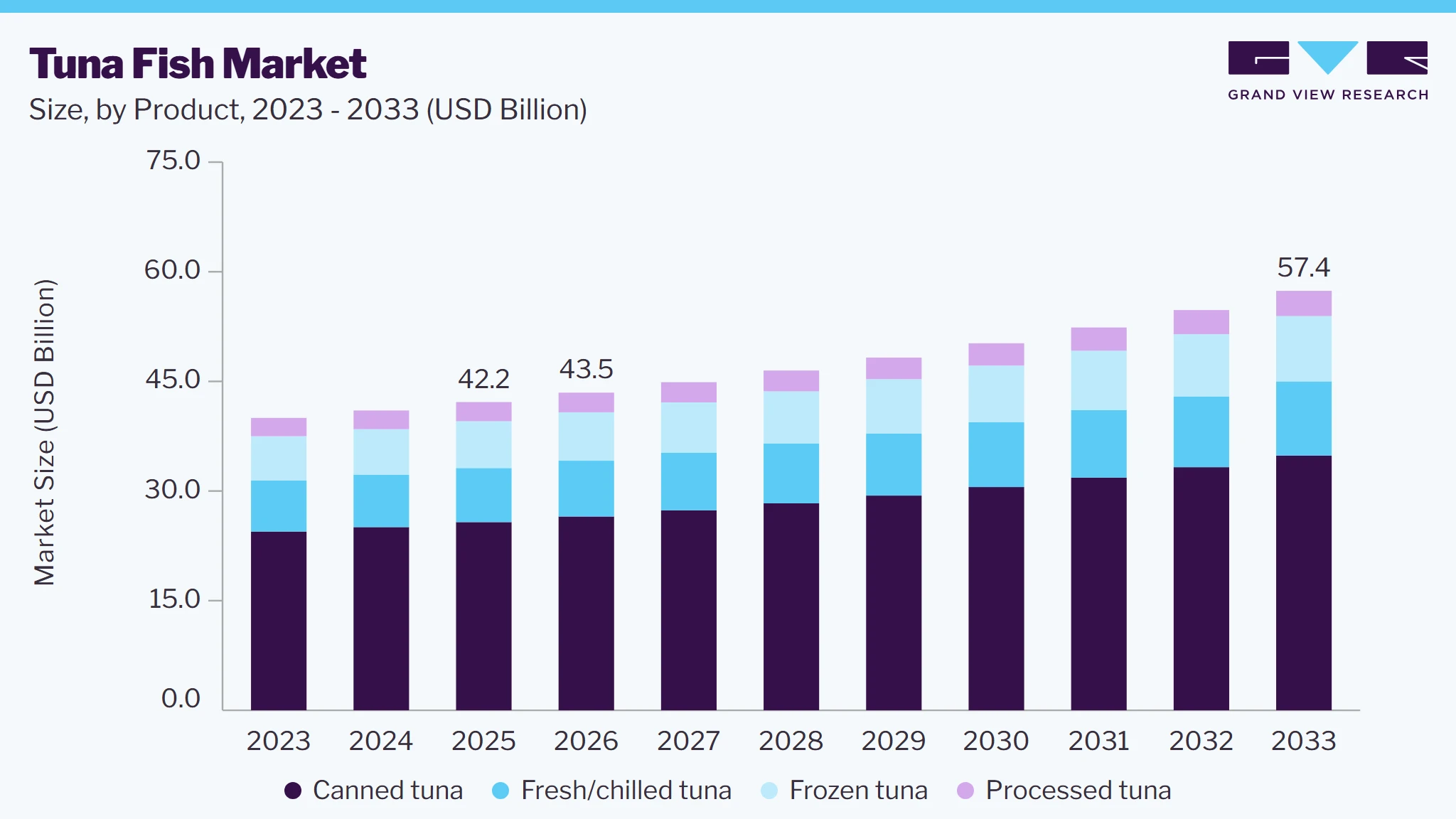
The tuna industry is also supported by the expansion of the food service industry, including restaurants, hotels, and catering businesses. Changing lifestyles and rising urbanization encourage convenient seafood options that require minimal preparation. Marketing activities, product innovation, and improved packaging further help companies attract different consumer groups.
Consumer Insights for the Tuna Fish Market:
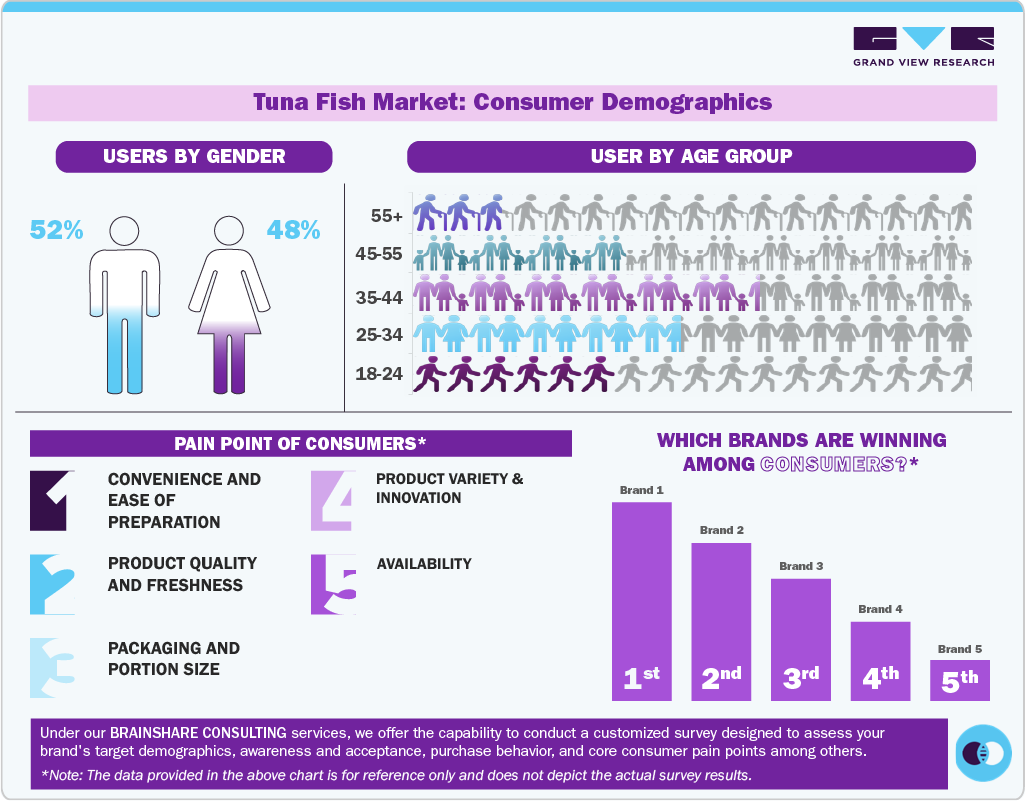
Consumer trends and preferences in the tuna fish market are increasingly influenced by convenience, nutrition, affordability, and product quality. Consumers prefer tuna products that offer easy preparation, consistent quality, and versatile usage across different meals. Growing health awareness is also increasing interest in tuna as a protein-rich seafood option with desirable nutritional attributes. Product variety, packaging formats, portion sizes, and freshness are becoming important purchase considerations. The popularity of ready-to-eat meals, seafood-based dishes, and convenient home cooking is further supporting demand for tuna products.
Market Dynamics
Consumers are increasingly seeking foods that provide higher nutritional value and support healthier lifestyles. Tuna is recognized as a convenient source of protein and essential nutrients. Growing awareness of balanced diets is encouraging consumers to include seafood in regular meals. According to the data published in December 2025, seafood is emerging as a top protein choice for health-conscious consumers due to its omega-3s, high-quality protein, vitamins, and minerals. This trend is particularly relevant among fitness-focused and health-conscious consumers. As a result, demand for tuna products can benefit from the broader shift toward protein-rich food choices.
Tuna producers must comply with strict food safety standards to protect consumers from potential health hazards. Regulatory requirements can involve processing, packaging, storage, labeling, and quality-control procedures. Meeting these standards may increase operational complexity and compliance costs for manufacturers. Product recalls or safety incidents can also lead to increased regulatory scrutiny and reputational damage. In February 2025, several canned tuna products from major brands such as Genova, Trader Joe’s, and Van Camp’s were voluntarily recalled due to a potential risk of Clostridium botulinum contamination, linked to a manufacturing defect in can seals. These factors can create challenges for companies operating across multiple markets.
Manufacturers can capture emerging market opportunities by expanding their portfolios with value-added tuna products that offer greater convenience, variety, and differentiation. Product formats such as seasoned and flavored tuna, ready-to-eat meals, tuna salads, snack-sized portions, and portion-controlled packs can cater to evolving consumer preferences. Such offerings can also support premium positioning and create opportunities for higher-value products across retail and foodservice channels. Product innovation also allows companies to target specific dietary preferences and consumption occasions. In June 2024, Frime launched a ready-to-eat line featuring marinated tuna that is not smoked and suitable for raw consumption, backed by extensive food safety controls. The range includes tenderloin, chunk, tartar, and carpaccio, helping restaurants reduce preparation time, waste, and operating costs. This creates opportunities for manufacturers to diversify their offerings and capture additional consumer segments.
Analyst Perspective
The global tuna market is experiencing steady growth, driven by rising demand for convenient, affordable, protein-rich seafood with a long shelf life and versatile applications. Product innovation across canned, pouch, flavored, and premium formats, alongside growing demand for sustainable and health-focused options, is expanding consumer appeal, while supermarkets remain key sales channels and online retail continues to grow.
Product Insights
The canned tuna segment accounted for the largest share of 61.0% of the revenue in 2025. Canned tuna is widely used because of its convenient storage and long shelf life. It is commonly purchased for household meals, sandwiches, salads, and prepared foods. The segment benefits from its affordability and ease of preparation compared with fresh seafood. Different varieties, flavors, and packaging sizes allow manufacturers to target diverse consumer preferences. Retail availability through supermarkets, convenience stores, and online channels further supports the segment.
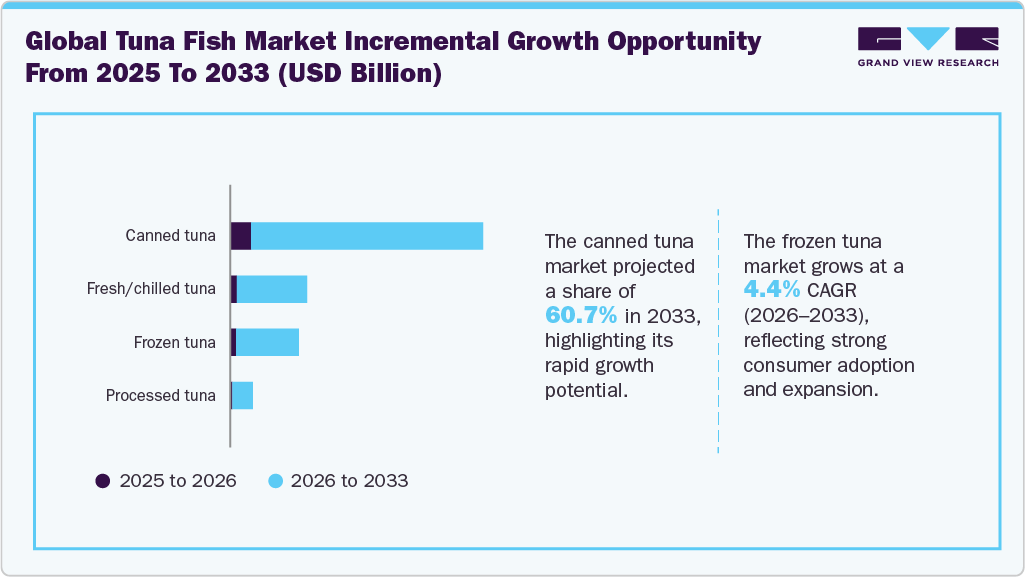
The frozen tuna segment is projected to grow significantly at a CAGR of 4.4% from 2026 to 2033. Frozen tuna is mainly preferred for preserving the quality of the fish over extended periods before consumption or further processing. It is widely utilized by restaurants, seafood processors, and food-service businesses requiring a consistent supply. Freezing enables tuna to be transported across longer distances while maintaining its usability. The segment is also important for applications where tuna is later processed into prepared meals or other seafood products. Improvements in freezing and cold-storage technologies can further support product quality and distribution.
Distribution Channel Insights
The supermarkets & hypermarkets channel in the tuna fish market accounts for the largest share of 56.8% of the global revenue in 2025. Supermarkets & hypermarkets provide broad visibility for tuna products through dedicated seafood and packaged-food sections. Consumers can compare brands, pack sizes, prices, and product varieties during routine grocery shopping. Promotional offers, discounts, and in-store displays can encourage purchase decisions. These outlets also enable manufacturers to reach large customer bases through established retail networks. According to the data published in March 2026, Fishwife is expanding its retail presence through Costco, bringing its premium tinned seafood products to a wider customer base. The move highlights the growing mainstream demand for high-quality, sustainable seafood options and gives the brand greater visibility among Costco’s large membership audience.
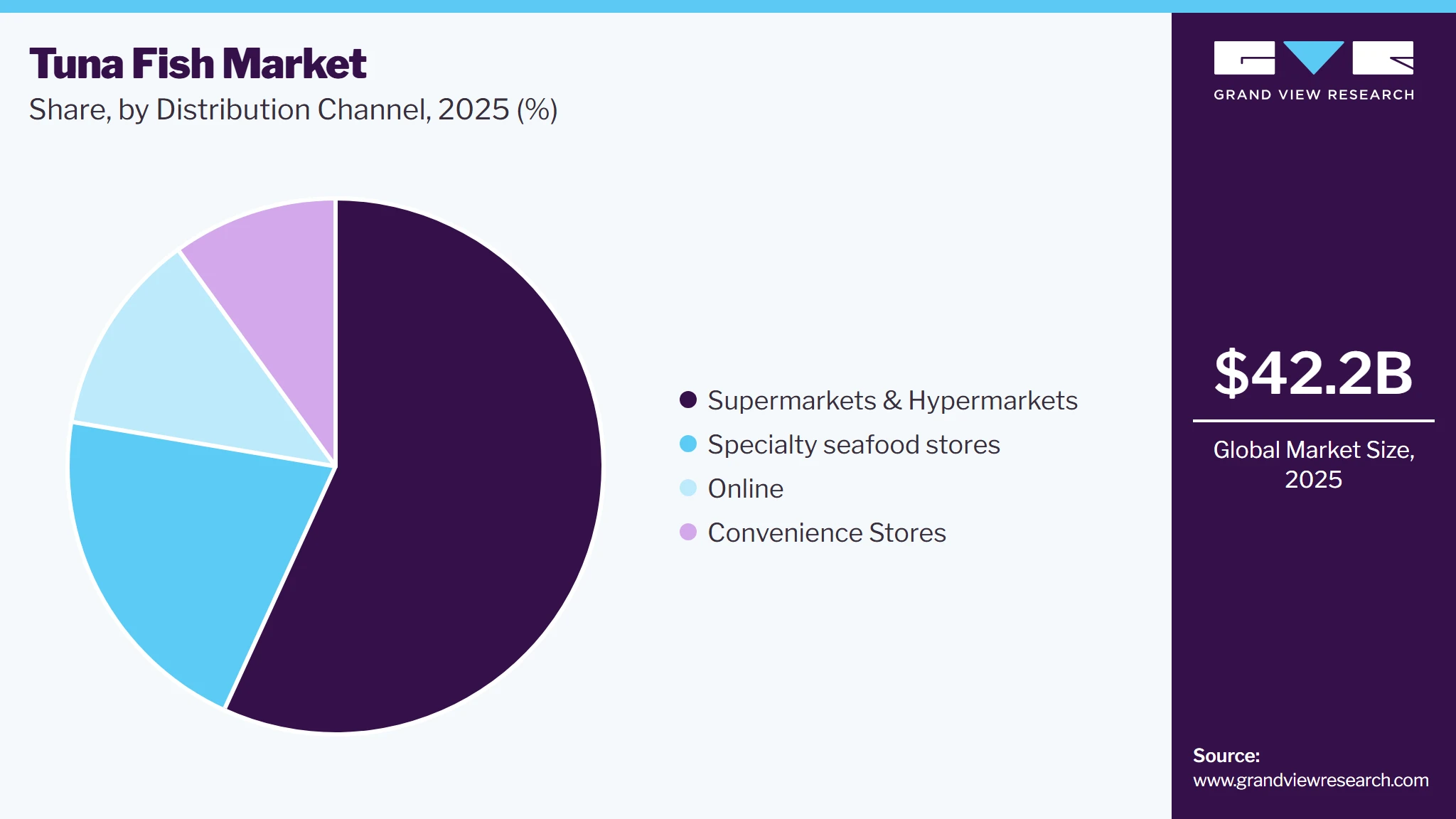
The online channel in the tuna fish market is projected to grow at the fastest CAGR of 4.4% from 2026 to 2033. Online distribution enables consumers to purchase tuna products through e-commerce platforms and digital grocery stores. It offers convenient home delivery and allows shoppers to browse a wider assortment without visiting physical stores. Product reviews, detailed descriptions, and price comparisons can influence online purchasing decisions. Subscription services and bundled offerings can also encourage repeat purchases. Improved delivery infrastructure and cold-chain capabilities are supporting the availability of seafood through digital channels.
Regional Insights
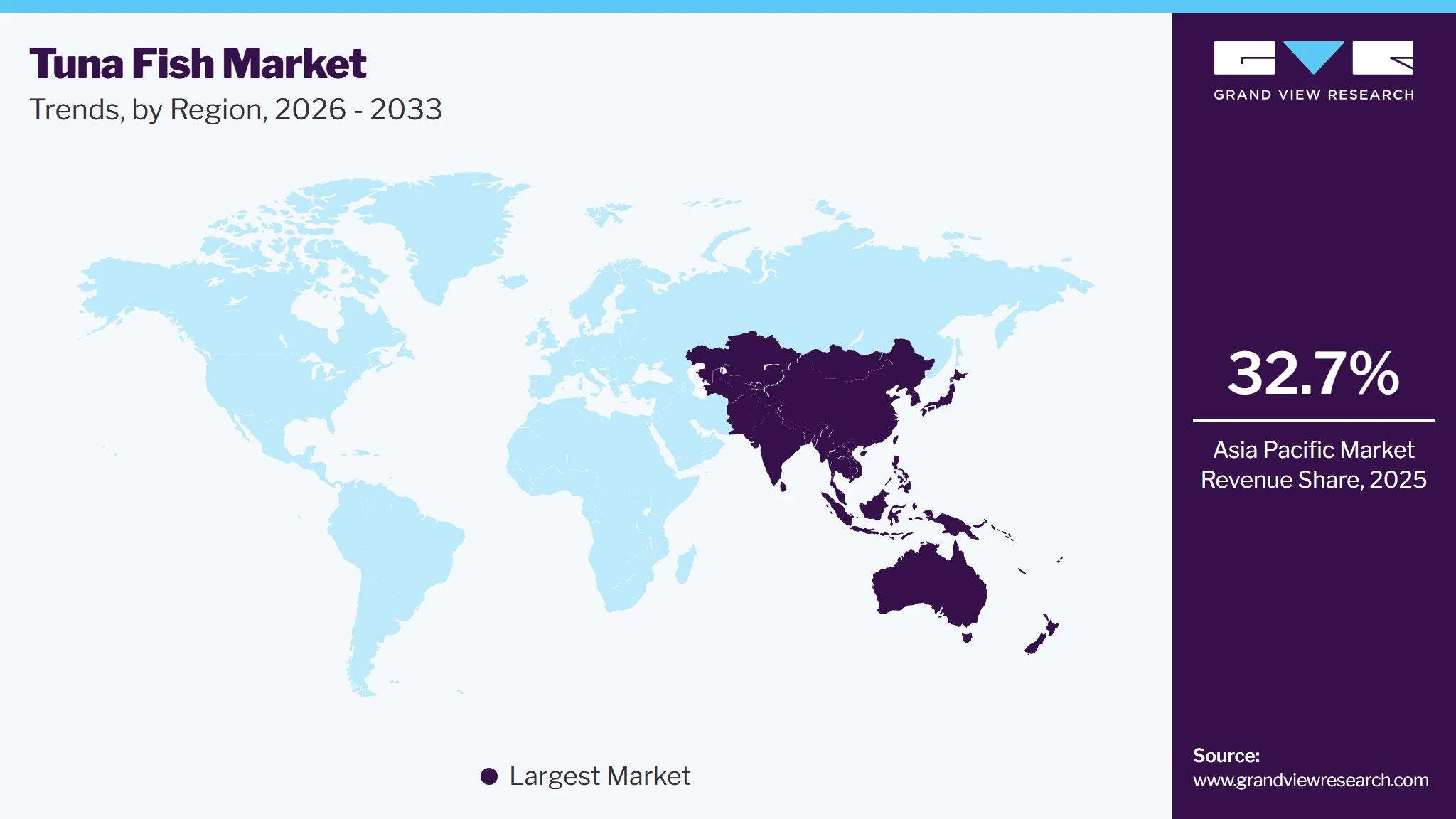
The Asia Pacific tuna fish market accounted for the largest market share of 32.7% in 2025. The tuna fish market in the region is driven by the region's strong seafood consumption culture and expanding food-service sector. Tuna is increasingly used across diverse cuisines, particularly in urban markets. Rising disposable incomes are enabling consumers to spend more on seafood and prepared foods. Growth in modern retail and food-delivery services is improving product accessibility. Increasing investment in seafood processing and distribution is also supporting regional market expansion.
China Tuna Fish Market Trends
The China tuna fish market led the Asia Pacific industry in 2025, holding the largest market share with 31.5% of the region’s total revenue. China's tuna market is supported by increasing urbanization and the expansion of modern food retail. Growing exposure to international cuisines is encouraging greater consumption of tuna-based dishes. The country's expanding restaurant and hospitality sectors provide additional demand from commercial buyers. Improvements in cold-chain logistics are making seafood products more accessible across inland cities. Rising consumer interest in convenient and nutritious foods further supports market development.
North America Tuna Fish Market Trends
The North America tuna fish market accounted for a market share of 15.0% in 2025. The North American tuna market benefits from strong demand for convenient seafood products. Established food-processing and retail industries support the availability of tuna across multiple product formats. High household spending on packaged foods also supports regular purchases. The region has a well-developed seafood distribution network serving both retail and food-service customers. Growing interest in nutritious meal options further supports market development.
The U.S. tuna fish market led the North America market in 2025, holding the largest market share with 81.6% of the region’s total revenue. The U.S. tuna fish market is supported by the popularity of tuna-based meals among households and food-service operators. Strong demand for sandwiches, salads, and prepared meals creates multiple consumption occasions. Large-scale food manufacturers provide extensive product availability across the country. Brand variety and frequent product innovation help maintain consumer interest. Demand from institutional and commercial food-service establishments also contributes to market growth.
Europe Tuna Fish Market Trends
The tuna fish market in Europe is projected to grow at a CAGR of 3.6% from 2026 to 2033. Europe fish market benefits from established seafood consumption habits and a mature processed-food industry. Tuna is incorporated into a wide range of traditional and contemporary European dishes. Strong supermarket networks provide manufacturers with extensive access to consumers. Growing interest in convenient meal solutions supports demand for processed tuna products. Cross-border trade within the region also facilitates the movement of tuna products between major markets.
The Spain tuna fish market led the Europe market in 2025, holding the largest market share with 25.4% of the region’s total revenue. Spain is a major market for tuna consumption and processing, supported by its strong seafood culture. Tuna is widely used in household cooking, tapas, salads, and other dishes. The country's developed fish-processing industry supports large-scale production and distribution. Strong domestic demand provides a stable customer base for tuna manufacturers. Spain's established seafood trade connections also strengthen its position within the European market. According to the USDA data published in April 2026, Spain exported USD 920.3 million worth of tunas, skipjack tuna, and bonito in 2025, up from USD 842.2 million in 2024, making tuna-related products the largest seafood export category by value.
Central & South America Tuna Fish Market Trends
The Central & South America tuna fish market is projected to grow at a CAGR of 3.9% from 2026 to 2033. The region benefits from its proximity to major tuna fishing grounds and established seafood-processing activities. Coastal economies have developed industries around tuna harvesting, processing, and export. Increasing urban populations are expanding demand for convenient seafood products. Improvements in regional food distribution are making processed tuna more accessible to consumers. Export-oriented seafood businesses also contribute to the development of the regional tuna industry.
Middle East & Africa Tuna Fish Market Trends
The Middle East & Africa tuna fish market is expected to grow at a CAGR of 4.4% from 2026 to 2033. The tuna fish market in the Middle East & Africa is supported by population growth and increasing demand for affordable protein sources. Expanding urban centers are contributing to greater consumption of packaged and processed foods. Modern retail development is improving access to imported and locally distributed tuna products. Growth in hospitality and tourism is creating additional demand from restaurants and hotels. Improvements in food logistics and distribution networks are helping tuna products reach a broader consumer base.
Key Tuna Fish Company Insights
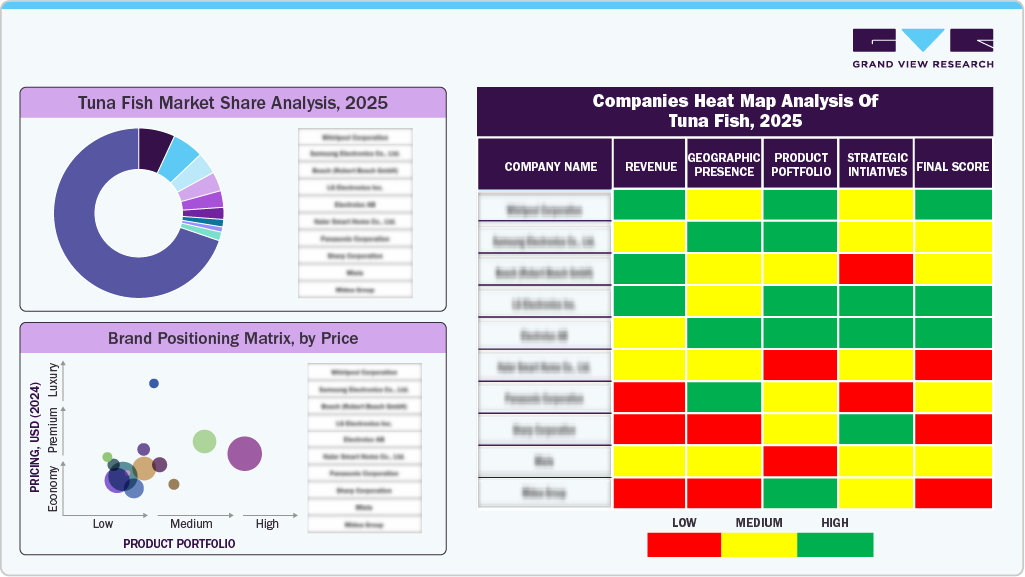
The tuna fish industry is highly competitive, with major players including Thai Union Group, Dongwon Group, Bolton Group, and Century Pacific Foods. The market remains fragmented, with several companies competing across different regions and product segments. Companies are focusing on sustainability, supply chain efficiency, product innovation, and expansion into international markets. Overall, competition is shaped by brand strength, sourcing capabilities, processing capacity, and global distribution networks.
Key Tuna Fish Companies
The following key companies have been profiled for this study on the tuna fish market.
-
Tri Marine International Inc.
-
StarKist Co.
-
Albacora S.A.
-
Frinsa
-
Calvo
-
Wild Planet Foods Inc.
-
Thai Union Group
-
Dongwon Group
-
Bolton Group
-
Century Pacific Food, Inc.
Competitive Benchmarking
Category
Operating Strategies
Competitive Edge
Weakness
Established Players (Tri Marine International Inc., StarKist Co., Frinsa)
Scale sourcing, expand value-added products, and strengthen global distribution.
Strong supply chains, recognized brands, and broad market access.
High exposure to raw material costs and sustainability pressures.
Emerging Players (Wild Planet Foods Inc.; Dongwon Group; Bolton Group)
Target regional demand, offer affordable formats, and develop differentiated products.
Local market knowledge, flexible operations, and competitive pricing.
Smaller scale and limited international reach.
Recent Developments:
-
In March 2026, Fishwife is expanding its retail presence through Costco, bringing its premium tinned seafood products to a wider customer base. The move highlights the growing mainstream demand for high-quality, sustainable seafood options and gives the brand greater visibility among Costco’s large membership audience.
-
In June 2024, Frime launched a ready-to-eat line featuring marinated tuna that is not smoked and is suitable for raw consumption, backed by extensive food safety controls. The range includes tenderloin, chunk, tartar, and carpaccio, helping restaurants reduce preparation time, waste, and operating costs.
Tuna Fish Market Report Scope
Report Attribute
Details
Market size in 2025
USD 42.2 Billion
Estimated market size in 2026
USD 43.5 billion
Projected market size by 2033
USD 57.4 billion
Growth rate
CAGR of 4.1% from 2026 to 2033
Actual data
2021 - 2025
Forecast period
2026 - 2033
Quantitative units
Revenue in USD Billion, and CAGR from 2026 to 2033
Report coverage
Revenue forecast, company ranking, competitive landscape, growth factors, and trends
Segments covered
Product, Distribution Channel, and Region
Regional Scope
North America; Europe; Asia Pacific; Central & South America; Middle East & Africa
Country scope
U.S.; Canada; Mexico; UK; Germany; France; Italy; Spain; China; Japan; India; Australia & New Zealand; South Korea; Brazil; South Africa
Key companies profiled
Tri Marine International Inc.; StarKist Co.; Albacora S.A.; Frinsa; Calvo; Wild Planet Foods Inc.; Thai Union Group; Dongwon Group; Bolton Group; Century Pacific Food, Inc.
Customization scope
Free report customization (equivalent up to 8 analysts’ working days) with purchase. Addition or alteration to country, regional & segment scope.
Pricing and purchase options
Avail customized purchase options to meet your exact research needs. Explore purchase options
Global Tuna Fish Market Report Segmentation
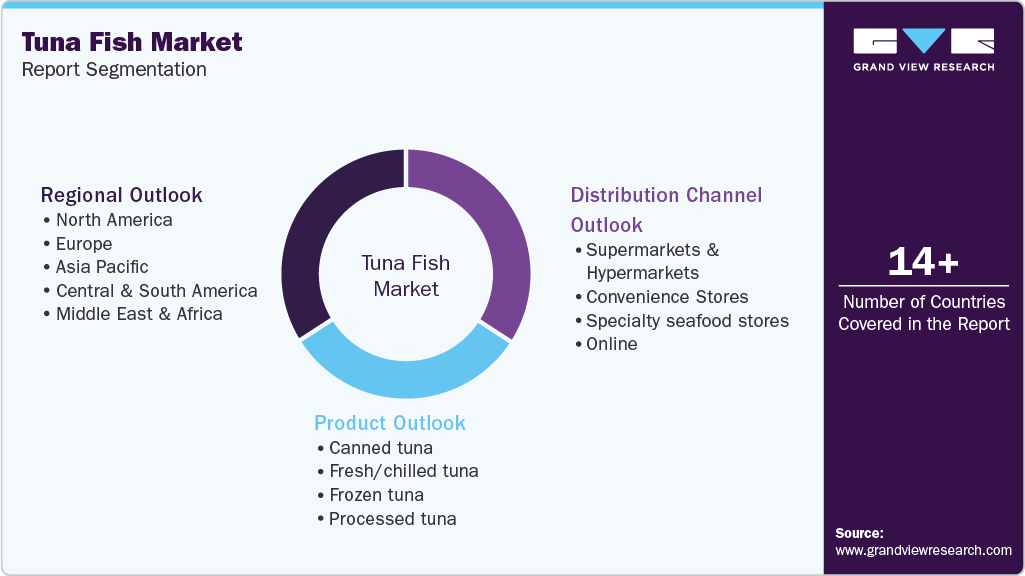
This report forecasts revenue growth at the regional and country levels and provides an analysis of the latest industry trends and opportunities in each of the sub-segments from 2021 to 2033. For the purpose of this study, Grand View Research has segmented the global tuna fish market report on the basis of product, distribution channel, and region.
-
Product Outlook (Revenue, USD Billion, 2021 - 2033)
-
Canned tuna
-
Fresh/chilled tuna
-
Frozen tuna
-
Processed tuna
-
-
Distribution Channel Outlook (Revenue, USD Billion, 2021 - 2033)
-
Supermarkets & Hypermarkets
-
Convenience Stores
-
Specialty seafood stores
-
Online
-
-
Regional Outlook (Revenue, USD Billion, 2021 - 2033)
-
North America
-
U.S.
-
Canada
-
Mexico
-
-
Europe
-
UK
-
Germany
-
France
-
Italy
-
Spain
-
-
Asia Pacific
-
China
-
Japan
-
India
-
Australia & New Zealand
-
South Korea
-
-
Central & South America
-
Brazil
-
-
Middle East & Africa
-
South Africa
-
-
Research Methodology
The tuna fish market figures in this report are based on a proven research process that combines executive interviews with secondary research from proprietary databases, company filings, and recognized regulatory and institutional sources. Market size is built through value-chain sizing—reconciling supply-side and demand-side estimates—and triangulated with bottom-up and top-down approaches. Every estimate passes multiple levels of expert validation before publication, with each tuna fish segment quantified using the revenue-capture definitions in the table below.
Segment Definition
Product
Revenue capture definition
Canned tuna
Tuna fish generate revenue through the sale of shelf-stable canned products to households, retailers, and food-service operators. Revenue is captured through individual cans, multi-packs, and different portion sizes. Product variations such as oil-packed, water-packed, and flavored options allow brands to address diverse consumer preferences. Strong shelf stability enables products to be distributed across a wide geographic area.
Fresh/chilled tuna
Tuna fish generate revenue through the sale of refrigerated products to consumers, restaurants, and seafood-focused businesses. Revenue is captured through whole fish, loins, steaks, and other fresh cuts sold according to weight or portion size. Premium quality and freshness can support higher selling prices. This segment also benefits from demand for tuna used in sushi, sashimi, and fresh seafood preparations.
Frozen tuna
Tuna fish generate revenue through frozen products supplied to retailers, wholesalers, restaurants, and food processors. Revenue is captured through frozen loins, steaks, fillets, and bulk formats. Frozen storage allows suppliers to maintain inventory and serve customers beyond immediate fishing periods. The format is particularly suitable for long-distance transportation and large-volume commercial purchases.
Processed tuna
Tuna fish generate revenue through products that undergo additional preparation before reaching end consumers. Revenue is captured through ready-to-eat meals, tuna salads, spreads, seasoned products, and other prepared formats. Processing adds convenience and enables manufacturers to differentiate products through recipes and formulations. These products can command additional value by reducing preparation time for consumers.
Estimation Model
Layer No.
Layer Name
Key Question
Description
01
Consumption Profile Layer
Who consumes tuna fish?
Identifies consumers by diet, age, income, health focus, and usage occasions such as meals, snacks, and convenience foods.
02
Market Reach Layer
Where and how is tuna purchased?
Maps access across supermarkets, hypermarkets, seafood stores, foodservice, convenience outlets, and e-commerce.
03
Purchase & Retention Layer
What drives tuna choice and repeat purchase?
Evaluates price, taste, freshness, quality, format, nutrition, brand trust, packaging, and convenience.
04
Value Generation Layer
Where is value created in the tuna market?
Assesses opportunities across premium tuna, ready-to-eat formats, sustainable sourcing, value-added products, private label, and differentiated brands.
Delivered Customizations
This report has been delivered with the following In-depth customizatio
CLIENT REQUEST
CUSTOMIZATION DELIVERED
VALUE ADDS
Global Tuna Fish Product & Format Assessment
Evaluated demand across canned, frozen, chilled, ready-to-eat, pouch, and prepared tuna formats, with emphasis on convenience, shelf life, and usage occasions.
Supports format prioritization, portfolio optimization, and identification of high-growth product opportunities.
Global Tuna Fish Channel & Purchase Behavior Assessment
Assessed purchasing channels, retail formats, online adoption, price sensitivity, and key factors influencing tuna brand and product selection.
Identifies priority channels, optimizes route-to-market strategies, and highlights opportunities to improve conversion and distribution.
Global Tuna Fish Competitive & Brand Positioning Assessment
Benchmarked leading tuna brands across pricing, product claims, packaging, sustainability credentials, innovation, and consumer perceptions across key markets.
Reveals competitive gaps, whitespace opportunities, and positioning strategies to strengthen market differentiation.
Frequently Asked Questions About This Report
The global tuna fish market size was valued at USD 42.2 billion in 2025 and is estimated at USD 43.5 billion for 2026.
Key factors driving the tuna fish market include rising global demand for seafood, increasing consumer preference for protein-rich and nutritious foods, and growing consumption of canned and processed tuna products.
The canned tuna fish market led with a 61.0% revenue share in 2025.
The frozen tuna fish market is projected to grow at the fastest CAGR of 4.4% from 2026 to 2033.
The Asia Pacific tuna fish led the global market with a 32.7% revenue share in 2025.
The sale of tuna fish through supermarkets & hypermarkets accounted for the largest share of 56.8% of the revenue in 2025.
The sale of tuna fish through online channels is projected to grow at a CAGR of 4.4% from 2026 to 2033.
Key players include Tri Marine International Inc., StarKist Co., Albacora S.A., Frinsa, Calvo, Wild Planet Foods Inc., Thai Union Group, Dongwon Group, Bolton Group, and Century Pacific Food, Inc.
The global tuna fish market is expected to grow at a CAGR of 4.1% from 2026 to 2033, reaching USD 57.4 billion by 2033.
About the Author(s)
Consumer F&B Research Team
Consumer Goods · Consumer F&BThis report was authored by the consumer f&b research team at Grand View Research - comprising two research analysts, one senior research analyst, and one industry expert - with specialized expertise in the consumer f&b segment of the consumer goods industry. All findings are based on proprietary consumer goods databases, executive interviews, and regulatory analysis, subject to internal peer review prior to publication.
Last Updated:
Speak to Analyst


Customize this report to your needs - add regions, segments, or data points, with 20% free customization.
Or view our licence options:


ISO 9001:2015 & 27001:2022 Certified
We are GDPR and CCPA compliant! Your transaction & personal information is safe and secure. For more details, please read our privacy policy.


