
- Home
- »
- Communications Infrastructure
- »
-
Underwater Wireless Optical Communication System Market Report 2033GVR Report cover

Underwater Wireless Optical Communication System Market (2026 - 2033)
Size, Share & Trends Analysis Report By Application (Real-time Video Transmission, Vehicle Docking & Control), By End User (Defense & Naval, Offshore Energy, Ocean Research Organizations), By Region, And Segment Forecasts
Market Size, 2025
$45.4MMarket Estimate, 2026
$51.0MMarket Forecast, 2033
$147.9MCAGR, 2026–2033
16.4%Underwater Wireless Optical Communication System Market Summary
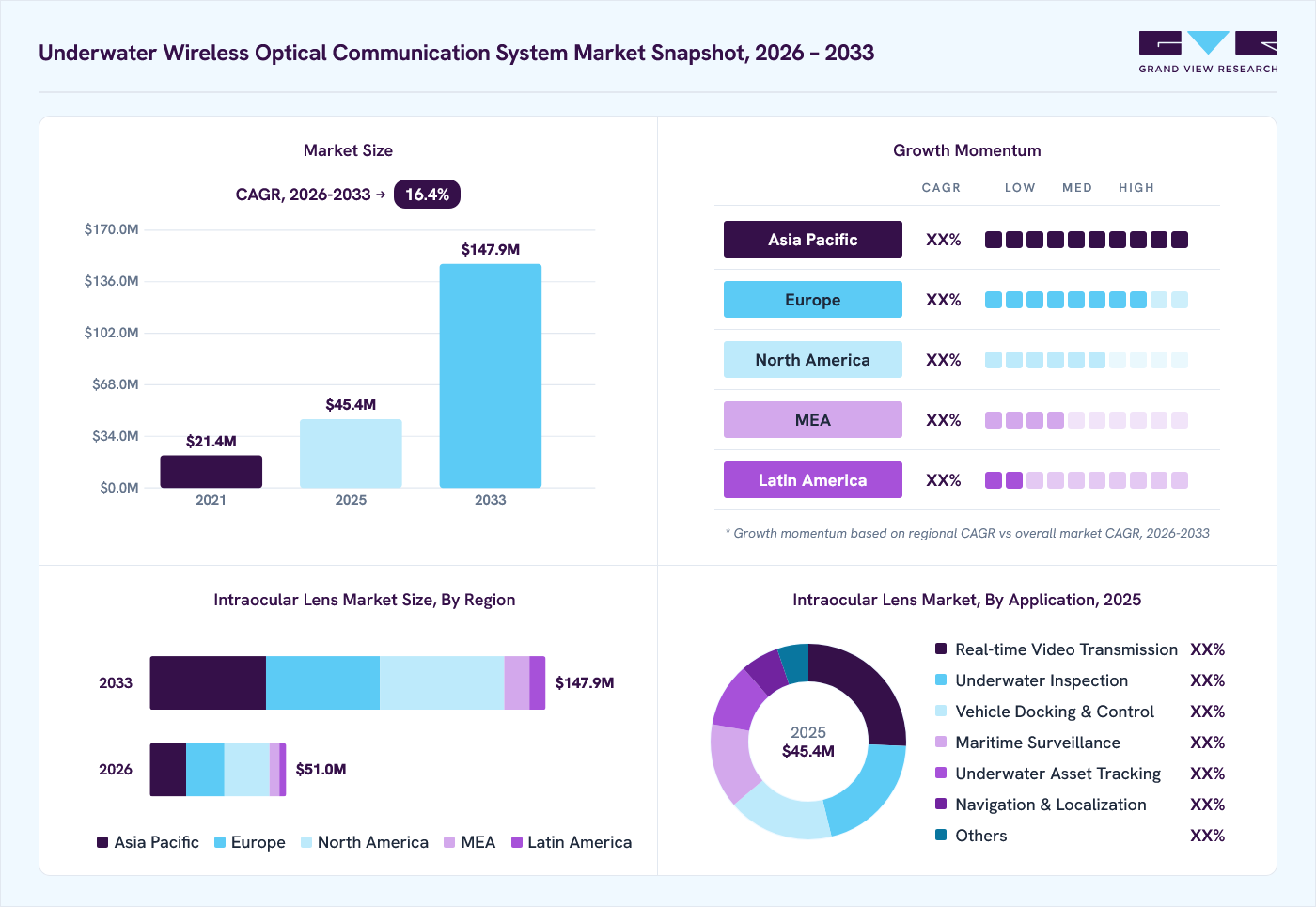
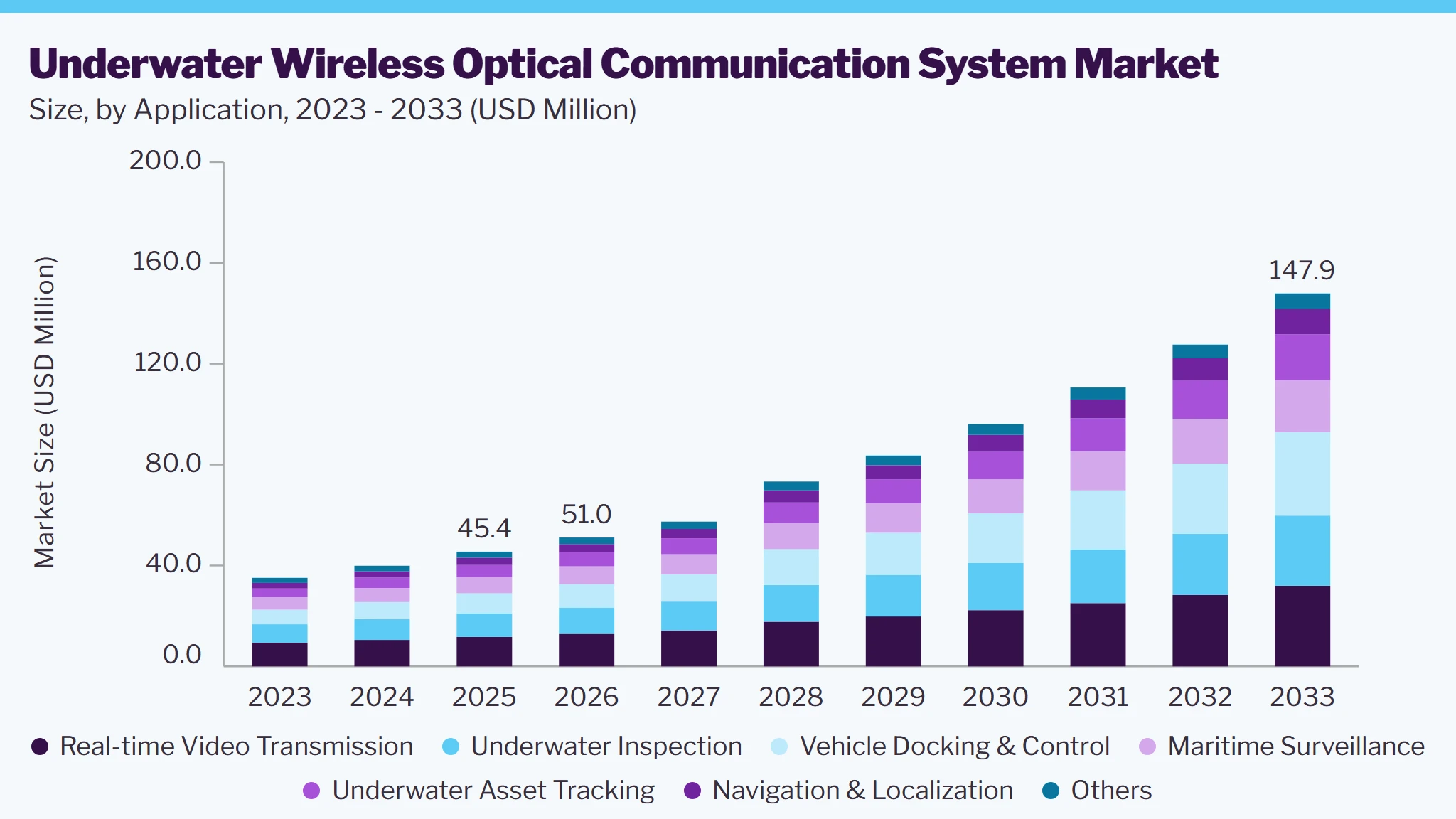
The global underwater wireless optical communication system market size was valued at USD 45.4 million in 2025 and is projected to grow from USD 51.0 million in 2026 to USD 147.9 million by 2033, at a CAGR of 16.4% from 2026 to 2033. North America dominated the market, accounting for a revenue share of 33.2% in 2025. The increasing adoption of autonomous underwater vehicles (AUVs) is fueling the growth of the underwater wireless optical communication system market.
 Source: Grand View Research, IR Documents, Primary Interviews, Paid DatabasesTo learn more about this report,
 Download Free Sample Report
Key Market Trends & Insights
- By application: Real-time video transmission segment dominated the market, with a revenue share of 25.8% in 2025.
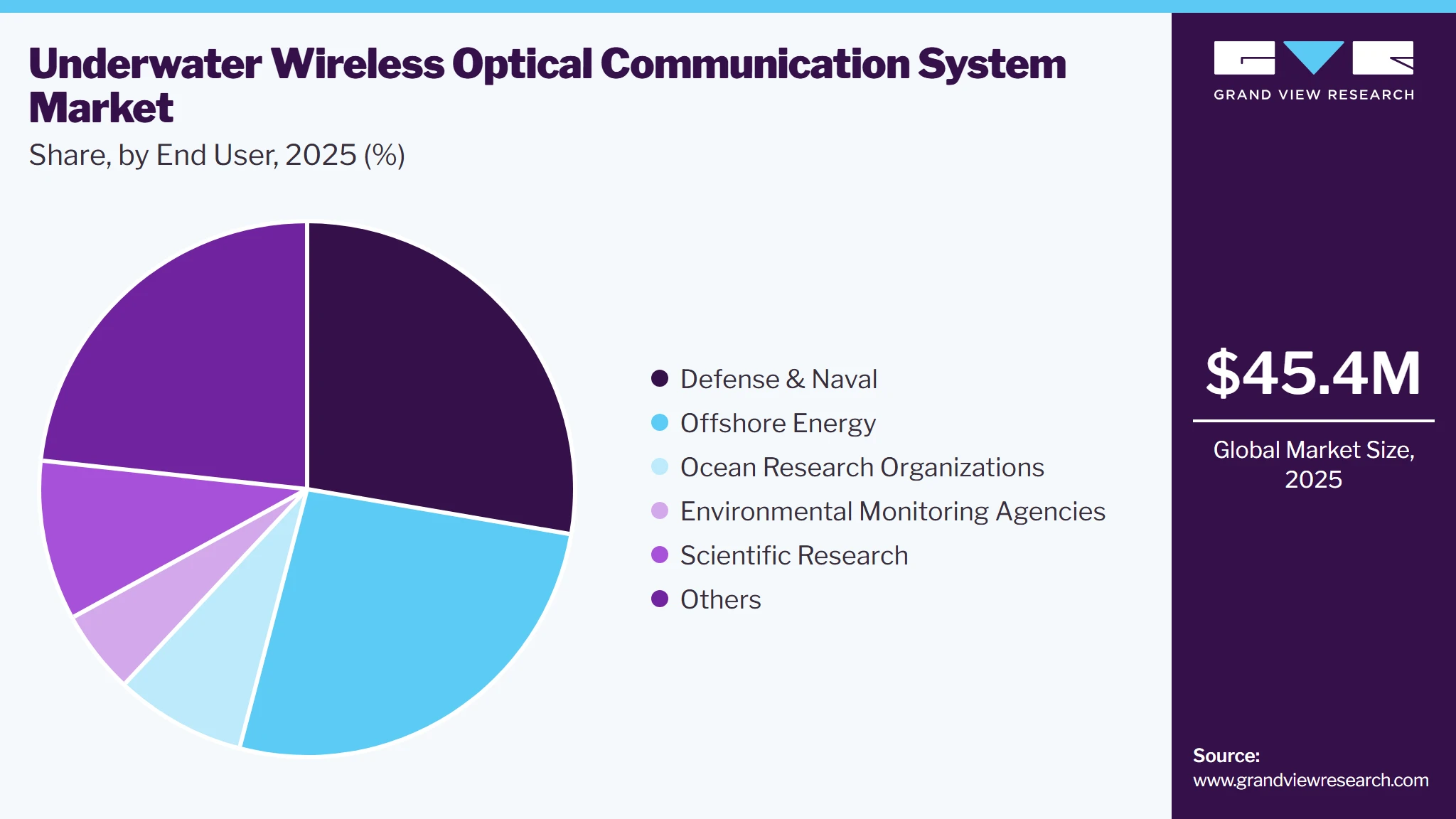
- By end user: Defense & naval segment held the largest market share of 27.7% in 2025.
Regional Highlights
- Largest regional market: North America (33.2% revenue share, 2025)
- Fastest-growing regional market: Asia Pacific (highest CAGR, 2026-2033)
- By country: The U.S. held the largest market share in 2025.
Market Size & Forecast
- Market size in 2025: USD 45.4 Million
- Estimated market size in 2026: USD 51.0 Million
- Projected market size by 2033: USD 147.9 Million
- CAGR (2026-2033): 16.4%
Prism AI by Grand View Research Free to tryAsk a question about the underwater wireless optical communication system marketTry asking✓Every figure cited from GVR research Prefer the report? Download free sample →
The increasing deployment of autonomous underwater vehicles (AUVs) for ocean exploration, seabed mapping, environmental monitoring, and subsea inspection is driving demand for efficient underwater communication technologies. These vehicles use high-resolution cameras, sonar, and environmental sensors that generate large volumes of data, increasing the need for high-speed wireless data transfer. Furthermore, the growing adoption of small, low-cost AUVs and multi-vehicle operations is creating opportunities for Underwater Wireless Optical Communication (UWOC) between nearby vehicles, sensors, and docking stations. Continued investments in uncrewed underwater technologies by government agencies and research organizations are further supporting potential UWOC applications.The development of energy-efficient, high-speed optical communication is an technology trend in the Underwater Wireless Optical Communication (UWOC) market. UWOC enables high data rates and low-latency communication over short underwater distances, supporting faster data transfer than conventional acoustic communication in suitable conditions. Research by Woods Hole Oceanographic Institution (WHOI) has demonstrated optical communication rates of 10-20 Mbit/s over approximately 150 meters. These capabilities are particularly relevant for battery-powered AUVs and underwater sensors, as efficient data transmission helps conserve energy for propulsion, sensing, and navigation.
 To learn more about this report, Download Free Sample Report
Regulatory requirements in the Underwater Wireless Optical Communication (UWOC) market primarily involve optical radiation safety, equipment compliance, and export controls. The IEC 60825 series specify laser safety requirements that may apply to UWOC systems using laser-based transmitters, depending on their design and application. Export-control regulations may restrict the international transfer of specialized underwater communication equipment based on its technical capabilities and intended use. These requirements influence product design, safety testing, certification, and commercialization across different markets.
The complex and variable underwater optical environment poses a technical challenge for the UWOC market. Water absorption, suspended sediments, plankton, and other particles scatter or weaken optical signals, reducing communication range and link reliability. Performance varies with water clarity, depth, and environmental conditions, making it difficult to maintain consistent communication across different underwater environments. These limitations increase the need for improved optical transmitters, sensitive receivers, and adaptive communication technologies.
Market Dynamics
The underwater wireless optical communication system market is influenced by the increasing need for high-speed underwater data transmission, growing deployment of autonomous underwater systems, and rising requirements for real-time marine operations. Advances in optical transmitters, receivers, compact communication modules, and underwater networking technologies are supporting the development of faster and more efficient communication systems. However, limited optical transmission range, water turbidity, and alignment requirements continue to restrict deployment under certain underwater conditions. Market development is expected to depend on improvements in optical link reliability, system integration, and the adoption of underwater communication technologies across defense, offshore energy, and ocean research applications.
Underwater operations increasingly require rapid exchange of large volumes of data between submerged devices, underwater vehicles, sensors, and surface-connected systems. Conventional acoustic communication provides relatively long transmission ranges but has limitations in data transfer rates, latency, and the transmission of high-resolution information. These limitations create challenges for underwater missions that require timely access to visual information, sensor readings, and operational data. The growing use of autonomous underwater platforms and data-intensive marine activities strengthens the need for communication technologies that support faster information exchange over short underwater distances.
Underwater wireless optical communication system addresses this requirement by transmitting data through modulated light signals, supporting high data rates and low latency under suitable water conditions. Its ability to transfer substantial amounts of information over short distances makes it relevant to applications that require rapid data exchange between submerged equipment and nearby communication nodes. Improvements in optical components, receiver sensitivity, and communication system integration support more reliable underwater data links. These capabilities are expected to encourage adoption in data-intensive underwater operations and contribute to market growth.
Underwater wireless optical communication system is constrained by light absorption and scattering, which reduces signal strength as light travels through water. Suspended particles, sediment, plankton, and other impurities can further degrade optical signals, while movement between the transmitter and receiver can disrupt the communication link. These factors limit the effective transmission distance and make system performance dependent on underwater environmental conditions. Moreover, optical communication systems may require precise alignment, careful equipment positioning, and additional engineering measures to maintain stable connections.
These limitations affect adoption in applications that require communication across large underwater distances or operate in environments with variable water clarity. Defense and naval operations, offshore installations, and environmental monitoring deployments may require complementary communication technologies to maintain connectivity when optical links become unreliable. The need for additional infrastructure, system integration, and operational planning can increase deployment complexity and restrict adoption among users with limited budgets. As a result, the market's expansion depends partly on improvements in link reliability and the integration of optical communication with other underwater communication methods.
The expanding use of autonomous underwater vehicles, remotely operated platforms, and connected subsea equipment creates opportunities for high-speed optical communication systems. These platforms increasingly require efficient transfer of mission data, sensor information, and operational instructions within underwater environments. Advances in compact optical components, onboard processing, and automated positioning technologies are improving the feasibility of integrating optical communication equipment into underwater platforms. This creates opportunities for communication systems designed for short-range, high-bandwidth links between vehicles, docking stations, instruments, and subsea infrastructure.
Manufacturers offering compact, energy-efficient, and easily integrated optical communication systems are well positioned to benefit from this opportunity. Demand potential is particularly relevant to underwater vehicle docking and control, scientific data collection, subsea inspection, and defense-related applications requiring rapid data transfer. Suppliers that combine optical communication hardware with networking capabilities, reliable link management, and integration support may strengthen their competitive positioning. Continued development of autonomous underwater operations is expected to create opportunities for specialized vendors and established subsea technology suppliers to expand their product portfolios and address emerging communication requirements.
Market Concentration & Characteristics
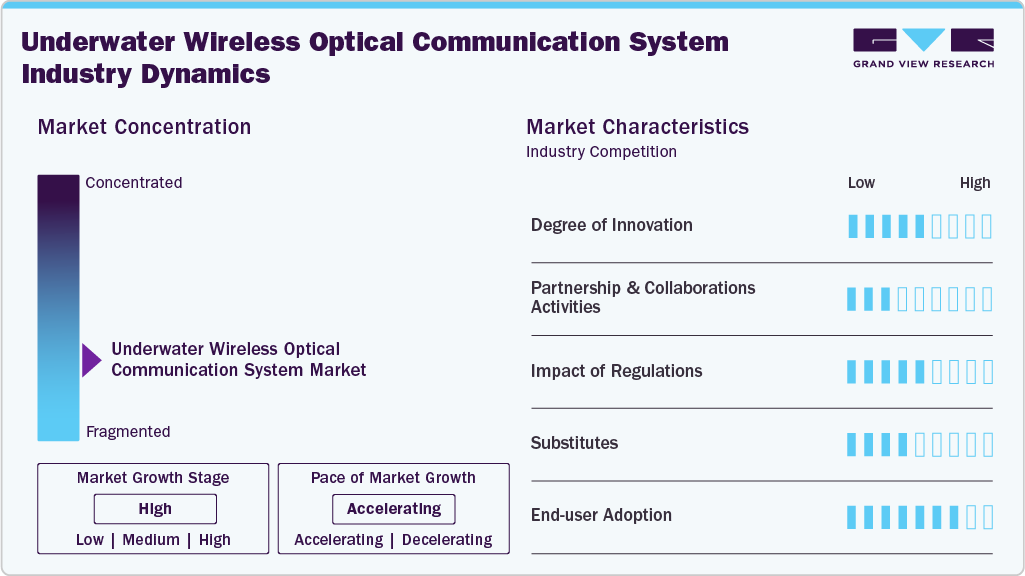
The underwater wireless optical communication system market is fragmented, as the industry comprises multiple companies, research institutions, and specialized technology developers working on underwater optical communication solutions. The market has not yet reached a stage where a few major players dominate the industry through extensive commercial deployments. Participants focus on developing high-speed underwater data transmission systems, optical transmitters and receivers, laser-based communication technologies, and solutions for autonomous underwater vehicles (AUVs), underwater sensor networks, and offshore infrastructure monitoring. Differences in technology capabilities, transmission range, data rates, and application requirements create opportunities for specialized companies to serve specific customer needs. The presence of research-driven organizations and emerging technology providers also contributes to the fragmented competitive structure. As a result, competition is influenced by technological expertise, product performance, research and development capabilities, and the ability to establish partnerships with maritime, defense, offshore, and underwater robotics organizations.
 To learn more about this report, Download Free Sample Report
The market is characterized by high innovation, moderate partnership activity, and relatively low end-user adoption, reflecting the developing nature of UWOC technology. Companies continue to improve communication speed, reliability, and performance under challenging underwater conditions, where water turbidity, light scattering, and limited transmission distances remain important technical constraints. Partnerships among technology developers, research institutions, defense organizations, and marine equipment manufacturers support technology validation and the development of application-specific solutions. Regulatory requirements related to optical radiation safety, equipment testing, and defense-related technology controls may influence product development and deployment, although their impact varies by application and jurisdiction. Acoustic communication, underwater radio-frequency communication in suitable conditions, and physical communication links, such as cables, act as substitutes depending on the required transmission speed, distance, and operating environment. Despite these alternatives, UWOC offers advantages for high-speed, short-range underwater data transfer. The market's exponential growth stage and accelerating growth rate indicate growing technological interest and development activity, while broader commercial adoption depends on improving system reliability, reducing deployment costs, and enhancing compatibility with existing underwater infrastructure.
Analyst Perspective
The underwater wireless optical communication system market is advancing through technological development and rising demand for high-speed subsea connectivity. The adoption of autonomous underwater platforms, data-intensive marine operations, and advanced optical communication components is shaping market development. Technology improvements are focusing on higher transmission speeds, compact equipment, improved energy efficiency, and more reliable communication links under varying underwater conditions. Investment is expected to target product commercialization, system integration, and the development of communication solutions for defense, offshore energy, and marine research applications. Competitive positioning is likely to depend on technological differentiation, product reliability, and the ability to integrate optical communication with existing underwater platforms.
Application Insights
Based on application, the real-time video transmission segment accounted 25.8%, for the largest share of global revenue in 2025. This segment is driven by the demand for high-speed underwater data transmission across defense, scientific research, and subsea infrastructure monitoring applications. Underwater wireless optical communication facilitate the transmission of live video feeds and high-resolution images between remotely operated vehicles (ROVs), autonomous underwater vehicles (AUVs), underwater cameras, and control stations. The technology supports real-time visual monitoring, underwater inspections, and operational decision-making by enabling high-bandwidth, low-latency data transfer over short distances. Moreover, segment adoption remains influenced by water turbidity, optical alignment, transmission distance, and variations in underwater environmental conditions, which affect signal quality and communication reliability.
The vehicle docking & control segment is expected to grow at a fastest CAGR over the forecast period. This segment can be attributed to the increasing use of autonomous underwater vehicles (AUVs) and unmanned underwater platforms in subsea operations. Underwater wireless optical communication enable high-speed data exchange between underwater vehicles and docking stations, supporting positioning, maneuvering, docking coordination, and operational control. These systems facilitate the transfer of commands and vehicle status information during docking, recovery, and underwater charging activities, supporting operational accuracy and reducing communication delays over short distances. Moreover, adoption is influenced by optical alignment requirements, water clarity, transmission range, and the reliability of communication links under varying underwater conditions.
End User Insights
Based on end user, the defense & naval segment held the largest market revenue share of 27.7% in 2025. Defense & naval segment utilizes underwater wireless optical communications for secure, high-speed data exchange between submarines, autonomous underwater vehicles (AUVs), unmanned underwater vehicles (UUVs), and naval equipment. These systems support military operations that require real-time communication, underwater surveillance, tactical information sharing, and coordination among underwater platforms. The demand for optical communication solutions is supported by the need for high-bandwidth data transmission over short underwater distances, particularly in applications where conventional acoustic communication offers limited data rates or higher transmission delays.
 To learn more about this report, Download Free Sample Report
The scientific research segment is projected to grow at the fastest CAGR over the forecast period. The scientific research segment uses underwater wireless optical communications to facilitate data collection and transfer during oceanographic studies, marine biology research, underwater exploration, and environmental monitoring. Researchers use these systems to transmit large volumes of information, including high-resolution images, video recordings, and sensor measurements, between underwater instruments, remotely operated vehicles (ROVs), and research platforms. Technology supports scientific missions that require rapid data retrieval and coordination among underwater equipment, particularly in clear-water environments where optical signals can provide high data rates over short distances.
Regional Insights
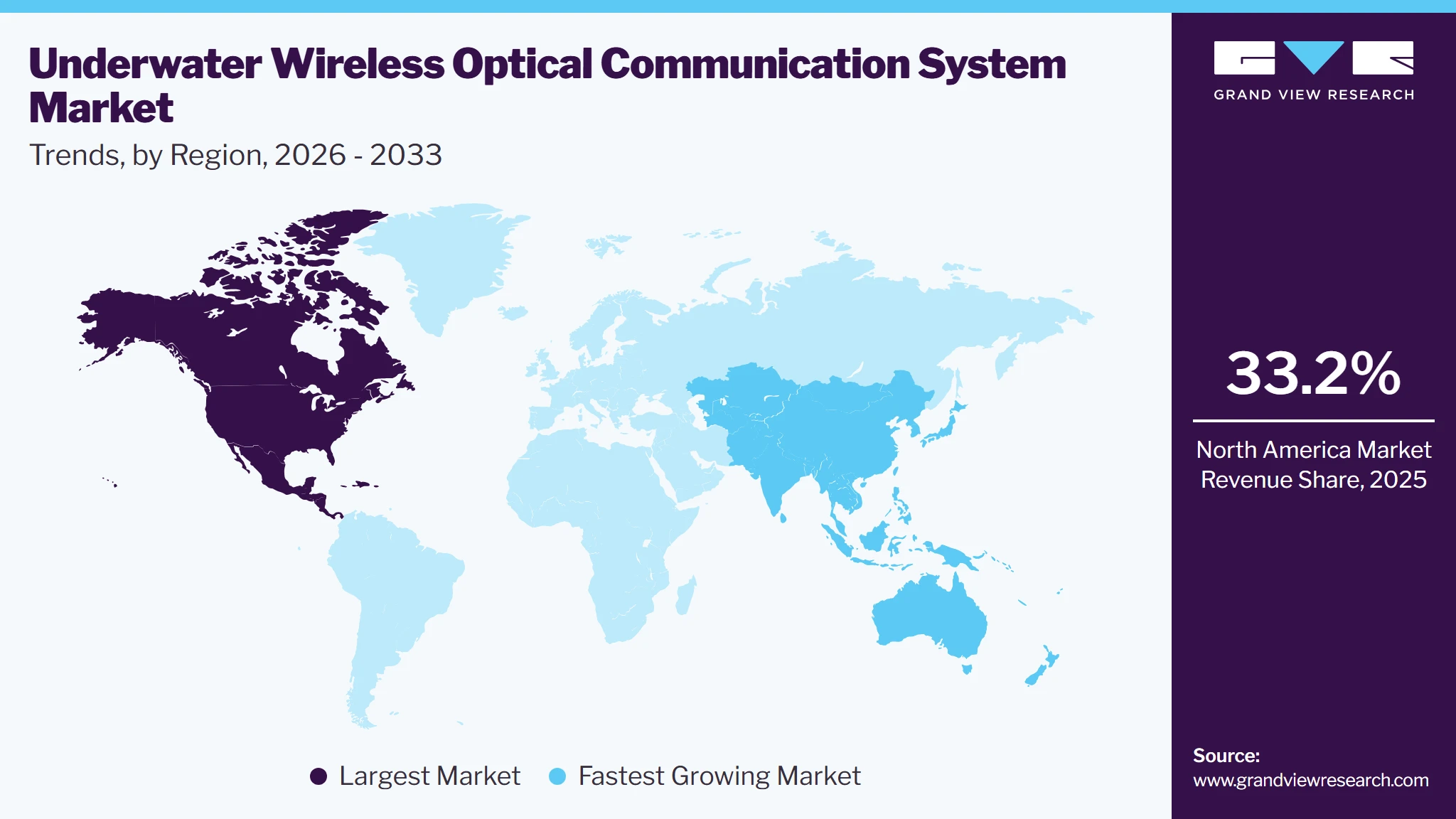
North America underwater wireless optical communication system market led the global market and accounted for 33.2% of the global revenue in 2025. North America is supported by investments in naval modernization, underwater surveillance, marine research, and autonomous underwater vehicle technologies. Demand for underwater wireless optical communications is driven by the need for high-speed, low-latency data transmission in defense operations, subsea infrastructure inspection, and scientific exploration. The presence of defense contractors, marine technology developers, and research institutions supports the development and adoption of advanced underwater communication solutions.
 To learn more about this report, Download Free Sample Report
U.S. Underwater Wireless Optical Communication System Market Trends
The U.S. underwater wireless optical communication system market is held the largest market share. The U.S. market is driven by defense modernization, unmanned underwater vehicle development, and oceanographic research activities. Underwater wireless optical communication supports high-bandwidth data exchange for underwater surveillance, real-time video transmission, and communication between autonomous platforms and docking systems. Continued investment in naval capabilities and marine research supports demand for reliable, short-range optical communication technologies.
Asia Pacific Underwater Wireless Optical Communication System Market Trends
The Asia Pacific underwater wireless optical communication system is projected to grow at the fastest CAGR over the forecast period. Asia Pacific is witnessed by investments in marine research, underwater robotics, naval modernization, and ocean exploration technologies. Countries across the region are developing advanced underwater communication capabilities to improve data transfer between autonomous underwater vehicles, seabed observation equipment, and research platforms. Increasing demand for underwater monitoring and high-bandwidth communication supports market development, although adoption remains influenced by transmission range, water clarity, and system costs.
China held a dominant share in the Asia Pacific underwater wireless optical communication system market. China's market is associated with the development of underwater robotics, marine exploration capabilities, and advanced communication technologies for subsea applications. Underwater wireless optical communication support the transmission of high-resolution images, sensor data, and operational information between underwater vehicles and monitoring platforms. Research into autonomous underwater systems and marine observation technologies supports demand for optical communication solutions in applications requiring high data rates and low transmission delays over short distances.
Japan underwater wireless optical communication system market is expected to grow at a significant CAGR over the forecast period. Japan's market is supported by established marine research capabilities and advancements in underwater optical communication technology. Research and development activities focus on improving data transmission rates, communication reliability, and integration with autonomous underwater vehicles and seabed observation systems. Technology supports applications in oceanographic research, seabed monitoring, underwater inspection, and autonomous underwater operations, where rapid transfer of large volumes of data is required.
Europe Underwater Wireless Optical Communication System Market Trends
The Europe underwater wireless optical communication system market poised significant growth from 2026 to 2033. Europe's market is driven by marine research, offshore infrastructure monitoring, naval technology development, and the adoption of autonomous underwater systems. Underwater wireless optical communication enables high-speed data transmission for underwater inspection, scientific data collection, and communication between submerged devices. Investments in maritime technologies and underwater robotics support the development of optical communication solutions designed to improve data transfer efficiency and operational performance.
The U.K. underwater wireless optical communication system market is supported by defense technology development, marine research, and the increasing use of autonomous maritime systems. Underwater wireless optical communication offers opportunities for high-speed data exchange between submerged vehicles, sensors, and control systems used in naval operations, underwater surveillance, and subsea infrastructure inspection. Continued advantage in advanced undersea communication capabilities supports the development of technologies that improve data transmission efficiency and coordination between underwater platforms.
The Germany held a substantial share in the Europe underwater wireless optical communication system market. Germany is supported by marine engineering capabilities, underwater robotics research, and advancements in optical communication technologies. Research and development activities focused on laser-based communication systems contribute to improvements in underwater data transmission speed, signal alignment, and communication reliability. Demand is associated with applications such as subsea inspection, marine research, and autonomous underwater operations that require high-speed data exchange over short distances.
Key Underwater Wireless Optical Communication System Company Share Insights
Key players in the underwater wireless optical communication system market are expanding their portfolios through product development, technological innovation, and improvements in optical communication capabilities. Companies are focusing on high-speed data transmission, compact system designs, improved communication reliability, and integration with autonomous underwater vehicles (AUVs), remotely operated vehicles (ROVs), and subsea monitoring equipment. These strategies aim to address demand from defense, marine research, offshore infrastructure inspection, and underwater exploration applications.
-
Hydromea company is a Switzerland-based underwater technology company that provides wireless communication, inspection, robotics, and data connectivity solutions. It offers optical wireless communication solutions for underwater data transfer, video transmission, and connectivity among underwater vehicles, sensors, and subsea infrastructure.
-
Seaward Technologies Co., Ltd. is a China-based marine technology company that provides marine equipment and customized solutions for marine engineering and oceanographic research. Its portfolio includes the AquaLink UWOC Modem, an underwater wireless optical communication solution for data transmission between underwater equipment and subsea assets.
Key Underwater Wireless Optical Communication System Companies
The following key companies have been profiled for this study on the underwater wireless optical communication system market.
-
Sonardyne
-
Hydromea
-
Shimadzu Corporation.
-
Aquatec
-
Lumasys, Inc.
-
KYOCERA Corporation
-
Trimatiz Ltd.
-
UON Technologies Inc.
-
Seaward Technologies Co., Ltd.
-
Oceanit.
Competitive Benchmarking
Operating Strategies
Competitive Edge
Weaknesses
Mature Players: Sonardyne, Hydromea, Shimadzu Corporation, KYOCERA Corporation
- Mature players in the underwater wireless optical communication system market are focus on developing and commercializing underwater optical communication systems, improving transmission performance, and integrating communication technologies with subsea equipment.
- Mature players gain a competitive advantage through established technical capabilities, dedicated communication products, and experience in optical or subsea technologies support product credibility and integration opportunities. Their portfolios address different transmission, operating-depth, and connectivity requirements.
- These companies often face challenges related to high development and integration costs may restrict adoption among budget-conscious customers. Dependence on water conditions, operating distance, and equipment compatibility can also limit deployment flexibility.
Emerging Players: Aquatec, Lumasys, Inc., UON Technologies Inc.
- Emerging players in the underwater wireless optical communication system market are focusing on specialized underwater communication products, targeted application requirements, and the development of solutions for specific subsea monitoring and data-transfer needs.
- Emerging players gain market traction through product development and focused engineering capabilities support responsiveness to customer requirements. Smaller or more focused portfolios may also allow greater attention to niche applications.
- Emerging players face limitations due to limited portfolio breadth and market reach may restrict access to large procurement contracts. Smaller commercial footprints and fewer integration resources may slow adoption across multiple industries and regions.
Recent Developments
-
In March 2026, Sonardyne launched Observer, a subsea monitoring system that combines real-time monitoring, analytics, sensors, and wireless underwater communications. It enables operators to remotely monitor assets such as pipelines, risers, and moorings and wirelessly offload data on demand without recovering the system.
-
In March 2026, Hydromea announced Equinor ASA, an international energy company, the world’s first subsea-to-cloud wireless broadband link, using Hydromea’s LUMA optical communication technology to transmit seabed sensor data and HD video in real time to the cloud. The technology supports speeds of up to 10 Mbps at depths of 6,000 meters, enabling wireless subsea monitoring and supporting autonomous underwater operations.
Underwater Wireless Optical Communication System Market Report Scope
Report Attribute
Details
Market size in 2025
USD 45.4 million
Estimated Market size in 2026
USD 51.0 million
Projected Market size by 2033
USD 147.9 million
Growth Rate
CAGR of 16.4% from 2026 to 2033
Base year for estimation
2025
Historical data
2021 - 2024
Forecast period
2026 - 2033
Quantitative units
Revenue in USD million and CAGR from 2026 to 2033
Report coverage
Revenue forecast, company ranking, competitive landscape, growth factors, and trends
Segments covered
Application, end user, region
Regional scope
North America, Europe, Asia Pacific, Latin America, MEA
Country scope
U.S., Canada, Mexico, Germany, U.K., France, China, Japan, India, South Korea, Australia, Brazil, KSA, UAE, and South Africa
Key companies profiled
Sonardyne, Hydromea, Shimadzu Corporation., Aquatec, Lumasys, Inc., KYOCERA Corporation, Trimatiz Ltd., UON Technologies Inc., Seaward Technologies Co., Ltd., and Oceanit.
Customization scope
Free report customization (equivalent up to 8 analysts working days) with purchase. Addition or alteration to country, regional & segment scope.
Pricing and purchase options
Avail customized purchase options to meet your exact research needs. Explore purchase options
Global Underwater Wireless Optical Communication System Market Report Segmentation
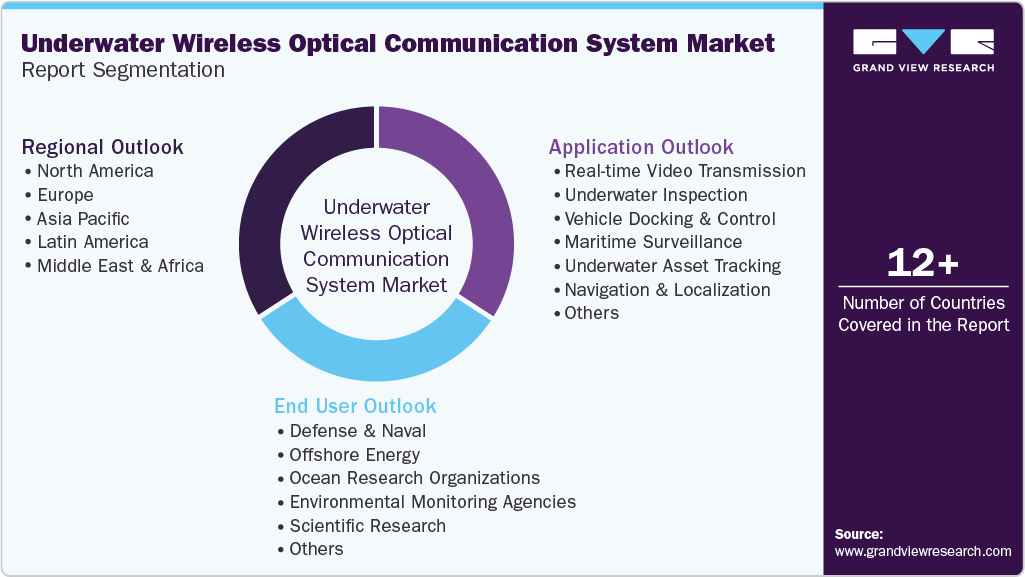
The report forecasts revenue growth at global, regional, and country levels and provides an analysis of the latest industry trends in each of the sub-segments from 2021 to 2033. For the purpose of this study, Grand View Research has segmented the global underwater wireless optical communication system market based on application, end user, and region.
 To learn more about this report, Download Free Sample Report
-
Application Outlook (Revenue, USD Million, 2021 - 2033)
-
Real-time Video Transmission
-
Underwater Inspection
-
Vehicle Docking & Control
-
Maritime Surveillance
-
Underwater Asset Tracking
-
Navigation & Localization
-
Others
-
-
End User Outlook (Revenue, USD Million, 2021 - 2033)
-
Defense & Naval
-
Offshore Energy
-
Ocean Research Organizations
-
Environmental Monitoring Agencies
-
Scientific Research
-
Others
-
-
Regional Outlook (Revenue, USD Million, 2021 - 2033)
- North America
-
U.S.
-
Canada
-
Mexico
-
- Europe
-
Germany
-
U.K.
-
France
-
- Asia Pacific
-
China
-
India
-
Japan
-
South Korea
-
Australia
-
-
Latin America
-
Brazil
-
- Middle East & Africa (MEA)
-
UAE
-
Kingdom of Saudi Arabia (KSA)
-
South Africa
-
- North America
Research Methodology
The underwater wireless optical communication system market figures in this report are based on a proven research process that combines executive interviews with secondary research from proprietary databases, company filings, and recognized regulatory and institutional sources. Market size is built through value-chain sizing-reconciling supply-side and demand-side estimates-and triangulated with bottom-up and top-down approaches. Every estimate passes multiple levels of expert validation before publication, with each underwater wireless optical communication system segment quantified using the revenue-capture definitions in the table below.
Segment Definition
Application
Revenue capture definition
Real-time Video Transmission
The segment revenue is generated from the sale of optical communication systems, hardware, and associated software used to transmit live underwater video streams between submerged devices and receiving systems.
Underwater Inspection
The segment revenue is generated from optical communication equipment and integrated systems used to transmit inspection images, video feeds, and equipment condition data during underwater inspection activities.
Vehicle Docking & Control
The segment revenue is generated from optical communication modules, docking communication interfaces, and integrated control communication systems used to exchange data between underwater vehicles and docking stations.
Maritime Surveillance
The segment revenue is generated from optical communication systems and associated equipment used to transmit underwater surveillance data, sensor information, and operational signals for maritime monitoring activities.
Underwater Asset Tracking
The segment revenue is generated from optical communication devices, tracking interfaces, and integrated communication systems used to exchange identification, location-related, and status data associated with underwater assets.
Navigation & Localization
The segment revenue is generated from optical communication equipment and integrated systems used to exchange positioning, navigation, ranging, and localization data between underwater platforms and reference devices.
Others
The segment revenue is generated from optical communication equipment, modules, software, and integrated systems used in underwater applications not classified under the other specified segments.
End User
Revenue capture definition
Defense & Naval
The segment revenue is generated from optical communication equipment, integrated communication systems, and related components procured for naval operations, underwater defense platforms, and military subsea communication requirements.
Offshore Energy
The segment revenue is generated from optical communication systems and associated equipment deployed for subsea infrastructure communication, offshore asset inspection, underwater maintenance, and energy-related marine operations.
Ocean Research Organizations
The segment revenue is generated from optical communication equipment and integrated systems acquired for oceanographic observation, underwater instrumentation, marine data collection, and research platform connectivity.
Environmental Monitoring Agencies
The segment revenue is generated from optical communication devices and systems used to transmit underwater environmental sensor readings, water-quality measurements, and marine ecosystem monitoring data.
Scientific Research
The segment revenue is generated from optical communication hardware, modules, and integrated systems procured for scientific experiments, underwater data acquisition, and research involving submerged instruments and platforms.
Others
The segment revenue is generated from optical communication equipment, software, modules, and integrated systems purchased by end users not classified under the other specified categories.
Estimation Model
Layer Name
Key Question
Description
Industry Demand Assessment
What is driving demand for underwater optical communication?
This layer assesses demand across the major application and end-user categories of the Underwater Wireless Optical Communication System Market. It evaluates requirements for high-speed underwater data transmission, low-latency communication, and connectivity between submerged systems. It also considers the adoption of autonomous underwater platforms and the development of subsea infrastructure. The findings establish the overall demand framework for market estimation.
Technology and Product Assessment
Which products and technologies generate market revenue?
This layer evaluates optical transmitters, receivers, transceivers, communication modules, and integrated underwater optical communication systems. It considers technical characteristics such as transmission speed, operating distance, power consumption, alignment requirements, and performance under different water conditions. Product integration and compatibility with underwater platforms are also assessed. This analysis helps identify the product categories contributing to market revenue.
Revenue and Market Sizing Assessment
How is market revenue quantified?
This layer estimates revenue associated with the sale of underwater optical communication equipment, integrated systems, and relevant software or services included within the defined market scope. Revenue is assessed across application categories, end users, and geographic markets while accounting for differences in deployment requirements and system configurations. Supplier disclosures, product information, procurement records, and other credible industry sources support the estimation process. Potential overlap between hardware, integrated systems, and bundled services is reviewed to reduce double counting.
Validation and Forecast Assessment
Are the market estimates consistent with industry conditions?
This layer validates the estimated market size through cross-checking of supplier information, product availability, deployment activity, and end-user demand. The assessment compares the estimated revenue distribution across applications, end users, and regions to identify inconsistencies. Key factors include optical communication performance, underwater system adoption, procurement activity, and technology development. The validated estimates provide the basis for assessing future market direction and growth opportunities.
Delivered Customization
We have successfully delivered the following deep-dive customizations:
Client Request
Customization Delivered
Value Adds
Regional Underwater Wireless Optical Communication System Market Opportunity Assessment
Country/region-wise market sizing and forecasts
Analysis of demand, adoption trends, and regulatory landscape
Identification of high-growth regions and investment hotspots
Identified region-specific growth opportunities
Supported expansion and go-to-market strategy
Enabled informed regional investment decisions
Cross-Segmentation Analysis for the Underwater Wireless Optical Communication System Market
Criss-cross market analysis by application, end user
Demand and adoption assessment across key segments
Segment attractiveness and growth potential benchmarking
Identified high-potential market segments
Supported targeted component positioning and marketing strategy
Improved customer and segment prioritization
Competitive Benchmarking and Strategic Positioning in the Underwater Wireless Optical Communication System Market
Benchmarking of key competitors across components, pricing, partnerships, and innovation
Comparative assessment of market share, capabilities, and strategies
Analysis of competitive strengths, gaps, and differentiation areas
Identified competitive white spaces and growth gaps
Supported strategic positioning and differentiation
Enabled data-driven competitive strategy development
Frequently Asked Questions About This Report
The global underwater wireless optical communication system market size was valued at USD 45.4 million in 2025 and is estimated at USD 51.0 million for 2026
The global underwater wireless optical communication system market is expected to grow at a CAGR of 16.4% from 2026 to 2033, reaching USD 147.9 billion by 2033.
The increasing adoption of autonomous underwater vehicles (AUVs) is fueling the growth of the underwater wireless optical communication system market.
Some key players operating in the underwater wireless optical communication system market include Sonardyne, Hydromea, Shimadzu Corporation., Aquatec, Lumasys, Inc., KYOCERA Corporation, Trimatiz Ltd., UON Technologies Inc., Seaward Technologies Co., Ltd. and Oceanit.
Real-time video transmission segment accounted for 25.8% of the largest share of global revenue in 2025. This segment is driven by the demand for high-speed underwater data transmission across defense, scientific research, and subsea infrastructure monitoring applications
North America market led the global market and accounted for 33.2% of the global revenue in 2025.
Defense & naval segment accounted for the largest market revenue share in 2025, while scientific research segment is projected to grow at the fastest CAGR over the forecast period
Asia Pacific is the fastest-growing region over the forecast period.
About the Author(s)
Communications Infrastructure Research Team
Technology · Communications InfrastructureThis report was authored by the communications infrastructure research team at Grand View Research - comprising two research analysts, one senior research analyst, and one industry expert - with specialized expertise in the communications infrastructure segment of the technology industry. All findings are based on proprietary technology databases, executive interviews, and regulatory analysis, subject to internal peer review prior to publication.
Last Updated:
Speak to Analyst

Customize this report to your needs - add regions, segments, or data points, with 20% free customization.
Or view our licence options:


ISO 9001:2015 & 27001:2022 Certified
We are GDPR and CCPA compliant! Your transaction & personal information is safe and secure. For more details, please read our privacy policy.


