
- Home
- »
- Next Generation Technologies
- »
-
Unpowered Ground Support Equipment Market Report 2033GVR Report cover

Unpowered Ground Support Equipment Market (2026 - 2033)
Size, Share & Trends Analysis Report By Product (Baggage Carts, Cargo Dollies, Container Dollies), By Ownership (Service Provider Owned, Airline Owned, Airport Owned), By Region, And Segment Forecasts
Market Size, 2025
$5.2BMarket Estimate, 2026
$5.4BMarket Forecast, 2033
$7.3BCAGR, 2026–2033
4.3%Unpowered Ground Support Equipment Market Summary
The global unpowered ground support equipment market size was valued at USD 5.2 billion in 2025 and is projected to grow from USD 5.4 billion in 2026 to USD 7.3 billion by 2033, at a CAGR of 4.3% from 2026 to 2033. North America dominated the market, accounting for the largest revenue share of 48.3% in 2025. The growth is driven by increasing air passenger traffic, ongoing airport infrastructure expansion and modernization projects, rising investments in efficient ground-handling operations, and growing demand for durable, lightweight, and low-maintenance unpowered equipment across commercial airports, cargo terminals, maintenance facilities, and ground-handling service providers.
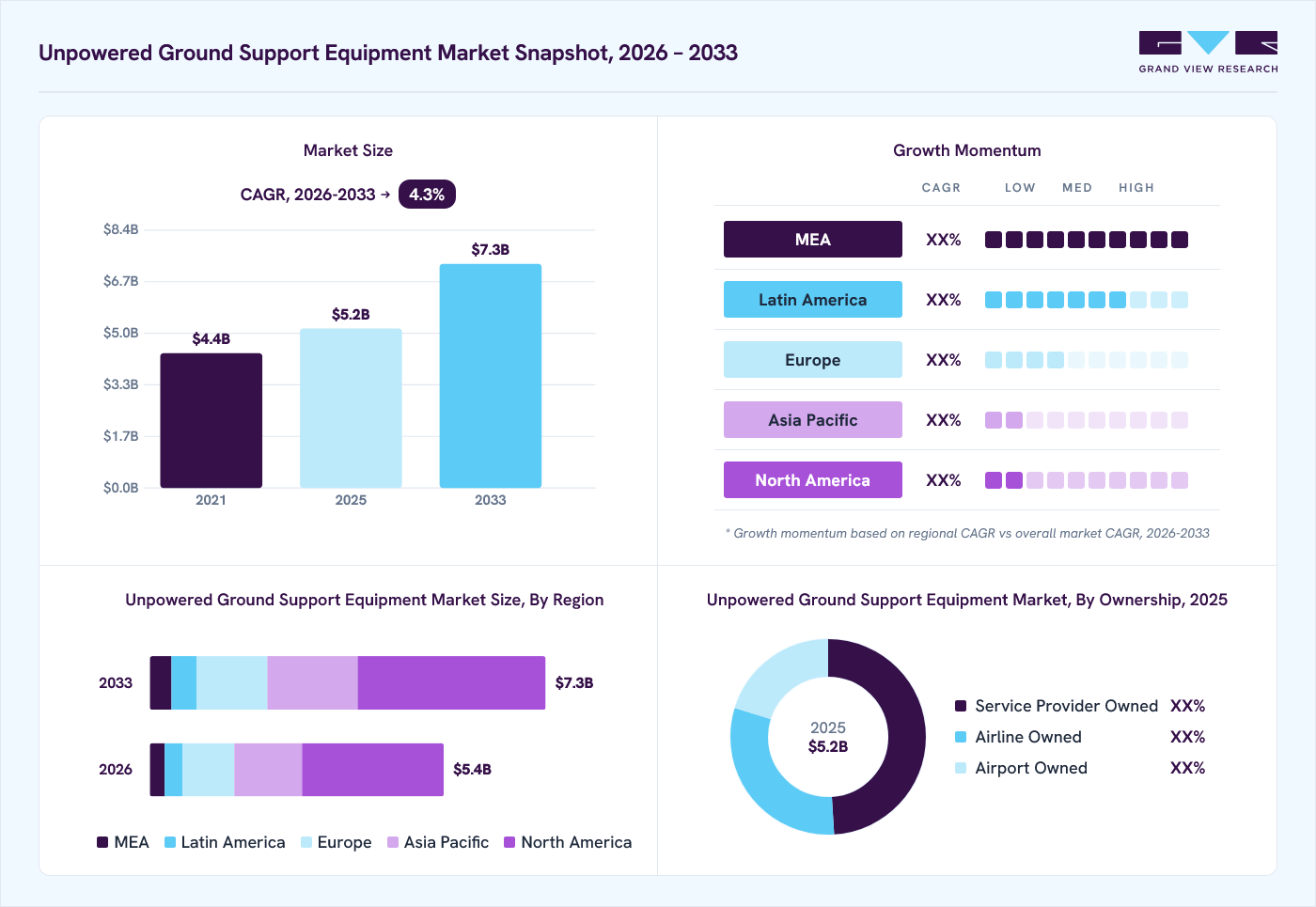 Source: Grand View Research, IR Documents, Primary Interviews, Paid DatabasesTo learn more about this report,
 Download Free Sample Report
Key Market Trends & Insights
- By product: Baggage carts segment held the dominant position and accounted for the highest revenue share of 22.8% in 2025.
- By ownership: Service provider owned segment accounted for the largest revenue share of 49.0% in 2025.
Regional Highlights
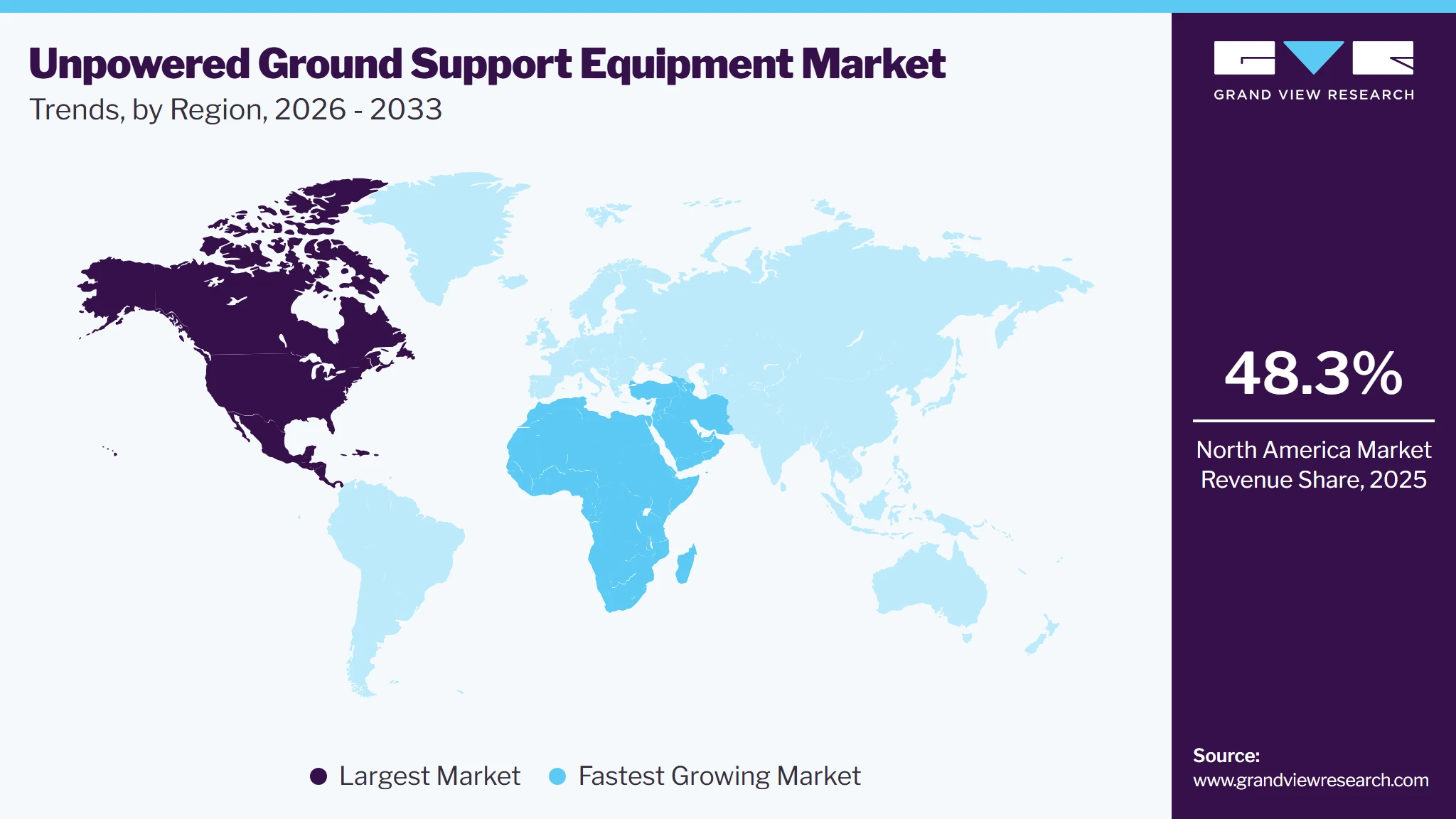
- Largest regional market: North America (48.3% revenue share, 2025)
- Fastest growing regional market: Middle East & Africa (highest CAGR, 2026-2033)
- By country: The U.S. held the largest market share in 2025.
Market Size & Forecast
- Market size in 2025: USD 5.2 Billion
- Estimated market size in 2026: USD 5.4 Billion
- Projected market size by 2033: USD 7.3 Billion
- CAGR (2026-2033): 4.3%
Prism AI by Grand View Research Free to tryAsk a question about the unpowered ground support equipment marketTry asking✓Every figure cited from GVR research Prefer the report? Download free sample →
The industry is driven by the increasing replacement of aging airport ground handling equipment, the expansion of low-cost carrier networks, and the rising emphasis on improving aircraft turnaround efficiency at airports. Growing investments in fleet support infrastructure, the increasing outsourcing of ground handling services to specialized operators, and the adoption of ergonomically designed, corrosion-resistant, and high-durability unpowered equipment are encouraging airports, airlines, and cargo handling companies to enhance operational productivity, reduce maintenance requirements, improve worker safety, and optimize ground support operations across commercial and regional aviation facilities.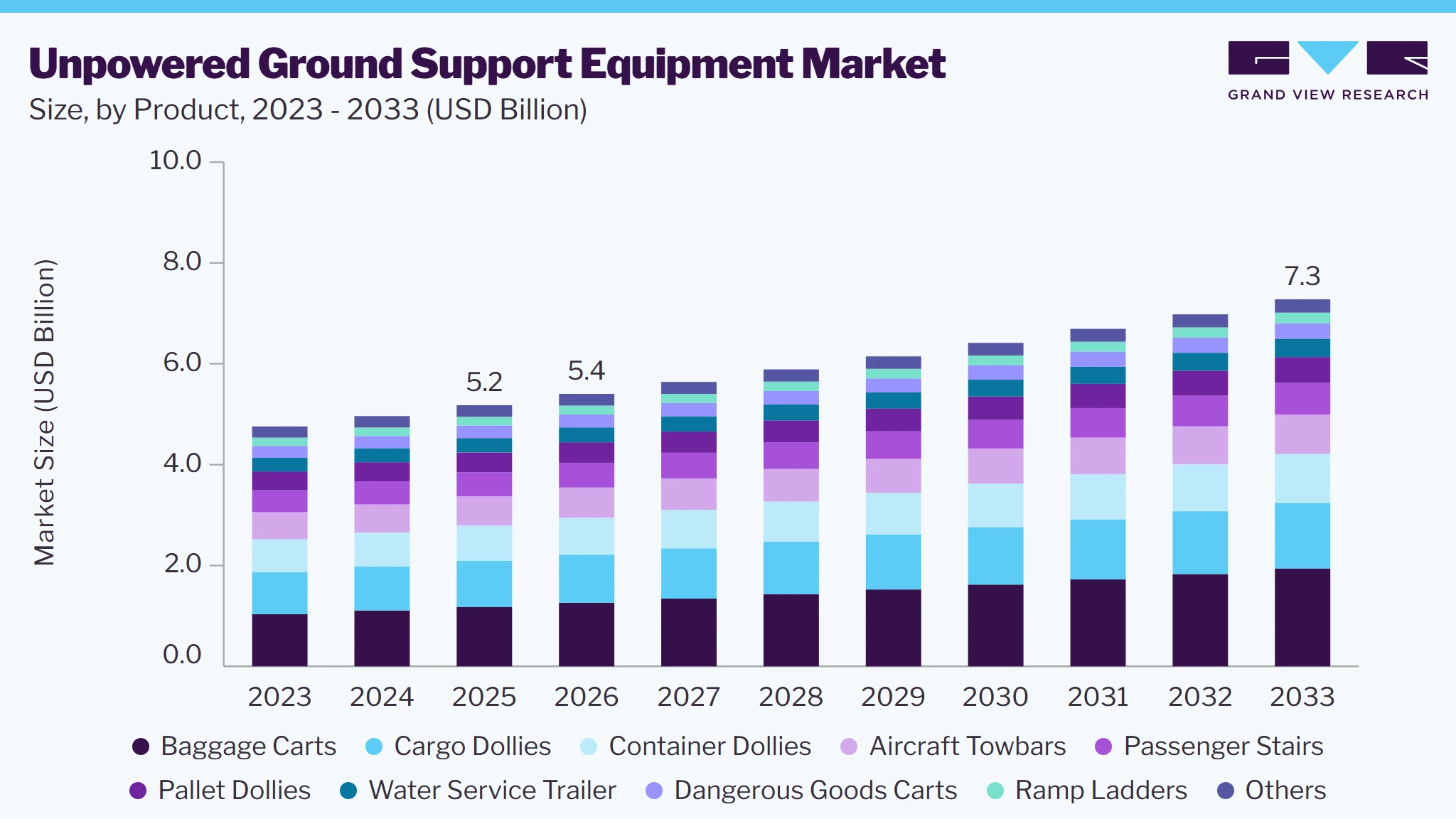 To learn more about this report, Download Free Sample Report
The industry is witnessing steady expansion due to the increasing focus on airport capacity optimization, the rising number of aircraft movements at regional and secondary airports, and the growing need to maximize ground handling efficiency without significantly increasing operating costs. Airport operators and ground handling companies are expanding their fleets of unpowered baggage carts, cargo dollies, passenger stairs, and maintenance platforms to support faster aircraft servicing, improve equipment availability, and streamline apron operations while maintaining operational flexibility across diverse airport environments.
Additionally, the strengthening of aviation safety regulations and workplace ergonomics standards is encouraging the adoption of advanced unpowered ground support equipment worldwide. Manufacturers are introducing equipment with enhanced braking systems, corrosion-resistant materials, modular structures, and ergonomic handling features to improve operator safety, reduce equipment wear, and ensure reliable performance under demanding airport operating conditions. These product innovations are helping airlines and ground service providers comply with safety requirements while minimizing maintenance needs and extending equipment service life.
Moreover, the continued expansion of air cargo logistics, cross-border e-commerce shipments, and specialized freight-handling activities is creating sustained demand for unpowered cargo-handling equipment. Growing investments in cargo terminals, logistics hubs, and aircraft maintenance facilities are driving the deployment of container dollies, pallet dollies, and other non-powered handling equipment to improve cargo-movement efficiency, enhance operational reliability, and support the evolving requirements of commercial aviation, express logistics providers, and airport ground-handling companies.
Market Dynamics
The industry is experiencing significant growth, driven by the modernization of airport ground support infrastructure, the increasing expansion of airport terminal and apron facilities, and the growing adoption of standardized ground handling equipment across commercial aviation. Rising investments in fleet support assets, increasing focus on asset utilization, and demand for cost-efficient, high-reliability ground-handling solutions are accelerating market expansion. The development of lightweight, high-strength equipment, modular product designs, corrosion-resistant materials, and maintenance-friendly configurations is improving operational efficiency, equipment longevity, worker safety, and turnaround performance, creating substantial long-term growth opportunities for the market.
The modernization of airport infrastructure across the globe is creating sustained demand for unpowered ground support equipment as airports expand terminals, upgrade aprons, and improve aircraft servicing capabilities. Investments in new gates, remote parking stands, cargo handling zones, and maintenance facilities require additional baggage carts, cargo dollies, passenger stairs, aircraft towbars, and maintenance platforms to ensure efficient ground operations, support increasing aircraft movements, and improve operational reliability. Airport operators and ground handling companies are prioritizing standardized, durable, and low-maintenance equipment that can withstand intensive daily use across diverse operating environments. Replacing aging equipment with modern designs featuring lightweight construction, corrosion-resistant materials, ergonomic handling, and improved maneuverability enables operators to reduce maintenance requirements, enhance workforce productivity, improve turnaround efficiency, and maintain consistent service quality across commercial and regional airports.
The long operational lifespan of unpowered ground support equipment reduces the frequency of replacement purchases, creating a challenge for manufacturers seeking consistent order volumes. Many airports and ground handling providers continue utilizing existing baggage carts, dollies, passenger stairs, and aircraft towbars for extended periods through regular maintenance and refurbishment, delaying investments in new equipment despite increasing airport activity and evolving operational requirements. Budget constraints among regional airports and independent ground handling companies further extend procurement cycles, particularly where capital expenditure is carefully prioritized toward larger infrastructure projects. Since unpowered equipment generally requires limited maintenance and has relatively low operating costs, buyers often postpone fleet renewal unless equipment reaches the end of its service life or new regulatory and operational requirements necessitate replacement.
The continuous expansion of air cargo infrastructure across the globe is creating new opportunities for suppliers of unpowered ground support equipment. Growing investments in cargo terminals, logistics parks, and airport freight-handling facilities are increasing demand for container dollies, pallet dollies, baggage carts, and maintenance platforms that enable efficient cargo movement, support higher freight volumes, and improve operational continuity throughout airport logistics networks. The rapid expansion of cross-border e-commerce, pharmaceutical logistics, and temperature-sensitive cargo handling is encouraging airports and logistics operators to strengthen their ground support capabilities. Manufacturers can capitalize on this trend by offering specialized, modular, and application-specific unpowered equipment designed to improve cargo handling efficiency, optimize equipment utilization, support evolving logistics requirements, and accommodate future airport infrastructure developments.
Market Concentration & Characteristics
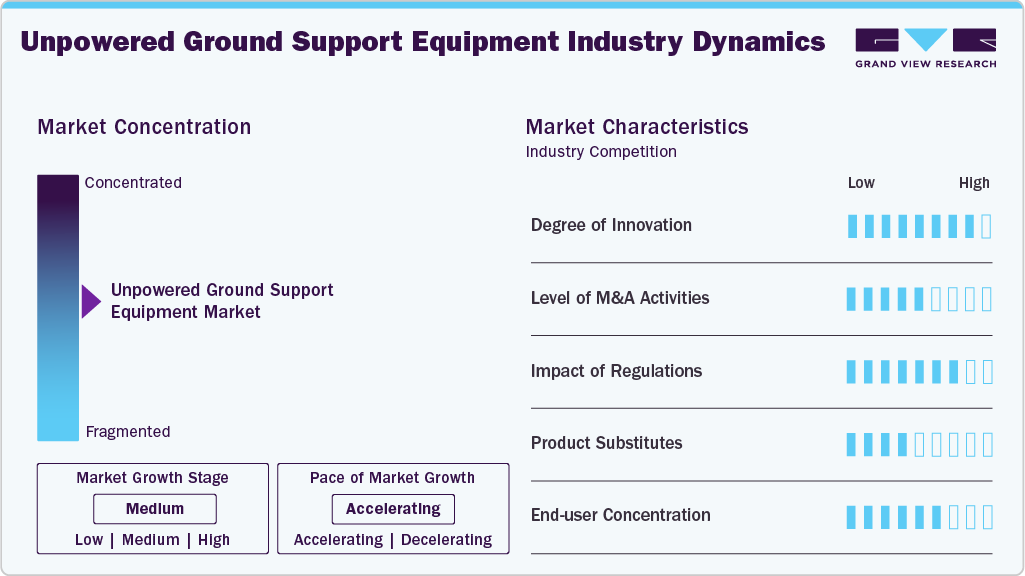
The industry is moderately fragmented, comprising airport ground support equipment manufacturers, specialized aviation equipment suppliers, regional engineering firms, and custom equipment manufacturers serving commercial airports, cargo terminals, ground handling service providers, airlines, and maintenance organizations. The market is experiencing steady expansion due to ongoing airport modernization programs, increasing investments in aviation infrastructure, rising aircraft movements, and the growing need for efficient, durable, and cost-effective ground-handling equipment. Strategic collaborations with airport operators, product portfolio expansion, and investments in advanced manufacturing capabilities are enabling companies to strengthen their market presence and expand across major aviation hubs.
 To learn more about this report, Download Free Sample Report
The industry is characterized by a moderately high level of innovation, supported by ongoing developments in lightweight structural materials, corrosion-resistant finishes, modular equipment designs, and ergonomic handling features that enhance operational efficiency and equipment longevity. The industry is experiencing moderate merger and acquisition activity, with manufacturers acquiring complementary businesses to expand product portfolios and strengthen regional distribution networks. Product substitution remains relatively low because unpowered ground support equipment performs essential airport operational functions with limited alternatives. Stringent aviation safety regulations and increasing customer demand for standardized, application-specific equipment continue to reinforce product differentiation and competitive positioning.
Analyst Perspective
The industry is driven by the rapid post-pandemic recovery in passenger air traffic, aggressive cargo logistics expansion, and stringent Union sustainability mandates. Rising frequency in turnarounds across commercial, regional, low-cost carrier, and air cargo hubs is encouraging product diversification in essential non-powered assets, including baggage dollies, cargo palette trailers, aircraft chocks, maintenance ladders, and boarding stairs. These innovations are helping GSE providers improve turnaround efficiency (TAT), reduce ramp-handling damage, meet stringent occupational health and safety standards, strengthen brand differentiation, and capture long-term procurement contracts across civil, commercial, and defense aviation applications.
Product Insights
The baggage carts segment accounted for the largest market share of 22.8% in 2025, propelled by the high volume of passenger baggage handled at commercial airports, the ongoing expansion of airport terminals, and the growing emphasis on efficient baggage-handling operations. Airports and ground handling service providers are extensively deploying baggage carts to facilitate rapid luggage movement between terminals, sorting facilities, and aircraft, while reducing manual handling. Their versatility, cost-effectiveness, ease of maintenance, and widespread use across virtually every airport operation continue to reinforce the segment's leading market position.
The cargo dollies segment is expected to witness a significant CAGR from 2026 to 2033. The segment is driven by the rapid expansion of air cargo transportation, increasing cross-border e-commerce shipments, and growing investments in dedicated cargo terminals across the globe. Rising demand for faster freight handling, pharmaceutical logistics, perishables transportation, and high-value cargo movement is encouraging airports to expand cargo handling infrastructure. The increasing need for efficient unit load device (ULD) transportation and optimized cargo transfer operations is expected to accelerate demand for the cargo dollies segment in the market.
Ownership Insights
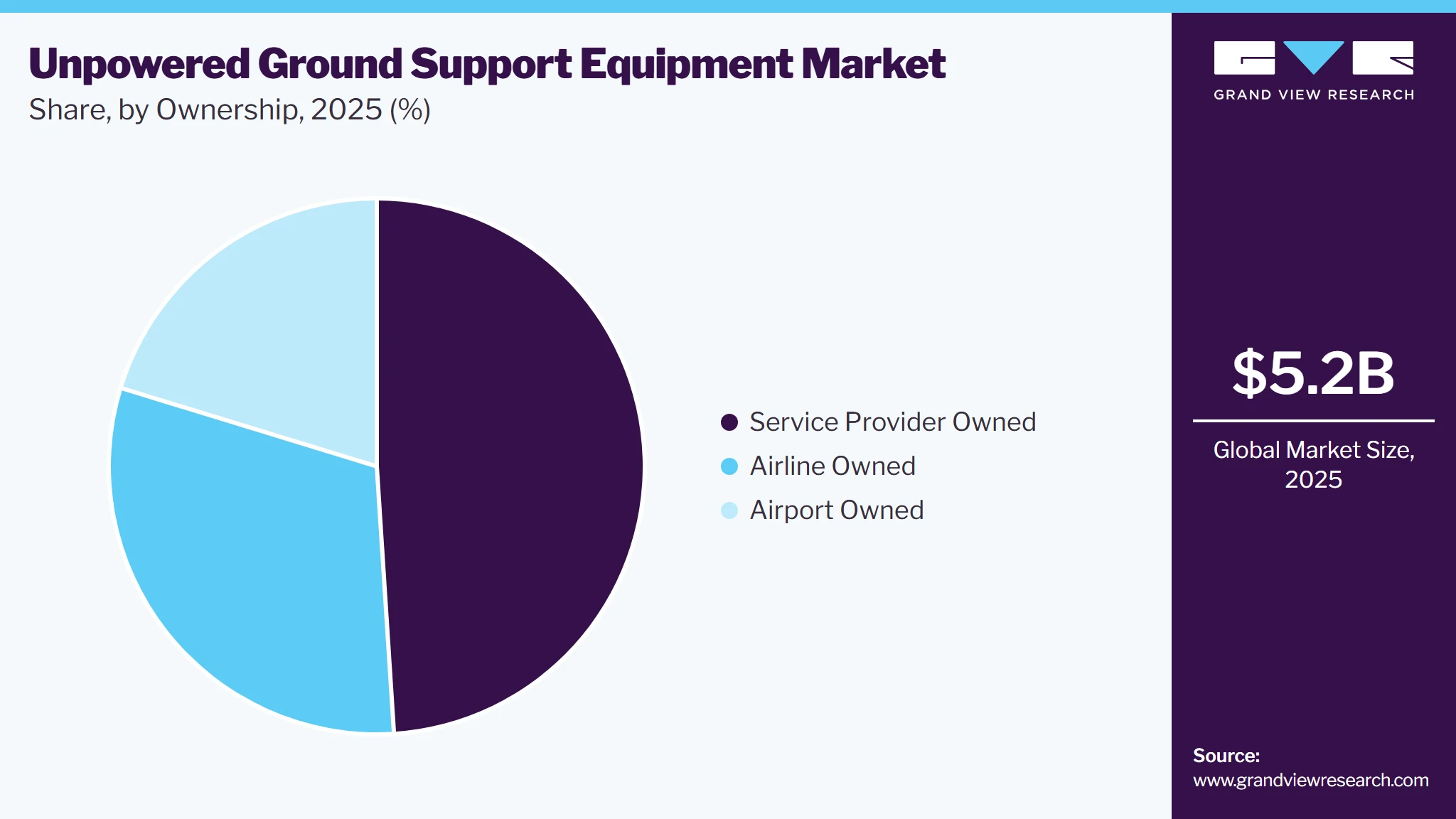
The service provider owned segment accounted for the largest market share of 49.0% in 2025, fueled by the increasing outsourcing of airport ground handling operations, the expanding presence of independent ground handling companies, and the need to serve airlines with shared equipment fleets. Service providers maintain large inventories of baggage carts, cargo dollies, passenger stairs, aircraft towbars, and other unpowered equipment to maximize asset utilization across numerous aircraft operations. Their ability to achieve operational efficiencies, optimize equipment deployment, and reduce costs for airline customers continues to strengthen the segment's market leadership.
 To learn more about this report, Download Free Sample Report
The airline owned segment is expected to witness a significant CAGR from 2026 to 2033, driven by increasing investments in dedicated ground support assets, fleet expansion by full-service and low-cost carriers, and the growing focus on improving operational control over aircraft turnaround activities. Airlines are expanding their ownership of unpowered ground support equipment to ensure consistent availability and enhance service quality at major operating bases. The rising emphasis on operational reliability, schedule adherence, and long-term cost optimization is expected to support strong growth in this segment throughout the forecast period.
Regional Insights
The North America unpowered ground support equipment market held the largest revenue share of 48.3% in 2025, supported by a large installed base of airport infrastructure, high aircraft movement volumes, frequent replacement of aging ground-support fleets, and continued investments in airport modernization. Growing air cargo activity, adoption of standardized ground-handling practices, stringent worker-safety requirements, and the presence of established GSE manufacturers are further strengthening procurement and replacement demand across major U.S. and Canadian airports.
 To learn more about this report, Download Free Sample Report
U.S. Unpowered Ground Support Equipment Market Trends
The U.S. unpowered ground support equipment market is supported by a large network of commercial and cargo airports, high aircraft movement volumes, frequent replacement of aging ground-handling fleets, and ongoing investments in airport modernization. Growing passenger and air cargo traffic, stringent airport safety standards, increasing focus on efficient aircraft turnaround, and the presence of established GSE manufacturers are further driving procurement and replacement demand across major U.S. airports. Furthermore, the replacement of older equipment with ergonomically designed and low-maintenance solutions is supporting sustained market growth across the country.
Europe Unpowered Ground Support Equipment Market Trends
The unpowered ground support equipment market in Europe is supported by extensive airport infrastructure, high passenger and air cargo traffic, and continued replacement of aging ground-handling fleets. Airports, airlines, and ground handling companies are increasingly investing in durable and low-maintenance baggage carts, cargo dollies, container dollies, passenger stairs, and aircraft towbars to improve turnaround efficiency and operational reliability.
The UK unpowered ground support equipment market held the largest regional share of 18.3% in 2025, driven by ongoing investments in airport expansion projects, rising passenger traffic, and a growing focus on improving ground-handling productivity. Rising adoption of shared ground-handling services, expansion of air cargo operations, and modernization of airport support infrastructure are driving demand for baggage carts, cargo dollies, passenger stairs, and aircraft towbars. Increasing emphasis on operational efficiency and regulatory compliance is further supporting equipment procurement across major UK airports.
The unpowered ground support equipment market in Germany is supported by the country's strong aviation manufacturing ecosystem, expanding air cargo logistics network, and ongoing investments in airport modernization. Airport operators and ground handling companies are increasingly deploying high-quality, corrosion-resistant, and ergonomically designed unpowered equipment to improve operational reliability and reduce maintenance requirements. Growing freight movement, ongoing fleet support infrastructure upgrades, and a growing focus on standardized airport operations are strengthening Germany's position as one of the leading markets for unpowered ground support equipment.
Key Unpowered Ground Support Equipment Companies Insights
Some of the key players operating in the market are TLD and Mallaghan Group Ltd., among others.
-
TLD is a leading player, offering one of the industry's most comprehensive portfolios of airport ground support equipment, including baggage carts, cargo dollies, passenger stairs, aircraft towbars, and other apron handling solutions. The company strengthens its market position through continuous product innovation, extensive manufacturing capabilities, strong relationships with airports and airlines, and a broad service network. Its ability to provide integrated, high-quality ground support solutions reinforces its leadership across the commercial aviation sector.
-
Mallaghan Group Ltd. is recognized for its extensive range of airport support equipment serving commercial airports, ground handling companies, and airlines. The company focuses on engineering excellence, product customization, and continuous investment in advanced manufacturing technologies to deliver durable and reliable unpowered ground support equipment. Its strong international distribution network and long-standing presence in the aviation industry continue to strengthen its competitive position across the market.
PINON-AEROTEC and TBD Owen Holland Ltd. are some of the emerging participants in the unpowered ground support equipment market.
-
PINON-AEROTEC is an emerging player in the market, specializing in aircraft towing systems, aircraft towbars, maintenance equipment, and customized ground support solutions. The company is strengthening its presence through application-specific engineering, product customization, and close collaboration with aircraft manufacturers and airport operators. Its expertise in specialized aviation equipment and focus on high-quality manufacturing are enhancing its position in the ground support equipment industry.
-
TBD Owen Holland Ltd. specializes in unpowered airport handling equipment such as baggage carts, cargo dollies, maintenance platforms, and aircraft servicing solutions. The company emphasizes robust product design, customer-specific engineering, and dependable equipment for airport ground handling operations. Its expanding portfolio of specialized unpowered ground support equipment and growing relationships with airports and ground handling service providers are strengthening its presence across the aviation market.
Key Unpowered Ground Support Equipment Companies
Some prominent players in the unpowered ground support equipment market include:
-
TLD
-
Mallaghan Group Ltd.
-
Blumenbecker Group
-
SACO Airport Equipment
-
TREPEL Airport Equipment GmbH
-
Timsan GSE
-
PINON-AEROTEC
-
KNOTT spol. s r.o.
-
Wilcox GSE
-
TBD Owen Holland Ltd
Competitive Benchmarking
Category
Operating Strategies
Competitive Edge
Weakness
Established Players (TLD, Mallaghan Group Ltd., TREPEL Airport Equipment GmbH)
- Focus on expanding comprehensive GSE portfolios by diversifying products and partnering with airport infrastructure providers.
- Invest heavily in engineering, manufacturing capabilities, and product standardization to deliver reliable airport handling solutions.
- A strong distribution network, established relationships with airports, and extensive experience in the aviation industry reinforce market leadership.
- A broad product portfolio with proven durability, regulatory compliance, and comprehensive after-sales service enhances customer retention.
- Dependence on mature airport procurement cycles can limit short-term revenue expansion opportunities.
- Large organizational structures may reduce flexibility in responding to niche customer customization requirements.
Emerging Players (PINON-AEROTEC, TBD Owen Holland Ltd., Wilcox GSE)
- Emerging players are focusing on specialized unpowered equipment through customized engineering and airport-specific product development.
- Expand regional distribution partnerships while strengthening manufacturing capabilities for evolving airport handling requirements.
- High product customization capabilities enable efficient solutions for specialized airport ground handling applications.
- Agile operations support faster product modifications and responsive customer service across regional aviation markets.
- Limited distribution networks restrict access to large international airport modernization projects.
- Smaller manufacturing scale reduces pricing competitiveness against established multinational ground support equipment suppliers.
Recent Developments:
-
In May 2026, Mallaghan Group Ltd. expanded its airport equipment portfolio with next-generation passenger boarding stairs and ground support solutions designed to improve aircraft turnaround efficiency and operational safety. The development reflects the company's continued investment in innovative airport handling equipment and its strategy to strengthen its position across the industry.
-
In September 2025, TREPEL Airport Equipment GmbH launched enhanced cargo handling equipment and apron logistics solutions to support growing air freight operations and airport modernization projects. The new equipment focuses on improving cargo-handling productivity, operational reliability, and lifecycle performance for airport ground-handling operators.
-
In May 2025, TLD expanded its airport ground support equipment portfolio by introducing new-generation baggage handling equipment, aircraft servicing solutions, and advanced towbar systems for commercial aviation customers. The expanded product range emphasizes improved operational efficiency, equipment durability, and compatibility with modern aircraft fleets, reinforcing TLD's leadership in the market.
Unpowered Ground Support Equipment Market Report Scope
Report Attribute
Details
Market size in 2025
USD 5.2 billion
Estimated market size in 2026
USD 5.4 billion
Projected market size by 2033
USD 7.3 billion
Growth rate
CAGR of 4.3% from 2026 to 2033
Base year for estimation
2025
Historical data
2021-2024
Forecast period
2026- 2033
Quantitative units
Revenue in USD billion and CAGR from 2026 to 2033
Report coverage
Revenue forecast, company ranking, competitive landscape, growth factors, and trends
Segments covered
Product, ownership, region
Regional scope
North America; Europe; Asia Pacific; Middle East & Africa; Latin America
Country scope
U.S.; Canada; Mexico; UK; Germany; France; Italy; China; Japan; India; South Korea; Australia; Brazil; UAE; Saudi Arabia; South Africa
Key companies profiled
TLD; Mallaghan Group Ltd.; Blumenbecker Group; SACO Airport Equipment; TREPEL Airport Equipment GmbH; Timsan GSE; PINON-AEROTEC; KNOTT spol. s r.o.; Wilcox GSE; TBD Owen Holland Ltd
Customization scope
Free report customization (equivalent to up to 8 analyst’s working days) with purchase. Addition or alteration to country, regional & segment scope.
Pricing and purchase options
Avail customized purchase options to meet you exact research needs. Explore purchase options
Global Unpowered Ground Support Equipment Market Report Segmentation
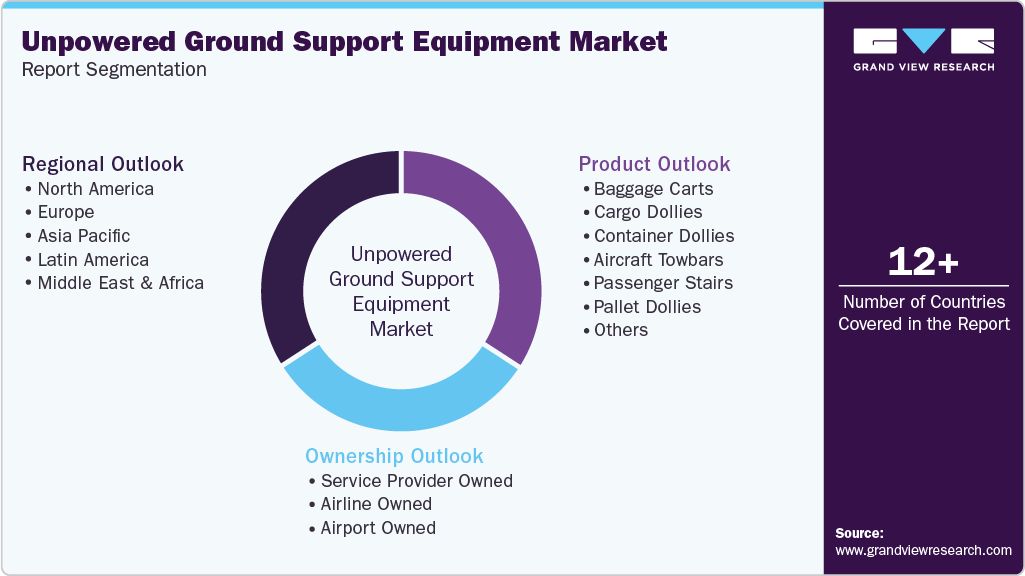
This report forecasts revenue growth at the global, regional and country levels and provides an analysis of the latest technological trends in each of the sub-segments from 2021 to 2033. For this study, Grand View Research has segmented the global unpowered ground support equipment market report based on product, ownership, and region:
 To learn more about this report, Download Free Sample Report
-
Product Outlook (Revenue, USD Billion, 2021-2033)
-
Baggage Carts
-
Cargo Dollies
-
Container Dollies
-
Aircraft Towbars
-
Passenger Stairs
-
Pallet Dollies
-
Water Service Trailer
-
Dangerous Goods Carts
-
Ramp Ladders
-
Slave Pallets
-
Others
-
-
Ownership Outlook (Revenue, USD Billion, 2021- 2033)
-
Service Provider Owned
-
Airline Owned
-
Airport Owned
-
-
Regional Outlook (Revenue, USD Billion, 2021-2033)
-
North America
-
U.S.
-
Canada
-
Mexico
-
-
Europe
-
U.K.
-
Germany
-
France
-
-
Asia Pacific
-
China
-
Japan
-
India
-
Australia
-
South Korea
-
-
Latin America
-
Brazil
-
-
Middle East and Africa (MEA)
-
KSA
-
UAE
-
South Africa
-
-
Research Methodology
The unpowered ground support equipment market figures in this report are based on a proven research process that combines executive interviews with secondary research from proprietary databases, company filings, and recognized regulatory and institutional sources. Market size is built through value-chain sizing—reconciling supply-side and demand-side estimates—and triangulated with bottom-up and top-down approaches. Every estimate passes multiple levels of expert validation before publication, with each unpowered ground support equipment segment quantified using the revenue-capture definitions in the table below.
Segment Definition
Segment - Product
Revenue capture definition
Baggage Carts
Revenue is generated from non-powered baggage carts designed for transporting passenger luggage between terminal buildings, baggage handling areas, and aircraft. These carts enable efficient baggage movement and improve operational productivity at commercial and regional airports.
Cargo Dollies
Revenue is generated through non-powered cargo dollies used to transport unit load devices (ULDs), bulk cargo, and freight containers across airport aprons and cargo terminals. They enable safe, efficient, and reliable cargo handling operations.
Container Dollies
Revenue is derived from unpowered dollies specifically designed to transport aviation cargo containers between cargo facilities and aircraft. These products improve container-handling efficiency and reduce manual handling in airport logistics operations.
Aircraft Towbars
Revenue is generated from non-powered aircraft towbars used to connect aircraft nose landing gear with tow tractors during aircraft towing and repositioning operations. These products ensure safe and secure aircraft ground movement.
Passenger Stairs
Revenue is generated from mobile, non-powered passenger boarding stairs used for passenger embarkation and disembarkation where jet bridges are unavailable. They are widely deployed at regional airports, remote stands, and military airfields.
Pallet Dollies
Revenue is generated through unpowered pallet dollies that efficiently transport aircraft cargo pallets between warehouses, cargo terminals, and aircraft loading areas. They support high-volume freight handling and logistics operations.
Water Service Trailer
Revenue is generated from non-powered water service trailers designed to transport potable water for aircraft servicing. These trailers support aircraft maintenance and ground servicing operations while ensuring compliance with aviation hygiene standards.
Dangerous Goods Carts
Revenue is derived from specialized, non-powered carts engineered for the safe transport of hazardous or regulated materials in airport environments. They support compliance with aviation safety and hazardous material handling regulations.
Ramp Ladders
Revenue is generated from portable, non-powered ramp ladders used by maintenance personnel to safely access aircraft doors, fuselage sections, and service areas during inspection and maintenance activities.
Slave Pallets
Revenue is captured through slave pallets used to facilitate the movement and transfer of cargo containers and pallets within airport cargo terminals and aircraft loading systems. They improve cargo handling efficiency and equipment compatibility.
Others
Revenue is generated from additional unpowered ground support equipment, including maintenance platforms, wheel chocks, equipment trailers, service trolleys, and specialized airport-handling equipment that support diverse ground operations.
Segment - Ownership
Revenue capture definition
Service Provider Owned
Revenue is generated from unpowered ground support equipment owned and operated by independent ground handling service providers. These organizations utilize shared equipment fleets to provide baggage and cargo handling, aircraft servicing, and apron support for multiple airlines across airport operations.
Airline Owned
Revenue is captured through unpowered ground support equipment purchased and operated directly by airlines for dedicated use within their ground handling operations. Airline-owned equipment improves operational control, equipment availability, and aircraft turnaround efficiency at key airport locations.
Airport Owned
Revenue is generated from unpowered ground support equipment procured and managed by airport authorities or airport operators to support common-use infrastructure, operational services, emergency response activities, and airport maintenance across terminal and airside operations.
Estimation Model
Layer No.
Layer Name
Key Question
Description
01
End-User Adoption Layer
Who are the potential adopters?
Identifies commercial airlines, regional and international airport operators, ground handling service providers (GHAs), cargo and logistics carriers, military airbases, private aviation/FBO facilities, and aerospace maintenance, repair, and overhaul (MRO) centers across the globe.
02
Product Enablement Layer
Who can provide unpowered ground support equipment?
Deployment depends on non-powered GSE manufacturers, aviation equipment engineering firms, component suppliers, specialized metal fabricators, logistics equipment distributors, and global airport technology integration partners.
03
Activity Deployment Layer
Where is unpowered ground support equipment currently being used?
Unpowered GSE, such as baggage dollies, cargo pallet trailers, tow bars, aircraft chocks, boarding stairs, and maintenance platforms, is deployed across airport apron zones, passenger terminal gates, air cargo hubs, hangar maintenance bays, and tarmac storage areas.
04
Revenue Generation Layer
How is revenue generated?
Revenue is generated through direct equipment manufacturing sales, long-term fleet leasing and rental agreements, custom engineering orders, institutional/airport tender procurements, spare parts sales, maintenance and overhaul contracts, and aftermarket refurbishing services.
Delivered Customizations
This report has been delivered with the following In-depth customizations
Client Request
Customization Delivered
Value Adds
Fleet Tracking & Asset Optimization Assessment
Assessed telematics integration and IoT-driven tracking across unpowered dolly fleets, cargo pallet trailers, and towbars to optimize tarmac positioning and fleet utilization.
Maximizes apron equipment efficiency, reduces asset misplacement, enhances fleet visibility, and optimizes airport capital expenditure.
Ergonomic Safety & Standards Compliance Evaluation
Evaluated advanced towbar hitching mechanisms, non-powered boarding stair stability, anti-collision braking, and aircraft chocks against Aviation Safety Agency (EASA) compliance mandates.
Improves ground-handling safety, minimizes the risk of aircraft damage, ensures regulatory compliance, and protects ramp personnel.
Lightweight Material & Durability Strategy
Analyzed high-strength steel composites, lightweight aluminum alloys, and anti-corrosive coatings used in baggage dollies to withstand harsh seasonal weather conditions.
Extends the operational lifespan of products, lowers equipment maintenance costs, enhances towing payload, and boosts structural durability.
Frequently Asked Questions About This Report
North America dominated the Unpowered Ground Support Equipment Market with a share of 48.3% in 2025, driven by the region’s extensive airport infrastructure, high passenger and aircraft movement volumes, and the large installed base of ground-handling equipment across major airports.
The global Unpowered Ground Support Equipment Market size was estimated at USD 5.2 billion in 2025 and is expected to reach USD 5.4 billion in 2026
The global Unpowered Ground Support Equipment Market is expected to grow at a compound annual growth rate of 4.3% from 2026 to 2033 to reach USD 7.3 billion by 2033.
North America dominated the Unpowered Ground Support Equipment Market with a share of 48.3% in 2025.
Some key players operating in the Unpowered Ground Support Equipment Market include TLD, Mallaghan Group Ltd., Blumenbecker Group, SACO Airport Equipment, TREPEL Airport Equipment GmbH, Timsan GSE, PINON-AEROTEC, KNOTT spol. s r.o., Wilcox GSE, TBD Owen Holland Ltd
Baggage Carts leads the market with revenue share of 22.8% in 2025 & is the fastest growing product type segment in the market.
Service Provider Owned leads the market with revenue share of 49.0% in 2025 & is the fastest growing ownership segment in the market.
U.K. leads the Europe market with revenue share of 18.2% in 2025.
Key factors driving the Unpowered Ground Support Equipment Market include rising air passenger and cargo traffic, airport infrastructure expansion, increasing demand for faster aircraft turnaround, replacement of aging GSE, and growing focus on safety, efficiency, and cost-effective ground handling operations
About the Author(s)
Next Generation Technologies Research Team
Technology · Next Generation TechnologiesThis report was authored by the next generation technologies research team at Grand View Research - comprising two research analysts, one senior research analyst, and one industry expert - with specialized expertise in the next generation technologies segment of the technology industry. All findings are based on proprietary technology databases, executive interviews, and regulatory analysis, subject to internal peer review prior to publication.
Last Updated:
Speak to Analyst

Customize this report to your needs - add regions, segments, or data points, with 20% free customization.
Or view our licence options:


ISO 9001:2015 & 27001:2022 Certified
We are GDPR and CCPA compliant! Your transaction & personal information is safe and secure. For more details, please read our privacy policy.


