
- Home
- »
- Medical Devices
- »
-
U.S. Aerosol Drug Delivery Devices Market Size Report, 2030GVR Report cover

U.S. Aerosol Drug Delivery Devices Market (2025 - 2030) Size, Share & Trends Analysis Report By Type (Inhaler, Nebulizer), By Application (COPD, Asthma, Cystic Fibrosis), By Distribution Channel, And Segment Forecasts
Market Size & Trends
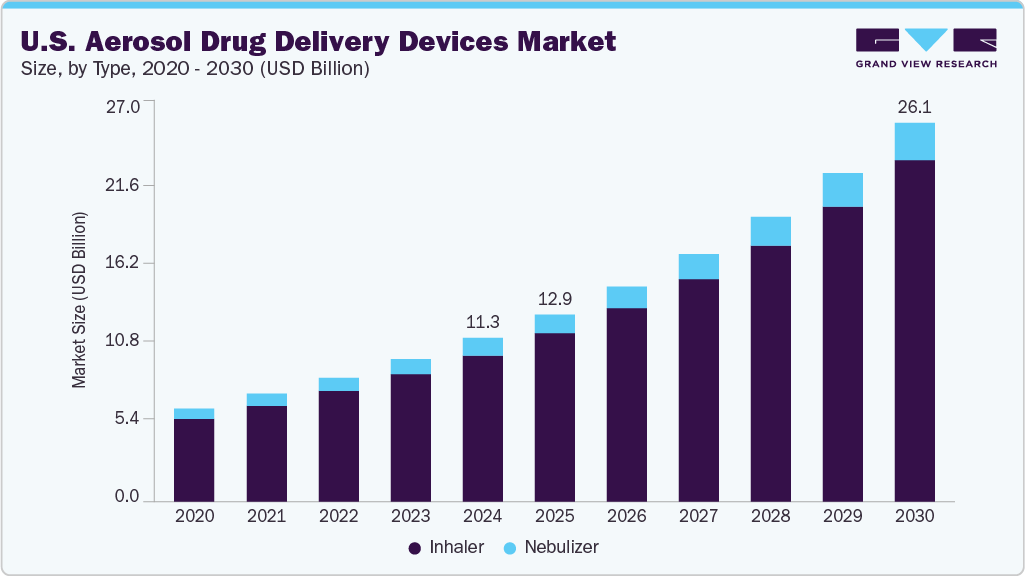
The U.S. aerosol drug delivery devices market size was estimated at USD 11.27 billion in 2024 and is expected to grow at a CAGR of 15.1% from 2025 to 2030. This is attributed to the rising prevalence of respiratory diseases, advancements in inhaler technology, increasing healthcare awareness, and the growing demand for home-based treatments. According to estimates from the American Lung Association, in 2022, approximately 11.7 million people, or 4.6% of adults, were diagnosed with COPD, including chronic bronchitis and emphysema.
 Source: Grand View Research, IR Documents, Primary Interviews, Paid DatabasesTo learn more about this report,
 Download Free Sample Report
In addition, the WHO projects that by 2030, life-threatening respiratory diseases such as COPD, lung cancer, and tuberculosis will be responsible for nearly one in five deaths worldwide. Such factors contribute to the widespread adoption of aerosol devices, including inhalers and nebulizers. The growing emphasis on home healthcare contributes to the increased adoption of aerosol drug delivery devices.
Patients and healthcare providers are seeking treatments administered in the comfort of home, reducing the need for hospital visits and associated healthcare costs. This shift drives demand for portable, user-friendly aerosol delivery devices that facilitate self-management of respiratory conditions. The availability of e-commerce platforms and online pharmacies has further enhanced accessibility to these devices.
Technological advancements in aerosol drug delivery devices significantly propel market growth. Smart inhalers with sensors to monitor medication usage and improve adherence are becoming increasingly prevalent. Innovations include dual-chamber DPIs, breath-actuated MDIs, and environmentally friendly propellants. These technologies enhance drug delivery efficiency and patient convenience. For instance, Aerogen’s vibrating mesh nebulizer technology, now widely adopted in U.S. hospitals, exemplifies innovation in improving treatment for ventilated and non-ventilated patients. Such advancements make devices more straightforward and practical, encouraging patient and healthcare provider adoption.
The COVID-19 pandemic had a positive impact on the U.S. market. The demand for inhalers and nebulizers surged as COVID-19 and related respiratory conditions increased, particularly affecting patients with asthma and COPD who required ongoing respiratory care. The shift toward at-home healthcare and telemedicine drove the adoption of portable and smart inhalation devices. However, the pandemic disrupted supply chains, leading to raw material shortages and production delays, temporarily constraining market growth. In addition, hospitals prioritized critical COVID-19 care, causing a decline in non-urgent respiratory treatments and procedures. Despite these setbacks, the crisis accelerated digital health innovation and supported the long-term outlook of the U.S. market.
Currently Available Aerosol Drug Formulations and Cost Analysis
Certain aerosol medications are available in multiple formulations. Newer aerosol drugs are typically developed either as HFA-propelled pressurized metered-dose inhalers (pMDIs)-such as levalbuterol-or more commonly as dry powder inhalers (DPIs), like tiotropium and mometasone.
The table below outlines the currently approved aerosol drug formulations in the U.S. along with their corresponding brand names, cost, and FDA-approved delivery devices.
Aerosol medications
Drug
Brand
Device
Strength
Doses
Cost
Cost/ Dose
Short-Acting Bronchodilator
Albuterol Sulfate HFA
AccuNeb
SVN
0.63
25
$45.00
$1.80
1.25
Proventil HFA
MDI
-
200
$73.74
$0.37
ProAir RespiClick
DPI
-
200
$67.23
$0.34
ProAir HFA
MDI
-
200
$35.00
$0.18
Albuterol Sulfate
SVN
5mg
25
$59.00
$2.36
Ventolin HFA
MDI
-
200
$68.00
$0.34
Long-Acting Bronchodilator
Detail analysis around the available formulations will be provided in the final deliverable.
Combination Drugs
Corticosteroids
Mucoactive Drugs
Other Drugs
Source: American Association for Respiratory Care, 2023
Market Concentration & Characteristics
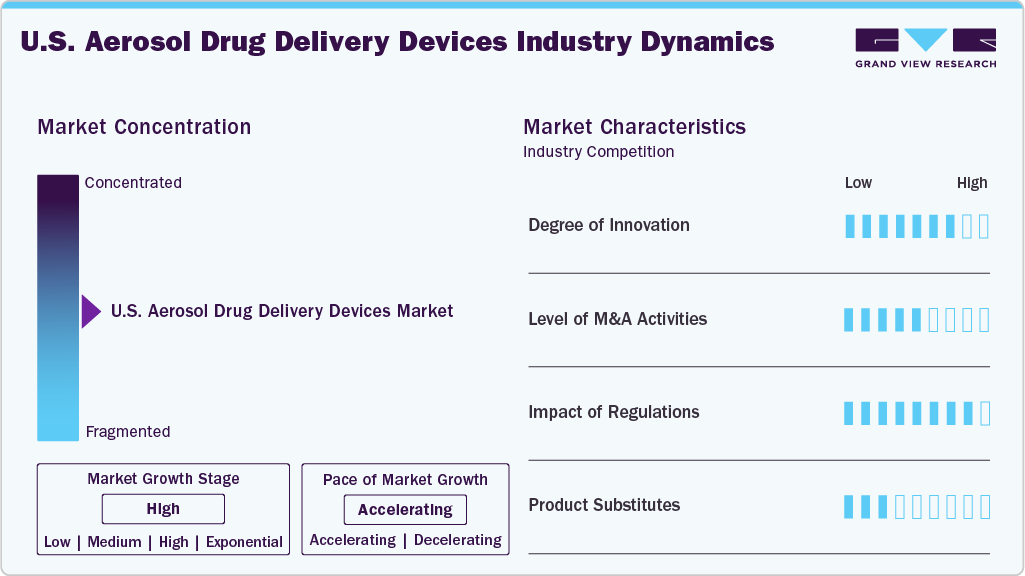
The market exhibits medium to high innovation, driven by advancements in smart inhalers, breath-actuated devices, and digital connectivity features that improve drug delivery efficiency and patient adherence. Technologies such as sensors that monitor medication usage and provide real-time feedback are becoming mainstream, enhancing treatment outcomes for chronic respiratory diseases. For instance, smart inhalers integrated with mobile apps help track doses and remind patients, reducing errors and improving compliance. Innovations include environmentally friendly propellants and dual-chamber dry powder inhalers, reflecting ongoing efforts to enhance usability and sustainability.
The market experiences a medium level of mergers and acquisitions, with companies seeking to expand their portfolios and capabilities. For instance, in January 2024, Kindeva Drug Delivery's acquisition of Summit Biosciences aimed to enhance its intranasal drug delivery offerings. Such strategic moves enable companies to integrate complementary technologies and strengthen their market positions.
 To learn more about this report, Download Free Sample Report
Regulations significantly impact the market, as stringent guidelines govern device safety and efficacy. Regulatory bodies, including the FDA, have established rigorous approval processes for new devices. For instance, in January 2023, the FDA approved Airsupra (albuterol and budesonide) inhalation aerosol to prevent or treat bronchoconstriction.
There are relatively few effective substitutes for aerosol drug delivery devices. While alternative treatments, such as oral medications, exist, they lack the targeted delivery and rapid onset of action provided by inhalers and nebulizers. Aerosol devices' unique advantages in managing respiratory conditions contribute to their continued dominance in treatment regimens.
Type Insights
Inhaler held the largest revenue share of 89.59% in 2024 and is expected to grow at the fastest CAGR for the forecast period, driven by its effectiveness in treating respiratory conditions, including asthma and COPD. Various research studies highlighting the benefits of adopting smart inhalers, such as assisting patients in treatment adherence and controlling symptoms, also contribute to the market growth. For instance, a 2020 Cleveland Clinic study discovered that patients with COPD using the Propeller company’s smart inhalers had a noticeably lower risk of being admitted to the hospital, with a nearly 35% drop in visits compared to the prior year. Moreover, the growing elderly population and awareness about early respiratory disease management increase demand. Technological advancements, such as smart inhalers with Bluetooth-enabled dose tracking and environmentally friendly features, are accelerating adoption.
The nebulizer segment is expected to grow significantly for the forecast period. Nebulizers are particularly effective in managing severe asthma, COPD, and various respiratory disorders. The rising demand for home-based healthcare and innovations, including compact, battery-powered devices, is fueling their market growth. For instance, the Pari Vios nebulizer system delivers medication efficiently in home settings, enhancing treatment results and encouraging broader use of nebulizers across the market.
Application Insights
Chronic Obstructive Pulmonary Disease (COPD) held the largest revenue share in 2024 and is the fastest-growing segment of the forecast period. The growth is attributed to the increasing prevalence of COPD among the aging population and smokers. Enhanced awareness of early diagnosis and management and advances in drug delivery technologies, including combination inhalers and smart devices, increase treatment adherence and patient outcomes.
The asthma segment is experiencing significant market growth, driven by factors such as the increasing prevalence of asthma, advancements in inhaler technologies, and a growing focus on patient adherence. According to the Asthma Facts and Figures report published in April 2025 by the Asthma and Allergy Foundation of America (AAFA), over 28 million people in the U.S. have asthma. In addition, innovations such as digital-tracking smart inhalers improve medication adherence and patient outcomes, while environmental factors such as pollution and smoking exacerbate respiratory conditions. The segment benefits from regulatory support for advanced, propellant-free inhalers and growing home healthcare adoption.
Distribution Channel Insights
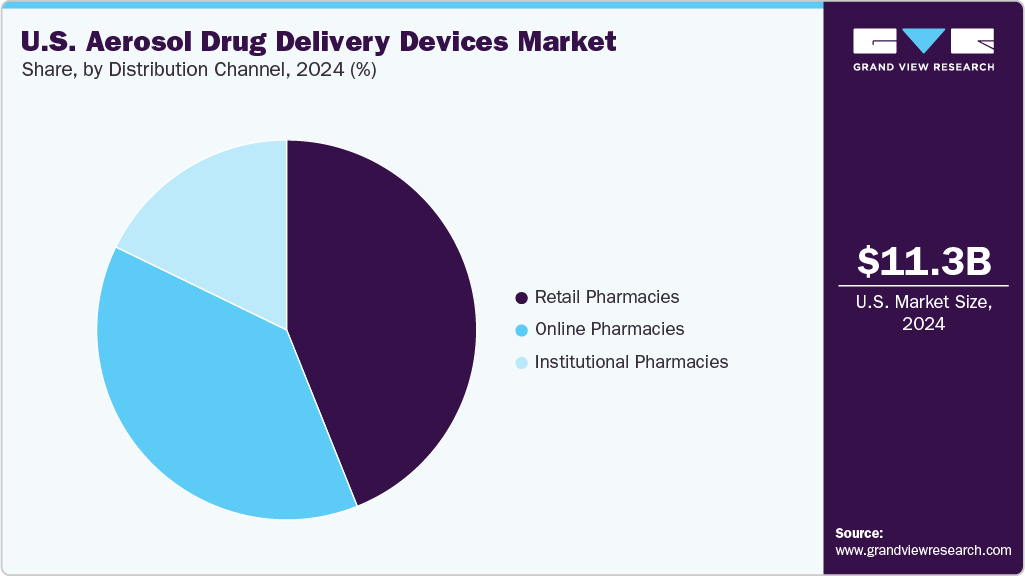
The institutional pharmacies segment held the largest revenue share in 2024 due to its role in providing medications to hospitals, clinics, and healthcare facilities. Major drivers include the rising need for respiratory therapies in clinical environments, the expanding population of patients with chronic respiratory diseases, and the growing demand for bulk medication distribution. Institutional pharmacies are well-positioned to handle high volumes and deliver customized treatment solutions.
 To learn more about this report, Download Free Sample Report
Online pharmacies are expected to grow at the fastest CAGR for the forecast period. The growth is driven by increased internet penetration, improved home delivery infrastructure, and the expansion of telemedicine. Online pharmacies offer convenient access to various aerosol drug delivery devices, such as inhalers and nebulizers, often at competitive prices with home delivery options. For instance, Amazon Pharmacy provides both prescription and over-the-counter aerosol devices, enhancing accessibility for patients.
Key U.S. Aerosol Drug Delivery Devices Companies Insights
Key players prioritize creating advanced inhalers, nebulizers, and cutting-edge delivery systems for asthma and COPD. Collaborations with healthcare providers, expansion, and regular FDA approvals for new and generic products help improve accessibility, affordability, and market presence. For instance, in January 2024, Recipharm, a CDMO, formed an exclusive partnership with Medspray and Resyca to jointly develop soft mist nasal delivery devices designed for administering both individual and combination medications. This partnership focuses on advancing soft mist technology for nasal drug delivery, including single and combination drug products. Soft mist inhalers produce a fine, slow-moving aerosol that improves lung deposition and reduces the degradation of fragile biological drugs, such as mRNA vaccines.
Key U.S. Aerosol Drug Delivery Devices Companies:
- AptarGroup, Inc.
- Koninklijke Philips N.V.
- AstraZeneca
- Novartis AG
- Sanofi
- OMRON Corporation
- Medline Industries, LP.
- GF Health Products, Inc.
- DRIVE MEDICAL GMBH & CO. KG
- Teva Pharmaceutical Industries Ltd
- Aerogen (Stamford Devices Limited Group)
- Sensirion AG
- PARI Respiratory Equipment, Inc.
- Catalent, Inc
- Pfizer Inc.
- Beurer GmbH
Prism AI by Grand View Research Free to tryAsk a question about the U.S. aerosol drug delivery devices marketTry asking✓Every figure cited from GVR research Prefer the report? Download free sample →Recent Developments
-
In December 2024, Teva Pharmaceuticals, Inc. launched a new program in partnership with Direct Relief to provide free inhalers to qualifying patients in the U.S.
“In the United States, while 93% of Teva’s inhaler medicines are generic products with access at lower prices, particularly for insured patients, there remain uninsured patients who cannot access affordable generic inhalers. The aim of this program is to help address an unmet need in underserved communities nationwide, enhancing patient access to safe and affordable medicines delivered via inhalers, including both maintenance and rescue inhalers.”
- Chris Fox, Executive Vice President, U.S. Commercial at Teva
- In April 2024, Teva and Launch Therapeutics formed a clinical collaboration agreement to fast-track the development of the dual-action asthma rescue inhaler (ICS-SABA/TEV-’248) respiratory program. In addition, Teva entered a strategic development funding agreement with Abingworth.
“As we execute our Pivot to Growth Strategy, we are focused on accelerating our late-stage innovative pipeline and delivering meaningful new therapies to people with unmet medical needs. We are especially excited about the potential to deliver this new asthma therapy to patients working alongside the team at Launch Therapeutics, who have valuable experience in expediting clinical development programs.”
- Eric Hughes, MD, PhD, Executive Vice President, Teva Global R&D and Chief Medical Officer
U.S. Aerosol Drug Delivery Devices Market Report Scope
Report Attribute
Details
Revenue forecast in 2025
USD 12.93 billion
Revenue forecast in 2030
USD 26.12 billion
Growth rate
CAGR of 15.10% from 2025 to 2030
Actual data
2018 - 2024
Forecast data
2025 - 2030
Quantitative units
Revenue in USD million/billion and CAGR from 2025 to 2030
Report Coverage
Revenue forecast, company ranking, competitive landscape, growth factors, and trends
Segments Covered
Type, application, distribution channel
Key companies profiled
AptarGroup, Inc.; Koninklijke Philips N.V.; AstraZeneca; Novartis AG; Sanofi; OMRON Corporation; Medline Industries, LP.; GF Health Products, Inc.; DRIVE MEDICAL GMBH & CO. KG; Teva Pharmaceutical Industries Ltd.; Aerogen (Stamford Devices Limited Group); Sensirion AG; PARI Respiratory Equipment, Inc.; Catalent, Inc.; Pfizer Inc.; Beurer GmbH
Customization scope
Free report customization (equivalent to up to 8 analyst’s working days) with purchase. Addition or alteration to country & segment scope.
Pricing and purchase options
Avail customized purchase options to meet your exact research needs. Explore purchase options
U.S. Aerosol Drug Delivery Devices Market Report Segmentation
This report forecasts revenue growth at the country level and provides an analysis of the latest industry trends in each of the sub-segments from 2018 to 2030. For this study, Grand View Research has segmented the U.S. aerosol drug delivery devices market report based on type, application, and distribution channel:
-
Type Outlook (Revenue, USD Million, 2018 - 2030)
-
Inhaler
-
Pressurized Metered-Dose Inhaler (pMDI)
-
Dry-Powder Inhaler (DPI)
-
-
Nebulizer
-
Jet
-
Mesh
-
Active
-
Passive
-
-
Ultrasonic
-
-
-
Application Outlook (Revenue, USD Million, 2018 - 2030)
-
COPD
-
Asthma
-
Cystic Fibrosis
-
Other (Pulmonary Arterial Hypertension (PAH), etc.)
-
-
Distribution Channel Outlook (Revenue, USD Million, 2018 - 2030)
-
Retail Pharmacies
-
Online Pharmacies
-
Institutional Pharmacies
-
Frequently Asked Questions About This Report
The global U.S. aerosol drug delivery devices market size was estimated at USD 11.27 billion in 2024 and is expected to reach USD 12.93 billion in 2025.
The global U.S. aerosol drug delivery devices market is expected to grow at a compound annual growth rate of 15.10% from 2025 to 2030 to reach USD 26.12 billion by 2030.
Inhaler segment dominated the market with the largest revenue share of 89.59% in 2024. This growth is driven by its effectiveness in treating respiratory conditions, including asthma and COPD.
Some key players operating in the U.S. Aerosol Drug Delivery Devices market include AptarGroup, Inc., Koninklijke Philips N.V., AstraZeneca, Novartis AG, Sanofi, OMRON Corporation, Medline Industries, LP., GF Health Products, Inc., DRIVE MEDICAL GMBH & CO. KG, Teva Pharmaceutical Industries Ltd, Aerogen (Stamford Devices Limited Group), Sensirion AG, PARI Respiratory Equipment, Inc., Catalent, Inc, Pfizer Inc., Beurer GmbH
Key factors that are driving the market growth include the rising prevalence of respiratory diseases, advancements in inhaler technology, increasing healthcare awareness, and the growing demand for home-based treatments.
About the Author(s)
Medical Devices Research Team
Healthcare · Medical DevicesThis report was authored by the medical devices research team at Grand View Research - comprising two research analysts, one senior research analyst, and one industry expert - with specialized expertise in the medical devices segment of the healthcare industry. All findings are based on proprietary healthcare databases, executive interviews, and regulatory analysis, subject to internal peer review prior to publication.
Last Updated:
Speak to Analyst

Customize this report to your needs - add regions, segments, or data points, with 20% free customization.
Or view our licence options:


ISO 9001:2015 & 27001:2022 Certified
We are GDPR and CCPA compliant! Your transaction & personal information is safe and secure. For more details, please read our privacy policy.


