
- Home
- »
- Medical Devices
- »
-
U.S. Alzheimer’s-linked Imaging Market Size Report, 2033GVR Report cover

U.S. Alzheimer’s-linked Imaging Market (2025 - 2033) Size, Share & Trends Analysis Report By Imaging Modality (Positron Emission Tomography (PET), Magnetic Resonance Imaging (MRI), Single Photon Emission Computed Tomography), By End-use, And Segment Forecasts
Market Size & Trends
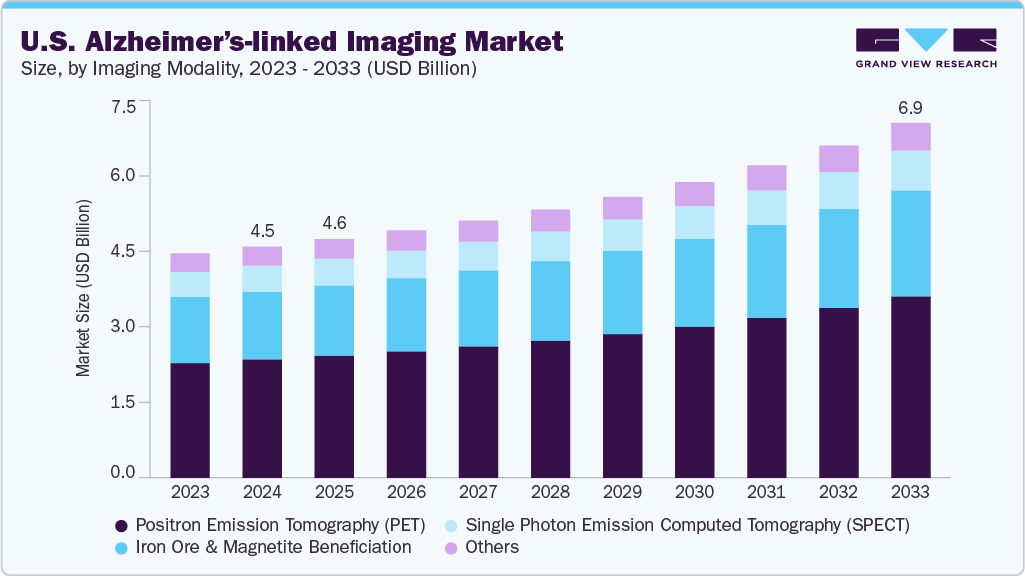
The U.S. Alzheimer’s-linked imaging market size was estimated at USD 4.49 billion in 2024 and is projected to reach USD 6.90 billion by 2033, growing at a CAGR of 5.1% from 2025 to 2033. Market growth is mainly driven by the rising number of Alzheimer’s cases across the country. According to the National Library of Medicine (NLH) (2024), around 6.9 million Americans aged 65 and older are currently living with Alzheimer’s dementia, and this number could reach 13.8 million by 2060 if no breakthrough occurs. Alzheimer’s is now the fifth-leading cause of death among older adults in the U.S., highlighting its growing public health impact.
 Source: Grand View Research, IR Documents, Primary Interviews, Paid DatabasesTo learn more about this report,
 Download Free Sample Report
As the prevalence of the disease increases, demand for early diagnosis and continuous monitoring is rising. This is creating strong opportunities for investment and innovation in Alzheimer’s-related imaging technologies and services. Government and public health agencies are also supporting this trend. For instance, the Centers for Disease Control and Prevention’s (CDC) Alzheimer’s disease Program promotes awareness, early detection, and diagnostic readiness. Together, these initiatives are helping expand diagnostic infrastructure, improve access to imaging services, and encourage technological advancements in brain-disease imaging across the U.S.
Furthermore, a study by Rush University highlighted significant regional differences in Alzheimer’s disease prevalence across the U.S., with the highest rates observed in states such as Florida and Maryland. These county-level variations are influenced by factors such as population age distribution, socioeconomic conditions, healthcare accessibility, and lifestyle habits.
Top U.S. Regions for Alzheimer’s Prevalence in Older Adults (2023)
Rank
County
State
Prevalence (%)
1
Miami-Dade County
Florida
16.6
2
Baltimore County
Maryland
16.6
3
Bronx County
New York
16.6
4
Prince George’s County
Maryland
16.1
5
Hinds County
Mississippi
15.5
6
Orleans Parish
Louisiana
15.4
7
Dougherty County
Georgia
15.3
8
Orangeburg County
South Carolina
15.2
9
Imperial County
California
15.0
10
El Paso County
Texas
15.0
Technological advancements continue to drive the growth of the U.S. Alzheimer’s-linked imaging industry. Currently used techniques, such as magnetic resonance imaging (MRI), positron emission tomography (PET), and single-photon emission computed tomography (SPECT), are essential methods for the diagnosis and monitoring of Alzheimer’s disease. MRI provides excellent anatomical imaging, PET allows visualization and quantification of amyloid-β plaques and tau tangles, and SPECT assesses cerebral blood flow and deficits in brain function. These techniques are routinely used to plan diagnosis and treatment in hospitals and outpatient imaging centers throughout the U.S.
AI-assisted diagnostics are transforming the U.S. Alzheimer’s-linked imaging market. For instance, Mayo Clinic’s StateViewer AI can detect nine types of dementia, including Alzheimer’s, from a single fluorodeoxyglucose positron emission tomography (FDG-PET) scan. By enhancing accuracy and reducing interpretation time, AI expands access to advanced diagnostics and boosts confidence in early, precise detection across clinical settings.
Furthermore, strong governmental support and strategic planning exist within the market. For instance, the National Institute on Aging (NIA), part of the U.S. Department of Health and Human Services, oversees all federal activities aimed at addressing Alzheimer's disease (AD) and related dementias. The National Alzheimer's Project Act (NAPA) established the National Plan to Address Alzheimer's Disease, which aims to accelerate research, treatment, and support patients, families, and caregivers on various related topics. The plan's primary focus is on improving early detection, enhancing patient care and the caregiver experience, expanding effective care models, and advancing research in diagnosis and treatment. These initiatives reflect the U.S. government’s commitment to strengthening Alzheimer’s care infrastructure and research capacity, fostering wider adoption of advanced diagnostic and imaging technologies, and supporting growth in the Alzheimer’s-linked imaging market.
Market Concentration & Characteristics
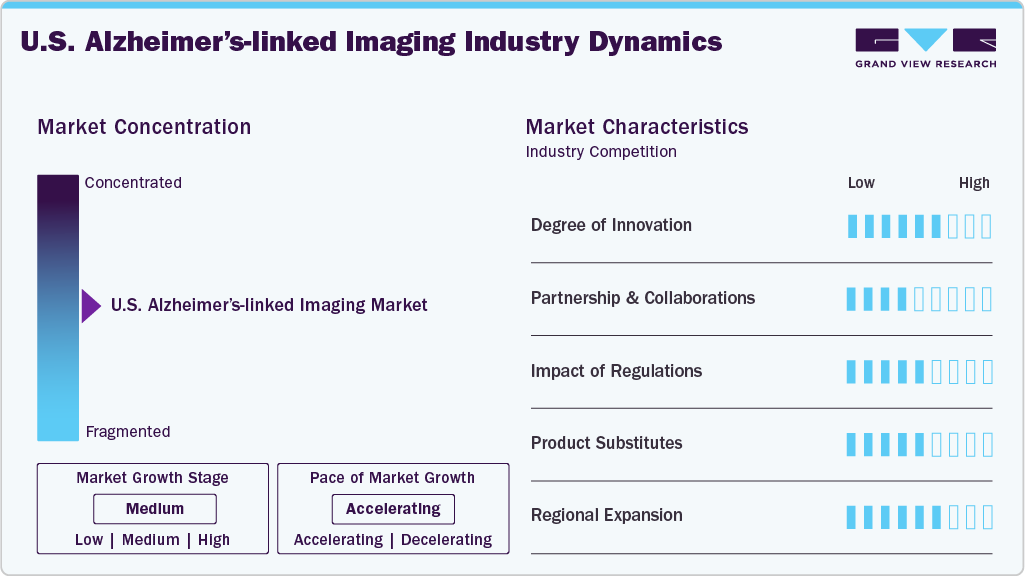
The U.S. Alzheimer’s-linked imaging market is moderately concentrated, with GE Healthcare and Siemens Healthineers holding a significant market share. These competitors offer state-of-the-art imaging technologies, such as PET and MRI, as well as AI-assisted diagnostic solutions, which lead to increased accuracy, detection, and workflow efficiency. The market is continuously being transformed by technological innovations, primarily driven by the integration of AI and multimodal imaging. Besides that, the increasing occurrence of Alzheimer's disease among the elderly population of the U.S. is the main reason for the demand for early and accurate diagnosis, which is leading to market growth and attracting new entrants with innovative diagnostic solutions.
The Alzheimer’s-linked imaging market in the U.S. is undergoing major innovations and advancements. In January 2025, the Alzheimer’s Association and Society of Nuclear Medicine and Molecular Imaging released updated Appropriate Use Criteria (AUC) for amyloid and tau PET imaging. These guidelines incorporate the latest technological advances and define 17 clinical scenarios to guide the use of these gold-standard imaging tests, marking a meaningful step in innovation and standardization in Alzheimer’s diagnostics. This innovation may be well-placed to provide state-of-the-art diagnostic support to clinics that lack the expertise or specialty in neurology, thereby improving the early and accurate diagnosis of dementia.
 To learn more about this report, Download Free Sample Report
Partnerships and collaborations are significant in improving access to emerging technologies and enhancing diagnostic accuracy in Alzheimer's imaging. For instance, in November 2024, Philips collaborated with Icometrix on integrating Icometrix's FDA-cleared quantitative brain solution into Philips' next-generation BlueSeal MR scanners. These scanners enable more accurate measurement of neurological diseases, such as Alzheimer's disease and multiple sclerosis, through AI-powered imaging solutions. Integration enhances workflows, builds diagnostic confidence, and facilitates individualized patient treatment planning, especially in areas with limited access to neurology expertise.
The Alzheimer’s-linked imaging industry in the U.S. is strictly regulated to ensure the safety, efficacy, and reliability of diagnostic devices. In the U.S., the U.S. Food and Drug Administration (FDA) regulates medical imaging devices used for diagnosing Alzheimer's disease, such as PET and MRI scans. Manufacturers must comply with the device classification, premarket notification (510(k)), and labeling requirements for diagnostic imaging devices to ensure that these devices continue to perform safely and effectively.
Blood-based Biomarkers (BBM) serve as a substitute for Alzheimer's-linked imaging. A new study of middle-aged adults reveals that changes in blood-based biomarkers, such as amyloid-beta and tau proteins, are correlated with early brain and intergenerational risk markers for neurodegenerative diseases. This suggests that blood tests could serve as accessible substitutes or complements to imaging tools in identifying individuals at risk for Alzheimer’s disease.
Imaging Modality Insights
The Positron Emission Tomography (PET) segment had the largest market share of 51.16% in 2024. The segment's expansion is mainly due to its capability to locate disease-causing proteins like amyloid and tau, thereby providing easy-to-understand diagnostic information that helps in the early and accurate detection and the progression of Alzheimer's disease. The segment's market share and dominance are further increased by the growing support of payers and the changes in clinical practice guidelines. For instance, in October 2023, a study by the American Medical Association, conducted to assess the condition of Medicare beneficiaries with mild cognitive impairment or dementia, reported that those who went through amyloid PET imaging experienced a 4.49% relative decrease in hospital admissions within 12 months. Moreover, changes in Medicare policies and wide-ranging accessibility have also contributed to PET's stronghold in the market. Furthermore, in October 2023, CMS removed the lifetime restriction of only one scan for beta-amyloid PET scans, thereby allowing for more extensive reimbursement and increased access. With this policy change, PET can be used more flexibly for the diagnosis, treatment, and follow-up of Alzheimer's disease.
The Magnetic Resonance Imaging (MRI) segment is growing at a CAGR of 5.25% over the forecast period, driven by its ability to provide high-resolution, non-invasive structural brain imaging ideal for detecting atrophy and neurodegenerative changes in Alzheimer’s disease. MRI serves as the primary neuroimaging method for dementia assessment in the U.S. because it is widely accessible, cost-effective, and free from ionizing radiation, making it a safer and more practical choice compared to PET scans. As detection of the disease at an early stage and treatment become more feasible, doctors are using more MRI scans to spot slight changes in the brain and to monitor the disease. In August 2025, the U.S. FDA supported the value of MRI by recommending that patients with Alzheimer’s disease who are on Leqembi (lecanemab) undergo MRI screening at an earlier stage to detect amyloid-related imaging abnormalities (ARIA-E), thereby ensuring patient safety. This regulatory change highlights MRI as both a diagnostic tool and a means for treatment monitoring. Consequently, the increased clinical use of MRI, combined with the healthcare sector's focus on early and cost-effective imaging, is making MRI the dominant technology for Alzheimer’s-linked imaging.
End Use Insights
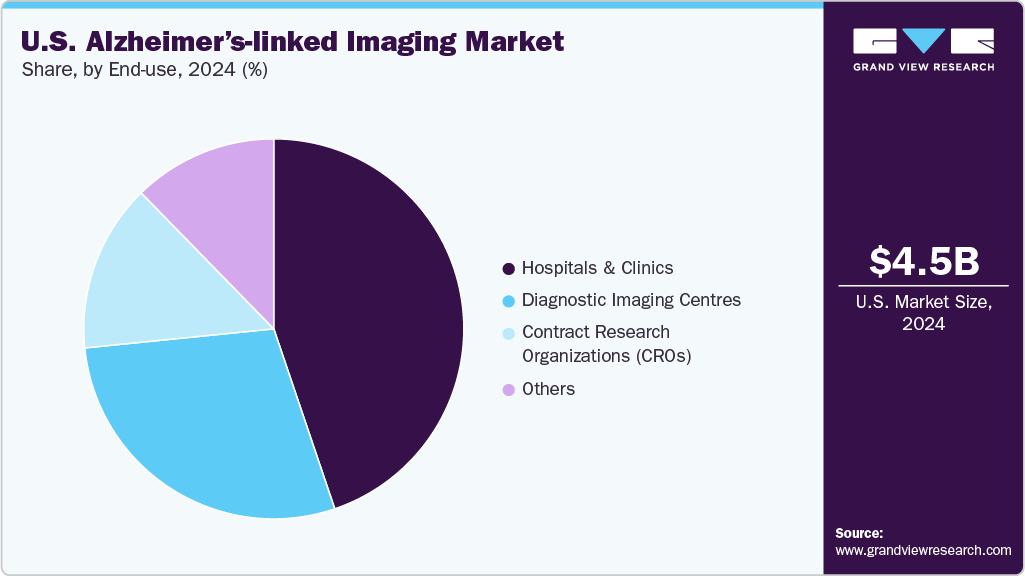
The hospitals and clinics segment is expected to account for the largest share, 44.80%, of the U.S. Alzheimer’s-linked imaging market in 2024. This growth is primarily driven by the increasing prevalence of Alzheimer's disease, which now affects close to 7 million Americans and has led to greater demand for in-house imaging services such as PET, SPECT, CT, and MRI to enable accurate diagnosis, disease staging, and treatment planning. Moreover, data from 2020 to 2022 reveal that elderly individuals with Alzheimer’s who have been to an emergency department are more likely to be admitted to a hospital than those without the disease, 37.2% versus 28.6%, thus generating a continuous demand for imaging services in inpatient and follow-up care. The consistent patient inflow, along with the rising investments in state-of-the-art imaging equipment and biomarker-based diagnostics, are some of the factors that propel hospitals and clinics to the next level in terms of diagnostic infrastructure.
 To learn more about this report, Download Free Sample Report
The diagnostic imaging centers segment is expected to grow significantly at a CAGR of 5.67% during the forecast period, driven by the rising demand for brain scans, such as MRI and PET, used in the detection and monitoring of Alzheimer's disease. The increase in Alzheimer's diagnostics and the growth of the imaging market are driving the rise of new PET/MRI investments and service expansion across the US. Most imaging centers are now functioning close to or at full capacity, thus highlighting their essential role in the timely provision of diagnostic services that are accessible to the public. For instance, in April 2025, a Southbury, Connecticut imaging facility, after reporting a 120% utilization of its existing scanner, sought approval for the installation of a second MRI unit, worth USD 1.7 million. This trend highlights how diagnostic imaging centers are becoming the primary sites for early, accurate, and convenient Alzheimer's assessment, as they offer more flexibility, quicker scheduling, and the potential for specialized diagnostics.
Key U.S. Alzheimer’s-linked Imaging Company Insights
The U.S. Alzheimer-linked imaging industry is highly competitive and has several key players. The major market players are focused on expanding their geographical presence, forming partnerships to enhance imaging services and patient care, leveraging key cooperation activities, and exploring mergers and acquisitions.
Key U.S. Alzheimer’s-linked Imaging Companies:
- GE Healthcare
- Siemens Healthineers AG
- Life Molecular Imaging (LMI)
- Eli Lilly and Company
- SOFIE Biosciences
- Lantheus Holdings, Inc.
- Jubilant Radiopharma
- Brainreader A/S/ Neuroreader
- Koninklijke Philips N.V.
- Alzevita
Prism AI by Grand View Research Free to tryAsk a question about the U.S. Alzheimer’s-linked imaging marketTry asking✓Every figure cited from GVR research Prefer the report? Download free sample →Recent Development
-
In July 2024, the FDA granted clearance to Positrigo’s NeuroLF, an ultra-compact brain PET system designed for the diagnosis and monitoring of neurological disorders, including Alzheimer’s disease, epilepsy, and Parkinson’s disease.
-
In June 2023, at the annual meeting of the Society of Nuclear Medicine and Molecular Imaging (SNMMI), Siemens Healthineers unveiled the Biograph Vision. X PET/CT scanner. The system delivers a time-of-flight performance of 178 ps, along with advanced digital detector technology, providing sharper lesion detection and improved workflow productivity.
U.S. Alzheimer’s-linked Imaging Market Report Scope
Report Attribute
Details
Market size value in 2025
USD 4.64 billion
Revenue forecast in 2033
USD 6.90 billion
Growth rate
CAGR of 5.1% from 2025 to 2033
Actual period
2021 - 2024
Forecast period
2025 - 2033
Quantitative units
Revenue in USD million/billion and CAGR from 2025 to 2033
Report coverage
Revenue forecast, company ranking, competitive landscape, growth factors, and trends
Segments covered
Imaging modality, end use
Key companies profiled
GE Healthcare; Siemens Healthineers AG; Life Molecular Imaging (LMI); Eli Lilly and Company; SOFIE Biosciences; Lantheus Holdings, Inc.; Jubilant Radiopharma; Brainreader A/S/ Neuroreader; Koninklijke Philips N.V.; Alzevita
Customization scope
Free report customization (equivalent up to 8 analysts working days) with purchase. Addition or alteration to country, regional & segment scope
Pricing and purchase options
Avail customized purchase options to meet your exact research needs. Explore purchase options
U.S. Alzheimer’s-linked Imaging Market Report Segmentation
This report forecasts revenue growth at the country level and analyzes the latest industry trends in each sub-segment from 2021 to 2033. For this study, Grand View Research has segmented the U.S. Alzheimer’s-linked imaging market report based on imaging modality, and end use:
-
Imaging Modality Outlook (Revenue, USD Million, 2021 - 2033)
-
Positron Emission Tomography
-
Amyloid Positron Emission Tomography
-
Tau Positron Emission Tomography
-
FDG- Positron Emission Tomography
-
-
Magnetic Resonance Imaging
-
Structural Magnetic Resonance Imaging
-
Advanced Magnetic Resonance Imaging
-
-
Single Photon Emission Computed Tomography
-
Others
-
-
End Use Outlook (Revenue, USD Million, 2021 - 2033)
-
Hospitals & Clinics
-
Diagnostic Imaging Centers
-
Contract Research Organizations (CROs)
-
Others
-
About the Author(s)
Medical Devices Research Team
Healthcare · Medical DevicesThis report was authored by the medical devices research team at Grand View Research - comprising two research analysts, one senior research analyst, and one industry expert - with specialized expertise in the medical devices segment of the healthcare industry. All findings are based on proprietary healthcare databases, executive interviews, and regulatory analysis, subject to internal peer review prior to publication.
Last Updated:
Speak to Analyst

Customize this report to your needs - add regions, segments, or data points, with 20% free customization.
Or view our licence options:


ISO 9001:2015 & 27001:2022 Certified
We are GDPR and CCPA compliant! Your transaction & personal information is safe and secure. For more details, please read our privacy policy.


