
- Home
- »
- Consumer F&B
- »
-
U.S. Bagel Market Size, Share And Trends Report, 2033GVR Report cover

U.S. Bagel Market (2026 - 2033)
Size, Share & Trends Analysis Report By Product (Plain Bagel, Flavored Bagel, Protein Bagel, Whole Wheat Bagel, Egg Bagel, Gluten-free Bagel), By Distribution Channel (Foodservice, Retail), And Segment Forecasts
Market Size, 2025
$3.2BMarket Estimate, 2026
$3.3BMarket Forecast, 2033
$4.5BCAGR, 2026–2033
4.6%U.S. Bagel Market Summary
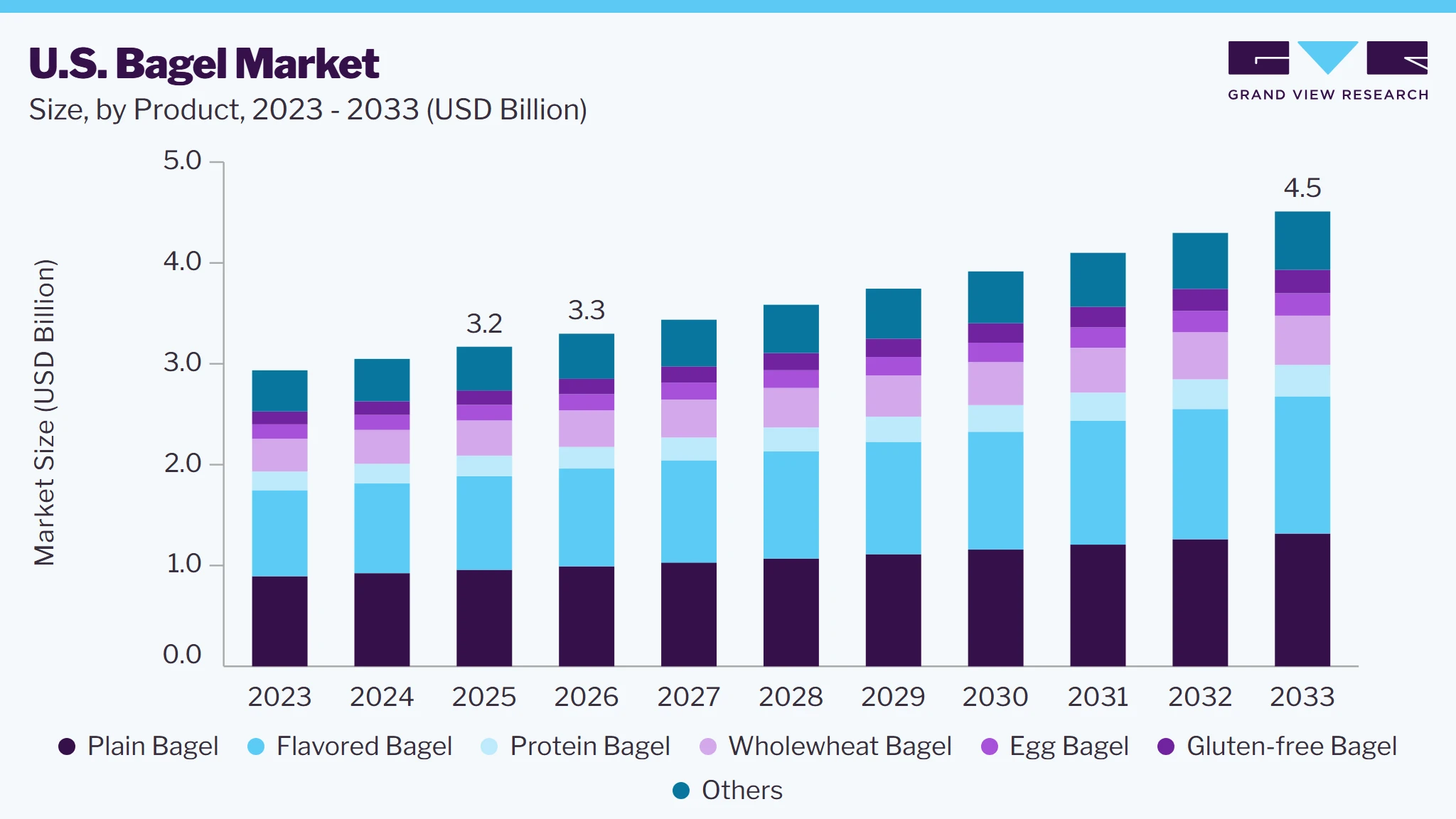
The U.S. bagel market size was valued at USD 3.2 billion in 2025 and is projected to grow from USD 3.3 billion in 2026 to USD 4.5 billion by 2033, at a CAGR of 4.6% from 2026 to 2033. The U.S. bagel industry is supported by the established role of the bagel as a convenient breakfast and meal option in the U.S., while changing consumption occasions, nutritional positioning, product variety, and expanding retail accessibility are creating additional growth opportunities. Within the product landscape, plain bagels accounted for the largest share of the market in 2025, while gluten-free and protein bagels are among the fastest-growing product segments. On the distribution side, retail accounted for the largest share in 2025, while online sales are projected to register the fastest growth through 2033.
Key Market Trends & Insights
- By product: Plain bagel led the market, accounting for 30.2% of revenue in 2025.
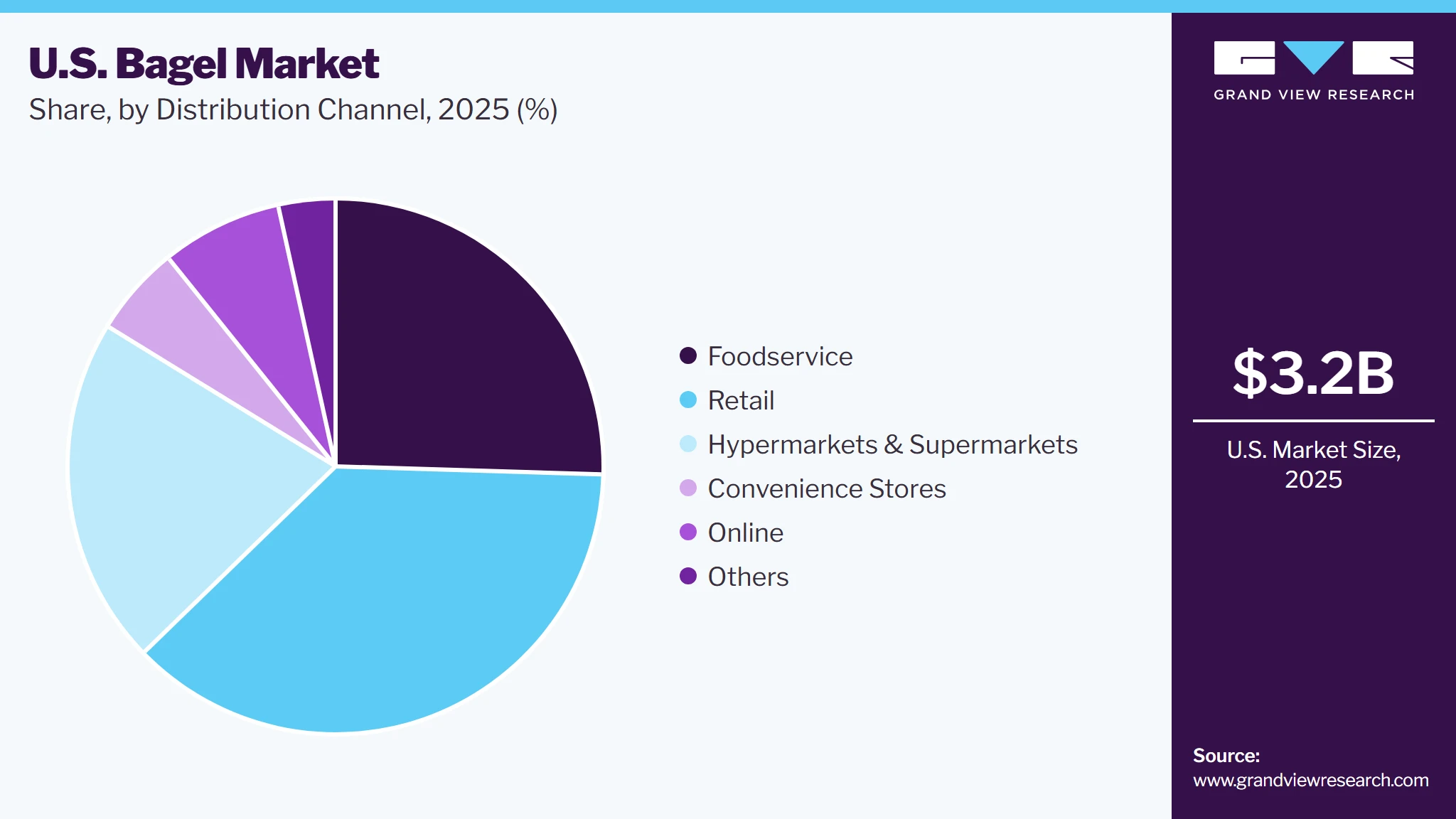
- By distribution channel: Retail led the market, accounting for 59.4% of revenue in 2025.
Market Size & Forecast
- Market Size in 2025: USD 3.2 Billion
- Estimated Market Size in 2026: USD 3.3 Billion
- Projected Market Size by 2033: USD 4.5 Billion
- CAGR (2026-2033): 4.6%
Three ways to get this report
Buy it, customize it, or ask a question.Ask an Analyst
A direct answer, usually in 1 working day
- AccessReport author, directly
- Reply timeWithin 1 working day
- No sales callDirect answer only
- FormatEmail reply
- CostFree, no cost
Get the Full Report
What the study covers
- FormatsPDF · Excel · Dashboard
- Timeline2026–2033 annual, 2025 base
- Coverage20+ countries, 5 regions
- Companies10+ key players profiled
Customize the Report
20% free customization
- IncludeCountries, segments, points
- TailorTo your product definition
- ExtendDeeper competitor detail
- OrA fully bespoke study
- Turnaround5–10 working days
The U.S. bagel market continues to benefit from the product's strong integration into American eating habits and its versatility across different consumption occasions. Although bagels have traditionally been associated with breakfast, their role is expanding across other meal and snack occasions. According to a nationwide survey of 1,000 U.S. adults released in January 2026, 52% of respondents reported eating a bagel at any time of day. This indicates that bagels are increasingly moving beyond their traditional breakfast positioning, creating additional consumption occasions throughout the day.
 Source: Grand View Research, IR Documents, Primary Interviews, Paid DatabasesTo learn more about this report,
 Download Free Sample Report
 Convenience and adaptability are strengthening the role of the bagel within the U.S. bakery market. Their compact format makes them suitable for at-home preparation, takeaway meals, and on-the-go consumption, while their ability to accommodate spreads, proteins, vegetables, and other fillings enables use across a wide variety of meal formats. This flexibility allows bagel to compete not only with conventional breakfast bakery products but also with sandwiches and other convenient meal solutions. The combination of portability, customization, and ease of preparation, therefore, supports their relevance across different consumer lifestyles.
The U.S. bagel industry also benefits from the coexistence of packaged retail products and freshly prepared foodservice offerings. Packaged bagel support planned household purchases and at-home consumption, while bagel shops, bakery cafés, coffee shops, and other foodservice establishments provide freshly prepared products and bagel-based meals. This combination enables the category to address both routine grocery purchasing and immediate-consumption occasions, broadening how consumers interact with bagels across the U.S. market.
Market Dynamics
Increasing consumer interest in protein-rich breakfast options is spurring the development of nutritionally enhanced bagels in the U.S. Bagels offer manufacturers a familiar, convenient format for incorporating additional protein and other nutritional attributes. In April 2025, Thomas' introduced the High Protein Bagel, containing 20 grams of protein per bagel in Plain and Everything varieties. The company also reported that 64% of surveyed breakfast eaters believe a better-for-you breakfast should be high in protein. The introduction of protein-enriched options allows the category to appeal to consumers seeking greater nutritional value in familiar breakfast foods. This trend is expected to support continued growth and product differentiation within the U.S. bagel market.
Growing attention to sodium intake presents a challenge for conventional bagel and other commercially prepared bakery products. The U.S. Food and Drug Administration states that average sodium intake in the U.S. remains almost 50% above the recommended limit, with more than 70% of sodium intake coming from sodium added during food manufacturing and commercial food preparation. Importantly for the bagel category, the FDA's 2022 food-supply assessment reported a sales-weighted mean sodium concentration of 427 mg per 100 grams for packaged bagels and soft pretzels. Consumers seeking to control sodium intake may therefore pay greater attention to nutrition labels and serving sizes when purchasing bakery products. This can create reformulation challenges for manufacturers, as sodium also contributes to flavor, texture, preservation, and other technical functions in baked foods.
There is an opportunity for U.S. bagel manufacturers to develop products with improved nutritional profiles while maintaining the taste and texture expected from a traditional bagel. Sodium reduction represents a particularly relevant area for formulation innovation. In its Phase II draft sodium-reduction guidance, the FDA established a proposed sales-weighted mean target of 350 mg sodium per 100 grams for packaged bagels and soft pretzels, compared with a 2022 baseline of 427 mg per 100 grams. The FDA also notes that gradual sodium reduction can allow consumer tastes to adjust and that existing technical strategies can support reductions across food categories. Manufacturers that combine lower-sodium formulations with attributes such as protein enrichment, whole grains, and appropriate portion sizes can potentially address evolving nutritional expectations while differentiating their products in the U.S. bagel market.
Analyst Perspective
The U.S. bagel market is expected to maintain steady expansion as the category evolves from a predominantly breakfast-oriented bakery product into a more versatile meal and snacking format. A key characteristic of the market is the coexistence of large-scale packaged bakery products with freshly prepared offerings from bagel shops, bakery cafés, and foodservice operators. This creates opportunities across both planned household consumption and immediate meal occasions. In the future, market development is likely to depend on manufacturers' ability to preserve the familiarity and convenience associated with traditional bagels while adapting products to changing nutritional expectations and consumption patterns. The increasing crossover between packaged bakery, convenient meals, and specialty bagel offerings is expected to shape the market's longer-term development.
Product Insights
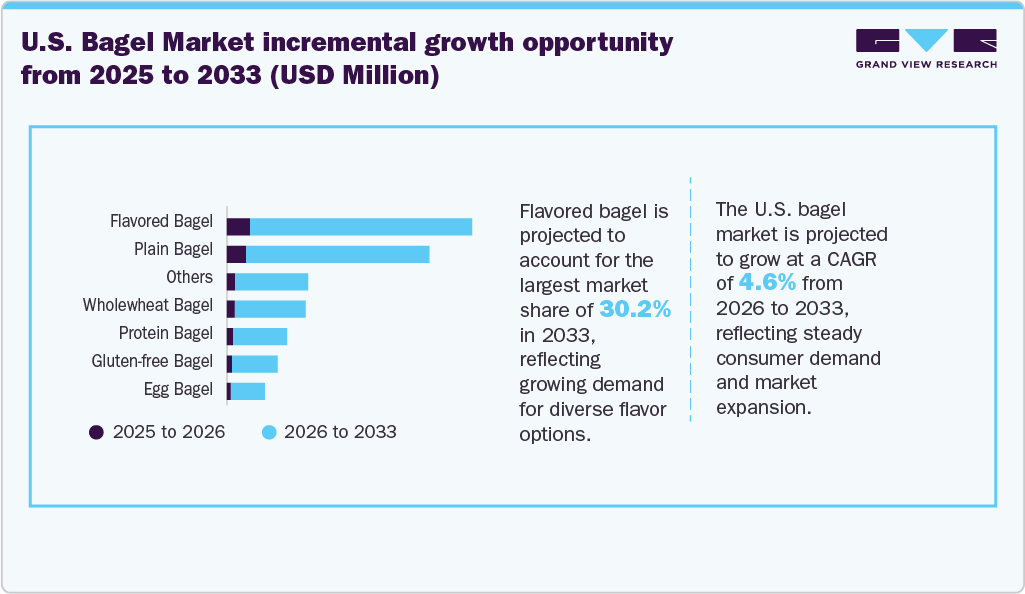
The plain bagel segment dominated the U.S. bagel industry, accounting for a revenue share of 30.2% o in 2025. Plain bagels maintain a broad appeal due to their familiar taste and ability to accommodate a wide variety of toppings, spreads, and fillings. Unlike more distinctly flavored varieties, their neutral profile makes them a flexible base for both sweet and savory preparations, supporting consumption at breakfast, as snacks, and for light meals. The segment also benefits from availability across multiple formats, ranging from packaged multipacks for household consumption to freshly baked offerings through bakeries and foodservice establishments. This versatility, familiarity, and broad availability continue to support plain bagels as the largest product segment in the U.S. market.
 To learn more about this report, Download Free Sample Report
 The gluten-free bagel segment is projected to grow at the fastest CAGR of 6.3% from 2026 to 2033. Growth is supported by demand for bakery alternatives suitable for consumers who avoid gluten, along with the expanding availability of specialized formulations within mainstream food channels. The U.S. FDA estimates that approximately 3 million Americans have celiac disease and has established a standardized federal definition for foods carrying a gluten-free claim. Under FDA requirements, foods labeled “gluten-free” must meet specified criteria, including having any unavoidable presence of gluten below 20 parts per million (ppm). This established labeling framework provides consumers with greater consistency when identifying suitable products and supports manufacturers in developing clearly positioned gluten-free bakery offerings.
Distribution Channel Insights
The retail channel dominated the U.S. bagel market, accounting for a revenue share of 59.4% in 2025. Retail benefits from the widespread availability of packaged and fresh bagels for at-home consumption. Grocery stores provide consumers with access to multiple bagel varieties, pack sizes, brands, and nutritional propositions during routine shopping trips. The American Bakers Association's 2025 bagel consumer research found that 60% of consumers purchase most of their bagels from grocery stores, reinforcing the importance of grocery retail in the U.S. bagel purchasing landscape. Convenient availability and the ability to purchase a bagel for multiple occasions continue to support the channel.
 To learn more about this report, Download Free Sample Report
 The online channel is projected to grow at the fastest CAGR of 6.2% from 2026 to 2033. Online distribution provides consumers with convenient access to packaged bagels without requiring visits to physical stores and enables comparison across brands, varieties, pack sizes, and nutritional attributes. Digital grocery platforms and retailer-operated e-commerce services have expanded the ways consumers can purchase bakery products for home delivery or pickup. The channel also provides greater convenience for repeat purchases and planned grocery shopping. Continued integration of online ordering, delivery, and pickup services in U.S. grocery retail is expected to enhance access to the bagel products through digital channels.
Key Companies & Market Share Insights
The U.S. bagel industry is characterized by the presence of large packaged bakery manufacturers, bakery-café operators, specialty bagel chains, retailers, and regional bakery companies. Companies compete through product quality, freshness, flavor variety, convenience, brand recognition, and availability across retail and foodservice channels. Established packaged bakery companies benefit from extensive retail distribution, while bakery-café and specialty bagel operators cater to demand for freshly prepared bagels and bagel-based meals.
Product and menu innovation remain important strategies in the market. Companies are expanding traditional bagel offerings through new flavors, nutritional positioning, convenient formats, and bagel-based sandwiches suitable for different eating occasions. Broader distribution and continued product differentiation are expected to support competition and strengthen consumer engagement across the U.S. bagel market.
 To learn more about this report, Download Free Sample Report
 Key U.S. Bagel Companies
-
Grupo Bimbo
-
Flowers Foods
-
Panera Bread
-
Bruegger's Bagel
-
Conagra, Inc.
-
United States Bakery
-
H&H Bagel, LLC
-
Barry Bagel
-
Jeff's Bagel Run
-
Neomonde Baking Company
Competitive Benchmarking
Category
Operating Strategies
Competitive Edge
Weakness
Established Players (Grupo Bimbo; Flowers Foods; Panera Bread; Bruegger's Bagel; Trader Joe's; United States Bakery)
- Expand bagel varieties and formats, leverage established retail/foodservice networks, introduce differentiated offerings, and strengthen omnichannel availability.
- Strong brand recognition, broad distribution, established customer base, and greater resources for product development and marketing.
- Large operating structures and mature product portfolios can reduce agility, while intense competition creates pressure on pricing and differentiation.
Emerging & Regional Players (H&H Bagel, LLC; Barry Bagel; Jeff's Bagel Run; Neomonde Baking Company)
- Focus on fresh and differentiated bagels, regional expansion, store/network growth, localized offerings, and distinctive customer experiences.
- Strong regional identity, specialization in bagels, product freshness, customer loyalty, and greater flexibility in responding to local preferences.
- Smaller geographic footprint, lower production scale, limited distribution reach, and comparatively lower marketing resources than established players.
Recent Developments
-
In January 2025, Panera Bread launched Asiago Bagel Stacks in three varieties-Chicken Roma, Spicy Steak, and Zesty Tuscan-across participating U.S. cafés. The launch marked the first time Panera specifically developed a lunch sandwich around one of its bagels, extending the bagel format beyond its traditional breakfast occasion.
-
In April 2024, Flowers Foods expanded its Wonder brand into the bagel category with the launch of Wonder Bagel in Classic, Everything, and Blueberry varieties. The introduction broadened the Wonder portfolio into bagels and provided consumers with multiple traditional and flavored options.
U.S. Bagel Market Report Scope
Report Attribute
Details
Market size in 2025
USD 3.2 billion
Estimated market size in 2026
USD 3.3 billion
Projected market size by 2033
USD 4.5 billion
Growth rate
CAGR of 4.6% from 2026 to 2033
Actuals
2021 - 2025
Forecast period
2026 - 2033
Quantitative units
Revenue in USD million and CAGR from 2026 to 2033
Report coverage
Revenue forecast, company ranking, competitive landscape, growth factors, and trends
Segments covered
Product, distribution channel
Key companies profiled
Grupo Bimbo; Flowers Foods; Panera Bread; Bruegger's Bagel; Conagra, Inc.; United States Bakery; H&H Bagel, LLC; Barry Bagel; Jeff's Bagel Run; Neomonde Baking Company
Customization scope
Free report customization (equivalent up to 8 analysts’ working days) with purchase. Addition or alteration to country, regional & segment scope.
Pricing and purchase options
Avail customized purchase options to meet your exact research needs. Explore purchase options
U.S. Bagel Market Report Segmentation
This report forecasts revenue growth at the country level and provides an analysis of the latest industry trends and opportunities in each of the sub-segments from 2021-2033. For this study, Grand View Research has segmented the U.S. bagel market report based on product, and distribution channel:
-
Product Outlook (Revenue, USD Million, 2021 - 2033)
-
Plain Bagel
-
Flavored Bagel
-
Protein Bagel
-
Whole Wheat Bagel
-
Egg Bagel
-
Gluten-free Bagel
-
Others
-
-
Distribution Channel Outlook (Revenue, USD Million, 2021 - 2033)
-
Foodservice
-
Retail
-
Hypermarkets & Supermarkets
-
Convenience Stores
-
Online
-
Others
-
-
Research Methodology
The U.S. bagel market figures in this report are based on a proven research process that combines executive interviews with secondary research from proprietary databases, company filings, and recognized regulatory and institutional sources. Market size is built through value-chain sizing - reconciling supply-side and demand-side estimates - and triangulated with bottom-up and top-down approaches. Every estimate passes multiple levels of expert validation before publication, with each U.S. bagel segment quantified using the revenue-capture definitions in the table below.
Segment Definition
Segment - Distribution Channel
Revenue Capture Definition
Foodservice
Revenue from bagels sold as prepared food through bagel shops, bakery cafés, coffee shops, restaurants, QSRs, institutional foodservice, and similar outlets. Covers individual bagel, bagel with spreads or toppings, and bagel-based sandwiches or meals intended for immediate consumption.
Retail
Revenue from bagels sold as retail products for at-home or later consumption through supermarkets & hypermarkets, convenience stores, online channels, and other retail outlets. Covers packaged, fresh, refrigerated, and frozen bagels sold under branded or private-label offerings.
Hypermarkets & Supermarkets
Revenue from packaged, fresh, refrigerated, and frozen bagels purchased through supermarkets, hypermarkets, supercenters, and large-format grocery stores, including products sold through packaged bakery aisles and in-store bakery sections.
Convenience Stores
Revenue from bagels purchased through convenience stores, gas-station convenience outlets, and similar small-format retailers, including packaged, single-serve, multipack, and applicable grab-and-go bagels.
Online
Revenue from retail bagel purchases made through online grocery platforms, retailer websites and apps, marketplaces, and direct-to-consumer channels for home delivery or store pickup. Prepared bagel meals ordered from foodservice establishments are captured under foodservice.
Others
Revenue from retail bagel sales through channels not separately classified above, including independent grocery stores, specialty food stores, warehouse clubs, natural/health-food stores, and other applicable retail formats.
Estimation Model
Step Number
Layer
Guiding Question
Description
01
Consumption Profile Layer
Who consumes Bagel?
Captures consumers across age groups, household types, lifestyle, and dietary preferences, while assessing bagel consumption across breakfast, snacking, lunch, and other meal occasions.
02
Market Reach Layer
Where and how do consumers access Bagel?
Covers bagel availability across supermarkets, convenience stores, bagel shops, bakery cafés, foodservice outlets, and online channels, highlighting differences between at‑home purchases and freshly prepared consumption.
03
Purchase & Retention Layer
What drives trial, repeat purchase, and brand switching?
Examines factors such as taste, freshness, texture, flavor variety, price, convenience, nutritional attributes, promotions, and brand familiarity that influence bagel selection, repeat purchases, and switching behavior.
04
Value Generation Layer
How is value created across the Bagel market?
Assesses value creation through premium offerings, specialty flavors, nutritional differentiation, convenient formats, bagel‑based meals, multipacks, private‑label products, and differentiated brand positioning.
Delivered Customizations
This report has been delivered with the following In-depth customizations
Client Request
Customization Delivered
Value Adds
U.S. Bagel Consumer & Consumption Occasion Assessment
Assessed consumer profiles, consumption frequency, breakfast versus all-day usage, purchase drivers, and at-home versus on-the-go consumption patterns.
Identifies high-potential consumer groups and opportunities to expand bagel consumption across different eating occasions.
U.S. Bagel Pricing & Competitive Benchmarking
Benchmarked key bagel companies and brands across pricing, product assortment, pack sizes, positioning, distribution presence, and product innovation.
Supports pricing decisions, competitive positioning, and identification of portfolio gaps and differentiation opportunities.
U.S. Bagel Flavor & Ingredient Assessment
Assessed demand for traditional and emerging flavors, grains, seeds, toppings, inclusions, and ingredients, along with attributes such as high-protein, whole-grain, gluten-free, and clean-label positioning.
Identifies flavor and ingredient opportunities for product innovation, differentiation, and development of offerings aligned with evolving consumer preferences.
Frequently Asked Questions About This Report
The U.S. bagel market is expected to grow at a CAGR of 4.6% from 2026 to 2033, reaching USD 4.5 billion by 2033.
The U.S. bagel industry is supported by the established role of the bagel as a convenient breakfast and meal option in the U.S., while changing consumption occasions, nutritional positioning, product variety, and expanding retail accessibility are creating additional growth opportunities.
By distribution channel, retail led the market, accounting for 59.4% of revenue in 2025.
U.S. bagel market size was valued at USD 3.2 billion in 2025 and is projected to grow from USD 3.3 billion in 2026
By product, plain bagels led the market, accounting for 30.2% of revenue in 2025
The Key players involved in the U.S. Bagel market are Grupo Bimbo, Flowers Foods, Panera Bread, Bruegger's Bagels, Conagra, Inc., United States Bakery, H&H Bagels, LLC, Barry Bagels, Jeff's Bagel Run, Neomonde Baking Company.
About the Author(s)
Consumer F&B Research Team
Consumer Goods · Consumer F&BThis report was authored by the consumer f&b research team at Grand View Research - comprising two research analysts, one senior research analyst, and one industry expert - with specialized expertise in the consumer f&b segment of the consumer goods industry. All findings are based on proprietary consumer goods databases, executive interviews, and regulatory analysis, subject to internal peer review prior to publication.
Last Updated:
Speak to Analyst

Customize this report to your needs - add regions, segments, or data points, with 20% free customization.
Or view our licence options:


ISO 9001:2015 & 27001:2022 Certified
We are GDPR and CCPA compliant! Your transaction & personal information is safe and secure. For more details, please read our privacy policy.


