
- Home
- »
- Network Security
- »
-
U.S. Data Diode Market Size And Share Report, 2026-2033GVR Report cover

U.S. Data Diode Market (2026 - 2033)
Size, Share, & Trends Analysis Report By Type (Standard, Ruggedized), By Data Flow (Unidirectional Outbound, Inbound), By Deployment, By Application, By End User, And Segment Forecasts
Market Size, 2025
$187.6MMarket Estimate, 2026
$204.7MMarket Forecast, 2033
$447.8MCAGR, 2026–2033
11.8%U.S. Data Diode Market Summary
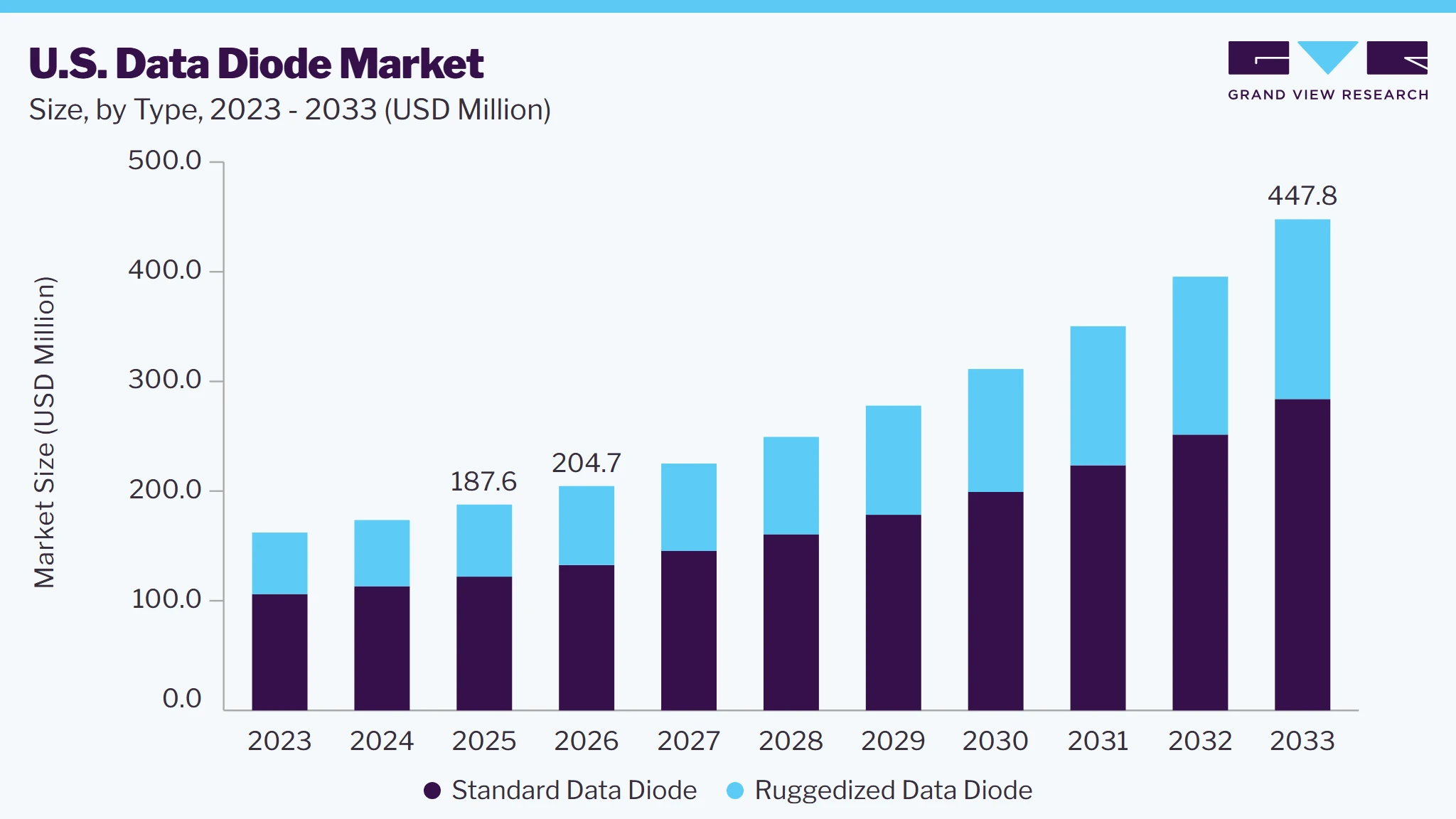
The U.S. data diode market size was valued at USD 187.6 million in 2025 and is projected to grow from USD 204.7 million in 2026 to USD 447.8 million by 2033, at a CAGR of 11.8% from 2026 to 2033. The U.S. market is gaining importance as organizations across critical infrastructure and high-security environments seek to establish physically enforced, unidirectional communication between networks with different trust levels.
Key Market Trends & Insights
- By type: The standard data diode segment dominated the market, with a revenue share of 65.0% in 2025
- By data flow: The unidirectional outbound dominated the market, with a revenue share of 85.1% in 2025
- By deployment: The on-premises segment held the largest market share of 78.9% in 2025
- By application: The network segmentation & isolation segment held the largest market share of 29.3% in 2025
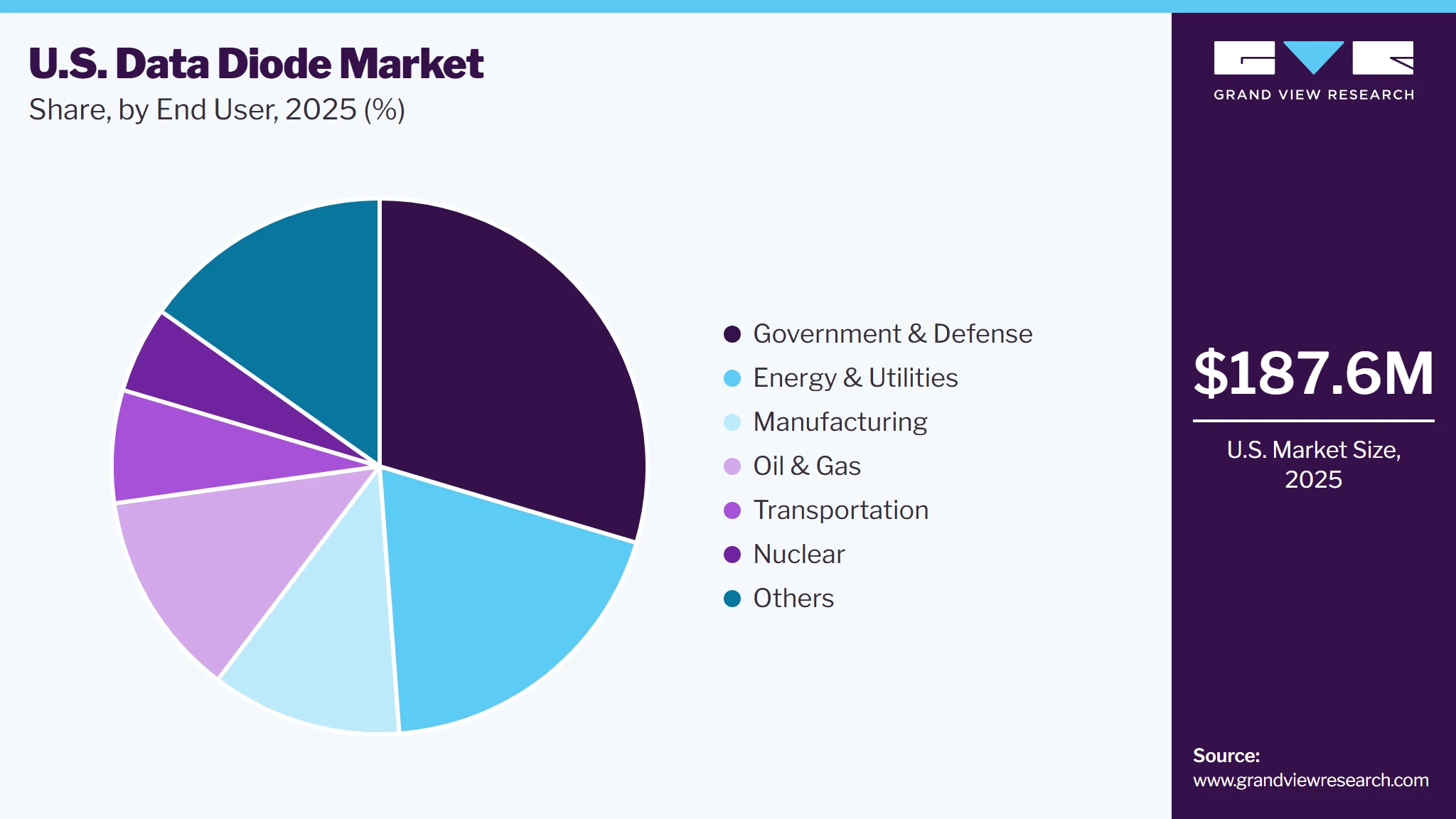
- By end user: The government & defense segment held the largest market share of 29.6% in 2025
Market Size & Forecasts
- Market size in 2025: USD 187.6 Million
- Estimated market size in 2026: USD 204.7 Million
- Projected market size by 2033: USD 447.8 Million
- CAGR (2026-2033): 11.8%
Prism AI by Grand View Research Free to tryAsk a question about the U.S. data diode marketTry asking✓Every figure cited from GVR research Prefer the report? Download free sample →
A data diode enables data to travel in only one direction, providing an additional layer of network isolation for sensitive IT, OT, ICS, SCADA, classified, and air-gapped environments. The U.S. market is particularly relevant across government & defense, energy & utilities, manufacturing, oil & gas, transportation, and nuclear applications, where uninterrupted operations and protection against unauthorized access are critical.Market growth is being supported by increasing IT-OT convergence, industrial digitalization, ransomware risks, and investments in critical infrastructure cybersecurity. As industrial operators increasingly connect OT environments with enterprise networks, cloud platforms, analytics systems, and centralized security operations, the need to transfer operational and monitoring data without creating an inbound pathway into protected environments is increasing. Data diodes address this requirement by enabling secure one-way transfer while maintaining network isolation. U.S. market research also identifies government, aerospace & defense, power, and oil & gas as key opportunity areas, with industrial IoT, digitalization, and regulatory requirements further supporting adoption.
 Source: Grand View Research, IR Documents, Primary Interviews, Paid DatabasesTo learn more about this report,
 Download Free Sample Report
The market is also evolving toward ruggedized, high-throughput, and application-specific data diode solutions. Ruggedized products are particularly relevant for defense, energy, remote industrial facilities, and other harsh operating environments where resistance to temperature variation, vibration, humidity, and other environmental conditions is required.
Market Dynamics
The market is primarily driven by the increasing need to protect critical infrastructure and OT/ICS environments from cyber threats while maintaining operational visibility. U.S. critical infrastructure sectors rely extensively on interconnected OT, ICS, and IT systems, increasing the potential for operational networks to be exposed to cyber incidents. Data diodes provide hardware-enforced one-way communication, allowing organizations to transfer operational data, logs, and monitoring information to enterprise or security environments without creating a return communication path. This is particularly relevant across energy & utilities, manufacturing, government & defense, oil & gas, transportation, and nuclear facilities, where network isolation and continuity of operations are critical. NIST specifically identifies unidirectional gateways/data diodes as a security control for protecting OT environments. At the same time, its electric-utility guidance demonstrates its use for transferring ICS monitoring data into enterprise SIEM environments.
However, high implementation costs, integration requirements, and limitations of one-way communication can hinder adoption in the U.S. Data diode deployments may require changes to network architecture, specialized hardware, protocol adaptation, and integration with existing SCADA, OT monitoring, and security platforms. Technology is also most suitable for use cases where unidirectional communication is sufficient, limiting applicability where continuous bidirectional interaction is required. Nevertheless, increasing IT-OT convergence, industrial digitalization, remote monitoring, and demand for secure transfer of OT data into enterprise and security environments are creating significant opportunities. NIST notes that manufacturers are increasingly connecting OT systems with IT networks to improve operational efficiency, while this connectivity also increases cybersecurity exposure. As U.S. organizations seek to gain visibility into operational environments without directly exposing sensitive control networks, demand for data diodes-particularly ruggedized and high-assurance solutions for critical infrastructure and remote facilities-is expected to increase.
The growing convergence of IT and OT networks across the U.S. critical infrastructure is driving demand for data diodes. Organizations in energy, manufacturing, transportation, and other critical sectors are increasingly connecting operational systems with enterprise, monitoring, and analytics environments, improving visibility but also expanding the potential attack surface. NIST identifies data diodes as a mechanism for enforcing one-way data flows, including transferring ICS monitoring data from operational environments to enterprise security systems while preventing reverse communication.
The deployment of data diodes can involve specialized hardware, network reconfiguration, protocol integration, and technical expertise, increasing implementation and ownership costs compared with conventional network security controls. Moreover, because data diodes are designed to permit data flow in only one direction, they are less suitable for applications requiring interactive or bidirectional communication, thereby limiting adoption to specific high-security and critical-network use cases.
The increasing need to obtain real-time or near-real-time visibility into OT/ICS environments without exposing control networks to inbound connections presents a significant opportunity. U.S. utilities and industrial operators are increasingly seeking mechanisms to transmit operational data to centralized SIEM, monitoring, analytics, and security platforms while maintaining network isolation. This creates opportunities for high-throughput and ruggedized data diodes across energy & utilities, manufacturing, oil & gas, transportation, and other critical infrastructure applications.
Market Concentration & Characteristics
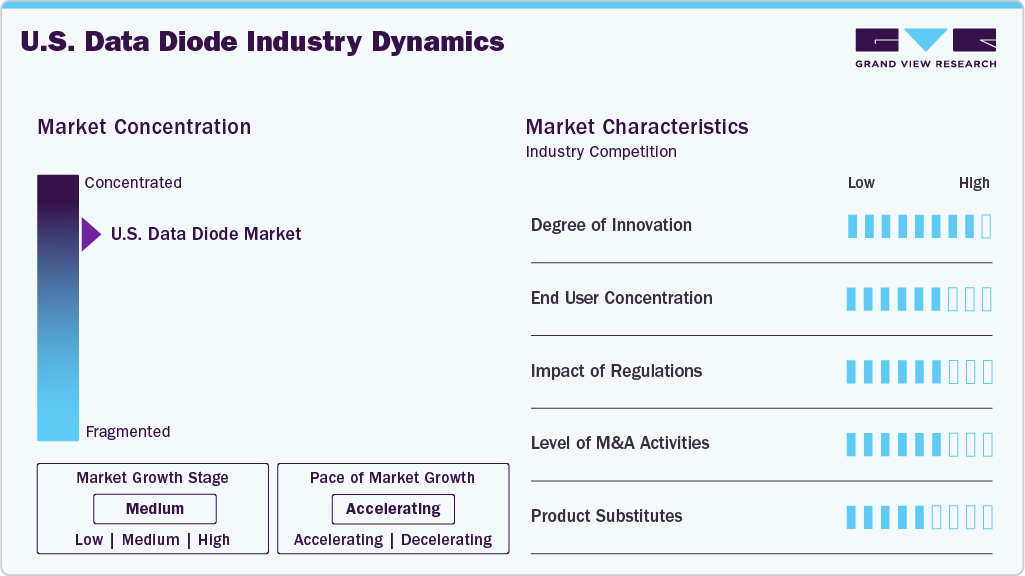
The U.S. data diode industry is moderately concentrated, with a mix of established cybersecurity, defense, industrial technology, and specialized unidirectional security vendors. Key participants include Owl Cyber Defense, OPSWAT, Everfox, Forcepoint, Garland Technology, BAE Systems, Belden, and Waterfall Security Solutions, among others. Leading vendors compete through hardware-enforced unidirectional communication, OT network isolation, secure cross-domain data transfer, and integration with critical infrastructure security architectures. The competitive landscape remains specialized because data diode deployments are concentrated in high-security applications such as government & defense, energy & utilities, manufacturing, oil & gas, transportation, and nuclear environments.
 To learn more about this report, Download Free Sample Report
The U.S. data diode industry is characterized by increasing technological development focused on improving security, throughput, interoperability, reliability, and environmental resilience. Vendors are developing solutions that can support higher data volumes while maintaining strict unidirectional communication and isolation between trusted and untrusted networks. Growing demand for protection against cyberattacks targeting critical infrastructure is encouraging the integration of data diodes with OT monitoring, SIEM, threat detection, network segmentation, and secure data transfer platforms. The market is also witnessing increased adoption of ruggedized solutions designed for harsh industrial, defense, energy, and transportation environments. Furthermore, rising regulatory and cybersecurity requirements for critical infrastructure, coupled with increasing IT-OT convergence and industrial digitization, are encouraging organizations to deploy data diodes as part of defense-in-depth and network isolation strategies.
Analyst Perspective
The U.S. market is transitioning from highly specialized cybersecurity technology toward a more broadly adopted critical-infrastructure and OT network-isolation solution, driven by rising cyber risks in industrial and mission-critical environments. Demand is expected to remain particularly strong across government & defense, energy & utilities, manufacturing, oil & gas, and nuclear applications, where hardware-enforced unidirectional communication provides a high-assurance mechanism for separating sensitive networks while enabling controlled data transfer. The market is also shifting toward ruggedized, high-throughput, and application-specific data diodes, reflecting requirements for harsh operating environments, remote infrastructure, and increasing volumes of OT telemetry.
Type Insights
The standard data diode segment accounts for the largest share of 65.0% in 2025, driven by its broad applicability across conventional IT, OT, ICS, SCADA, government, manufacturing, utilities, and enterprise network environments where extreme environmental protection is not required. Standard data diodes provide hardware-enforced unidirectional communication and secure network isolation at a comparatively lower deployment cost than ruggedized solutions, making them suitable for fixed indoor facilities such as control rooms, data centers, security operations environments, and enterprise network infrastructure. The increasing need to securely transfer operational data, logs, telemetry, and monitoring information from protected networks to IT and security environments is further supporting adoption.
The ruggedized data diode segment is expected to witness a significant CAGR from 2026 to 2033, driven by the increasing deployment of secure network-isolation technologies across defense, energy & utilities, transportation, oil & gas, and industrial control environments operating under harsh or mission-critical conditions. Ruggedized data diodes are designed to withstand temperature fluctuations, vibration, humidity, dust, electromagnetic interference, and other environmental stresses while maintaining hardware-enforced one-way communication, making them suitable for field facilities, substations, remote industrial sites, tactical platforms, and critical infrastructure. In addition, growing U.S. investments in military modernization, critical infrastructure cybersecurity, remote OT monitoring, and industrial digitalization are creating demand for compact, durable, and high-throughput data diode solutions. Recent product developments, such as NSA-listed 10-Gigabit data diode solutions designed for defense, utilities, and industrial automation, also indicate increasing emphasis on higher throughput, rugged hardware, and easier deployment.
Data Flow Insights
The unidirectional outbound segment accounted for the largest share of 85.1% in 2025, driven by the widespread requirement to transfer operational, monitoring, security, and telemetry data from protected OT/ICS environments to enterprise IT, SIEM, SOC, and analytics systems without permitting a return communication path. This architecture is particularly relevant across utilities, manufacturing, government & defense, and other critical infrastructure environments where organizations need operational visibility while minimizing exposure of control networks to external threats. NIST's electric-utility reference architecture specifically uses a unidirectional gateway to move data from operations to enterprise services, including SIEM and monitoring systems. The segment is further supported by the increasing IT-OT convergence and centralized security monitoring requirements in U.S. industrial environments. NIST recognizes unidirectional gateways/data diodes as an alternative to firewalls for enforcing authorized one-way communication and providing additional protection when higher-level networks are compromised.
The unidirectional inbound segment is predicted to register the fastest CAGR over the coming years, driven by the growing need to securely introduce trusted information into highly isolated environments, including software patches, firmware updates, configuration files, threat intelligence, and approved operational data. Defense facilities, nuclear installations, utilities, and industrial plants are increasingly adopting controlled inbound transfer mechanisms to modernize isolated systems without compromising their security posture. The growing need for secure patch management and controlled content delivery in environments with restricted direct network connectivity is expected to accelerate the adoption of inbound data diode solutions.
Deployment Insights
The on-premises segment dominated the market with revenue share of 78.9% in 2025, driven by the security-sensitive nature of data diode applications, particularly across government & defense, energy & utilities, nuclear, manufacturing, and other critical infrastructure environments. Organizations in these sectors typically require direct control over the physical security, configuration, and operation of network-isolation hardware, making on-premises deployment preferable to cloud-based alternatives. Data diodes are also frequently integrated directly into OT/ICS and classified network architectures, where physically enforced one-way communication is required. In addition, on-premises deployment provides greater control over data location, network boundaries, and hardware-level security, which is particularly important for classified and regulated U.S. environments. NIST architectures, for example, demonstrate data diodes deployed between operational and enterprise networks to securely transfer ICS monitoring data while maintaining the separation of the underlying environments.
The cloud segment is projected to grow notably during the forecast period, driven by the rapid acceleration of IT-OT convergence and digital transformation across critical infrastructure sectors. As organizations increasingly migrate operational technology (OT) data and SCADA analytics to cloud environments, securing these data pipelines against external cyber threats becomes paramount. Cloud-managed data diode solutions fulfill this need by enabling safe, unidirectional telemetry exfiltration to public or private clouds while maintaining strict isolation from inbound network attacks. Furthermore, stringent federal cybersecurity mandates such as NERC CIP and NIST frameworks, alongside Zero Trust initiatives, are compelling enterprises to modernize their perimeter defenses. Combined with reduced on-premises hardware overhead, rapid scalability, and simplified deployment, cloud-based data diode architectures offer an ideal balance between real-time operational intelligence and absolute network security.
Application Insights
The network segmentation & isolation segment held the largest revenue share by application of 29.3% in 2025, driven by rising adoption across critical infrastructure and government networks seeking to physically isolate operational technology (OT) and industrial control systems (ICS) from corporate IT networks and the public internet. Utilities, defense installations, and nuclear facilities have increasingly deployed data diodes to enforce strict one-way data flow between segmented network zones, preventing lateral movement of cyber threats while still allowing essential telemetry and monitoring data to pass outbound. Heightened regulatory scrutiny following high-profile OT/ICS breaches, along with mandates such as NERC CIP for the energy sector, has further pushed organizations to adopt hardware-enforced segmentation over software-based firewalls, which are viewed as more vulnerable to misconfiguration and remote exploitation. The growing convergence of IT and OT environments, coupled with an expanding attack surface from IIoT device deployment, is expected to sustain demand for this application segment through the forecast period.
The remote monitoring segment is expected to grow at the fastest CAGR from 2026 to 2033, driven by the increasing need for secure, real-time visibility into critical infrastructure and industrial assets without exposing operational networks to external cyber threats. As utilities, oil & gas facilities, water treatment plants, and manufacturing sites expand remote asset monitoring and predictive maintenance programs, data diodes are increasingly deployed to securely transmit sensor data, equipment health metrics, and operational telemetry from isolated OT environments to centralized monitoring dashboards and cloud-based analytics platforms. This growth is further supported by the rising adoption of Industrial Internet of Things (IIoT) devices and SCADA-integrated remote monitoring systems, which require continuous, one-way data extraction while maintaining strict network isolation. In addition, the shift toward predictive and condition-based maintenance strategies, aimed at reducing unplanned downtime and operational costs, is prompting greater investment in secure remote monitoring infrastructure, positioning this segment for outsized growth relative to other applications over the forecast period.
End User Insights
The government & defense segment accounted for the largest share of 29.6% in 2025, driven by sustained federal investment to secure critical national security networks, classified systems, and the defense industrial base (DIB) infrastructure against escalating nation-state cyber threats. U.S. federal agencies, including the Department of Defense (DoD) and Department of Energy (DOE), have mandated the use of hardware-based unidirectional security gateways to protect classified networks and weapons systems data under frameworks such as the DoD's Risk Management Framework (RMF) and Cybersecurity Maturity Model Certification (CMMC), pushing contractors and agencies alike toward data diode adoption. The increasing frequency of state-sponsored cyberattacks targeting U.S. defense contractors and military supply chains has further reinforced the need for physically enforced network segmentation between classified and unclassified environments. In addition, ongoing modernization of legacy defense IT infrastructure, along with growing investment in secure data transfer for weapons testing, satellite communications, and intelligence systems, continues to reinforce the government & defense segment's dominant position, with sustained federal cybersecurity budgets expected to support continued spending through the forecast period.
 To learn more about this report, Download Free Sample Report
The manufacturing segment is expected to grow at a significant CAGR due to the accelerating adoption of smart manufacturing and Industry 4.0 initiatives across U.S. industrial facilities, which has expanded the attack surface connecting shop-floor operational technology (OT) to enterprise IT networks and cloud-based analytics platforms. As U.S. manufacturers, particularly in automotive, aerospace, semiconductor, and pharmaceutical production, increasingly integrate connected sensors, programmable logic controllers (PLCs), and industrial control systems into broader digital ecosystems, the need to secure proprietary production data and prevent unauthorized access to critical manufacturing systems has intensified. Rising incidents of ransomware and supply chain attacks targeting U.S. industrial facilities have further pushed manufacturers to adopt hardware-enforced, one-way data transfer solutions to safeguard intellectual property and maintain operational continuity without risking costly production downtime. In addition, federal initiatives promoting reshoring and expansion of domestic semiconductor and defense-related manufacturing capacity, backed by legislation such as the CHIPS and Science Act, are prompting new and upgraded facilities to incorporate robust OT security architecture, including data diodes, from the outset, supporting sustained growth in this segment through the forecast period.
Key U.S. Data Diode Company Insights
Some of the key companies operating in the market include Advenica AB, Arbit Cyber Defence Systems, BAE Systems plc, and Belden Inc., among others. These companies are some of the leading participants in the U.S. market.
-
In June 2026, Owl Cyber Defense and Trihedral integrated Owl’s hardware-enforced data diodes with VTScada to enable secure, one-way transfer of SCADA data from isolated OT environments into IT and cloud systems. The solution is already deployed at water/wastewater facilities in Houston and Nashville, demonstrating its use in critical infrastructure to improve operational visibility while preventing a return path into protected OT networks.
-
In December 2024, OPSWAT acquired Fend Incorporated to strengthen its data diode and unidirectional gateway portfolio for critical infrastructure protection. The acquisition expanded OPSWAT’s capabilities across high-speed, mobile, cellular, cloud-based, and ruggedized data diode solutions, supporting secure one-way connectivity for OT, government, utilities, oil & gas, and manufacturing environments.
Key U.S. Data Diode Companies
-
Advenica AB
-
Arbit Cyber Defence Systems
-
BAE Systems plc
-
Belden Inc.
-
Deep Secure Ltd.
-
Everfox
-
Forcepoint
-
Garland Technology
-
Genua GmbH
-
Infodas GmbH
-
Nexor Limited
-
OPSWAT Inc.
-
Siemens AG
-
ST Engineering
-
Waterfall Security Solutions Ltd.
Competitive Benchmarking
Operating Strategies
Competitive Edge
Weaknesses
Mature Players: BAE Systems; Belden; Cisco Systems; Forcepoint; Genua; Infodas; OPSWAT; Siemens; ST Engineering; Waterfall Security Solutions; Owl Cyber Defense
- Developing and expanding hardware-enforced data diode and unidirectional gateway portfolios for critical infrastructure, defense, government, energy, and manufacturing, and OT/ICS environments.
- Focusing on ruggedized, high-throughput, and mission-critical data diode solutions designed for harsh industrial, defense, and remote operating environments.
- Strong presence in critical infrastructure, defense, industrial cybersecurity, and government markets, supported by established customer relationships and cybersecurity expertise.
- Ability to integrate data diodes with OT security, network segmentation, SIEM, SCADA, industrial automation, and secure gateway ecosystems, improving the value proposition for enterprise and critical-infrastructure customers.
- Data diode solutions can involve higher upfront deployment and integration costs compared with software-based network security solutions.
- Hardware-centric architectures can require specialized infrastructure, network redesign, and technical expertise, which may lengthen deployment cycles.
Emerging Players: Advenica; Garland Technology; Nexor; Deep Secure; Arbit Cyber Defence Systems
- Developing specialized unidirectional gateways, data diode appliances, and secure cross-domain solutions targeted at defense, government, industrial, and critical infrastructure applications.
- Focusing on high-assurance, ruggedized, and application-specific data diode solutions for environments requiring strict network isolation and controlled data exchange.
- Greater specialization enables emerging vendors to respond quickly to specific OT, classified-network, ruggedization, throughput, and secure data-transfer requirements.
- Agile product development allows these companies to introduce specialized architectures and customized solutions for niche security requirements.
- Smaller installed customer bases and limited global distribution networks compared with established cybersecurity and industrial technology vendors.
- Limited financial and R&D resources may constrain the ability to compete on large-scale global deployments and continuously expand product portfolios.
U.S. Data Diode Market Report Scope
Report Attribute
Details
Market size in 2025
USD 187.6 million
Estimated market size in 2026
USD 204.7 million
Projected market size by 2033
USD 447.8 million
Growth rate
CAGR of 11.8% from 2026 to 2033
Actual data
2021 - 2025
Forecast period
2026 - 2033
Quantitative units
Revenue in USD million and CAGR from 2026 to 2033
Report coverage
Revenue forecast, company share, competitive landscape, growth factors, and trends
Segments covered
Type, data flow, deployment, application, end user
Key companies profiled
Advenica AB; Arbit Cyber Defence Systems; BAE Systems plc; Belden Inc.; Deep Secure Ltd.; Everfox; Forcepoint; Garland Technology; Genua GmbH; Infodas GmbH; Nexor Limited; OPSWAT Inc.; Siemens AG; ST Engineering; Waterfall Security Solutions Ltd.
Customization scope
Free report customization (equivalent to 8 analysts working days) with purchase. Addition or alteration to country, regional & segment scope.
Pricing and purchase options
Avail customized purchase options to meet your exact research needs. Explore purchase options
U.S. Data Diode Market Report Segmentation
This report forecasts revenue growth at country levels and provides an analysis of the latest trends in each of the sub-segments from 2021 to 2033. For this study, Grand View Research has segmented the U.S. data diode market report based on type, data flow, deployment, application, and end user:
-
Type Outlook (Revenue, USD Million, 2021 - 2033)
-
Standard Data Diode
-
Ruggedized Data Diode
-
-
Data Flow Outlook (Revenue, USD Million, 2021 - 2033)
-
Unidirectional Outbound
-
Unidirectional Inbound
-
-
Deployment Outlook (Revenue, USD Million, 2021 - 2033)
-
On-Premises
-
Cloud
-
-
Application Outlook (Revenue, USD Million, 2021 - 2033)
-
Network Segmentation & Isolation
-
Secure Data Transfer
-
OT/ICS Monitoring
-
Security Monitoring & SIEM Data Transfer
-
Cross-Domain Data Transfer
-
Remote Monitoring
-
Others
-
-
End User Outlook (Revenue, USD Million, 2021 - 2033)
-
Government & Defense
-
Energy & Utilities
-
Manufacturing
-
Oil & Gas
-
Transportation
-
Nuclear
-
Others
-
Research Methodology
The data diode market figures in this report are based on a proven research process that combines executive interviews with secondary research from proprietary databases, company filings, and recognized regulatory and institutional sources. Market size is built through value-chain sizing-reconciling supply-side and demand-side estimates-and triangulated with bottom-up and top-down approaches. Every estimate passes multiple levels of expert validation before publication, with each data diode segment quantified using the revenue-capture definitions in the table below.
Segment Definition
Type
Revenue Capture Definition
Standard Data Diode
Revenue generated from standard data diode solutions designed to enforce unidirectional data transfer between networks in controlled or conventional operating environments. Includes data diodes deployed across enterprise IT networks, government systems, industrial facilities, data centers, and standard OT/ICS environments where enhanced environmental protection is not a primary requirement.
Ruggedized Data Diode
Revenue generated from ruggedized data diode solutions engineered to operate in harsh, mission-critical, or field environments. Includes data diodes with enhanced resistance to temperature variations, vibration, shock, humidity, dust, electromagnetic interference, and other environmental stresses, primarily for defense, energy, transportation, industrial, and remote infrastructure applications.
Data Flow
Revenue Capture Definition
Unidirectional Outbound
Revenue generated from data diode solutions that enable one-way transmission of data from a protected or isolated network to a less-trusted, external, or monitoring network while preventing reverse communication. Includes solutions used to transfer operational data, system logs, telemetry, security events, and other information from OT, ICS, SCADA, classified, or sensitive environments to enterprise IT, monitoring, analytics, or security networks.
Unidirectional Inbound
Revenue generated from data diode solutions that enable one-way transmission of data from an external, enterprise, or less-sensitive network into a protected network while preventing data or communication from flowing in the reverse direction. Includes solutions used for securely delivering software updates, threat intelligence, configuration data, files, or other approved information into isolated OT, ICS, defense, and critical infrastructure environments.
Deployment
Revenue Capture Definition
On-Premises
Revenue generated from Generative AI security solutions deployed within customer-owned data centers, enterprise infrastructure, and private AI environments. Includes locally deployed AI security platforms, AI governance software, AI monitoring tools, identity management systems, and security solutions installed on-premises.
Cloud
Revenue generated from Generative AI security solutions delivered through public, private, or hybrid cloud deployment models. Includes SaaS-based AI security platforms, cloud-native AI governance, AI posture management, managed AI security services, cloud workload protection, and subscription-based AI security offerings.
Deployment
Revenue Capture Definition
On-Premises
Revenue generated from data diode solutions deployed within customer-owned data centers, enterprise facilities, industrial sites, control centers, classified environments, and other physical network infrastructures. Includes hardware-based data diodes, dedicated appliances, associated management components, and solutions installed and operated within the customer's premises.
Cloud
Revenue generated from data diode and unidirectional data transfer solutions implemented within or integrated with cloud and virtualized environments. Includes virtualized data diode capabilities, cloud-based unidirectional gateways, and solutions supporting secure one-way data transfer between cloud environments, enterprise networks, and isolated workloads.
Application
Revenue Capture Definition
Network Segmentation & Isolation
Revenue generated from data diode solutions used to establish strong separation between networks with different security classifications, trust levels, or operational requirements. Includes solutions that isolate IT and OT networks, classified and unclassified environments, production networks, critical infrastructure systems, and other sensitive network segments while permitting controlled one-way data exchange.
Secure Data Transfer
Revenue generated from data diode solutions that enable secure, controlled, and unidirectional transfer of files, telemetry, operational information, logs, and other data between isolated or differently trusted networks. Includes solutions supporting secure information exchange while preventing unauthorized reverse communication or network access.
OT/ICS Monitoring
Revenue generated from data diode solutions used to securely transfer operational technology and industrial control system data to monitoring, analytics, security, and enterprise environments. Includes applications involving SCADA systems, industrial control systems, programmable logic controllers, distributed control systems, and industrial IoT environments.
Security Monitoring & SIEM Data Transfer
Revenue generated from data diode solutions used to securely transmit security logs, alerts, event data, network telemetry, and other security information from protected environments to Security Information and Event Management (SIEM), Security Operations Center (SOC), threat detection, and security analytics platforms.
Cross-Domain Data Transfer
Revenue generated from data diode solutions enabling controlled information transfer between networks or systems operating at different security classifications, trust levels, or administrative domains. Includes applications across classified and unclassified networks, defense environments, government systems, and other high-security infrastructures.
Remote Monitoring
Revenue generated from data diode solutions that enable secure one-way transmission of operational and monitoring data from remote facilities, field locations, industrial sites, and critical infrastructure assets to centralized monitoring or control centers without establishing a bidirectional network connection.
Others
Revenue generated from data diode solutions used for other applications, including secure software or firmware update distribution, threat intelligence transfer, backup and replication, network analytics, operational data aggregation, and specialized secure communication requirements.
End User
Revenue Capture Definition
Government & Defense
Revenue generated from data diode solutions deployed by government agencies, defense organizations, intelligence agencies, military installations, and public-sector institutions to protect classified networks, command-and-control systems, intelligence infrastructure, and sensitive government information. Includes applications requiring secure communication between classified and unclassified environments and protection against cyber threats and unauthorized access.
Energy & Utilities
Revenue generated from data diode solutions adopted by electricity generation and distribution companies, utilities, renewable energy operators, and other energy infrastructure providers to protect power generation, transmission, distribution, grid management, and other critical operational systems. Includes secure data transfer between OT/ICS environments and enterprise or monitoring networks.
Manufacturing
Revenue generated from data diode solutions deployed by manufacturing organizations to protect industrial control systems, production networks, automation infrastructure, robotics, and connected manufacturing environments. Includes applications supporting secure transfer of production data, operational telemetry, and security information between OT and IT environments while maintaining network isolation.
Oil & Gas
Revenue generated from data diode solutions adopted by upstream, midstream, and downstream oil and gas companies to protect drilling operations, pipelines, refineries, processing facilities, and other critical industrial infrastructure. Includes secure one-way data transfer between SCADA, ICS, remote monitoring systems, and enterprise networks.
Transportation
Revenue generated from data diode solutions used by railways, airports, ports, maritime operators, road transportation organizations, and other transportation infrastructure providers to secure operational networks, signaling systems, traffic management systems, navigation infrastructure, and connected transportation environments.
Nuclear
Revenue generated from data diode solutions deployed across nuclear power plants, nuclear research facilities, nuclear fuel facilities, and other nuclear infrastructure to enforce strict network isolation and secure one-way transfer of operational, monitoring, and safety-related information. Includes applications supporting highly regulated and safety-critical control environments.
Others
Revenue generated from data diode solutions adopted across other end-user industries and organizations, including healthcare, telecommunications, financial services, water and wastewater, mining, aerospace, and research institutions requiring secure unidirectional communication and protection of sensitive or critical networks.
Estimation Model
Layer
Question
Analysis
Critical Infrastructure & High-Security Network Layer (TAM)
Who might require data diode solutions?
All organizations operating critical, sensitive, classified, or operational networks that require secure separation between networks with different trust levels. This includes organizations across government & defense, energy & utilities, manufacturing, oil & gas, transportation, nuclear, telecommunications, healthcare, financial services, and other sectors operating OT, ICS, SCADA, classified, or mission-critical infrastructure. These organizations may require data diodes to protect sensitive networks while enabling controlled transfer of operational, monitoring, or security data.
Unidirectional Communication Requirement Layer (SAM)
Who can technically adopt data diode solutions?
Organizations operating environments where one-way data transfer and strong network isolation are technically required or appropriate. This includes organizations with IT-OT networks, classified and unclassified environments, isolated control systems, SCADA networks, industrial automation systems, security monitoring networks, and cross-domain environments. These organizations require unidirectional data transfer for secure data exchange, network segmentation, OT/ICS monitoring, SIEM data transfer, remote monitoring, and cross-domain information sharing.
Active Data Diode Adoption Layer (SOM)
Who actively deploys data diode solutions today?
Organizations actively implementing hardware-based or ruggedized data diodes and unidirectional security solutions to protect critical networks and operational environments. This includes organizations deploying data diodes for network segmentation, secure data transfer, OT/ICS monitoring, security monitoring and SIEM integration, cross-domain data transfer, remote monitoring, and protection of classified or air-gapped environments. Adoption is particularly relevant among government & defense, energy & utilities, manufacturing, oil & gas, transportation, and nuclear organizations with stringent cybersecurity and network-isolation requirements.
Revenue Realization Layer
How is revenue generated?
Revenue is generated through the sale, licensing, subscription, and deployment of data diode solutions, including standard and ruggedized data diode hardware, unidirectional gateways, associated management software, and supporting components. Additional revenue is generated through implementation, installation, system integration, configuration, technical support, maintenance, upgrades, and other services directly associated with data diode deployments. Revenue also includes solutions designed for secure data transfer, OT/ICS monitoring, security monitoring and SIEM integration, cross-domain communication, and remote monitoring where the data diode or unidirectional security technology forms the core product.
Delivered Customizations
This report has been delivered with the following In-depth customizations
Client Request
Customization Delivered
Value Adds
Data diode security strategy and network isolation assessment for an enterprise operating critical OT/ICS infrastructure
Comprehensive assessment of the organization's OT/ICS, SCADA, IT, and critical network architecture, including identification of environments requiring physically enforced unidirectional communication.
Evaluation of security requirements covering network segmentation, one-way data transfer, IT-OT connectivity, cross-domain communication, remote monitoring, and protection of sensitive operational networks.
Developed a data diode deployment roadmap to strengthen network isolation while enabling secure transfer of operational and monitoring data.
Recommended security architecture and deployment practices to minimize risks associated with unauthorized access, malware propagation, lateral movement, and IT-OT exposure.
Data diode technology and vendor benchmarking for critical infrastructure deployment
Comparative assessment of leading data diode and unidirectional gateway solutions based on throughput, hardware-enforced isolation, protocol support, ruggedization, interoperability, deployment architecture, and security capabilities.
Benchmarking of vendors based on capabilities across government & defense, energy & utilities, manufacturing, oil & gas, transportation, and nuclear applications.
Delivered a structured vendor evaluation framework to support selection of data diode solutions aligned with the organization's security architecture and operational requirements.
Identified opportunities to improve network resilience through high-throughput, ruggedized, and application-specific unidirectional security solutions.
Data diode use-case, cyber threat, and critical infrastructure security assessment
Assessment of cybersecurity risks affecting OT/ICS, SCADA, classified networks, air-gapped environments, and critical infrastructure, including ransomware, malware propagation, unauthorized remote access, lateral movement, and IT-OT network exposure.
Evaluation of data diode applications across network segmentation & isolation, secure data transfer, OT/ICS monitoring, SIEM data transfer, cross-domain communication, and remote monitoring.
Provided actionable recommendations for strengthening critical network isolation, secure data transfer, OT cybersecurity, and defense-in-depth architectures.
Identified high-priority deployment opportunities across critical infrastructure environments based on security requirements, network architecture, operational criticality, and regulatory considerations.
Frequently Asked Questions About This Report
The U.S. data diode market size was estimated at USD 187.6 million in 2025 and is expected to reach USD 204.7 million in 2026.
The U.S. data diode market is expected to grow at a compound annual growth rate of 11.8% from 2026 to 2033 to reach USD 447.8 million by 2033.
The standard data diode segment led with a 65.0% revenue share in 2025, while the ruggedized data diode segment is the fastest-growing segment.
The unidirectional outbound segment led with a 85.1% revenue share in 2025, while the unidirectional inbound segment is the fastest-growing segment.
Key factors include driving U.S. data diode market growth include gaining importance as organizations across critical infrastructure and high-security environments seek to establish physically enforced, unidirectional communication between networks with different trust levels.
Key players operating in the U.S. data diode market include Advenica AB, Arbit Cyber Defence Systems, BAE Systems plc, Belden Inc., Deep Secure Ltd., Everfox, Forcepoint, Garland Technology, Genua GmbH, Infodas GmbH, Nexor Limited, OPSWAT Inc., Siemens AG, ST Engineering, Waterfall Security Solutions Ltd., and Others.
The on-premises segment led with a 78.9% revenue share in 2025, while cloud segment is the fastest-growing segment.
The network segmentation & isolation segment led with a 29.3% revenue share in 2025, while remote monitoring segment is the fastest-growing segment.
The government & defense segment led with a 29.6% revenue share in 2025,driven by sustained federal investment to secure critical national security networks, classified systems, and the defense industrial base (DIB) infrastructure against escalating nation-state cyber threats.
About the Author(s)
Network Security Research Team
Technology · Network SecurityThis report was authored by the network security research team at Grand View Research - comprising two research analysts, one senior research analyst, and one industry expert - with specialized expertise in the network security segment of the technology industry. All findings are based on proprietary technology databases, executive interviews, and regulatory analysis, subject to internal peer review prior to publication.
Last Updated:
Speak to Analyst

Customize this report to your needs - add regions, segments, or data points, with 20% free customization.
Or view our licence options:


ISO 9001:2015 & 27001:2022 Certified
We are GDPR and CCPA compliant! Your transaction & personal information is safe and secure. For more details, please read our privacy policy.


