
- Home
- »
- Medical Devices
- »
-
U.S. Dialysis Furniture Market Size, Industry Report, 2033GVR Report cover

U.S. Dialysis Furniture Market (2025 - 2033) Size, Share & Trends Analysis Report By Product (Dialysis Chairs, Task Chairs/Treatment Tables), By Modality/Use, By End Use And Segment Forecasts
U.S. Dialysis Furniture Market Summary
The U.S. dialysis furniture market size was valued at USD 28.34 million in 2024 and is anticipated to reach USD 49.16 million by 2033, expanding at a CAGR of 6.40% from 2025 to 2033. This growth can be attributed to the growing ESRD patient population, expansion of dialysis centers, and increasing adoption of home dialysis setups.
Key Market Trends & Insights
- By product, the dialysis chairs segment led the market with the largest revenue share in 2024.
- By modality/use, the hemodialysis segment led the market with the largest revenue share in 2024.
- By end use, the dialysis centers segment led the market with the largest revenue share in 2024.
Market Size & Forecast
- 2024 Market Size: USD 28.34 Million
- 2033 Projected Market Size: USD 49.16 Million
- CAGR (2025-2033): 6.40%
Prism AI by Grand View Research Free to tryAsk a question about the U.S. dialysis furniture marketTry asking✓Every figure cited from GVR research Prefer the report? Download free sample →
Rising emphasis on patient comfort during long treatment hours, demand for ergonomic and infection-control-focused furniture, and ongoing infrastructure upgrades by large dialysis chains further support market growth. Additionally, technological integration, safety compliance requirements, and replacement cycles for aging equipment continue to drive consistent investment in specialized dialysis furniture across the country. The growing prevalence of chronic kidney disease is a primary driver of the U.S. dialysis furniture market. CKD is a long-term condition in which the kidneys gradually lose their ability to filter waste and excess fluids from the blood, requiring dialysis to sustain health. As CKD cases continue to rise in the U.S., more patients progress to end-stage kidney failure, increasing the need for frequent dialysis treatments and driving demand for specialized dialysis furniture designed for comfort, safety, and long treatment durations. The increasing number of patients is expected to encourage dialysis centers to add more seats and upgrade to modern, comfortable chairs. This is supported by the high number of older adults with CKD, who require chairs that offer better support, easy adjustment features, and greater accessibility.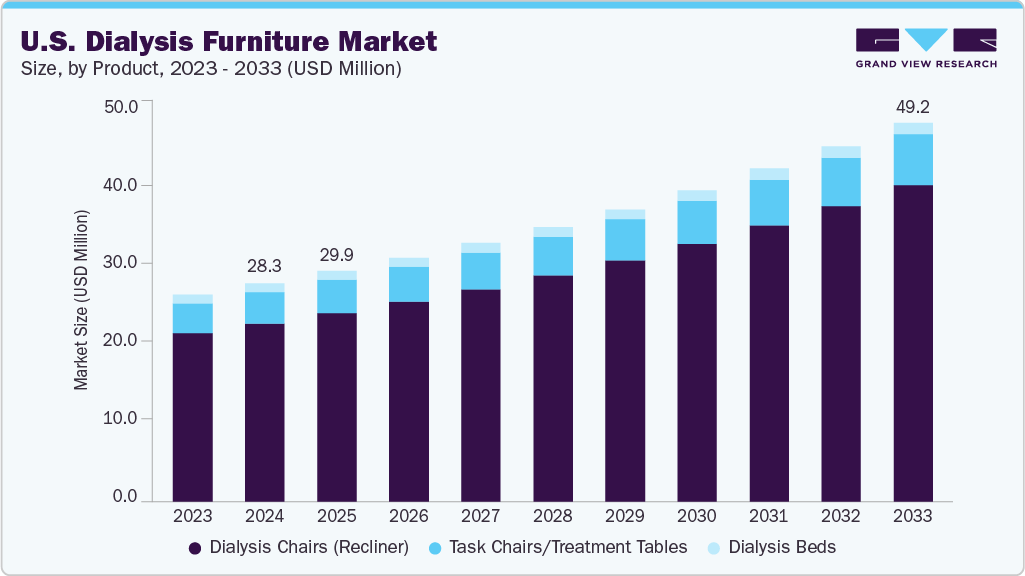 Source: Grand View Research, IR Documents, Primary Interviews, Paid DatabasesTo learn more about this report,
 Download Free Sample Report
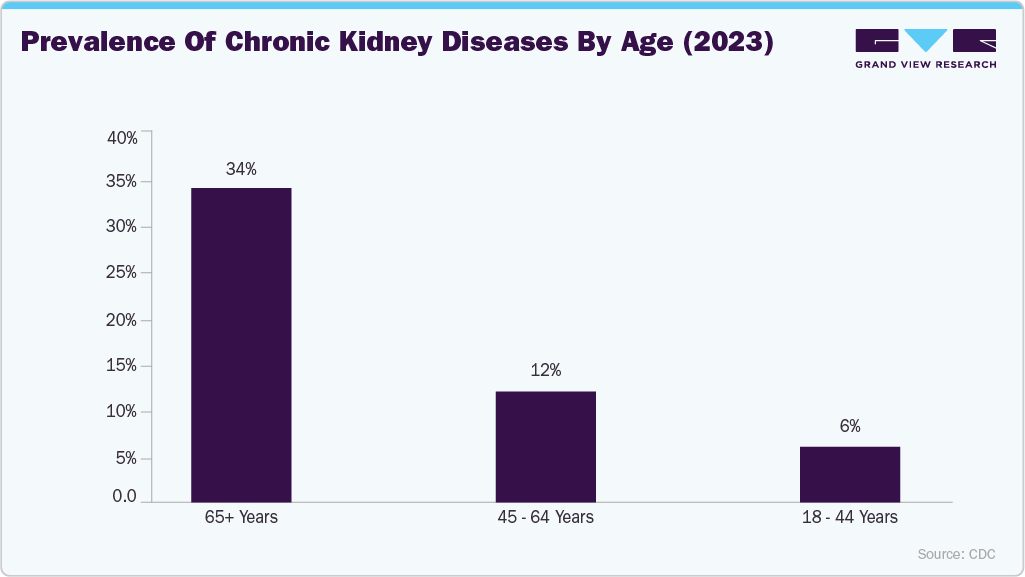
The figure below shows that CKD has become common in the geriatric population. The data highlights a rise in CKD rates among adults over 60, reflecting age as one of the risk factors for kidney diseases.
 To learn more about this report, Download Free Sample Report
The ongoing expansion of dialysis centers across the U.S. is a key driver of the dialysis furniture market, as rising patient volumes are pushing providers to increase treatment capacity and upgrade care environments. New centers and expansions of existing facilities continue to generate strong demand for specialized chairs, tables, cabinets, and supportive furnishings designed for long-duration treatments, patient comfort, and workflow efficiency. According to National ESRD data published in March 2025, the 18 ESRD networks collectively support 7,556 dialysis centers and 223 transplant centers treating more than 516,837 dialysis patients and 316,873 transplant patients nationwide, underscoring the growing need for advanced clinical infrastructure. As providers strive to meet regulatory standards while enhancing patient comfort and efficiency, investments in durable, ergonomic, and high-quality dialysis furniture remain a crucial component of facility development and modernization.
In the U.S. dialysis furniture market, demand for highly customizable equipment is increasing as providers seek solutions tailored to both patient comfort and clinical workflow needs. Because dialysis sessions last three to four hours multiple times per week, facilities prefer chairs and furnishings with adjustable features such as height, recline angle, cushioning, armrest style, and accessory attachments like IV poles, storage trays, reading lights, and touchscreen holders. Providers also value customization that supports diverse room layouts, infection-control protocols, and specialized patient groups, including geriatric, bariatric, and mobility-challenged individuals, through enhanced ergonomic support and higher weight capacities. As clinics continue to expand and modernize, configurable furniture that maximizes patient comfort, accessibility, and operational efficiency is becoming a core purchasing priority across the market.
The table below highlights various companies that offer advanced and customizable dialysis furniture products, showcasing their specialized features and capabilities in the U.S. market.
Advanced And Customizable Dialysis Furniture Products
Sr. No.
Company
Product
Product Features
Application
1
Champion Manufacturing Inc.
Ascent II (Power, Power XL)
• Extra padding for enhanced comfort during long treatments• Modern design with subtle curves• Swing-away arms for easy entry/exit• Durable engineering similar to Classic model• Upscale design for extended therapies• Reliable for both patients and providers
• Dialysis• Infusion & Oncology
2
Invacare Corporation
Invacare Clinical Three-Position Recliner, Blueridge
• Two side tables for prep materials• Gas cylinder for instant Trendelenburg positioning• Footrests fold under for easier standing• Easy-to-clean blow-molded side panels• Articulating headrest for better visibility• Flame-retardant, fluid-resistant upholstery (CA117)
• Blood collection• Dialysis• Same-day surgery
Source: Company Websites, Company Brochures
Market Concentration & Characteristics
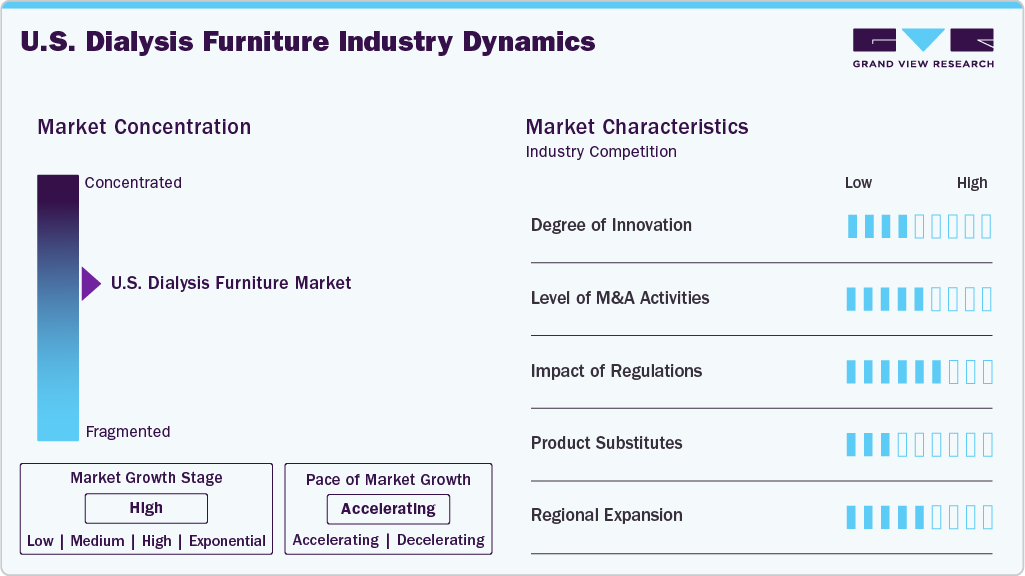
The degree of innovation in the U.S. dialysis furniture market is steadily rising as manufacturers integrate advanced ergonomics, digital connectivity, and patient-centric design to enhance long treatment sessions and improve clinical workflow efficiency. Newer dialysis chairs now feature multi-zone pressure-relief cushions, automated positioning, fall-prevention sensors, and ports for integrating medical devices and monitoring systems. Infection-control innovations, such as antimicrobial upholstery, seamless surfaces, and easy-clean modular components, are also becoming standard. In addition, manufacturers are introducing customization platforms that allow clinics to configure furniture based on patient type, treatment room layout, and operational needs.
The level of M&A activity in the U.S. dialysis furniture market has been moderate, driven primarily by strategic consolidation aimed at expanding product portfolios, geographic reach, and technological capabilities. Established medical furniture manufacturers have shown increasing interest in acquiring specialized dialysis seating and treatment furniture companies to strengthen their foothold in the renal care segment. These acquisitions are often focused on integrating advanced ergonomics, smart features, and infection-control innovations into broader product lines, while gaining access to long-term contracts with dialysis chains and healthcare systems.
 To learn more about this report, Download Free Sample Report
Regulations have a significant impact on the U.S. dialysis furniture market, shaping product design, material selection, and facility procurement decisions. Dialysis chairs and treatment furniture must comply with stringent safety, durability, and infection-control standards mandated by bodies such as the FDA, CMS, OSHA, and state health departments. Requirements related to antimicrobial surfaces, emergency positioning capabilities, weight-bearing standards, fire-safety ratings, and patient accessibility strongly influence manufacturer specifications. In addition, reimbursement and facility accreditation guidelines push dialysis providers to invest in ergonomically designed, high-quality furniture that supports patient comfort during long treatment hours and minimizes caregiver strain.
Product substitutes in the U.S. dialysis furniture market remain limited, but alternative solutions can reduce direct demand for specialized dialysis chairs and treatment furniture in certain settings. Some facilities use multipurpose recliners, infusion chairs, or general medical treatment couches as cost-saving alternatives, especially in smaller clinics or home-based dialysis environments. Home hemodialysis and peritoneal dialysis performed with standard residential seating can also serve as indirect substitutes, reducing reliance on purpose-built clinical furniture. Additionally, advances in remote patient monitoring and wearable dialysis technologies under development could further shift some treatment volume outside dedicated clinics in the long term.
Product Insights
The dialysis chairs segment held the largest share of the U.S. dialysis furniture market in 2024. This dominance is attributed due to these chairs are central to every hemodialysis and peritoneal dialysis session, making them the most frequently purchased and replaced furniture category in renal care facilities. Dialysis treatments typically last three to four hours and occur multiple times a week, so providers prioritize chairs that offer high levels of comfort, adjustability, pressure-relief support, and infection-control features to enhance the patient experience and reduce clinical risks. With growing patient volumes, frequent expansion of dialysis centers, and replacement cycles driven by heavy daily use, chairs represent the highest recurring capital investment compared to accessory furniture such as tables, storage, and cabinets.
Modality/Use Insights
The hemodialysis dominate the U.S. dialysis furniture market 2024 due to the overwhelming prevalence of hemodialysis compared with peritoneal dialysis, making it the primary modality performed in both hospital and outpatient dialysis centers. Hemodialysis requires patients to visit treatment facilities multiple times per week for long sessions lasting three to four hours, placing significant emphasis on the need for specialized ergonomic chairs, treatment tables, and supporting cabinetry designed for frequent and intensive clinical use. The high patient volume, strict infection-control protocols, and continuous workflow in hemodialysis drove facilities to invest heavily in durable, comfortable, and technologically enhanced furniture to improve patient outcomes and reduce staff strain.
Peritoneal dialysis are expected to grow at the fastest CAGR in the U.S. dialysis furniture market as more patients and healthcare providers shift toward home-based and less facility-dependent treatment models. Peritoneal dialysis offers greater lifestyle flexibility, reduced travel burden, and lower infection exposure risk compared with in-center hemodialysis, driving wider adoption, especially among elderly patients, those in remote areas, and individuals seeking greater autonomy in their care routines. As home-based renal care expands, demand is rising for compact, adjustable, and multi-functional furniture designed specifically for peritoneal dialysis, including recliners, ergonomic seating, storage-enabled cabinets, and safe fluid-handling setups. Growing reimbursement support and increasing investments from healthcare and MedTech companies in home dialysis programs are further accelerating uptake, positioning the peritoneal dialysis segment for the fastest market growth over the forecast period.
End Use Insights
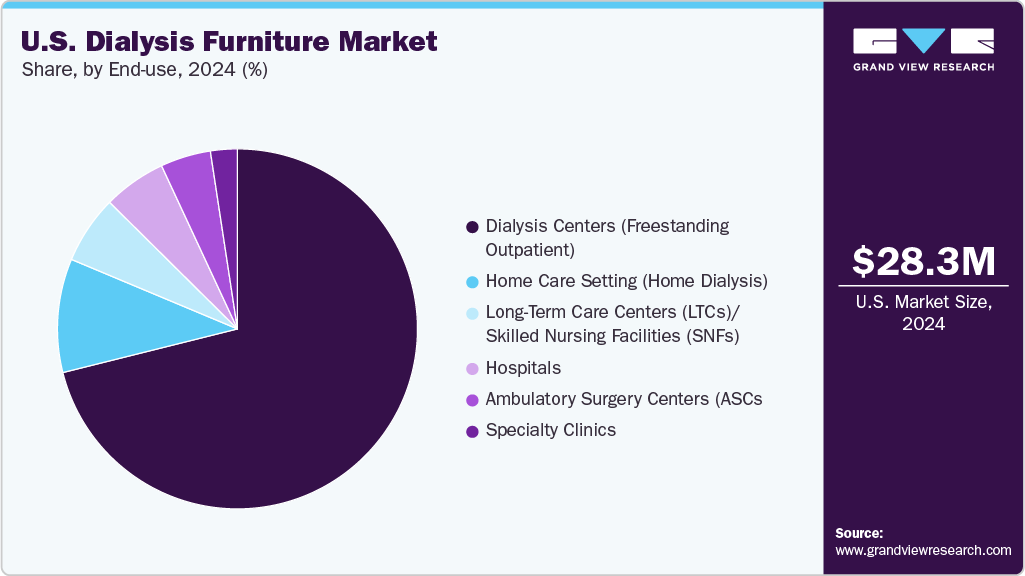
The dialysis centers segment held the largest share of the U.S. dialysis furniture market in 2024. This dominance is attributed due to most renal patients continue to rely on in-center hemodialysis, which requires highly specialized treatment environments equipped with purpose-built furniture. Dialysis centers operate multiple high-throughput treatment stations running several patient cycles per day, driving consistent demand for durable, ergonomic, and infection-control-compliant chairs, tables, and ancillary furnishings. Additionally, the continuous expansion of existing centers and the opening of new facilities to accommodate the growing ESRD population further contributed to procurement volumes.
 To learn more about this report, Download Free Sample Report
Home care setting are expected to grow at the fastest CAGR in the U.S. dialysis furniture market due to the shift toward home-based treatment accelerates, driven by rising adoption of home hemodialysis and peritoneal dialysis, supportive reimbursement policies, and patient preference for greater comfort and independence. Home-based renal therapy reduces the burden of clinic visits and enables personalized care, prompting demand for compact, ergonomically designed, and easy-to-operate dialysis chairs and furniture tailored for residential environments. Additionally, manufacturers are increasingly introducing space-saving, portable, and customizable models suited for home users, further fueling market expansion.
Key U.S. Dialysis Furniture Company Insights
The industry players are undertaking several strategic initiatives such as acquisitions, partnerships and collaborations. Moreover, the launch of novel products is anticipated to boost the competitive rivalry in the U.S. dialysis furniture market.
Key U.S. Dialysis Furniture Companies:
- Champion Manufacturing Inc.
- Invacare Corporation
- Diasol, Inc.
- Digiterm Ltd.
- Zimed Healthcare LLC
- GF Health Products, Inc.
- Dynarex Corporation.
- SEERS Medical Limited
Recent Developments
-
In June 2025, Invacare America has announced the integration of its Freedom Designs and Matrx by Motion Concepts divisions. This partnership brings together their expertise to deliver fully integrated manual wheelchairs and seating solutions, enhancing product performance and providing more comprehensive options for Invacare America’s customers.
-
In November 2025, Invacare Holdings Corporation and MIGA Holdings LLC announced that MIGA has acquired Invacare’s North American business, a move that allows Invacare to streamline its operations and accelerate regional growth. The acquisition strengthens Invacare’s ability to meet evolving customer needs while reinforcing its position as a leading player in the healthcare mobility market.
-
In April 2024, GF Health Products, Inc. (“Graham-Field”) announced that it has acquired substantially all assets of Transfer Master Products, Inc. (“TMP”), a company with more than 30 years of experience designing and manufacturing high-quality hi-low adjustable beds for home and healthcare environments. The acquisition expands Graham-Field’s product portfolio and strengthens its position in the homecare and medical furnishings market.
U.S. Dialysis Furniture Market Report Scope
Report Attribute
Details
Market size value in 2025
USD 29.93 million
Revenue forecast in 2033
USD 49.16 million
Growth rate
CAGR of 6.40% from 2025 to 2033
Actual data
2021 - 2024
Forecast period
2025 - 2033
Quantitative units
Revenue in USD Million and CAGR from 2025 to 2033
Segments covered
Product, modality/use, end use, and region
Regional scope
U.S.
Report coverage
Revenue, competitive landscape, growth factors, and trends
Key companies profiled
Champion Manufacturing Inc.; Invacare Corporation; Digiterm Ltd.; GF Health Products, Inc.; Dynarex Corporation.; SEERS Medical Limited; Diasol, Inc.; Zimed Healthcare LLC.
Customization scope
Free report customization (equivalent to 8 analysts working days) with purchase. Addition or alteration to country, regional & segment scope
Pricing and purchase options
Avail customized purchase options to meet your exact research needs. Explore purchase options
U.S. Dialysis Furniture Market Report Segmentation
This report forecasts revenue growth at the country levels and provides an analysis of the latest industry trends in each of the sub-segments from 2021 to 2033. For the purpose of this study, Grand View Research has segmented the U.S. dialysis furniture market report on the basis of product, modality/use, andend use:
-
Product Outlook (Revenue, USD Million, 2021 - 2033)
-
Dialysis Chairs (Recliner)
-
Electric Dialysis Chairs
-
Standard/Manual Dialysis Chairs
-
-
Dialysis Beds
-
Task Chairs/Treatment Tables
-
-
Modality/Use Outlook (Revenue, USD Million, 2021 - 2033)
-
Hemodialysis
-
Peritoneal Dialysis
-
Phlebotomy
-
Infusion Therapy
-
Oncology
-
-
End Use Outlook (Revenue, USD Million, 2021 - 2033)
-
Dialysis Centers (Freestanding Outpatient)
-
Home Care Setting (Home Dialysis)
-
Hospitals
-
Long-Term Care Centers (LTCs) / Skilled Nursing Facilities (SNFs)
-
Specialty Clinics
-
Ambulatory Surgery Centers (ASCs)
-
Frequently Asked Questions About This Report
The U.S. dialysis furniture market size was estimated at USD 28.34 million in 2024 and is expected to reach USD 29.93 million in 2025
The U.S. dialysis furniture market is expected to grow at a compound annual growth rate of 6.40% from 2025 to 2033 to reach USD 49.16 million by 2033.
Dialysis chairs dominated the U.S. dialysis market with a share of 28.9% in 2019. This dominance is attributed due to these chairs are central to every hemodialysis and peritoneal dialysis session, making them the most frequently purchased and replaced furniture category in renal care facilities.
Some key players operating in the U.S. dialysis furniture market include Champion Manufacturing Inc.; Invacare Corporation; Digiterm Ltd.; GF Health Products, Inc.; Dynarex Corporation.; SEERS Medical Limited; Diasol, Inc.; Zimed Healthcare LLC.
Key factors that are driving the market growth include the growing ESRD patient population, expansion of dialysis centers, and increasing adoption of home dialysis setups. Rising emphasis on patient comfort during long treatment hours, demand for ergonomic and infection-control-focused furniture, and ongoing infrastructure upgrades by large dialysis chains further support market growth.
About the Author(s)
Medical Devices Research Team
Healthcare · Medical DevicesThis report was authored by the medical devices research team at Grand View Research - comprising two research analysts, one senior research analyst, and one industry expert - with specialized expertise in the medical devices segment of the healthcare industry. All findings are based on proprietary healthcare databases, executive interviews, and regulatory analysis, subject to internal peer review prior to publication.
Last Updated:
Speak to Analyst

Customize this report to your needs - add regions, segments, or data points, with 20% free customization.
Or view our licence options:


ISO 9001:2015 & 27001:2022 Certified
We are GDPR and CCPA compliant! Your transaction & personal information is safe and secure. For more details, please read our privacy policy.


