
- Home
- »
- Advanced Interior Materials
- »
-
U.S. Docks Market Size, Share & Trends Report, 2026-2033GVR Report cover

U.S. Docks Market (2026 - 2033)
Size, Share & Trends Analysis Report By Material (Wood, Metal, Plastics, Composites, Concrete), By Substructure Material, By Product Type (Floating, Fixed), By Application, By Dock Accessories, And Segment Forecasts
Market Size, 2025
$4.3BMarket Estimate, 2026
$4.4BMarket Forecast, 2033
$5.7BCAGR, 2026–2033
3.7%U.S. Docks Market Summary
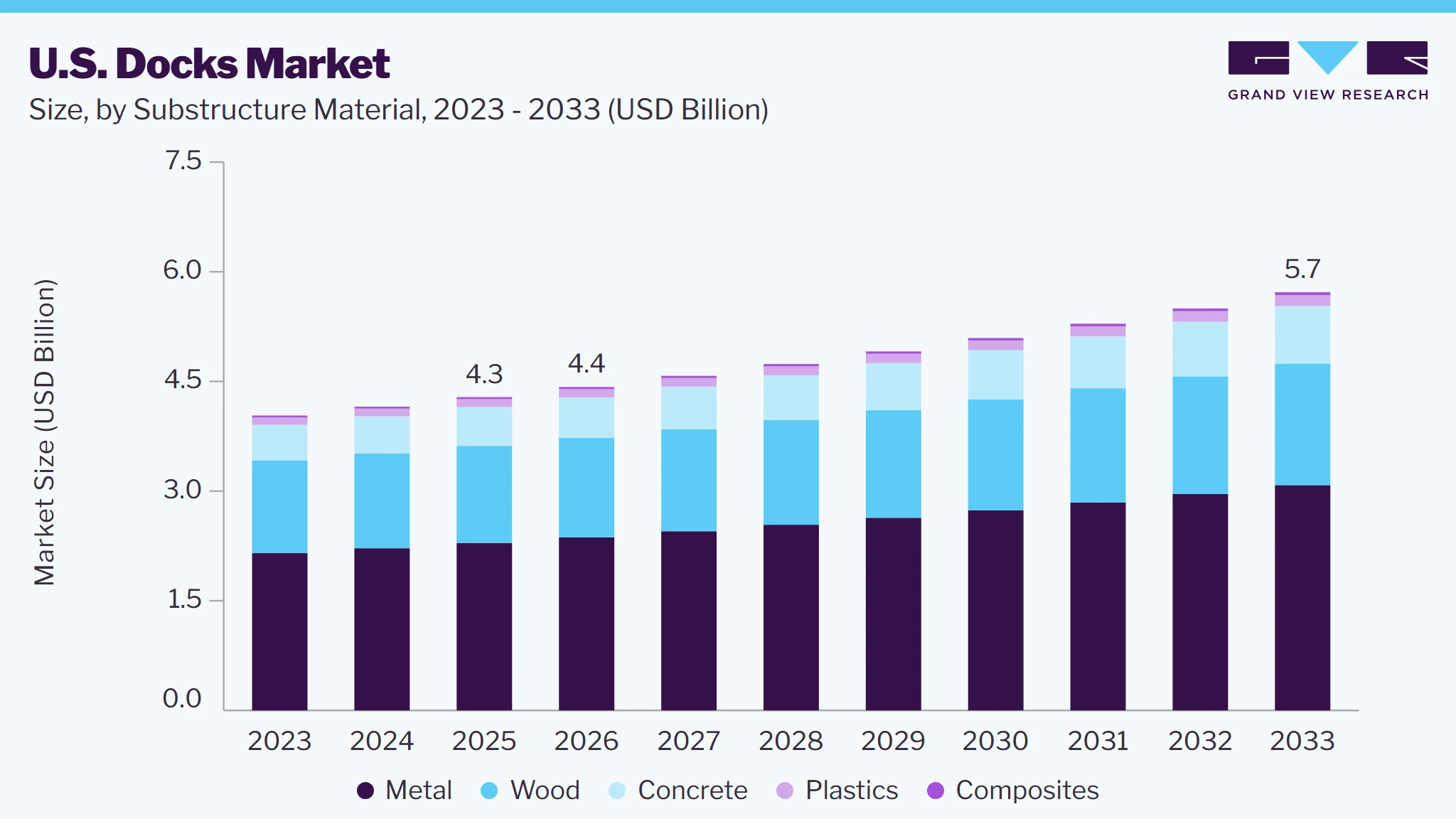
The U.S. docks market size was estimated at USD 4.3 billion in 2025 and is projected to grow from USD 4.4 billion in 2026 to USD 5.7 billion by 2033, at a CAGR of 3.7% from 2026 to 2033. The U.S. docks market is supported by recreational boating, waterfront residential development, marina infrastructure, and commercial marine activities.
Key Market Trends & Insights
- By material: Wood decking segment dominated the U.S. docks market with the largest revenue share of 41.3% in 2025.
- By substructure material: Metal substructure segment dominated the U.S. docks market with a revenue share of 53.4% in 2025.
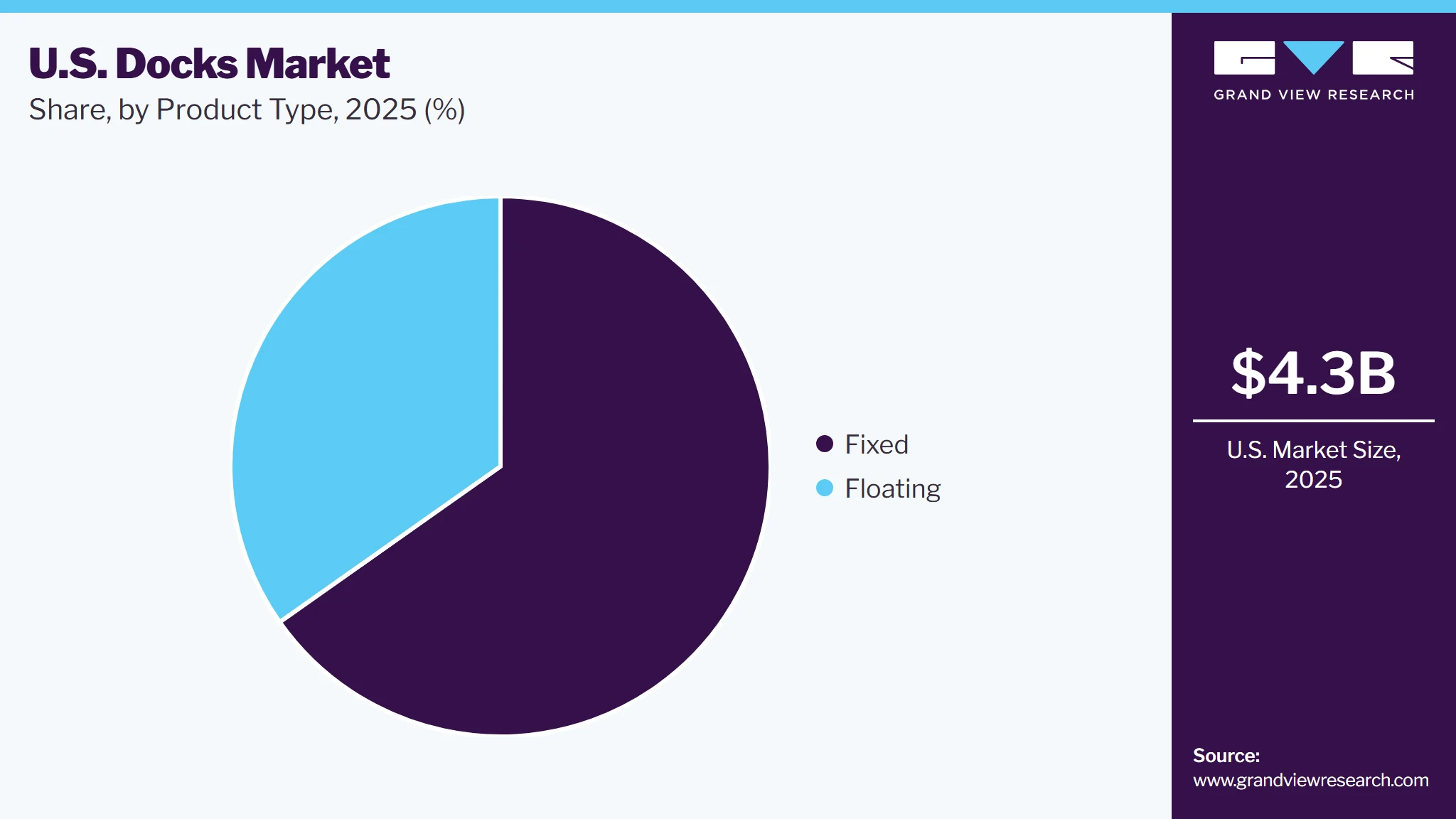
- By product type: Fixed docks segment dominated the market in 2025 with a revenue share of 65.2%.
- By application: Industrial segment dominated the U.S. docks market with a revenue share of 41.4% in 2025.
- By dock accessories: Lighting segment dominated the U.S. dock accessories market with a revenue share of 15.6% in 2025.
Market Size & Forecast
- Market size in 2025: USD 4.3 Billion
- Estimated market size in 2026: USD 4.4 Billion
- Projected market size by 2033: USD 5.7 Billion
- CAGR (2026-2033): 3.7%
GVR research-powered AIAsk Prism AI about the U.S. docks marketGet cited answers from GVR research on market growth, segments, regulations and forecasts.Start with✓ Source-linked answers ✓ Market-specific context ✓ Traceable figuresExplore Prism AI ↗
Docks provide access to lakes, rivers, coastal areas, and other water bodies for boat mooring, passenger movement, fishing, and waterfront recreation. Residential property owners use private docks for boat storage and leisure activities, while marinas and commercial facilities require larger structures to accommodate multiple vessels and support marine operations. Demand also comes from public waterfront facilities, tourism destinations, and industrial locations requiring water access.Market development is influenced by recreational boating participation, waterfront property ownership, marina capacity requirements, and investment in coastal and inland water infrastructure. Residential customers prioritize durability, ease of installation, low maintenance, and compatibility with their waterfront properties. Commercial buyers focus on structural strength, operational reliability, load-bearing capacity, and long-term maintenance requirements. Material selection plays an important role, with wood, aluminum, steel, concrete, and composite materials serving different applications.
 Source: Grand View Research, IR Documents, Primary Interviews, Paid DatabasesTo learn more about this report,
 Download Free Sample Report
Technological developments are improving dock durability, installation flexibility, and maintenance efficiency. Modular floating docks and interlocking dock systems allow users to configure layouts according to shoreline conditions, available space, and changing operational requirements. Recycled polymers and composite materials offer alternatives to conventional materials where resistance to moisture, corrosion, and routine maintenance is important. Tool-free assembly systems and lightweight components can simplify transportation, installation, seasonal removal, and expansion.
Market Dynamics
The U.S. docks market is shaped by recreational boating activity, waterfront property development, marina infrastructure requirements, material performance, and environmental permitting conditions. Demand varies by geography, with coastal areas, inland lakes, and riverfront locations presenting different installation and maintenance needs. Residential buyers generally emphasize appearance, ease of use, and affordability, whereas commercial operators prioritize capacity, stability, durability, and operational continuity. Product innovation is centered on modular construction, corrosion resistance, improved installation methods, and lower maintenance requirements.
Increasing investment in waterfront residential properties across the U.S. supports demand for dock systems in coastal communities and properties located near lakes and rivers. Homeowners and property developers incorporate docks to provide convenient boat access, support recreational activities, and improve the functionality of waterfront properties. Demand extends across fixed docks, floating docks, and customized docking structures designed to accommodate different shoreline conditions, water depths, and property layouts.
The development of premium waterfront housing and residential communities creates opportunities for dock manufacturers to supply customized solutions alongside new property construction. Homebuyers seeking direct water access may prefer properties with private docking facilities for boating, fishing, and other recreational activities. Developers can incorporate dock systems into residential projects to improve property appeal and provide convenient access to nearby waterways, particularly in regions with established recreational boating activity.
High installation costs and complex environmental permitting requirements act as a major restraint in the U.S. docks market, as dock construction involves expenses related to materials, transportation, site preparation, labor, anchoring systems, and installation equipment. The total project cost varies according to dock size, design, water depth, shoreline conditions, and intended application. Floating docks, fixed docks, and customized marina systems may require different structural components and installation methods, increasing project complexity and limiting affordability for residential property owners and smaller marina operators.
Modular dock systems present opportunities to serve customers seeking flexible layouts, simplified installation, and easier future expansion. Interlocking components allow dock configurations to be adjusted according to water depth, shoreline shape, vessel requirements, and available space. Floating systems are particularly relevant in locations with fluctuating water levels, while modular designs can support seasonal installation and removal where required. Suppliers can differentiate their offerings through compatible accessories, replaceable components, installation support, and configurations for residential and commercial applications. These systems also provide opportunities to address customers seeking upgrades without undertaking extensive reconstruction of existing waterfront facilities.
Market Concentration & Characteristics
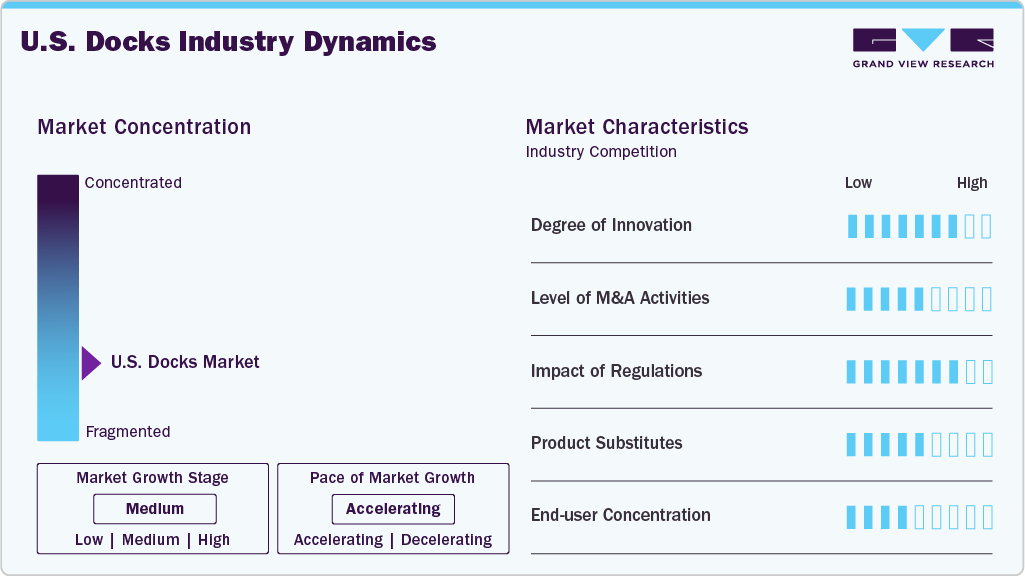
The U.S. docks market comprises manufacturers and suppliers serving residential, recreational, commercial, and industrial applications. Competition is influenced by product durability, material quality, installation flexibility, customization capabilities, distribution reach, and after-sales support. The market includes established suppliers offering modular floating docks, fixed dock structures, marine infrastructure systems, and specialized waterfront products, alongside regional manufacturers and installation-focused businesses. Product differentiation is particularly relevant in applications requiring corrosion resistance, adaptable configurations, and performance under varying water and weather conditions. Suppliers compete through product design, ease of assembly, accessory compatibility, and the ability to address different site requirements.
 To learn more about this report, Download Free Sample Report
The threat of substitutes in the U.S. docks market depends on the intended use, site conditions, and customer requirements. Shore-based boat storage, boat ramps, dry-stack storage facilities, and marina services can serve as alternatives to private dock ownership for certain customers. Beach access, shared waterfront facilities, and public launch sites may also reduce the need for individual residential docks where suitable alternatives are available. However, these options do not fully replace the convenience of private mooring, direct waterfront access, or dedicated loading and unloading facilities. Fixed docks may be substituted by floating docks in locations with changing water levels, while modular systems can provide alternatives to conventional custom-built structures.
Analyst Perspective
The U.S. docks market is supported by recreational boating, marina development, waterfront residential properties, and commercial marine infrastructure. Demand varies by dock material, product type, installation requirements, and end-use application. Floating and modular dock systems offer flexibility in areas with changing water levels, while fixed docks serve permanent waterfront installations. Material durability, maintenance costs, environmental exposure, and regulatory requirements influence purchasing decisions. Manufacturers focusing on corrosion-resistant materials, low-maintenance designs, customizable configurations, and integrated accessories are well positioned to address evolving residential and commercial customer needs.
Material Insights
Wood dominated the docks market in 2025 with a revenue share of 41.3%, supported by its natural appearance, structural versatility, and widespread use across residential waterfront properties, recreational facilities, and marinas. Pressure-treated lumber is commonly used because it offers protection against moisture, decay, and outdoor exposure when properly maintained. Wood also allows flexibility in dock design, dimensions, and surface finishing, making it suitable for customized installations. Its availability through established lumber supply chains and familiarity among contractor’s further support adoption.
The composites segment is expected to grow at a CAGR of 4.8% over the forecast period, as customers increasingly seek durable, low-maintenance alternatives to conventional wood decking. Wood-plastic composites and other engineered materials offer resistance to moisture, splintering, and decay, reducing the need for frequent maintenance and surface treatment. These characteristics make composite decking suitable for residential docks, marinas, resorts, and recreational waterfront facilities exposed to regular weather fluctuations.
Substructure Material Insights
The metal substructure segment dominated the U.S. docks market with a revenue share of 53.4% in 2025, supported by the strength, stability, and durability of aluminum and steel structural components. Metal frames, beams, supports, and connectors provide the load-bearing capacity required across residential, recreational, and commercial dock installations. Aluminum is particularly suitable for applications requiring lighter structures and corrosion resistance, while galvanized and treated steel serve installations requiring substantial structural strength.
The concrete substructure segment is expected to grow at a CAGR of 5.1% over the forecast period, as investment in permanent waterfront infrastructure, commercial marinas, and heavy-duty marine facilities increases. Reinforced and precast concrete components provide structural stability, load-bearing capacity, and durability for installations designed for long-term use. These characteristics make concrete suitable for large docking platforms, commercial marine facilities, and projects requiring substantial structural support. Precast construction can also improve consistency and reduce certain on-site construction activities.
Product type Insights
The fixed docks segment dominated the market in 2025 with a revenue share of 65.2%, driven by demand for stable, permanent waterfront access across residential properties, commercial facilities, and industrial locations. These structures are typically supported by pilings, posts, or foundations anchored to the seabed or shoreline, providing a stationary platform for boat mooring, loading, fishing, and other waterfront activities. Fixed docks are particularly suitable for locations with relatively stable water levels and favorable installation conditions.
 To learn more about this report, Download Free Sample Report
The floating docks segment is expected to grow at a CAGR of 4.1% over the forecast period, based on revenue. Floating structures rise and fall with the water surface, making them useful in lakes, rivers, and coastal locations where water levels fluctuate. Modular systems allow users to expand, reconfigure, or relocate dock sections according to available space and operational requirements. These systems are increasingly relevant to marinas, recreational boating facilities, boat rental businesses, and residential waterfront properties. Improvements in polymer materials, composite decking, anchoring systems, and interlocking designs are further supporting the development of flexible and low-maintenance floating dock solutions.
Application Insights
The industrial segment dominated the U.S. docks market with a revenue share of 41.4% in 2025, supported by demand for docking infrastructure at industrial waterfront facilities, ports, manufacturing locations, and other operational marine sites. Docks at these facilities support vessel access, equipment movement, material handling, servicing, and related industrial activities. Buyers typically prioritize structural strength, load-bearing capacity, operational reliability, and resistance to prolonged environmental exposure. Industrial installations may require specialized engineering, reinforced substructures, and customized layouts to accommodate site-specific operating conditions.
The commercial segment is expected to grow at a CAGR of 4.1% over the forecast period, as marina development, waterfront tourism, boating services, and recreational businesses increase demand for docking infrastructure. Marinas, resorts, boat rental operators, waterfront restaurants, and tourism facilities require docks to support vessel mooring, passenger movement, customer access, and recreational activities. Floating and modular systems can help commercial operators optimize available waterfront space and adjust configurations to changing requirements. Demand is also supported by upgrades to existing marina facilities and the development of waterfront destinations.
Dock Accessories Insights
The lighting segment dominated the U.S. dock accessories market with a revenue share of 15.6% in 2025, supported by the need for improved visibility, safe movement, and convenient access during low-light conditions. Dock lighting products include pathway lights, post-mounted fixtures, solar-powered lights, and other illumination systems installed along dock surfaces and access routes. Residential property owners and marina operators use these products to improve nighttime usability and visibility around docking areas. Solar-powered options can reduce dependence on conventional electrical connections in selected installations, while energy-efficient lighting supports long-term operating efficiency.
The fish cleaning station segment is expected to grow at a CAGR of 5.4% over the forecast period, as these accessories provide dedicated areas for preparing catches and may include cutting surfaces, sinks, water connections, storage features, and waste-handling components. Private dock owners, fishing piers, marinas, and resorts may install fish cleaning stations to improve convenience and support fishing-related activities. Demand is influenced by recreational fishing participation, facility amenities, ease of cleaning, corrosion resistance, and sanitation requirements. Durable materials and designs suited to outdoor marine environments can further support adoption across residential and commercial waterfront installations.
Key U.S. Docks Company Insights
Some of the key players operating in the market include Snap Dock and Tommy Docks
-
Snap Dock manufactures modular floating dock systems made from durable, UV-resistant polyethylene. Its product portfolio includes customizable dock sections, personal watercraft (PWC) lifts, and accessories for residential, commercial, and industrial applications.
-
Tommy Docks is an American dock solutions provider established in 1987, offering do-it-yourself dock kits, floating and stationary dock systems, hardware, ladders, ramps, and accessories. The company focuses on user-friendly installation and customizable waterfront solutions.
Transpac Marinas Inc. and MariCorp U.S. are some of the emerging market participants in the U.S. docks market.
-
Transpac Marinas designs and manufactures floating dock systems and wave attenuation structures for commercial and recreational marinas. Established in 1984, the company offers timber, concrete, and steel float systems, along with specialized solutions for passenger transfer, cargo handling, and challenging marine environments.
-
MariCorp is a U.S. manufacturer and installer specializing in galvanized steel floating docks, boat lifts, and marina infrastructure. Established in 2003, the company provides customized solutions for commercial marinas, residential waterfront properties, fuel docks, rowing facilities, and wave attenuation systems.
Key U.S. Docks Companies:
-
Snap Dock
-
Tommy Docks
-
Connect-A-Dock
-
Carolina Docks
-
Bellingham Marine
-
AccuDock
-
MariCorp U.S.
-
Transpac Marinas Inc.
-
Meeco Sullivan
-
Jet Dock Systems, Inc.
-
EZ Dock
-
Mod-U-Dock
-
TechniDock
-
Carolina Waterworks (CWI)
-
Modular Concrete Docks LLC
Competitive Benchmarking
Category
Operating Strategies
Competitive Edge
Weakness
Established Players (Snap Dock, Tommy Docks, Connect-A-Dock, Carolina Docks, Bellingham Marine, AccuDock)
- Expand floating, fixed, and modular dock portfolios.
- Invest in durable, corrosion-resistant materials and flexible dock configurations.
- Strengthen dealer networks and serve residential, recreational, and commercial applications.
- Established brands and customer relationships.
- Broad dock product portfolios and application expertise.
- Established distribution networks and project execution capabilities.
- Higher manufacturing and distribution costs.
- Exposure to material price fluctuations and seasonal demand.
- Competition across dock materials, configurations, and price categories.
Emerging Players (MariCorp U.S., Transpac Marinas Inc., Meeco Sullivan, Jet Dock Systems, Inc., EZ Dock, Mod-U-Dock, TechniDock, Carolina Waterworks (CWI), Modular Concrete Docks LLC)
- Develop specialized floating, modular, and concrete dock systems.
- Focus on application-specific designs, installation flexibility, and low-maintenance materials.
- Expand contractor partnerships and regional distribution networks.
- Specialized expertise in dock systems and marine infrastructure.
- Flexible product configurations for specific waterfront requirements.
- Opportunities to serve niche applications and customized projects.
- Comparatively limited scale for some specialized suppliers.
- Dependence on distribution partners and component availability.
- Challenges in expanding geographic reach and competing with established manufacturers.
Recent Developments
-
In June 2026, Meeco Sullivan added S&S Precast to its business, expanding its portfolio to include concrete floating and fixed docks alongside its existing dock systems.
-
In December 2025, Snap Dock Appointed Scottco Marine as authorized distributor for the U.S. West Coast, British Columbia, and Alaska.
U.S. Docks Market Report Scope
Report Attribute
Details
Market size in 2025
USD 4.3 billion
Estimated market size in 2026
USD 4.4 billion
Projected market size by 2033
USD 5.7 billion
Growth Rate
CAGR of 3.7% from 2026 to 2033
Base year for estimation
2025
Historical data
2021 - 2024
Forecast period
2026 - 2033
Quantitative units
Revenue in USD billion and CAGR from 2026 to 2033
Report coverage
Revenue forecast, company ranking, competitive landscape, growth factors, and trends
Segments covered
Material, substructure material, product type, application, dock accessories
Country scope
U.S.
Key companies profiled
Snap Dock, Tommy Docks, Connect-A-Dock, Carolina Docks, Bellingham Marine, AccuDock, MariCorp U.S., Transpac Marinas Inc., Meeco Sullivan, Jet Dock Systems, Inc., EZ Dock, Mod-U-Dock, TechniDock, Carolina Waterworks (CWI), Modular Concrete Docks LLC
Customization scope
Free report customization (equivalent up to 8 analysts working days) with purchase. Addition or alteration to country, regional & segment scope.
Pricing and purchase options
Avail customized purchase options to meet your exact research needs. Explore purchase options
U.S. Docks Market Report Segmentation
This report forecasts revenue growth at regional & country levels and provides an analysis on the industry trends in each of the sub-segments from 2021 to 2033. For the purpose of this study, Grand View Research has segmented the U.S. docks market on the basis of material, substructure material, product type, application, and dock accessories:
-
Material Outlook (Revenue, USD Million, 2021 - 2033)
-
Wood
-
Metal
-
Aluminum
-
Others
-
-
Plastics
-
Composites
-
Concrete
-
-
Substructure Material Outlook (Revenue, USD Million, 2021 - 2033)
-
Wood
-
Metal
-
Aluminum
-
Others
-
-
Plastics
-
Composites
-
Concrete
-
-
Product type Outlook (Revenue, USD Million, 2021 - 2033)
-
Floating
-
Fixed
-
-
Application Outlook (Revenue, USD Million, 2021 - 2033)
-
Residential
-
Marine
-
Non-marine
-
-
Commercial
-
Marine
-
Non-marine
-
-
Industrial
-
Institutional
-
-
Dock Accessories Outlook (Revenue, USD Million, 2021 - 2033)
-
Ladders
-
Bumpers
-
Cleats
-
Carts
-
Benches/Seats
-
Fish Cleaning Station
-
Kayak Rack
-
Trash Cans
-
Lighting
-
Handrails
-
Other Accessories
-
Research Methodology
The U.S. docks market figures in this report are based on a proven research process that combines executive interviews with secondary research from proprietary databases, company filings, and recognized regulatory and institutional sources. Market size is built through value-chain sizing-reconciling supply-side and demand-side estimates-and triangulated with bottom-up and top-down approaches. Every estimate passes multiple levels of expert validation before publication, with each U.S. docks segment quantified using the revenue-capture definitions in the table below.
Segment Definition
Segment - Material
Revenue capture definition
Wood
Revenue generated from the sale of docks constructed primarily from wood, including pressure-treated lumber and other timber materials, for residential, commercial, and recreational waterfront applications.
Metal
Revenue generated from the sale of docks constructed primarily from metal materials, including aluminum, steel, and galvanized metal, for applications requiring structural strength, durability, and resistance to environmental exposure.
Plastics
Revenue generated from the sale of docks manufactured primarily from plastic materials, including high-density polyethylene (HDPE) and other durable polymers, for floating, modular, and waterfront applications.
Composites
Revenue generated from the sale of docks manufactured using composite materials, including wood-plastic composites and fiber-reinforced materials, for applications requiring durability, moisture resistance, and reduced maintenance.
Concrete
Revenue generated from the sale of docks constructed primarily from concrete, including precast and reinforced concrete structures, for permanent waterfront installations, marinas, and commercial marine facilities.
Segment - Substructure Material
Revenue capture definition
Wood
Revenue generated from the sale of dock substructures made primarily from timber, including wooden frames, beams, joists, and supporting members used to provide structural support to dock surfaces.
Metal
Revenue generated from the sale of dock substructures made primarily from aluminum, steel, galvanized steel, and other metals, including frames, beams, supports, and structural components.
Plastics
Revenue generated from the sale of plastic-based dock substructures, including polymer frames, modular structural components, and support systems designed for floating and modular dock installations.
Composites
Revenue generated from the sale of dock substructures made from composite materials, including fiber-reinforced polymers and other engineered composites, for applications requiring strength, corrosion resistance, and reduced maintenance.
Concrete
Revenue generated from the sale of concrete dock substructures, including reinforced concrete supports, foundations, piles, and structural components used in permanent and heavy-duty dock installations.
Segment - Product type
Revenue capture definition
Floating
Revenue generated from the sale of floating docks designed to rise and fall with changing water levels, including modular floating platforms, pontoon-based docks, and floating systems used for residential, recreational, commercial, and marina applications.
Fixed
Revenue generated from the sale of permanently installed docks supported by piles, posts, foundations, or other fixed structural systems, used for residential waterfront access, commercial facilities, industrial operations, and institutional applications.
Segment - Application
Revenue capture definition
Residential
Revenue generated from the sale of docks installed at private homes, lakefront properties, waterfront communities, and residential developments for private boat mooring, recreational access, fishing, swimming, and other waterfront activities.
Commercial
Revenue generated from the sale of docks used by marinas, resorts, tourism operators, boat rental businesses, waterfront restaurants, and other commercial establishments for vessel mooring, passenger access, customer recreation, and marine services.
Industrial
Revenue generated from the sale of docks used at industrial facilities, ports, manufacturing sites, and other operational waterfront locations for equipment access, material handling, vessel servicing, and industrial marine activities.
Institutional
Revenue generated from the sale of docks used by public authorities, educational institutions, research facilities, government organizations, parks, and recreational facilities for public access, training, research, water-based activities, and institutional operations.
Segment - Dock Accessories
Revenue capture definition
Ladders
Revenue generated from the sale of dock ladders and boarding ladders designed to support safe movement between the dock, boats, and water.
Bumpers
Revenue generated from the sale of dock bumpers and protective edging systems used to cushion vessel contact and reduce damage to boats and dock structures.
Cleats
Revenue generated from the sale of dock cleats used to secure mooring lines and hold vessels in position alongside docks.
Carts
Revenue generated from the sale of dock carts used to transport boating equipment, supplies, personal belongings, and other materials between shorelines, parking areas, and docks.
Benches/Seats
Revenue generated from the sale of benches and seating products designed for installation on docks to support recreational use, waiting areas, and waterfront relaxation.
Fish Cleaning Station
Revenue generated from the sale of fish cleaning stations designed for dockside fish preparation, including cleaning tables, cutting surfaces, sinks, and associated fixtures.
Kayak Rack
Revenue generated from the sale of kayak racks and storage systems used to secure, organize, and store kayaks and similar small watercraft near or on dock structures.
Trash Cans
Revenue generated from the sale of dock-mounted or freestanding waste containers used to collect and manage waste at residential waterfronts, marinas, and recreational facilities.
Lighting
Revenue generated from the sale of dock lighting products, including pathway lights, post lights, underwater lights, and solar-powered lighting systems used to improve visibility, navigation, and safety.
Handrails
Revenue generated from the sale of dock handrails and railing systems installed along dock edges, ramps, and access walkways to improve user safety and support movement.
Other Accessories
Revenue generated from the sale of other dock-related accessories, including fenders, mooring hardware, anchor systems, utility holders, storage products, and specialized components not classified under the specified accessory categories.
Estimation Model
Layer Name
Key Question
Description
Parent Market Analysis
What is the overall size and growth outlook of the U.S. docks market?
The analysis evaluates recreational boating, marina development, waterfront properties, commercial marine activities, dock installations, and replacement demand to establish the total addressable market for U.S. docks.
Dock & Substructure Material Penetration Analysis
What is the market contribution of different dock and substructure materials?
This layer assesses wood, metal, plastics, composites, and concrete based on durability, structural strength, maintenance, installation costs, and material preferences across floating and fixed docks.
Product Type, Application & Accessory Demand Assessment
Which dock types, applications, and accessories generate the highest demand?
Demand is assessed across floating and fixed docks, residential, commercial, industrial, and institutional applications, and key accessories based on installation requirements, end-user needs, and boating activity.
Company Revenue Validation & Market Forecasting
How is the final market size validated and forecast?
Estimates are validated using company revenues, product portfolios, manufacturing capacity, distribution networks, replacement demand, and industry developments. Bottom-up and top-down approaches are combined to forecast the U.S. docks market from 2021 to 2033.
Delivered Customizations
We have successfully delivered the following deep-dive customizations:
Client Request
Customization Delivered
Value Adds
Smart & Modular Dock Technology Assessment
Evaluate modular floating docks, interlocking systems, tool-free installation, recycled polymers, smart monitoring, solar-powered lighting, and electric boat charging based on application suitability and technological development.
Identifies product innovation opportunities and emerging technologies that can improve installation flexibility, functionality, and long-term dock performance.
Sustainability & Material Innovation Assessment
Assess the adoption of recycled plastics, composite materials, corrosion-resistant metals, durable construction, and low-maintenance dock systems across residential, commercial, and marina applications.
Highlights material preferences and sustainability-led opportunities while evaluating potential improvements in product lifespan and maintenance efficiency.
Dock Demand & Application Assessment
Analyze demand across residential, commercial, industrial, and institutional applications, considering floating and fixed docks, marina development, recreational boating, waterfront properties, and replacement requirements.
Identifies key demand-generating applications and evaluates the operational requirements influencing dock selection across the U.S. market.
About the Author(s)
Advanced Interior Materials Research Team
Advanced Materials · Advanced Interior MaterialsThis report was authored by the advanced interior materials research team at Grand View Research - comprising two research analysts, one senior research analyst, and one industry expert - with specialized expertise in the advanced interior materials segment of the advanced materials industry. All findings are based on proprietary advanced materials databases, executive interviews, and regulatory analysis, subject to internal peer review prior to publication.
Last Updated:
Speak to Analyst

Customize this report to your needs - add regions, segments, or data points, with 20% free customization.
Or view our licence options:


ISO 9001:2015 & 27001:2022 Certified
We are GDPR and CCPA compliant! Your transaction & personal information is safe and secure. For more details, please read our privacy policy.


