
- Home
- »
- Next Generation Technologies
- »
-
U.S. Drone Market Size And Share, Industry Report, 2033GVR Report cover

U.S. Drone Market (2026 - 2033) Size, Share & Trends Analysis Report By Component (Hardware, Software, Services), By Product (Fixed-Wing, Multi-Rotor, Single-Rotor, Hybrid), By Technology, By Payload Capacity, By Power Source, By End Use, And Segment Forecasts
U.S. Drone Market Summary
The U.S. drone market size was estimated at USD 29,326.2 million in 2025 and is projected to reach USD 58,522.8 million by 2033, growing at a CAGR of 8.3% from 2026 to 2033. This growth is driven by increasing adoption across commercial applications such as aerial surveillance, precision agriculture, infrastructure inspection, and last-mile delivery services.
Key Market Trends & Insights
- Based on the component, the hardware segment dominated the market with a share of over 60% in 2025.
- Based on product, the hybrid segment is expected to grow at the highest CAGR of over 10% from 2026 to 2033.
- Based on the power source, the battery-powered segment accounted for the largest revenue share of over 52% in 2025.
- Based on technology, the fully autonomous segment is anticipated to grow at the highest CAGR of over 11% from 2026 to 2033.
Market Size & Forecast
- 2025 Market Size: USD 29,326.2 Million
- 2033 Projected Market Size: USD 58,552.8 Million
- CAGR (2026-2033): 8.3%
Three ways to get this report
Buy it, customize it, or ask a question.Ask an Analyst
Analyst response in 1 business day
- AccessReport author, directly
- Reply timeWithin 1 working day
- No sales callDirect answer only
- FormatEmail reply
- CostFree, no cost
Get the Full Report
What the study covers
- FormatsPDF · Excel · Dashboard
- Timeline2026–2033 annual, 2025 base
- Coverage20+ countries, 5 regions
- Companies10+ key players profiled
Customize the Report
20% free customization
- IncludeCountries, segments, points
- TailorTo your product definition
- ExtendDeeper competitor detail
- OrA fully bespoke study
- Turnaround5–10 working days
Advancements in autonomous navigation, AI-powered analytics, and real-time data processing are enhancing operational efficiency and expanding use cases. In addition, rising investments in defense and homeland security, supportive regulatory developments for beyond visual line of sight (BVLOS) operations, and the integration of drones with IoT and 5G technologies are further shaping market trends.The U.S. drone market is experiencing robust growth fueled by escalating defense investments that prioritize unmanned aerial vehicles (UAVs) for critical surveillance and reconnaissance missions as part of broader military modernization initiatives. This strategic emphasis ensures a substantial market share for defense applications, where drones provide cost-effective, persistent monitoring capabilities over vast operational theaters. Complementing this dominance are rapid advancements in counter-unmanned aircraft systems (counter-UAS) technologies, which address escalating security threats from adversarial drones by integrating detection, jamming, and neutralization solutions across air, ground, and maritime domains. These factors are expected to drive the U.S. drone industry growth in the coming years.
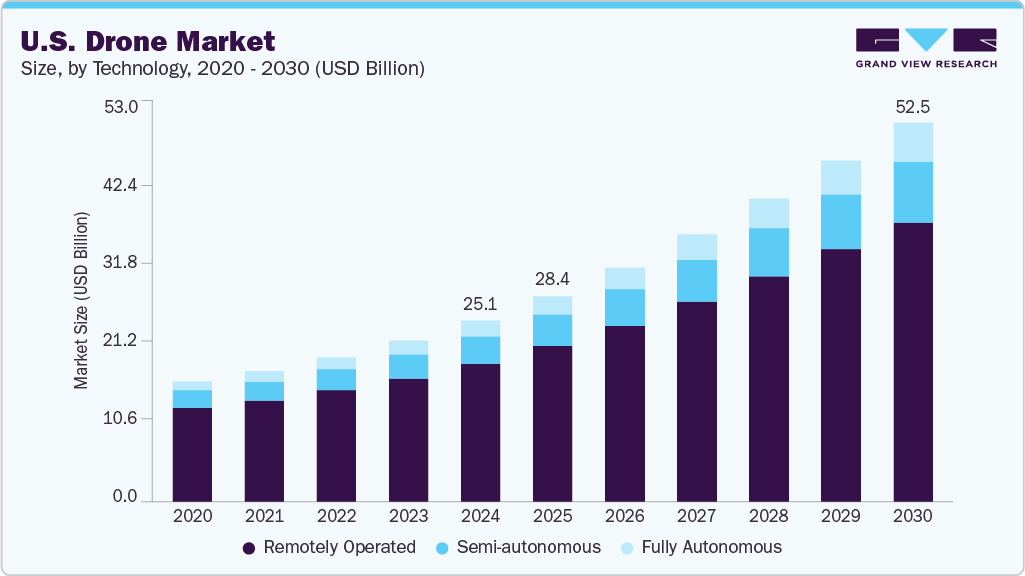 Source: Grand View Research, IR Documents, Primary Interviews, Paid DatabasesTo learn more about this report,
 Download Free Sample Report
 In addition, the integration of advanced technologies such as 5G, IoT, and augmented reality (AR) is significantly enhancing drone capabilities and accelerating market expansion. Nationwide 5G deployment enables faster, low-latency real-time data transmission critical for FAA-approved BVLOS operations in logistics hubs. IoT integration enhances connectivity and automation for surveillance in border patrol missions and precision agriculture. These innovations, backed by FAA waivers and DoD contracts, broaden drone applications from consumer videography to commercial sectors such as energy and delivery, fueling robust U.S. drone industry growth.
Furthermore, the U.S. market is investing heavily in next-generation drone technologies, such as AI-driven autonomy, 5G-enabled swarming, and counter-UAS defense systems, to maintain technological superiority and address evolving security challenges. These investments are boosting domestic manufacturing under NDAA-compliant standards, spurring job creation in drone hubs such as Silicon Valley and North Dakota and accelerating dual-use innovations that enhance commercial applications from precision agriculture to urban air mobility.
Moreover, key companies are engaging in strategic partnerships with defense contractors, tech giants, and logistics providers to accelerate innovation and market penetration. For instance, in January 2026, Northrop Grumman partnered with Kratos to integrate its PRISM autonomy software, advanced sensors, and mission systems onto the XQ-58 Valkyrie drone airframe for the Marine Corps' MUX TACAIR program. Such partnerships are expected to accelerate the deployment of next-generation UAVs, enhance U.S. technological superiority in contested environments, and drive dual-use innovations that expand commercial applications such as autonomous logistics and infrastructure monitoring, thereby fueling the U.S. drone industry expansion.
Component Insights
The hardware segment accounted for the largest market share of over 60% in 2025, driven by continuous technological advancements in sensors, propulsion systems, avionics, and lightweight materials that enhance drone performance, endurance, and operational reliability. Increasing deployment of drones across commercial, government, and defense applications is fueling demand for high-performance, mission-specific hardware capable of operating in complex and regulated environments.
The services segment is expected to grow at the fastest CAGR of over 10% from 2026 to 2033, driven by the rapid shift of end users toward outcome‑based and turnkey solutions rather than in‑house drone ownership and operations. Enterprises across agriculture, infrastructure, energy, public safety, and logistics increasingly prefer Drone‑as‑a‑Service models to reduce upfront capital costs, address regulatory complexity, and overcome shortages of skilled pilots and data analysts. Expanding commercial drone adoption, tightening aviation regulations, and rising demand for compliant BVLOS operations are accelerating outsourcing of flight operations, data processing, fleet management, and training services.
Product Insights
The multi-rotor segment accounted for the largest revenue share in 2025, primarily driven by its superior hover stability, ease of operation, and cost‑effectiveness, making it ideal for short‑range, high‑precision applications. Strong demand from commercial end users, including urban logistics, precision agriculture, infrastructure inspection, public safety, and media & entertainment, continues to fuel adoption, particularly in densely populated megacities across the U.S.
The hybrid segment is projected to experience the fastest growth from 2026 to 2033. The segmental growth is driven by its unique ability to combine vertical take‑off and landing (VTOL) capabilities with the long‑range efficiency of fixed‑wing aircraft, addressing critical operational gaps in diverse and geographically challenging environments. Demand is expanding across large‑scale agriculture, oil & gas pipeline inspection, mining surveys, border surveillance, and disaster‑response missions, where drones must operate from constrained or unprepared sites while covering extensive areas.
Technology Insights
The remotely operated segment accounted for the largest revenue share in 2025, owing to the strong demand in country for applications requiring direct human oversight, such as real-time aerial cinematography at crowded events in megacities across U.S. Defense forces across border regions favor this technology for tactical surveillance and payload deployment, leveraging low-latency video feeds and manual intervention to adapt to unpredictable threats such as adversarial jamming or sudden weather shifts in monsoon-prone areas. Infrastructure inspections across extensive rail networks, power grids, and offshore wind farms in the U.S. are benefiting from growing operator expertise in interpreting real-time thermal and sensor data for immediate fault detection.
 To learn more about this report, Download Free Sample Report
 The fully autonomous segment is expected to experience the fastest growth from 2026 to 2033. This growth is driven by increasing demand for large-scale, repetitive missions such as environmental monitoring, border surveillance, and infrastructure inspection across vast and often remote regions of the U.S Advanced machine learning and AI technologies are enabling drones to execute self-optimizing flight paths, swarm coordination, and real-time data fusion with minimal or no human intervention. This significantly reduces operational costs and enhances efficiency, particularly in low-connectivity or high-risk environments such as offshore energy sites, national parks, and critical infrastructure corridors.
Payload Capacity Insights
The up to 2KG segment accounted for the largest revenue share in 2025, primarily driven by strong demand across consumer and small-scale commercial applications, particularly in precision agriculture, aerial photography, inspection, and public safety. In the U.S., compact drones equipped with multispectral and high-resolution cameras are widely used by farmers to monitor crop health, detect pest infestations, and optimize irrigation across large-scale farms and orchards. Their affordability, ease of deployment, and user-friendly operation make them especially attractive to small and medium-sized enterprises (SMEs) and individual operators.
The 2KG to 19KG segment is expected to experience the fastest growth from 2026 to 2033. This growth is propelled by the increasing demand for versatile, mid-sized drones capable of carrying advanced payloads across a wide range of commercial and defense applications. In the U.S., this segment is widely used for infrastructure inspection across extensive highway networks, bridges, rail systems, and power transmission lines. Equipped with LiDAR scanners and thermal imaging cameras, these drones enable efficient detection of structural defects and maintenance issues without the need for manual inspection or scaffolding, significantly reducing operational costs and downtime.
Power Source Insights
The battery-powered segment accounted for the largest revenue share in 2025. Rapid expansion of commercial drone applications across agriculture for crop monitoring and precision spraying, logistics for urban last-mile deliveries amid booming e-commerce in densely populated cities, and defense for tactical surveillance drives the dominance of battery-powered drones in U.S. Technological advancements in lithium-ion and lithium-polymer chemistries from manufacturing powerhouses enhance energy efficiency, lightweight design, and quick charging suitability for frequent short-to-medium missions, aligning with high-volume production capabilities and cost-effective scalability.
The hydrogen fuel cell segment is expected to grow the fastest CAGR from 2026 to 2033, driven by needs for ultra-long endurance in defense reconnaissance, precision agriculture over large farmlands, and maritime surveillance across expansive oceanic regions in country. Government-led carbon neutrality initiatives and investments in green aviation technologies accelerate R&D, enabling faster refueling and zero-emission operations that surpass battery constraints in high-stakes missions requiring minimal downtime.
End Use Insights
The military segment accounted for the largest revenue share in 2025, primarily fueled by rising disposable incomes, increasing interest in aerial photography and videography, and the growing adoption of drones for recreational and semi-professional use across the U.S. Declining prices, compact designs, and continuous improvements in flight stability, camera quality, and battery life have made consumer drones more accessible to first-time buyers. The rapid expansion of social media and content creation platforms is further fueling demand for high-quality aerial visuals, particularly among influencers, hobbyists, and independent creators.
The consumer segment is expected to witness the fastest growth from 2026 to 2033, owing to the increasing affordability and accessibility of recreational drones. Continuous advancements in compact design, high-definition imaging, and user-friendly controls are making drones more appealing to hobbyists and content creators. The growing popularity of aerial photography, social media content creation, and recreational flying, along with the integration of automated flight modes and AI-based features, is accelerating the expansion of the consumer segment in the drone industry.
Key U.S. Drone Company Insights
Some of the key players operating in the market are Northrop Grumman Corporation, and RTX Corporation, among others.
-
Northrop Grumman Corporation provides aerospace and defense technology solutions to government, military, and commercial customers worldwide. The company operates across key segments, including unmanned systems, autonomous technologies, C4ISR, cybersecurity, mission systems, and space systems. Its product offerings span military aircraft, missile defense, advanced weapons, space technologies, and specialized engineering, logistics, and modernization services.
-
RTX Corporation operates across segments, including aerospace engines, avionics and mission systems, integrated defense systems, and aftermarket services such as fleet management and MRO. Its products include aircraft engines, avionics, mission systems, precision weapons, air defense solutions, and space technologies tailored for aviation, defense, and space exploration.
BlueHalo and 3DR, Inc. are some of the emerging market participants in the U.S. drone market.
-
BlueHalo is a U.S.-based defense technology company that specializes in developing advanced solutions across space systems, counter-uncrewed aircraft systems (C-UAS), autonomous platforms, electronic warfare, cyber operations, and artificial intelligence. The company focuses on rapidly designing and deploying next-generation technologies to support national security and critical defense missions. BlueHalo was acquired by AeroVironment, Inc. in May 2025.
-
3DR, Inc. is a U.S.-based technology company that specializes in the design and manufacture of electronic systems for unmanned vehicles, including drones and UAVs, with a strong focus on open-source and open-hardware autopilot platforms. The company leverages expertise in engineering, aerospace, and advanced electronics to develop innovative, high-quality components, including flight controllers, GPS modules, and telemetry systems.
Key U.S. Drone Companies:
- AeroVironment Inc.
- Northrop Grumman Corporation
- RTX Corporation
- L3Harris Technologies
- Lockheed Martin Corporation
- General Atomics Aeronautical Systems Inc.
- Teledyne FLIR LLC
- Boeing
- Skydio
- BlueHalo
- 3DR, Inc.
- Shield AI Inc.
Recent Developments
-
In April 2026, the U.S. Navy selected Shield AI to compete for a USD 800 million ISR (Intelligence, Surveillance, and Reconnaissance) services contract featuring their V-BAT vertical take-off drone.
-
In March 2026, Skydio secured a USD 52 million order from the U.S. Army for nearly 3,000 X10D drones. This is the largest single-vendor small UAS purchase in U.S. military history.
-
In February 2026, General Atomics Aeronautical Systems Inc. announced development of long-range weapons capabilities for its MQ-9B Sky Guardian and Sea Guardian drones. This expands MQ-9B from ISR to multi-role strike missions for U.S. allies and partners.
U.S. Drone Market Report Scope
Report Attribute
Details
Market size value in 2026
USD 33,400.9 million
Revenue forecast in 2033
USD 58,552.8 million
Growth rate
CAGR of 8.3% from 2026 to 2033
Base year for estimation
2025
Historical data
2021 - 2024
Forecast period
2026 - 2033
Quantitative units
Revenue in USD million/billion, and CAGR from 2026 to 2033
Report product
Revenue forecast, company ranking, competitive landscape, growth factors, and trends
Segments covered
Component, product, technology, payload capacity, power source, end use
Country scope
U.S.
Key companies profiled
AeroVironment Inc.; Northrop Grumman Corporation; RTX Corporation; L3Harris Technologies; Lockheed Martin Corporation; General Atomics Aeronautical Systems Inc.; Teledyne FLIR LLC; Boeing; Skydio; BlueHalo; 3DR, Inc.; Shield AI Inc.
Customization scope
Free report customization (equivalent to up to 8 analyst’s working days) with purchase. Addition or alteration to country, regional & segment scope.
Pricing and purchase options
Avail customized purchase options to meet you exact research needs. Explore purchase options
U.S. Drone Market Report Segmentation
This report forecasts revenue growth at the country level and provides an analysis of the latest technology trends in each of the sub-segments from 2021 to 2033. For this study, Grand View Research has segmented the drone market report based on component, product, technology, payload capacity, power source, and end use:
-
Component Outlook (Revenue, USD Million, 2021 - 2033)
-
Hardware
-
Frames
-
Control System
-
Power & Product System
-
Camera System
-
Navigation System
-
Transmitter
-
Wings
-
Others
-
-
Software
-
Services
-
Integration & Engineering
-
Maintenance & Support
-
Training & Education
-
Others
-
-
-
Product Outlook (Revenue, USD Million, 2021 - 2033)
-
Fixed-Wing
-
Multi-Rotor
-
Single-Rotor
-
Hybrid
-
-
Technology Outlook (Revenue, USD Million, 2021 - 2033)
-
Remotely Operated
-
Semi-Autonomous
-
Fully Autonomous
-
-
Payload Capacity Outlook (Revenue, USD Million, 2021 - 2033)
-
Up to 2KG
-
2KG to 19KG
-
20KG to 200KG
-
Over 200KG
-
-
Power Source Outlook (Revenue, USD Million, 2021 - 2033)
-
Battery-Powered
-
Gasoline-Powered
-
Hydrogen Fuel Cell
-
Solar
-
-
End Use Outlook (Revenue, USD Million, 2021 - 2033)
-
Consumer
-
Prosumer
-
Toy/Hobbyist
-
Photogrammetry
-
-
Commercial
-
Inspection/Maintenance
-
Mapping & Surveying
-
Photography/Filming
-
Surveillance & Monitoring
-
Localization/Detection
-
Spraying/Seeding
-
Others
-
-
Military
-
Intelligence, Surveillance, Target Acquisition, and Reconnaissance (ISTAR)
-
Communication
-
Combat Operations
-
Military Cargo Transport
-
Precision Strikes
-
Others
-
-
Government & law enforcement
-
Frequently Asked Questions About This Report
The U.S. drone market size was estimated at USD 29,326.2 million in 2025 and is expected to reach USD 33,400.9 million in 2026.
Some key players operating in the U.S. drone market include AeroVironment, Northrop Grumman, RTX (Raytheon Technologies), L3Harris Technologies, Lockheed Martin, General Atomics, Teledyne FLIR, Boeing, Skydio, BlueHalo, 3D Robotics (3DR), and Shield AI.
Key factors that are driving the market growth include increasing adoption of drones for commercial applications, rising demand for advanced sensors and imaging systems, and growing investments in defense and surveillance operations.
The global U.S. drone market is expected to grow at a compound annual growth rate of 8.3% from 2026 to 2033 to reach USD 58,552.8 million by 2033.
The hardware segment dominated the U.S. drone market with a share of over 59% in 2025, owing to rising investments in advanced drone components such as sensors, cameras, navigation systems, and propulsion technologies that enhance performance, durability, and operational efficiency.
About the Author(s)
Next Generation Technologies Research Team
Technology · Next Generation TechnologiesThis report was authored by the next generation technologies research team at Grand View Research - comprising two research analysts, one senior research analyst, and one industry expert - with specialized expertise in the next generation technologies segment of the technology industry. All findings are based on proprietary technology databases, executive interviews, and regulatory analysis, subject to internal peer review prior to publication.
Last Updated:
Speak to Analyst

Customize this report to your needs - add regions, segments, or data points, with 20% free customization.
Or view our licence options:


ISO 9001:2015 & 27001:2022 Certified
We are GDPR and CCPA compliant! Your transaction & personal information is safe and secure. For more details, please read our privacy policy.


