
- Home
- »
- Medical Devices
- »
-
U.S. Emergency Medical Services Disposable Products Market 2033GVR Report cover

U.S. Emergency Medical Services Disposable Products Market (2025 - 2033) Size, Share & Trends Analysis Report By Product (Blankets, Straps, Sheers, Packs, Stretcher Sheets, Soft Stretchers), By End Use (Hospitals & Trauma Centers, Ambulatory Surgical Centers), And Segment Forecasts
U.S. Emergency Medical Services Disposable Products Market Summary
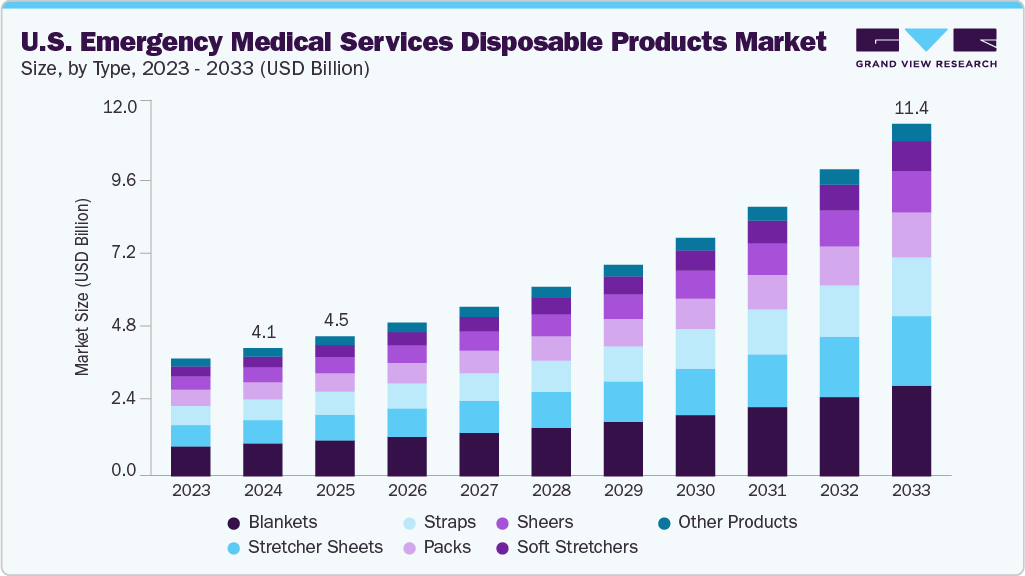
The U.S. emergency medical services disposable products market size was valued at USD 4.13 billion in 2024 and is expected to reach USD 11.36 billion by 2033, growing at a CAGR of 8.10% from 2025 to 2033. This growth can be attributed to an aging population and rising prevalence of chronic diseases are increasing EMS call volumes and the need for single-use dressings, consumable diagnostic kits, and other disposables. Operational modernization of EMS (upgrades to ALS/BLS equipment, point-of-care diagnostics, telemedicine-enabled ambulances) and rising EMS budgets push agencies to adopt advanced disposable consumables that simplify workflows and shorten turnaround times.
 Source: Grand View Research, IR Documents, Primary Interviews, Paid DatabasesTo learn more about this report,
 Download Free Sample Report
Increasing Medical Emergencies and Chronic Disease Prevalence
The rising incidence of medical emergencies and the increasing prevalence of chronic diseases in the U.S. are driving the demand for Emergency Medical Services (EMS) disposable products. As the population continues to age and lifestyle-related health conditions become more widespread, the need for emergency interventions is growing. A report from the 2023 American Heart Association (AHA) indicates that nearly half of the U.S. population (48.6%) has some form of cardiovascular disease, including coronary heart disease, heart failure, stroke, and high blood pressure. The increasing prevalence of such conditions results in more medical emergencies, such as heart attacks and strokes, which require rapid EMS interventions and the use of disposable products such as defibrillators, ECG monitors, and oxygen equipment.
In addition, according to a CDC report, in 2023, approximately 76.4% of U.S. adults reported having at least one chronic condition, which translates to about 194 million individuals. Among these, 51.4% (approximately 130 million adults) experienced multiple chronic conditions. The prevalence of chronic conditions has notably increased over the past decade, particularly among younger adults, where the incidence rose from 52.5% in 2013 to 59.5% in 2023.
Advancements in Materials and Product Design
The growth of the U.S. EMS disposable products market is significantly driven by advancements in materials and product design. These innovations are transforming the way EMS products are used, improving safety, efficiency, and patient comfort. With better materials and design, EMS disposable products are becoming more effective and easier to use in urgent situations.
For instance, thermal blankets used in emergency care have evolved with the use of advanced mylar technology, which offers superior heat retention while remaining lightweight and compact. These blankets are designed to rapidly warm patients suffering from hypothermia, providing a non-toxic, waterproof, and breathable material that reflects body heat back toward the patient. In addition, safety straps have also benefited from advancements in materials such as high-strength polyester and reinforced nylon, which have significantly enhanced both the security and comfort of patients during transport. These straps are designed for quick deployment, with smooth surfaces that reduce discomfort while providing firm restraint.
Growing Emphasis on Healthcare Cost Reduction
Healthcare cost reduction is a key driver for the growing adoption of disposable products in the U.S. As healthcare providers face increasing pressure to lower operational expenses while maintaining high-quality care, disposable EMS products, such as sterile gloves, bandages, sheets, and catheters, offer an efficient and cost-effective solution. These single-use products reduce the need for expensive reprocessing of reusable medical equipment, thus lowering the overall cost burden on hospitals and EMS providers.
Reprocessing reusable medical equipment incurs significant costs, including labor, sterilization materials, and time, with the added risk of infection if equipment is not properly sanitized. For instance, in many U.S. hospitals, reusable equipment such as surgical instruments and catheters requires extensive cleaning and sterilization procedures. A study by Rady Children’s Hospital in San Diego found that reprocessing costs, encompassing maintenance, packaging, labor, and high-level disinfection, range from $0.51 to $0.77 per instrument. Moreover, only 13% to 21.9% of opened instruments are ultimately used, leading to inefficiencies and increased expenses. This makes disposable alternatives a more cost-effective option, as they eliminate the need for these ongoing reprocessing costs.
Market Concentration & Characteristics
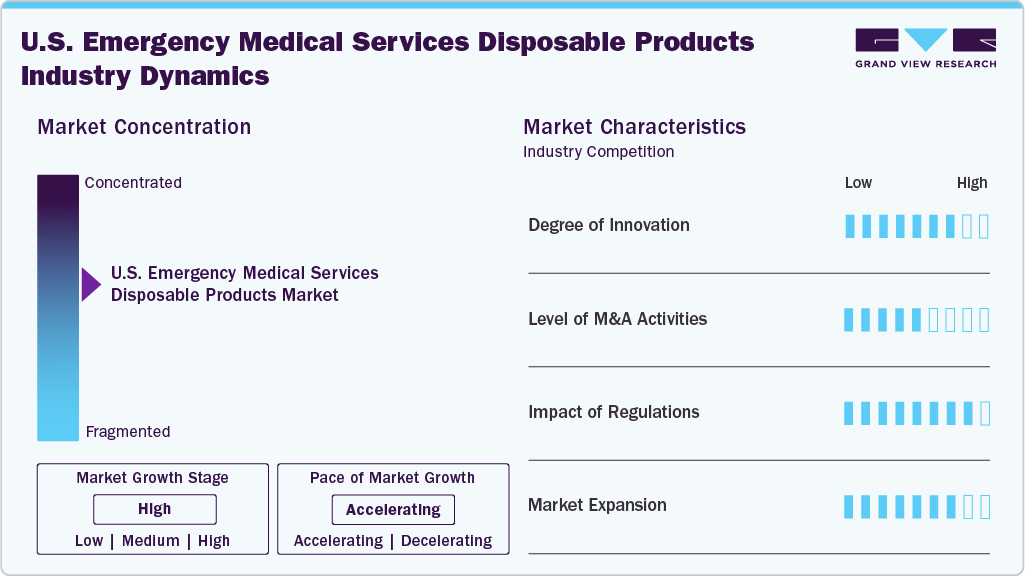
The industry is fragmented, with many small players entering the market and launching new innovative products. The degree of innovation is medium, and the level of merger & acquisition activities is medium. The impact of regulations on the market is high, and the market expansion of players is medium.
Innovation in the industry is driven by a push for smarter, safer, and more sustainable single-use items. In July 2025, Medline Industries introduced its ComfortTemp Patient Warming System, designed to enhance patient care by maintaining optimal body temperature during medical procedures. The system features warming blankets and gowns that provide consistent, controlled heat, helping to prevent hypothermia in patients undergoing surgery or extended treatments.
 To learn more about this report, Download Free Sample Report
Key players are leveraging strategies such as collaborations, partnerships, and acquisitions to promote the reach of their offerings and increase their product capabilities. In September 2025, SAM Medical (a pre-hospital emergency medical products company based in Tualatin, Oregon) announced that it had acquired TyTek Medical, which is part of the TyTek Group. By bringing in TyTek’s chest decompression needle line, SAM Medical enhances its own product offerings. That means they can provide more comprehensive trauma-care solutions for first responders, EMS, tactical teams, wilderness rescue, and similar markets.
"The acquisition of TyTek Medical strengthens our ability to deliver a comprehensive range of solutions for emergency medical professionals," said Jim Seidel, CEO of SAM Medical. "TyTek's strong reputation for high-quality, life-saving products aligns perfectly with our commitment to support first responders in their most critical moments. This acquisition better positions us to set the standard in the markets we serve."
In the market, federal regulation is layered and focused on safety, labeling, manufacturing controls, worker protection, and safe disposal. The FDA treats many disposables (syringes, single-use airway devices, PPE, etc.) as medical devices subject to device classification (Class I-III), applicable premarket requirements (510(k) or PMA when not exempt), labeling/UDI rules, and post-market reporting. Manufacturers must operate under the FDA’s Quality System/Good Manufacturing Practice rules (21 CFR Part 820 / QSR), now being aligned with ISO-13485 requirements, which govern design controls, production, sterility assurance and complaints.
The level of market expansion is significant in the U.S. due to various government programs and initiatives. For instance, in April 2024, Teleflex Incorporated inaugurated an expanded manufacturing facility at its Teleflex Medical OEM site in Jaffrey, New Hampshire. The 8,200-square-foot expansion enhances the company's extrusion capabilities, enabling the production of polytetrafluoroethylene (PTFE) tubing and fluorinated ethylene propylene (FEP) heat shrink products.
Product Insights
The blankets segment dominated the market with a revenue share of 25.62% in 2024 due to several key operational, environmental, and institutional factors. A major factor driving this trend is the heightened focus on patient comfort, protection, and thermal regulation during emergency care and transport. Proper management of body temperature is crucial for preventing hypothermia and enhancing clinical outcomes in trauma or disaster scenarios. Moreover, the increasing frequency of natural disasters, mass-casualty incidents, and outdoor emergencies has led to a greater reliance on compact, lightweight emergency blankets that offer quick insulation and protection from the elements. The introduction of the Thermal Emergency Blanket (SKU: WL3537) by WNL Products represents a practical development within the market, particularly in the segment of emergency preparedness and patient protection solutions. This product reflects ongoing advancements in material science and design that focus on portability, efficiency, and reliability in critical environments.
The stretcher sheets segment is anticipated to grow at the fastest CAGR during the forecast period. The heightened focus on infection control and sanitation within emergency medical environments is a significant reason for the rising demand. Disposable sheets help prevent cross-contamination and eliminate the need for laundry, thus lowering the risk of pathogen transmission, especially in busy facilities with quick patient turnover. In addition, these sheets are cost-effective, providing a practical solution for EMS providers looking to reduce operational costs. The ease and efficiency of using single-use sheets contribute to increasing adoption in EMS practices.
End Use Insights
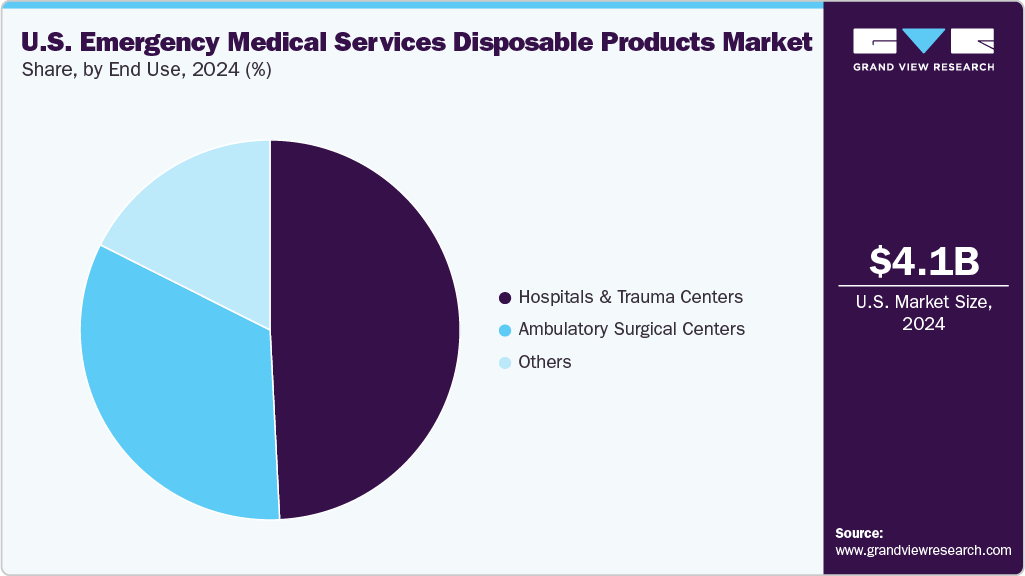
The hospitals & trauma centers segment dominated the market with the largest revenue share of 49.20% in 2024. The necessity for infection control, operational efficiency, and compliance with stringent regulatory standards essentially drives this demand. The heightened focus on reducing hospital-acquired infections (HAIs) and preventing cross-contamination has led to increased usage of single-use disposable items, including airway management devices, catheters, gloves, syringes, suction systems, and wound care materials. The advancement of emergency response systems and point-of-care treatments within hospital emergency departments also drives this increased consumption. For instance, institutions such as the Mayo Clinic, Johns Hopkins Hospital, and Massachusetts General Hospital have dedicated trauma and emergency response units that depend heavily on sterile, single-use products to ensure a swift turnaround between patients.
 To learn more about this report, Download Free Sample Report
The ambulatory surgical centers (ASCs) segment is expected to grow at the fastest CAGR over the forecast period. The demand for disposable EMS products in ASCs across the U.S. is mainly influenced by an increased emphasis on patient safety, infection control, and operational efficiency. ASCs handle a large number of outpatient procedures that often necessitate quick responses to emergencies such as airway obstructions, cardiac issues, or trauma-related complications. Disposable items, such as anesthesia masks, breathing bags, bougies for intubation, biohazard bags, and pediatric breathing devices, help reduce the risk of cross-contamination and ensure adherence to strict CDC and OSHA standards. The trend toward single-use products is also supported by the growing number of outpatient surgeries, advancements in EMS technology, and greater awareness of hospital-acquired infections.
Key U.S. Emergency Medical Services Disposable Products Companies Insights
Key players operating in the U.S. emergency medical services disposable products market are undertaking various initiatives to strengthen their presence and increase the reach of their products and services. Strategies such as expansion activities and partnerships are key in propelling the market growth. Medline and McKesson supply broad portfolios of EMS-specific disposables (stretchers/linen packs, wound care, airway kits, PPE and prepacked EMS kits) and emphasize fast distribution and EMS-focused catalogs for BLS/ALS crews. Cardinal Health and Owens & Minor are major national distributors with strong private-label and single-use product lines (underpads, exam supplies, single-use instruments) and logistics capabilities that help agencies manage inventory and contracts. Ambu and Teleflex are prominent manufacturers of single-use airway and ventilation disposables.
Key U.S. Emergency Medical Services Disposable Products Companies:
- Busse Hospital Disposables
- Stryker
- ICU Medical
- Medline Industries
- Teleflex Incorporated
- NovoSci
- Mercury Medical
- Ambu Inc.
- AdvaCare Pharma
- Narang Medical USA Corporation
Prism AI by Grand View Research Free to tryAsk a question about the U.S. emergency medical services disposable products marketTry asking✓Every figure cited from GVR research Prefer the report? Download free sample →Recent Developments
- In September 2025, ICU Medical announced that its Clave portfolio of needlefree IV connectors has received new FDA 510(k) clearance for updated labeling claims, reflecting enhanced infection control capabilities. This clearance is based on robust clinical and laboratory data demonstrating the device’s ability to reduce the risk of catheter-related bloodstream infections (CRBSIs).
“This new 510(k) is a testament to our team’s dedication to infusion safety and the patients we serve,” said corporate vice president and general manager of ICU Medical Infusion Consumables. “IV connectors are often treated as a commodity, but this new evidence shows they are anything but. The right connector is a critical part of a hospital’s infection prevention and care strategy-and Clave technology proves how smart standardization can lead to meaningful reductions in infections, mortality, and cost.”
- In July 2025, Mercury Medica partnered with Flat Medical to introduce the EpiFaith Smart Syringe to the U.S. market, marking a significant advancement in injectable device technology. This collaboration enables Mercury Medical to leverage Flat Medical’s innovative technology and establish a presence in the U.S. smart medical device segment, reflecting the growing trend toward digital and connected healthcare solutions that prioritize both patient safety and provider convenience.
“We are excited to partner with Flat Medical to bring this groundbreaking epidural safety technology to our US customers,” said M.D., President and CEO of Mercury Medical. “The EpiFaith Smart Syringe represents an elegant practical innovation that directly aligns with our corporate mission and improves patient outcomes - something our clinical customer base expects and values.”
- In August 2024, Dynarex introduced two new emergency-medical product lines DynaSafety and Code Blue Care to deepen its footprint in first aid, trauma, and EMS preparedness. The DynaSafety line comprises ANSI-compliant first aid essentials from antiseptic sprays, adhesive bandages, fluid disposal systems, to tourniquets and CPR shields crafted for broad use in workplaces, schools, homes, and general first responder settings.
"First aid and emergency care are both crucial in managing health crises, and Dynarex now offers a full range of premium products to meet both sets of needs," said Kristen Dreyer, Dynarex Manager of Product Development. "The new DynaSafety and Code Blue Care products exemplify our dedication to providing top-tier, reliable solutions for both every day and emergency situations."
U.S. Emergency Medical Services Disposable Products Market Report Scope
Report Attribute
Details
Market size in 2025
USD 4.51 billion
Revenue forecast in 2033
USD 11.36 billion
Growth rate
CAGR of 8.10% from 2025 to 2033
Actual data
2021 - 2024
Forecast data
2025 - 2033
Quantitative units
Revenue in USD million/billion and CAGR from 2025 to 2033
Report coverage
Revenue forecast, company ranking, competitive landscape, growth factors, and trends
Segments covered
Product, end use
Country scope
U.S.
Key companies profiled
Busse Hospital Disposables; Stryker; ICU Medical; Medline Industries; Teleflex Incorporated; NovoSci; Mercury Medical; Ambu Inc.; AdvaCare Pharma; Narang Medical USA Corporation
Customization scope
Free report customization (equivalent up to 8 analysts working days) with purchase. Addition or alteration to country, regional & segment scope.
Pricing and purchase options
Avail customized purchase options to meet your exact research needs. Explore purchase options
U.S. Emergency Medical Services Disposable Products Market Report Segmentation
This report forecasts revenue growth at the country level and provides an analysis of the latest industry trends in each of the sub-segments from 2021 to 2033. For this study, Grand View Research has segmented the U.S. emergency medical services disposable products market report based on product and end use.
-
Product Outlook (Revenue, USD Billion, 2021 - 2033)
-
Blankets
-
Straps
-
Sheers
-
Packs
-
Stretcher Sheets
-
Soft stretchers
-
Other Products
-
-
End Use Outlook (Revenue, USD Billion, 2021 - 2033)
-
Hospitals & Trauma Centers
-
Ambulatory Surgical Centers
-
Others
-
About the Author(s)
Medical Devices Research Team
Healthcare · Medical DevicesThis report was authored by the medical devices research team at Grand View Research - comprising two research analysts, one senior research analyst, and one industry expert - with specialized expertise in the medical devices segment of the healthcare industry. All findings are based on proprietary healthcare databases, executive interviews, and regulatory analysis, subject to internal peer review prior to publication.
Last Updated:
Speak to Analyst

Customize this report to your needs - add regions, segments, or data points, with 20% free customization.
Or view our licence options:


ISO 9001:2015 & 27001:2022 Certified
We are GDPR and CCPA compliant! Your transaction & personal information is safe and secure. For more details, please read our privacy policy.


