
- Home
- »
- Homecare & Decor
- »
-
U.S. Floor Care Chemicals Market, Industry Report, 2033GVR Report cover

U.S. Floor Care Chemicals Market (2026 - 2033) Size, Share & Trends Analysis Report By Product (Floor Cleaners & Maintainers, Floor Disinfectant, Carpet Cleaner Solution, Floor Polish/ Wax, Floor Strippers), By Supply Type, By End-user, By Type, By Enterprise Size, And Segment Forecasts
Market Size, 2025 (US$B)$4.00Forecast, 2033 (US$B)$5.08CAGR, 2026 - 20333.1%U.S. Floor Care Chemicals Market Summary
The U.S. floor care chemicals market size was estimated at approximately USD 4.00 billion in 2025 and is projected to reach USD 5.08 billion in 2033, growing at a CAGR of 3.1% from 2026 to 2033. The growth is primarily driven by the expansion of outsourced facility management and contract cleaning models across healthcare, retail, commercial offices, and education, which standardize floor maintenance protocols and increase per-site chemical consumption and recurring demand.
Key Market Trends & Insights
- By product, the floor disinfectant segment accounted for a market share of 33.7% in 2025.
- By end-user, the food service segment accounted for a market share of 14.7% in 2025.
- By supply type, the contract-based floor care chemicals segment accounted for a market share of 74.0% in 2025.
- By type, the product-only supply contracts in contract-based segment accounted for a market share of 25.4% in 2025.
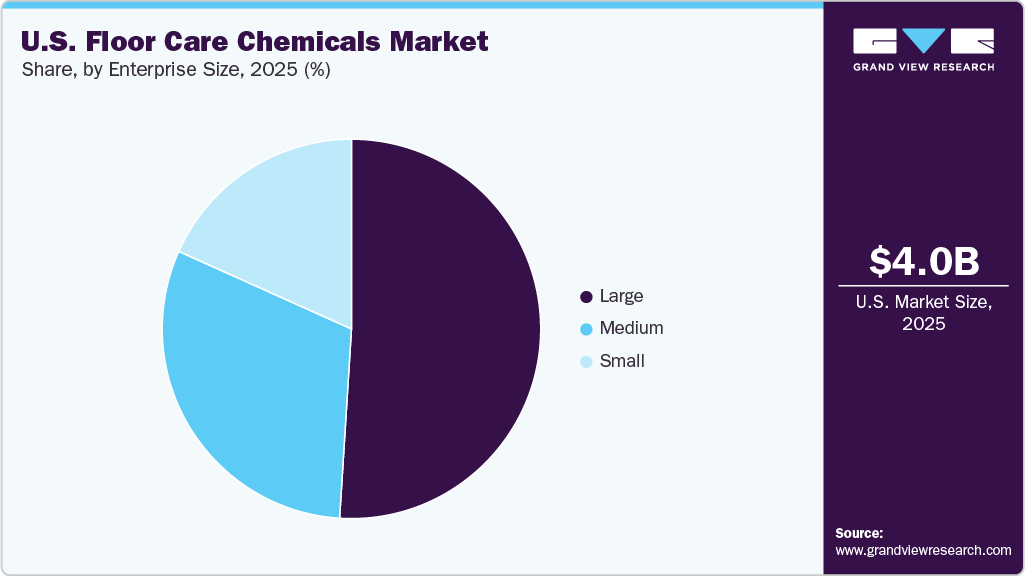
- By enterprise size, the large enterprises segment accounted for a market share of 51.0% in 2025.
Market Size & Forecast
- 2025 Market Size: USD 4.00 Billion
- 2033 Projected Market Size: USD 5.08 Billion
- CAGR (2026-2033): 3.1%
Prism AI by Grand View Research Free to tryAsk a question about the U.S. floor care chemicals marketTry asking✓Every figure cited from GVR research Prefer the report? Download free sample →
At the same time, the shift toward system-based cleaning (auto-scrubbers, robotics, and dilution control systems) and the faster adoption of premium formulations, such as low-foam auto-scrubber detergents, disinfectant cleaners, and high-performance floor finishes are outpacing basic cleaners, lifting overall market value beyond volume growth, while sustainability requirements (low-VOC, environmentally preferable chemistries) and stricter hygiene standards continue to reinforce premiumization and long-term demand.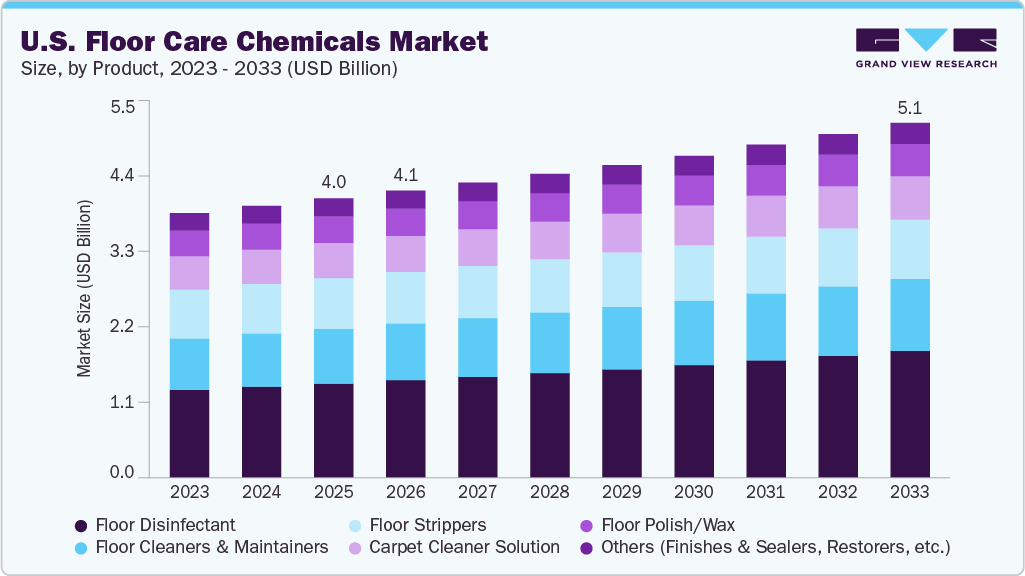 Source: Grand View Research, IR Documents, Primary Interviews, Paid DatabasesTo learn more about this report,
 Download Free Sample Report
Additionally, sector-specific demand intensity is increasing, particularly in high-footfall environments such as hospitals, airports, and large-format retail, where continuous operations require more frequent maintenance cycles and specialized surface treatments. The growing use of resilient flooring materials (e.g., LVT and polished concrete) is also shifting chemical demand toward restorative cleaners, conditioners, and protective coatings, creating incremental revenue streams tied to floor lifecycle management rather than just routine cleaning.
The biggest structural driver in the U.S. floor care chemicals industry is the shift toward contract-based facility management, in which floor care is delivered through bundled programs covering chemicals, dilution systems, equipment, maintenance schedules, audits, and staff training. This model is being supported by the scale of the U.S. cleaning workforce: janitors and building cleaners held about 2.4 million jobs in 2024, with 351,300 openings projected annually through 2034. Under these managed programs, cleaners, degreasers, disinfectants, strippers, and floor finishes are being applied through controlled dilution and closed-loop dosing systems, creating standardized consumption and recurring chemical demand across hospitals, schools, offices, retail stores, and public facilities.
Another major driver for the U.S. floor care chemicals market is the tightening of hygiene and safety protocols in institutional environments. CDC guidance indicates that patient-area floors in healthcare facilities should generally be cleaned daily, while outpatient examination areas require cleaning at least twice daily, shared toilets require cleaning and disinfection at least twice daily, and several procedural or high-risk spaces require cleaning before and after each procedure. This increases the use of multi-stage floor care systems, in which soil removal, disinfection, slip-risk reduction, and surface protection are performed as separate yet interconnected processes.
Growth is also being strengthened by sustainability-led premiumization. The U.S. EPA reported 1,656 Safer Choice-certified products in FY2025, with a strategic target of 2,300 certified products by September 30, 2026, reflecting growing institutional preference for safer, lower-toxicity chemistries. As auto-scrubbers, robotic systems, low-foam detergents, high-durability finishes, and restorative coatings are increasingly adopted, value growth is being driven not only by increased cleaning frequency but also by improved product mix, longer floor-protection lifecycles, and service integration.
Brand Share Analysis
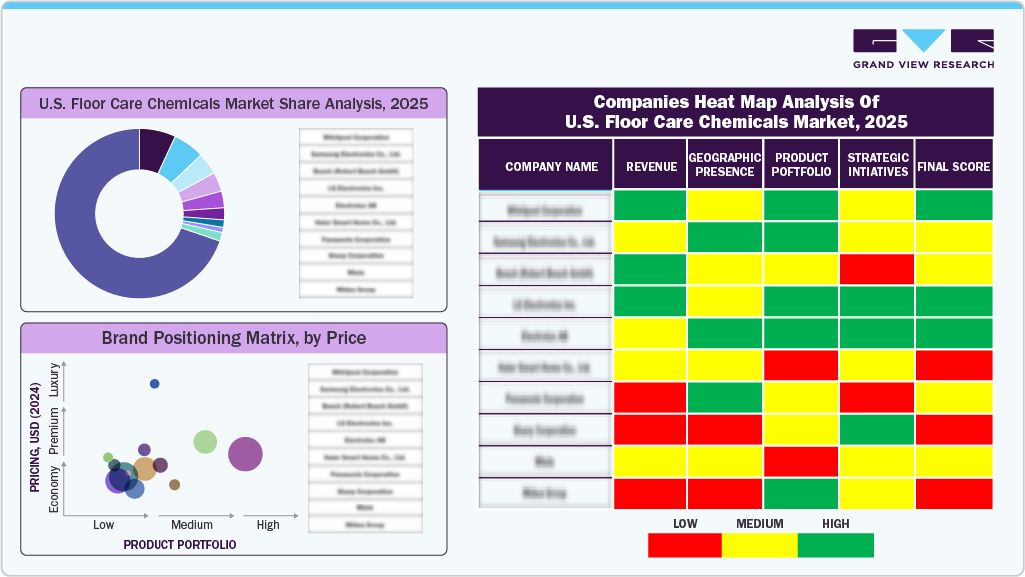
The U.S. floor care chemicals market is moderately consolidated, with a few multinational hygiene and cleaning solution providers accounting for a significant share of institutional demand, while a fragmented base of regional and private-label suppliers competes on price and niche applications. Leading companies such as Ecolab, Diversey Holdings, Clorox Company, SC Johnson Professional, and Spartan Chemical Company dominate the institutional segment through integrated service offerings, strong distributor networks, and long-term service contracts with healthcare systems, education institutions, and commercial facilities. These players compete primarily through bundled solutions that combine chemicals with dispensing systems, compatibility with floor care equipment, and technical service support, rather than through standalone product sales.
Competition is increasingly centered on system-based differentiation and performance outcomes, where suppliers offer low-foam auto-scrubber formulations, high-durability floor finishes, restorative coatings, and EPA-compliant disinfectant cleaners tailored to specific floor types and use environments. Larger players leverage closed-loop dilution systems, digital monitoring, and compliance reporting to strengthen client retention and increase share of wallet within contracted accounts. At the same time, private-label brands and regional manufacturers often distributed through janitorial supply networks are gaining traction in cost-sensitive segments such as small and mid-sized commercial facilities, intensifying pricing pressure in commoditized product categories.
 To learn more about this report, Download Free Sample Report
Sustainability positioning is also emerging as a key competitive lever, with leading brands expanding portfolios of low-VOC, safer choice-aligned, and environmentally preferable formulations to meet institutional procurement standards. Additionally, the growing adoption of e-procurement platforms and distributor-led digital channels is reshaping competitive dynamics by improving product visibility, enabling faster replenishment cycles, and allowing smaller brands to access a broader customer base. As a result, competition is evolving from product-centric differentiation toward integrated service delivery, compliance assurance, and lifecycle floor care performance, reinforcing the strategic importance of scale, innovation, and customer integration in maintaining brand share.
Product Insights
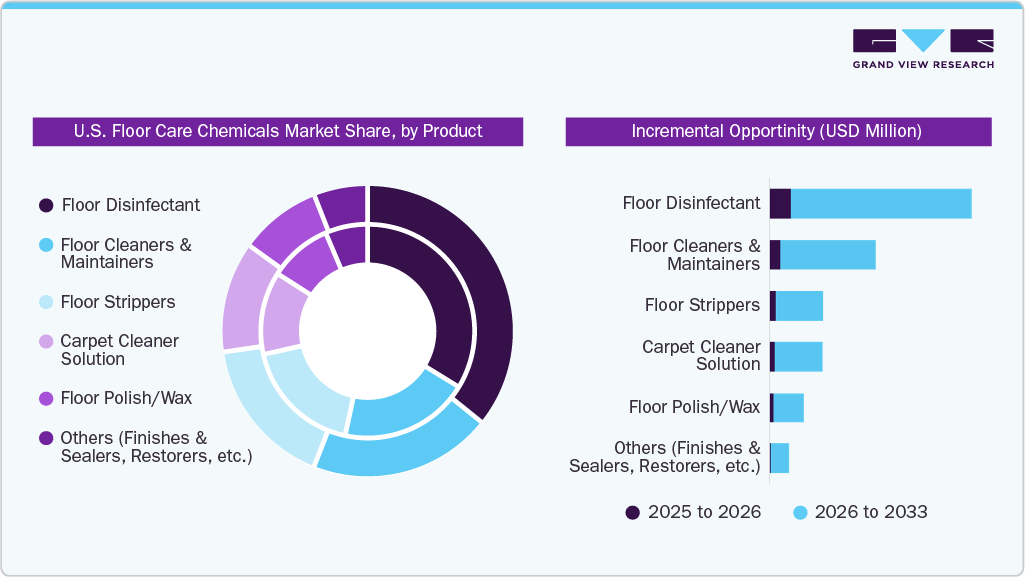
Floor disinfectants led the U.S. floor care chemicals industry, accounting for the largest share of 33.7% in 2025, supported by their critical role in maintaining hygiene and infection control across healthcare facilities, commercial buildings, retail environments, and public infrastructure. Consistent use is driven by high-frequency cleaning protocols, particularly in high-footfall, high-risk areas where microbial contamination risks are elevated. The segment benefits from regulatory emphasis on surface disinfection and the use of EPA-registered formulations, reinforcing its necessity within institutional cleaning programs. In addition, continuous formulation advancements such as fast-acting, broad-spectrum disinfectants compatible with auto-scrubber systems and low-residue chemistries are strengthening adoption. Integration with standardized cleaning workflows and contract-based facility management services further supports recurring demand and high consumption intensity per site.
 To learn more about this report, Download Free Sample Report
The floor cleaners and maintainers segment is expected to grow at a CAGR of 3.5% from 2026 to 2033, driven by the increasing focus on routine floor upkeep, lifecycle extension, and cost-efficient maintenance practices across commercial and institutional settings. Demand is being supported by the widespread adoption of modern flooring materials such as luxury vinyl tile (LVT) and polished concrete, which require specialized cleaners, conditioners, and maintenance solutions to preserve appearance and durability. At the same time, the shift toward automated cleaning systems, including auto-scrubbers and robotic equipment, is encouraging the use of low-foam, equipment-compatible formulations that enhance operational efficiency. The segment is also benefiting from sustainability trends, with growing preference for low-VOC and environmentally preferable chemistries, alongside product innovations that combine cleaning, gloss retention, and protective properties within a single application cycle.
End-user Insights
Food service accounted for the largest share of the U.S. floor care chemicals market at 14.7% in 2025, driven by the high-frequency and hygiene-critical nature of cleaning operations in restaurants, cafés, catering units, and cloud kitchens. Floors in these environments are exposed to continuous grease, oil, food residue, and liquid spills, necessitating multiple cleaning cycles per day to comply with food safety and sanitation standards. This results in consistent, repetitive consumption of degreasers, disinfectants, and scrubber-compatible cleaners, unlike more periodic cleaning needs in other end-use segments. The segment is further supported by the increasing adoption of specialized floor care programs, in which high-performance degreasing formulations and slip-resistant cleaning solutions are deployed through controlled dosing systems to enhance cleaning efficiency, reduce labor time, and ensure safety compliance in fast-paced kitchen environments.
Pharmaceutical manufacturing is expected to grow at a CAGR of 4.1% from 2026 to 2033, supported by the expansion of drug production facilities and stringent regulatory requirements for contamination control. Cleanrooms and controlled environments require validated, residue-free cleaning protocols, with floors maintained using low-particulate, non-residue-forming, and disinfectant-compatible chemical formulations. As production scales and compliance standards tighten, cleaning frequency, documentation, and process validation requirements are increasing, driving steady demand for specialized floor care chemicals. Additionally, the shift toward good manufacturing practice (GMP)-aligned cleaning systems and audit-ready sanitation processes is reinforcing the use of premium, application-specific chemistries, supporting consistent growth in this segment.
Supply Type Insights
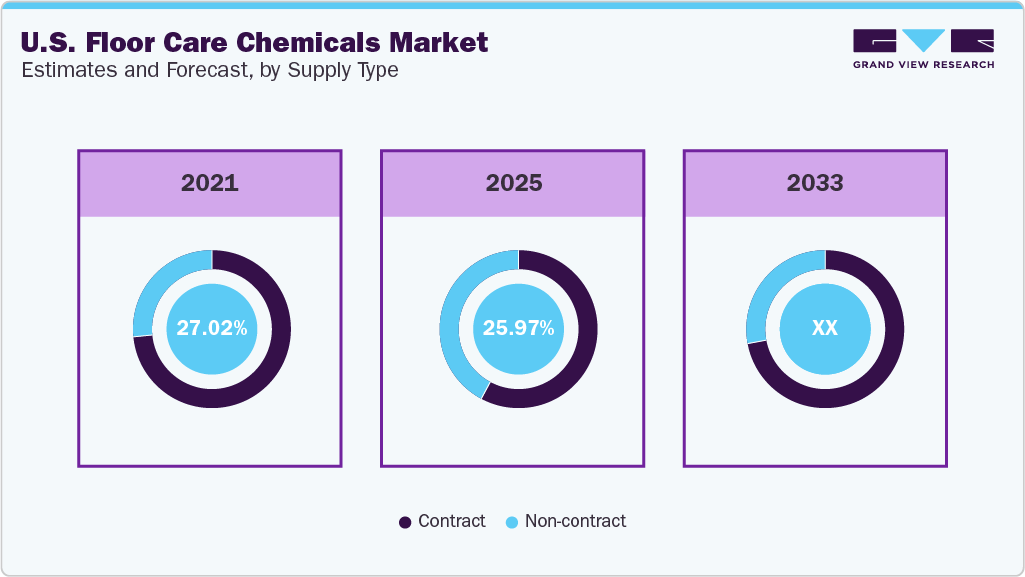
Contract-based supply accounted for the largest share of the U.S. floor care chemicals industry at 74.0% in 2025, as large institutional users such as healthcare systems, retail chains, commercial offices, and facility management companies prefer integrated service models that combine chemicals with dilution systems, floor care equipment compatibility, maintenance schedules, and technical support. These contracts ensure standardized cleaning outcomes, compliance with hygiene and safety protocols, and predictable operating costs, making them more reliable than spot purchasing. Given the high-frequency, continuous nature of floor maintenance across these sectors, contract-based models enable consistent, recurring chemical consumption, supported by monitoring, audits, and performance-based service delivery.
 To learn more about this report, Download Free Sample Report
The non-contract-based supply segment is expected to grow at a CAGR of 2.0% from 2026 to 2033, driven by small and mid-sized businesses, independent facilities, and price-sensitive users that procure chemicals on a need basis through distributors or retail channels. Growth in this segment is supported by localized demand across small commercial establishments and decentralized operations, where long-term service agreements are less prevalent. However, limited access to integrated systems, lower process standardization, and the ongoing shift toward managed service models are constraining its expansion relative to the broader market.
Type Insights
Product-only supply contracts, a subset of contract-based models, accounted for 25.4% of the market in 2025, representing the more traditional form of structured procurement where chemicals are supplied under fixed agreements without full-service integration. These arrangements are typically adopted by institutions that require pricing stability and assured supply continuity, but manage dosing, application, and operational processes internally. While still relevant in certain mid-sized facilities and cost-controlled environments, this segment is gradually being overshadowed by more advanced contract formats that bundle equipment, automation, and performance monitoring, as end users seek greater efficiency, assurance of compliance, and outcome-based service delivery.
Non-contract-based supply is expected to grow at a CAGR of 2.0% from 2026 to 2033, reflecting its continued presence in decentralized, independently operated facilities where procurement decisions are made on a short-term or ad hoc basis. This segment is characterized by flexible purchasing through distributors or retail channels, enabling users to adjust product selection and volumes in response to immediate operational needs. However, the absence of structured dosing systems, limited technical oversight, and variability in application practices often result in inconsistent cleaning outcomes and lower process efficiency, thereby restricting scalability. As operational standards tighten and automation becomes more prevalent, this segment is expected to remain functionally relevant but structurally constrained in long-term value contribution.
Enterprise Size Insights
Large enterprises accounted for the largest share of the U.S. floor care chemicals market at 51.0% in 2025, as organizations such as hospital networks, large retail chains, airports, and corporate campuses operate high-traffic, continuously maintained facilities and rely on contract-based, integrated floor care programs. Their scale enables standardized cleaning protocols, higher cleaning frequency, and consistent chemical consumption, resulting in a disproportionate share of total demand. For instance, Ecolab has expanded its integrated facility care programs with large institutional clients, combining floor care chemicals, dosing systems, equipment compatibility, and digital monitoring tools to optimize cleaning efficiency and sustainability outcomes across multi-site operations, reflecting how large enterprises depend on long-term, performance-driven supply models.
 To learn more about this report, Download Free Sample Report
The medium enterprises segment is expected to grow at a CAGR of 3.0% from 2026 to 2033, supported by the increasing formalization of cleaning practices across mid-sized commercial facilities, education institutions, and regional healthcare providers. As these organizations scale operations, there is a gradual shift from manual, ad-hoc cleaning toward more structured maintenance programs, driving demand for standardized chemical solutions and basic dilution systems. However, adoption of fully integrated service models remains selective, with cost considerations and operational flexibility influencing procurement decisions, resulting in steady but measured growth within this segment.
Key U.S. Floor Care Chemicals Companies:
- Ecolab
- Diversey
- Solenis
- Henkel
- Christeyns
- Kao Corporation
- NCH Corporation
- Stepan Company
- Sealed Air
- Nouryon
Recent Developments
-
In March 2026, Diversey Holdings introduced an advanced floor care program integrating low-foam auto-scrubber detergents with IoT-enabled dosing and monitoring systems, enabling real-time tracking of chemical usage and improving cleaning consistency across large commercial facilities while reducing water and chemical waste.
-
In November 2025, Ecolab expanded its sustainable floor care portfolio with next-generation floor finishes and strippers designed for reduced VOC emissions and extended durability, allowing institutional users to lower maintenance frequency and lifecycle costs while meeting environmental compliance standards.
-
In July 2025, Spartan Chemical Company launched a new line of high-performance, environmentally preferable floor cleaners and maintainers, formulated for compatibility with automated cleaning equipment and designed to deliver effective soil removal with lower residue, supporting efficiency and sustainability goals in commercial and institutional settings.
U.S. Floor Care Chemicals Market Report Scope
Report Attribute
Details
Market size value in 2026
USD 4.11 billion
Revenue forecast in 2033
USD 5.08 billion
Growth rate
CAGR of 3.1% from 2026 to 2033
Base year for estimation
2025
Historical data
2021 - 2025
Forecast period
2026 - 2033
Quantitative units
Revenue in USD million/billion, and CAGR from 2026 to 2033
Report coverage
Revenue forecast, company ranking, competitive landscape, growth factors, and trends
Segments covered
Product, end-user, supply type, type, enterprise size
Country scope
U.S.
Key companies profiled
Ecolab; Diversey; Solenis; Henkel; Christeyns; Kao Corporation; NCH Corporation; Stepan Company; Sealed Air; Nouryon
Customization scope
Free report customization (equivalent up to 8 analysts working days) with purchase. Addition or alteration to country, regional & segment scope.
Pricing and purchase options
Avail customized purchase options to meet your exact research needs. Explore purchase options
U.S. Floor Care Chemicals Market Report Segmentation
This report forecasts revenue growth at the country level and provides an analysis of the latest trends and opportunities in each of the sub-segments from 2021 to 2033. For this study, Grand View Research has segmented the U.S. floor care chemicals market report based on product, end-user, supply type, type, and enterprise size:
-
Product Outlook (Revenue, USD Million, 2021 - 2033)
-
Floor Cleaners and Maintainers
-
Stone Cleaners
-
Concrete Cleaners
-
Wood Cleaners
-
Vinyl & Linoleum Cleaners
-
-
Floor Disinfectant
-
Carpet Cleaner Solution
-
Floor Polish/Wax
-
Floor Strippers
-
Others (Finishes & Sealers, Restorers, etc.)
-
-
End-user Outlook (Revenue, USD Million, 2021 - 2033)
-
Healthcare
-
Hospitals
-
Senior Living and Retirement Communities
-
Medical Centers (Life Science, Biotech, Research Centers)
-
Ambulatory Surgical Centers
-
Doctor's Offices and Clinics
-
Others (Small Rehab Centers, etc.)
-
-
Food Service
-
Restaurants & Beverage Outlets
-
Cafés, Bars, and Pubs
-
Catering Establishments
-
Informal and Mobile Food Service Establishments
-
-
Hotels & Hospitality
-
Hotels & Resorts
-
Non-Hotel & Alternative Hospitality Accommodation
-
Leisure and Entertainment Parks
-
Event Venues and Recreational Facilities
-
-
Industrial and Manufacturing Facilities
-
Food Processing and Beverage Facilities
-
Pharmaceutical Manufacturing
-
Defense & Aerospace Facilities
-
Building Service Contractors and Facility Management Companies
-
Retail & Public-Facing Commercial Spaces
-
Educational Institutions
-
Transportation and Travel
-
Airports
-
Railway Stations
-
Bus Terminals and Depots
-
Metro and Subway Systems
-
-
Ports and Harbors
-
Offices and Business Parks
-
Government Offices and Buildings
-
Others (Religious Institutions, etc.)
-
-
Supply Type Outlook (Revenue, USD Million, 2021 - 2033)
-
Contract
-
Service-Led Contract Holders
-
Building Service Contractors (BSCs)
-
Facilities Management (FM) Companies
-
-
End-User-Led Contract Holders
-
Group Purchasing Organizations (GPOs)
-
-
Non-contract
-
-
Type Outlook (Revenue, USD Million, 2021 - 2033)
-
Contract
-
Product-Only Supply Contracts
-
Service Inclusive Contracts
-
Equipment Inclusive Supply Contracts
-
Training & Compliance Inclusive Contracts
-
Fully Integrated Hygiene-as-a-Service (HaaS)/Performance-Based
-
-
Non-contract
-
-
Enterprise Size Outlook (Revenue, USD Million, 2021 - 2033)
-
Small
-
Medium
-
Large
-
Frequently Asked Questions About This Report
The floor disinfectant holds the largest market share of 33.7% in the U.S. floor care chemicals market due to its widespread use across healthcare, hospitality, food service, institutional, and commercial facilities, where high-traffic floors require frequent pathogen control, regulatory hygiene compliance, and routine disinfection to maintain safe indoor environments.
Key players in the U.S. floor care chemicals market are Ecolab, Diversey, Solenis, Henkel, Christeyns, Kao Corporation, NCH Corporation, Stepan Company, Sealed Air, and Nouryon.
The U.S. floor care chemicals market is driven by rising cleaning frequency across healthcare, hospitality, food service, education, retail, and commercial facilities. Demand is further supported by hygiene compliance requirements, outsourced facility management, high-traffic floor maintenance needs, and adoption of safer, low-odor chemical formulations.
The U.S. floor care chemicals market was estimated at USD 4.00 billion in 2025 and is expected to reach USD 4.11 billion in 2026.
The U.S. floor care chemicals market is expected to grow at a compound annual growth rate of 3.1% from 2026 to 2033 to reach USD 5.08 billion by 2033.
About the Author(s)
Homecare & Decor Research Team
Consumer Goods · Homecare & DecorThis report was authored by the homecare & decor research team at Grand View Research - comprising two research analysts, one senior research analyst, and one industry expert - with specialized expertise in the homecare & decor segment of the consumer goods industry. All findings are based on proprietary consumer goods databases, executive interviews, and regulatory analysis, subject to internal peer review prior to publication.
Last Updated:
Speak to Analyst

Customize this report to your needs - add regions, segments, or data points, with 20% free customization.
Or view our licence options:


ISO 9001:2015 & 27001:2022 Certified
We are GDPR and CCPA compliant! Your transaction & personal information is safe and secure. For more details, please read our privacy policy.


