
- Home
- »
- Beauty & Personal Care
- »
-
U.S. K-Beauty Products Market Size And Share Report, 2033GVR Report cover

U.S. K-Beauty Products Market (2026 - 2033)
Size, Share & Trends Analysis Report By Product (Skin Care, Hair Care, Color Cosmetics), By End Use (Women, Men), By Distribution Channel (Hypermarkets & Supermarkets, Specialty Beauty Stores), And Segment Forecasts
Market Size, 2025
$2.9BMarket Estimate, 2026
$3.2BMarket Forecast, 2033
$7.5BCAGR, 2026–2033
12.8%U.S. K-Beauty Products Market Summary
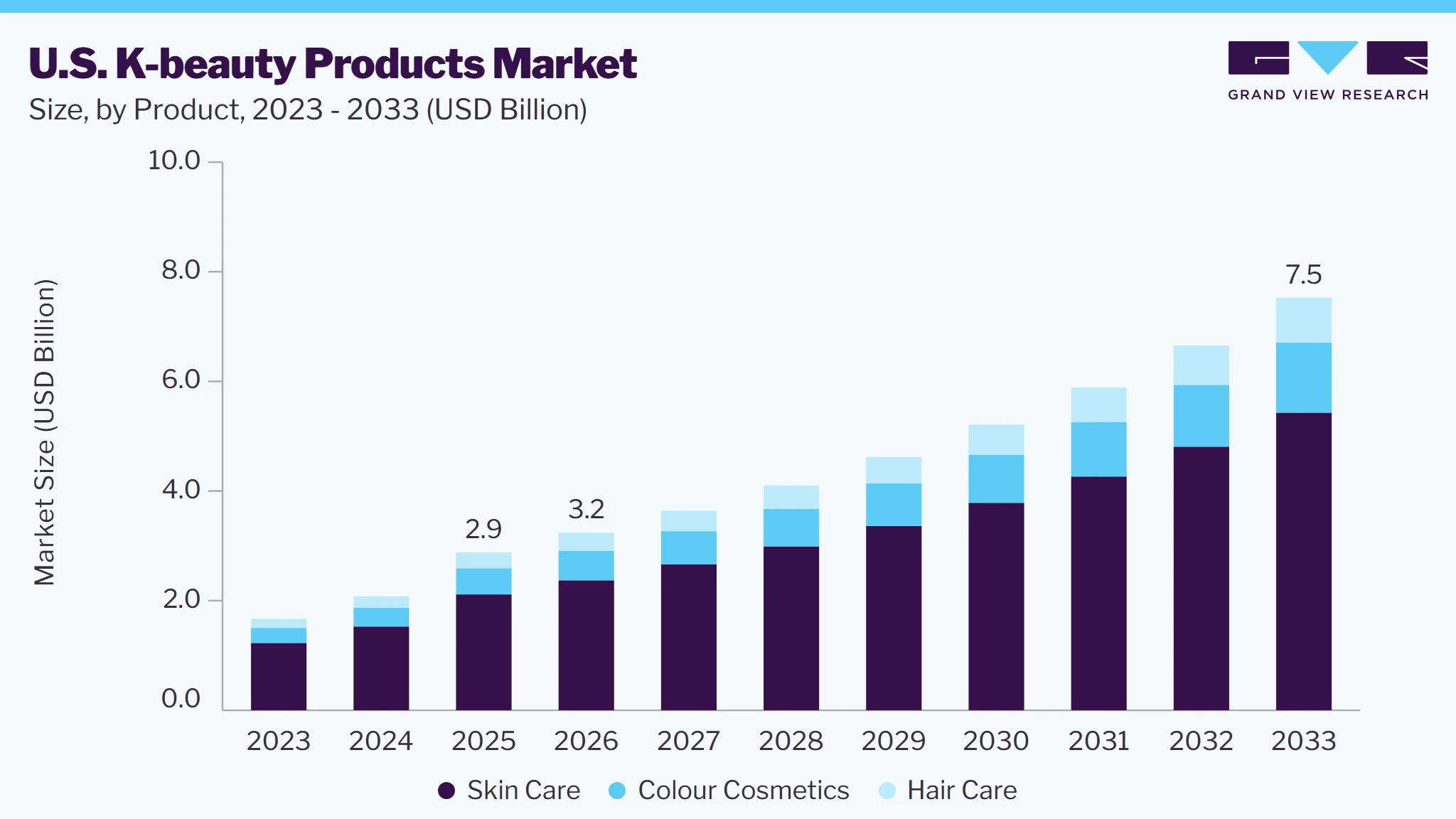
The U.S. K-beauty products market size was valued at USD 2.9 billion in 2025 and is projected to grow from USD 3.2 billion in 2026 to USD 7.5 billion by 2033, at a CAGR of 12.8% from 2026 to 2033. The growth is driven by increasing consumer interest in Korean skincare routines, growing demand for innovative beauty formulations, the rising popularity of multi-step skincare regimens, and the expanding availability of K-beauty products through online platforms and specialty beauty retailers.
Key Market Trends & Insights
- By product: Skin care segment accounted for the largest revenue share of 73.4% in 2025.
- By end use: Women segment accounted for the largest revenue share of 68.7% in 2025.
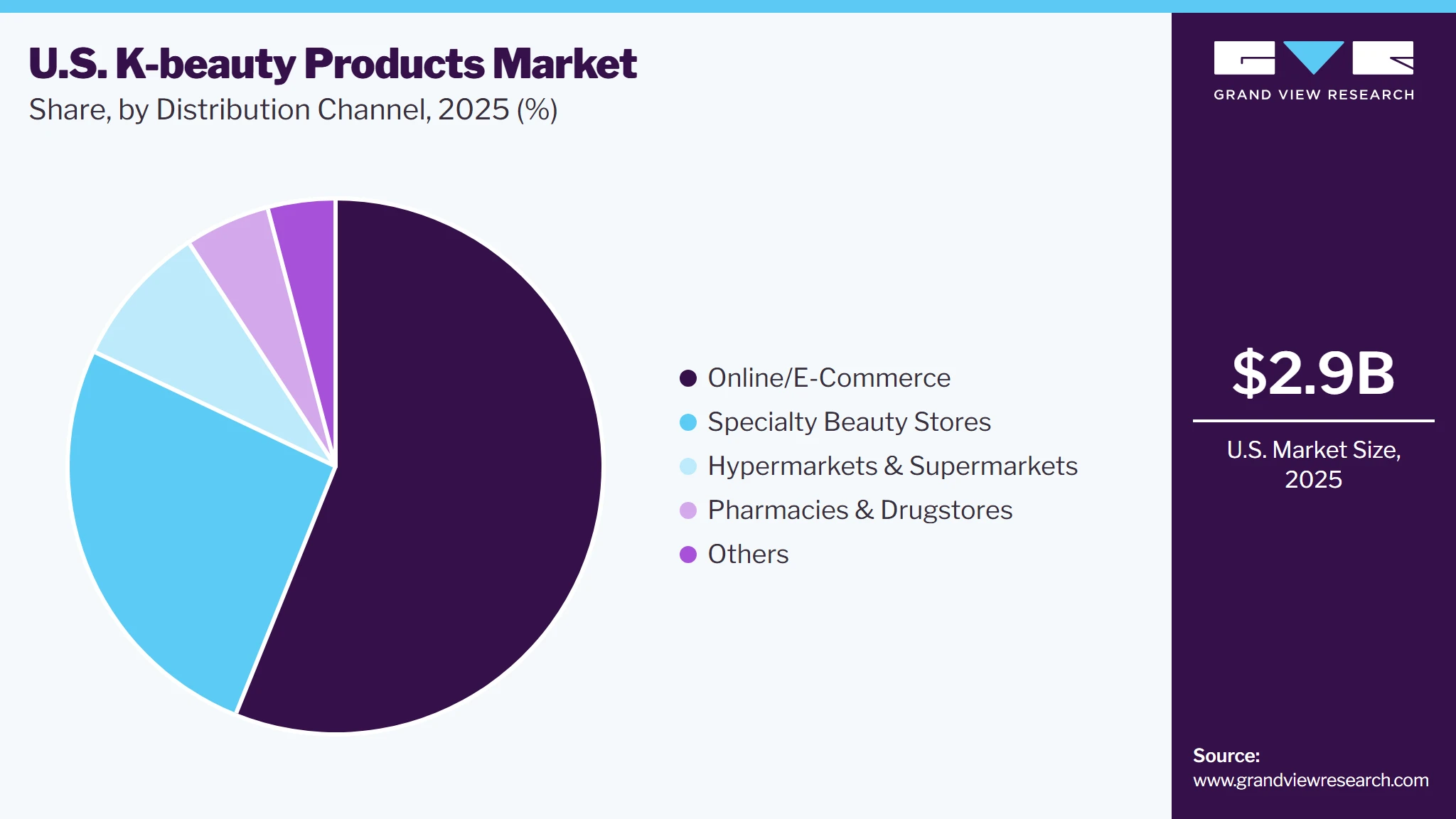
- By distribution channel: Online/e-commerce segment accounted for a market share of 56.1% in 2025.
Market Size & Forecast
- Market size in 2025: USD 2.9 Billion
- Estimated market size in 2026: USD 3.2 Billion
- Projected Market Size by 2033: USD 7.5 Billion
- CAGR (2026-2033): 12.8%
Three ways to get this report
Buy it, customize it, or ask a question.Ask an Analyst
Analyst response in 1 business day
- AccessReport author, directly
- Reply timeWithin 1 working day
- No sales callDirect answer only
- FormatEmail reply
- CostFree, no cost
Get the Full Report
What the study covers
- FormatsPDF · Excel · Dashboard
- Timeline2026–2033 annual, 2025 base
- Coverage20+ countries, 5 regions
- Companies10+ key players profiled
Customize the Report
20% free customization
- IncludeCountries, segments, points
- TailorTo your product definition
- ExtendDeeper competitor detail
- OrA fully bespoke study
- Turnaround5–10 working days
The growing international demand for Korean beauty products is strengthening the supply base for the U.S. K-Beauty Products Market. According to South Korea's Ministry of Food and Drug Safety, as reported by Yonhap News Agency in January 2026, Korean cosmetics exports to the U.S. reached USD 2.19 billion in 2025, up 15.1% from the previous year. The U.S. became South Korea's largest cosmetics export destination for the first time, highlighting the increasing importance of American consumers to Korean beauty brands. This expansion is supporting the availability of Korean skincare, makeup, and other beauty products across U.S. retail and e-commerce channels.The U.S. K-beauty products market is entering a renewed growth phase, with Korean Skincare emerging as the primary contributor to category expansion. The current wave differs from the earlier K-Beauty adoption cycle by placing greater emphasis on science-backed formulations, ingredient innovation, skin-barrier health, efficacy, and accessible premium positioning. In U.S. prestige retail, K-Beauty brands recorded 23% growth in dollar sales and 24% growth in units during Q1 2026, while skincare drove most sales and all net gains. K-Beauty accounted for 3% of the U.S. prestige beauty market, indicating continued room for broader penetration.
 Source: Grand View Research, IR Documents, Primary Interviews, Paid DatabasesTo learn more about this report,
 Download Free Sample Report
 The industry is expanding beyond traditional skincare, with innovation now influencing hair care, advanced treatments, science-driven formulations, and new skin-finish preferences. The following trends demonstrate how Korean skincare concepts are shaping product development and consumer demand across the U.S. beauty industry.
-
K-Beauty hair care - Korean scalp and hair-care products are attracting attention by applying the ingredient-focused, innovation-driven approach of Korean skincare to hair care.
-
Western beauty inspired by K-Beauty - Leading Western brands, including L’Oréal Paris, Nivea, YSL Beauty, and Maybelline, are increasingly incorporating Korean innovations and trends into their products and marketing.
-
Collagen masks - Collagen hydrogel and sheet masks remain popular as consumers seek immediate, visible skincare results. The article also links this trend to emerging ingredients such as PDRN.
-
K-Pharmacy - Korean pharmacy-inspired skincare is emerging as a clinically focused segment, emphasizing efficacy, ingredients, skin health, and science-based formulations.
-
Bloom skin - The shift from the highly reflective "glass skin" look to a softer, naturally radiant appearance linked to long-term skin health. Google searches for "bloom skin" rose 800% over the past year, and "bloom skin care" searches increased 5,000% for the year ending July 2026.
Market Dynamics
South Korean pop culture has become one of the strongest engines behind K-beauty demand. K-pop idols and K-drama actors have massive, devoted fan bases who follow their every move closely, including what skincare products they use or promote. When a brand signs one of these stars as an ambassador, or a product appears on screen in a popular drama, fans see it not as a typical advertisement but as something personal, a way to look like, feel closer to, or copy their favorite star.
Celebrity endorsements and the growing global popularity of K-dramas and K-pop are accelerating product discovery and purchase intent in the U.S. K-beauty products market. As Korean celebrities and influencers showcase skincare routines and beauty products across platforms such as Netflix, YouTube, and social media, U.S. consumers are increasingly exposed to Korean beauty trends and product recommendations. This exposure encourages consumers to explore and purchase Korean skincare and cosmetics, helping brands translate cultural popularity into direct product demand.
The impact of regulatory compliance is particularly significant for smaller Korean beauty brands entering the U.S. market, as additional documentation, product testing, and registration requirements can increase administrative expenses, extend product-launch timelines, and limit the introduction of new K-beauty products. The challenge is more pronounced for products making drug-related claims, such as acne treatment or sun protection, which may be subject to additional FDA requirements.
According to the U.S. Food and Drug Administration (FDA), data published in May 2026 reported more than 15,000 active cosmetic facility registrations and over 1 million active cosmetic product listings, compared with 5,176 establishment registrations and 35,102 product listings under the former voluntary registration program. The expanded regulatory framework may increase documentation, monitoring, and compliance-management costs for companies operating in the K-beauty industry, creating additional barriers for smaller brands seeking to establish or expand their presence in the U.S. K-beauty products market.
Growing consumer demand for clinically proven and science-backed skincare solutions is creating opportunities for K-beauty companies to expand their portfolios with biotechnology-based formulations. Ingredients such as PDRN, exosomes, peptides, microbiome complexes, ceramides, and fermented actives are gaining popularity for their skin repair, anti-aging, and barrier-strengthening benefits. Increasing investment in cosmetic biotechnology and dermatological research is expected to support innovation in premium skincare products while enabling manufacturers to differentiate themselves in highly competitive international markets.
According to CJ Olive Young's 2025 Beauty Trend Report, consumers are increasingly seeking biotechnology-driven skincare products formulated with advanced active ingredients that offer clinically supported skin benefits. The report highlighted a significant rise in interest in next-generation skincare ingredients, with searches for PDRN increasing by 695% and searches for peptide-based skincare products increasing by 72% compared to the previous year's Olive Young Sale. This growing consumer demand for science-backed and functional skincare presents substantial opportunities for K-beauty companies to develop innovative formulations targeting anti-aging, skin barrier repair, hydration, and skin regeneration, while strengthening their presence in the premium skincare segment.
Analyst Perspective
The U.S. K-beauty products market is evolving toward ingredient-focused, personalized, and multifunctional beauty routines, with Korean Skincare gaining attention for its emphasis on innovative formulations, layered skincare regimens, and targeted solutions. Demand is supported by growing consumer interest in skincare efficacy, accessible premium beauty products, and product formats such as serums, sheet masks, moisturizers, and sunscreens. K-Beauty brands are expanding their presence across specialty beauty stores, online marketplaces, and brand-owned e-commerce platforms while introducing innovative formulations, trend-driven cosmetics, and products tailored to diverse U.S. consumer preferences.
Consumer Insights
The U.S. K-beauty products market primarily serves consumers interested in Korean Skincare, innovative beauty formulations, multi-step skincare routines, and products designed to address specific skin concerns.
-
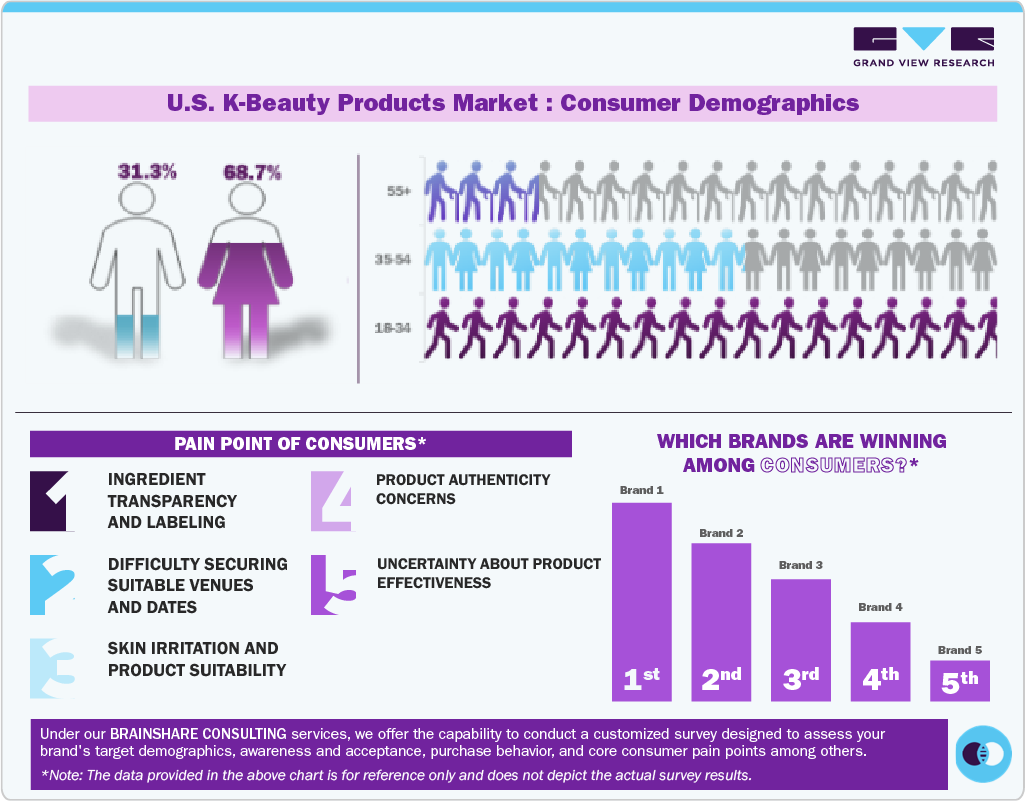
Female consumers account for the largest share at 68.7%, reflecting their significant participation in skincare routines and interest in Korean beauty products, including serums, moisturizers, sheet masks, and other skincare formulations. Female consumers represent an important customer segment for brands operating in the K-Beauty Industry.
-
Male consumers account for 31.3%, highlighting the growing participation of men in skincare and personal grooming. Male consumers may seek Korean Skincare products such as cleansers, moisturizers, sunscreens, and targeted treatment products, supporting the expansion of K-Beauty Products beyond traditional female-oriented beauty segments.
 To learn more about this report, Download Free Sample Report
 Consumers aged 18-34 represent a key user group in the U.S. K-beauty products market, consisting of younger adults, skincare enthusiasts, beauty-conscious consumers, and social media users who are interested in Korean skincare routines, innovative formulations, sheet masks, serums, and trending beauty products. Consumers aged 35-54 primarily seek effective skincare solutions, hydration, anti-aging formulations, and targeted treatments that address specific skin concerns while fitting into established beauty routines. Consumers aged 55 and above generally focus on moisturization, skin nourishment, hydration, and products designed to address mature skin concerns, including fine lines, dryness, and loss of elasticity.
Consumers in the U.S. K-beauty products market commonly face several challenges when selecting and purchasing Korean skincare products.
-
Ingredient transparency and labeling: Unfamiliar ingredients, complex product labels, and differences in product information can make it difficult for consumers to assess product suitability and understand formulations.
-
Difficulty securing suitable products and shades: Consumers may face challenges finding Korean beauty products that match their skin types, tones, and individual skincare requirements, particularly when purchasing specialized formulations.
-
Skin irritation and product suitability: Consumers may experience irritation or sensitivity when using unfamiliar formulations or combining multiple active ingredients, creating concerns about product compatibility.
-
Product authenticity concerns: Purchasers may encounter uncertainty regarding product authenticity, seller reliability, and ingredient quality, particularly when buying K-Beauty Products through unfamiliar online marketplaces.
-
Uncertainty about product effectiveness: Consumers may hesitate to purchase products when their expectations are based primarily on influencer recommendations or beauty trends rather than clear information about product performance and suitability.
Product Insights
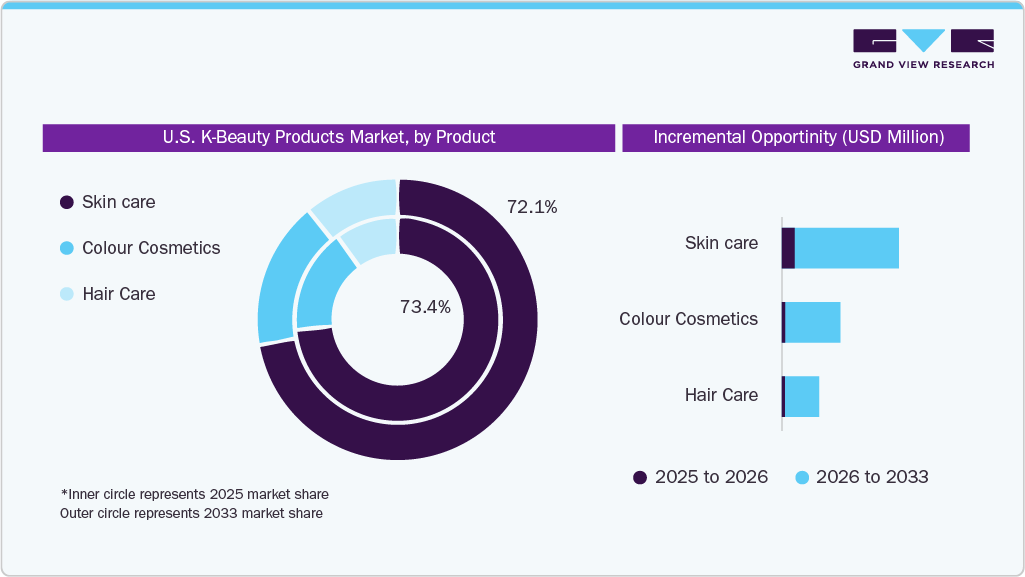
The skin care segment accounted for the largest share of revenue at 73.4% in 2025, driven by the strong global adoption of Korean skincare routines, consumer preference for preventive and targeted skin solutions, and continuous innovation in products such as serums, essences, masks, and ampoules. The segment continues to benefit from Korean brands’ focus on advanced formulations, functional ingredients, and affordable product offerings across international markets. According to the 2025 Korean Customs Service data, basic skin care products and lotions accounted for 41.7% of cosmetic exports, while sunscreens and anti-wrinkle products represented a further 25.5%, together accounting for more than two-thirds of export value.
 To learn more about this report, Download Free Sample Report
 K-beauty hair care is expected to grow at a CAGR of 14.0% from 2026 to 2033, driven by concerns about hair thinning, scalp imbalances, and hair loss, which are increasingly affecting younger consumers. Anti-hair-loss care has become a major focus in Korea, leading to the expansion of specialized product categories, including scalp ampoules, strengthening serums, and hair-growth treatments. Supporting this trend, brands such as LABO-H, Lilyeve, and Vivelab have introduced scalp-targeted ampoules that ranked among the most searched hair care products at Olive Young. The growing popularity of these products demonstrates how consumers are moving beyond basic shampoos toward treatment-oriented hair care solutions. For instance, in 2025, Olive Young launched ROOTECA, its first private-label professional hair care brand, featuring products such as the Root Enhancing Ampoule Shampoo, which combines ampoule and shampoo functionality in a single product to improve root volume and hair elasticity.
End Use Insights
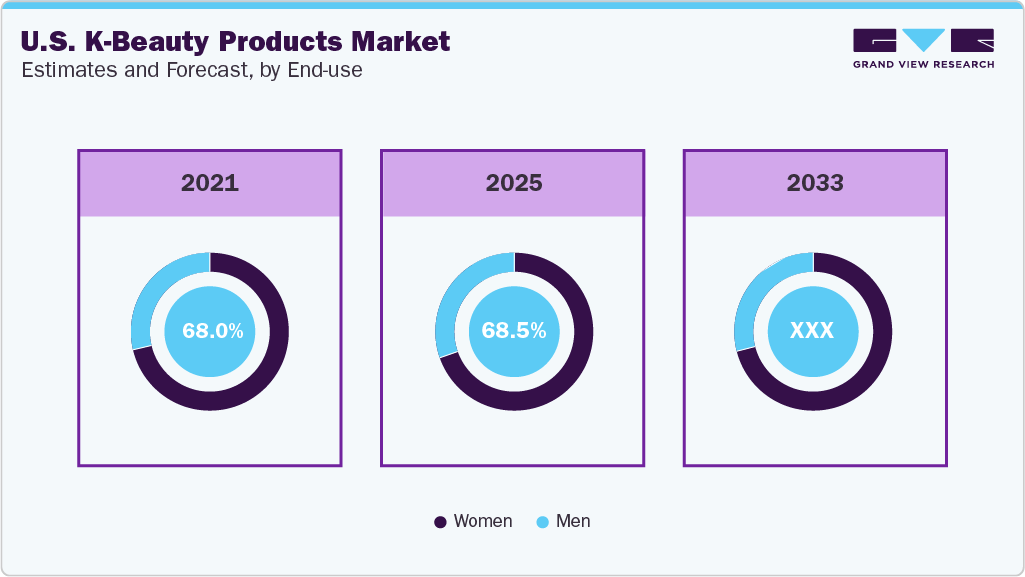
K-beauty products for the women segment accounted for the largest revenue share of 68.7% in 2025, supported by women’s strong engagement with multi-step skincare routines and higher adoption of specialized products such as serums, masks, essences, and treatment-based formulations. The segment continues to benefit from growing demand for personalized skincare solutions, preventive beauty practices, and innovative Korean formulations targeting specific skin concerns such as hydration, brightening, and anti-aging.
 To learn more about this report, Download Free Sample Report
 K-beauty products for the men segment are expected to grow at a CAGR of 12.2% from 2026 to 2033. Men are showing a strong preference for all-in-one skincare products, scalp-care treatments, anti-hair-loss solutions, and lightweight complexion-enhancing products that simplify routines while delivering visible results. This trend is reflected in the success of Olive Young's men's private label brand, Ideal for Men, which has remained the retailer's No.1 men's brand for four consecutive years since 2019. The brand has expanded beyond skincare into color cosmetics and grooming products, indicating that male consumers are becoming more comfortable with a broader range of beauty and appearance-enhancing products.
Distribution Channel Insights
The sale of K-beauty products through online/e-commerce channels accounted for a 56.1% share of the revenue in 2025, driven by the strong presence of Korean brands on digital marketplaces, rising adoption of cross-border shopping, and the growing influence of social commerce and online beauty communities. The channel continues to benefit from social media-driven product discovery, influencer marketing, and direct-to-consumer strategies, enabling emerging Korean beauty brands to reach international consumers more efficiently. In September 2026, Seoul Economic Daily reported that Medicube, a Korean skincare brand owned by APR, generated USD 16.77 million in sales on U.S. TikTok Shop over the preceding 30 days, according to Kalodata data. Dr. Melaxin, another Korean beauty brand, ranked fourth with USD 9.55 million in sales. These examples demonstrate how TikTok Shop's integrated product discovery, creator content, and in-app purchasing can help Korean beauty brands convert social media engagement into direct sales.
 To learn more about this report, Download Free Sample Report
 The sale of K-beauty products through specialty beauty stores is expected to grow at a CAGR of 13.0% from 2026 to 2033, driven by consumers' preference for product discovery, expert recommendations, and access to the latest beauty innovations. Specialty beauty stores provide a curated shopping environment where consumers can compare products, test formulations, and receive personalized guidance.
Key U.S. K-Beauty Products Company Insights
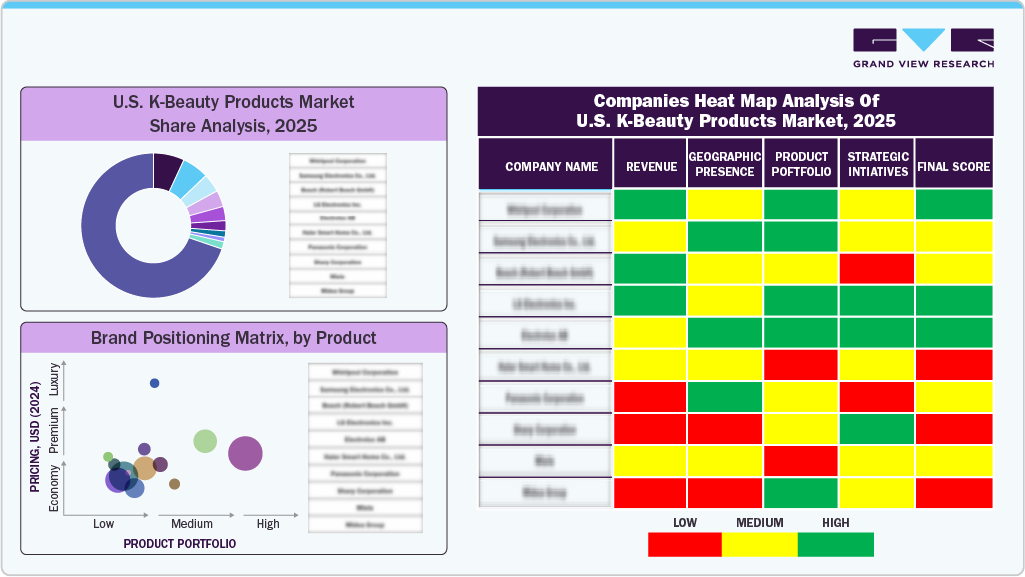
The U.S. K-beauty products market is characterized by competition among established Korean beauty conglomerates, specialized skincare brands, cosmetics manufacturers, and emerging beauty companies with growing international presence. Competition is primarily shaped by brand recognition, product innovation, skincare efficacy, ingredient differentiation, distribution reach, digital marketing, and the ability to address evolving consumer preferences for Korean skincare and multifunctional beauty products.
-
Major Korean Beauty Conglomerates: AMOREPACIFIC, LG Household & Health Care Ltd., and APR Corporation compete through broad brand portfolios, product development capabilities, and investments in skincare, cosmetics, and international distribution. AMOREPACIFIC operates across skincare and color cosmetics, while LG Household & Health Care participates in beauty through brands such as The Face Shop and belif. APR Corporation strengthens its position through Medicube's technology-oriented skincare products and beauty devices, supported by digital marketing and international expansion.
-
Specialized Skincare & K-Beauty Brands: COSRX, TONYMOLY, and Nature Republic compete by focusing on skincare formulations, ingredient-led product development, and accessible Korean beauty routines. COSRX emphasizes targeted skincare solutions, while TONYMOLY and Nature Republic offer skincare, cleansing, moisturizing, and other beauty products designed around Korean beauty preferences. Their market participation is influenced by product differentiation, brand awareness, and availability through online and offline retail channels.
-
Color Cosmetics & Makeup Specialists: Clio and Able C&C compete in the U.S. K-Beauty Products Market through makeup-focused product portfolios, including eye makeup, complexion products, lip cosmetics, and other color cosmetics. Clio leverages its professional makeup positioning and trend-oriented product development, while Able C&C's MISSHA brand supports competition through affordable skincare and makeup offerings. Both companies participate in the market through brand-led product innovation and beauty retail distribution.
-
Cleansing, Makeup Removal & Premium Skincare Brands: BANILA CO and CARVER KOREA CO. (Unilever) compete through specialized cleansing and skincare offerings. BANILA CO is associated with cleansing products, particularly makeup-removing formulations, while CARVER KOREA's AHC brand focuses on skincare and premium beauty positioning. Their competitive strategies emphasize formulation quality, consumer recognition, product specialization, and expansion across international beauty channels.
 To learn more about this report, Download Free Sample Report
 Key U.S. K-Beauty Products Companies
The following key companies have been profiled for this study on the U.S. K-beauty products market:
-
AMOREPACIFIC
-
LG HOUSEHOLD & HEALTH CARE LTD
-
APR Corporation
-
COSRX
-
Clio
-
Able C&C
-
BANILA CO
-
CARVER KOREA CO. (Unilever)
-
TONYMOLY
-
Nature Republic
Competitive Benchmarking
Category
Operating Strategies
Competitive Edge
Key Challenges
Established Players (AMOREPACIFIC; LG HOUSEHOLD & HEALTH CARE LTD; APR Corporation; COSRX; Clio; Able C&C)
- Focus on expanding product portfolios across skincare, makeup, cleansing, and beauty devices, while strengthening brand visibility in the U.S. through online marketplaces, specialty beauty stores, and other retail channels. These companies invest in product innovation, digital marketing, influencer collaborations, and localized product offerings to attract U.S. consumers.
- Strong brand recognition, established product development capabilities, specialized skincare and cosmetics expertise, and access to established distribution networks. AMOREPACIFIC and LG HOUSEHOLD & HEALTH CARE LTD benefit from broad beauty portfolios, while APR Corporation, COSRX, Clio, and Able C&C strengthen competition through specialized skincare, makeup, and technology-oriented beauty offerings.
- High marketing and customer-acquisition costs, intense competition from domestic and international beauty brands, regulatory requirements for cosmetic products, and the need to build sustained brand loyalty. Companies also face challenges in differentiating products, maintaining competitive pricing, and adapting Korean beauty concepts to U.S. consumer preferences.
Emerging & Specialized Players (BANILA CO; CARVER KOREA CO. (Unilever); TONYMOLY; Nature Republic)
- Focus on distinctive skincare, cleansing, and color cosmetics offerings, supported by ingredient-led product development, accessible pricing, and targeted brand positioning. These companies seek to expand their presence through specialty beauty retailers, e-commerce platforms, social media marketing, and partnerships with distributors and retail chains.
- Product specialization, recognizable Korean beauty positioning, differentiated formulations, and the ability to target specific consumer needs. BANILA CO benefits from its focus on cleansing products, while CARVER KOREA CO. (Unilever), TONYMOLY, and Nature Republic compete through skincare portfolios, brand identity, and international beauty distribution.
- Limited brand visibility relative to larger beauty conglomerates, competition for premium retail shelf space, customer-acquisition costs, and the need to maintain product differentiation. These companies must also navigate changing consumer preferences, pricing pressure, and the challenge of establishing long-term customer loyalty in the U.S. market.
Recent Developments
-
In August 2026, Sephora announced the launch of 19 OLIVE YOUNG-curated Korean beauty brands across more than 500 U.S. stores and Sephora.com. The assortment includes brands such as Abib, Torriden, Arencia, and Rejuran Cosmetics. This expansion is creating additional points of access for consumers seeking Korean skincare formulations and is helping move K-beauty beyond specialist online platforms into mainstream beauty retail.
-
In May 2026, AMOREPACIFIC expanded its presence in the U.S. market by launching its Mamonde skincare brand exclusively through Amazon Premium Beauty. The expansion marked the fourth new brand introduced by the company in the U.S. within 15 months, strengthening its North American growth strategy. The launch features science-backed, floral-inspired skincare products designed to appeal to younger consumers while enhancing the brand's digital retail presence and reinforcing AMOREPACIFIC's position in the global K-beauty industry.
-
In May 2026, Nature Republic expanded its presence in the North American K-Beauty Products Market by broadening the distribution of its premium anti-aging skincare products through Costco. Following a successful launch in the U.S., the company expanded into Costco Canada and Costco Mexico, strengthening its offline retail network while leveraging strong momentum in both online and offline sales. This expansion is expected to significantly increase the brand's visibility and accelerate revenue growth across North America, supporting Nature Republic's long-term global expansion strategy.
-
In April 2026, Able C&C expanded its global retail footprint by launching its flagship MISSHA brand in Costco stores across the U.S., Canada, and Taiwan, strengthening its offline distribution network beyond established online channels such as Amazon and TikTok Shop. The expansion added approximately 150 Costco stores in the U.S., 60 stores in Canada, and 14 stores in Taiwan, enhancing the company's international market presence, increasing brand accessibility, and supporting its long-term strategy to accelerate global growth in the K-Beauty Products Market through premium retail partnerships.
U.S. K-Beauty Products Market Report Scope
Report Attribute
Details
Market size in 2025
USD 2.9 billion
Estimated market size in 2026
USD 3.2 billion
Projected market size by 2033
USD 7.5 billion
Growth rate
CAGR of 12.8% from 2026 to 2033
Base Year
2025
Actuals
2021 - 2025
Forecast period
2026 - 2033
Quantitative units
Revenue in USD billion and CAGR from 2026 to 2033
Report coverage
Revenue forecast, company ranking, competitive landscape, growth factors, and trends
Segments covered
Product, end use, distribution channel
Key companies profiled
AMOREPACIFIC; LG HOUSEHOLD & HEALTH CARE LTD; APR Corporation; COSRX; Clio; Able C&C; BANILA CO; CARVER KOREA CO. (Unilever); TONYMOLY; Nature Republic
Customization scope
Free report customization (equivalent up to 8 analysts’ working days) with purchase. Addition or alteration to country, regional & segment scope.
Pricing and purchase options
Avail customized purchase options to meet your exact research needs. Explore purchase options
U.S. K-Beauty Products Market Report Segmentation
This report forecasts revenue growth at the country level and provides an analysis of the latest trends and opportunities in each of the sub-segments from 2026 to 2033. For this study, Grand View Research has segmented the U.S. K-beauty products market report on the basis of product, end use, and distribution channel.
-
Product Outlook (Revenue, USD Billion, 2021 - 2033)
-
Skin Care
-
Face Skin Care
-
Lotions, Face Creams, & Moisturizers
-
Cleansers & Face Wash
-
Facial Serums
-
Facial Masks
-
Sunscreen/Sun Care
-
Others (Scrub, etc.)
-
-
Body Skin Care
-
Lotions, Creams, & Moisturizers
-
Body Sunscreen/Sun Care
-
Body Scrub
-
Others (Serum, Oils, etc.)
-
-
-
HairCare
-
Shampoo
-
Conditioner
-
Oils
-
Serums & Ampoules
-
Others (Hair Masks, Peels, etc.)
-
-
Color Cosmetics
-
Face Color Cosmetics
-
Lip Color Cosmetics
-
Eye Color Cosmetics
-
Nail Color Cosmetics
-
-
-
End Use Outlook (Revenue, USD Billion, 2021 - 2033)
-
Women
-
Men
-
-
Distribution Channel Outlook (Revenue, USD Billion, 2021 - 2033)
-
Hypermarkets & Supermarkets
-
Specialty Beauty Stores
-
Pharmacies & Drugstores
-
Online/E-Commerce
-
Others
-
Research Methodology
The U.S. K-beauty products marketfigures in this report are based on a proven research process that combines executive interviews with secondary research from proprietary databases, company filings, and recognized regulatory and institutional sources. Market size is built through value-chain sizing-reconciling supply-side and demand-side estimates-and triangulated with bottom-up and top-down approaches. Every estimate passes multiple levels of expert validation before publication, with eachU.S. K-beauty productssegment quantified using the revenue-capture definitions in the table below.
Segment Definition
End Use
Revenue capture definition
Women
Revenue from K-beauty products purchased by female consumers in the U.S., including Korean Skincare, facial cleansers, serums, moisturizers, sunscreens, sheet masks, makeup, and other beauty products for personal skincare and cosmetic needs.
Men
Revenue from K-beauty products purchased by male consumers in the U.S., including facial cleansers, moisturizers, serums, sunscreens, exfoliators, and other Korean Skincare and grooming products for personal skincare and cosmetic needs.
Estimation Model
Title
Guiding Question
Description
K-Beauty Products Base
Who purchases K-beauty products?
Identifies the U.S. consumer population purchasing Korean beauty products, including skincare, facial cleansers, serums, moisturizers, sunscreens, sheet masks, and color cosmetics.
Consumer Demand Layer
Who actively seeks K-beauty products?
Captures consumers interested in Korean skincare, ingredient-focused formulations, multifunctional beauty products, and Korean cosmetics. Focuses on shoppers with an active intention to purchase K-beauty products.
Retail & Purchase Layer
Who completes K-beauty product purchases?
Segments demand by end user, product category, price tier, and distribution channel. Includes purchases through specialty beauty stores, online marketplaces, brand-owned websites, department stores, and other retail channels.
Monetization Layer
How much revenue is generated?
Converts completed K-beauty product purchases into market revenue using product selling prices, purchase frequency, average transaction value, and spending across skincare, cosmetics, and other defined product categories.
Delivered Customizations
This report has been delivered with the following In-depth customizations
Client Request
Customization Delivered
Value Adds
U.S. K-Beauty Products Market Consumer Demand, Preference & Buying Behavior Analysis
Conducted a detailed assessment of consumer demand for K-Beauty Products in the U.S., evaluating preferences for Korean Skincare, ingredient-focused formulations, multifunctional beauty products, clean beauty concepts, and affordable premium offerings. The analysis also considers purchasing behavior across online marketplaces, specialty beauty stores, and other retail channels.
Helps stakeholders identify high-value consumer segments, understand evolving skincare and cosmetics preferences, and assess purchasing motivations across different age groups, product categories, and retail channels.
U.S. K-Beauty Products Market Product Innovation, Product Customization & Experience Trends
Evaluated innovation across Korean Skincare, facial cleansers, serums, moisturizers, sunscreens, sheet masks, makeup, and other K-Beauty Products. The assessment covers ingredient-led formulations, multifunctional products, advanced skincare technologies, customized beauty routines, and product launches targeting U.S. consumers.
Provides insights into emerging product trends, formulation differentiation, consumer expectations, and opportunities for brands to strengthen product portfolios through innovative, convenient, and targeted beauty solutions.
U.S. K-Beauty Products Market Distribution & Market Opportunity Assessment
Assessed growth opportunities across specialty beauty stores, department stores, drugstores, online marketplaces, brand-owned e-commerce platforms, and other retail channels. The analysis evaluates retail presence, distribution partnerships, product accessibility, pricing strategies, and opportunities for Korean beauty brands to expand their U.S. market reach.
Supports investment and expansion decisions by identifying promising distribution channels, retail partnerships, customer-acquisition opportunities, and market-entry strategies for K-Beauty Products. It also helps stakeholders assess competitive positioning and opportunities to strengthen brand visibility in the U.S. beauty market.
Frequently Asked Questions About This Report
The U.S. K-Beauty Products market size was valued at USD 2.9 billion in 2025 and is estimated at USD 3.2 billion in 2026.
Emerging trends in the U.S. k-beauty products market include K-Beauty-inspired hair care, collagen and PDRN-based formulations, and K-Pharmacy products. Growing interest in innovative ingredients and Korean beauty routines adapted to U.S. consumer preferences is also shaping the market.
The U.S. k-beauty products Market is driven by growing consumer interest in ingredient-focused, multi-step Korean skincare routines and innovative formulations. Rising social media influence, expanding retail availability, and increasing demand for products such as serums, masks, and moisturizers are further supporting market growth.
Key players in the U.S. k-beauty products market include AMOREPACIFIC, LG Household & Health Care, APR, COSRX, Clio, Able C&C, and BANILA CO. CARVER KOREA, TONYMOLY, and Nature Republic also hold a presence in the U.S. market through their expanding K-Beauty product portfolios.
The U.S. k-beauty products market is expected to grow at a compound annual growth rate of 12.8% from 2025 to 2033, reaching USD 7.5 billion by 2033.
Skin care segment accounted for the largest revenue share of 73.4% in 2025, driven by the strong global adoption of Korean skincare routines, consumer preference for preventive and targeted skin solutions, and continuous innovation in products such as serums, essences, masks, and ampoules.
K-beauty products for the women segment accounted for the largest revenue share of 68.7% in 2025 while men segment is second fastest growing market
Online/e-commerce segment accounted for a market share of 56.1% in 2025.
About the Author(s)
Beauty & Personal Care Research Team
Consumer Goods · Beauty & Personal CareThis report was authored by the beauty & personal care research team at Grand View Research - comprising two research analysts, one senior research analyst, and one industry expert - with specialized expertise in the beauty & personal care segment of the consumer goods industry. All findings are based on proprietary consumer goods databases, executive interviews, and regulatory analysis, subject to internal peer review prior to publication.
Last Updated:
Speak to Analyst

Customize this report to your needs - add regions, segments, or data points, with 20% free customization.
Or view our licence options:


ISO 9001:2015 & 27001:2022 Certified
We are GDPR and CCPA compliant! Your transaction & personal information is safe and secure. For more details, please read our privacy policy.


