
- Home
- »
- Consumer Goods
- »
-
U.S. Lip Color Cosmetics Market Size & Share Report, 2026-2033GVR Report cover

U.S. Lip Color Cosmetics Market (2026 - 2033)
Size, Share & Trends Analysis Report By Product (Lipstick, Lip Liner, Lip Gloss, Lip Tint), By Product, By Price Tier, By Product By Type, By Product By Distribution Channel, And Segment Forecasts
Market Size, 2025
$7.0BMarket Estimate, 2026
$7.6BMarket Forecast, 2033
$13.4BCAGR, 2026–2033
8.4%U.S. Lip Color Cosmetics Market Summary
The U.S. lip color cosmetics market size was valued at USD 7.0 billion in 2025 and is expected to grow from USD 7.6 billion in 2026 to USD 13.4 billion in 2033, at a CAGR of 8.4% from 2026 to 2033. The market growth is driven by rising demand for long-wearing and multifunctional lip products, growing consumer preference for premium and clean beauty formulations, increasing popularity of lip oils, tints, glosses, and matte lipsticks, and continued product innovation in shade ranges, textures, and skincare-infused formulas.
Key Market Trends & Insights
- By product: Lipstick held the largest revenue share of 55.7% in 2025.
- By product by price tier: Mass/entry lipstick held the largest revenue share of 62.4% in 2025.
- By product by type: Conventional lipstick held the largest revenue share of 82.5% in 2025.
- By product by distribution channel: Specialty beauty stores lipstick held the largest revenue share of 27.6% in 2025.
Market Size & Forecast
- Market Size in 2025: USD 7.0 Billion
- Estimated Market Size in 2026: USD 7.6 Billion
- Projected Market Size by 2033: USD 13.4 Billion
- CAGR (2026-2033): 8.4%
Three ways to get this report
Buy it, customize it, or ask a question.Ask an Analyst
Analyst response in 1 business day
- AccessReport author, directly
- Reply timeWithin 1 working day
- No sales callDirect answer only
- FormatEmail reply
- CostFree, no cost
Get the Full Report
What the study covers
- FormatsPDF · Excel · Dashboard
- Timeline2026–2033 annual, 2025 base
- Coverage20+ countries, 5 regions
- Companies10+ key players profiled
Customize the Report
20% free customization
- IncludeCountries, segments, points
- TailorTo your product definition
- ExtendDeeper competitor detail
- OrA fully bespoke study
- Turnaround5–10 working days
The U.S. lip color cosmetics industry is shaped by evolving beauty preferences, product innovation, shade personalization, and growing consumer interest in multifunctional lip products. Demand is expanding beyond traditional lipstick toward lip glosses, lip oils, lip stains, and liners that combine color payoff with hydration, shine, comfortable wear, and precise application. According to Circana, lip products such as liners, oils, and balms contributed to growth in both prestige and mass-market makeup in 2025, reflecting consumer interest in products that combine cosmetic performance with skincare benefits. These evolving preferences are creating new opportunities across the lip color cosmetics market, encouraging brands to expand their product portfolio with innovative textures, versatile finishes, and skincare-infused formulations. The lip color cosmetics category also benefits from demand for personalized makeup looks, allowing brands to differentiate their offerings through diverse shades, long-wearing formulas, and products suited to different consumer preferences.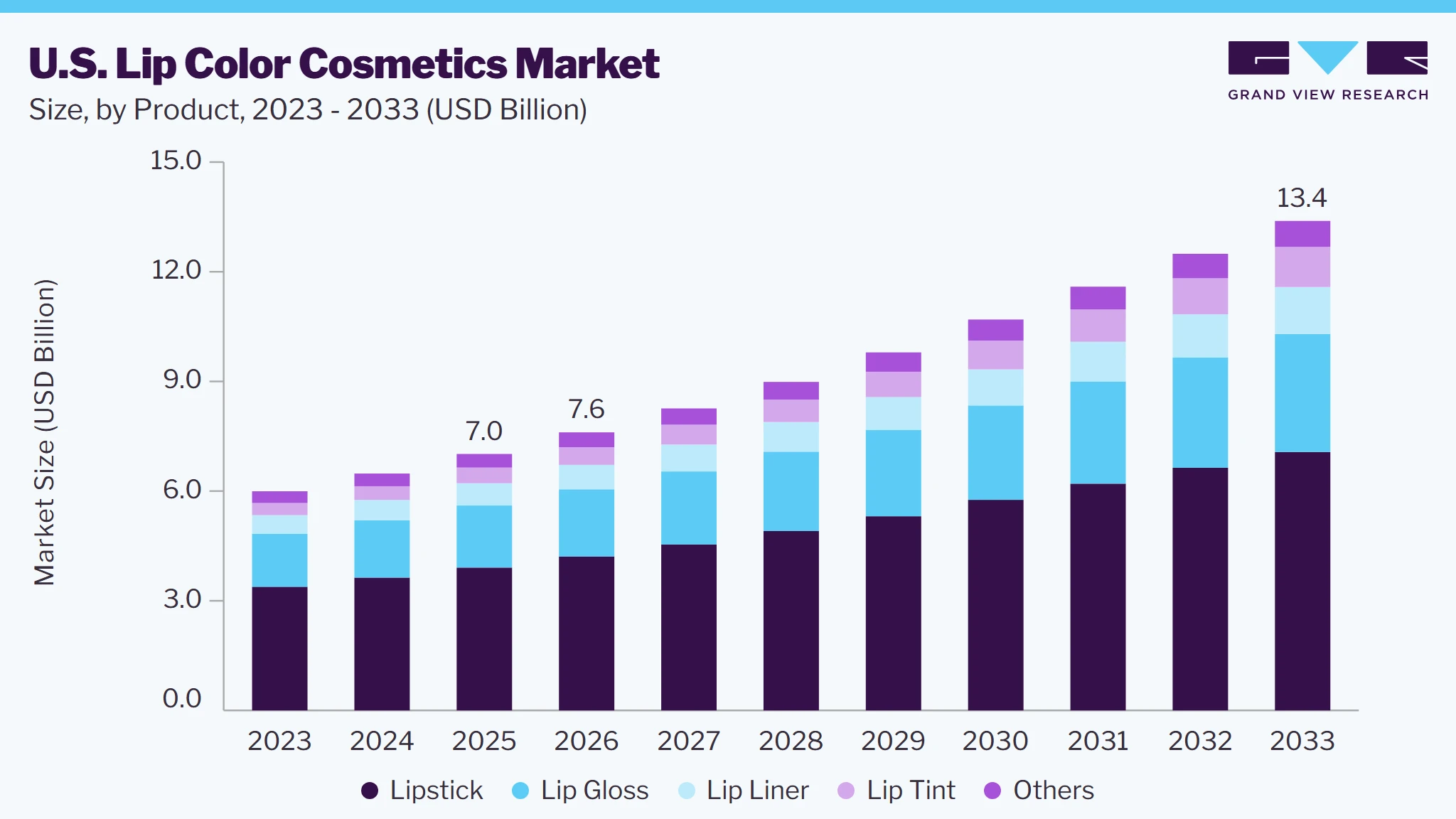 Source: Grand View Research, IR Documents, Primary Interviews, Paid DatabasesTo learn more about this report,
 Download Free Sample Report
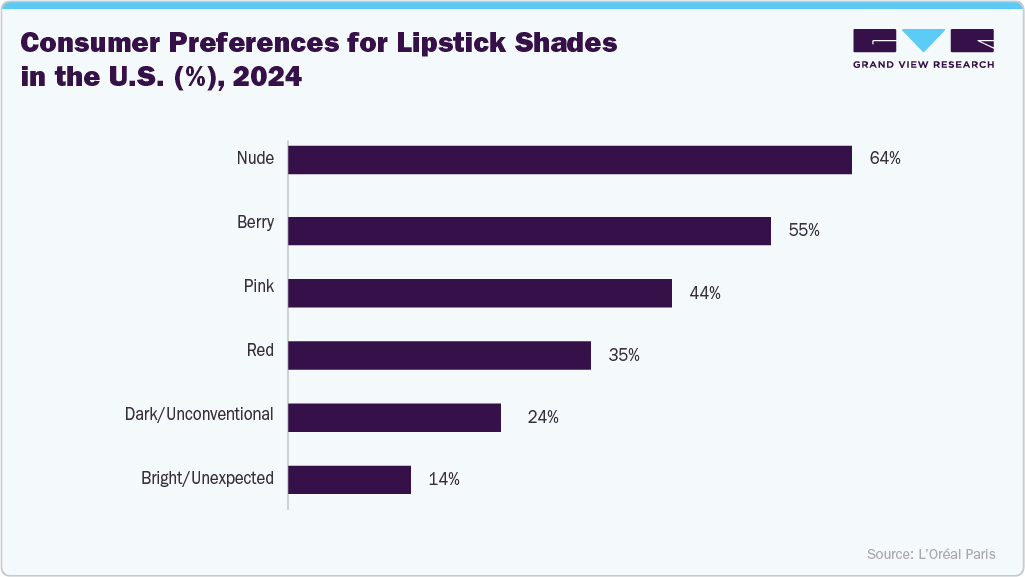
Consumer preferences for lipstick shades are shaping product development and purchasing trends in lip color cosmetics. A L’Oréal Paris survey found that U.S. women most often prefer nude shades, followed by berry and pink shades. Demand for both versatile and bold colors is prompting brands to expand their shade ranges to suit various occasions, makeup styles, and individual tastes.
 To learn more about this report, Download Free Sample Report
Social media platforms, beauty tutorials, and influencer-led product demonstrations are driving demand in lip color cosmetics by increasing awareness of trending shades, lip-lining techniques, and application styles. Short-form videos and user-generated reviews encourage consumers to experiment with new colors and product combinations, while viral beauty trends can accelerate product discovery and purchasing decisions. This creates opportunities for brands in the lip color cosmetics market to strengthen engagement through digital campaigns, creator collaborations, and trend-led product launches.
Market Dynamics
Rising consumer interest in lip contouring, layered makeup looks, and personalized shade combinations is strengthening demand across the U.S. lip color cosmetics market. Lip liners are increasingly used alongside lipsticks, glosses, and lip stains to define lip shape, improve color precision, and create customized finishes. Circana reported that U.S. lip liner sales increased 34% in the 12 months ending May 2026, reflecting strong category momentum. This growth creates opportunities for brands to expand complementary product ranges, introduce coordinated shades, and encourage consumers to purchase multiple products as part of a single lip makeup routine, thereby supporting further expansion of the lip color cosmetics market.
Concerns about irritation, allergic reactions, and ingredient safety influence purchasing decisions in the U.S. lip color cosmetics market, especially among frequent users. Fragrances, pigments, and certain preservatives can cause sensitivity, prompting consumers to scrutinize product labels and formulation claims. As a result, brands must invest in formulation testing, ingredient transparency, and product development, which may increase compliance and development costs. Products that do not clearly communicate their benefits or suitability for sensitive users may struggle to maintain consumer confidence.
The convergence of color cosmetics and skincare presents opportunities for brands in the lip color cosmetics market to develop products that deliver both pigmentation and skincare benefits. Products such as lip oils, tinted balms, hydrating lipsticks, and glossy stains attract consumers who value comfort, versatility, and cosmetic performance. Brands can respond by using ingredients like hyaluronic acid, plant-derived oils, and peptides, while offering a range of shades and innovative textures. For instance, COSRX introduced its nine-product 5 Peptide Lip Collection exclusively at Ulta Beauty in the U.S., combining lip color and high-shine finishes with peptides, collagen, ceramides, hyaluronic acid, and squalane. The collection features seven tinted shades with sheer-to-buildable coverage, demonstrating how skincare-infused formulations can help brands differentiate their portfolios and appeal to consumers seeking multifunctional lip products. This innovation supports premium positioning and enables brands to expand their offerings in the lip color cosmetics market.
Consumer Insights
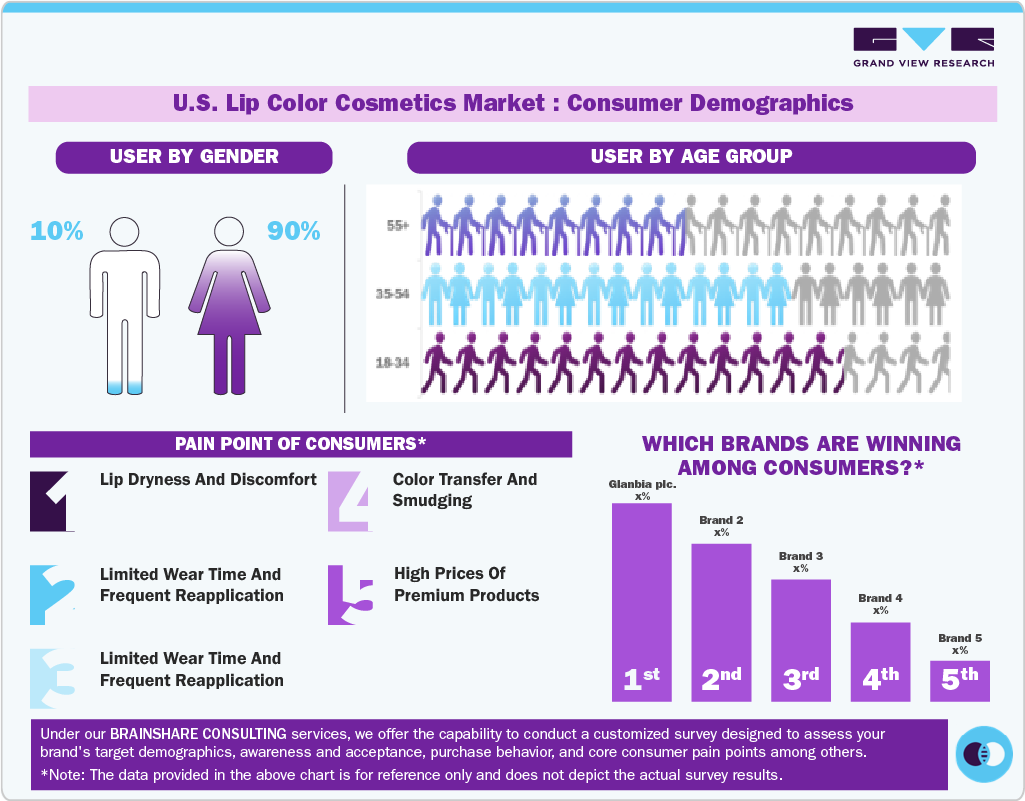
The U.S. lip color cosmetics market serves consumers across different genders and age groups, with purchasing behavior influenced by personal grooming preferences, beauty trends, desired lip color finishes, product performance, and spending preferences.
 To learn more about this report, Download Free Sample Report
Users by Gender
-
Female consumers account for the estimated share at 90%, reflecting their established participation in lip color cosmetics purchases across lipstick, lip gloss, lip liner, lip tint, and other lip makeup products. Demand is influenced by shade preferences, product innovation, long-wear formulations, hydrating ingredients, and interest in both everyday makeup and occasion-specific looks.
-
Male consumers account for an estimated 10%, reflecting potential demand for tinted lip balms, lip tints, lip glosses, and lipsticks for grooming, personal expression, fashion, and professional use. Growing visibility of gender-inclusive beauty products may encourage broader participation; however, this share is an illustrative estimate rather than a verified market statistic.
Users by Age Group
Consumers aged 18-34 tend to explore emerging beauty trends, follow social media recommendations, try newly launched products, and experiment with lip tints, glosses, lip oils, and diverse lipstick shades. Consumers aged 35-54 often prioritize product quality, comfortable wear, reliable color payoff, long-lasting formulations, and shades suitable for everyday use and professional settings. Consumers aged 55 and above may prefer moisturizing lipsticks, comfortable formulations, wearable shades, and products that deliver consistent color while minimizing the appearance of lip lines.
Consumers in the U.S. lip color cosmetics industry commonly face several challenges when selecting and using lip color products.
-
Lip dryness and discomfort remain concerns for consumers using certain matte and long-wear formulations, creating demand for products that combine color intensity with moisturizing ingredients and comfortable wear.
-
Limited wear time and frequent reapplication can inconvenience consumers when lip color fades, smudges, or transfers during eating, drinking, and daily activities.
-
Difficulty finding the right shade can affect purchasing decisions because skin tone, natural lip pigmentation, and undertones influence the appearance of lip color, particularly when consumers shop online.
-
Color transfer and smudging can reduce satisfaction among consumers seeking precise application and long-lasting results without marks on cups, clothing, or surrounding skin.
-
High prices of premium products can discourage frequent purchases and experimentation with multiple shades, particularly among price-sensitive consumers comparing luxury lipsticks with mass-market alternatives.
Analyst Perspective
The U.S. lip color cosmetics market is evolving toward product innovation, diversified formulations, and personalized color experiences, with lipsticks, lip tints, glosses, and tinted lip treatments catering to a wide range of consumer preferences. Demand is supported by the popularity of long-wearing color, hydrating formulations, diverse shade ranges, and products that combine cosmetic benefits with skincare ingredients. Beauty brands are expanding their portfolios through seasonal collections, limited-edition shades, and formulations inspired by emerging beauty trends, while leveraging social media and celebrity collaborations to strengthen consumer engagement. The growing availability of lip color products across specialty beauty retailers, mass-market stores, and online platforms is further expanding consumer access and intensifying competition among established brands and emerging beauty companies.
Product Insights
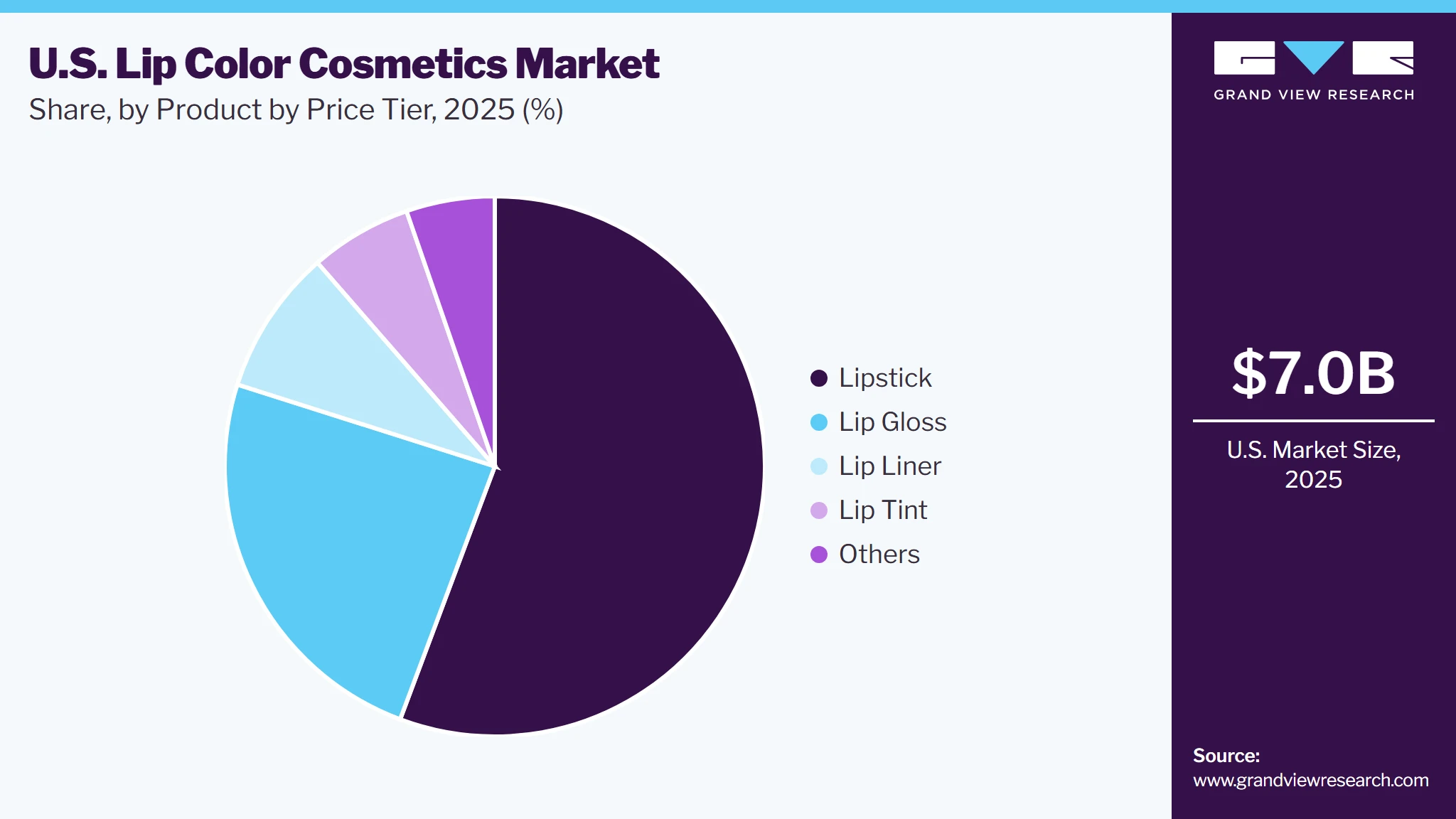
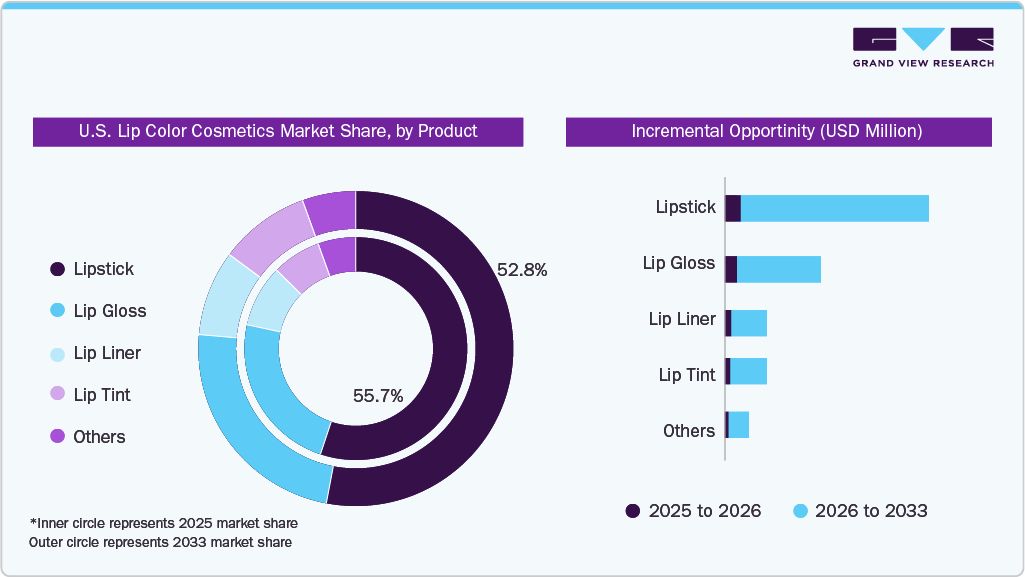
The lipstick segment dominated the U.S. lip color cosmetics industry, accounting for a revenue share of 55.7% in 2025, driven by demand for a wide range of shades, finishes, and formulations suitable for various occasions. Finishes such as matte, satin, cream, and glossy address diverse preferences for appearance and comfort. Consumers increasingly value moisturizing ingredients, long-wear and transfer-resistant formulas, and inclusive shade ranges. Brands are responding with skincare-infused lipsticks that offer both color and hydration. For instance, in September 2025, Jones Road Beauty introduced The Classic Lip, its first lipstick collection, featuring 12 shades and a peptide- and vitamin E-enriched formula. These innovations, along with a mix of premium and affordable options, continue to broaden consumer choice and reinforce lipstick’s importance in the lip color cosmetics market.
 To learn more about this report, Download Free Sample Report
The lip tint segment is expected to grow at a CAGR of 12.5% from 2026 to 2033. Consumer preference for lightweight, natural-looking, and long-lasting lip products is driving market growth. These products offer sheer, buildable pigmentation and are available in liquid, gel, water-based, and balm-like formats to meet various application needs. Demand for transfer-resistant color, easy application, and minimal reapplication is prompting brands to develop innovative lip tints with enhanced staying power and comfort. Products that combine color with moisturizing ingredients are increasingly popular among consumers seeking both color intensity and lip comfort. A wide range of shades, from subtle pinks and nudes to deep reds and berries, broadens their appeal for both everyday and special-occasion use, supporting growth in the lip color cosmetics market. For instance, in January 2026, LANEIGE launched its JuicePop Box Lip Tint collection in the U.S. market, featuring eight shades inspired by different music genres and promoted through a campaign with global partner KATSEYE. Priced at USD 23 per unit, the lip tint delivers buildable color for up to 12 hours, with a lightweight, water-fresh texture and a glossy finish. Formulated with the brand's Water-Oil Remix Complex, the product releases nourishing oil to help maintain lip hydration and color throughout the day. Its curved applicator supports smooth, even application, while clip-on packaging enhances portability.
Product by Price Tier Insights
The mass/entry lipstick dominated the U.S. lip color cosmetics industry, accounting for the largest revenue share of 62.4% in 2025, driven by demand for affordable products that deliver reliable color, comfortable wear, and a wide range of shades. Consumers seek value, ease of application, and versatile formulations for both daily use and special occasions. Matte, satin, and cream finishes cater to diverse preferences, while moisturizing and long-wear options address concerns about dryness and frequent touch-ups.
 To learn more about this report, Download Free Sample Report
Drugstores, mass retailers, and online platforms make budget-friendly brands widely available and promote repeat purchases through frequent promotions. Brands are expanding ranges and introducing innovative, accessible formulations to attract younger and price-conscious consumers. These factors continue to drive demand for mass/entry lipstick products. Revlon offers its Super Lustrous Lipstick in the U.S. market at USD 11.99, featuring a range of shades in crème and pearl finishes. Its formula contains 80% conditioning ingredients and microfine pigments for smooth application and rich color payoff. The affordable price and variety of shades support its positioning in the mass/entry segment of the U.S. lip color cosmetics market.
The premium & luxury lip tint segment is expected to grow at a CAGR of 14.3% from 2026 to 2033, driven by consumer demand for high-performance formulations, sophisticated shades, and enhanced lip care benefits. Luxury beauty brands differentiate their products through long-lasting color, transfer-resistant performance, premium packaging, and innovative ingredients that combine pigmentation with hydration. Consumers seeking premium lip tints often prioritize comfortable wear, refined finishes, and versatile shades suitable for everyday use and special occasions. Dior offers the Dior Addict Lip Tint for USD 42, featuring 12 shades in natural and vibrant hues, including nude, coral, rose, and berry. The formula contains 94% ingredients of natural origin and is infused with cherry oil to hydrate lips for up to 24 hours. It provides a semi-matte finish, transfer-resistant color, and up to 12 hours of wear, positioning the product within the premium and luxury segment of the lip color cosmetics market.
Product by Type Insights
The conventional lipstick segment accounted for the largest revenue share of 82.5% in 2025, supported by its wide availability, established consumer acceptance, and extensive choice of shades and finishes. These products use conventional cosmetic ingredients, including synthetic pigments, waxes, oils, and emollients, to deliver consistent color payoff, smooth application, and product stability. Consumers can choose from matte, satin, cream, and pearl finishes based on their makeup preferences and intended use. Manufacturers continue to refine conventional formulations to improve wear time, transfer resistance, texture, and color intensity while maintaining competitive prices. Conventional lipstick remains popular in the lip color cosmetics market due to its established use in daily makeup routines, diverse shade options, and availability in matte, satin, cream, and pearl finishes. Manufacturers continue to improve pigment quality, texture, wear time, and transfer resistance to meet evolving consumer preferences. For instance, in October 2026, M·A·C Cosmetics relaunched its Frost Lipstick collection with 23 shades, including 13 new shades and returning favorites. The updated collection features a pearlescent finish and a smoother, moisturizing formula incorporating ingredients such as castor seed oil and jojoba oil.
The organic & natural lip tint segment is expected to grow at a CAGR of 16.0% from 2026 to 2033, driven by growing consumer interest in plant-derived ingredients and formulations positioned around natural-origin components. Manufacturers are incorporating botanical extracts, plant-based oils, and naturally derived waxes to develop lip tints that provide color while supporting lip moisturization. In addition, increasing attention to ingredient transparency and organic product certifications creates opportunities for brands to differentiate their offerings within the broader lip color cosmetics market. For instance, Primally Pure launched its Lip + Cheek Tint SPF 15 as part of its new Tinted Face Care collection. The multi-purpose color balm is designed to provide a natural flush to the lips and cheeks while nourishing the skin. Its formulation combines grass-fed tallow and thoughtfully sourced ingredients with mineral sun protection, reflecting the brand’s focus on natural-origin ingredients and simplified beauty routines.
Product by Distribution Channel Insights
The specialty beauty stores lipstick segment dominated the U.S. lip color cosmetics industry, accounting for a revenue share of 27.6% in 2025. The availability of extensive lipstick assortments across brands, shades, finishes, and price points. Retailers such as Sephora and Ulta Beauty offer consumers access to mass-premium and prestige lipstick brands, enabling product comparisons and exploration of different formulations. The availability of exclusive collections, new product launches, and seasonal shades encourages consumers to explore specialty beauty retailers within the broader lip color cosmetics market.
In-store services, including shade matching, product demonstrations, and beauty consultations, help consumers identify lipstick shades and finishes suited to their preferences. In February 2026, Laka launched its Blonding Glow Lipstick through Sephora.com as part of its U.S. retail debut. The lipstick features a hydrating formulation and buildable color designed for everyday use. The launch expands the availability of Korean lip color products through a specialty beauty retailer, providing consumers with access to international beauty brands and differentiated lipstick formulations.
The online/e-commerce lip tint segment is expected to grow at a CAGR of 15.7% from 2026 to 2033, gaining traction as beauty brands use their own websites to launch trend-driven lip tints, test seasonal shades, and reach consumers beyond their physical retail networks. Direct online sales allow brands to control product presentation, communicate formulation benefits, and offer limited-edition variants without relying solely on third-party retailers. In June 2026, Rhode introduced three limited-edition Bronze Peptide Lip Tint shades, Colada, Macadamia Butter, and Honey Mango, as part of its Summer 2026 collection. The products feature shimmering color and summer-inspired scents, expanding the brand's seasonal lip color assortment. Their availability through Rhode's official online store illustrates how brands use direct-to-consumer e-commerce to market exclusive lip tint variants and respond to seasonal beauty preferences.
Key U.S. Lip Color Cosmetics Company Insights
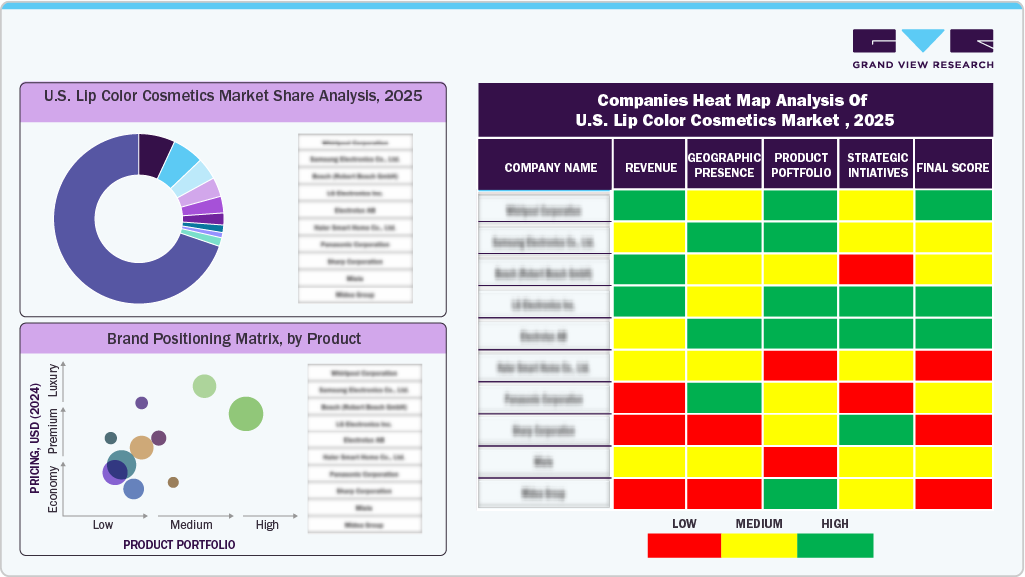
The U.S. lip color cosmetics market is characterized by competition among global beauty conglomerates, established cosmetics manufacturers, luxury beauty houses, and independent color cosmetics brands. Competition is shaped by brand recognition, product performance, shade inclusivity, formulation innovation, pricing, and distribution reach. Companies compete across lipsticks, lip glosses, lip tints, lip oils, and lip liners, with offerings spanning mass-market, mid-tier, and premium segments. Product differentiation increasingly centers on long-wear color, hydration, comfortable textures, transfer resistance, and finishes suited to different consumer preferences.
-
Global Beauty & Cosmetics Leaders: L’Oréal S.A.; The Estée Lauder Companies Inc.; and Coty Inc. compete through extensive brand portfolios, product development capabilities, and broad consumer reach. L’Oréal participates through brands such as Maybelline New York, NYX Professional Makeup, and Lancôme, addressing mass-market and premium lip color demand. The Estée Lauder Companies competes through M·A·C, Estée Lauder, and other prestige beauty brands, with products spanning statement lipsticks, glosses, and treatment-oriented lip formulations. Coty participates through brands including CoverGirl, Rimmel London, and Gucci Beauty, reaching consumers across accessible and luxury price points.
-
Established & Value-Oriented Cosmetics Brands: Revlon, Inc., e.l.f. Beauty, Inc., and Milani Cosmetics compete through accessible pricing, broad shade ranges, and products designed for everyday makeup use. Revlon maintains a long-standing presence in lipstick, including its Super Lustrous range, with emphasis on color selection and comfortable wear. e.l.f. Beauty participates in the lip color cosmetics market through affordable lip products, including lip stains, glosses, liners, and lip oils, supported by a digitally engaged consumer base. Milani Cosmetics strengthens competition in the mass and masstige segments through lipsticks, glosses, lip liners, and lip oils that combine trend-led shades with accessible pricing.
-
Luxury & Prestige Beauty Houses: LVMH Moët Hennessy Louis Vuitton SE and Chanel Limited compete in the premium end of the U.S. lip color cosmetics market through luxury positioning, distinctive packaging, and brand-led product experiences. LVMH participates primarily through Dior Beauty and Guerlain, offering lipsticks, lip oils, and lip treatments that emphasize finish, color payoff, and premium formulations. Chanel competes through its Rouge Coco, Rouge Allure, and other lip color collections, using established luxury brand recognition, curated shade palettes, and product presentation to appeal to prestige beauty consumers.
 To learn more about this report, Download Free Sample Report
Key U.S. Lip Color Cosmetics Companies
-
L’Oréal S.A.
-
The Estée Lauder Companies Inc.
-
Coty Inc.
-
Revlon, Inc.
-
e.l.f. Beauty, Inc.
-
Shiseido Company, Limited
-
LVMH Moët Hennessy Louis Vuitton SE
-
Chanel Limited
-
Milani Cosmetics
-
Kendo Brands
Competitive Benchmarking
Category
Operating Strategies
Competitive Edge
Key Challenges
Established Players: L’Oréal S.A.; The Estée Lauder Companies Inc.; Coty Inc.; Revlon, Inc.; Shiseido Company, Limited; LVMH Moët Hennessy Louis Vuitton SE; Chanel Limited
- Focus on expanding lip color portfolios through product innovation, premium formulations, diverse shade ranges, and differentiated finishes, including matte, satin, glossy, and hydrating textures. Leverage established brands such as L’Oréal Paris, Maybelline, MAC Cosmetics, Lancôme, CoverGirl, Revlon, Dior, and Chanel to serve mass-market, prestige, and luxury consumers. Invest in brand positioning, packaging, long-wear performance, lip care-infused formulas, and digital beauty experiences to strengthen consumer engagement and encourage repeat purchases.
- Strong brand recognition, extensive product development capabilities, established retail relationships, broad distribution networks, and substantial marketing resources. Diverse brand portfolios enable companies to target different consumer groups, price tiers, and makeup preferences. Premium and luxury brands benefit from heritage, perceived quality, distinctive product design, and exclusive collections, while mass-market brands compete through accessibility, product variety, and frequent innovation.
- Intense competition across mass-market, prestige, and luxury price tiers can increase promotional spending and pressure margins. Premium pricing may limit accessibility for price-sensitive consumers, while large product portfolio and established brand positioning can make it challenging to respond quickly to fast-changing beauty trends. Competition from affordable alternatives, independent brands, and social-media-driven challengers also increases pressure to maintain product differentiation and consumer loyalty.
Specialist Players: e.l.f. Beauty, Inc.; Milani Cosmetics; Kendo Brands
- Focus on accessible pricing, trend-led product development, distinctive formulations, and targeted brand positioning. e.l.f. Beauty emphasizes premium-quality cosmetics at accessible prices, alongside digital engagement and broad retail availability. Milani Cosmetics targets consumers seeking expressive color cosmetics and value-oriented products, while Kendo Brands develops and manages differentiated beauty brands, including Fenty Beauty, with an emphasis on distinctive brand identities, product innovation, and consumer-focused positioning.
- Agile product development, competitive pricing, strong appeal among digitally engaged beauty consumers, and the ability to capitalize on emerging lip trends, including lip oils, tinted balms, lip liners, high-shine glosses, and statement lip colors. Focused brand identities, social media visibility, creator collaborations, and differentiated product concepts can help these companies attract consumers seeking alternatives to traditional mass-market and luxury offerings.
- Comparatively limited resources for some brands to match the global advertising budgets, research capabilities, and retail reach of major established competitors. Dependence on trend-driven demand and social media visibility can create uncertainty around sustained product popularity. Price competition, imitation of successful formulations, retail shelf-space constraints, and the need to continuously introduce relevant shades and textures can also challenge long-term brand differentiation and profitability.
Recent Developments
-
In October 2026, Victoria Beckham Beauty launched its Rouge Victoria lipstick collection featuring six demi-matte red shades, ranging from bright poppy to deep wine. The formulation incorporates a plant-derived, biodegradable gel designed to provide smooth application and long-lasting color, alongside pomegranate extract for antioxidant and hydrating benefits. The collection debuted during Paris Fashion Week, expanding the brand’s premium lipstick portfolio with high-impact color and distinctive alabaster packaging.
-
In May 2026, Coty relaunched Marc Jacobs Beauty with a new color cosmetics collection featuring the Heart On Lipstick alongside products for eyes and complexion. The lipstick delivers saturated pigmentation, a soft, dewy, long-wearing finish, and cherry oil, hyaluronic acid, and biomimetic peptides to help maintain lip moisture. The collection debuted on MarcJacobs.com on May 28, followed by Sephora.com on June 1, expanding the brand’s prestige lipstick portfolio through direct-to-consumer and specialty beauty retail channels.
U.S. Lip Color Cosmetics Market Report Scope
Report Attribute
Details
Market size in 2025
USD 7.0 billion
Estimated market size in 2026
USD 7.6 billion
Projected market size by 2033
USD 13.4 billion
Growth rate
CAGR of 8.4% from 2026 to 2033
Base year
2025
Actuals
2021 - 2024
Forecast period
2026 - 2033
Quantitative units
Revenue in USD billion and CAGR from 2026 to 2033
Report coverage
Revenue forecast, company ranking, competitive landscape, growth factors, and trends
Segments covered
Product, product by price tier, product by type, product by distribution channel
Key companies profiled
L’Oréal S.A.; The Estée Lauder Companies Inc.; Coty Inc.; Revlon, Inc.; e.l.f. Beauty, Inc.; Shiseido Company, Limited; LVMH Moët Hennessy Louis Vuitton SE; Chanel Limited; Milani Cosmetics; Kendo Brands
Customization scope
Free report customization (equivalent up to 8 analysts’ working days) with purchase. Addition or alteration to country, regional & segment scope.
Pricing and purchase options
Avail customized purchase options to meet your exact research needs. Explore purchase options
U.S. Lip Color Cosmetics Market Report Segmentation
This report forecasts revenue growth at the country level and provides an analysis of the latest trends and opportunities in each of the sub-segments from 2026 to 2033. For this study, Grand View Research has segmented the U.S. lip color cosmetics market report based on product, product by price tier, product by type, and product by distribution channel
-
Product Outlook (Revenue, USD Billion, 2021 - 2033)
-
Lipstick
-
Lip Liner
-
Lip Gloss
-
Lip Tint
-
Others
-
-
Product By Price Tier Outlook (Revenue, USD Billion, 2021 - 2033)
-
Lipstick
-
Mass/Entry
-
Mid-Tier
-
Premium & Luxury
-
-
Lip Liner
-
Mass/Entry
-
Mid-Tier
-
Premium & Luxury
-
-
Lip Gloss
-
Mass/Entry
-
Mid-Tier
-
Premium & Luxury
-
-
Lip Tint
-
Mass/Entry
-
Mid-Tier
-
Premium & Luxury
-
-
Others
-
Mass/Entry
-
Mid-Tier
-
Premium & Luxury
-
-
-
Product By Type Outlook (Revenue, USD Billion, 2021 - 2033)
-
Lipstick
-
Conventional
-
Organic & Natural
-
-
Lip Liner
-
Conventional
-
Organic & Natural
-
-
Lip Gloss
-
Conventional
-
Organic & Natural
-
-
Lip Tint
-
Conventional
-
Organic & Natural
-
-
Others
-
Conventional
-
Organic & Natural
-
-
-
Product By Distribution Channel Outlook (Revenue, USD Billion, 2021 - 2033)
-
Lipstick
-
Hypermarkets & Supermarkets
-
Specialty Beauty Stores
-
Pharmacies & Drugstores
-
Online/E-commerce
-
Others
-
-
Lip Liner
-
Hypermarkets & Supermarkets
-
Specialty Beauty Stores
-
Pharmacies & Drugstores
-
Online/E-commerce
-
Others
-
-
Lip Gloss
-
Hypermarkets & Supermarkets
-
Specialty Beauty Stores
-
Pharmacies & Drugstores
-
Online/E-commerce
-
Others
-
-
Lip Tint
-
Hypermarkets & Supermarkets
-
Specialty Beauty Stores
-
Pharmacies & Drugstores
-
Online/E-commerce
-
Others
-
-
Others
-
Hypermarkets & Supermarkets
-
Specialty Beauty Stores
-
Pharmacies & Drugstores
-
Online/E-commerce
-
Others
-
-
Research Methodology
The U.S. lip color cosmetics market figures in this report are based on a proven research process that combines executive interviews with secondary research from proprietary databases, company filings, and recognized regulatory and institutional sources. Market size is built through value-chain sizing - reconciling supply-side and demand-side estimates - and triangulated with bottom-up and top-down approaches. Every estimate passes multiple levels of expert validation before publication, with each U.S. lip color cosmetics segment quantified using the revenue-capture definitions in the table below.
Segment Definition
Segment - Product
Revenue capture definition
Lipstick
Revenue from lip color products in traditional lipstick formats, including bullet lipsticks, liquid lipsticks, matte lipsticks, satin lipsticks, cream lipsticks, and long-wear formulations, designed to provide color, coverage, and different finishes for the lips.
Lip Liner
Revenue from lip liner products, including pencil, retractable, and liquid liner formats, used to define lip contours, enhance lip shape, improve lipstick application, and help extend the wear of lip color products.
Lip Gloss
Revenue from lip gloss products that provide shine, a glossy finish, and varying levels of color coverage, including clear, tinted, shimmer, and high-pigment glosses, as well as formulations offering moisturizing and plumping effects.
Lip Tint
Revenue from lip tint products, including liquid tints, lip stains, gel tints, and water-based or oil-based tint formulations, designed to deliver sheer-to-buildable color, a natural-looking finish, and varying degrees of long-lasting color retention.
Others
Revenue from other lip color cosmetics products not classified under lipstick, lip liner, lip gloss, or lip tint, including lip powders, lip plumpers, and other specialized lip makeup formats designed to provide color, volume-enhancing effects, or distinctive finishes.
Estimation Model
01 - Lip Color Cosmetics Base Layer
02 - Lip Color Cosmetics Demand Layer
03 - Purchase & Distribution Layer
04 - Monetization Layer
Who is part of the potential market?
Which consumers purchase or use lip color cosmetics?
Which products are purchased, and where?
How much revenue is generated?
Identifies the U.S. population of potential lip color cosmetics consumers, including individuals who use makeup for daily wear, professional settings, social occasions, and special events. Establishes the addressable consumer pool based on population characteristics, makeup usage patterns, and potential demand for lip color products.
Estimates the share of potential consumers who use or purchase lipsticks, lip liners, lip glosses, lip tints, and other lip color products. Evaluates product preferences, purchase frequency, preferred finishes, shade selection, and demand across mass-market, prestige, and luxury price segments.
Assesses active purchasing across product categories, including lipstick, lip liner, lip gloss, lip tint, and other specialized lip products. Accounts for purchase frequency, average units purchased, realized selling prices, and sales through specialty beauty stores, hypermarkets and supermarkets, pharmacies and drugstores, online platforms, and other retail channels.
Converts estimated product sales into market revenue by multiplying the number of units sold by their realized selling prices across product categories and distribution channels. Accounts for differences in mass-market, prestige, and luxury pricing, while reconciling channel-level estimates to derive the total revenue of the U.S. Lip Color Cosmetics Market.
Delivered Customizations
This report has been delivered with the following In-depth customizations
Client Request
Customization Delivered
Value Adds
U.S. Lip Color Cosmetics Consumer Preferences & Buying Behavior Analysis
Conducted a detailed assessment of U.S. consumer preferences for lipsticks, lip glosses, lip liners, lip tints, and other lip color products, examining shade preferences, finish selection, wear time, texture, price sensitivity, brand loyalty, and purchasing motivations. Evaluated the influence of beauty trends, social media, creator recommendations, and product reviews on consumer discovery and purchase decisions.
Helps stakeholders identify key consumer segments, understand purchasing motivations, evaluate demand for different lip color formats and finishes, and develop targeted product portfolio, pricing strategies, and marketing campaigns.
Lip Color Innovation, Formulation & Consumer Trends
Evaluated product innovation across long-wear lipsticks, high-shine glosses, lip oils, tinted balms, lip stains, and lip liners, with emphasis on hydrating ingredients, skincare-infused formulations, pigmentation, transfer resistance, comfortable wear, and inclusive shade ranges. Assessed emerging preferences for multifunctional lip products, evolving color trends, premium textures, and differentiated packaging.
Provides insights into evolving consumer expectations, supports product development and brand differentiation, identifies opportunities for hybrid lip color and lip care formulations, and enables companies to align innovation pipelines with changing shade, finish, performance, and ingredient preferences.
U.S. Lip Color Cosmetics Distribution & Market Opportunity Assessment
Assessed growth opportunities across specialty beauty stores, brand-owned websites, online marketplaces, department stores, drugstores, and mass-market retailers. Evaluated the role of digital product discovery, online shade-selection tools, customer reviews, influencer-led promotion, in-store product testing, and retail brand positioning in shaping lip color purchases.
Supports channel investment decisions, distribution expansion, product launch planning, and retail strategy development by identifying high-potential sales channels, consumer touchpoints, digital engagement opportunities, and approaches to improving product visibility and conversion across the U.S. Lip Color Cosmetics Market.
About the Author(s)
Consumer Goods Research Team
Research · Consumer GoodsThis report was authored by the consumer goods research team at Grand View Research - comprising two research analysts, one senior research analyst, and one industry expert - with specialized expertise in the consumer goods segment of the research industry. All findings are based on proprietary research databases, executive interviews, and regulatory analysis, subject to internal peer review prior to publication.
Last Updated:
Speak to Analyst

Customize this report to your needs - add regions, segments, or data points, with 20% free customization.
Or view our licence options:


ISO 9001:2015 & 27001:2022 Certified
We are GDPR and CCPA compliant! Your transaction & personal information is safe and secure. For more details, please read our privacy policy.


