
- Home
- »
- Beauty & Personal Care
- »
-
U.S. Perfume Market Size And Share Report, 2026-2033GVR Report cover

U.S. Perfume Market (2026 - 2033)
Size, Share & Trends Analysis Report By Product (Parfum, Eau de Parfum, Eau de Toilette, Eau de Cologne, Eau Fraiche), By Price Range (Mass, Premium), By Gender, By Distribution Channel, And Segment Forecasts
Market Size, 2025
$7.5BMarket Estimate, 2026
$8.1BMarket Forecast, 2033
$14.7BCAGR, 2026–2033
8.8%U.S. Perfume Market Summary
The U.S. perfume market size was valued at USD 7.5 billion in 2025 and is projected to grow from USD 8.1 billion in 2026 to USD 14.7 billion by 2033, at a CAGR of 8.8% from 2026 to 2033. The U.S. perfume industry is a highly developed fragrance category characterized by strong consumer penetration, premiumization, and increasing product-format diversification. Perfume remains an important component of the broader U.S. beauty and personal-care industry, supported by demand across department stores, specialty beauty retailers, luxury boutiques, mass merchants, drugstores, brand-owned stores, and e-commerce platforms.
Key Market Trends & Insights
- By product: Eau de Parfum (EDP) segment held the largest revenue share of 45.8% in 2025.
- By price tier: Premium segment held the largest revenue share of 61.3% in 2025.
- By gender: Women segment held the largest revenue share of 49.8% in 2025.
- By distribution channel: Offline segment held the largest revenue share of 57.8% in 2025.
Market Size & Forecast
- Market size in 2025: USD 7.5 Billion
- Estimated market size in 2026: USD 8.1 Billion
- Projected market size by 2033: USD 14.7 Billion
- CAGR (2026-2033): 8.8%
Prism AI by Grand View Research Free to tryAsk a question about the U.S. perfume marketTry asking✓Every figure cited from GVR research Prefer the report? Download free sample →The category is increasingly moving beyond conventional eau de toilette and eau de parfum formats, with consumers showing greater interest in higher-concentration perfumes, extrait formats, miniatures, travel sizes, body mists, hair fragrances, perfume oils, and discovery sets. Circana reported in 2025 that higher-concentration formats, such as parfums and eau de parfums, were among the key contributors to U.S. fragrance performance, while mini and travel formats also recorded strong unit momentum.
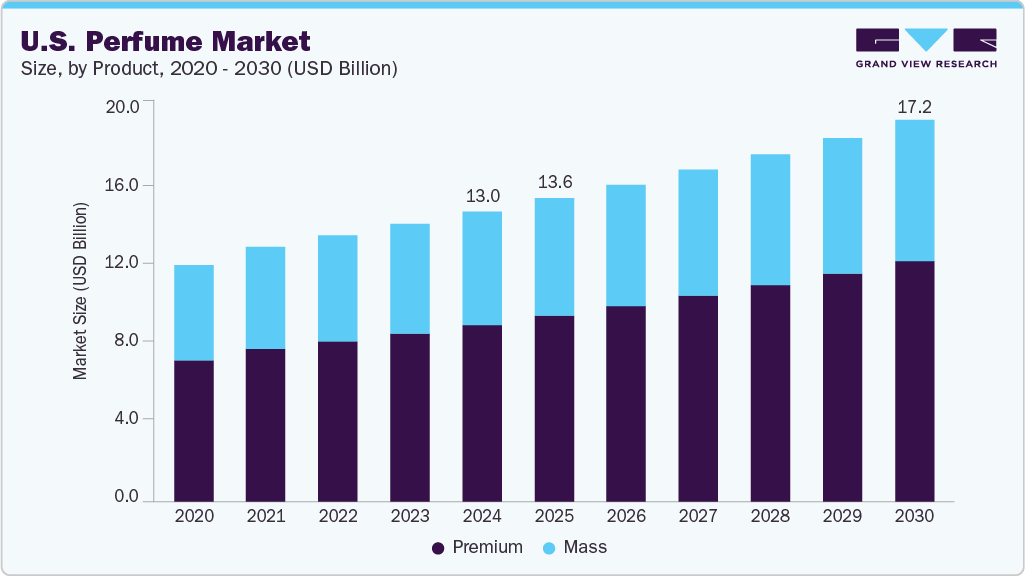 Source: Grand View Research, IR Documents, Primary Interviews, Paid DatabasesTo learn more about this report,
 Download Free Sample Report
The U.S. perfume market is also becoming increasingly segmented around premiumization, personalization, self-expression, and fragrance experimentation. Luxury and designer houses such as Chanel, Dior, Hermès, Gucci, Tom Ford, and Jo Malone London compete alongside specialist fragrance brands and digitally native labels such as KAYALI, Phlur, and Ellis Brooklyn, creating a wider spectrum of scent profiles and price points. Product innovation is extending fragrance into complementary formats, including body sprays, hair perfumes, scented body care, layering products, and discovery collections, allowing consumers to build multi-format fragrance wardrobes rather than rely on a single signature scent. This expansion is supported by the growing role of fragrance as an affordable form of luxury and self-expression, while social media and online discovery are accelerating awareness of niche scents, layering combinations, gourmand profiles, gender-fluid fragrances, and emerging fragrance brands.
Premiumization and fragrance innovation are strengthening the value proposition of the U.S. perfume market. Consumers are increasingly being offered higher-concentration perfumes, luxury collections, limited editions, and differentiated scent profiles, allowing brands to capture demand across multiple price tiers. LVMH’s Perfumes & Cosmetics business generated USD 9.23 billion in revenue in 2025, while Parfums Christian Dior benefited from launches including Miss Dior Essence and Dior Homme, and Guerlain identified fragrance as its main growth driver in 2025, supported by additions to its Aqua Allegoria and L’Art & La Matière collections. These developments demonstrate how established fragrance houses are using continuous product launches and premium collections to stimulate repeat purchases and encourage consumers to trade into more specialized scents.
“I think today the ‘lipstick effect’ has become the ‘fragrance effect.’ Why? Because by wearing a fragrance, it delivers a very strong emotional experience.” - Jean Madar, CEO & Chairman, Interparfums, Retail Brew, September 2026.
The shift from the traditional “lipstick effect” toward a “fragrance effect” highlights the expanding role of perfume as an affordable luxury, emotional-consumption category, and self-expression tool in the U.S. market. Unlike a conventional beauty purchase, fragrance can be used across multiple occasions and identities, encouraging consumers to own multiple scents rather than rely on a single signature fragrance. This behavior is broadening the addressable consumer base while supporting higher purchase frequency, premiumization, and demand for differentiated fragrance propositions across mass, prestige, and luxury segments.
Personalization, discovery, and multi-format usage are further expanding fragrance consumption beyond the traditional full-size perfume bottle. Brands are increasingly using discovery sets, seasonal launches, limited editions, and complementary fragrance formats to encourage experimentation. Inter Parfums reported that its U.S. operations represented approximately 32% of net sales in 2025, with a portfolio spanning brands including Abercrombie & Fitch, Ferragamo, GUESS, MCM, Oscar de la Renta, and Donna Karan/DKNY; the company states that it typically introduces new fragrance families every few years, alongside more frequent seasonal and limited-edition launches. Similarly, Estée Lauder Companies expanded its fragrance distribution by approximately 40 net new freestanding stores globally in fiscal 2025, led by Jo Malone London and Le Labo, while Le Labo added 90 new points of distribution.
Perfume Trend Popularity
- 66.7K - Average monthly searches
- +26.8% - Year-over-year growth in popularity
- 39.2% - TikTok share relative to global Google Search
Key Insight: Perfume is a highly popular and rapidly growing trend, with 26.8% year-over-year growth across search interest. Google Search remains the primary engagement channel, while TikTok accounts for 39.2% of the search share, highlighting significant potential for social-media-driven discovery and trend adoption.
The U.S. perfume industry is evolving from a traditional signature-scent category toward a more diversified and experience-led fragrance ecosystem. Premium concentrations, niche and luxury launches, discovery sets, minis, layering formats, and complementary products are giving consumers more ways to explore and personalize fragrance. The continued expansion of brands such as Dior, Guerlain, Le Labo, Jo Malone London, and Inter Parfums’ portfolio brands reflects how companies are responding through frequent innovation, broader distribution, and differentiated scent propositions. This combination of premiumization, personalization, experimentation, and multi-format consumption is expected to remain central to category development as fragrance increasingly functions as both a beauty product and an accessible form of personal expression.
Major Trends in the U.S. Perfume Market
Fragrance layering is shifting consumption toward multi-product scent wardrobes Fragrance is increasingly positioned as a customizable routine rather than a single-product purchase, with brands encouraging consumers to combine different scents and formats. Jo Malone London has actively promoted self-expression through scent layering, including its 2025 “Uniquely You” campaign. The brand's parent company, Estée Lauder Companies, also expanded its fragrance portfolio and retail footprint, opening approximately 40 net new freestanding fragrance stores globally in fiscal 2025, led by Jo Malone London and Le Labo. This creates opportunities for perfumes, colognes, body products, and complementary scents to be purchased together as personalized fragrance wardrobes.
Niche and prestige fragrance brands are expanding through selective distribution and experiential retail The U.S. perfume landscape is becoming more diverse as specialist fragrance houses expand their physical presence alongside traditional department-store distribution. Le Labo added 90 new points of distribution during Estée Lauder Companies’ fiscal 2025, including new flagship stores, while Jo Malone London and Le Labo together led the company's addition of approximately 40 net new freestanding fragrance stores globally. In 2026, Estée Lauder Companies further expanded its fragrance network, opening 33 net new freestanding fragrance stores globally, again led by Le Labo and Jo Malone London. The expansion demonstrates the importance of boutique environments, fragrance discovery, and direct consumer experiences in premium fragrance.
Continuous fragrance launches are accelerating scent experimentation and portfolio expansion Fragrance companies are increasingly using frequent launches, flankers, limited editions, and extensions of established franchises to create additional purchase occasions. Parfums Christian Dior launched Miss Dior Essence and Dior Homme in 2025, while Guerlain expanded its Aqua Allegoria and L’Art & La Matière lines, and Givenchy introduced a new floral version of L’Interdit Parfum. LVMH reported that its Perfumes & Cosmetics business maintained a strong innovation program in 2025, with fragrance launches playing an important role across its major houses. This continuous product renewal gives consumers more opportunities to explore different scent profiles while allowing established brands to generate incremental demand from existing fragrance franchises.
Digital personalization is becoming part of fragrance discovery and selection Fragrance discovery is increasingly incorporating digital tools to help consumers navigate large and complex scent portfolios. In December 2025, Jo Malone London introduced an AI Scent Advisor, developed with Google Gemini and Google Cloud Vertex AI, allowing consumers to receive personalized fragrance recommendations through conversational, natural-language interactions. Estée Lauder Companies also continued expanding its fragrance brands across physical and digital channels, while investing in consumer-facing experiences. Such initiatives can reduce the difficulty of selecting fragrances online and create opportunities for brands to translate personal preferences, occasions, and scent descriptions into individualized product recommendations.
These trends indicate that the U.S. perfume market is evolving from a traditional signature-scent category toward a more diversified, premium, and experience-led fragrance ecosystem, with brands increasingly addressing consumer demand for premium concentrations, niche and luxury scents, personalization, layering, and fragrance discovery. At the same time, product innovation is expanding across mini and travel formats, discovery sets, body and hair fragrances, limited-edition launches, and complementary scent products, enabling consumers to experiment with multiple fragrances and build personalized fragrance wardrobes.
Market Dynamics
U.S. consumers are increasingly incorporating fragrance into multiple moments of the day rather than reserving perfume for formal or special occasions, expanding the addressable usage base for the category. Interparfums CEO Jean Madar recently described this shift as consumers having a “fragrance wardrobe,” with different scents selected according to lifestyle, mood, and occasion. This behavior is also broadening the role of fragrance beyond conventional eau de parfum to include body mists, hair fragrances, travel sizes, rollerballs, discovery sets, and higher-concentration parfums. According to Circana, U.S. consumers are expanding fragrance purchases across both premium concentrations and lower-commitment formats. During January-September 2025, mini/travel-size fragrance units increased 12%, while mini/discovery fragrance sets rose 41%, alongside continued strength in eau de parfums and parfums. For consumers, these formats lower the commitment associated with purchasing a full-size fragrance and make it easier to carry, layer, reapply, or rotate scents throughout the day.
Brands are responding by creating broader fragrance ecosystems rather than relying on a single signature perfume, encouraging consumers to build scent routines. Bath & Body Works, for example, has historically operated across fragrance and body-care formats and reported approximately 39 million active loyalty members as of February 2025, with nearly 80% of its U.S. sales in 2024 generated by loyalty members. The company also states that it launches new fragrances and products every four to six weeks, with new products introduced nearly every week. More recently, its strategy has included expanding fragrance mists into different forms and sizes, such as rollerball formats, to appeal to younger consumers and enhance portability. Similarly, Estée Lauder Companies reported 10% fragrance sales growth in fiscal 2026, supported by brands such as Le Labo, TOM FORD, and KILIAN PARIS, alongside innovation, including perfuming hand creams and new fragrance launches. This expansion across occasion, format, price point, and application increases purchase frequency and encourages consumers to own multiple fragrances, supporting sustained demand in the U.S. perfume market.
Affordable fragrance alternatives are increasing competitive pressure on traditional perfume brands by offering consumers similar scent profiles at substantially lower price points. The trend has moved beyond small direct-to-consumer dupe brands into major mass-retail channels. Fine’ry, developed by Maesa and sold at Target, offers eau de parfum at around USD 30 and body mists at USD 15; Maesa reports that one Fine’ry unit is sold approximately every 10 seconds, while Target identifies it as its fastest-growing and number one fragrance brand. Target has also expanded its affordable fragrance assortment with Dossier, explicitly positioning the brand around prestige-inspired scents at accessible prices. Its 2025 assortment included fragrances such as Ambery Saffron, Gourmand Vanilla, Fruity Almond, and Floral Marshmallow. This broadening availability makes it easier for consumers to experiment with multiple scents without committing to the higher prices associated with designer and luxury perfumes.
The competitive threat is further amplified by social media, where fragrance comparison content, dupe recommendations, and creator-led discovery reduce the information gap between premium perfumes and lower-priced alternatives. Oakcha, Dossier, and ALT. Fragrances have built businesses around designer-inspired products, while Oakcha generated approximately USD 6.2 million in TikTok Shop sales during the first half of 2025, according to Charm.io data reported by Charm. The pressure is not limited to independent dupe companies: mass-market players such as Bath & Body Works already operate at significant scale, with USD 7.29 billion in total FY2025 sales and 1,814 U.S. company-operated stores in January 31, 2026. As consumers gain access to increasingly sophisticated, affordable scent alternatives across Target, DTC platforms, and social commerce, premium perfume brands face greater difficulty justifying price premiums solely through fragrance appeal, increasing promotional pressure, and potentially shifting purchases toward lower-priced formats.
Fragrance layering is creating an opportunity for U.S. perfume brands to expand consumption beyond the traditional single-fragrance purchase toward personalized fragrance wardrobes built around different moods, occasions, seasons, and desired scent intensity. The trend is broadening the role of fragrance across eau de parfum, perfume oils, body mists, hair fragrances, balms, body creams, and scented oils, allowing consumers to combine complementary products and create individualized scent profiles. KAYALI has positioned layering as a core element of its portfolio, with its U.S. Freedom Discovery Set comprising four 1.5-ml layering perfumes designed to encourage experimentation across different combinations. Similarly, Sol de Janeiro integrates fragrance mists with body creams, washes, and oils, demonstrating how scent can be incorporated across multiple stages of the personal-care routine.
The development of layering behavior creates opportunities for perfume companies to build modular fragrance portfolios and cross-format product ecosystems that increase engagement within individual fragrance franchises. Phlur positions its body and hair mists as both standalone fragrances and complementary layering products, while Sol de Janeiro's 2026 Intense Perfume Mist extends an existing fragrance franchise into a higher-intensity format supported by matching body creams. For U.S. perfume brands, this creates opportunities to layer discovery sets, travel-size collections, fragrance-and-body-care bundles, complementary scent boosters, and hair-and-body fragrance extensions. These formats can lower the barrier to fragrance experimentation, broaden usage occasions, and encourage repeat purchases across multiple products within the same fragrance portfolio.
Analyst Perspective
The U.S. perfume market is evolving toward a more diversified fragrance wardrobe, with consumers increasingly exploring multiple scents for different occasions, moods, and seasons rather than relying on a single signature perfume. This is expanding demand across women’s, men’s, and unisex fragrances, while niche and independent brands are gaining visibility alongside established designer and luxury houses. The Fragrance Foundation highlights growing consumer curiosity, greater product knowledge, and stronger interest in fragrance discovery, supported by social media, sampling, discovery sets, and personalized retail experiences. Premiumization is also evident through the continued introduction of luxury, ultra-luxury, and prestige fragrances, while gifting remains an important purchase occasion.
Consumer Insights
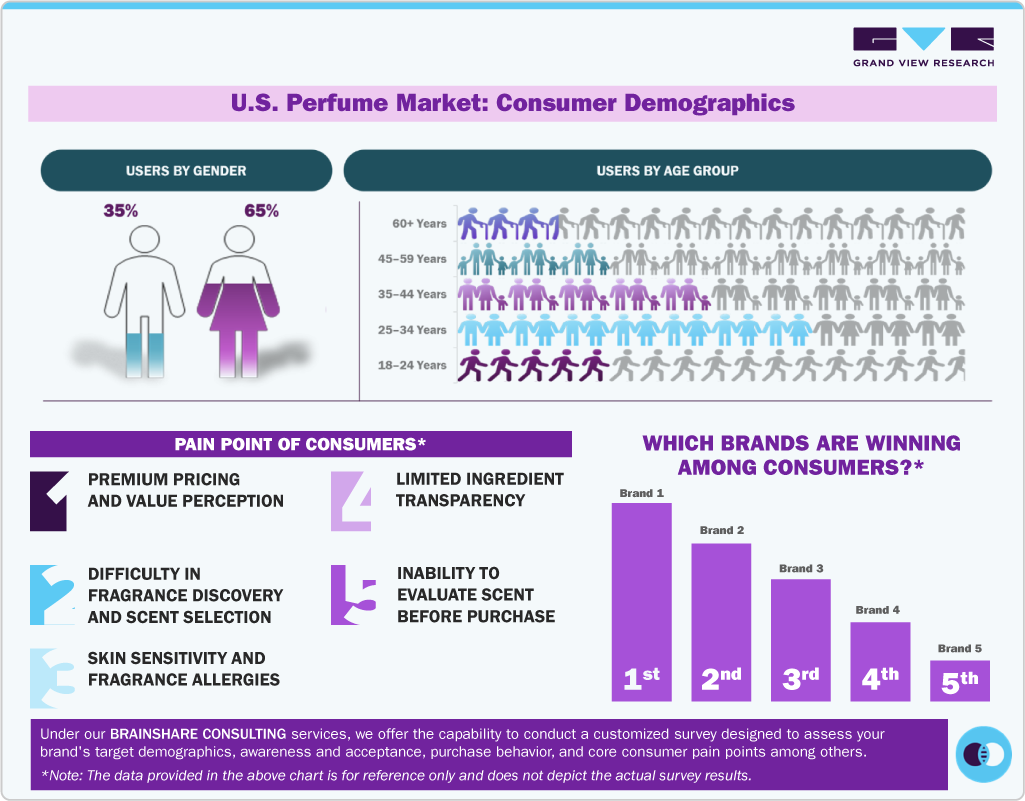
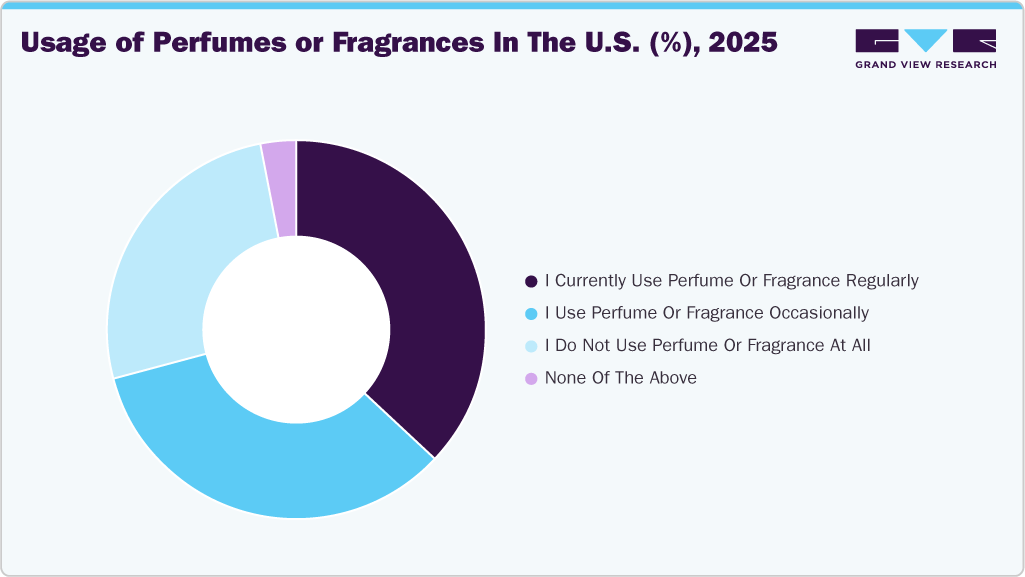
Perfume has become a widely adopted yet increasingly diversified part of U.S. personal-care and beauty routines, serving both as a habitual grooming product and a form of personal expression. U.S. consumers exhibit a combination of routine fragrance use and active experimentation, with many users maintaining one or two familiar scents while others regularly explore new fragrances.
 To learn more about this report, Download Free Sample Report
This combination of habitual replenishment and experimentation creates demand for both recognizable signature fragrances and new product discovery. For perfume brands, the consumer base therefore extends beyond traditional luxury fragrance buyers to include consumers seeking affordable, occasion-specific, seasonal, and exploratory scent options.
 To learn more about this report, Download Free Sample Report
-
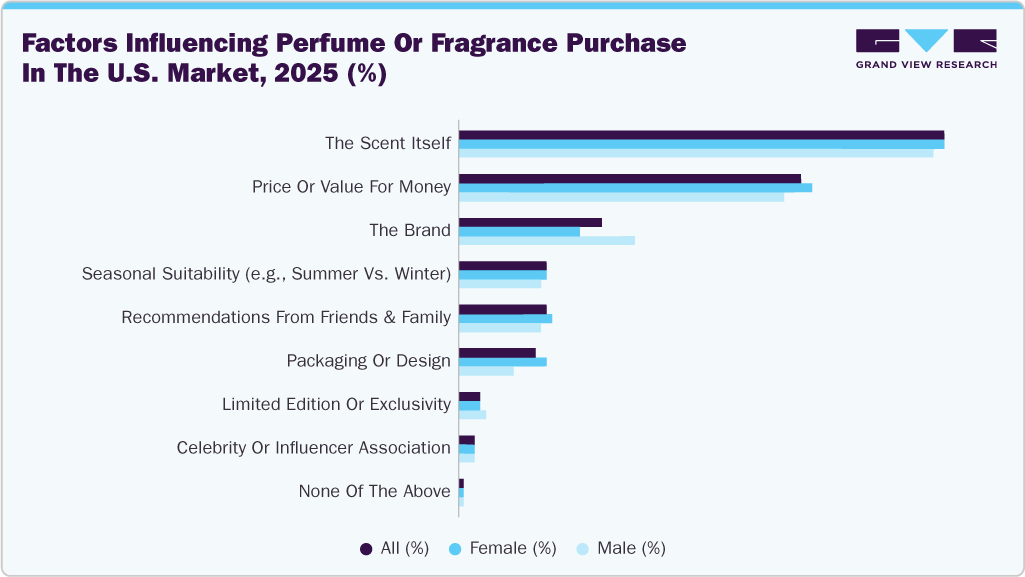
Scent remains the primary consideration when consumers select perfume: Fragrance purchasing is strongly driven by the sensory characteristics of the product rather than simply the reputation of the manufacturer. YouGov found that 88% of U.S. perfume users consider scent when purchasing, compared with 26% who consider brand. Price or value for money was also important at 62%. This creates a consumer decision process in which the fragrance profile, perceived quality, and expected wearing experience can outweigh brand recognition alone. The behavior also helps explain the continued importance of testers and sampling, particularly for unfamiliar fragrances, because consumers cannot fully evaluate an olfactory product through conventional visual product information.
 To learn more about this report, Download Free Sample Report
-
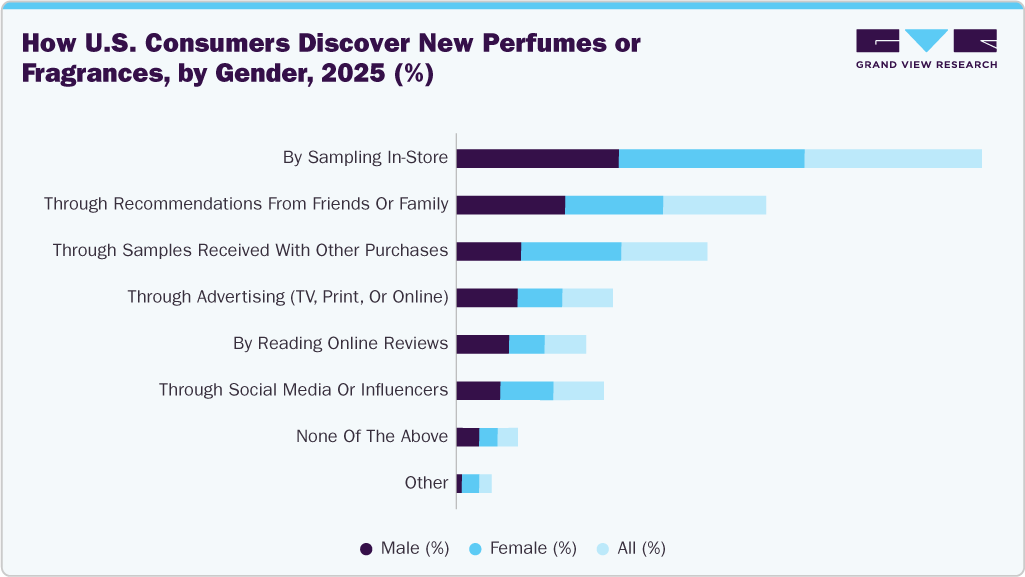
Consumers continue to rely heavily on physical sampling before purchasing unfamiliar fragrances: Perfume remains a highly experiential category despite the expansion of online beauty retail. YouGov found that 60% of U.S. perfume users usually discover fragrances through in-store sampling, making it substantially more common than discovery through advertising, social media/influencers, or online reviews. Recommendations from friends and family were the second-most common route at 35%, while 29% discovered fragrances through samples received with other purchases. This behavior creates an important role for department stores, specialty fragrance retailers, testers, gift-with-purchase programs, and discovery sets. It also suggests that digital channels are more effective when they provide mechanisms that reduce the uncertainty of purchasing a scent without physically smelling it.
-
Consumers are increasingly purchasing smaller fragrance formats to facilitate trial and portability: Smaller formats provide consumers with a lower-commitment way to experiment with fragrances and carry products during travel or throughout the day. U.S. beauty retail data reported by Circana found that mini/travel-size fragrance units increased 15% during the first half of 2025, almost four times the rate of other fragrance sizes. The same period also saw strong performance from lower-priced fragrance formats. This behavior is particularly relevant for consumers who want to explore multiple scents without committing to a large bottle. Companies are responding with travel sprays, minis, discovery collections, and smaller gift sets, effectively making trial and portability part of the fragrance purchasing experience.
 To learn more about this report, Download Free Sample Report
-
Consumers are increasingly combining social-media discovery with physical sampling to reduce the uncertainty of trying unfamiliar fragrances: TikTok has become an important discovery channel, with 45% of social-media-driven fragrance purchases in the U.S. attributed to the platform, while #PerfumeTok has accumulated billions of views and helped bring niche fragrances, fragrance comparisons, reviews, and “dupe” recommendations to a mass audience. However, digital discovery does not eliminate the need for sensory validation. This combination has encouraged brands and retailers to use discovery sets, samples, travel sizes, personalized fragrance recommendations, and social media storytelling to bridge the gap between seeing a fragrance online and experiencing it on the skin. The resulting consumer journey increasingly moves from social discovery → recommendation/review → sampling or trial → full-size purchase, particularly for unfamiliar or premium fragrances.
-
Consumers are increasingly using fragrance across different occasions rather than restricting it to one signature scent: Fragrance usage is becoming more flexible, with consumers able to maintain different products for work, evenings, social occasions, travel, or everyday wear. The behavior is reflected in the increasing breadth of company portfolios, where brands launch multiple concentrations, flankers, body sprays, and complementary scented products around established fragrance franchises. For example, Estée Lauder's fragrance portfolio includes differentiated luxury propositions such as Le Labo, Jo Malone London, and KILIAN PARIS, while Le Labo's growth has been supported by its Classic Collection, City Exclusive program, new products, and expanded consumer reach. The company's fiscal 2025 results reported double-digit year-over-year net sales increases for Le Labo in each quarter, indicating continued consumer engagement with differentiated fragrance propositions.
-
Fragrance is an important gifting purchase in addition to self-consumption: Consumer behavior in perfume extends beyond personal use because fragrance is closely associated with gifting occasions. Circana reported that approximately one in five U.S. consumers purchased fragrance as a holiday gift in the previous year. The same source noted that prestige fragrance gift sets typically represent more than 25% of Q4 prestige fragrance sales, highlighting the importance of sets during the holiday period. Mother's Day also generated significant fragrance demand, with one in five consumers choosing to gift fragrance during the 2025 Mother's Day period. This creates seasonal demand for gift sets, minis, recognizable fragrances, premium packaging, and products that are easier to purchase for another person without knowing their exact scent preferences.
-
Consumers are increasingly exploring fragrances through new product launches and differentiated scent propositions: Product innovation is becoming an important mechanism for stimulating experimentation. U.S. prestige fragrance sales increased 6% in the first half of 2025, while new fragrance launches accounted for nearly one-third of total fragrance dollar gains during the period. Higher concentrations, particularly eau de parfums and parfums, were also important contributors. Company activity reflects this demand for continuous innovation: Estée Lauder reported fragrance growth led by Le Labo and Jo Malone London, supported by hero products and new launches such as Eucalyptus 20 and Hinoki & Cedarwood. This suggests that consumers are not simply replacing identical products; new scents and extensions can actively stimulate incremental purchasing.
-
Digital purchasing is growing, but online fragrance consumers still face a sensory-information gap: U.S. consumers increasingly purchase perfume through online retailers and brand websites, although physical stores remain important for discovery. YouGov reported that 23% of perfume users purchased their latest fragrance from an online retailer and 10% from a brand website, compared with 46% who purchased from a department store. The gap between online purchasing and in-store discovery indicates that consumers may research or replenish familiar fragrances online while relying on physical retail for scent discovery. This behavior encourages brands to strengthen online fragrance descriptions, reviews, sampling programs, product comparison tools, and direct-to-consumer experiences.
-
Ingredient sensitivity and transparency can influence fragrance choices among a subset of consumers: Fragrance can create a particular consideration for consumers with known sensitivities. The FDA identifies fragrances among the common classes of cosmetic allergens and notes that cosmetic reactions can include itchy, red rashes and contact dermatitis. At the same time, U.S. cosmetic labeling rules allow fragrance mixtures to be declared generally as “fragrance” or “perfume” rather than requiring individual fragrance components to be listed. This can make it more difficult for consumers who are actively avoiding specific fragrance ingredients to assess a product based on the label alone. Consequently, formulation communication, ingredient information, and clear product claims can become relevant differentiators for consumers concerned about tolerability.
Fragrance Foundation Awards - U.S. Perfume Market, 2025
Rank
Fragrance/Product
Company/Brand
Award
1
Kilian Paris Sunkissed Goddess
Estée Lauder Companies
Fragrance of the Year - Women’s Luxury
2
Kayali Vanilla Candy Rock Sugar | 42
Kayali
Fragrance of the Year - Women’s Prestige
3
Tom Ford Bois Pacifique
Estée Lauder Companies
Fragrance of the Year - Men’s Luxury
4
Ralph Lauren Polo ’67 EDT
L’Oréal
Fragrance of the Year - Men’s Prestige
5
Rabanne 1 Million Eau de Toilette
Puig
Fragrance Hall of Fame
6
Maison Margiela Replica Afternoon Delight
L’Oréal
Fragrance of the Year - Universal Prestige
7
Byredo Desert Dawn
Puig
Fragrance of the Year - Universal Luxury
8
Tom Ford Black Lacquer
Estée Lauder Companies
Fragrance of the Year - Ultra Luxury
9
Vacation® AFTER SUN
Vacation
Fragrance of the Year - Popular
U.S. perfume consumption is characterized by broad category penetration, increasing experimentation, and strong emphasis on scent, value, and trialability. Consumers are gradually moving from single-signature fragrances toward diversified fragrance wardrobes, while younger consumers show greater interest in alternative formats and discovery. At the same time, gender and income differences influence purchase drivers and spending levels, creating opportunities for brands to differentiate through price-tiered offerings, sampling, personalization, innovative formats, and occasion-based positioning.
Product Insights
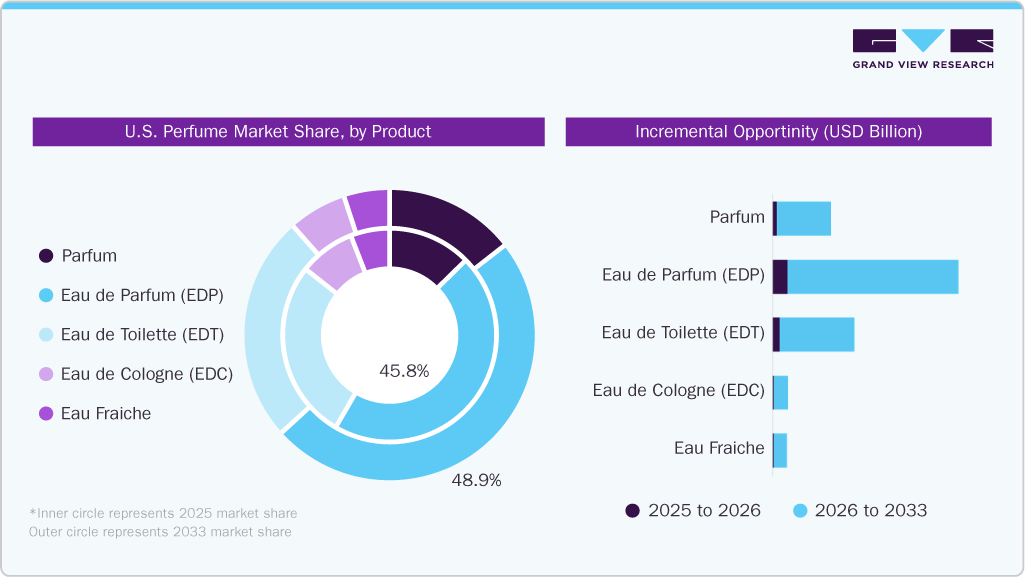
Eau de Parfum (EDP) accounted for the largest share of 45.8% in 2025, supported by its established position as a core fragrance concentration across designer, prestige, and luxury portfolios. The segment's scale is consistent with the broad availability of EDP formats across major fragrance brands and retailers, where consumers can choose from a wide range of floral, woody, gourmand, and fresh scent profiles. Product innovation is also expanding the role of EDP beyond conventional perfume use through travel sizes, complementary body products, and fragrance-layering routines. For example, CHANEL's CHANCE EAU SPLENDIDE is offered as an Eau de Parfum alongside complementary body and hair products, illustrating how brands are building broader fragrance rituals around established EDP franchises.
Type
Oil Concentration
Longevity on Skin
Projection
Best For
Parfum (Extrait / Pure Parfum)
20-40%
8-12+ hours
Strong & luxurious
Special occasions, evenings, intimate signature scent
Eau de Parfum (EDP)
15-20%
6-10 hours
Medium to strong
Everyday luxury, day-to-night wear
Eau de Toilette (EDT)
5-15%
4-6 hours
Light to medium
Fresh daytime wear, office, casual
Eau de Cologne (EDC)
2-5%
2-4 hours
Light & bright
Summer, refreshing spritz, gym bag
Eau Fraîche
1-3%
1-2 hours
Very light
Heat, humidity, very subtle scent moments
Perfume Oils / Attars
20-35% (undiluted botanical oils)
6-14 hours (varies by resin)
Soft & intimate, close to the body
Natural perfumery, skin-to-skin intimacy, scent ritual
 To learn more about this report, Download Free Sample Report
The parfum segment is expected to grow at the fastest CAGR of 10.6% from 2025 to 2033. Its faster growth reflects increasing product availability in highly concentrated fragrance formats, particularly within niche and luxury collections, as well as the expansion of extrait and parfum variants from established fragrance houses. For instance, Dior expanded its La Collection Privée Christian Dior with parfum- and extrait-oriented offerings, while luxury fragrance houses such as Maison Francis Kurkdjian, Byredo, Le Labo, and Creed continue to build portfolios around concentrated, distinctive fragrance compositions. The growing availability of smaller, high-concentration formats also allows brands to position fragrance around craftsmanship, distinctive ingredients, and elevated scent profiles rather than simply frequency of use.
Price Tier Insights
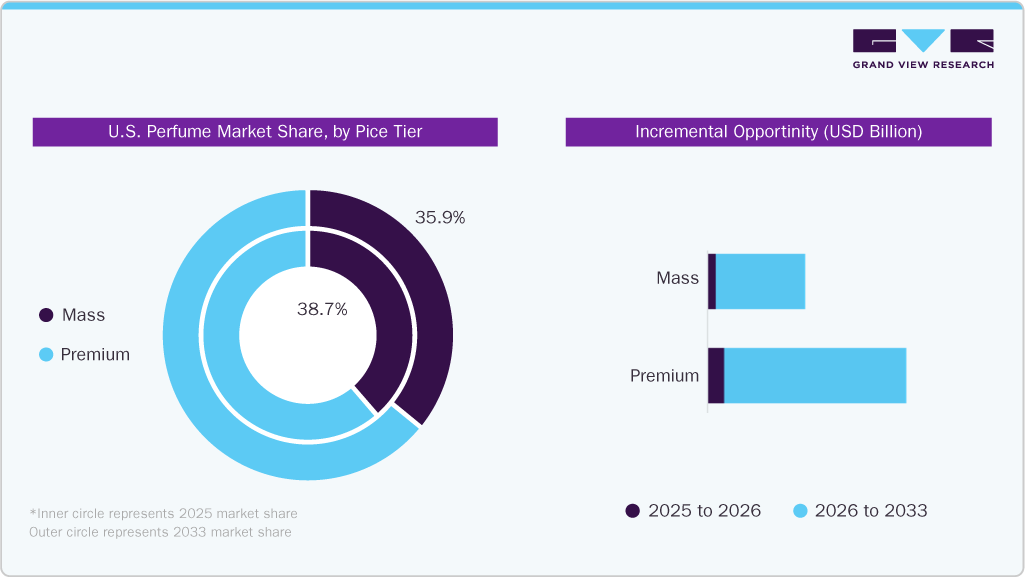
The premium perfume segment dominated the U.S. perfume industry, accounting for a revenue share of 61.3% in 2025, supported by continued premiumization, demand for differentiated fragrances, and strong innovation from prestige brands. The shift toward higher-value fragrance products is supported by industry developments, including increased consumer interest in prestige, luxury, niche, and ultra-premium fragrances. In FY2026, Estée Lauder Companies reported 10% growth in fragrance net sales, driven primarily by double-digit growth from its Luxury Brands portfolio, including Le Labo, TOM FORD, and KILIAN PARIS. The company also reported that Le Labo gained value share in the U.S. fragrance market during calendar 2025. LVMH likewise reported that fragrance showed the strongest momentum at Sephora in 2025, supported by product innovation and newer applications such as mists and layering. These developments reinforce demand for differentiated scent profiles, premium formulations, niche positioning, and experiential fragrance consumption.
 To learn more about this report, Download Free Sample Report
Luxury brands are also stepping up with immersive launches and limited-edition offerings that blend craftsmanship with storytelling. E-commerce and social media enhance accessibility, allowing niche and designer fragrances to reach a wider audience. For instance, in 2024, Chanel launched its premium fragrance Chance Eau Splendide in the U.S., with an immersive pop-up at The Grove in Los Angeles. Rising disposable incomes and lifestyle shifts toward self-expression and wellness fuel demand for premium fragrances. Innovative presentation and formats, such as layering kits, refillable bottles, and interactive pop-ups, further enhance product appeal.
 To learn more about this report, Download Free Sample Report
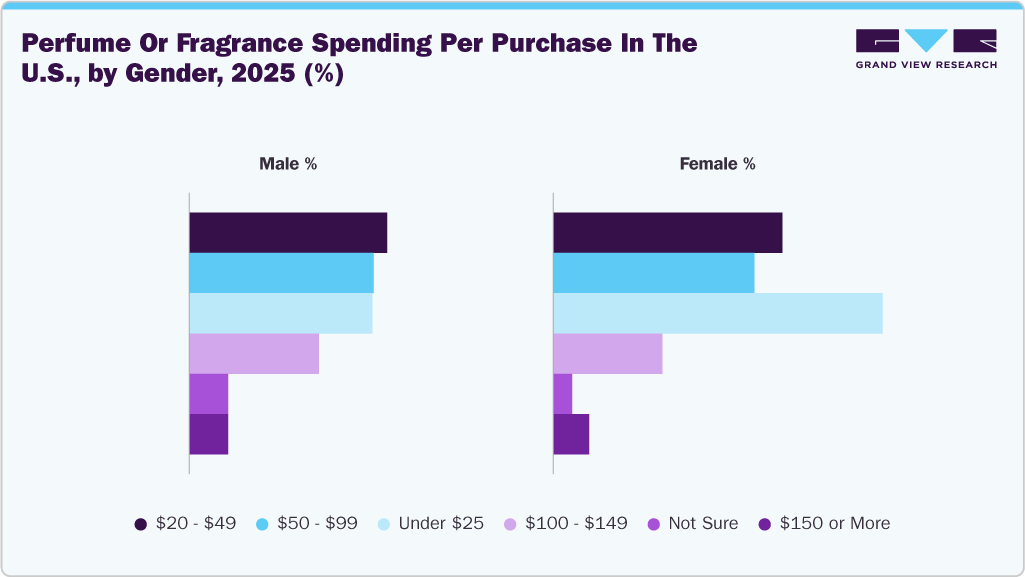
The mass perfume segment is projected to grow at a 7.8% CAGR from 2025 to 2030, driven by affordability, everyday use, and demand for accessible fragrance formats. Recent consumer evidence indicates that affordability remains an important consideration in the U.S. market. According to YouGov's November 2025 survey, 62% of U.S. perfume users identified price or value for money as a purchase factor, while 57% reported spending less than USD 50 on their most recent fragrance purchase. At the same time, the mass segment is evolving beyond traditional low-priced fragrances through body mists, smaller formats, celebrity fragrances, and accessible premium offerings. LVMH's 2025 reporting also identified mists and layering as important areas of fragrance innovation at Sephora. This combination of affordability and format innovation supports continued demand for mass-market perfume products.
Gender Insights
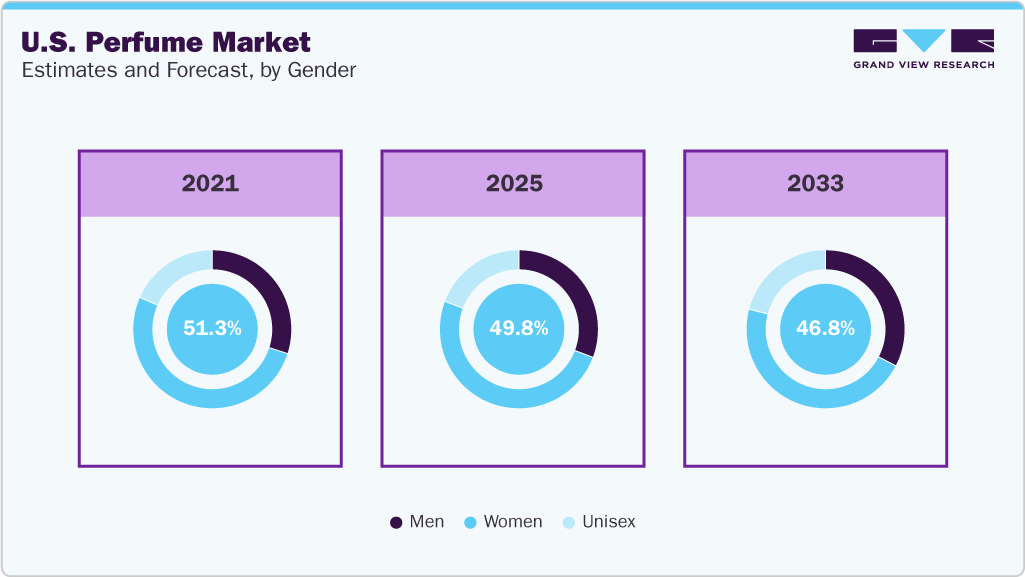
The women segment dominated the U.S. perfume market, accounting for a revenue share of 49.8% in 2025, reflecting its established consumer base and continued demand for designer, prestige, and established fragrance franchises. Recent consumer data confirms the continued importance of women in fragrance purchasing and discovery. YouGov's November 2025 survey found that women were more likely than men to purchase fragrances from department stores (50% vs 40%) and more likely to discover fragrances through in-store sampling (63% vs 55%). Brand innovation continues to reinforce the segment, with major fragrance houses expanding female-oriented portfolios alongside niche and luxury launches. Estée Lauder Companies reported broad-based growth across its Luxury Brands fragrance portfolio in FY2026, including Le Labo, TOM FORD, and KILIAN PARIS. Moreover, Women seek signature scents that reflect their individuality, boosting demand for premium and innovative launches.
For instance, in July 2025, Burberry launched Goddess Parfum, an elevated expression of its feminine fragrance collection, featuring notes of raspberry, lavender, three forms of vanilla, and suede. The fragrance is vegan and refillable, aligning product innovation with evolving sustainability expectations while reinforcing themes of self-discovery and personal expression. In addition, rising disposable incomes, expanding online retail channels, and the influence of social media enhance fragrance accessibility and brand engagement. The increasing availability of differentiated scent profiles, refillable formats, and prestige launches enables consumers to build fragrance wardrobes around individual preferences, occasions, and moods.
 To learn more about this report, Download Free Sample Report
Unisex fragrance is the fastest-growing category by momentum and cultural shift, with the segment projected to register a 9.7% CAGR from 2026 to 2033 in the U.S. perfume market. Modern consumers are increasingly moving away from traditional gender-based fragrance positioning, particularly among younger demographics, with 60% of Gen Z consumers favoring gender-neutral scents. This behavioral shift is encouraging fragrance houses to broaden product positioning around scent profiles, ingredients, mood, and personal identity rather than relying on explicit masculine or feminine classifications. Industry sources indicate that nearly half of new premium fragrance introductions are now positioned without explicit gender labels, highlighting the growing influence of gender-neutral concepts on product innovation. The trend is also reinforced by the expansion of niche and luxury fragrance brands, where consumers often select fragrances based on individual preferences and layering possibilities rather than conventional gender categories. As brands increasingly emphasize individuality, personalization, and self-expression, unisex positioning is gaining relevance across premium and niche fragrance portfolios and supporting faster adoption among younger U.S. consumers.
Distribution Channel Insights
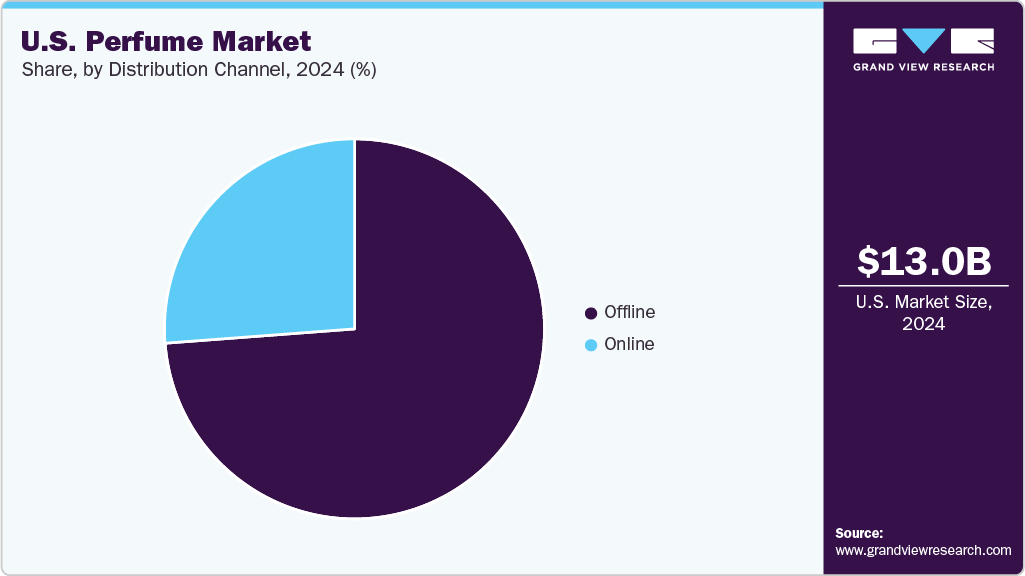
The offline distribution channel accounted for the largest share of 57.8% in 2025, supported by the experiential nature of fragrance purchasing and the importance of physical scent testing. YouGov's latest U.S. fragrance survey found that 60% of perfume users usually discover fragrances through in-store sampling, making physical retail a particularly important discovery and conversion point. Department stores were also the most frequently reported purchase location, with 46% of U.S. perfume users purchasing their latest fragrance from a department store, compared with 23% purchasing through an online retailer. Sephora's 2025 performance further demonstrates the continued relevance of physical beauty retail. LVMH reported solid growth, continued market-share gains, and the opening of approximately 100 Sephora locations globally during 2025, alongside continued expansion of its North American store network.
 To learn more about this report, Download Free Sample Report
The online distribution channel is expected to grow at the fastest CAGR of 10.9% from 2025 to 2030, driven by convenience, broader product assortment, direct-to-consumer purchasing, reviews, social discovery, and improved digital merchandising. YouGov's November 2025 data shows that 23% of U.S. perfume users purchased their latest fragrance from an online retailer and 10% from a brand website. Men showed particularly strong digital purchasing behavior, with 26% purchasing from online retailers and 15% from brand websites. Leading beauty retailers are also integrating physical and digital experiences rather than treating the channels independently. LVMH reported that Sephora continued strengthening its omnichannel strategy in 2025, including further development of its app as a digital flagship while expanding its physical retail network. This combination of digital convenience and omnichannel integration supports the continued expansion of online perfume distribution.
Cross Segmentation Analysis
The study provides a detailed cross-segmentation analysis of the U.S. perfume market to assess how demand varies across product types, price tiers, and distribution channels. Beyond individual product and segment analysis, the report evaluates Parfum, Eau de Parfum (EDP), Eau de Toilette (EDT), Eau de Cologne (EDC), and Eau Fraiche across mass and premium price tiers, providing a granular view of how price positioning differs by fragrance concentration and product type. The analysis also cross-segments each perfume product type across offline and online distribution channels, enabling assessment of how purchasing behavior and digital adoption vary across fragrance formats. These cross-segment insights help identify premiumization opportunities, product-specific pricing strategies, channel expansion opportunities, and shifts toward online perfume purchasing, supporting brands in optimizing product portfolios, price positioning, and omnichannel distribution strategies.
 To learn more about this report, Download Free Sample Report
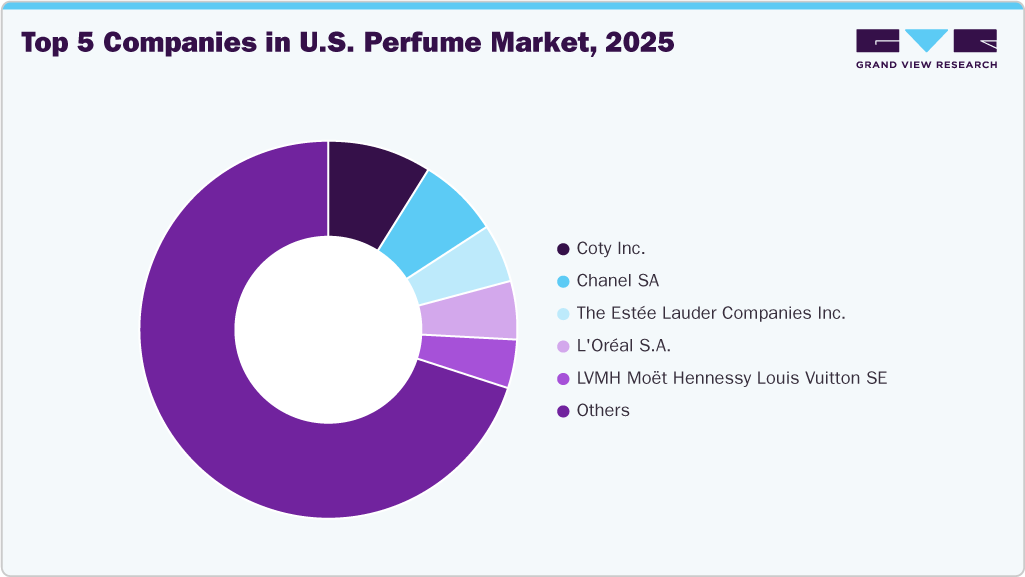
The U.S. perfume market is highly competitive and fragmented across mass, prestige, luxury, and niche fragrance propositions. Major international beauty and luxury groups compete alongside specialized fragrance companies and vertically integrated U.S. retailers, with portfolios spanning designer perfumes, celebrity-led fragrances, heritage maisons, niche scents, and accessible body-fragrance formats. Key participants include L'Oréal, LVMH, Coty, The Estée Lauder Companies, and others. Competitive differentiation is increasingly shaped by brand equity, fragrance launches, portfolio breadth, olfactory innovation, premium positioning, retail exclusivity, digital discovery, and the ability to build fragrance franchises around recognizable signatures.
Leading companies and their perfume brands in the U.S. perfume market
Company
Key Perfume Brands
Coty Inc.
Gucci, Burberry, Calvin Klein, Hugo Boss, Marc Jacobs, Chloé
Chanel SA
Chanel N°5, Coco Mademoiselle, Bleu de Chanel, Chance
The Estée Lauder Companies Inc.
Jo Malone London, Le Labo, Tom Ford, Estée Lauder, AERIN
L'Oréal S.A.
Yves Saint Laurent, Armani, Prada, Valentino, Mugler, Maison Margiela, Ralph Lauren, Azzaro
LVMH Moët Hennessy Louis Vuitton SE
Dior, Guerlain, Givenchy, Maison Francis Kurkdjian, Kenzo, Acqua di Parma, Loewe
Puig Brands, S.A.
Rabanne, Carolina Herrera, Jean Paul Gaultier, Byredo, Penhaligon's, Nina Ricci
Shiseido Company, Limited
Narciso Rodriguez, Issey Miyake, Serge Lutens, Zadig & Voltaire
Inter Parfums, Inc.
Jimmy Choo, Coach, Montblanc, Kate Spade, Oscar de la Renta, Ferragamo, Lacoste, Lanvin
Bath & Body Works, Inc.
A Thousand Wishes, Into the Night, Japanese Cherry Blossom, Gingham, Champagne Toast, Warm Vanilla Sugar
Hermès International S.A.
Terre d'Hermès, H24, Twilly d'Hermès, Eau des Merveilles, Un Jardin sur le Nil
-
Leading Perfume Companies: L'Oréal, LVMH, Coty, Estée Lauder, and Puig maintain broad fragrance portfolios spanning designer, prestige, luxury, and niche positioning. L'Oréal Luxe reported that it was the No. 1 fragrance player globally in 2025, with a portfolio of 27 brands. In the U.S., L'Oréal reported that its Luxe portfolio held five of the top 10 men's fragrance brands and three of the top 10 women's fragrance brands, demonstrating its substantial competitive presence in the U.S. prestige fragrance category. Its portfolio includes Yves Saint Laurent, Giorgio Armani, Prada, Valentino, Lancôme, Ralph Lauren, and Maison Margiela. LVMH participates through Dior, Guerlain, Givenchy, and Maison Francis Kurkdjian, while Puig reported three brands among the world's top 10 fragrance brands in 2025, Rabanne (#5), Carolina Herrera (#6), and Jean Paul Gaultier (#9).
-
Brand Positioning & Competitive Strength: Brand equity remains a central competitive factor, particularly within U.S. prestige and luxury fragrance. L'Oréal reported that Yves Saint Laurent Libre was the world's No. 1 feminine fragrance in 2025, and that its leading fragrance portfolio also included Prada Paradoxe, Lancôme La Vie Est Belle, Valentino Born in Roma, Ralph Lauren Polo, and Armani Acqua di Giò among the global top 15 fragrances. LVMH's Dior combines high-volume designer franchises such as Sauvage and J'adore with higher-end fragrance collections, while Guerlain and Maison Francis Kurkdjian provide exposure to high-perfumery and niche-oriented consumers. This portfolio structure allows major groups to compete across multiple price points while retaining strong brand differentiation.
-
Brand Growth & Portfolio Momentum: Company results indicate continued momentum for established fragrance franchises and newer luxury brands. Puig's Fragrance and Fashion segment generated USD 4.12 billion in revenue in 2025, up 3.8% year over year from USD 3.97 billion in 2024. Within the segment, Puig's niche portfolio recorded double-digit growth, led by Byredo and Dries Van Noten, while Penhaligon's and L'Artisan Parfumeur also delivered strong performance. Estée Lauder reported that its fragrance net sales were broadly flat in fiscal 2025, while its Luxury Brands delivered mid-single-digit growth, driven by strong double-digit growth at Le Labo and additional growth at KILIAN PARIS.
-
New Fragrance Launches & Innovation: Product launches remain a key mechanism for extending established fragrance franchises and attracting new consumers. In 2025, L'Oréal launched Miutine, Miu Miu's first fragrance with L'Oréal, alongside Prada Paradigme, while continuing to build YSL Libre, Prada Paradoxe, Valentino Born in Roma, and other major franchises. L'Oréal's 2026 first-half results subsequently reported that fragrances continued to grow at double-digit rates, driven particularly by Prada Paradigme, Emporio Armani, YSL Libre, MYSLF, and Valentino Born in Roma. Innovation is therefore increasingly centered on new fragrance pillars, flankers, concentrations, limited editions, and extensions of established brand franchises.
-
Niche, Luxury & Selective Fragrance Expansion: Niche fragrance has become an increasingly important component of competitive differentiation. Estée Lauder's Le Labo recorded strong double-digit year-over-year net-sales growth in every quarter of fiscal 2025, supported by products such as Eucalyptus 20 and Osmanthus 19. The company also expanded Le Labo's distribution by 90 new points of distribution during fiscal 2025. Puig's niche portfolio similarly grew at a double-digit rate in 2025, led by Byredo and Dries Van Noten. These developments indicate how niche brands are being used by major beauty groups to participate in premium price points and differentiate through craftsmanship, distinctive scent profiles, exclusivity, and brand storytelling.
-
Premiumization & Fragrance-Led Luxury: Premiumization is particularly relevant to companies with luxury fragrance portfolios, as higher-priced collections provide opportunities to increase value per consumer while strengthening brand positioning. L'Oréal Luxe operates across multiple luxury price points through brands such as Armani, Prada, Yves Saint Laurent, Valentino, and Lancôme, while its haute-perfumery portfolio provides additional exposure to premium consumers. The division reported No. 1 fragrance positioning globally in 2025 and continued to outperform the luxury beauty market, supported by its fragrance portfolio. LVMH similarly combines large-scale Dior and Guerlain franchises with higher-end offerings from Maison Francis Kurkdjian and other luxury houses.
-
Distribution & Omnichannel Expansion: Distribution expansion remains an important competitive lever as fragrance purchases increasingly span department stores, specialty beauty retailers, boutiques, e-commerce, and direct-to-consumer channels. Estée Lauder opened approximately 40 net new freestanding fragrance stores globally in fiscal 2025, primarily through Jo Malone London and Le Labo, while Le Labo added 90 new distribution points. The company continued this expansion in fiscal 2026, opening 33 net new freestanding fragrance stores globally, led by Le Labo and Jo Malone London. For the U.S. market, this expansion is relevant because selective distribution and branded retail environments give luxury fragrance companies greater control over the consumer experience and brand presentation.
-
Designer Licensing & Brand Portfolio Breadth: Licensing remains an important competitive model, particularly for Inter Parfums and Coty. Inter Parfums operates a portfolio of more than 40 prestige and luxury fragrance brands and distributes its products across more than 120 countries. Its portfolio includes Coach, Jimmy Choo, Kate Spade, Lacoste, Montblanc, Lanvin, Longchamp, Moncler, and Van Cleef & Arpels. This model allows fragrance specialists to leverage established fashion and luxury brand identities while contributing product development, manufacturing, marketing, and distribution capabilities. Coty's broad designer portfolio similarly provides exposure to multiple consumer segments and fragrance price tiers.
-
Mass-Premium & Accessible Fragrance Competition: Competition also extends beyond traditional prestige perfume houses. Bath & Body Works operates a differentiated fragrance model built around Fine Fragrance Mists, Eau de Parfum, body fragrances, and fragrance-led body-care collections, supported by its extensive U.S. store network and digital channels. This positioning creates a distinct consumption occasion compared to traditional luxury perfume, emphasizing frequent use, gifting, fragrance layering, and accessible price points. Consequently, the U.S. competitive landscape extends from luxury eau de parfum and niche perfumery to accessible fragrance formats, allowing companies to target substantially different purchase frequencies and consumer budgets.
The U.S. perfume industry is therefore characterized by competition across designer, luxury, niche, prestige, and accessible fragrance formats, rather than by a single competitive model. Major companies are strengthening their positions through established fragrance franchises, frequent product launches, selective distribution, niche-brand acquisitions and investments, premium collections, and expanded e-commerce availability. L'Oréal and LVMH have particularly broad luxury fragrance portfolios, while Puig and Estée Lauder have strengthened their exposure to niche and prestige fragrance. Coty and Inter Parfums benefit from extensive designer licensing portfolios, whereas Bath & Body Works provides a distinct, accessible fragrance and body-care model. Market share assessment should consequently distinguish among company-level fragrance sales, individual brand performance, and U.S.-specific retail presence, since most companies report fragrance revenues at the global or regional level rather than at a U.S.-perfume-only level.
 To learn more about this report, Download Free Sample Report
Key U.S. Perfume Companies
-
Coty Inc.
-
Chanel SA
-
The Estée Lauder Companies Inc.
-
L'Oréal S.A.
-
LVMH Moët Hennessy Louis Vuitton SE
-
Puig Brands, S.A.
-
Shiseido Company, Limited
-
Inter Parfums, Inc.
-
Bath & Body Works, Inc.
-
Hermès International S.A.
Competitive Benchmarking
Category
Operating Strategies
Competitive Edge
Weakness
Established Global Fragrance Players (Coty Inc.; Chanel SA; The Estée Lauder Companies Inc.; L'Oréal S.A.; LVMH Moët Hennessy Louis Vuitton SE; Puig Brands, S.A.; Shiseido Company, Limited; Inter Parfums, Inc.)
- Maintain broad fragrance portfolios spanning mass-premium, prestige, luxury, and niche positioning while investing in new fragrance launches, flankers, celebrity/licensing partnerships, and high-visibility marketing. Strengthen department stores, specialty beauty, travel-retail, e-commerce, and brand-owned distribution while using selective retail strategies for luxury and premium collections.
- Expand fragrance innovation through new scent profiles, premium ingredients, refillable formats, and adjacent categories such as body mists. Coty, for example, is strengthening fragrance across price points from mass to ultra-premium and expanding e-commerce and U.S. distribution, while Puig continues to expand both prestige and niche fragrance portfolios.
- Strong brand recognition, extensive fragrance portfolios, established relationships with retailers and distributors, and significant marketing and product-development capabilities.
- Ownership or licensing of globally recognized fashion and luxury brands provides strong consumer awareness and supports premium pricing. Large-scale manufacturing, sourcing, and distribution networks also enable rapid commercialization of new launches across multiple price tiers.
- High dependence on discretionary consumer spending and premium beauty demand, particularly within prestige and luxury fragrance. Large portfolios can increase complexity in product management and marketing allocation, while intense competition for retail visibility and consumer attention can raise launch and promotional costs.
- Exposure to international sourcing, currency movements, tariffs, and changing fragrance regulations can also pressure margins.
Luxury & Heritage Fragrance Houses (Chanel SA; LVMH Moët Hennessy Louis Vuitton SE; Hermès International S.A.)
- Focus on brand heritage, craftsmanship, distinctive fragrance identities, premium ingredients, and controlled distribution to reinforce luxury positioning. Invest in flagship boutiques, selective department-store distribution, experiential retail, storytelling, limited editions, and high-end fragrance collections.
- Develop fragrance lines that extend beyond core perfumes into complementary luxury scenting products while maintaining strong brand consistency. LVMH's Perfumes & Cosmetics business, for instance, continues to emphasize selective retail and fragrance innovation across Dior, Guerlain, Givenchy, and other maisons.
- Exceptional brand equity, heritage, exclusivity, strong pricing power, and high consumer recognition. Direct control over brand image and selective distribution helps preserve scarcity and premium positioning. Strong emotional associations with fashion, luxury, craftsmanship, and lifestyle allow these players to command higher average selling prices than mass-market competitors.
- Premium pricing limits addressable consumer segments, particularly during periods of weaker discretionary spending. Highly controlled distribution can also restrict volume expansion relative to broader omnichannel competitors. Maintaining exclusivity while responding quickly to fast-changing fragrance trends and digitally driven consumer discovery can create additional strategic challenges.
Recently Closed Transactions
Fundamental Brands expands its U.S. fragrance portfolio through the acquisition of Great American Beauty In April 2026, Fundamental Brands signed a definitive agreement to acquire Great American Beauty (GAB) and its licensing subsidiary, Palm Beach Beauté. The fragrance business generated approximately USD 31 million in net sales in 2025 and manages licensed and proprietary brands including Mustang, Ellen Tracy, IZOD, Ram Truck, and Top Gun. GAB also serves as a U.S. distributor for Disney Fragrances and Lattafa. The acquisition expands Fundamental Brands’ presence in fragrance while creating opportunities to strengthen direct-to-consumer e-commerce and omnichannel distribution. The company also plans to leverage U.S.-based manufacturing capabilities to improve production and supply-chain efficiency.
Turpaz Industries strengthens its U.S. fragrance and flavor platform through the acquisition of Phoenix In May 2026, Turpaz Industries acquired 100% of Phoenix Flavors & Fragrances Inc., a U.S.-based developer and manufacturer of fragrance and flavor extracts, through its wholly owned U.S. subsidiary Klabin-Turpaz. The transaction was valued at USD 95 million, with an additional potential consideration of up to USD 5 million based on Phoenix’s 2026 performance. The acquisition establishes a broader U.S. operating platform for Turpaz and combines Phoenix’s capabilities with Turpaz’s existing operations. Phoenix’s portfolio and manufacturing capabilities strengthen Turpaz’s presence in fragrance creation, production, and related applications in the U.S. market.
Givaudan expands its U.S. fragrance capabilities through the acquisition of Belle Aire Creations In December 2025, Givaudan completed the acquisition of Belle Aire Creations, a U.S.-based fragrance house headquartered in Illinois. Givaudan acquired 100% of the company for approximately CHF 188 million (USD 234 million). Founded in 1982, Belle Aire provides fragrance solutions to customers across North America and employs approximately 191 people in the U.S. The acquisition strengthens Givaudan’s regional customer relationships and creative capabilities while expanding its U.S. fragrance platform. The transaction forms part of Givaudan’s strategy to increase its presence among local and regional customers and enhance its ability to serve the North American fragrance market.
Interparfums strengthens its prestige fragrance portfolio through the acquisition of Maison Goutal In March 2025, Interparfums announced that its 72%-owned French subsidiary, Interparfums SA, acquired all worldwide intellectual property rights relating to Maison Goutal from Amorepacific Europe. The transaction included rights covering the established French fragrance house, founded by Annick Goutal in 1981, with a portfolio spanning high-end perfumes, bath products, and home fragrances. Amorepacific continued operating the brand under an existing license through December 2025, after which Interparfums began commercial use in January 2026. The acquisition strengthens Interparfums’ portfolio of prestige fragrance brands and provides additional opportunities for international development, including distribution in the U.S. market.
Interparfums adds Off-White fragrance and cosmetics trademarks to its luxury portfolio In December 2024, Interparfums’ 72%-owned French subsidiary acquired the Off-White brand names and registered trademarks for Class 3 fragrance and cosmetic products. The transaction gives Interparfums ownership of the relevant fragrance and beauty intellectual property, subject to an existing license that expired on December 31, 2025. Interparfums planned to use 2026 for the initial development of Off-White fragrances, with the first fragrance launch expected in 2027. The acquisition adds a fashion and streetwear brand with strong luxury positioning to Interparfums’ fragrance portfolio and creates opportunities to develop Off-White fragrances across international prestige markets, including the U.S.
Givaudan expands its global fragrance platform through a majority stake in Eurofragance In June 2026, Givaudan announced an agreement to acquire a majority stake in Eurofragance, a Barcelona-based fragrance house operating across fine fragrance, personal care, and consumer fragrance applications. The transaction forms part of Givaudan’s 2030 strategy to expand its presence and capabilities across local and regional markets. Eurofragance adds fragrance creation and innovation capabilities to Givaudan’s global platform and strengthens its exposure to regional fragrance customers. Although Eurofragance is headquartered outside the U.S., its international operations and North American activities make the transaction relevant to the competitive landscape of fragrance suppliers serving the U.S. perfume market.
Recent Developments
-
In September 2026, Khloé Kardashian expanded her fragrance portfolio into Sephora across the U.S. and Canada in partnership with Luxe Brands. The rollout includes XO Khloé, Almost Always, and XO BLUE across approximately 1,300 Sephora U.S. and Sephora Kohl’s locations. The development highlights the increasing role of celebrity-led fragrance portfolios and prestige beauty retail partnerships in expanding consumer reach.
-
In July 2026, Coty partnered with Megan Thee Stallion to launch Hot Girl Summer Eau de Parfum, a unisex fragrance available through selected retailers in the U.S., U.K., and Canada. Offered in 90 ml and 10 ml formats, the fragrance combines notes of coconut milk, orchid, and vetiver. The collaboration strengthens Coty’s use of celebrity partnerships to attract younger and more inclusive fragrance consumers.
-
In July 2026, Estée Lauder launched Glimmer, a new prestige fragrance featuring an amber-floral composition with a gourmand element and actress and singer Hailee Steinfeld as its global campaign face. The fragrance launched in August at key retailers at USD 130 for 50 ml and USD 160 for 100 ml. The launch reflects continued investment in prestige fragrance and celebrity-led brand storytelling.
-
In January 2026, Coty partnered with Netflix and Shondaland to launch the Bridgerton fragrance collection, comprising three Eau de Parfums inspired by the series. The collection was introduced through authorized perfumeries and department stores, with 50 ml fragrances priced at USD 60. The collaboration demonstrates the use of entertainment intellectual property to create fragrance collections with strong storytelling and fan engagement.
-
In January 2026, Ajmal Perfumes announced an expansion of its presence in the U.S., bringing its Arabian fragrance portfolio, including oud-focused compositions, to American consumers. The company operates more than 350 exclusive showrooms across the GCC and other markets, and distributes its products in more than 60 countries. The development reflects the increasing availability of Middle Eastern-inspired fragrance offerings in the U.S. market.
-
In November 2025, Revlon entered a global fragrance licensing agreement with Authentic Brands Group’s Champion to develop Champion’s first signature fragrance collection, scheduled for 2027. The agreement expands Revlon’s licensed fragrance portfolio while bringing an established sportswear brand into the fragrance category.
U.S. Perfume Market Report Scope
Report Attribute
Details
Market size in 2025
USD 7.5 billion
Estimated market size in 2026
USD 8.1 billion
Projected market size by 2033
USD 14.7 billion
Growth rate
CAGR of 8.8% from 2026 to 2033
Base year
2025
Actuals
2021 - 2025
Forecast period
2026 - 2033
Quantitative units
Revenue in USD billion and CAGR from 2026 to 2033
Report coverage
Revenue forecast, company ranking, competitive landscape, growth factors, and trends
Segments covered
Product, price tier, gender, and distribution channel
Country scope
U.S.
Key companies profiled
Coty Inc.; Chanel SA; The Estée Lauder Companies Inc.; L'Oréal S.A.; LVMH Moët Hennessy Louis Vuitton SE; Puig Brands, S.A.; Shiseido Company, Limited; Inter Parfums, Inc.; Bath & Body Works, Inc.; Hermès International S.A.
Customization scope
Free report customization (equivalent up to 8 analysts’ working days) with purchase. Addition or alteration to country, regional & segment scope.
Pricing and purchase options
Avail customized purchase options to meet your exact research needs. Explore purchase options
U.S. Perfume Market Report Segmentation
This report forecasts revenue growth at the country level and provides an analysis of the latest trends and opportunities in each of the sub-segments from 2026 to 2033. For this study, Grand View Research has segmented the U.S. perfume market report based on product, price tier, gender, and distribution channel:
-
Product Outlook (Revenue, USD Billion, 2021 - 2033)
-
Parfum
-
Eau de Parfum (EDP)
-
Eau de Toilette (EDT)
-
Eau de Cologne (EDC)
-
Eau Fraiche
-
-
Price Tier Outlook (Revenue, USD Billion, 2021 - 2033)
-
Mass
-
Premium
-
-
Gender Outlook (Revenue, USD Billion, 2021 - 2033)
-
Men
-
Women
-
Unisex
-
-
Distribution Channel Outlook (Revenue, USD Billion, 2021 - 2033)
-
Offline
-
Online
-
-
Product by Price Tier Outlook (Revenue, USD Billion, 2021 - 2033)
-
Parfum
-
Mass
-
Premium
-
-
Eau de Parfum (EDP)
-
Mass
-
Premium
-
-
Eau de Toilette (EDT)
-
Mass
-
Premium
-
-
Eau de Cologne (EDC)
-
Mass
-
Premium
-
-
Eau Fraiche
-
Mass
-
Premium
-
-
-
Product by Distribution Channel Outlook (Revenue, USD Billion, 2021 - 2033)
-
Parfum
-
Offline
-
Online
-
-
Eau de Parfum (EDP)
-
Offline
-
Online
-
-
Eau de Toilette (EDT)
-
Offline
-
Online
-
-
Eau de Cologne (EDC)
-
Offline
-
Online
-
-
Eau Fraiche
-
Offline
-
Online
-
-
Research Methodology
The U.S. perfume market figures in this report are based on a proven research process that combines executive interviews with secondary research from proprietary databases, company filings, and recognized regulatory and institutional sources. Market size is built through value-chain sizing - reconciling supply-side and demand-side estimates - and triangulated with bottom-up and top-down approaches. Every estimate passes multiple levels of expert validation before publication, with each U.S. perfume segment quantified using the revenue-capture definitions in the table below.
Segment Definition
Segment - Product
Revenue capture definition
Parfum
Parfum includes highly concentrated fragrance formulations containing a relatively high proportion of aromatic compounds and providing extended fragrance longevity. The scope includes pure perfume and extrait de parfum products sold for personal fragrance use. Both traditional and contemporary formulations across luxury, premium, and mass-market offerings are included.
Eau de Parfum (EDP)
Eau de Parfum includes fragrance formulations with a high concentration of aromatic compounds, generally positioned between parfum and lighter fragrance categories in intensity and longevity. The scope includes spray and non-spray EDP products marketed for personal use across women’s, men’s, and unisex fragrance collections.
Eau de Toilette (EDT)
Eau de Toilette includes lighter fragrance formulations with a moderate concentration of aromatic compounds and shorter-lasting fragrance performance than Eau de Parfum. The scope includes spray and other EDT formats marketed for everyday, occasion-based, and seasonal personal fragrance use across women’s, men’s, and unisex offerings.
Eau de Cologne (EDC)
Eau de Cologne includes relatively light fragrance formulations characterized by a lower concentration of aromatic compounds and a fresh, short-lasting scent profile. The scope includes cologne sprays and related personal fragrance products marketed for men, women, and unisex use, including traditional and contemporary interpretations of the category.
Eau Fraiche
Eau Fraiche includes very light fragrance formulations characterized by a low concentration of aromatic compounds and a predominantly refreshing scent experience. The scope includes sprays, mists, and other lightweight personal fragrance products marketed for women, men, and unisex use, including fresh, seasonal, and everyday fragrance applications.
Segment - Price Tier
Revenue capture definition
Mass
The mass price tier includes perfumes positioned at accessible and value-oriented price points across the U.S. market. It covers eau de parfum, eau de toilette, eau de cologne, body mists, and other concentrated fragrance formats sold through mass retailers, drugstores, supermarkets, department stores, specialty stores, and online channels.
Premium
The premium price tier includes higher-priced perfumes positioned through prestige, luxury, and selective distribution strategies in the U.S. market. It covers eau de parfum, parfum, eau de toilette, extrait, and other concentrated formats offered by designer, luxury, niche, and prestige fragrance brands across physical and digital retail channels.
Segment - Gender
Revenue capture definition
Men
The men’s segment includes perfumes and fragrance products primarily marketed and formulated for male consumers in the U.S. market. It covers eau de parfum, eau de toilette, eau de cologne, parfum, and related concentrated fragrance formats sold through department stores, specialty retailers, brand stores, mass retailers, and e-commerce platforms.
Women
The women’s segment includes perfumes and fragrance products primarily marketed and formulated for female consumers in the U.S. market. It covers eau de parfum, eau de toilette, parfum, eau de cologne, body mists, and other fragrance formats distributed through department stores, specialty stores, brand outlets, mass retailers, and online channels.
Unisex
The unisex segment includes perfumes designed and marketed for use by consumers irrespective of gender in the U.S. market. It covers gender-neutral eau de parfum, eau de toilette, parfum, extrait, eau de cologne, and other fragrance formats offered by designer, luxury, niche, and independent brands through offline and online channels.
Segment - Distribution Channel
Revenue capture definition
Offline
The offline distribution channel includes physical retail locations through which perfumes are purchased in the U.S. market. It covers department stores, specialty beauty and fragrance stores, brand-owned stores, mass retailers, supermarkets, drugstores, warehouse clubs, and other brick-and-mortar outlets offering perfume products directly to consumers.
Online
The online distribution channel includes digital platforms through which perfumes are purchased by U.S. consumers. It covers brand-owned websites, retailer websites, online marketplaces, beauty and fragrance e-commerce platforms, and other digital commerce channels selling perfumes through direct-to-consumer or third-party online transactions.
Estimation Model
01
02
03
04
Fragrance Consumer Universe Layer
Fragrance Usage & Purchase Layer
Product & Channel Conversion Layer
Monetisation Layer
Who represents the potential perfume consumer base?
Who actively uses and purchases perfume?
Where does fragrance demand translate into perfume purchases?
How much is spent on perfumes and fragrances products?
The addressable population comprises U.S. consumers with established personal-care and beauty purchasing behavior, with further relevance among consumers who use fragrances for personal grooming, self-expression, gifting, and everyday or occasion-based use. Population, household, demographic, and consumer spending datasets provide a practical foundation for defining this consumer universe.
Consumer fragrance-usage, purchase-incidence, and usage-frequency indicators narrow the potential consumer base to active fragrance buyers. Public consumer surveys and beauty-industry research can provide evidence on fragrance ownership, purchase frequency, gifting, gender participation, and increasing fragrance usage, while company disclosures provide supporting evidence on category demand.
The active fragrance consumer base is differentiated across prestige and mass/consumer fragrance, with purchasing occurring through department stores, specialty beauty retailers, brand stores, drugstores, mass merchants, and e-commerce. Channel sales, beauty retail penetration, consumer expenditure, and company disclosures provide attributable indicators for assessing the portion of fragrance spending attributable to perfume.
Market value is reflected through consumer spending across eau de parfum, eau de toilette, parfum/extrait, cologne, and related fragrance formats, with premium and luxury products carrying materially higher price points. Brand-level revenues, product pricing, portfolio disclosures, and public-company filings provide useful triangulation of category value.
Delivered Customizations
This report has been delivered with the following In-depth customizations
Client Request
Customization Delivered
Value Adds
Fragrance Format & Concentration Analysis
Detailed analysis of the U.S. perfume market by fragrance format and concentration, including Eau de Parfum (EDP), Eau de Toilette (EDT), Parfum/Extrait, Eau de Cologne (EDC), and Eau Fraiche, with assessment of how concentration, longevity, and intended usage influence consumer adoption across mass and premium offerings.
Provides a more granular view of product demand beyond the existing Mass/Premium split and identifies where higher-concentration formats are gaining relevance. It also helps brands assess opportunities for premiumization, long-lasting fragrance positioning, and portfolio expansion.
Brand Share Analysis/Competitive Benchmarking
Comprehensive benchmarking of leading U.S. perfume brands and portfolios across mass, premium, and prestige positioning, with comparison of their exposure to men’s, women’s, and unisex fragrances, eau de parfum/eau de toilette formats, fragrance families, price points, product claims, innovation focus, and channel presence. The analysis can benchmark mass-market fragrance portfolios against luxury and niche propositions to identify differences in brand architecture, olfactory specialization, pricing, exclusivity, and route-to-market.
Helps distinguish scale-driven mass brands from luxury, prestige, and niche fragrance propositions, while identifying whitespace across emerging consumer needs such as gender-fluid scents, long-lasting formulations, personalized fragrance, ingredient transparency, layering, and discovery-oriented formats. The continued expansion of premium and niche fragrances, alongside growing digital and direct-to-consumer engagement, provides a basis for evaluating where brands are moving beyond traditional signature scents toward differentiated, higher-value fragrance propositions.
Price-Tier & Brand Positioning Opportunity Mapping
Expanded the existing Mass/Premium segmentation into Mass, Accessible Prestige, Prestige/Designer, Niche/Luxury, and Ultra-Luxury price bands. The analysis benchmarks representative brands and products across price points, product positioning, fragrance complexity, packaging, and consumer proposition.
Highlights the price points where competition is concentrated and identifies whitespace between accessible and luxury fragrances. It also provides a framework for evaluating premiumization, entry-level luxury, and niche fragrance opportunities in the U.S. market.
Frequently Asked Questions About This Report
The women segment dominated the market with a 49.8% revenue share in 2025, while Unisex is projected to be the fastest-growing gender segment, with a 9.7% CAGR from 2025 to 2030.
Offline channels held the largest revenue share of 57.8% in 2025.
Online is projected to be the fastest-growing distribution channel, with a 10.9% CAGR from 2026 to 2033.
Key players include Coty Inc., Chanel S.A., The Estée Lauder Companies Inc., L’Oréal S.A., LVMH, Puig Brands, Shiseido Company, Limited, Inter Parfums, Inc., Bath & Body Works, Inc., and Hermès International S.A.
The premium segment dominated the market with a 61.3% revenue share in 2025 and is projected to be the fastest-growing price tier, with a 9.4% CAGR from 2025 to 2030.
The U.S. perfume market size was valued at USD 7.5 billion in 2025 and is estimated at USD 8.1 billion in 2026.
The U.S. perfume market is expected to grow at a CAGR of 8.8% from 2025 to 2030, reaching USD 14.7 billion by 2033.
Key factors include growing consumer interest in premium fragrances, increasing demand for personalized and expressive scents, rising adoption of unisex fragrances, expansion of online perfume retail, and continued demand for both mass-market and premium fragrance offerings.
Some of the key players operating in the U.S. perfume market are International Flavors & Fragrances Inc., Alpha Aromatics, Coty Inc., The Estée Lauder Companies, Revlon, The Fragrance Shop, Elizabeth Arden, Inter Parfums, Inc., and Bath & Body Works Direct, Inc.
About the Author(s)
Beauty & Personal Care Research Team
Consumer Goods · Beauty & Personal CareThis report was authored by the beauty & personal care research team at Grand View Research - comprising two research analysts, one senior research analyst, and one industry expert - with specialized expertise in the beauty & personal care segment of the consumer goods industry. All findings are based on proprietary consumer goods databases, executive interviews, and regulatory analysis, subject to internal peer review prior to publication.
Last Updated:
Speak to Analyst

Customize this report to your needs - add regions, segments, or data points, with 20% free customization.
Or view our licence options:


ISO 9001:2015 & 27001:2022 Certified
We are GDPR and CCPA compliant! Your transaction & personal information is safe and secure. For more details, please read our privacy policy.


