
- Home
- »
- Advanced Interior Materials
- »
-
U.S. Pharmaceutical Isolators Market Size Report, 2033GVR Report cover
![U.S. Pharmaceutical Isolators Market Size, Share & Trends Report]()
U.S. Pharmaceutical Isolators Market (2026 - 2033) Size, Share & Trends Analysis Report By Product (Positive Pressure, Negative Pressure), By Type (Open Isolator, Closed Isolator), Consumer Behavior And Competitive Analysis, And Segment Forecasts
U.S. Pharmaceutical Isolators Market Summary
The U.S. pharmaceutical isolators market size was estimated at USD 177.3 million in 2025 and is projected to reach USD 276.0 million by 2033, growing at a CAGR of 5.9% from 2026 to 2033. The U.S. pharmaceutical isolators industry is being driven by growing regulatory pressure to ensure higher sterility assurance and operator safety in drug manufacturing and compounding.
Key Market Trends & Insights
- The U.S. pharmaceutical isolators market is expected to grow at a CAGR of 5.9% from 2026 to 2033.
- By product, the negative pressure segment is expected to grow at the fastest CAGR of 6.2% from 2026 to 2033.
- By type, the closed isolator segment is expected to grow at the fastest CAGR of 6.4% from 2026 to 2033.
Market Size & Forecast
- 2025 Market Size: USD 177.3 Million
- 2033 Projected Market Size: USD 276.0 Million
- CAGR (2026-2033): 5.9%
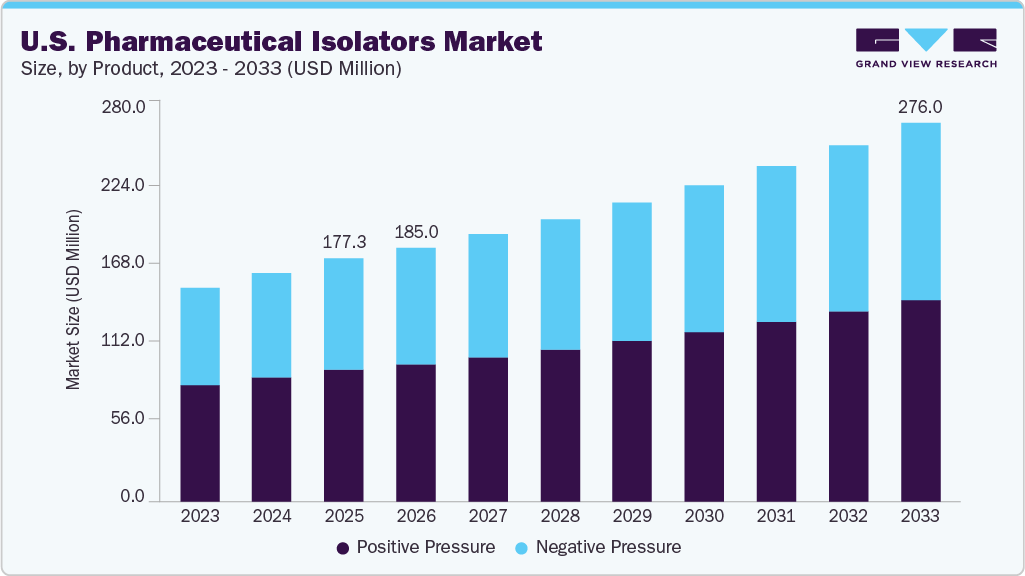
Stricter guidelines on aseptic processing and hazardous drug handling are pushing healthcare facilities and manufacturers to adopt closed, well-controlled systems. Another key driver is the rapid growth of biologics, cell and gene therapies, and high-potency drugs that require tightly controlled environments. These therapies are highly sensitive to contamination and often involve hazardous materials, increasing demand for advanced containment solutions. Technological improvements such as automated decontamination and modular isolator designs are also improving usability and adoption. Together, these factors are accelerating investment in pharmaceutical isolators across both developed and emerging markets.
Market Concentration & Characteristics
The U.S. pharmaceutical isolators industry is moderately concentrated, with a limited number of well-established manufacturers accounting for a large share of domestic demand. These players benefit from strong familiarity with U.S. regulatory requirements, broad product offerings, and long-term relationships with pharmaceutical companies and hospital pharmacies. However, the market is not fully consolidated, as mid-sized and specialized suppliers continue to compete effectively by addressing niche applications, customization needs, and regional customer requirements.
The U.S. pharmaceutical isolators industry shows a strong focus on innovation as drug formulations become more complex and safety expectations rise. Manufacturers are increasingly adopting automated decontamination, advanced airflow management, and modular designs to improve efficiency and adaptability. Digital controls, real-time monitoring, and data logging are now standard features in many systems. Most innovation is application-led, addressing needs in aseptic processing, high-containment manufacturing, and advanced therapies.
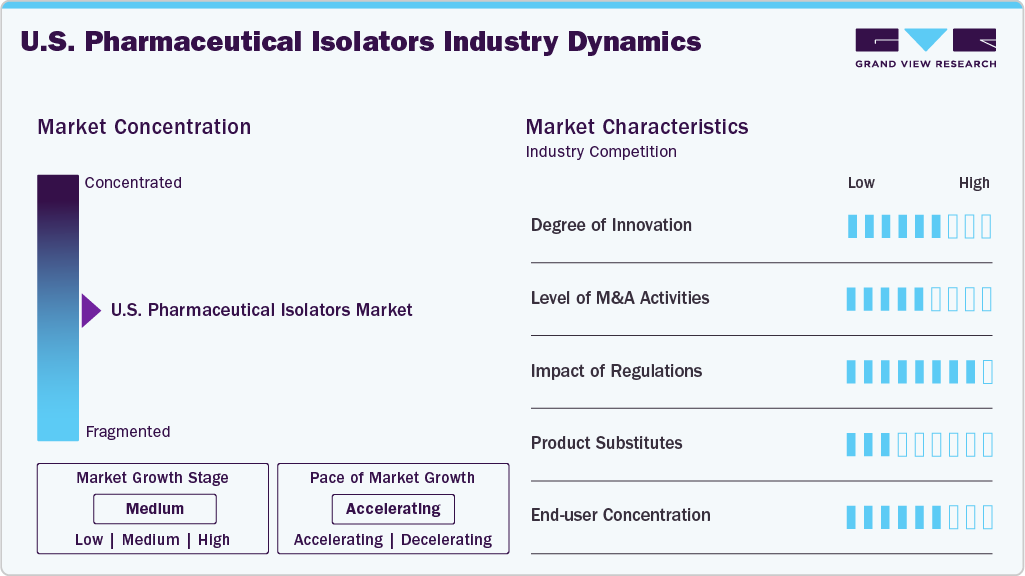
Regulation plays a decisive role in shaping the U.S. pharmaceutical isolators industry. Requirements related to sterile compounding, aseptic manufacturing, and hazardous drug handling are driving adoption of enclosed and fully validated isolator systems. Compliance demands favor established suppliers with proven regulatory expertise and certified products. As U.S. guidelines continue to evolve, manufacturers must regularly upgrade designs to maintain compliance and customer trust.
End user demand in the U.S. is moderately concentrated, with large pharmaceutical manufacturers and hospital pharmacy networks accounting for a significant share of installations. These organizations often standardize equipment across multiple sites, benefiting suppliers with broad portfolios and service capabilities. At the same time, research labs, CMOs, and smaller pharmacies sustain demand for customized and flexible isolator solutions. This balance supports stable market volumes while leaving room for niche-focused players.
Drivers, Opportunities & Restraints
The U.S. pharmaceutical isolators industry is driven by growing emphasis on sterility assurance and operator protection in drug manufacturing and compounding. Increasing output of sterile injectables, biologics, and high-potency drugs is accelerating the shift toward closed and controlled systems. Stricter U.S. regulations for aseptic processing and hazardous drug handling are reinforcing this trend. Healthcare facilities are also moving away from traditional cleanrooms to minimize contamination risk and reduce human intervention.
Significant opportunities are emerging from rising investment in biologics, cell and gene therapies, and personalized medicines. Expansion of pharmaceutical manufacturing capacity and ongoing facility upgrades are increasing demand for advanced containment technologies. Innovations such as modular isolator designs, automation, and digital monitoring are enabling product differentiation. Retrofitting older facilities with compact and flexible isolator systems further supports market expansion.
Despite strong demand drivers, market growth is restrained by high upfront costs and installation complexity, particularly for smaller pharmacies and facilities. Ongoing expenses related to maintenance, validation, and regulatory compliance increase total ownership costs. Operation and upkeep of isolator systems also require skilled personnel, creating staffing challenges. These factors can slow adoption in the short term, even as long-term market fundamentals remain positive.
Product Insights
The positive pressure isolators segment led the market with the largest revenue share of 54.4% in 2025, due to their extensive use in sterile drug manufacturing and aseptic compounding. By maintaining higher internal pressure, these systems prevent external contaminants from entering the workspace and ensure high sterility assurance. They are widely adopted for injectables, vaccines, and biologics where product protection is the primary concern. Regulatory emphasis on contamination control and the replacement of conventional cleanrooms continue to support strong demand for positive pressure isolators.
Negative pressure isolators segment is expected to grow at the fastest CAGR of 6.2% from 2026 to 2033.The negative pressure isolators segment is anticipated to grow at the fastest CAGR during the forecast period, as pharmaceutical companies place greater focus on operator and environmental safety. These systems contain hazardous and high-potency drugs by ensuring inward airflow, preventing the escape of toxic substances. Rising production of oncology drugs, HPAPIs, and targeted therapies is driving adoption across manufacturing and compounding settings. Stricter safety regulations and expanding CMO activity are further accelerating growth in this segment.
Type Insights
The open isolators segment led the market with the largest revenue share of 58.1% in 2025, due to their widespread use in aseptic processing and sterile compounding applications. They offer a balance between contamination control and operational flexibility, allowing easier operator access during routine pharmaceutical workflows. Lower installation costs and simpler integration into existing cleanroom infrastructure make them attractive for hospitals, compounding pharmacies, and mid-sized manufacturers. Ongoing enforcement of USP <797> and <800> guidelines continues to support strong adoption of open isolator systems.
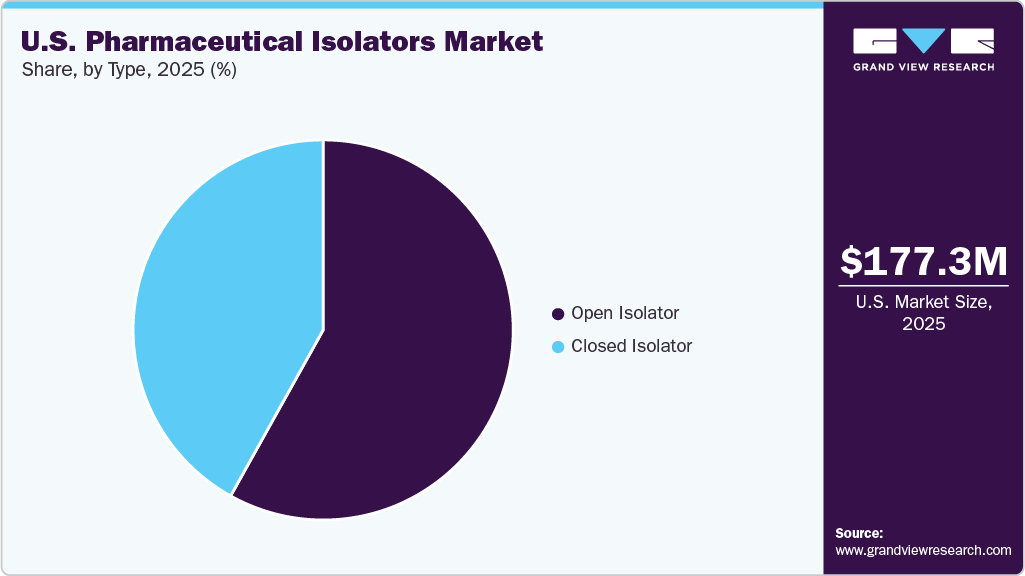
The closed isolator segment is expected to grow at the fastest CAGR of 6.4% from 2026 to 2033.The closed isolators segment is anticipated to grow at the fastest CAGR during the forecast period, as pharmaceutical manufacturing increasingly prioritizes maximum sterility and operator protection. Fully sealed designs minimize human intervention and significantly reduce contamination and exposure risks. Rising production of biologics, HPAPIs, and cytotoxic drugs, along with stricter FDA expectations, is accelerating demand. Growing investment in automation, robotics, and high-volume sterile manufacturing further drives rapid adoption of closed isolators across the U.S. market.
Key U.S. Pharmaceutical Isolators Company Insights
Some of the key players operating in the market include NuAire, Inc., Esco Micro Pte. Ltd., and Bioquell, An Ecolab Solution.
-
NuAire, Inc. develops and manufactures laboratory and pharmaceutical equipment that supports contamination control and safety in life-science environments. Its portfolio spans biosafety cabinets, laminar airflow workstations, pharmaceutical isolators, CO₂ incubators, ultralow temperature freezers, and equipment for animal research. These products are commonly used across research laboratories, hospitals, biotech and pharmaceutical facilities, and compounding pharmacies to maintain controlled conditions and protect users and materials. Strengthening its market position, the company was acquired by Kewaunee Scientific Corporation in a USD 55 million transaction, expanding combined capabilities across laboratory infrastructure and equipment solutions.
-
Esco Micro Pte. Ltd. is a global supplier of laboratory and pharmaceutical equipment focused on controlled environments and contamination control. The company designs and manufactures biosafety cabinets, clean air and containment systems, pharmaceutical isolators, incubators, and related solutions used across research laboratories, hospitals, biotech firms, and pharmaceutical manufacturing facilities. Its products are built to support product integrity, operator safety, and compliance with international regulatory standards. Esco operates through an extensive global sales and service network, serving customers across multiple life-science and healthcare markets.
Key U.S. Pharmaceutical Isolators Companies:
- NuAire, Inc.
- Germfree
- Esco Micro Pte. Ltd.
- Bioquell, An Ecolab Solution
- Labconco
- Howorth Air Technology Limited
- Containment Technologies Group, Inc.
- Terra Universal. Inc.
- The Baker Company
- Schaefer Technologies
Recent Developments
-
In January 2025, Labconco introduced the pure2 Aseptic Isolator to the North American market through a collaboration with SKAN. The system is designed to maintain ISO Class 5 (GMP Grade A) conditions for sterile processing using controlled airflow and integrated decontamination. Its modular design allows flexible configuration to suit pharmaceutical and biotech workflows. The launch strengthens Labconco’s aseptic processing portfolio with advanced isolator technology.
- In November 2024, NuAire, Inc. was acquired by Kewaunee Scientific Corporation in a USD 55 million transaction, expanding combined capabilities across laboratory infrastructure and equipment solutions.
U.S. Pharmaceutical Isolators Market Report Scope
Report Attribute
Details
Market size value in 2026
USD 185.0 million
Revenue forecast in 2033
USD 276.0 million
Growth rate
CAGR of 5.9% from 2026 to 2033
Base year for estimation
2025
Historical data
2021 - 2024
Forecast period
2026 - 2033
Quantitative units
Revenue in USD million/billion, and CAGR from 2026 to 2033
Report coverage
Revenue forecast, company ranking, competitive landscape, growth factors, and trends
Segments covered
Product, type, region
Country scope
U.S.
Key companies profiled
NuAire, Inc.; Germfree; Esco Micro Pte. Ltd.; Bioquell, An Ecolab Solution; Labconco; Howorth Air Technology Limited; Containment Technologies Group, Inc.; Terra Universal, Inc.; The Baker Company; Schaefer Technologies.
Customization scope
Free report customization (equivalent up to 8 analysts working days) with purchase. Addition or alteration to country, regional & segment scope.
Pricing and purchase options
Avail customized purchase options to meet your exact research needs. Explore purchase options
U.S. Pharmaceutical Isolators Market Report Segmentation
This report forecasts revenue growth at the U.S. level and provides an analysis of the latest industry trends in each of the sub-segments from 2021 to 2033. For this study, Grand View Research has segmented the U.S. pharmaceutical isolators market report based on product, type.
-
Product Outlook (Revenue, USD Million, 2021 - 2033)
-
Positive Pressure
-
Negative Pressure
-
-
Type Outlook (Revenue, USD Million, 2021 - 2033)
-
Open Isolator
-
Closed Isolator
-
Frequently Asked Questions About This Report
The key factors driving the U.S. pharmaceutical isolator market include the rapid growth of the pharmaceutical industry in the U.S coupled with rapid technological advancements in the pharmaceutical industry.
The U.S. pharmaceutical isolators market size was estimated at USD 177.3 million in 2025 and is expected to be USD 185.0 million in 2026.
The U.S. pharmaceutical isolators market, in terms of revenue, is expected to grow at a compound annual growth rate of 5.9% from 2026 to 2033 to reach USD 276.0 million by 2033.
Open isolators currently dominate the pharmaceutical isolators market in 2025 and accounted for 58.1% share, due to their widespread use in aseptic processing and sterile compounding applications. They offer a balance between contamination control and operational flexibility, allowing easier operator access during routine pharmaceutical workflows.
Some of the key players operating in the U.S. pharmaceutical isolators market include NuAire, Inc.; Germfree; Esco Micro Pte. Ltd.; Bioquell, An Ecolab Solution; Labconco; Howorth Air Technology Limited; Containment Technologies Group, Inc.; Terra Universal, Inc.; The Baker Company; Schaefer Technologies.
About the Author(s)
Advanced Interior Materials Research Team
Advanced Materials · Advanced Interior MaterialsThis report was authored by the advanced interior materials research team at Grand View Research - comprising two research analysts, one senior research analyst, and one industry expert - with specialized expertise in the advanced interior materials segment of the advanced materials industry. All findings are based on proprietary advanced materials databases, executive interviews, and regulatory analysis, subject to internal peer review prior to publication.
Last Updated:
Speak to Analyst


Customize this report to your needs — add regions, segments, or data points, with 20% free customization.
Or view our licence options:


ISO 9001:2015 & 27001:2022 Certified
We are GDPR and CCPA compliant! Your transaction & personal information is safe and secure. For more details, please read our privacy policy.


