
- Home
- »
- Healthcare
- »
-
U.S. Red Light Therapy Beds Market Size Report, 2026-2033GVR Report cover

U.S. Red Light Therapy Beds Market (2026 - 2033) Size, Share & Trends Analysis Report By Device Class (Premium Grade, Economical-Budget Friendly), By Sales Channel (Direct Manufacturer Sales, Authorized Distributors/Dealers), By End-use, By Region, And Segment Forecasts
U.S. Red Light Therapy Beds Market Summary
The U.S. red light therapy beds market size was valued at USD 84.7 million in 2025 and is projected to grow from USD 100.5 million in 2026 to USD 198.4 million by 2033, at a CAGR of 10.2% from 2026 to 2033. The growth is attributable to the awareness of pain-free wellness solutions among the population, increasing acceptance in medical and wellness centers, growing availability of affordably priced options, and advances in technology, making treatments more effective and easy-to-use. According to the American Med Spa Association’s (AmSpa) 2024 Medical Spa State of the Industry Executive Report Recap released in November 2024, the total number of medical spas grew from 8,899 locations in 2022 to 10,488 in 2023.
Key Market Trends & Insights
- The red-light therapy beds market in the West region is anticipated to grow at the fastest CAGR during the forecast period.
- By device class, the premium grade segment led the market with the largest revenue share of 58.8% in 2025.
- By sales channels, the direct manufacturer sales segment held a leading market share in 2025.
- By end use, the B2B segment held a leading market share in 2025.
Market Size & Forecast
- Market size in 2025: USD 84.7 Million
- Estimated market size in 2026: USD 100.5 Million
- Projected market size by 2033: USD 198.4 Million
- CAGR (2026-2033): 10.2%
Three ways to get this report
Buy it, customize it, or ask a question.Ask an Analyst
Analyst response in 1 business day
- AccessReport author, directly
- Reply timeWithin 1 working day
- No sales callDirect answer only
- FormatEmail reply
- CostFree, no cost
Get the Full Report
What the study covers
- FormatsPDF · Excel · Dashboard
- Timeline2026–2033 annual, 2025 base
- Coverage20+ countries, 5 regions
- Companies10+ key players profiled
Customize the Report
20% free customization
- IncludeCountries, segments, points
- TailorTo your product definition
- ExtendDeeper competitor detail
- OrA fully bespoke study
- Turnaround5–10 working days
The significant increase highlights not only sustained consumer demand for medical aesthetics but also entrepreneurs' and medical professionals’ confidence to invest in innovative treatments. Red-light therapy beds are evolving from a wellness add-on to a core offering in wellness facilities, as owners look for non-invasive, tech-forward options to attract patients and boost revenue.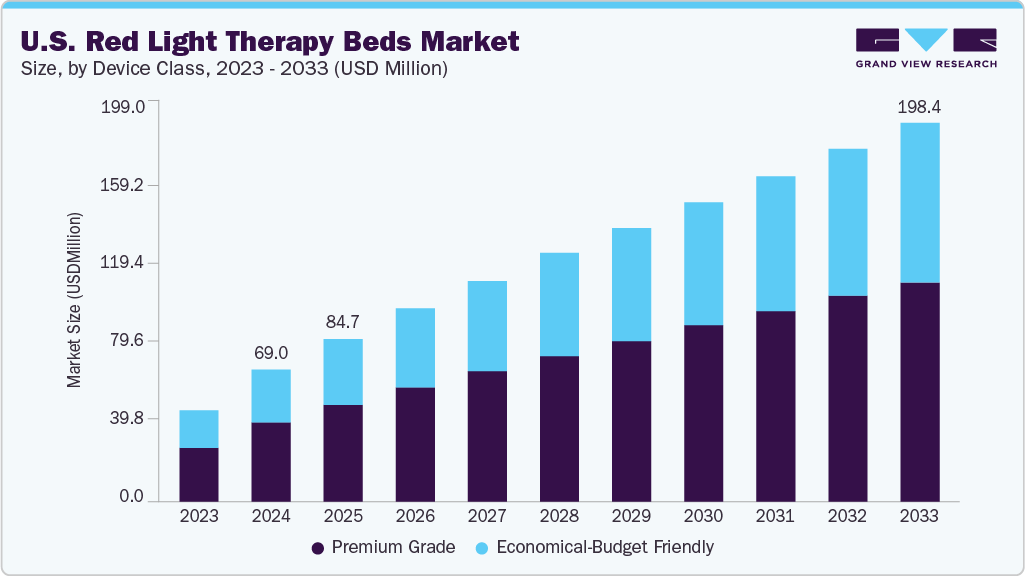 Source: Grand View Research, IR Documents, Primary Interviews, Paid DatabasesTo learn more about this report,
 Download Free Sample Report
 The growth of the U.S. red light therapy beds industry is largely driven by the uptake among athletes, performance teams, fitness centers, and recovery providers. Furthermore, several high-profile adoptions and scientific endorsements are lending credibility and bolstering demand. The public nature of athlete use is significant. Public posts, media coverage, and athlete testimonials advance consumer understanding. Erling Haaland’s public acquisition of a ~£15,000 (USD 18,900) red-light therapy bed for muscle treatment (August 2024) is one example; by sharing usage on social media, such high-profile athletes popularize red-light therapy among fans, amateur athletes, and fitness-minded consumers alike. Even celebrity anecdotes (Pete Davidson using a red-light wand before red-carpet events) add to the cultural cachet.
 To learn more about this report, Download Free Sample Report
  To learn more about this report, Download Free Sample Report
 Recent scientific research increasingly supports the idea that red-light therapy beds (through light therapy, or PBM) can help to relieve many medical conditions from flooding to psoriasis, thus creating a major growth opportunity within the United States; multiple systematic reviews and clinical/preclinical research that will take place between 2024-2025, show that there will be improved outcomes with much lower adverse events rates than are currently available for PBM therapy, in a variety of autoimmune, neurologic, musculoskeletal, and skin based diseases allowing for operators and product companies to validly go after disease specific use cases and partner with medical professionals and health care providers. For instance, in 2024, a systematic review of PBM use in patients with MS found that inflammation, oxidative stress, and apoptosis biomarker levels, as well as physical and cognitive improvements, were observed after PBM therapy.
As a result, red light therapy beds represent a growing market for new applications as adjunctive therapies for chronic disease and/or disordered condition management, rather than their original use strictly for health & beauty purposes. For example, people can use these devices for autoimmune diseases such as multiple sclerosis, dermatological disorders (psoriasis), chronic pain syndromes, superficial or deep wound care (diabetic ulcer care; pressure sore care), post-injury/surgical rehabilitation, early neurological recovery/neuroprotection, and many more.
These patient success stories highlight how consumer-focused red-light therapy brands emerged to meet unmet health needs.
“In 2016, Jake Kreuz, founder of Vital Red Light, was diagnosed with Lyme disease and suffered debilitating fatigue, pain, and brain fog. Dissatisfied with conventional medicine, he turned to photobiomodulation in his doctor’s office, which transformed his health. Noting the high cost and limited access of consumer devices, he launched Vital Red Light to bring medical-grade red-light therapy directly to consumers.”
- Founder of Vital Red Light
“We decided to get the Prism Light Pod to help people who suffer from the debilitating effects of Multiple Sclerosis. Over the past 5 years, we have helped over 1000 people who not only suffer from MS but many other autoimmune disorders and pain issues to live their best quality of life with little to no pain at all. We have helped MS patients who had lost the ability to do things on their own regain their independence just by getting in the red light for 15 min 3-4 times per week. Patients who suffered with chronic pain have left in tears of joy after their 4th or 5th session in the pod because their pain was either gone or down to a tolerable level. Thank you, Prism Light (Life) Pod, for making this possible.”
- Coastal Contours & Wellness
The U.S. red light therapy beds market is witnessing a technological revolution, integrating advanced features such as AI, IoT connectivity, multi-wavelength light therapy, and smart user interfaces. These innovations are enhancing therapeutic efficacy, improving user experience, and enabling precise tracking and optimization of treatment sessions. Full-body light therapy beds offer non-invasive solutions that penetrate deeply to stimulate cellular function, reduce inflammation, accelerate recovery, and support overall wellness.
Technology delivers transformative wellness benefits, much like it does for Dave Asprey, Founder of Bulletproof 360. Advanced tools such as light therapy beds boost energy, accelerate recovery, and enhance overall performance. By integrating science-backed innovations, individuals can achieve measurable improvements in health and longevity.
 To learn more about this report, Download Free Sample Report
 5-Point Buying Checklist: What Consumers Use to Evaluate Devices
Consumers are turning more to checklists to separate reliable devices from inferior ones. Observing the questions they ask offers insight into key product features and guides marketing positioning.
Checklist Item
Key Concern
What Good Devices Deliver
Circuit Boards vs Strip Lights
Power consistency, durability, coverage
Rigid circuit boards with high-density diodes and good heat management
Made in the USA vs Resold Overseas
Quality control, support, part supply
Clearly labeled domestic manufacturing / transparent import supply, warranty support
Certifications & Legit Specs
Safety, legality, accurate claims
FDA registration, UL / ETL / NRTL lab safety marks, full spec sheets
Prove Certifications
Credibility, trust
Public registration numbers, lab test results, visible documentation
Proximity to Skin
Efficacy of treatment (light intensity)
Design ensuring LEDs no farther than ~1-2 inches from skin; contoured housings, side panels, adjustable positioning
Source: Investor Presentations, Primary Interviews, Grand View Research
Market Dynamics
The U.S. red-light therapy beds market is being propelled by the rapid expansion of medical spas and next-generation wellness clubs. According to the American Med Spa Association’s (AmSpa) 2024 Medical Spa State of the Industry Executive Report Recap released in November 2024, the total number of medical spas grew from 8,899 locations in 2022 to 10,488 in 2023. This remarkable jump underscores both sustained consumer demand for medical aesthetics and the willingness of entrepreneurs and medical professionals to invest in innovative treatments. Red-light therapy beds, once a niche wellness add-on, are now becoming a core fixture in these facilities as owners look for non-invasive, tech-forward ways to attract patients and boost revenue.
While red light and infrared therapy beds/pods are growing in popularity, a key restraint on market expansion is the limited reimbursement by insurers and the lack of standardized coverage. Many payers (both private and public) either deny claims, consider the therapy experimental, or require extensive documentation and medical necessity for any chance of reimbursement. This imposes cost, administrative burden, and uncertainty on providers and consumers, slowing adoption. One central issue is the CPT Code 97026, which is the code commonly used for “attended infrared light therapy”. According to AAPC and Holistic Billing Services, this CPT code is often not covered by Medicare because the Centers for Medicare and Medicaid Services (CMS) considers infrared light therapy under this code experimental or investigational. Private insurers may reimburse under certain conditions, but the policies vary widely by carrier and state.
Market Concentration & Characteristics
The U.S. red light therapy beds industry is moderately concentrated, with a mix of established companies, specialized wellness equipment manufacturers, and emerging players in aesthetics and fitness. Market concentration stems from the presence of key players who dominate through advanced technology integration, FDA clearances, and strong distribution networks. However, the industry also includes a significant number of small and mid-sized companies targeting niche applications in beauty, sports recovery, and wellness centers, further shaping its competitive dynamics.
The industry is characterized by increasing adoption in spas, gyms, dermatology clinics, and wellness facilities, driven by rising consumer demand for non-invasive skin rejuvenation, pain management, and body recovery treatments. Technological advancements such as full-body beds with customizable wavelengths, energy-efficient LEDs, and integration with complementary therapies enhance product differentiation. Regulatory compliance, especially FDA guidelines, and growing awareness of potential health benefits further shape the industry landscape. Additionally, rental models and subscription-based business approaches are expanding accessibility. Overall, the sector combines innovation, wellness-driven consumer trends, and diversified business models, making it both competitive and growth-oriented while maintaining opportunities for new entrants in specialized niches.
 To learn more about this report, Download Free Sample Report
 The U.S. red light therapy beds market demonstrates a high degree of innovation, with companies integrating advanced LED technology, customizable wavelengths, and user-friendly designs. Innovations focus on enhancing cellular recovery, skin rejuvenation, and pain relief. For example, Senior Associate Athletic Trainer Owen Stanley highlighted the TheraLight 360, explaining how just 20 minutes in bed promotes cellular recovery and stimulates new cell production. Such advancements illustrate the industry’s emphasis on non-invasive, science-backed therapies that appeal to wellness, sports, and medical sectors. Continuous product upgrades and clinical validation are driving broader acceptance, making innovation a key competitive differentiator.
The industry is increasingly driven by partnerships and collaborations to enhance credibility and market reach. For instance, in May 2025, Ammortal secured strong early backing through its partnership with the Denver Broncos and support from MLB’s Matt Chapman, who joined its advisory board. The company’s wellness chambers are strategically installed in high-profile venues such as Proper Hotel Santa Monica, Yellowstone Club, SWTHZ sites, Padel United, and Infinity Club. These collaborations demonstrate how industry players utilize partnerships in sports, hospitality, and fitness to expand their reach, foster trust, and accelerate adoption in the growing wellness and recovery market.
Regulations significantly impact the U.S. red light therapy beds market, shaping product safety, market access, and consumer trust. FDA clearances and registrations ensure that devices meet strict standards, influencing adoption in medical, wellness, and fitness settings. Compliance also drives innovation, as companies must align technology with regulatory expectations while maintaining therapeutic effectiveness. For instance, in February 2025, Health and Med launched the SpectraLight Full Spectrum Therapy Bed through Spectra Red Light LLC. As an FDA-registered Class 1 medical device, it uses red, blue, green, and near-infrared light to enhance circulation, support cellular recovery, and relieve discomfort, highlighting the regulatory role in credibility.
The U.S. red light therapy beds industry faces competition from several product substitutes that address similar wellness, recovery, and aesthetic needs. Competition from alternative therapies is a significant restraint on the market. As consumers seek faster recovery and holistic wellness, red-light beds leveraging photobiomodulation and ATP enhancement compete with cryotherapy, cold-plunge services, infrared saunas, PEMF, and multi-modal recovery chambers, hyperbaric oxygen therapy, IV vitamin infusions, compression systems, and traditional modalities like massage and acupuncture. According to an NCBI study (December 2023), whole-body cryostimulation reduces pain and inflammation and improves metabolic, mental health, and sleep outcomes. These substitutes challenge adoption by competing on efficacy, immediacy, cost, and integration into memberships or athlete-focused packages.
The market is experiencing notable expansion, driven by growing consumer demand for wellness, recovery, and clinical applications. In October 2024, TheraLight expanded its presence to 21 countries, including the U.S., Canada, Europe, and Asia, and now offers full-body LED light therapy systems such as TheraLight 360 and FIT. This international growth underscores increasing acceptance of red and near-infrared therapies for cellular recovery, pain relief, and overall well-being. Rising adoption in spas, fitness centers, and medical facilities, combined with technological innovations, is fueling industry growth and positioning the U.S. market as a key segment in global expansion strategies.
Device Class Insights
The premium grade segment dominated the U.S. red light therapy beds market in 2025, accounting for the largest revenue share, due to high demand from wellness centers, clinics, and athletic facilities. These beds offer high irradiance, precise wavelength control, full-body coverage, and durable construction, delivering clinically relevant results in shorter sessions. Leading brands like NovoTHOR offer U.S.-made beds with red and near-infrared LEDs, used by elite athletes and military personnel for recovery, pain relief, and improved circulation. LightStim beds are also preferred for skin rejuvenation and anti-inflammatory care, supported by precise calibration, long operational life, and reliable customer service.
The economical, budget-friendly segment is projected to grow at the fastest CAGR over the forecast period, driven by rising awareness of non-invasive wellness solutions and demand for affordable at-home and professional recovery systems. Brands like Mito Red MitoRecharge, Vital 2.0, and NEO Science offer cost-effective alternatives while maintaining therapeutic efficacy. The MitoRecharge bed, priced around USD 23,000, features over 4,200 LEDs across four wavelengths, motorized height adjustment, and a modular design for easy setup. It delivers benefits such as improved circulation, recovery, pain relief, and skin rejuvenation, making high-quality light therapy accessible to more users.
Sales Channel Insights
The direct manufacturer sales segment dominated the U.S. red light therapy beds industry in 2025, driven by growing demand for medical-grade, reliable, and safe devices. Purchasing directly offers users certified devices, transparent specifications, and comprehensive support, including installation, training, and warranties. Brands like ARRC LED and Red-Light Wellness leverage direct sales to deliver professional- and home-use beds, implement innovations quickly, and maintain quality standards. This model reduces costs by eliminating intermediaries, making devices more accessible while fostering long-term customer relationships. Direct engagement also enables tailored product design and community-building, enhancing user confidence and driving market adoption across wellness centers, clinics, and homes.
The direct-to-consumer (D2C) online segment is expected to grow at the fastest CAGR over the forecast period, driven by rising demand for home-focused or dual-use devices. Brands like LightStim and Red-Light Wellness offer FDA-cleared, modular, and user-friendly beds that deliver professional-grade benefits safely at home. Online channels provide lower costs, convenience, and rapid access to innovations such as adjustable panels, app integration, and foldable designs. Enhanced digital experiences, including virtual demos, AR previews, and influencer endorsements, reduce purchase risk, making high-value red light therapy beds more accessible and appealing to individual consumers.
End Use Insights
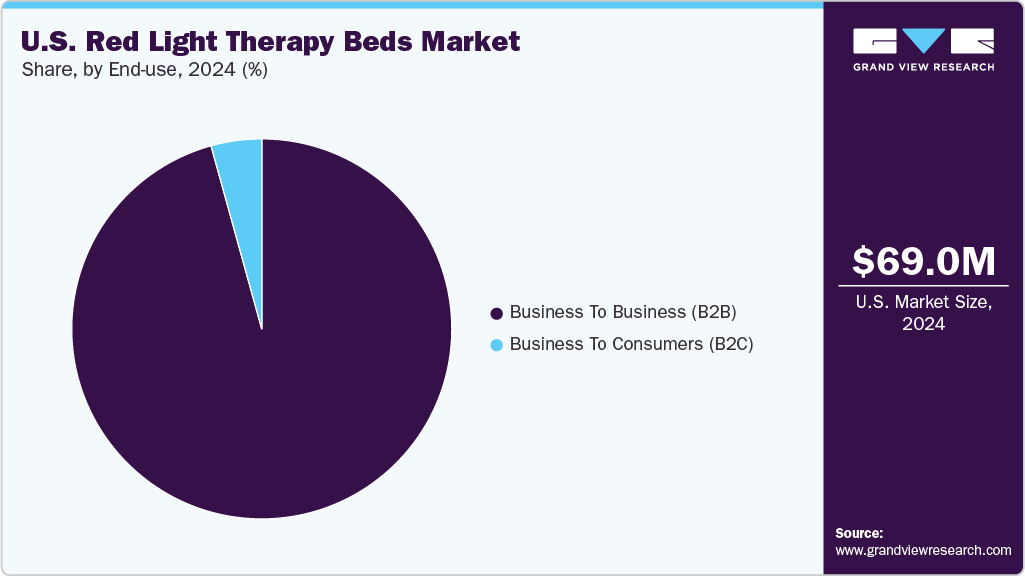
The B2B segment dominated the U.S. red light therapy beds market in 2025, driven by adoption among clinics, wellness centers, and medical practices integrating these devices into their service offerings. For example, a clinic purchasing TheraLight 360 and Aspen Laser systems enrolled ten patients on the first day and generated USD 13,000 in the first month, prompting a second purchase to meet rising demand. B2B adoption is fueled by immediate revenue potential, professional support, and measurable patient benefits, including improvements in psoriasis, arthritis, pain relief, mental clarity, and overall wellness, highlighting both clinical and financial advantages of advanced red light therapy beds.
 To learn more about this report, Download Free Sample Report
 The B2C segment is poised to grow at the fastest CAGR over the forecast period, driven by the increasing consumer demand for home-based wellness solutions. Buyers are drawn to non-invasive therapies that offer pain relief, reduced inflammation, improved circulation, and skin rejuvenation. Convenience and the ability to integrate treatments into daily routines further drive adoption. Millennials and Gen Z are incorporating red light therapy into fitness and wellness regimens. Rising awareness of long-term health benefits, coupled with affordable, user-friendly home devices, is accelerating growth in the B2C segment across the U.S. market.
Country Insights
SouthEast Red Light Therapy Beds Market Trends
The Florida red light therapy beds market in 2025, driven by Florida’s booming tourism and retirement industries, plus its 1,350 miles of coastline and world-class resorts, has positioned it as a leading wellness destination. Recent investments underscore this shift: in August 2024, Tavistock Development Company announced the USD 1 billion redevelopment of Fort Lauderdale’s Pier Sixty-Six, debuting the Zenova Spa & Wellness with nine treatment rooms and high-tech therapies including LED and red-light treatments. In October 2024, Amrit Ocean Resort in Palm Beach County launched Florida’s largest spa, a 103,000-square-foot facility integrating Eastern and Western wellness traditions with advanced technologies, including red-light therapy, hydrothermal experiences, and MediSpa facial rejuvenation systems.
Midwest Red Light Therapy Beds Market Trends
The Michigan red light therapy beds market in the Midwest in 2025 is influenced by Michigan’s 96,714 square miles, a GDP of USD 706.6 billion, and a population of 10,140,459. The state’s median income is USD 41,662, with 42.4% of residents holding a college degree. In April 2025, Michigan State University (MSU) announced the USD 150 million Spartan Gateway District. Covering 14 acres at Trowbridge and Harrison roads, the development features a 6,000-seat Olympic sports arena, hotel, housing, retail, restaurants, offices, parking, and a future academic or healthcare facility, creating potential for advanced wellness and red-light therapy integration across sports, healthcare, and hospitality sectors.
West Red Light Therapy Beds Market Trends
The California red light therapy beds market is growing due to California’s wellness and sports sectors actively incorporating red-light therapy for recovery, skin health, and performance enhancement. High-profile examples, such as the USD 160,000 Ammortal Chamber featured at the 2025 U.S. Open, highlight rising interest in advanced recovery technologies that combine red-light, near-infrared, PEMF, and vibroacoustic therapies. In April 2025, the Placentia-Yorba Linda Unified School District transformed its multipurpose room into a high-tech gym and recovery center at the Universal Sports Institute, providing students with recliners equipped with red-light therapy for muscle recovery and illustrating adoption beyond private spas into public institutions.
Northeast Red Light Therapy Beds Market Trends
The New York red light therapy beds market is growing due to advanced systems, such as the USD 160,000 Ammortal Chamber (launched in 2023), being introduced at wellness and sports facilities across the state. This device integrates red and near-infrared light, PEMF/PEF, vibroacoustic therapy, molecular hydrogen, guided meditation, and breathwork, offering multiple therapeutic benefits in a single session. Ammortal reports that 95% of users achieve deep relaxation, 85% notice improved focus, and 90% experience a “caffeinated calm.” Professional athletes, including MLB’s Bobby Miller, credit it for faster recovery, while teams like the Arizona Diamondbacks and the NFL’s Denver Broncos have incorporated it into their training programs.
Southwest Red Light Therapy Beds Market Trends
The Texas red light therapy beds market is growing due to increasing adoption within athletic institutions. Texas Christian University (TCU) in Fort Worth unveiled the USD 50 million Simpson Family Restoration Center ahead of the September 2025 football season, featuring infrared therapy beds, relaxation pods, cryo lounges, and hydrotherapy pools. These innovations support student-athletes by accelerating recovery from bone and soft-tissue injuries, enhancing blood circulation, and reducing inflammation at the cellular level. Coupled with Texas’s diverse population, strong wellness culture, and rapid integration of advanced recovery technologies, the state is emerging as one of the fastest-expanding regional markets for red light therapy beds in the U.S.
Key U.S. Red Light Therapy Beds Company Insights
Market players such as TheraLight and NovoTHOR have positioned themselves prominently in the U.S. red light therapy beds market by focusing on innovation, quality, and competitive pricing. Companies are developing advanced full-body LED systems with precise wavelength control, high irradiance, and user-friendly designs to meet growing demand in wellness, fitness, and clinical sectors. Strategic initiatives include direct-to-consumer sales, digital engagement, and professional support services, enhancing accessibility and customer trust. By combining technological advancements with effective marketing and service models, these players are driving adoption, strengthening brand recognition, and maintaining a competitive edge in a rapidly expanding market.
Key U.S. Red Light Therapy Beds Companies
-
THOR PHOTOMEDICINE LTD (NovoThor)
-
TheraLight
-
Prism Light Pod
-
Red Light Wellness
-
Ammortal
-
Body Balance System
-
Mito Red
-
LightStim
-
NEO Science
-
Spectra Red Light LLC (Vasindux)
-
Vital Red Light
-
Precor
-
ARRC LED
Competitive Benchmarking
Operating Strategies
Competitive Edge
Weaknesses
Mature Players: NovoTHOR
- Mature companies focus on expanding product portfolios across full-body red light therapy beds, wellness pods, photobiomodulation systems, and recovery-focused solutions for spas, wellness centers, fitness facilities, and medical-aesthetic clinics.
- Companies emphasize premium system designs, higher-power LED configurations, patented light delivery technologies, subscription-based service programs, financing options, and nationwide distributor partnerships to strengthen market penetration.
- Established manufacturers benefit from strong brand recognition, broad installation bases, proven clinical validation, extensive dealer networks, and long-standing relationships with wellness and aesthetic providers.
- Advanced engineering capabilities, larger R&D budgets, product reliability, after-sales support infrastructure, and regulatory expertise enhance customer confidence and competitive differentiation.
- High R&D and manufacturing costs, increasing competition, evolving wellness trends, and continuous technology upgrade requirements raise operational complexity.
- Larger organizations may face slower innovation cycles due to complex distribution structures, pricing pressures, compliance requirements, and changing customer preferences.
Emerging Players: Mito Red
- Emerging companies focus on niche photobiomodulation technologies, cost-effective full-body systems, customizable red and near-infrared therapy beds, and direct-to-consumer sales models targeting wellness-conscious consumers.
- These players prioritize rapid product development, influencer collaborations, digital marketing, e-commerce expansion, targeted product launches, and compact high-performance systems for recovery and wellness applications.
- Emerging companies benefit from faster innovation cycles and greater flexibility in introducing trend-focused red light therapy solutions tailored to wellness, recovery, longevity, and athletic performance markets.
- Their ability to leverage social media engagement, online communities, competitive pricing, and personalized customer experiences strengthens differentiation within the competitive landscape.
- Emerging companies face limited financial resources, lower brand awareness, smaller distribution networks, and reduced clinical evidence compared with established industry leaders.
- Challenges in scaling manufacturing, maintaining product quality consistency, securing certifications, and building long-term customer trust may restrict broader commercial expansion.
Recent Developments
-
In May 2025, TheraLight unveiled the TheraLight 360i, a cutting-edge whole-body therapy bed integrating Photobiomodulation, PEMF, and Acoustic Resonance. This multi-modality system enhances cellular repair, circulation, relaxation, and recovery. With 45,000 LEDs and synchronized therapies, it delivers drug-free, non-invasive solutions for longevity, performance optimization, and holistic body-mind revitalization.
-
In July 2024, The podcast "Yours Mine Away," hosted by Mark Howard, has renewed its sponsorship with Mito Red Light, a company specializing in red light therapy devices. This partnership will provide listeners with valuable health insights, new product information, and special promotions from Mito Red Light
-
In October 2023, Prism Light Pod launched its fourth-generation red light therapy bed, delivering 30% more irradiance with 17,000 LEDs, improved reflective shelves, and wavelengths of 630nm, 660nm, and 850nm. Designed for spas and recovery centers, it accelerates healing, relieves pain, supports anti-aging, and is energy-efficient and safe.
U.S. Red Light Therapy Beds Market Report Scope
Report Attribute
Details
Market size in 2025
USD 84.7 million
Estimated Market size in 2026
USD 100.5 million
Projected Market size by 2033
USD 198.4 million
Growth rate
CAGR of 10.2% from 2026 to 2033
Base year
2025
Actual data
2018 - 2024
Forecast period
2026 - 2033
Quantitative units
Revenue in USD million & volume in units and CAGR from 2026 to 2033
Report coverage
Revenue forecast, company ranking, competitive landscape, growth factors, and trends
Segments covered
Device class, sales channel, end use, region
Regional scope
Southeast; Midwest; West; Northeast; Southwest
Key companies profiled
NovoTHOR; TheraLight; Prism Light Pod; Red Light Wellness; Ammortal; Body Balance; Mito Red; LightStim; NEO Science; Spectra Red Light LLC; Vital Red Light; Precor; ARRC LED
Customization scope
Free report customization (equivalent upto 8 analysts working days) with purchase. Addition or alteration to country, regional & segment scope.
Pricing and purchase options
Avail customized purchase options to meet your exact research needs. Explore purchase options
U.S. Red Light Therapy Beds Market Report Segmentation
This report forecasts volume & revenue growth at the country level and analyzes the latest industry trends in each of the sub-segments from 2018 to 2033. For this study, Grand View Research has segmented the U.S. red light therapy beds market report based on device class, sales channel, end use, and region:
-
Device Class Outlook (Volume, Units; Revenue, USD Million, 2018 - 2033)
-
Premium Grade
-
Economical-Budget Friendly
-
-
Sales Channel Outlook (Volume, Units; Revenue, USD Million, 2018 - 2033)
-
Direct Manufacturer Sales
-
Authorized Distributors/Dealers
-
Direct-to-Consumer (D2C-Online)
-
-
End Use Outlook (Volume, Units; Revenue, USD Million, 2018 - 2033)
-
Business to Business (B2B)
-
Wellness Clinics & Spas
-
Medical/Therapeutical Clinics
-
Sports Facilities
-
-
Business to Consumers (B2C)
-
-
Regional Outlook (Volume, Units; Revenue, USD Million, 2018 - 2033)
-
Southeast
-
Alabama
-
Arkansas
-
Florida
-
Georgia
-
Kentucky
-
Louisiana
-
Mississippi
-
North Carolina
-
South Carolina
-
Tennessee
-
Virginia
-
West Virginia
-
-
Midwest
-
Illinois
-
Indiana
-
Michigan
-
Ohio
-
Wisconsin
-
Iowa
-
Kansas
-
Minnesota
-
Missouri
-
Nebraska
-
North Dakota
-
South Dakota
-
-
West
-
Alaska
-
California
-
Colorado
-
Hawaii
-
Idaho
-
Montana
-
Nevada
-
Oregon
-
Utah
-
Washington
-
Wyoming
-
-
Northeast
-
Connecticut
-
Maine
-
Massachusetts
-
New Hampshire
-
Rhode Island
-
Vermont
-
New Jersey
-
New York
-
Pennsylvania
-
Delaware
-
Maryland
-
-
Southwest
-
Arizona
-
New Mexico
-
Oklahoma
-
Texas
-
-
Delivered Customizations
This report has been delivered with the following In-depth customizations
Client Request
Customization Delivered
Value Adds
Consumer Insights & Trends Analysis
Conducted a comprehensive assessment of U.S. consumer behavior and adoption trends within the red-light therapy beds market. The study evaluated consumer awareness levels, purchasing motivations, treatment frequency patterns, and preferred treatment settings (home, wellness centers, fitness facilities, and medspas), spending behavior, and perceptions regarding recovery, wellness, anti-aging, pain management, and performance enhancement applications. The analysis further optimized the influence of social media, wellness influencers, athlete endorsements, longevity trends, and emerging consumer preferences shaping product demand.
Enables stakeholders to understand evolving consumer expectations, treatment adoption patterns, and demand drivers influencing the U.S. red-light therapy beds market. The study supports targeted marketing strategies, customer acquisition planning, product positioning, service portfolio optimization, and commercialization initiatives aligned with changing wellness and recovery trends.
Average Selling Price Analysis in the Overall U.S.
Conducted a detailed ASP assessment of red-light therapy beds across the country market, which evaluates pricing variations based on product configuration, treatment coverage area, LED power output, technology specifications, clinical-grade versus wellness-grade systems, and end-user segments. The study also analyzed pricing structures adopted by leading manufacturers, distributor markups, leasing models, installation costs, maintenance programs, and regional pricing variations influencing purchasing decisions across wellness centers, gyms, recovery clinics, and medical aesthetic facilities.
Enables stakeholders to gain actionable insights into pricing dynamics, competitive positioning, and revenue optimization opportunities across the U.S. market. The study supports pricing strategy development, margin assessment, distributor negotiations, procurement planning, and investment decisions while identifying premium and value-oriented market opportunities.
Global Trade Data (HS Code 9018.20) - Top 10 Importers & Exporters (Estimated Value & Volume)
Conducted an in-depth trade analysis focused on HS Code 9018.20 covering ultraviolet and infrared ray apparatus relevant to red-light therapy technologies. The study assessed U.S. import and export trends, trade volumes, estimated shipment values, key supplier countries, leading importers and exporters, product formats, tariff considerations, and sourcing chain dynamics. The analysis further evaluated major market participants, import dependency levels, sourcing strategies, and international trade movements, influencing equipment availability and market competitiveness.
Enables stakeholders to understand global supply chain structures, trade dependencies, sourcing opportunities, and competitive import-export dynamics impacting the U.S. red-light therapy beds market. The study supports strategic sourcing, supplier diversification, risk mitigation, market entry planning, capacity expansion decisions, and long-term procurement strategies while identifying key trade partners and emerging supply opportunities.
Frequently Asked Questions About This Report
The premium grade segment dominated the U.S. red light therapy beds market in 2025, accounting for the largest revenue share of 58.8% due to high demand from wellness centers, clinics, and athletic facilities. These beds offer high irradiance, precise wavelength control, full-body coverage, and durable construction, delivering clinically relevant results in shorter sessions.
Key factors that are driving the market growth include rising consumer awareness of non-invasive wellness solutions, expanding adoption in medical and wellness centers, increasing availability of affordable options, and technological advancements enhancing treatment effectiveness and user convenience.
The key players operating in the U.S. red light therapy beds market are NovoTHOR, TheraLight, Prism Light Pod, Red Light Wellness, Ammortal, Body Balance, Mito Red, LightStim, NEO Science, Spectra Red Light LLC, Vital Red Light, Precor, ARRC LED.
The Southeast region dominated the U.S. red light therapy beds with a 25.2% revenue share in 2025.
The West region is the fastest-growing region over the forecast period.
Direct manufacturer sales held the largest revenue share in 2025, while the direct-to-consumer (D2C-online) segment is the fastest-growing area.
B2B held the largest revenue share in 2025, while B2C is the fastest-growing area.
The U.S. red light therapy beds market size was estimated at USD 84.7 million in 2025 and is expected to reach USD 100.5 million in 2026.
The U.S. red light therapy beds market is expected to grow at a compound annual growth rate of 10.2% from 2026 to 2033 to reach USD 198.4 million by 2033.
About the Author(s)
Healthcare Research Team
Research · HealthcareThis report was authored by the healthcare research team at Grand View Research - comprising two research analysts, one senior research analyst, and one industry expert - with specialized expertise in the healthcare segment of the research industry. All findings are based on proprietary research databases, executive interviews, and regulatory analysis, subject to internal peer review prior to publication.
Last Updated:
Speak to Analyst

Customize this report to your needs - add regions, segments, or data points, with 20% free customization.
Or view our licence options:


ISO 9001:2015 & 27001:2022 Certified
We are GDPR and CCPA compliant! Your transaction & personal information is safe and secure. For more details, please read our privacy policy.


