
- Home
- »
- Advanced Interior Materials
- »
-
U.S. Refractory Flow Control Products Market Report, 2033GVR Report cover

U.S. Refractory Flow Control Products Market (2026 - 2033)
Size, Share & Trends Analysis Report By Product (Submerged Entry Nozzles, Ladle Shrouds, Tundish Slide-Gate Refractory Plates, Tundish Upper and Lower Nozzles, Submerged Entry Nozzles), By Region, And Segment Forecasts
Market Size, 2025
$423.7MMarket Estimate, 2026
$457.8MMarket Forecast, 2033
$752.3MCAGR, 2026–2033
7.4%U.S. Refractory Flow Control Products Market Summary
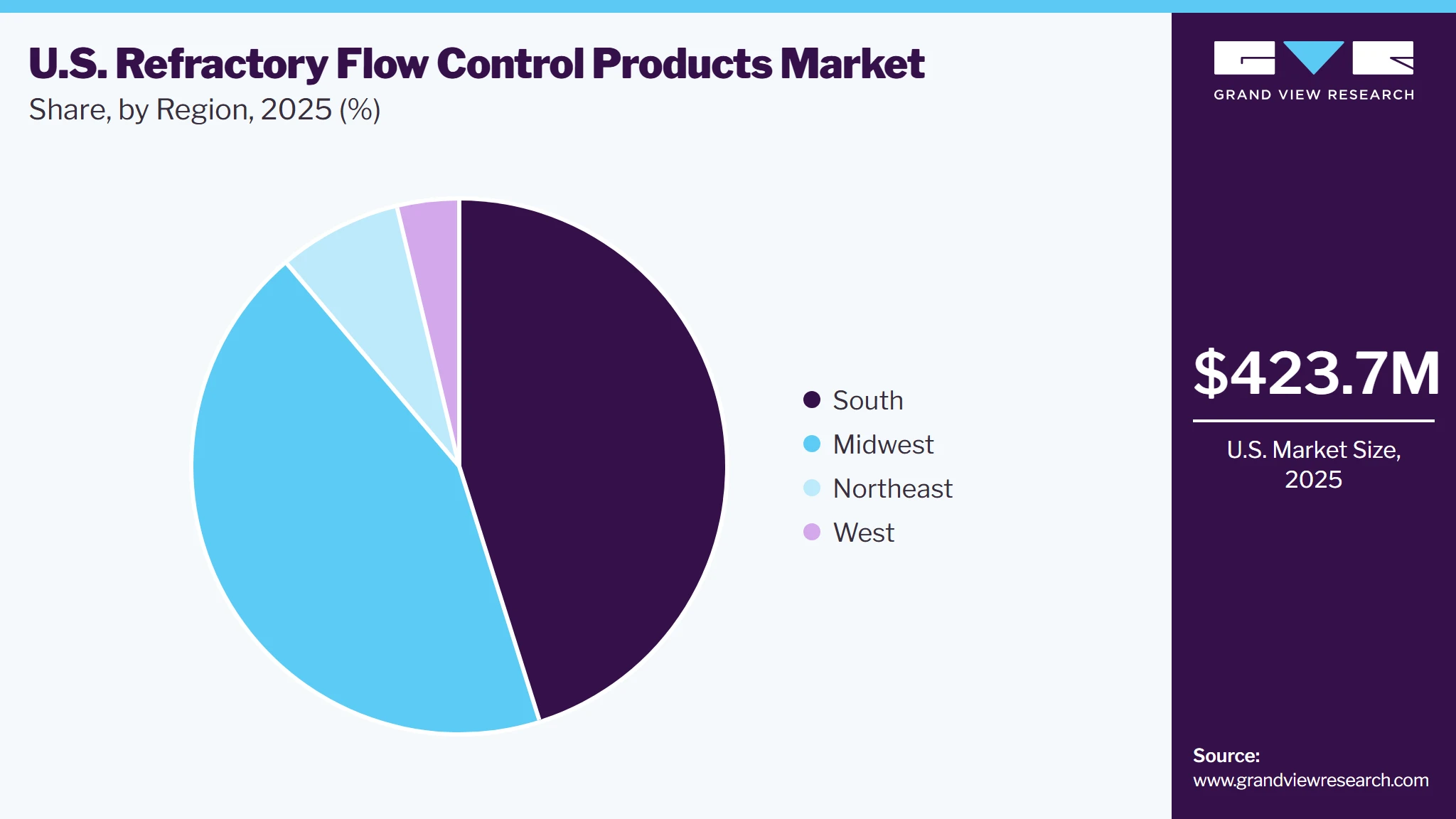
The U.S. refractory flow control products market size was valued at USD 423.7 million in 2025 and is projected to grow from USD 457.8 million in 2026 to USD 752.3 million in 2033, at a CAGR of 7.4% from 2026 to 2033. South U.S. dominated the market with the largest revenue share of 45.1% in 2025. The market is driven by steady demand for crude steel production and continuous casting operations across the country.
Key Market Trends & Insights
- By product: Submerged entry nozzles (SENs) segment held the largest market share of 32.1% in 2025.
- The ladle slide gate refractory plates and related components segment is anticipated to register the fastest CAGR of 8.1% from 2026 to 2033.
Market Size & Forecast
- Market size in 2025: USD 423.7 Million
- Estimated market size in 2026: USD 457.8 Million
- Projected market size by 2033: USD 752.3 Million
- CAGR (2026-2033): 7.4%
GVR research-powered AIAsk Prism AI about the U.S. refractory flow control products marketGet cited answers from GVR research on market growth, segments, regulations and forecasts.Start with✓ Source-linked answers ✓ Market-specific context ✓ Traceable figuresExplore Prism AI ↗
Ongoing investments in domestic steelmaking capacity, modernization of existing mills, and replacement of aging production equipment are supporting recurring demand for these products. The growing emphasis on operational efficiency and higher casting productivity is further encouraging steel producers to adopt high-performance flow control refractories with improved thermal shock resistance, corrosion resistance, and service life.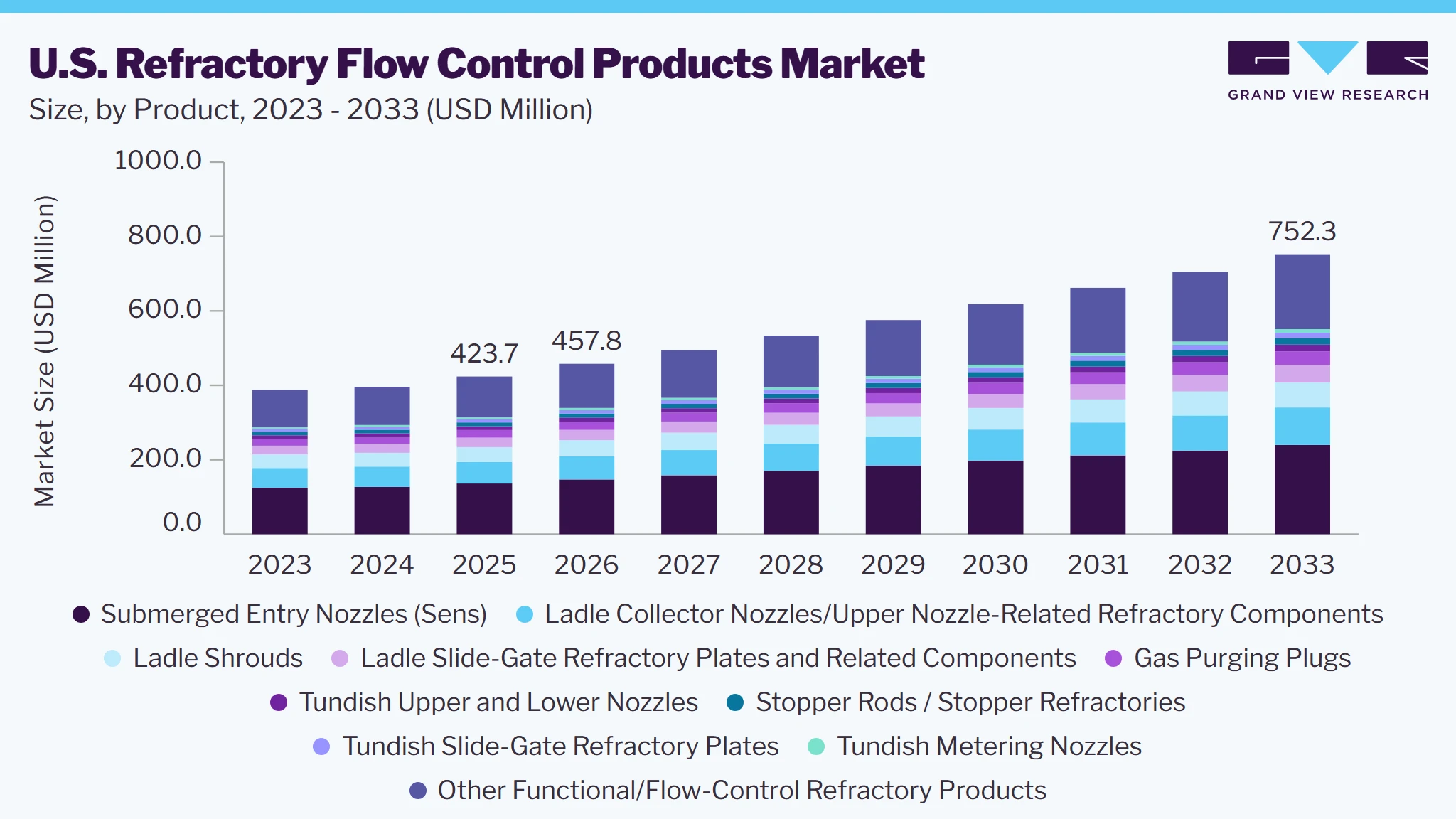 Source: Grand View Research, IR Documents, Primary Interviews, Paid DatabasesTo learn more about this report,
 Download Free Sample Report
Modernization and technological upgrades across U.S. steel mills are another important growth driver. Steel producers are increasingly investing in advanced continuous casting systems, automation, process monitoring, and higher throughput equipment to improve yield and reduce production losses. These developments increase the need for engineered refractory flow control products capable of operating under demanding temperature, pressure, and metallurgical conditions. Manufacturers are also developing longer-life products and customized refractory geometries to reduce unplanned shutdowns, refractory consumption, and maintenance requirements. As steelmakers focus on reducing the cost per tonne of steel produced, the replacement of conventional refractories with higher-performance flow control solutions is creating additional market opportunities.
Market Dynamics
The growth of continuous casting operations across U.S. steel mills is a key market driver. Products such as tundish nozzles, submerged entry nozzles, stopper refractories, slide gate plates, and ladle shrouds are essential for controlling molten steel flow during casting. Continued steel production and modernization of domestic steelmaking facilities are therefore supporting recurring demand for these consumable refractory products.
The increasing focus on casting efficiency, steel quality, and operational reliability is further driving demand for high-performance flow control refractories. Steel producers are seeking products with longer service life, improved thermal shock resistance, and better erosion and corrosion resistance to minimize breakout risks, casting interruptions, and refractory consumption. Investments in advanced continuous casting equipment and process optimization are consequently creating demand for higher-performance flow control solutions.
The market is closely linked to steel production levels, making demand vulnerable to fluctuations in steelmaking activity, capacity utilization, and economic conditions. In addition, advanced refractory products require specialized raw materials, manufacturing processes, and quality control, resulting in relatively high costs. Rising energy, raw material, and transportation costs can further pressure margins and increase procurement costs for steel producers.
The modernization of U.S. steel mills, expansion of electric arc furnace capacity, and increasing investments in efficient continuous casting systems are creating significant opportunities for refractory flow control product manufacturers. Steel producers are increasingly seeking advanced slide gate systems, nozzles, stopper refractories, and gas purging solutions that improve casting stability and reduce refractory consumption. Development of longer life and application-specific products can further strengthen supplier opportunities as U.S. steelmakers prioritize productivity, quality, and cost efficiency.
Analyst Perspective
The market is positioned for steady growth, supported by rising crude steel production, continued casting activity, and modernization of domestic steelmaking facilities. Demand for high-performance tundish nozzles, submerged entry nozzles, ladle shrouds, slide-gate plates, stopper refractories, and other flow-control components is increasing as steel producers focus on casting efficiency, steel quality, longer service life, and reduced refractory consumption.
Product Insights
Based on product, the submerged entry nozzles (SENs) held the largest revenue share of 32.1% in 2025. The SEN segment is expected to witness steady market growth due to their critical role in continuous casting operations for directing molten steel from the tundish into the mold while protecting the steel stream from atmospheric exposure. SENs are manufactured from specialized refractory materials that provide resistance to thermal shock, erosion, corrosion, and molten steel attack, making their performance essential for maintaining casting stability and steel quality.
The ladle slide gate refractory plates and related components segment is anticipated to register the fastest CAGR of 8.1% from 2026 to 2033, due to their critical role in controlling the flow of molten steel during ladle operations. These refractory components are exposed to extreme temperatures, thermal shock, mechanical stresses, and aggressive molten steel and slag, requiring high strength, wear resistance, and dimensional stability. Continued production of crude steel and increasing adoption of continuous casting processes in U.S. steelmaking facilities are supporting demand for reliable slide gate systems.
Regional Insights
The South U.S. accounted for the largest market revenue share of 45.1% in 2025, supported by expanding steel production capacity, new electric arc furnace projects, and investments in advanced manufacturing facilities. Texas, Alabama, Arkansas, Kentucky, and South Carolina have significant steelmaking and metal processing activities, while continued industrial development is increasing demand for domestic steel. The expansion and modernization of EAF-based production is particularly important because these facilities require reliable ladle and tundish flow control systems to maintain casting productivity and steel quality.
 To learn more about this report, Download Free Sample Report
West Refractory Flow Control Products Market Trends
The refractory flow control products market in the West is expected to experience growth as steel production and EAF-based capacity expand across states such as California, Oregon, Washington, Utah, and Colorado. The region has been witnessing investments in domestic steelmaking capacity, recycling-based steel production, and infrastructure-related manufacturing, creating additional requirements for continuous casting consumables. EAF operations generate recurring demand for ladle and tundish flow control refractories, while producers increasingly prioritize energy efficiency, casting productivity, and reduced refractory consumption per tonne of steel.
Midwest Refractory Flow Control Products Market Trends
The refractory flow control products market in the Midwest is a key growth region for the market due to its strong concentration of integrated steel mills, electric arc furnace operations, and continuous casting facilities. States such as Indiana, Ohio, Michigan, and Illinois have substantial steelmaking and downstream manufacturing activity, supporting recurring demand for tundish nozzles, submerged entry nozzles, slide gate refractory plates, stopper refractories, and ladle flow control components. The region’s ongoing investment in modernizing steelmaking assets, improving casting efficiency, and expanding higher-quality steel production is expected to increase the consumption of flow control refractories, particularly as steel producers focus on longer refractory service life, reduced casting interruptions, and improved yield.
Northeast Refractory Flow Control Products Market Trends
The refractory flow control products market in the Northeast is supported by an established base of specialty steel producers, mini mills, foundries, and metal processing facilities concentrated across Pennsylvania, New York, and surrounding states. Demand for refractory flow control products is driven by the region’s production of specialty grades, long products, and value-added steel products, where precise molten steel flow control and consistent casting performance are important. Modernization of aging steelmaking and casting infrastructure, replacement of refractory systems, and increasing emphasis on operational efficiency are expected to sustain demand.
Key U.S. Refractory Flow Control Products Company Insights
Some of the key players operating in the market include Vesuvius, RHI Magnesita North America, and others.
-
Vesuvius is a global specialist in molten metal flow engineering, serving the steel and foundry industries through its Steel Flow Control, Advanced Refractories, and Technical Services businesses. The company develops customized refractory materials, flow control systems, and technologies designed to improve the quality, consistency, safety, and productivity of steelmaking and continuous casting operations. Its flow control solutions are specifically designed to contain and regulate molten steel while limiting atmospheric exposure and contamination during continuous casting.
-
RHI Magnesita North America is the North American operation of RHI Magnesita, supplying advanced refractory products and customized solutions for high-temperature industrial processes, particularly steelmaking. The company provides refractory materials, technical services, process optimization, research and development, and recycling solutions to support the performance and service life of industrial equipment. Its North American portfolio includes specialized flow control products manufactured from refractory materials, supported by technical expertise and regional production capabilities.
Key U.S. Refractory Flow Control Products Companies
-
BNZ Materials
-
HarbisonWalker International (Calderys)
-
Krosaki Harima
-
Minerals Technologies Inc.
-
Morgan Advanced Materials and its affiliates
-
RHI Magnesita North America
-
Shinagawa Advanced Materials Americas Inc.
-
TYK America, Inc.
-
Vesuvius
-
Wesco Refractories Inc.
Competitive Benchmarking
Category
Operating Strategies
Competitive Edge
Weakness
Established Players (e.g., Vesuvius, HarbisonWalker International)
- Mature players in the U.S. refractory flow control products industry generally operate through integrated manufacturing and technical-service networks supplying tundish slide-gate plates, upper and lower nozzles, submerged entry nozzles (SENs), stopper refractories, ladle shrouds, metering nozzles, purging plugs, and related flow-control components.
- The primary competitive advantage of mature players is their extensive experience in continuous-casting operations and refractory engineering. Their ability to formulate refractories for different steel grades and casting conditions enables consistent performance across SENs, stopper rods, slide-gate plates, ladle shrouds, and other flow-control components.
- Mature players typically operate capital-intensive manufacturing and technical-service infrastructures, with significant expenditure required for high-temperature processing equipment, specialized forming systems, machining, laboratory testing, and inventory.
Emerging & Regional Players (e.g., BNZ Materials)
- Emerging players in the U.S. refractory flow control products industry generally focus on specialized products, customized refractory formulations, and underserved steelmaking applications rather than attempting to compete across the entire product portfolio.
- The main competitive advantage of emerging players is their flexibility in developing application-specific flow-control refractory products. They can work closely with steel mills to address specific problems such as SEN clogging, premature nozzle wear, thermal cracking, slide-gate leakage, or reduced casting sequence length.
- Emerging players face significant barriers associated with qualification, production scale, and customer trust. Flow-control refractories directly interact with molten steel, meaning product failures can result in casting interruptions, steel contamination, equipment damage, and substantial production losses.
Recent Development
- In February 2026, Plibrico Company acquired TFL Incorporated, a Houston-based provider of refractory materials and precast refractory shapes, strengthening Plibrico’s presence across Texas and the Southern U.S. The acquisition expands Plibrico’s geographic footprint, product availability, and technical support capabilities for high-temperature industries, particularly energy, petrochemical, and other thermal processing applications.
U.S. Refractory Flow Control Products Market Report Scope
Report Attribute
Details
Market definition
The market size represents the revenue generated from the sale of flow control refractory products used in continuous casting across the U.S. in a given year.
Market size in 2025
USD 423.7 million
Estimated market size in 2026
USD 457.8 million
Projected market size by 2033
USD 752.3 million
Growth rate
CAGR of 7.4% from 2026 to 2033
Historical data
2021 - 2025
Forecast period
2026 - 2033
Quantitative units
Revenue in USD million and CAGR from 2026 to 2033
Report coverage
Revenue forecast, competitive landscape, growth factors, and trends
Segments covered
Product, region
Country scope
U.S.
Regional scope
Midwest; South; Northeast; West
Key companies profiled
BNZ Materials; HarbisonWalker International (Calderys); Krosaki Harima; Minerals Technologies Inc.; Morgan Advanced Materials and its affiliates; RHI Magnesita North America; Shinagawa Advanced Materials Americas Inc.; TYK America, Inc.; Vesuvius; Wesco Refractories Inc.
Customization scope
Free report customization (equivalent up to 8 analysts working days) with purchase. Addition or alteration to country, regional & segment scope.
Pricing and purchase options
Avail customized purchase options to meet your exact research needs. Explore purchase options
U.S. Refractory Flow Control Products Market Report Segmentation
This report forecasts revenue growth at global, regional, and country levels and provides an analysis of the latest industry trends in each of the sub-segments from 2021 to 2033. For this study, Grand View Research has segmented the U.S. refractory flow control products market report based on product and region:
-
Product Outlook (Revenue, USD Million, 2021 - 2033)
-
Tundish Slide-Gate Refractory Plates
-
Tundish Upper and Lower Nozzles
-
Submerged Entry Nozzles (Sens)
-
Tundish Metering Nozzles
-
Ladle Shrouds
-
Stopper Rods / Stopper Refractories
-
Ladle Collector Nozzles/Upper Nozzle-Related Refractory Components
-
Ladle Slide-Gate Refractory Plates and Related Components
-
Gas Purging Plugs
-
Others
-
-
Regional Outlook (Revenue, USD Million, 2021 - 2033)
-
Midwest
-
South
-
Northeast
-
West
-
Research Methodology
The U.S. refractory flow control products market figures in this report are based on a proven research process that combines executive interviews with secondary research from proprietary databases, company filings, and recognized regulatory and institutional sources. Market size is built through value-chain sizing-reconciling supply-side and demand-side estimates-and triangulated with bottom-up and top-down approaches. Every estimate passes multiple levels of expert validation before publication, with each U.S. refractory flow control products segment quantified using the revenue-capture definitions in the table below.
Segment Definition
Product
Revenue Capture Definition
Tundish Slide-Gate Refractory Plates
The tundish slide-gate refractory plates segment captures revenue generated from refractory plates used in tundish slide-gate systems to regulate and interrupt the flow of molten steel into the mold during continuous casting.
Tundish Upper and Lower Nozzles
The tundish upper and lower nozzles segment represents revenue generated from refractory nozzles that control the transfer of molten steel from the tundish toward the submerged entry nozzle or mold.
Submerged Entry Nozzles (Sens)
The submerged entry nozzles segment includes revenue generated from refractory nozzles that deliver molten steel from the tundish into the mold below the molten steel surface.
Tundish Metering Nozzles
The tundish metering nozzles segment captures revenue generated from refractory metering nozzles used to regulate the controlled discharge of molten steel from the tundish during continuous casting.
Ladle Shrouds
The ladle shrouds segment represents revenue generated from refractory tubes used to protect the molten steel stream as it flows from the ladle into the tundish.
Stopper Rods / Stopper Refractories
The stopper rods and stopper refractories segment includes revenue generated from refractory stopper assemblies used to regulate or stop molten steel flow from the ladle or tundish.
Ladle Collector Nozzles/Upper Nozzle-Related Refractory Components
The ladle collector nozzles and upper nozzle-related refractory components segment captures revenue generated from refractory components positioned at the lower portion of the ladle flow-control system to guide molten steel toward the slide-gate and downstream nozzle assembly.
Ladle Slide-Gate Refractory Plates and Related Components
The ladle slide-gate refractory plates and related components segment represents revenue generated from refractory plates and associated components used in ladle slide-gate systems to start, regulate, and stop molten steel flow.
Gas Purging Plugs
The gas purging plugs segment includes revenue generated from porous refractory plugs installed in ladle bottoms to introduce inert gases, primarily argon, into molten steel.
Others
The others segment captures revenue generated from additional refractory flow-control products such as well blocks, impact pads, seating blocks, flow-control sleeves, protective tubes, and specialized refractory components used in ladles, tundishes, and continuous casting systems.
Estimation Model
Layer Name
Key Question
Description
U.S. Continuous Casting Steel Demand Base Layer
What forms the demand base?
Identify U.S. demand for refractory flow control products based on crude steel production, continuous casting steel output, number of heats, and operating capacity of electric arc furnace (EAF) and integrated steelmaking facilities. Assess regional steel production and continuous casting activity to establish the total addressable demand for flow control refractories.
Flow Control Product Application Penetration Layer
Where are refractory flow control products utilized?
Estimate the penetration of flow control refractories across continuous casting operations and key products, including tundish slide-gate refractory plates, tundish upper and lower nozzles, submerged entry nozzles (SENs), tundish metering nozzles, ladle shrouds, stopper rods, ladle collector/upper nozzle components, ladle slide-gate plates and related components, gas purging plugs, and other functional flow-control refractories.
Refractory Consumption Intensity Layer
How much flow control refractory is consumed per heat?
Analyze consumption intensity based on the number of steel heats, heat size, casting sequence length, tundish and ladle operating practices, and replacement frequency of individual flow control components. Estimate product usage per heat, per casting sequence, or per ton of continuously cast steel, considering refractory life, steel grade, casting speed, nozzle configuration, and plant operating conditions.
Revenue Layer
How is market revenue generated?
Market revenue is quantified through the manufacture and sale of flow control refractory products and related replacement, installation, and technical services. Revenue is driven by U.S. continuous casting activity, steel production, number of heats, refractory consumption per heat, product mix, and average selling prices. Market value is influenced by refractory material composition, product specifications, service life, casting technology, steel plant utilization, and replacement requirements.
Delivered Customizations
We have successfully delivered the following deep-dive customizations
Client Request
Customization Delivered
Value Adds
Regional Segmentation
Detailed analysis of the U.S. refractory flow control products industry across the Midwest, South, Northeast, and West, with state-level assessment of steelmaking capacity, continuous casting operations, electric arc furnace activity, caster configurations, steel mill modernization, and refractory consumption.
Identified high-demand steelmaking regions and regional opportunities for refractory suppliers. Supported targeted sales strategies, regional capacity planning, distributor development, and customer prioritization.
Opportunity Assessment
Identification of opportunities linked to EAF expansion, modernization of continuous casting equipment, higher quality steel production, longer casting sequences, automation, robotic refractory handling, improved tundish metallurgy, reduced steel reoxidation, and development of longer life flow control products.
Enabled prioritization of high-value product segments and technology opportunities. Supported capacity expansion, product innovation, automation investments, customer-specific development, and strategic business development with U.S. steel producers.
Competitive Benchmarking
Benchmarking analysis of major suppliers, including Vesuvius, RHI Magnesita North America, HarbisonWalker International, and others. Companies were compared based on flow control product portfolio, isostatic pressing capabilities, product performance, technical services, installed customer base, manufacturing footprint, automation capabilities, research and development, and steel mill relationships.
Assisted in evaluating supplier positioning, product differentiation, technical capabilities, and competitive intensity. Supported supplier selection, account targeting, partnership assessments, and strategic positioning.
Frequently Asked Questions About This Report
South U.S. dominated the market with revenue share of 45.1% in 2025.
West U.S. registered a CAGR of 11.0% over the forecast period.
The submerged entry nozzles segment accounted for the largest revenue share of 32.1% in 2025.
The U.S. refractory flow control products market size was valued at USD 423.7 million in 2025 and is estimated at USD 457.8 million for 2026.
The key driver of growth in the U.S. refractory flow control products market is rising steel production and continuous casting activity, which is increasing demand for high-performance flow control refractories used to regulate molten steel flow, improve casting efficiency, and minimize steel contamination and refractory wear.
The U.S. refractory flow control products market is expected to grow at a CAGR of 7.4% from 2026 to 2033, reaching USD 752.3 million by 2033.
Ladle slide-gate refractory plates and related components is anticipated to register the fastest CAGR over the forecast period.
Some of the key players of the U.S. refractory flow control products market are BNZ Materials, HarbisonWalker International (Calderys), Minerals Technologies Inc., Morgan Advanced Materials and its affiliates, Krosaki Harima, RHI Magnesita North America, Shinagawa Advanced Materials Americas Inc., TYK America, Inc., Vesuvius, Wesco Refractories Inc., and others.
About the Author(s)
Advanced Interior Materials Research Team
Advanced Materials · Advanced Interior MaterialsThis report was authored by the advanced interior materials research team at Grand View Research - comprising two research analysts, one senior research analyst, and one industry expert - with specialized expertise in the advanced interior materials segment of the advanced materials industry. All findings are based on proprietary advanced materials databases, executive interviews, and regulatory analysis, subject to internal peer review prior to publication.
Last Updated:
Speak to Analyst

Customize this report to your needs - add regions, segments, or data points, with 20% free customization.
Or view our licence options:


ISO 9001:2015 & 27001:2022 Certified
We are GDPR and CCPA compliant! Your transaction & personal information is safe and secure. For more details, please read our privacy policy.


