
- Home
- »
- Electronic & Electrical
- »
-
U.S. Residential Backup Power Market Report, 2026-2033GVR Report cover

U.S. Residential Backup Power Market (2026 - 2033)
Size, Share & Trends Analysis Report By Product (Standby Generators, Portable Generators, Home Battery Energy Storage Systems (BESS), Portable Power Stations), By Power Capacity, By Backup Configuration, By Region, And Segment Forecasts
Market Size, 2025
$5.5BMarket Estimate, 2026
$5.9BMarket Forecast, 2033
$9.9BCAGR, 2026–2033
7.5%U.S. Residential Backup Power Market Summary
The U.S. residential backup power market size was valued at USD 5.5 billion in 2025 and is expected to grow from 5.9 billion in 2026 to USD 9.9 billion by 2033, at a CAGR of 7.5% from 2026 to 2033. The market growth is driven by increasing concerns regarding grid reliability, severe weather events, and prolonged power outages, along with the growing dependence of U.S. households on uninterrupted electricity for essential appliances, heating and cooling systems, remote work, communication, and connected home technologies.
Key Market Trends & Insights
- By product: Standby generators segment accounted for the largest revenue share of 38.6% in 2025.
- By power capacity: 10-20 kW segment accounted for the largest revenue share of 37.1% in 2025.
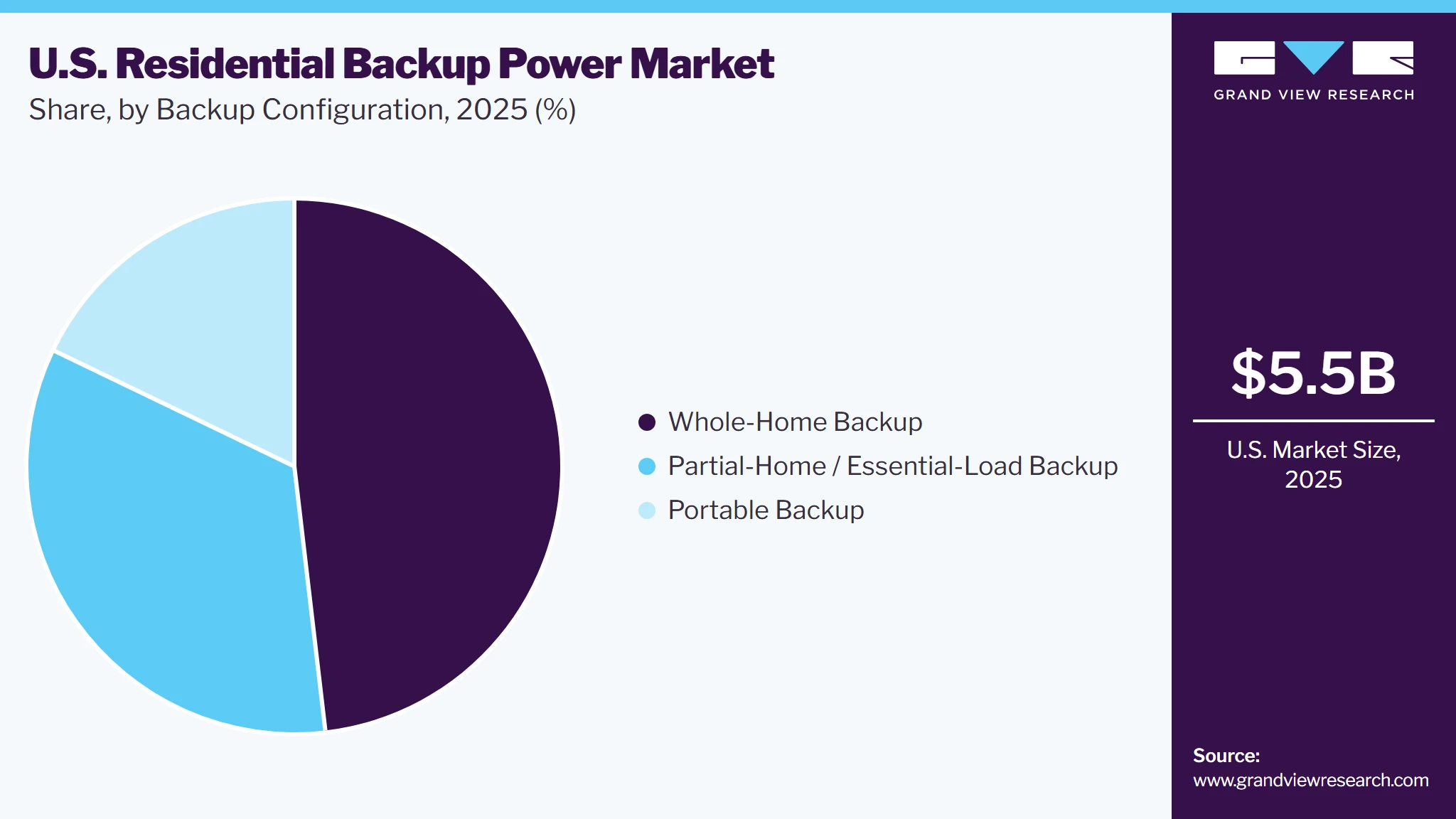
- By backup configuration: Whole-home backup segment accounted for the largest revenue share of 48.1% in 2025.
Market Size & Forecast
- Market size in 2025: USD 5.5 Billion
- Estimated market size in 2026: USD 5.9 Billion
- Projected market size by 2033: USD 9.9 Billion
- CAGR (2026-2033): 7.5%
Three ways to get this report
Buy it, customize it, or ask a question.Ask an Analyst
Analyst response in 1 business day
- AccessReport author, directly
- Reply timeWithin 1 working day
- No sales callDirect answer only
- FormatEmail reply
- CostFree, no cost
Get the Full Report
What the study covers
- FormatsPDF · Excel · Dashboard
- Timeline2026–2033 annual, 2025 base
- Coverage20+ countries, 5 regions
- Companies10+ key players profiled
Customize the Report
20% free customization
- IncludeCountries, segments, points
- TailorTo your product definition
- ExtendDeeper competitor detail
- OrA fully bespoke study
- Turnaround5–10 working days
Demand is further supported by the adoption of residential backup power, home energy storage systems, and home battery backup systems, which enable households to improve energy resilience and reduce dependence on the central electricity grid. Growth is also supported by the transition from conventional generators toward battery-based storage, solar-integrated backup solutions, hybrid power systems, and intelligent energy management technologies.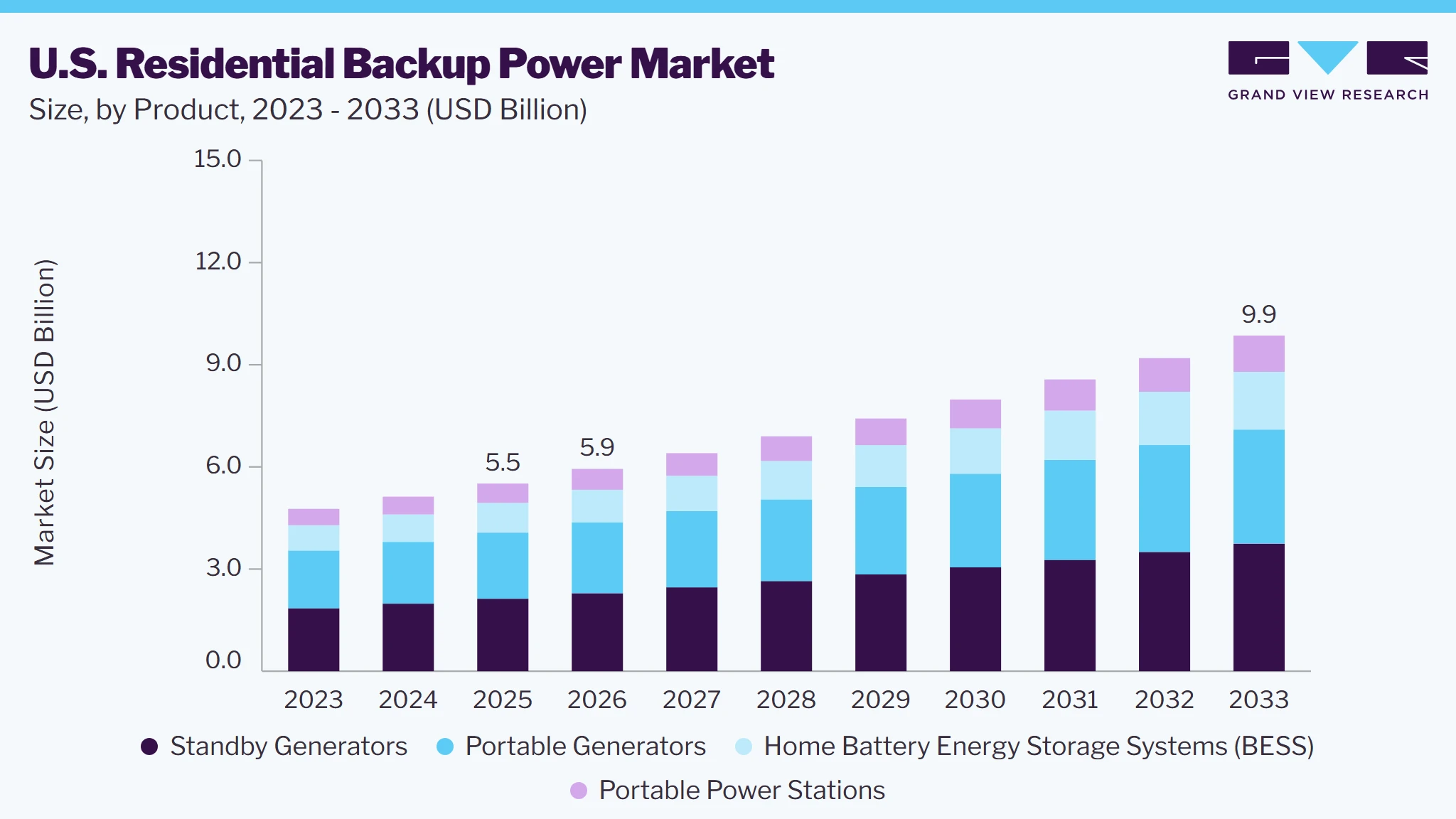 Source: Grand View Research, IR Documents, Primary Interviews, Paid DatabasesTo learn more about this report,
 Download Free Sample Report
The U.S. residential backup power market is growing as households increasingly prioritize reliable electricity access amid rising concerns regarding power outages, extreme weather, and grid instability. With the market scope focused on physical equipment and hardware, demand is centered on standby and portable generators, home energy storage systems, home battery backup systems, inverters, battery packs, transfer switches, and integrated solar-compatible backup equipment. A 2025 homeowner survey highlighted strong demand for such equipment, with 91% of respondents expressing concern about the impact of extreme weather, rising energy costs, and grid instability, while 67% stated that having a home backup power solution is important. In addition, 70% of homeowners either already had a solar battery solution or were interested in adding one, and 46% expected power outages to increase in the coming years. These findings indicate growing consumer interest in residential backup hardware that can provide greater energy resilience and maintain electricity supply during disruptions.
The increasing preference for higher capacity, integrated, and modular backup equipment is further supporting market growth. U.S. consumers are increasingly moving beyond conventional generators toward home energy storage systems and home battery backup systems that combine battery storage with inverters, solar connectivity, and whole-home backup capabilities. This shift is encouraging manufacturers to introduce scalable hardware that can support different household electricity requirements. For instance, Eco Flow introduced its OCEAN Pro integrated home energy system in the U.S. in July 2025, combining multiple energy sources within a single residential backup platform. Similarly, Enphase Energy began shipments of its IQ Battery 5P with higher domestic content in July 2025, reflecting continued product development and domestic manufacturing activity in residential battery backup hardware.
The broader expansion of energy storage equipment in the U.S. also provides a supportive environment for residential backup hardware adoption. According to the American Clean Power Association and Wood Mackenzie, the U.S. installed a record 18.9 GW of energy storage capacity in 2025, representing a 52% increase over 2024 across utility-scale, commercial, industrial, and residential installations. Although this figure covers the overall U.S. energy storage market, it demonstrates the accelerating deployment of battery storage technologies and the expanding hardware ecosystem supporting home energy storage systems and other battery-based power solutions.
Overall, the U.S. residential backup power market is evolving toward a diversified equipment portfolio that includes conventional generators alongside advanced battery storage, inverter systems, and integrated backup hardware. Increasing outage exposure, growing household dependence on electricity, and continued innovation in scalable and modular equipment are expected to support demand for residential backup power, particularly for systems designed to provide reliable whole-home or essential-load backup.
Market Dynamics
The increasing need to maintain access to electricity during emergencies and utility disruptions is driving demand for physical residential backup power equipment in the U.S. Households are increasingly dependent on electricity to operate essential appliances, lighting, communication devices, refrigeration, and other critical home equipment, supporting demand for standby generators, portable generators, home energy storage systems, home battery backup systems, inverters, and transfer equipment. A 2025 study published in Nature Energy, based on an assessment of more than 500,000 U.S. households, found that 63% of households could achieve affordable backup power during outages, covering an average of 51% of their essential energy needs through solar-and-battery systems. The findings highlight the growing role of residential battery and solar-compatible hardware in improving household energy resilience during grid disruptions.
The relatively high cost of advanced backup equipment remains a significant restraint for the U.S. residential backup power market. Whole-home battery systems can require substantial investment in battery modules, inverters, electrical panels, transfer switches, and other supporting hardware. The U.S. Department of Energy identifies energy storage systems, inverters, and electrical balance-of-system components as separate cost elements within residential solar-plus-storage installations, illustrating the multiple equipment components that contribute to overall system costs.
Hardware complexity can also create barriers for consumers, particularly where a backup system requires electrical modifications, dedicated backup circuits, or integration with existing solar equipment. This can limit adoption among cost-sensitive households and renters and may encourage consumers to choose smaller portable generators or power stations instead of higher-capacity whole-home systems. The need to address these barriers is encouraging manufacturers to develop more compact, modular, and plug-and-play backup equipment.
Growing demand for scalable backup hardware presents a significant opportunity in the U.S. residential backup power market. Rather than investing in large whole-home systems, consumers can increasingly select equipment designed to support essential appliances or expand capacity as household requirements change. This creates opportunities for manufacturers offering modular batteries, portable power stations, integrated inverters, and dedicated backup transfer equipment.
For instance, Fortress Power introduced its eForce residential battery system in March 2025, featuring 9.6 kWh modular battery units that can be stacked to provide up to 28.8 kWh per stack. The system can also be paired with compatible inverter hardware, allowing homeowners to configure capacity according to their backup requirements. In April 2026, Fronius introduced the Essential Backup Load Unit (EBLU) in the U.S., a physical microgrid interconnect device designed to work with the GEN24 Plus inverter and automatically disconnect the home from the grid during an outage to supply designated backup circuits. These developments highlight an opportunity for manufacturers to expand beyond conventional generator-based solutions by offering modular, appliance-focused, and easier-to-integrate residential backup power hardware tailored to different household power requirements.
Analyst Perspective
The U.S. residential backup power market is evolving from a conventional emergency-power category into a broader residential energy resilience market. Increasing grid disruptions, extreme weather events, and growing dependence on electricity are supporting demand for standby and portable generators, home battery backup systems, energy storage, inverters, and solar-plus-storage solutions. Manufacturers are focusing on higher-capacity batteries, intelligent energy management, remote monitoring, modular designs, and solar integration. Growing consumer awareness, alongside expanding direct-to-consumer and installer networks, is expected to support the adoption of more flexible, efficient, and integrated residential backup power solutions.
Consumer Insights
The consumer profile of the U.S. residential backup power market reflects demand across different household income groups and property types, with purchasing decisions influenced by outage exposure, homeownership, power requirements, and the ability to invest in permanent or portable backup solutions.
-
High-income households account for approximately 55% of the market, supported by their greater capacity to invest in higher-value solutions such as whole-home standby generators, home battery energy storage systems, automatic transfer switches, and integrated energy-management technologies.
-
Middle-income households represent around 35% of the market, with demand primarily focused on cost-effective standby generators, portable generators, and modular battery backup systems that can support essential household loads during power outages.
-
Low-income households account for approximately 10% of the market, with purchasing decisions largely centered on affordability and essential-load protection. Portable generators and smaller-capacity power stations are particularly relevant to this consumer group.
By property type, detached homes represent the primary consumer base for residential backup power solutions, as homeowners generally have greater flexibility to install standby generators, battery storage systems, and solar-plus-storage configurations. Semi-detached homes and townhouses also present opportunities for compact and space-efficient systems, while apartment residents and consumers in other property types are more likely to rely on portable generators and portable battery power stations due to installation restrictions and limited available space.
Consumers in the U.S. residential backup power market commonly encounter several challenges during product selection and ownership.
-
High initial investment costs can limit the adoption of whole-home generators and battery storage systems.
-
Battery degradation and limited lifespan remain concerns for consumers investing in battery-based backup solutions.
-
Uncertainty regarding return on investment can affect purchasing decisions, particularly for systems used primarily during infrequent outages.
-
Space constraints can restrict the installation of permanent generators and larger battery systems.
-
Maintenance requirements also create additional ownership consideration for generator-based backup systems.
These consumer insights indicate that purchasing decisions are increasingly influenced by affordability, installation flexibility, power capacity, reliability, and ease of maintenance. Accordingly, manufacturers are focusing on scalable systems, compact designs, smart monitoring, automated operation, and integrated energy-management capabilities to address the diverse requirements of U.S. households.
Product Insights
The standby generators segment accounted for the largest revenue share of 38.6% in 2025, supported by continued demand for reliable whole-home electricity during utility outages, severe weather events, and declining grid reliability. The segment is particularly attractive as standby generators provide automatic backup power and can support essential residential loads without requiring manual setup. According to Generac's August 2025 investor presentation, home standby generator penetration in the U.S. was approximately 6.75% in 2025, while the company estimated 63 million addressable homes, defined as owner-occupied, single-family detached homes valued above USD 175,000. Generac further estimated that a 1-percentage-point increase in penetration represents approximately USD 4.5 billion of retail market opportunity, highlighting the substantial untapped potential for standby generators in U.S. households.
A July 2025 survey by EcoFlow x Horowitz indicates that 38% of respondents purchased a backup power source for their homes in the previous 12 months, reflecting growing consumer investment in residential energy resilience. Among these consumers, portable generators were the most preferred option (48%), followed by standby generators (27%) and backup batteries (13%), highlighting the continued importance of flexible and cost-effective backup solutions in the U.S. residential backup power market.
The home battery energy storage systems (BESS) segment is expected to grow at a CAGR of 8.6% from 2026 to 2033, are gaining importance in the U.S. residential backup power market as households increasingly seek alternatives that can provide backup electricity while also enabling solar energy storage, peak-load management, and greater energy independence. In 2025, U.S. home battery installations were on pace for a record year, with home battery installations increasing 27% year over year in Q3 2025. California remained a major adoption center, with battery attachment rates reaching 78% in June 2025, compared with single-digit levels two years earlier, driven partly by changes under the state's NEM 3.0 policy. The data also indicates that consumers are adopting home batteries primarily for economic and resiliency/backup-power benefits, strengthening the role of BESS as a residential backup solution. California provides another strong indicator of residential BESS adoption. In May 2025, California had more than 15,763 MW of total battery storage capacity, representing a 1,944% increase from 2019. Residential and commercial battery systems accounted for approximately 2,500 MW, or 16% of the state's total battery storage capacity, demonstrating the growing contribution of smaller behind-the-meter systems to energy resilience.
The expansion continued through 2025, with California reporting more than 200,000 homes equipped with behind-the-meter battery systems totaling 2,213 MW by November 2025. These systems were increasingly being used not only for backup power but also to reduce demand during high-use periods and improve grid flexibility.
Power Capacity Insights
The 10-20 kW segment accounted for the largest revenue share of 37.1% in 2025, represents an important range within the U.S. residential backup power market, as these systems are generally suited to households requiring backup for multiple essential circuits, including refrigeration, heating, cooling, sump pumps, kitchen appliances, and home-office equipment. Industry data indicates that this capacity range is gaining traction: North American gen-set production in the 10-20 kW range reached approximately 145,885 units in 2025, up from 141,234 units in 2024, representing an increase of approximately 3.3%. The data covers all fuels and includes mobile and stationary gen-sets, so it should be used as an industry-level indicator rather than a direct measure of U.S. residential sales.
A relevant product instance is Kohler's 20 kW 20RCA home standby generator, which is rated at 20 kW on liquid propane and 18 kW on natural gas. The system provides automatic backup, has a 10-second response time, and supports remote monitoring through the KOHLER app. This illustrates how products at the upper end of the 10-20 kW range are being positioned for households seeking comprehensive backup coverage combined with connected monitoring capabilities.
The below 5 kW segment is expected to grow at a CAGR of 8.3% from 2026 to 2033, driven by households seeking portable and compact backup-power solutions for essential appliances and electronics rather than whole-home power. Manufacturer offerings demonstrate continued product availability in this range. For example, Honda's EU2200i provides 2,200 watts of maximum output, while its inverter technology is designed to provide stable power for sensitive electronics. Honda specifically lists applications including televisions, refrigerators, coffee makers, and other household equipment, positioning the product for essential-load residential backup. Another example is Cummins' Onan P2500i, a 2,500-watt gasoline-powered portable inverter generator. Cummins positions its portable-generator portfolio around flexible power that can be used wherever electricity is required, demonstrating the continued availability of sub-5-kW inverter-generator solutions.
Backup Configuration Insights
The whole-home backup segment accounted for the largest revenue share of 48.1% in 2025, becoming an increasingly important configuration within the U.S. residential backup power market, as homeowners seek systems capable of maintaining electricity across the entire residence rather than limiting backup power to a predefined set of critical circuits. The configuration is increasingly supported by integrated battery storage, automatic grid-isolation equipment, intelligent energy management, and higher continuous-power ratings, allowing households to maintain operation of appliances such as refrigerators, air conditioning, heating systems, and connectivity equipment during outages. A notable 2025 instance is Tesla Powerwall, which provides 13.5 kWh of energy capacity and 11.5 kW of continuous backup power. Tesla states that this output is sufficient to cover peak usage in approximately 95% of U.S. homes, illustrating the increasing ability of residential battery systems to support whole-home rather than partial-load backup. Tesla also introduced/continued its Storm Watch functionality, which automatically charges the battery when severe weather is forecast, strengthening the system's role as a residential resilience solution.
 To learn more about this report, Download Free Sample Report
The portable backup segment is expected to grow at a CAGR of 8.3% from 2026 to 2033, offering flexible and cost-effective solutions for households requiring temporary power during outages. Portable generators and battery power stations can support essential loads without permanent installation, while advancements in inverter technology, dual-fuel operation, remote monitoring, and compact designs are improving convenience and usability. For instance, in 2025, BLUETTI's launched the Apex 300 portable power station. Introduced in January 2025, the system provides 3,840 W of maximum AC output and 3,072 Wh of LFP battery storage, supports both 120-V and 240-V loads, and can be expanded to up to 58 kWh using additional batteries. The system was designed for multiple applications, including home backup, off-grid use, job sites, and recreational vehicles, illustrating the growing convergence between portable energy storage and residential emergency power.
Key U.S. Residential Backup Power Company Insights
The U.S. residential backup power market is characterized by a competitive landscape comprising standby generator manufacturers, portable generator companies, and residential energy-storage providers. Companies compete through generator capacity, fuel flexibility, automatic transfer technology, battery storage capacity, smart energy management, remote monitoring, installation networks, and after-sales services. The market serves homeowners seeking whole-home backup, essential-load protection, and portable emergency power solutions.
-
Residential Standby Power Leaders: Companies such as Generac Holdings Inc., Rehlko (formerly Kohler Energy), Cummins Inc., and Briggs & Stratton, LLC maintain strong positions in the residential generator segment. These companies offer automatic standby generators across multiple capacity ranges and differentiate through reliable engine technology, automatic transfer systems, connected monitoring, and extensive dealer and installation networks. Their products primarily target homeowners seeking automatic and longer-duration backup during utility outages.
-
Established Generator Manufacturers: Cummins Inc. and Briggs & Stratton, LLC compete through broad generator portfolios covering standby and portable applications. Their residential offerings emphasize dependable power generation, fuel flexibility, compact designs, and solutions suitable for different household power requirements.
-
Home Energy Storage & Backup Providers: The market is also expanding beyond conventional generators, with companies such as Generac, Tesla, and Enphase Energy competing through Home Battery Energy Storage Systems (BESS), solar-plus-storage configurations, and integrated energy-management platforms. These solutions combine backup power with energy optimization and renewable-energy integration, increasing competition between battery-based and generator-based backup technologies.
-
Technology & Product Differentiation: Competitive intensity is increasing as manufacturers integrate smart monitoring, mobile applications, automatic load management, inverter technology, modular battery systems, and whole-home backup capabilities. This allows companies to differentiate their products beyond basic power generation and address growing consumer demand for connected and flexible residential energy-resilience solutions.
Key U.S. Residential Backup Power Companies
-
Generac Holdings Inc.
-
Rehlko (formerly Kohler Energy)
-
Cummins Inc.
-
Briggs & Stratton, LLC
-
Honda Motor Co., Ltd.
-
Champion Power Equipment
-
Tesla, Inc.
-
Enphase Energy, Inc.
-
EcoFlow Inc.
-
SolarEdge Technologies, Inc.
Competitive Benchmarking
Category
Operating Strategies
Competitive Edge
Weakness
Established Players: Generac Holdings Inc.; Rehlko; Cummins Inc.; Briggs & Stratton, LLC; Honda Motor Co., Ltd.; Champion Power Equipment
Focus on strengthening market presence through broad portfolios of home standby generators, portable generators, inverter generators, transfer switches, remote monitoring, and energy storage systems. These companies leverage established dealer networks, retail partnerships, professional installation services, and product innovation to address varying residential backup requirements. Generac, for example, has expanded beyond conventional generators into an integrated home energy ecosystem incorporating solar, battery storage, generators, and smart energy management.
Strong brand recognition, extensive distribution and dealer networks, engineering expertise, and established consumer trust provide a significant advantage. Their broad product portfolios allow them to serve different household sizes, power requirements, and budgets. Generac identifies a broad residential product range spanning home standby generators, portable generators, battery storage, and energy management technologies, reinforcing its strong competitive position.
Higher installation and equipment costs, particularly for permanently installed standby generators, can limit adoption. Traditional generator manufacturers also face increasing competition from battery-based backup systems and solar-plus-storage solutions. Dependence on dealer and installer networks may additionally increase installation timelines and create variations in customer experience.
Emerging Players: Tesla, Inc.; Enphase Energy, Inc.; EcoFlow Inc.; SolarEdge Technologies, Inc
Focus on expanding home battery backup systems, portable power stations, solar-plus-storage solutions, smart inverters, and digital energy management platforms. Their strategies emphasize clean energy, modularity, remote monitoring, app-based control, and integration with rooftop solar systems. SolarEdge, for instance, offers an integrated residential ecosystem combining batteries, backup interfaces, inverters, smart energy devices, and energy management software.
Strong technological capabilities, advanced software integration, scalable battery systems, and alignment with the transition toward electrification and distributed energy resources provide a competitive advantage. These companies can differentiate through integrated energy ecosystems that enable homeowners to monitor, store, manage, and optimize electricity consumption alongside backup functionality. SolarEdge's residential portfolio specifically integrates storage and backup with solar generation and smart energy management.
Limited experience in conventional fuel-based standby generators may restrict their ability to serve consumers requiring extended-duration backup during prolonged outages. Battery-based systems can also involve relatively high upfront costs, installation complexity, and dependence on solar generation, battery capacity, or grid-charging availability. In addition, these companies face intense competition from established generator manufacturers that are increasingly expanding into battery storage and integrated home energy solutions.
Recent Developments
-
In August 2026, Enphase Energy expanded support in the U.S. and Canada for homeowners with existing third-party solar systems to add the IQ Battery 10C and whole-home backup without replacing their existing solar equipment. The battery provides 10 kWh of usable energy and 7.08 kW of continuous power, reflecting the industry's shift toward flexible battery-based backup solutions compatible with existing residential solar installations.
-
In May 2026, Enphase Energy expanded its Power Match technology for IQ Battery 10C systems in North America. The software dynamically adjusts battery operation based on household electricity demand, supporting more efficient energy management and improving the functionality of residential battery backup systems.
-
In January 2025, BLUETTI unveiled the Apex 300 portable power station, featuring 3,840 W of AC output and 3,072 Wh of battery capacity, with expandable storage of up to 58 kWh. The system supports both 120 V and 240 V applications and demonstrates growing demand for scalable portable battery solutions for residential backup and emergency power.
U.S. Residential Backup Power Market Report Scope
Report Attribute
Details
Market size value in 2026
USD 5.5 billion
Estimated market size in 2026
USD 5.9 billion
Projected market size by 2033
USD 9.9 billion
Growth rate
CAGR of 7.5% from 2026 to 2033
Base Year
2025
Historical data
2021 - 2024
Forecast period
2026 - 2033
Quantitative units
Revenue in USD billion and CAGR from 2026 to 2033
Report coverage
Revenue forecast, company ranking, competitive landscape, growth factors, and trends
Segments covered
Product, power capacity, backup configuration
Key companies profiled
Generac Holdings Inc.; Rehlko (formerly Kohler Energy); Cummins Inc.; Briggs & Stratton, LLC; Honda Motor Co., Ltd.; Champion Power Equipment; Tesla, Inc.; Enphase Energy, Inc.; EcoFlow Inc.; SolarEdge Technologies, Inc.
Customization scope
Free report customization (equivalent up to 8 analysts’ working days) with purchase. Addition or alteration to country, regional & segment scope.
Pricing and purchase options
Avail customized purchase options to meet your exact research needs. Explore purchase options
U.S. Residential Backup Power Market Segmentation
This report forecasts revenue growth at country levels and provides an analysis of the latest trends and opportunities in each of the sub-segments from 2026 to 2033. For this study, Grand View Research has segmented the U.S. residential backup power market based on product, power capacity, and backup configuration:
-
Product Outlook (Revenue, USD Billion, 2021 - 2033)
-
Standby Generators
-
Portable Generators
-
Home Battery Energy Storage Systems (BESS)
-
Portable Power Stations
-
-
Power Capacity Outlook (Revenue, USD Billion, 2021 - 2033)
-
Below 5 kW
-
5-10 kW
-
10-20 kW
-
Above 20 kW
-
-
Backup Configuration Outlook (Revenue, USD Billion, 2021 - 2033)
-
Whole-Home Backup
-
Partial-Home / Essential-Load Backup
-
Portable Backup
-
Research Methodology
The U.S. residential backup power market figures in this report are based on a proven research process that combines executive interviews with secondary research from proprietary databases, company filings, and recognized regulatory and institutional sources. Market size is built through value-chain sizing-reconciling supply-side and demand-side estimates-and triangulated with bottom-up and top-down approaches. Every estimate passes multiple levels of expert validation before publication, with each U.S. residential backup power segment quantified using the revenue-capture definitions in the table below.
Segment Definition
Segment -
Revenue capture definition
Standby Generators
This segment includes permanently installed generator systems sold for residential backup power applications. Revenue includes the generator unit and associated system components sold as part of the equipment package, such as transfer switches and integrated control equipment. Contractor installation and standalone service revenue are excluded to avoid adding a separate installation market to equipment revenue.
Portable Generators
This segment includes equipment revenue generated from portable generators purchased for residential backup power purposes. These systems are typically used to provide temporary electricity to essential household appliances and devices during outages. The segment excludes portable generator sales for commercial, industrial, and other non-residential applications.
Home Battery Energy Storage Systems (BESS)
This segment includes residential battery-storage systems purchased primarily for backup power and energy resilience. Relevant system revenue includes the battery units, inverters or power electronics, and other associated equipment sold as part of the residential BESS package. The segment covers systems designed to support essential-load or whole-home backup applications.
Portable Power Stations
This segment includes consumer portable battery power stations purchased for emergency and residential backup use. These systems are generally used to power essential appliances, electronics, communication devices, and other household loads during temporary power interruptions. The segment excludes demand primarily associated with camping, recreation, or outdoor use where the product is not intended to provide residential backup power.
Estimation Model
Layer Name
Key Question
Description
Residential Household Base Layer
Who forms the addressable customer base?
Households across urban, suburban, and rural areas requiring reliable electricity for everyday living, essential appliances, home offices, and safety during power interruptions.
Backup Power Need Layer
Which households purchase backup power?
Households purchasing backup power solutions due to frequent grid outages, extreme weather events, unreliable electricity supply, remote locations, or the need for uninterrupted power for essential loads.
Technology, Capacity & Configuration Layer
What type of backup solution do households purchase?
Households selecting standby generators, home battery energy storage systems (BESS), or portable power stations based on power capacity requirements, installation preferences, budget, fuel availability, and renewable energy integration.
Monetisation Layer
How much revenue is generated?
The number of systems purchased is converted into market revenue using product, capacity, and configuration-specific average selling prices, with the resulting value allocated across regions and distribution channels.
Delivered Customizations
This report has been delivered with the following In-depth customizations
Client Request
Customization Delivered
Value Adds
U.S. Residential Backup Power Consumer Preferences & Buying Behavior Analysis
Conducted a detailed assessment of household demand for residential backup power solutions, covering standby and portable generators, home battery backup systems, solar-plus-storage solutions, fuel preferences, power capacity requirements, price sensitivity, reliability expectations, and purchasing behavior during outages and extreme weather events.
Helps stakeholders identify high-growth consumer segments, understand evolving preferences for reliable and uninterrupted electricity access, and develop targeted product portfolios and customer engagement strategies. Consumer priorities are increasingly centered on affordability, reliability, safety, high power output, and ease of integration with existing home energy systems.
U.S. Residential Backup Power Product Innovation, Energy Storage & Market Trends
Evaluated developments across smart standby generators, portable power stations, home battery systems, integrated solar-plus-storage solutions, hybrid generator-battery configurations, modular energy storage, remote monitoring, and intelligent home energy management technologies. The assessment also considers innovations that simplify installation and expand access to backup power for homeowners, apartments, and other residential settings.
Provides insights into evolving technology preferences and emerging product opportunities, enabling companies to differentiate through higher power capacity, seamless whole-home backup, modularity, smart controls, improved safety, and integration with solar, generators, and connected home devices. Recent launches illustrate the shift toward integrated and intelligent residential energy ecosystems.
U.S. Residential Backup Power Distribution & Market Opportunity Assessment
Assessed growth opportunities across independent dealers, electrical and solar installers, home improvement retailers, specialty power equipment stores, distributors, brand-owned channels, and e-commerce platforms. The analysis also evaluates regional demand patterns, installation and maintenance requirements, replacement opportunities, and the growing importance of omnichannel purchasing.
Supports expansion and investment decisions by identifying high-potential distribution channels and consumer touchpoints. Dealer and installer networks remain particularly important for whole-home systems requiring consultation, installation, and ongoing service, while retail and e-commerce channels broaden access to portable generators and battery-based backup solutions.
Frequently Asked Questions About This Report
Standby generators accounted for the largest share of the U.S. residential backup power market, capturing 38.6% of total market revenue in 2025.
The U.S. residential backup power market size was estimated at USD 5.5 billion in 2025 and is expected to reach USD 5.9 billion in 2026.
The U.S. residential backup power market is expected to grow at a compound annual growth rate of 7.5% from 2025 to 2033 to reach USD 9.9 billion by 2033.
Emerging trends include Home Battery Energy Storage Systems (BESS), solar-plus-storage integration, and smart, connected backup solutions.
The U.S. residential backup power market is driven by increasing power outages, extreme weather events, and growing concerns about grid reliability. Rising adoption of Home Battery Backup Systems, renewable energy integration, and the need for uninterrupted power supply further support market growth.
Key players in the U.S. residential backup power market include Generac Holdings, Rehlko, Cummins, Briggs & Stratton, Honda, Champion Power Equipment, Tesla, Enphase Energy, EcoFlow, and SolarEdge. These companies compete across standby generators, portable generators, and home battery backup systems.
The 10–20 KW power capacity segment dominated the U.S. residential backup power market, accounting for the largest revenue share of 37.1% in 2025.
The whole-home backup segment dominated the U.S. residential backup power market, accounting for the largest revenue share of 48.1% in 2025.
Home Battery Energy Storage Systems (BESS) are projected to register the fastest CAGR of 8.6% in the U.S. residential backup power market.
About the Author(s)
Electronic & Electrical Research Team
Consumer Goods · Electronic & ElectricalThis report was authored by the electronic & electrical research team at Grand View Research - comprising two research analysts, one senior research analyst, and one industry expert - with specialized expertise in the electronic & electrical segment of the consumer goods industry. All findings are based on proprietary consumer goods databases, executive interviews, and regulatory analysis, subject to internal peer review prior to publication.
Last Updated:
Speak to Analyst

Customize this report to your needs - add regions, segments, or data points, with 20% free customization.
Or view our licence options:


ISO 9001:2015 & 27001:2022 Certified
We are GDPR and CCPA compliant! Your transaction & personal information is safe and secure. For more details, please read our privacy policy.


