
- Home
- »
- Power Generation & Storage
- »
-
Portable Generator Market Size & Share Report, 2026-2033GVR Report cover

Portable Generator Market (2026 - 2033)
Size, Share & Trends Analysis Report By Product (Gasoline Generator, Gaseous Generator), By Power Range (Low Power, Medium Power, High Power), By Application, By End-use, By Region, And Segment Forecasts
Market Size, 2025
$5.2BMarket Estimate, 2026
$5.5BMarket Forecast, 2033
$8.0BCAGR, 2026–2033
5.4%Portable Generator Market Summary
The global portable generator market size was valued at USD 5.2 billion in 2025 and is projected to grow from USD 5.5 billion in 2026 to USD 8.0 billion by 2033, growing at a CAGR of 5.4% from 2026 to 2033. Asia Pacific dominated the portable generator market with the largest revenue share of 33.4% in 2025. With severe weather events becoming more frequent and more intense, consumers are looking for reliable generators that can keep their homes and businesses powered in times of crisis.
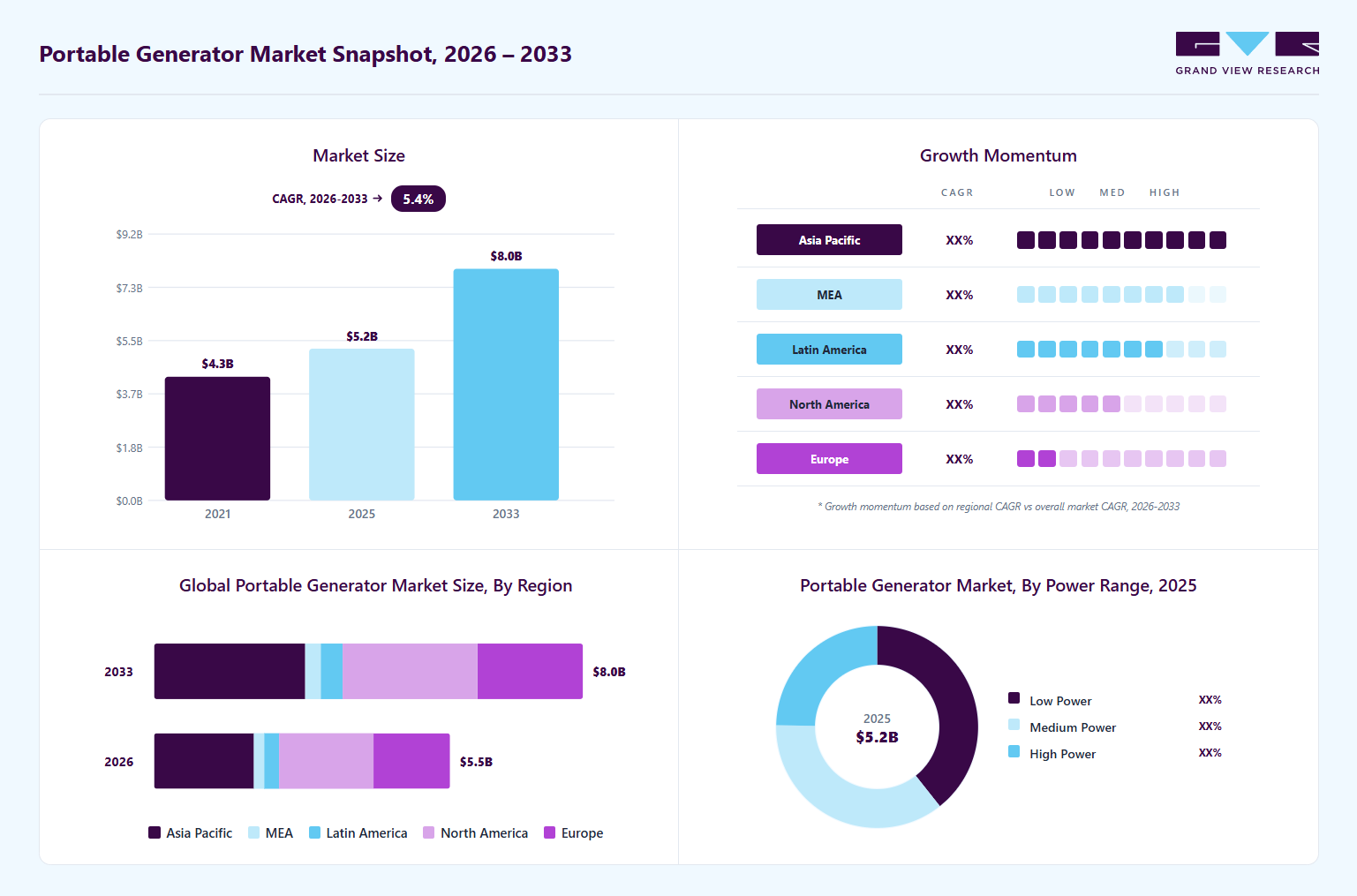 Source: Grand View Research, IR Documents, Primary Interviews, Paid DatabasesTo learn more about this report,
 Download Free Sample Report
 Key Market Trends & Insights
- By product: Gasoline generator segment led the market with the largest revenue share of 42.7% in 2025.
- By power range: Low power segment led the market with the largest revenue share of 39.3% in 2025.
- By end use: Residential segment led the market with the largest revenue share of 40.9% in 2025.
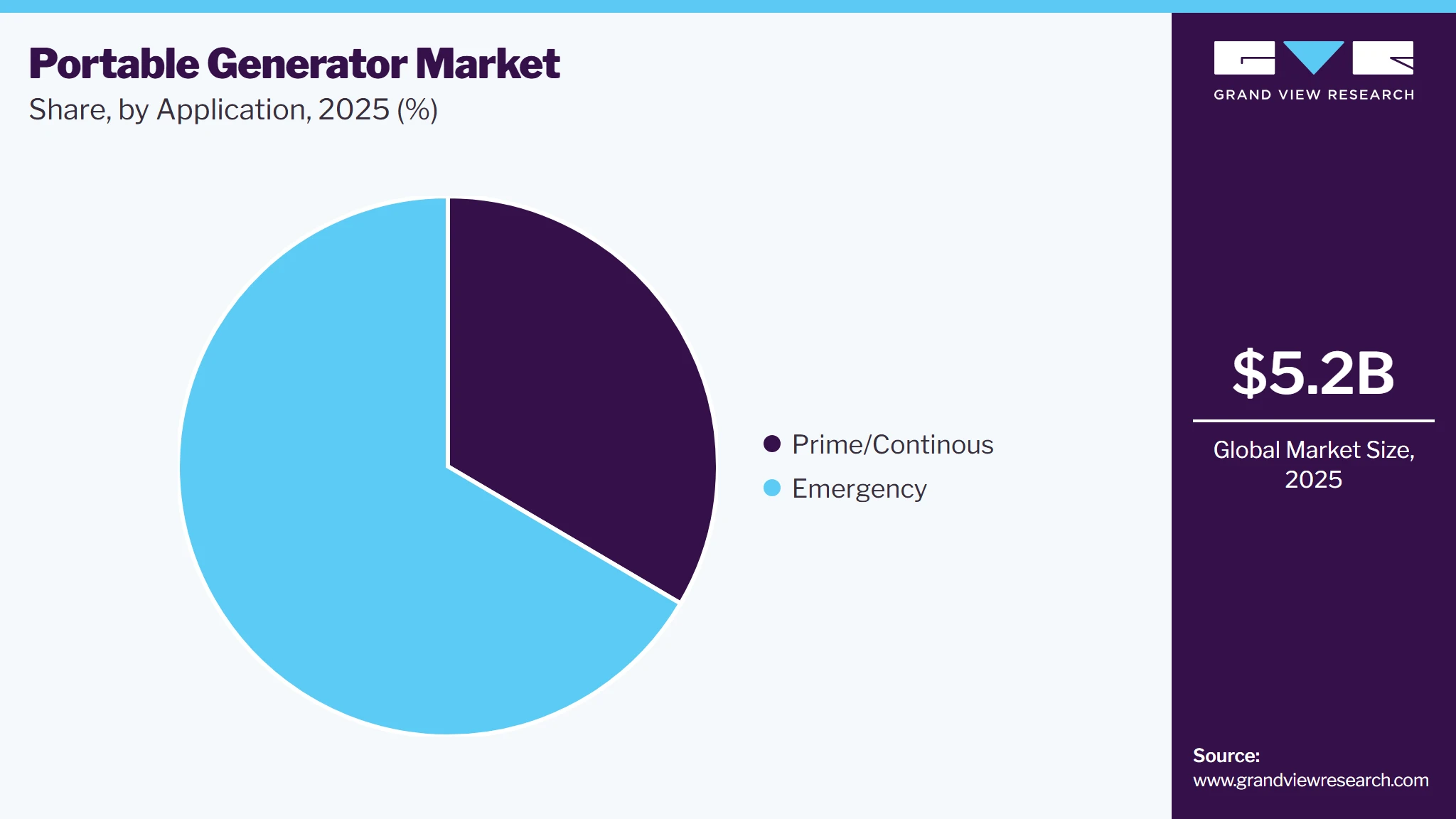
- By application: Emergency segment led the market with the largest revenue share of 66.5% in 2025.
Regional Highlights
- Largest regional market: Asia Pacific (33.4% revenue share, 2025)
- By country: The China held the largest market share in 2025.
Market Size & Forecast
- Market size in 2025: USD 5.2 Billion
- Estimated market size in 2026: USD 5.5 Billion
- Projected market size by 2033: USD 8.0 Billion
- CAGR (2026-2033): 5.4%
Three ways to get this report
Buy it, customize it, or ask a question.Ask an Analyst
Analyst response in 1 business day
- AccessReport author, directly
- Reply timeWithin 1 working day
- No sales callDirect answer only
- FormatEmail reply
- CostFree, no cost
Get the Full Report
What the study covers
- FormatsPDF · Excel · Dashboard
- Timeline2026–2033 annual, 2025 base
- Coverage20+ countries, 5 regions
- Companies10+ key players profiled
Customize the Report
20% free customization
- IncludeCountries, segments, points
- TailorTo your product definition
- ExtendDeeper competitor detail
- OrA fully bespoke study
- Turnaround5–10 working days
At the same time, the growing popularity of outdoor activities, such as camping and tailgating, which require portable power sources for appliances and electronic devices, is also a significant factor driving the growth of the industry. Several portable generator solution providers are increasingly focusing on developing dual-fuel-capable portable solutions to offer customers an efficient option. For instance, in May 2022, Generac Power Systems, Inc., an energy technology solution provider, introduced two new dual-fuel capable Powermate portable generators, such as the Powermate 7500 Watt Dual Fuel Portable Generator and the Powermate 4500 Watt Dual Fuel Portable Generator. Both variants are intended to run on either gasoline or compressed natural gas. The Powermate 4,500-Watt Dual-Fuel Portable Generator has 4,500 starting watts and 3,600 operating watts (gas), making it powerful enough to run small electrical appliances at any campground or picnic spot while also versatile enough to power equipment for home-based chores.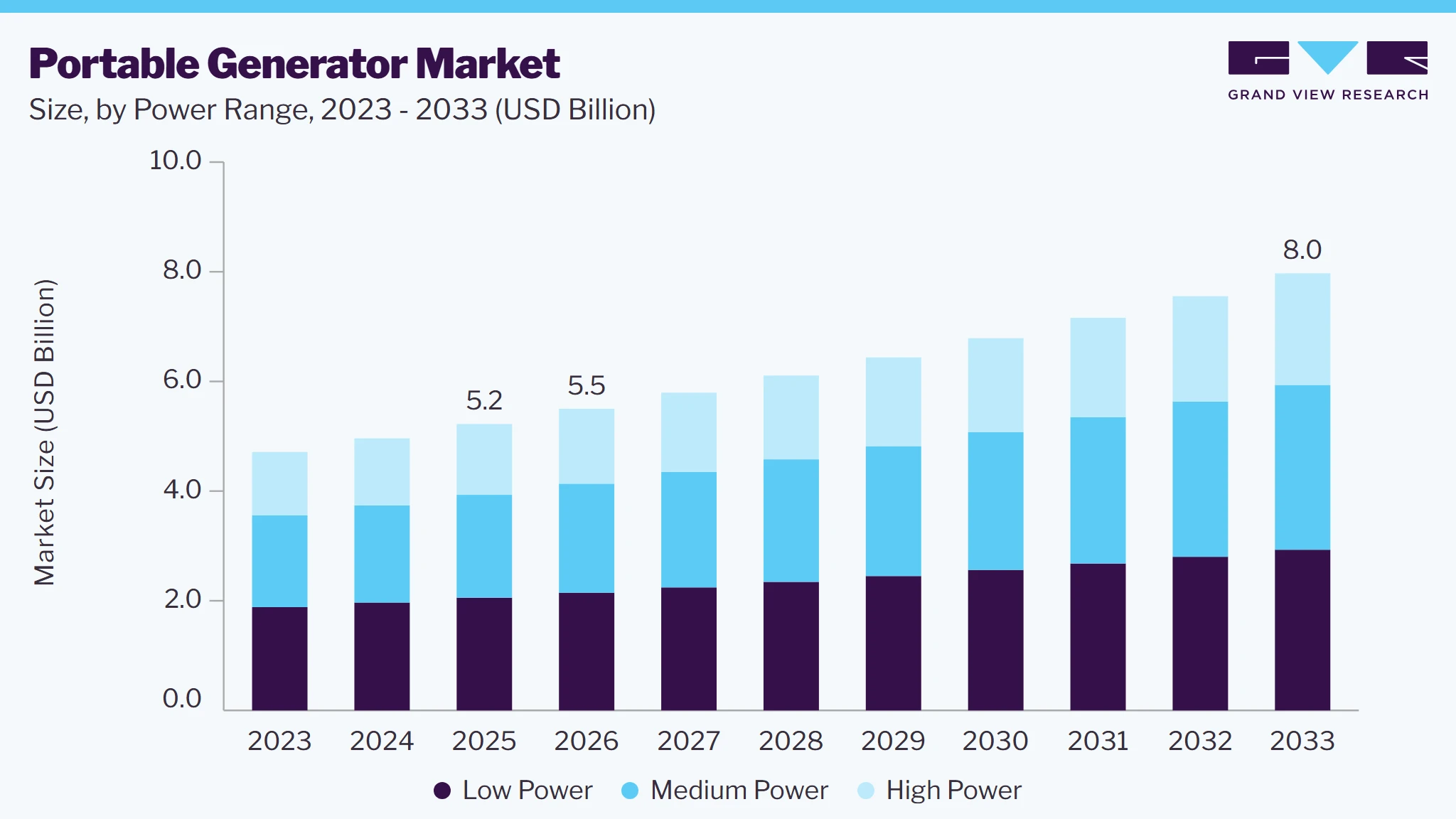 To learn more about this report, Download Free Sample Report
 In recent years, there has been a significant rise in the instances of power outages in the U.S. owing to extreme weather conditions. With climate change leading to more frequent and severe weather events, such as hurricanes, tornadoes, and wildfires, power grids are being increasingly challenged to keep up with the demands of a changing climate. For instance, according to the U.S. Energy Information Administration's 2021 annual power industry report, the average electricity customer was without power for 7 hours and 20 minutes that year, with more than 5 of those hours (72%) attributed to major weather events such as hurricanes, wildfires, and snowstorms. As a result, there is a growing need for backup power solutions, such as portable generators, to help keep homes and businesses powered during outages.
Solar-based portable generators are used in emergencies, providing a reliable power source during power outages or other disasters. With climate change an increasing concern, consumers are looking for renewable, sustainable alternatives to traditional gasoline generators, and solar-powered portable generators fit the bill perfectly. While they may be more expensive upfront than traditional gasoline generators, solar-powered portable generators can save money over time, as they do not require fuel and have minimal ongoing maintenance. Additionally, the increasing popularity of outdoor activities, such as camping and tailgating, has created a demand for portable power solutions that can be used in remote locations where access to traditional power sources may be limited.
The demand for portable generators powered by biofuel, a sustainable energy source, has increased as awareness of global warming has increased. Due to its chemical similarities to petroleum-based fuels, biofuel can be used as a straight replacement for diesel fuel. Moreover, biofuel gives nations like Japan and Italy, which buy natural gas and petroleum from other nations, energy independence. Canola, soybean, corn, leftover cooking oil, and animal fats may all be utilized to make biofuels. Hence, the participants in the market for portable generators would benefit from the rising demand for generators that run on biofuel. However, the key constraints on market expansion are stringent environmental restrictions aimed at reducing carbon emissions.
Market Dynamics
The portable generator market is driven by rising infrastructure development, concerns about power reliability, and a shift toward efficient, flexible energy solutions. Urbanization, construction growth, and reliance on uninterrupted power across sectors continue to support demand. Technological advancements, including inverter systems, dual-fuel options, and smart connectivity, are improving efficiency and broadening applications. However, increased adoption of renewable energy and stricter emission regulations are encouraging a shift toward cleaner alternatives. Despite these challenges, demand for reliable backup power remains strong in off-grid areas, during emergencies, and for infrastructure projects.
Rapid global construction growth, driven by urbanization and large-scale infrastructure projects, is a key factor in the expansion of the portable generator market. Migration to urban areas has increased demand for residential, commercial, and transportation infrastructure, including roads, bridges, railways, and airports. The World Economic Forum reports that the global urban population is growing by about 200,000 people per day and is projected to surpass 6 billion by 2045, further intensifying the need for new construction. This ongoing expansion in civil, industrial, and commercial construction is driving sustained demand for reliable, flexible power solutions at job sites.
Portable generators are essential for maintaining uninterrupted construction operations by supplying reliable power in remote or underdeveloped areas where grid access is limited. They are commonly used to operate heavy equipment, lighting, communication systems, and other critical site facilities, supporting efficient project execution. Portable generators also provide backup power during grid outages or temporary interruptions, reducing downtime and enhancing operational efficiency. As global construction expands, demand for portable and mobile power solutions is expected to grow, further supporting market growth.
The growing adoption of renewable energy is significantly limiting the growth of the portable generator market. As economies move toward cleaner energy systems, there is a clear shift away from fossil-fuel-based power toward alternatives such as solar, wind, and advanced battery storage. These technologies are being implemented in residential, commercial, and construction settings, reducing reliance on traditional fuel-powered generators. In off-grid and remote areas, solar panels with energy storage now provide reliable, continuous power, decreasing the need for generator-based backup.
Further advancements in energy storage technologies, particularly high-capacity lithium-ion batteries, are strengthening this shift by enabling efficient storage of surplus renewable energy for use during periods of low generation or outages. Supportive government policies, including subsidies, tax incentives, and stricter emissions regulations, further encourage the adoption of renewables and discourage conventional generators. Despite this shift, portable generators remain important for emergency backup, construction sites lacking renewable infrastructure, and outdoor events. Manufacturers are responding by developing cleaner alternatives, such as biodiesel and natural gas generators, and hybrid systems that combine renewable energy with storage to meet sustainability standards.
Technological advancements, including inverter technology and dual-fuel systems, are driving growth in the portable generator market. Inverter generators deliver cleaner, more stable electricity by adjusting engine speed to match load requirements. This consistent power output makes them ideal for sensitive electronic devices in construction, outdoor activities, residential backup, and commercial settings. The increasing reliance on electronic equipment across sectors is emphasizing demand for compact, efficient, and low-noise inverter generators.
Dual-fuel generators, which run on gasoline, propane, or natural gas, are gaining popularity for their flexibility and cost-effectiveness. Users can switch between fuel sources based on availability and price, reducing reliance on a single fuel and improving efficiency. Advancements such as electronic fuel injection, variable engine speed control, improved exhaust management, and smart connectivity are enhancing performance and user convenience. Features such as remote monitoring, mobile app integration, and predictive maintenance further enhance operational control and efficiency. These innovations make portable generators more versatile, efficient, and aligned with consumer expectations for sustainable and intelligent power solutions.
Analyst Perspective
The market continues to benefit from the need for an uninterrupted power supply in off-grid and emergency applications. However, the growing adoption of renewable energy and battery storage systems is gradually reducing long-term reliance on conventional generators. In response, manufacturers are focusing on fuel-efficient, low-emission, inverter, and dual-fuel technologies to stay competitive. Smart and connected generator solutions are also gaining traction to enhance operational efficiency and user convenience. While short-term demand remains strong, long-term growth will depend on innovation and alignment with sustainability trends.
Product Insights
Based on product, the gasoline generator segment led the market with the largest revenue share of 42.7% in 2025. The driving factors for the gasoline-based portable generator market include their affordability, versatility, and convenience. Gasoline generators are often less expensive than other types of backup power solutions, making them a popular choice for consumers on a budget. Additionally, gasoline generators can be used in a wide range of applications, from powering outdoor events to providing backup power for homes and businesses during power outages. Hence, the convenience of gasoline-based portable generators makes them a popular choice for consumers seeking reliable backup power solutions.
The gaseous generator segment is poised to witness the fastest growth during the forecast period. Factors such as lower emissions, fuel efficiency, and reliability offered by natural gas portable generators are the major factors driving the segment's growth. Natural gas offers cleaner-burning fuels than gasoline, producing fewer emissions and pollutants. This makes them a popular choice for consumers concerned about the environmental impact of their power usage. Additionally, gas-powered portable generators are typically more fuel-efficient than gasoline generators, meaning they can run for longer periods on less fuel. Such factors bode well for the growth of the segment over the forecast period.
Power Range Insights
Based on power range, the low-power segment led the market with the largest revenue share of 39.3% in 2025, as these generators are widely used for residential and commercial applications, powering air conditioners, water pumps, and refrigerators. These generators are often used as a reliable backup power source for small businesses and other settings where access to grid power may be limited or unavailable. They are also popular for outdoor events and job sites where power tools and equipment may need to be used. Low-power portable generators in this range are typically more affordable than larger standby generators and can power essential appliances and electronics during a power outage.
The medium power segment is expected to grow at a significant CAGR over the forecast period. The primary driving factors for the demand for these generators are the need for reliable backup power and remote power generation. Businesses and organizations rely on a continuous power supply to keep their operations running in the event of power outages, and these medium power generators provide a reliable solution to ensure that they do not face any interruptions. Additionally, medium-power generators are often used in remote locations where grid power is unavailable, such as construction sites, mining operations, and outdoor events. The compact and portable nature of these generators makes them a versatile power source for a variety of applications, thereby contributing to the growth of the segment.
Application Insights
Based on application, the emergency segment led the market with the largest revenue share of 66.5% in 2025. The demand for emergency portable generators is primarily driven by the need for reliable backup power in the event of power outages or emergencies. Emergency generators are primarily designed to provide backup power in the event of an outage or power failure, and they are typically used in residential and commercial settings. These generators are often smaller in size and portable, making them easy to transport and install. Additionally, the aging power infrastructure in many areas has led to an increased risk of power failures, further fueling the demand for emergency generators.
 To learn more about this report, Download Free Sample Report
 The prime/continuous segment is anticipated to register a significant CAGR over the forecast period. One of the main drivers of the use of prime/continuous portable generators is the growth of the construction industry, which relies heavily on them to power tools and equipment on job sites. Additionally, the expansion of the oil and gas industry, which requires reliable power for drilling and extraction operations in remote locations, is a key driver of the use of prime/continuous portable generators. Furthermore, the need for emergency power in critical facilities, such as hospitals, data centers, and airports, has also contributed to the growth of the prime/continuous portable generator market, as these facilities require continuous and reliable power to function properly.
End-use Insights
Based on end use, the residential segment led the market with the largest revenue share of 40.9% in 2025. The segment growth can be attributed to the increasing frequency of severe weather events, such as hurricanes and snowstorms, which can cause power outages and leave homeowners without electricity for days or even weeks. As a result, many homeowners are turning to portable generators as reliable backup power sources to keep their essential appliances and electronics running during these outages. Additionally, another trend driving the segment growth is the growing demand for portable generators that are easy to use, compact, and portable, allowing homeowners to take them on camping trips or use them for outdoor events.
The industrial segment is anticipated to register the fastest CAGR over the forecast period. The segment growth can be attributed to the need for reliable backup power in industries that rely on continuous operations, such as manufacturing and data centers. Portable generators provide a reliable backup power source, ensuring these operations can continue in the event of a power outage. At the same time, the increasing demand for clean and sustainable power has led to the development of new portable generators that use alternative fuels, such as propane and natural gas, and are more fuel-efficient and emit fewer emissions than traditional diesel generators are driving the segment growth. The growth of the construction industry and the need for portable power solutions on job sites have also contributed to the increasing adoption of portable generators for industrial use.
Regional Insights
North America portable generator market is expected to grow at a significant CAGR during the forecast period. The rising need for reliable backup power stems from the increasing frequency of natural disasters and extreme weather events. This has led more consumers to seek portable generators to ensure an uninterrupted power supply for their homes and businesses during power outages. Moreover, according to the International Energy Agency's 2021 reports, the U.S. is the world's second-largest energy user behind China, with massive electricity consumption. Despite the country's sophisticated energy grid architecture and 100% electricity availability, concerns such as power outages and rising demand for standby power sources are likely to increase demand for the portable generator industry.
U.S. Portable Generator Market Trends
The portable generator market in the U.S. held a dominant position in 2025. The growth of the market can be attributed to factors such as the increasing need for backup power solutions in the event of natural disasters and power outages.
Asia Pacific Portable Generator Market Trends
Asia Pacific dominated the portable generator market with the largest revenue share of 33.4% in 2025. The regional growth can be attributed to the increasing demand for reliable and accessible power in emerging markets, such as India and China, where grid power is often unreliable or inaccessible in rural areas. Portable generators provide a reliable and cost-effective solution for powering homes, small businesses, and farms in these areas. The growing construction industry in the region is also driving demand for portable generators for use on job sites to power tools and equipment. The increasing number of natural disasters, such as typhoons and earthquakes, in the region has also contributed to the growing demand for portable generators for emergency backup power.
 To learn more about this report, Download Free Sample Report
 China held the largest share of the Asia Pacific portable generator market in 2025. China's portable generator market is rising due to frequent power outages in rural areas and increasing reliance on backup power for businesses and households, especially during natural disasters. This trend is driven by a growing awareness of energy security and enhanced government support for emergency preparedness measures.
The portable generator market in Japan is shaped by strict energy regulations and a strong emphasis on sustainability, prompting consumers to favor low-emission, fuel-efficient models. These generators are increasingly valued as dependable backup solutions, especially as the country faces challenges from aging infrastructure and frequent extreme weather events.
Europe Portable Generator Market Trends
The portable generator market in Europe is experiencing strong growth, driven by rising demand for backup power solutions amid increasing grid instability and unpredictable weather patterns. Businesses and households are turning to portable generators to maintain energy resilience during outages and peak demand periods. Additionally, there is a growing consumer preference for eco-friendly, fuel-efficient models as the region’s environmental regulations tighten, encouraging manufacturers to innovate with low-emission technologies that align with Europe’s sustainability goals.
The U.K. portable generator market is experiencing growth driven by the rising frequency of power disruptions, particularly in rural areas and during extreme weather conditions. As concerns about energy security increase, both consumers and businesses are seeking reliable backup power solutions.
The portable generator market in Germany held a substantial share in 2025, driven by heightened demand for backup power amid frequent power outages and extreme weather events. The growing reliance on portable generators is fueled by concerns over energy security and the need for continuous power supply, particularly in rural areas and critical industries.
Key Portable Generator Company Insights
Some of the key companies in the portable generator market include Generac Holdings, Inc., Caterpillar, Inc., Cummins, Inc., and others. These players are focusing on investing in research and development to create innovative products that offer improved features and benefits for customers. This can help them to differentiate their products from competitors and attract new customers.
-
GENERAC HOLDINGS INC. offers portable generators for backup, recreational, and work power needs. The company's portable generators ensure that essential items, such as lights, freezers, refrigerators, sump pumps, and even space heaters and window air conditioners, remain operational, minimizing any disruptions. The company is strengthening its hold on the market by investing in R&D and product development.
-
Caterpillar, Inc. offers a wide array of portable generators designed for optimal performance, reliability, and durability. The company’s generators are designed for a variety of uses, including construction sites, outdoor gatherings, and emergency backup power.
Key Portable Generator Companies
The following key companies have been profiled for this study on the portable generator market.
-
Briggs & Stratton Corporation
-
Champion Power Equipment
-
Caterpillar, Inc.
-
Cummins Inc.
-
Generac Power Systems, Inc.
-
Kohler Co.
-
Multiquip Inc.
-
WINCO
-
Yamaha Motor Corporation, U.S.A.
-
Duromax Power Equipment
Competitive Benchmarking
Category
Operating Strategies
Competitive Edge
Weakness
Established Players (Briggs & Stratton Corporation, Caterpillar, Inc., Cummins Inc., Generac Power Systems, Inc., Kohler Co., Yamaha Motor Corporation, U.S.A.)
Expand global distribution networks through dealers, retail channels, and industrial partnerships
Invest in product innovation, including inverter, dual-fuel, and hybrid generator technologies
Strengthen focus on emission compliance and fuel efficiency standards
Strong global brand recognition and trusted product reliability
Broad and diversified product portfolio across residential, commercial, and industrial segments
Well-established service and aftermarket support networks
High manufacturing and R&D costs due to advanced technology integration
Exposure to stringent emission regulations and compliance requirements
Slower adaptation to rapidly changing low-carbon energy trends
Emerging Players (Champion Power Equipment, Multiquip Inc., WINCO, Duromax Power Equipment)
Focus on cost-effective portable and mid-range generator solutions
Expand e-commerce presence and direct-to-consumer sales channels
Target residential and small commercial end-users with affordable offerings
Competitive pricing with strong value-for-money positioning
Flexibility to quickly adapt to changing consumer demand and new product features
Growing presence in online retail and niche markets
Limited global distribution and service infrastructure
Lower brand recognition compared to established multinational players
Dependence on third-party suppliers and distributors for market reach
Recent Developments
-
In March 2026, Generac Power Systems, Inc. introduced its SD1250 and SD1500 diesel generator sets, powered by a 46-liter Perkins 5012 engine. The new models target mission-critical, high-power applications and emphasize fuel efficiency, reduced emissions, and a smaller footprint. These are industrial generator sets rather than portable units, making the development relevant primarily to Generac's broader power-generation business.
-
In December 2024, Caterpillar introduced the Cat XQ20 mobile diesel generator set, a 20 kVA portable power solution that expanded its compact mobile generator portfolio. Designed to meet U.S. EPA Tier 4 Final emissions standards, the towable unit targets construction sites, emergency response, disaster relief, and outdoor events.
Portable Generator Market Report Scope
Report Attribute
Details
Market size in 2025
USD 5.2 billion
Estimated Market size in 2026
USD 5.5 billion
Projected Market size by 2033
USD 8.0 billion
Growth rate
CAGR of 5.4% from 2026 to 2033
Base year for estimation
2025
Historical data
2021 - 2024
Forecast period
2026 - 2033
Quantitative units
Revenue in USD million/billion and CAGR from 2026 to 2033
Report coverage
Revenue forecast, company ranking, competitive landscape, growth factors, and trends
Segments covered
Product, power range, application, end use, region
Regional scope
North America; Europe; Asia Pacific; Latin America; MEA
Country scope
U.S.; Canada; Germany; U.K; France; China; India; Japan; South Korea; Australia; Brazil; Mexico; KSA; UAE; South Africa
Key companies profiled
Briggs & Stratton Corporation; Champion Power Equipment; Caterpillar, Inc.; Cummins Inc.; Generac Power Systems, Inc.; Kohler Co.; Multiquip Inc.; WINCO; Yamaha Motor Corporation, U.S.A.; Duromax Power Equipment
Customization scope
Free report customization (equivalent up to 8 analysts' working days) with purchase. Addition or alteration to country, regional & segment scope.
Pricing and purchase options
Avail customized purchase options to meet your exact research needs. Explore purchase options
Global Portable Generator Market Report Segmentation
This report forecasts revenue growth at global, regional, and country levels and provides an analysis of the latest industry trends in each of the sub-segments from 2021 to 2033. For this study, Grand View Research has segmented the global portable generator market report based on product, power range, application, end-use, and region.
-
Product Outlook (Revenue, USD Million, 2021 - 2033)
-
Diesel Generator
-
Gaseous Generator
-
Gasoline Generator
-
Others
-
-
Power Range Outlook (Revenue, USD Million, 2021 - 2033)
-
Low Power (8 - 20KW)
-
Medium Power (21 - 370KW)
-
High Power (371 - 450KW)
-
-
Application Outlook (Revenue, USD Million, 2021 - 2033)
-
Prime/Continuous
-
Emergency
-
-
End-use Outlook (Revenue, USD Million, 2021 - 2033)
-
Commercial
-
Residential
-
Industrial
-
Construction
-
Mining
-
Oil & Gas
-
Others
-
-
-
Regional Outlook (Revenue, USD Million, 2021 - 2033)
-
North America
-
U.S.
-
Canada
-
-
Europe
-
U.K.
-
Germany
-
France
-
-
Asia Pacific
-
China
-
India
-
Japan
-
South Korea
-
Australia
-
-
Latin America
-
Brazil
-
Mexico
-
-
Middle East & Africa (MEA)
-
Kingdom of Saudi Arabia (KSA)
-
UAE
-
South Africa
-
-
Research Methodology
Segment Definition
Segment - Product
Revenue capture definition
Diesel Generator
Revenue captured under this segment includes sales and aftermarket services of portable diesel-powered generators used across construction, industrial, infrastructure, and emergency backup applications. These generators generate revenue through unit sales, maintenance contracts, spare parts, and fuel-efficient high-load applications where diesel remains the preferred fuel due to durability and high power output.
Gaseous Generator
This segment includes revenue from portable generators powered by gaseous fuels such as natural gas, propane, or LPG. Revenue is generated through equipment sales and related servicing, driven by increasing demand for cleaner and lower-emission backup power solutions across residential, commercial, and light industrial applications.
Gasoline Generator
Revenue capture includes sales of portable gasoline-powered generators along with accessories and servicing. These generators are widely used in residential backup, small construction sites, outdoor activities, and temporary power needs, with revenue primarily driven by high-volume consumer and small-business demand due to affordability and ease of use.
Others
This segment captures revenue from alternative fuel and hybrid portable generators, including dual-fuel systems, solar-integrated generators, and battery-assisted or hybrid power solutions. Revenue streams include product sales, integrated system solutions, and advanced energy storage-linked generator offerings catering to sustainability-focused end users and niche applications.
Segment - Power Range
Revenue capture definition
Low Power (8 - 20KW)
Revenue in this segment is generated from the sale of compact portable generators designed for residential backup, small retail outlets, outdoor activities, and light-duty commercial use. It includes revenues from unit sales, basic servicing, and replacement parts, with demand primarily driven by affordability, ease of portability, and frequent usage in household and small-scale applications.
Medium Power (21 - 370KW)
This segment captures revenue from portable and semi-portable generators used in construction sites, medium-sized commercial establishments, events, and small industrial operations. Revenue is driven by higher unit value equipment sales, rental applications, maintenance contracts, and fuel system services, as these generators provide balanced performance for both mobility and higher load requirements.
High Power (371 - 450KW)
Revenue capture includes sales and service of high-capacity portable generators used in large infrastructure projects, industrial operations, mining sites, and critical backup power applications. This segment generates higher revenue per unit through premium pricing, advanced features, long-term service agreements, and demand for reliable high-load power supply in mission-critical environments.
Segment - Application
Revenue capture definition
Prime/Continuous
Revenue in the prime/continuous segment is generated from portable generators used for uninterrupted and long-duration power supply in off-grid and remote locations. This includes applications in construction sites, mining operations, oil & gas activities, and industrial projects where generators act as the primary power source. Revenue streams are driven by higher utilization rates, frequent servicing needs, fuel consumption efficiency solutions, and long-term deployment contracts.
Emergency
This segment captures revenue from portable generators used as backup power sources during grid outages, natural disasters, and unexpected power failures. It includes sales to residential users, commercial establishments, healthcare facilities, and critical infrastructure sectors. Revenue is primarily driven by one-time equipment purchases, seasonal demand spikes, and aftermarket services such as maintenance, warranty extensions, and emergency support solutions.
Segment - End Use
Revenue capture definition
Commercial
Revenue in the commercial segment is generated from portable generators used in offices, retail stores, hospitality establishments, educational institutions, and small business operations. It includes sales of backup power systems, rental solutions, maintenance services, and replacement parts, driven by the need for uninterrupted operations during grid outages and peak load conditions.
Residential
This segment captures revenue from portable generators used in households for backup power during electricity failures and for small-scale outdoor or domestic use. Revenue is driven by unit sales of low-power generators, fuel accessories, and basic servicing, with demand influenced by increasing concerns over power reliability and extreme weather events.
Industrial
Revenue in the Construction (Mining, Oil & Gas, Others) segment is generated from the deployment of portable generators in large-scale, off-grid, and power-intensive project environments. This includes construction sites requiring temporary and mobile power for tools, machinery, lighting, and on-site operations, as well as mining activities that depend on reliable energy in remote and harsh terrains. In the oil & gas sector, portable generators support exploration, drilling, and upstream operations where grid access is limited or unavailable.
Estimation Model
Layer
Key Question
Purpose
Installed Base / Demand Layer
Who owns or uses the equipment today?
Establish the total potential demand analysis by identifying all users, facilities, assets, or entities that currently own, operate, or could require the equipment. This serves as the foundation for market sizing before any market-specific filters are applied.
Addressable Market Layer
Who can realistically be reached and served?
Refine the total universe into the realistically serviceable market by applying geographic, industry, infrastructure, regulatory, and operational filters. This helps determine the portion of the installed base that can actually purchase or adopt the equipment.
Purchase & Replacement Layer
Who is likely to purchase or upgrade equipment?
Estimate the annual demand generation by evaluating replacement cycles, equipment aging, fleet expansion, new installations, technology upgrades, and adoption trends. This converts the addressable installed base into yearly purchasing activity.
Monetization Layer
How much revenue is generated from this demand?
Convert equipment demand into market revenue by applying average selling prices (ASP), product mix, aftermarket sales, maintenance contracts, spare parts, consumables, software, and other recurring revenue streams where applicable.
Delivered Customizations
This report has been delivered with the following In-depth customizations
Client Request
Customization Delivered
Value Adds
Portable Generators Market Overview
Assessment of global demand across residential, commercial, and industrial applications
Analysis of key demand drivers such as construction growth and infrastructure expansion
Identified high-growth end-use segments
Supported strategic market sizing and opportunity assessment
Technology & Product Innovation Analysis
Evaluation of inverter, dual-fuel, and smart generator technologies
Assessment of fuel efficiency and emission control advancements
Highlighted innovation-led growth opportunities
Supported product development and differentiation strategy
Competitive Landscape Assessment
Benchmarking of leading global manufacturers and emerging players
Analysis of product portfolios, pricing strategies, and distribution networks
Strengthened competitive intelligence
Identified gaps in product positioning and market penetration strategies
Frequently Asked Questions About This Report
Some key players operating in the portable generator market include Briggs & Stratton Corporation, Champion Power Equipment, Caterpillar, Inc., Cummins Inc., Generac Power Systems, Inc., Kohler Co., Multiquip Inc., WINCO, Yamaha Motor Corporation, U.S.A., and Duromax Power Equipment.
The global portable generator market size was estimated at USD 5.2 billion in 2025 and is expected to reach USD 5.5 billion in 2026.
The global portable generator market is expected to grow at a compound annual growth rate of 5.4% from 2026 to 2033 to reach USD 8.0 billion by 2033.
The portable generator market is driven by rising infrastructure development, concerns about power reliability, and a shift toward efficient, flexible energy solutions.
The residential segment led with a 40.9% revenue share in 2025, and industrial is the fastest growing end user.
Asia Pacific dominated with a 33.4% revenue share in 2025.
The low power segment led with a 39.3% revenue share in 2025, and medium power is the fastest growing segment.
The emergency segment led with a 66.5% revenue share in 2025.
About the Author(s)
Power Generation & Storage Research Team
Energy & Power · Power Generation & StorageThis report was authored by the power generation & storage research team at Grand View Research - comprising two research analysts, one senior research analyst, and one industry expert - with specialized expertise in the power generation & storage segment of the energy & power industry. All findings are based on proprietary energy & power databases, executive interviews, and regulatory analysis, subject to internal peer review prior to publication.
Last Updated:
Speak to Analyst

Customize this report to your needs - add regions, segments, or data points, with 20% free customization.
Or view our licence options:


ISO 9001:2015 & 27001:2022 Certified
We are GDPR and CCPA compliant! Your transaction & personal information is safe and secure. For more details, please read our privacy policy.


