
- Home
- »
- Consumer F&B
- »
-
U.S. Rice-based Products Market Size Report, 2026-2033GVR Report cover

U.S. Rice-based Products Market (2026 - 2033)
Size, Share & Trends Analysis Report By Product (Processed Rice Products, RTE/RTC Rice Products), By Distribution Channel (Foodservice, Wholesale), By Region, And Segment Forecasts
Market Size, 2025
$10.3BMarket Estimate, 2026
$10.7BMarket Forecast, 2033
$14.5BCAGR, 2026–2033
4.4%U.S. Rice-based Products Market Report Summary
The U.S. rice-based products market size was valued at USD 10.3 billion in 2025 and is projected to grow from USD 10.7 billion in 2026 to USD 14.5 billion by 2033, at a CAGR of 4.4% from 2026 to 2033. Growth is supported by expanding multicultural consumption, increasing demand for convenient and ready-to-eat products, and broader use of rice in processed foods and foodservice.
Key Market Trends & Insights
- By product: RTE/RTC rice products segment held the largest market share of 44.8% in 2025.
- By distribution channel: Household/retail segment held the largest market share of 65.8% in 2025.
Market Size & Forecast
- Market size in 2025: USD 10.3 Billion
- Estimated market size in 2026: USD 10.7 Billion
- Projected market size by 2033: USD 14.5 Billion
- CAGR (2026-2033): 4.4%
Three ways to get this report
Buy it, customize it, or ask a question.Ask an Analyst
Analyst response in 1 business day
- AccessReport author, directly
- Reply timeWithin 1 working day
- No sales callDirect answer only
- FormatEmail reply
- CostFree, no cost
Get the Full Report
What the study covers
- FormatsPDF · Excel · Dashboard
- Timeline2026–2033 annual, 2025 base
- Coverage20+ countries, 5 regions
- Companies10+ key players profiled
Customize the Report
20% free customization
- IncludeCountries, segments, points
- TailorTo your product definition
- ExtendDeeper competitor detail
- OrA fully bespoke study
- Turnaround5–10 working days
While conventional rice remains a mature staple, incremental growth is increasingly being generated through specialty varieties, new consumption occasions, value-added formats, and rice-derived ingredients. The U.S. rice-based products industry is driven by consumer demand for convenient meal solutions that deliver taste, nutritional value, and consistent product quality. Purchasing decisions are influenced by flavor profiles, ingredient composition, formulation, and ease of preparation, prompting manufacturers to balance convenience with sensory appeal and nutritional attributes. Growing demand for ready-to-eat (RTE) and ready-to-cook (RTC) products is encouraging the development of packaged rice meals that cater to busy lifestyles and diverse dietary preferences. In April 2026, Riviana Foods introduced Success Boil-in-Bag Sticky Rice in the U.S., adding restaurant-style sticky rice to its RTC portfolio. The product initially rolled out through select retailers in the Eastern U.S. before planned nationwide distribution.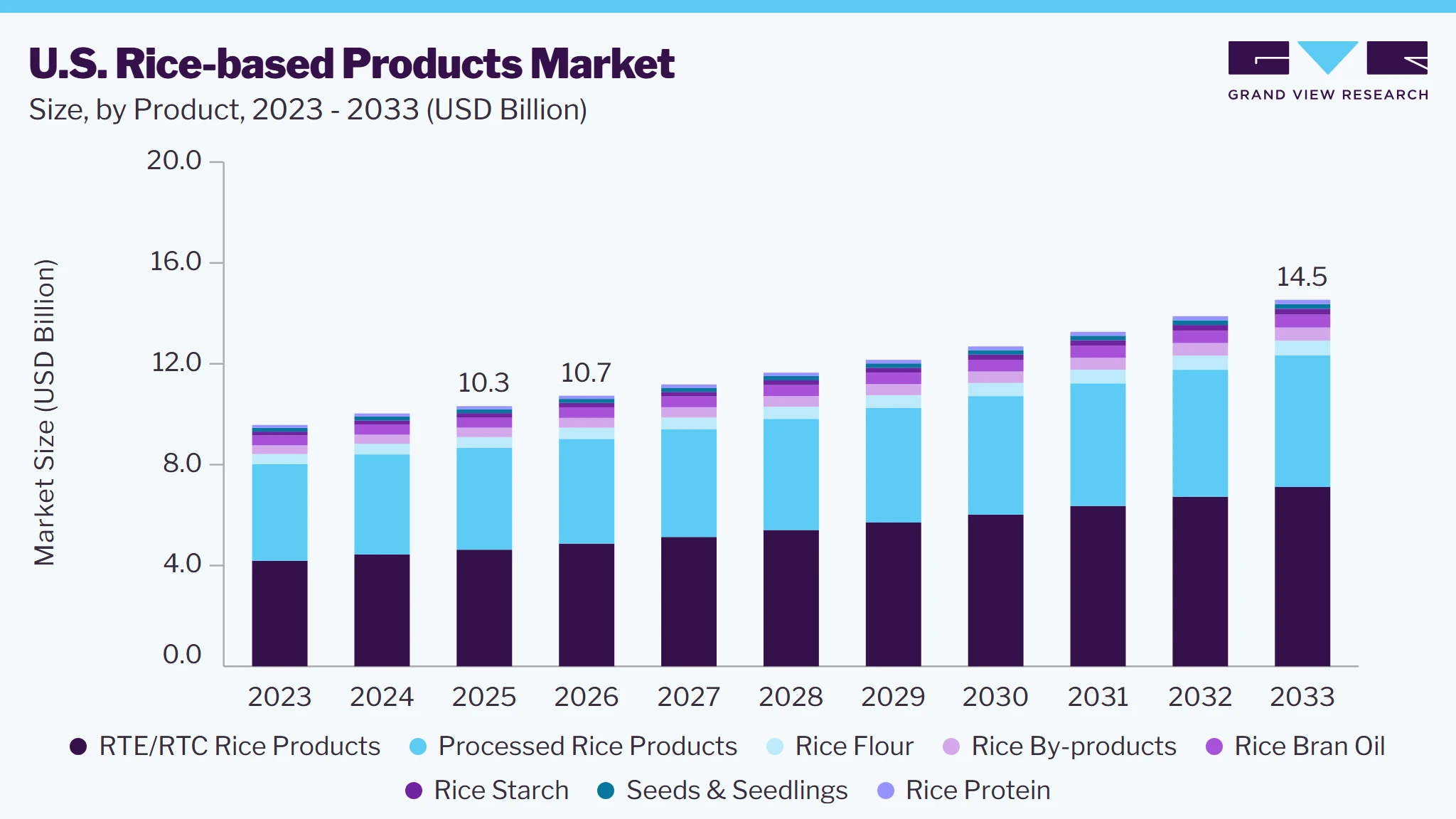 Source: Grand View Research, IR Documents, Primary Interviews, Paid DatabasesTo learn more about this report,
 Download Free Sample Report
Product innovation is a key trend shaping the market, with manufacturers expanding their portfolios to include flavored rice, microwaveable meals, frozen rice bowls, and combinations featuring vegetables, legumes, and protein ingredients. Increasing consumer attention to ingredient transparency and nutritional composition is also creating opportunities for clean-label products. Furthermore, advancements in food processing and packaging technologies are helping manufacturers improve product shelf life, maintain quality, and simplify preparation. The expansion of online grocery platforms is complementing traditional retail distribution by improving product accessibility and offering consumers greater purchasing flexibility. In January 2026, Tate’s Bake Shop introduced two new U.S. gluten-free cookie varieties made with rice flour, including double chocolate chip and oatmeal raisin, with both products becoming available through U.S. retailers.
Consumer Insights
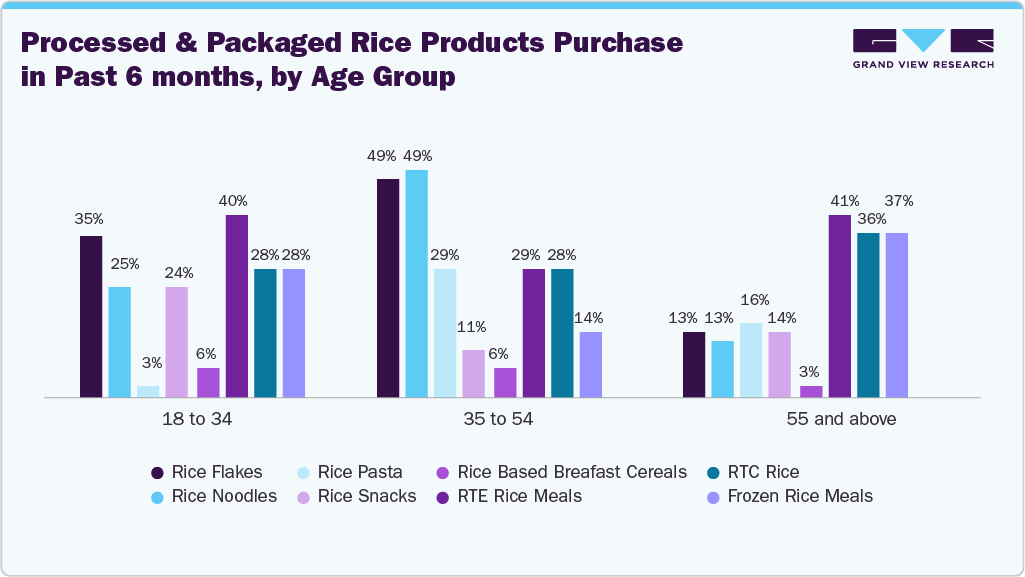
Processed and packaged rice products are increasingly influenced by convenience, taste, nutrition, quality, and health-oriented preferences. Approximately 60% of households consume processed rice products at least once a week, indicating established repeat usage. Consumer preferences also vary by age: younger consumers show stronger preference for RTE meals and rice snacks, while the 35-54 age group demonstrates higher adoption across products such as rice flakes and rice noodles.
 To learn more about this report, Download Free Sample Report
Processed & Packaged Rice Products Purchase in Past 6 months, by Age Group
Source: Consumer Survey By GVR
Health and wellness are becoming important differentiators:
-
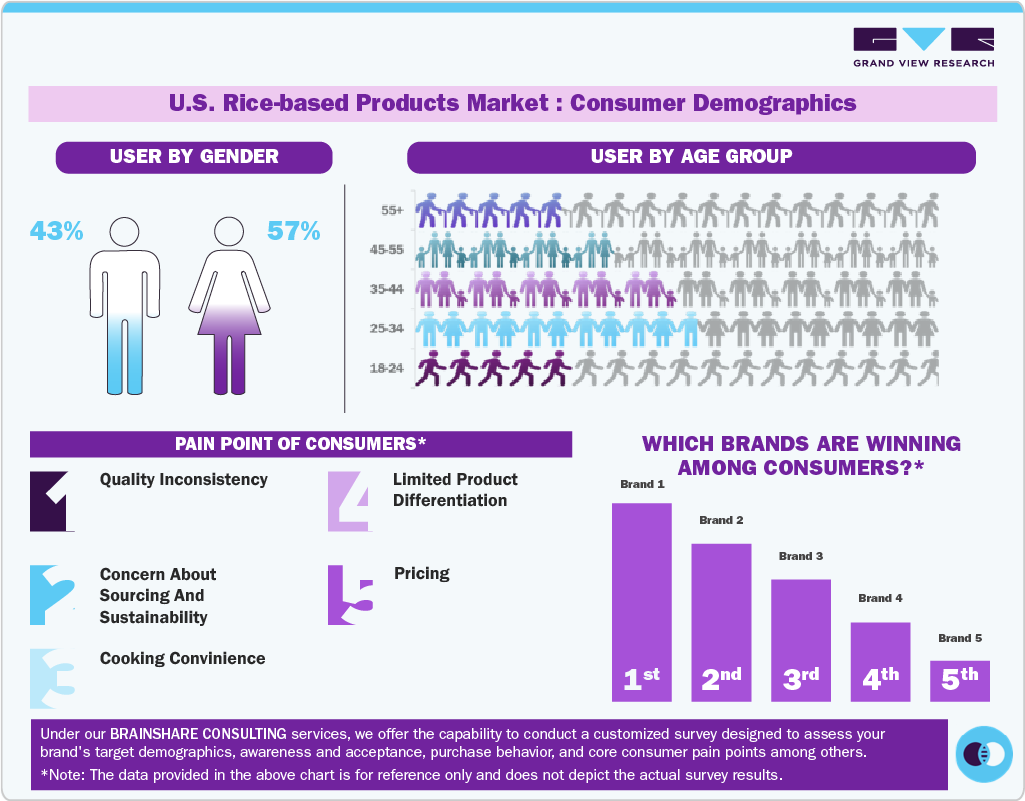
90% consider health and wellness goals important when purchasing rice-based products.
-
87% prefer processed rice products with added nutritional benefits.
-
86% value healthy ingredients.
-
85% consider clean-label attributes important.
 To learn more about this report, Download Free Sample Report
Taste, quality, nutrition, and ingredients are among the strongest purchase considerations, indicating that convenience must be supported by product quality and nutritional value. Supermarkets dominate purchasing, accounting for 96%, while online channels currently represent 4% but offer scope for future expansion through greater digital adoption and delivery convenience.
Market Dynamics
Busy households are steadily trading raw rice for ready-to-eat and heat-and-serve formats, and major processors are investing accordingly. Riviana Foods, one of the top rice companies, reported that its U.S. sales of ready-to-serve rice products spanning cup and pouch formats were the fastest-growing business in its segment in 2023, up nearly 19% in volume, with that pace continuing into 2024. To keep up with this shift, the company completed a USD 80.6 million investment in April 2024 that doubled capacity to produce Minute ready-to-serve rice cups at its Memphis, Tennessee, plant.
Rice is also gaining traction as a versatile ingredient in new food and beverage applications, expanding its role beyond traditional table rice. In 2025, USA Rice highlighted the growing use of rice and rice flour in products such as energy bars, snacks, craft beverages, and spirits, where they can contribute to flavor, texture, and nutritional characteristics. The industry’s focus on these applications is creating additional opportunities for processors to develop differentiated rice-based products and reach new consumption occasions. This diversification supports broader demand for rice as a functional and value-added ingredient.
Tariff uncertainty is emerging as one of the main concerns for the U.S. rice-based products market because changes in import duties can alter the competitiveness and availability of rice from major supplying countries. In 2025, the U.S. introduced a 10% baseline tariff on imports, with higher country-specific reciprocal tariffs potentially applying to trading partners. For rice, such measures can increase import costs, disrupt established sourcing relationships, and create uncertainty for processors and food manufacturers that rely on imported varieties, particularly aromatic rice.
In the US, tariffs on Jasmine rice rose from 1% to 19%, and on Basmati rice from 1% to 50%, resulting in a net impact of USD 10 million. Recent negotiations lowered the Basmati rice tariff to 25%, with a possible further cut to 18% now being discussed.
Tariff-related trade restrictions can also affect the competitiveness of U.S. rice in international markets. Retaliatory tariffs imposed by trading partners can make U.S.-grown rice more expensive for overseas buyers, potentially reducing export demand and creating uncertainty for farmers and processors. For instance, Canada imposed a 25% retaliatory tariff on U.S. rice in 2025, which was later eliminated, but USA Rice stated that it had created significant market-access challenges. Similarly, tariff measures in other export destinations can disrupt established trade flows and limit opportunities for U.S. rice and value-added rice products.
The increasing adoption of rice-derived ingredients presents growth opportunities in the U.S. rice-based products market. Ingredients such as rice bran oil, rice protein, rice flour, rice starch, and rice fiber are utilized across food, beverage, nutritional, and personal care formulations. Their functional attributes, including thickening, texture modification, and suitability for gluten-free applications, support their use in diverse product categories. Furthermore, the presence of bioactive compounds in rice bran creates opportunities for ingredient development in functional foods and nutraceuticals, subject to further research and application-specific validation. Investments in extraction technologies, ingredient processing, and formulation capabilities can enable manufacturers to improve resource utilization and expand their value-added product portfolios.
Demand for plant-based, gluten-free, and clean-label formulations also creates opportunities for rice-based product manufacturers. Companies can expand their offerings across protein ingredients, breakfast cereals, snack foods, bakery products, and specialized starch applications to address evolving requirements from food manufacturers and consumers. Collaboration among ingredient processors, food manufacturers, and technology providers can facilitate product innovation, improve commercialization capabilities, and strengthen the market position of value-added rice-based products.
Analyst Perspective
The market is supported by increasing demand for convenient food formats, including ready-to-eat (RTE) meals, ready-to-cook (RTC) products, and rice-based snacks. Changing lifestyles and consumer interest in gluten-free options, diverse flavor profiles, and simplified meal preparation are encouraging manufacturers to diversify their offerings. Product development focused on nutritional fortification, portion-specific packaging, and premium formulations is creating avenues for market differentiation. The expansion of e-commerce and organized retail is further strengthening product accessibility. However, volatility in raw material prices, competition from alternative grain-based products, and consumer price sensitivity may constrain market performance. Companies prioritizing product innovation, competitive pricing, nutritional value, and distribution efficiency are better positioned to capitalize on evolving consumption patterns and sustain their competitive position.
Product Insights
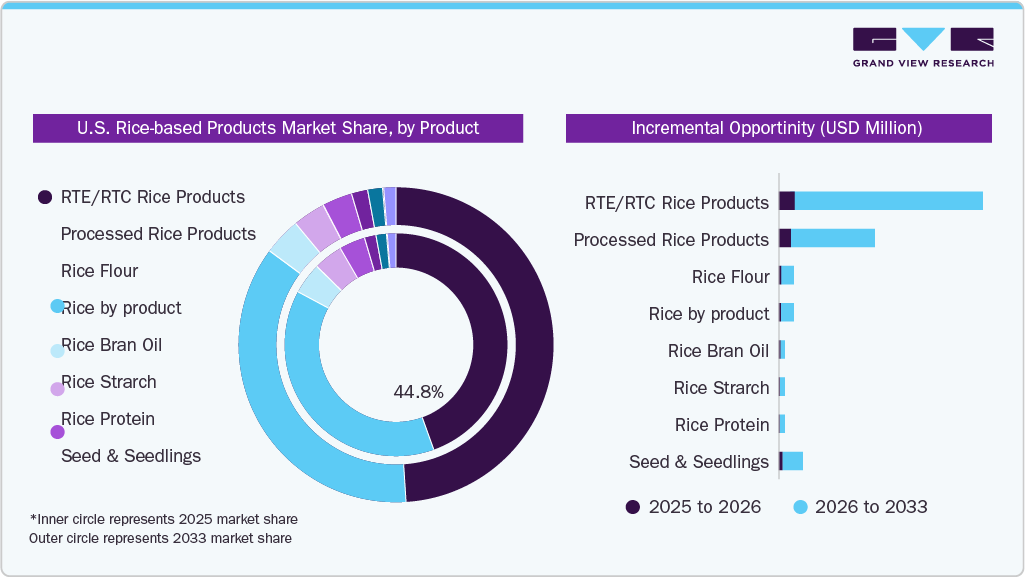
- The RTE/RTC rice products segment dominated the U.S. rice-based products industry, accounting for a revenue share of 44.8% of the revenue in 2025. The U.S. ready-to-eat (RTE) and ready-to-cook (RTC) rice-based products market is benefiting from growing consumer demand for convenient meal solutions, shorter preparation times, and diverse flavor options. Manufacturers are expanding their product portfolios to include microwaveable rice meals, frozen rice bowls, boil-in-bag rice, and seasoned rice mixes to cater to evolving consumption preferences. For instance, in June 2026, Conagra Brands introduced P.F. Chang’s Home Menu Korean BBQ Style Bowl in the U.S., combining rice, chicken, vegetables, and Korean BBQ sauce into a convenient frozen meal. Similarly, in April 2026, Riviana Foods introduced Success Boil-in-Bag Sticky Rice, expanding its RTC rice portfolio. These developments highlight opportunities for manufacturers to differentiate their offerings through globally inspired flavors, convenient packaging, portion-controlled servings, and versatile preparation formats across U.S. retail channels.
 To learn more about this report, Download Free Sample Report
The rice protein segment is projected to grow at a significant CAGR of 4.3% from 2026 to 2033. Rice protein has established applications in the nutrition and food-ingredient space, particularly in products that require a concentrated rice-derived protein source. NOW Foods currently sells sports sprouted brown rice protein powder, made from brown rice protein concentrate, and providing 80% protein. The company positions it for mixing into beverages and smoothies and lists it specifically under its rice protein category. Another product development is NOW Sports barley rice protein powder, which uses an upcycling process and provides 10 g of protein per serving. These products demonstrate that rice protein already has a defined commercial presence in the U.S., particularly in protein powders and convenient nutrition formats, with manufacturers differentiating products through protein concentration, processing method, and sourcing characteristics.
Distribution Channel Insights
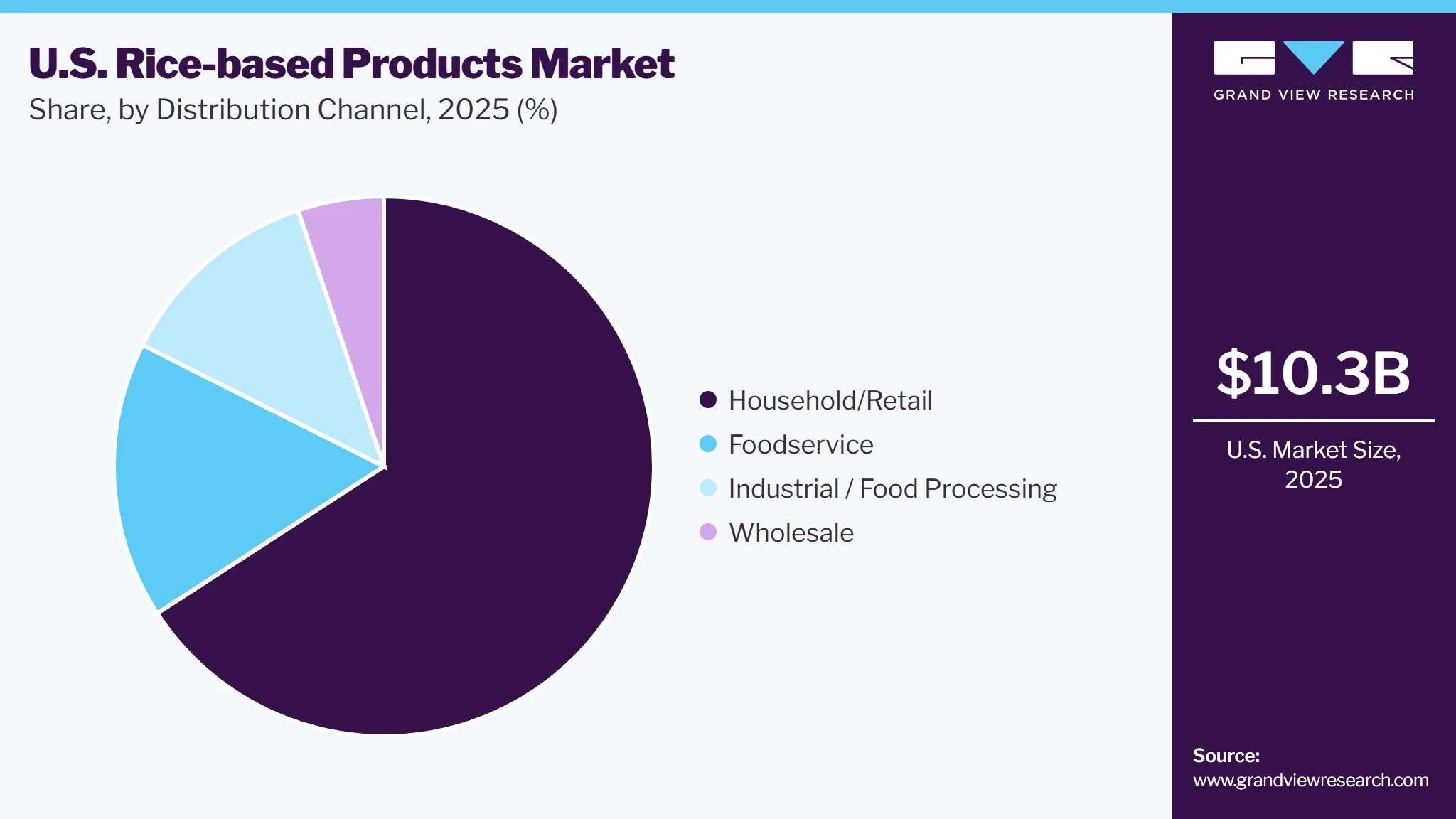
The sales of rice-based products in the U.S. through household/retail accounts for the largest share of 65.8% of the revenue in 2025. Household and retail distribution is an important channel for the U.S. rice-based products market, as it provides consumers with direct access to a wide range of products for everyday consumption. The channel covers hypermarkets & supermarkets, grocery stores, convenience stores, online platforms, and other retail outlets. Product availability varies across these formats, with offerings ranging from conventional white and brown rice to specialty varieties, organic products, flavored rice, and convenient prepared formats. Retailers also provide manufacturers with a broad consumer reach and opportunities to differentiate products through branding, packaging, pricing, assortment, and private-label offerings, supporting continued penetration across diverse household consumption needs.
 To learn more about this report, Download Free Sample Report
The foodservice channels segment of the U.S. rice-based products industry is projected to grow at a significant CAGR of 4.2% from 2026 to 2033. The growth is expected to be driven by increasing demand for convenient meal preparation, consistent food quality, and operational efficiency across restaurants, quick-service restaurants (QSRs), catering services, and institutional foodservice establishments. Ready-to-eat (RTE) and ready-to-cook (RTC) rice-based products help foodservice operators reduce preparation time, streamline kitchen operations, and maintain consistency across servings. Furthermore, the growing availability of frozen rice meals, pre-cooked rice, and flavored rice products is creating opportunities for suppliers to cater to diverse menu requirements. These factors are expected to support the adoption of rice-based products across foodservice establishments during the forecast period.
Regional Insights
The West region dominated the U.S. rice-based products market, accounting for a revenue share of 25.5% in 2025. The market growth is driven by established rice production in California and demand across household and foodservice applications. This can be attributed to consumer demand for convenient meal solutions, growing interest in diverse cuisines, and the availability of rice-based products across established retail channels. The region’s multicultural consumer base supports demand for products such as ready-to-eat (RTE) rice meals, ready-to-cook (RTC) rice products, and flavored rice varieties. Furthermore, the expansion of online grocery platforms and the availability of convenient packaged food options are supporting regional market demand. In July 2026, SunRice launched Protein+ in the U.S., a ready-to-heat rice product containing at least 10 grams of protein per serving and offered in Jasmine and Brown Jasmine varieties. The company stated that the product was initially being introduced across the Western United States, giving the broader Southwest region another convenient rice format with added protein.
According to the U.S. Census Bureau, Asian residents represented 4.2% of North Carolina’s population, which can support demand for rice-based foods associated with Asian cuisines. The procurement provides an indication of institutional purchasing for a traditional rice variety in the region.
The Southeast region of the U.S. rice-based products industry is expected to grow at the fastest CAGR of 5.0% from 2026 to 2033. The growth is driven by established rice production in states such as Arkansas, Louisiana, Mississippi, and Texas, which are major contributors to the U.S. supply of rice-based products. Growth is supported by increasing demand for convenient meal options, changing food consumption patterns, and the region’s established preference for rice-based dishes. Rising interest in ready-to-eat (RTE) and ready-to-cook (RTC) rice products is expected to support market expansion as consumers seek time-saving meal solutions. Furthermore, broader availability of packaged rice-based meals through supermarkets, convenience stores, and online grocery platforms is improving consumer access. These factors are expected to contribute to the region’s growth over the forecast period.
Key U.S. Rice-based Products Company Insights
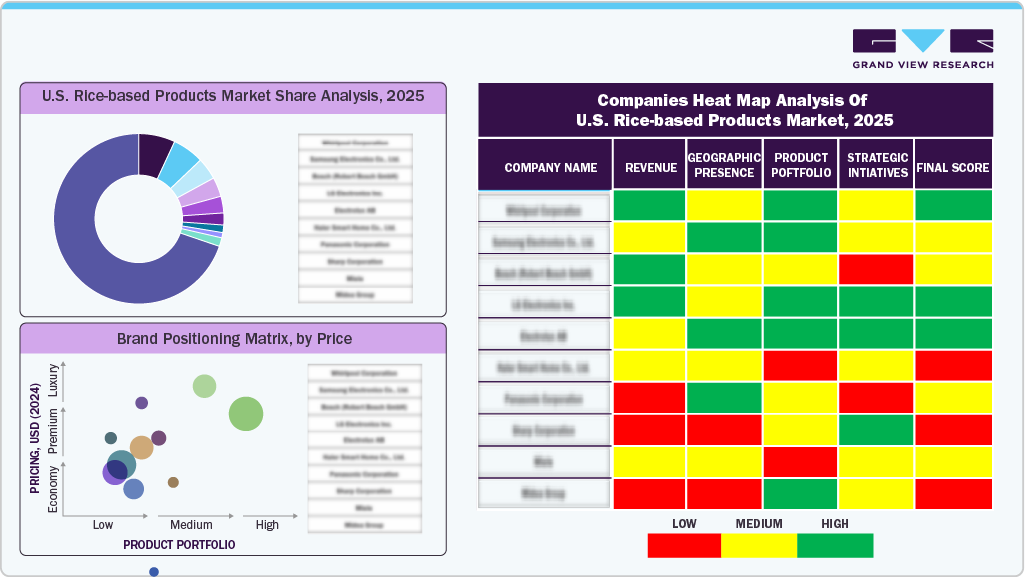
The U.S. rice-based products industry is experiencing increasing competition as established companies and emerging brands expand their product portfolios. The market remains fragmented across product categories, with opportunities for companies to strengthen their share through innovation and geographic expansion.
 To learn more about this report, Download Free Sample Report
Key U.S. Rice-based Products Companies
-
Lundberg Family Farms
-
ADM
-
SWAD
-
Delice Global Inc.
-
Kellanova
-
The Quaker Oats
-
Grainwell Puffed Grains
-
Element Snacks
-
CJ CheilJedang Corporation
Competitive Benchmarking
Category
Operating Strategies
Competitive Edge
Weakness
Established Players (Lundberg Family Farms; ADM; SWAD; Delice Global Inc. Kellanova; The Quaker Oats)
- Focus on expanding rice-based product portfolios, strengthening retail distribution, investing in product innovation, and leveraging established brands across multiple food categories.
- Strong brand recognition, extensive distribution networks, established retail relationships, and capabilities in product development and large-scale manufacturing.
- High operating costs, exposure to raw material price fluctuations, and the need for continuous product innovation to respond to changing consumer preferences.
Emerging Players (Grainwell Puffed Grains; Element Snacks; CJ CheilJedang Corporation)
- Emphasize specialty rice products, organic offerings, innovative rice-based meals and snacks, and differentiated formulations targeting specific dietary preferences.
- Product specialization, differentiated ingredients, niche consumer targeting, and flexibility in responding to emerging food trends.
- Limited distribution reach compared with established brands, lower economies of scale, higher production costs for specialized products, and challenges in expanding retail penetration.
Recent Developments
-
In June 2026, Like Air expanded into the fast-growing Rice cakes category with its new Drizzled Rice Cakes, available in four sweet flavors that are gluten-free, non-GMO, and just 80 calories per serving. The new product line will launch in 6,000 stores across the U.S. this summer, as the brand aims to capitalize on rising demand for better-for-you snacks in the rapidly growing rice cakes segment.
-
In April 2026, The Quaker Oats launched Protein Rice Crisps, a gluten-free, popped (never fried) snack made with rice and pea protein, delivering 6g of protein and 9g of whole grains per serving in Chocolate Caramel and Tangy Barbecue flavors. The launch expands PepsiCo's functional snack portfolio to meet growing consumer demand for protein-rich, better-for-you snacks.
-
In January 2026, Post Consumer Brands relaunched Cinnamon Pebbles nationwide in the U.S., bringing back a flavor like its Cinna-Crunch Pebbles cereal introduced in 1999. The cereal features crispy rice flakes baked with bold cinnamon and smooth vanilla notes and was initially available at select retailers in December 2025 before its nationwide release.
-
In March 2025, Lotus Foods introduced its Organic Wide White Rice Ramen, featuring extra-wide, never-fried noodles made exclusively from organic white rice. Naturally gluten-free and clean-label, the product was unveiled at Expo West 2025, earned recognition as a NEXTY Award finalist, and offers a healthier, more versatile option than traditional wheat-based ramen.
U.S. Rice-based Products Market Report Scope
Report Attribute
Details
Market size in 2025
USD 10.3 billion
Estimated market size in 2026
USD 10.7 billion
Projected market size by 2033
USD 14.5 billion
Growth rate
CAGR of 4.4% from 2026 to 2033
Actuals
2021 - 2025
Forecast period
2026 - 2033
Quantitative units
Revenue in USD million/billion and CAGR from 2026 to 2033
Report coverage
Revenue forecast, company ranking, competitive landscape, growth factors, and trends
Segments covered
Product, distribution channel, and region
Country scope
U.S.
Key companies profiled
Lundberg Family Farms; ADM; SWAD; Delice Global Inc.; Kellanova; The Quaker Oats; Grainwell Puffed Grains; Element Snacks; CJ CheilJedang Corporation.
Customization scope
Free report customization (equivalent up to 8 analysts’ working days) with purchase. Addition or alteration to country, regional & segment scope.
Pricing and purchase options
Avail customized purchase options to meet your exact research needs. Explore purchase options
U.S. Rice-based Products Market Report Segmentation
This report forecasts revenue & volume growth at the country level and provides an analysis of the latest industry trends and opportunities in each of the sub-segments from 2021 to 2033. For this study, Grand View Research has segmented the U.S. rice-based products market report based on product, distribution channel, and region:
-
Product Outlook (Volume, Kilo Tons; Revenue, USD Million/Billion, 2021 - 2033)
-
Processed Rice Products
-
Traditional Rice Products
-
Rice Flakes
-
Puffed Rice
-
-
Packaged Processed Products
-
Rice Noodles
-
Rice Pasta
-
Rice Cakes
-
Rice Snacks
-
Rice-based Breakfast Cereals
-
Other Packaged Processed Products
-
-
Sweeteners & Syrups
-
Brown Rice Syrup
-
Rice Maltodextrin
-
Rice Glucose
-
-
-
Rice Flour
-
Rice Starch
-
Rice Protein
-
Rice Bran Oil
-
Seeds & Seedlings
-
Rice By-products
-
RTE/RTC Rice Products
-
RTE Rice Meals
-
RTC Rice
-
Frozen Rice Meals
-
-
-
Distribution Channel Outlook (Volume, Kilo Tons; Revenue, USD Million/Billion, 2021 - 2033)
-
Industrial / Food Processing
-
Wholesale
-
Foodservice
-
Household/Retail
-
Hypermarkets & Supermarkets
-
Convenience Stores
-
Traditional Grocery Stores
-
Online
-
Amazon
-
Walmart
-
Other Online Channels
-
-
Other Household/Retail Channels
-
-
-
Regional Outlook (Volume, Kilo Tons; Revenue, USD Million/Billion, 2021 - 2033)
-
Northeast
-
Southeast
-
Southwest
-
West
-
Midwest
-
Research Methodology
The U.S. rice-based products market figures in this report are based on a proven research process that combines executive interviews with secondary research from proprietary databases, company filings, and recognized regulatory and institutional sources. Market size is built through value-chain sizing-reconciling supply-side and demand-side estimates-and triangulated with bottom-up and top-down approaches. Every estimate passes multiple levels of expert validation before publication, with each U.S. rice-based products segment quantified using the revenue-capture definitions in the table below.
Segment Definition
Product
Revenue capture definition
Processed Rice Products
This segment includes the sales of processed rice products, such as traditional rice products, packaged processed products, and others.
Rice Flour
This segment includes the sales of rice flours.
Rice Starch
This segment includes the sales of rice starch.
Rice Protein
This segment includes the sales of rice protein.
Rice Bran Oil
This segment includes the sales of rice bran oil.
Seeds & Seedlings
This segment includes the sales of seeds & seedlings.
Rice By-products
This segment includes the sales of rice by-products.
RTE/RTC Rice Products
This segment includes the sales of RTE/RTC rice products.
Estimation Model
Layer Name
Key Question
Description
Consumption Demand Layer
Who consumes rice-based products
Demand is driven by convenience, affordability, dietary preferences, and demand for RTE meals, RTC products, rice snacks, and gluten-free alternatives.
Market Reach Layer
Where are rice-based products distributed?
Products reach consumers through supermarkets, convenience stores, online platforms, specialty retailers, and foodservice channels.
Quality & Differentiation Layer
How can rice-based products be differentiated?
Differentiation is driven by flavors, nutritional value, ingredient quality, gluten-free formulations, packaging, and preparation convenience.
Value Generation Layer
How is value generated from rice-based products?
Value is generated through efficient sourcing, processing, product innovation, premium offerings, branding, and supply chain optimization.
Delivered Customizations
This report has been delivered with the following In-depth customizations
Client Request
Customization Delivered
Value Adds
Assess consumer demand and purchasing behavior in the rice-based products market
Evaluated consumer preferences for RTE meals, RTC products, rice snacks, pricing, convenience, and purchasing channels.
Identifies key consumer segments, purchase drivers, and demand opportunities.
Evaluate the competitive positioning of rice-based product companies
Assessed competitors based on product portfolios, innovation, pricing, distribution channels, brand positioning, and market presence.
Supports competitive benchmarking and identifies opportunities for differentiation and market expansion.
Identify emerging opportunities and product differentiation in the rice-based products market
Analyzed trends in gluten-free products, fortified rice products, convenient meal solutions, innovative flavors, and premium offerings.
Identifies opportunities for product innovation, portfolio diversification, and premium positioning.
About the Author(s)
Consumer F&B Research Team
Consumer Goods · Consumer F&BThis report was authored by the consumer f&b research team at Grand View Research - comprising two research analysts, one senior research analyst, and one industry expert - with specialized expertise in the consumer f&b segment of the consumer goods industry. All findings are based on proprietary consumer goods databases, executive interviews, and regulatory analysis, subject to internal peer review prior to publication.
Last Updated:
Speak to Analyst

Customize this report to your needs - add regions, segments, or data points, with 20% free customization.
Or view our licence options:


ISO 9001:2015 & 27001:2022 Certified
We are GDPR and CCPA compliant! Your transaction & personal information is safe and secure. For more details, please read our privacy policy.


