
- Home
- »
- Consumer F&B
- »
-
U.S. Rice Market Size, Share & Growth Report, 2026-2033GVR Report cover

U.S. Rice Market (2026 - 2033)
Size, Share & Trends Analysis Report By Type (Long Grain, Medium Grain), By Distribution Channel (Foodservice, Wholesale), By Region (Northeast, Southeast, Southwest) And Segment Forecasts
Market Size, 2025
$9.4BMarket Estimate, 2026
$9.7BMarket Forecast, 2033
$12.3BCAGR, 2026–2033
3.4%U.S. Rice Market Report Summary
The U.S. rice market size was valued at USD 9.4 billion in 2025 and is projected to grow from USD 9.7 billion in 2026 to USD 12.3 billion by 2033, at a CAGR of 3.4% from 2026 to 2033. Western U.S. dominated the market, accounting for a revenue share of 25.4% in 2025. U.S. is well-positioned due to strong household consumption, established retail and foodservice demand, and rice's role across diverse cuisines.
Key Market Trends & Insights
- By type: Long grain rice held the largest market share of 43.2% in 2025.
- By distribution channel: Household/retail held the largest market share of 66.3% in 2025.
Regional Highlights
- Largest regional market: Western U.S. (25.4% revenue share, 2025)
- Fastest-growing regional market: Southeast U.S. (highest CAGR, 2026-2033)
Key Market Trends & Insights
- Market Size in 2025: USD 9.4 Billion
- Estimated market size in 2026: USD 9.7 Billion
- Projected Market Size by 2033: USD 12.3 Billion
- CAGR (2026-2033): 3.4%
Three ways to get this report
Buy it, customize it, or ask a question.Ask an Analyst
Analyst response in 1 business day
- AccessReport author, directly
- Reply timeWithin 1 working day
- No sales callDirect answer only
- FormatEmail reply
- CostFree, no cost
Get the Full Report
What the study covers
- FormatsPDF · Excel · Dashboard
- Timeline2026–2033 annual, 2025 base
- Coverage20+ countries, 5 regions
- Companies10+ key players profiled
Customize the Report
20% free customization
- IncludeCountries, segments, points
- TailorTo your product definition
- ExtendDeeper competitor detail
- OrA fully bespoke study
- Turnaround5–10 working days
Within the segment, demand is increasingly shifting toward aromatic and specialty varieties, particularly jasmine, basmati, sushi/Japonica, and other differentiated rice. More than 60% of U.S. rice imports comprise aromatic varieties, indicating strong domestic demand for varieties that are not fully substituted by U.S. production. The U.S. rice industry produces approximately 20 billion pounds of rice annually across 2.8 million acres, with 5,563 rice farmers operating primarily through family-owned farms. Production is concentrated in six major rice-producing states, Arkansas, California, Louisiana, Mississippi, Missouri, and Texas, and is largely centered in four regions: the Arkansas Grand Prairie, Mississippi Delta, Gulf Coast, and Sacramento Valley of California. The Southern states primarily produce long-grain rice, while California specializes predominantly in medium- and short-grain varieties.
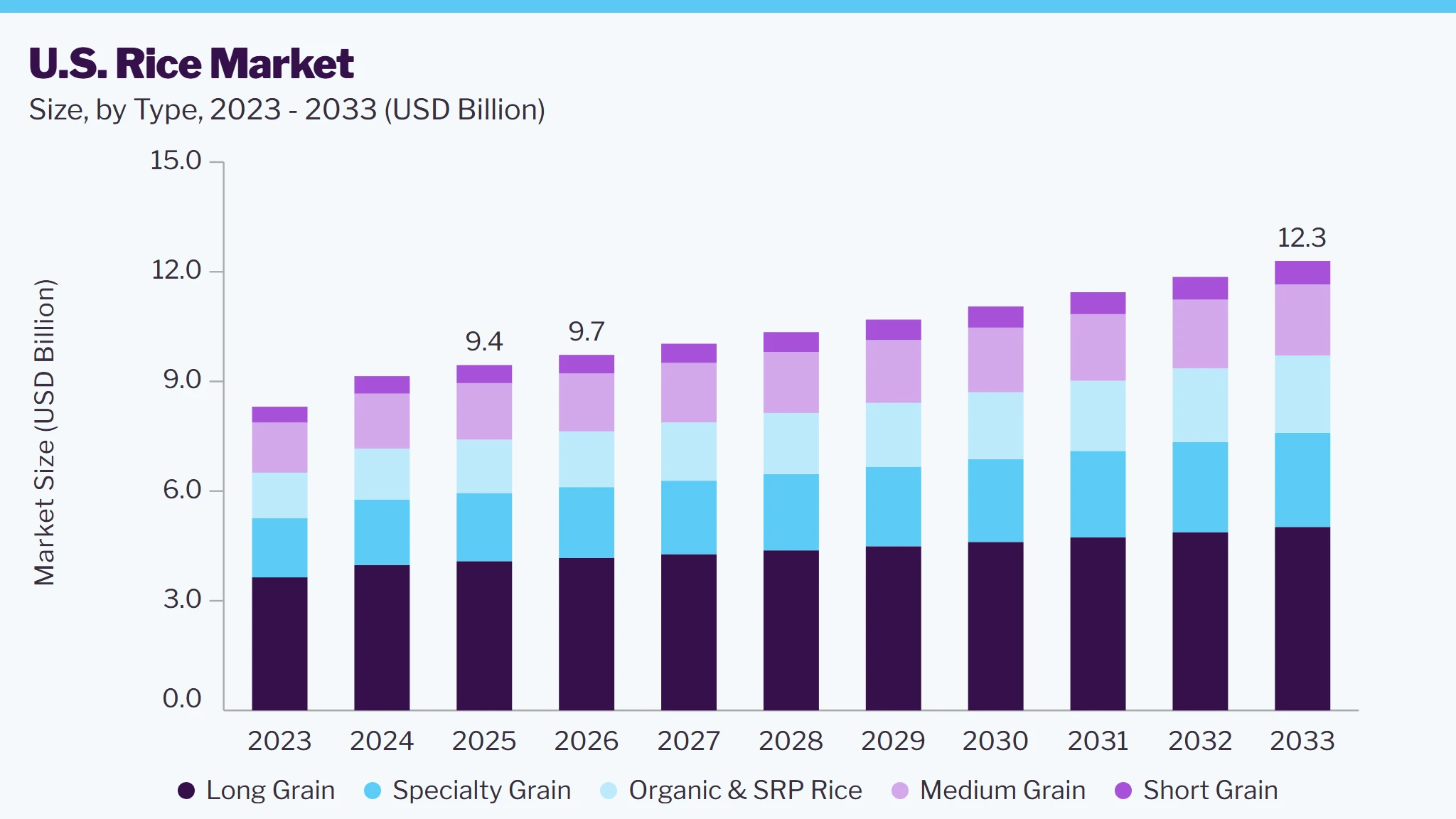 Source: Grand View Research, IR Documents, Primary Interviews, Paid DatabasesTo learn more about this report,
 Download Free Sample Report
 The rice segment includes long-grain, medium-grain, short-grain, specialty-grain, and organic & SRP rice, each serving different consumer and business needs. Long grain rice is widely preferred for its versatility and firm texture, while medium and short grain varieties are used in dishes where a softer or stickier texture is desired. Specialty grains, such as aromatic and colored rice, are gaining attention among consumers seeking greater variety and distinctive culinary experiences. Organic and SRP rice are also becoming more relevant as consumers and retailers place greater emphasis on sustainable farming, responsible sourcing, and product quality.
The rice is seeing greater interest in aromatic varieties, as well as broader use of rice in global cuisines and everyday household and foodservice meals. USDA reports that more than 60% of U.S. rice imports are aromatic varieties, mainly jasmine from Thailand and basmati from India and Pakistan, with imports expected to continue increasing. In 2026, U.S. Rice reported that jasmine rice was one of the fastest-growing rice varieties in the domestic market; 85% of U.S. consumers were aware of jasmine rice, while restaurant-menu mentions increased 24% over the previous year.
At the same time, supply conditions are influencing the raw rice market. Foodservice operators are also expanding rice into new meal occasions and menu formats. In 2025, USA Rice’s Rice & Shine K-12 contest featured breakfast applications such as Breakfast Baked Rice, Rice Pudding Parfait, and Breakfast Fried Rice, while Fuzzy’s Taco Shop promoted U.S.-grown rice through burritos and rice bowls across its restaurant network. These trends are strengthening demand for differentiated dry-rice offerings, particularly aromatic and long-grain varieties, while the continued use of rice across household meals, restaurants, and globally inspired cuisines supports consumption across multiple applications.
Market Dynamics
Rice consumption in the U.S. is closely tied to demographic shifts, and this connection is becoming more pronounced each year. USDA's own economic research has documented that non-Hispanic Asians may have slightly higher-quality diets on average than other racial and ethnic groups, and racial and ethnic diversification brought about by immigration is expected to shape U.S. food demand going forward. Academic analysis using national health survey data reinforces this, finding that nonwhite individuals, mostly of Asian, Black, and Hispanic origin, account for most of the rice consumed in the U.S., and food acculturation patterns mean immigrant populations tend to consume more rice than their U.S.-born counterparts.
 To learn more about this report, Download Free Sample Report
 The scale of this shift is well documented by the Census Bureau. USDA researchers note that individuals of Hispanic origin are projected to grow from 19% to 29% of the total U.S. population between 2020 and 2060, while the non-Hispanic Asian population is expected to rise from 6% to 9% over the same period. Because these groups already consume rice at disproportionately high rates, this demographic trajectory points toward structurally higher rice demand over the next several decades, independent of any pricing or marketing effort by industry players.
Tariff uncertainty is emerging as one of the main concerns for the U.S. rice market because changes in import duties can alter the competitiveness and availability of rice from major supplying countries. In 2025, the U.S. introduced a 10% baseline tariff on imports, with higher country-specific reciprocal tariffs potentially applying to trading partners. For rice, such measures can increase import costs, disrupt established sourcing relationships, and create uncertainty for processors and food manufacturers that rely on imported varieties, particularly aromatic rice.
In the US, tariffs on Jasmine rice rose from 1% to 19%, and on Basmati rice from 1% to 50%, resulting in a net impact of USD 10 million. Recent negotiations lowered the Basmati rice tariff to 25%, with a possible further cut to 18% now being discussed.
Source: Ebro Foods, S.A.
Tariff-related trade restrictions can also affect the competitiveness of U.S. rice in international markets. Retaliatory tariffs imposed by trading partners can make U.S.-grown rice more expensive for overseas buyers, potentially reducing export demand and creating uncertainty for farmers and processors. For instance, Canada imposed a 25% retaliatory tariff on U.S. rice in 2025, which was later eliminated, but USA Rice stated that it had created significant market-access challenges. Similarly, tariff measures in other export destinations can disrupt established trade flows and limit opportunities for U.S. rice and value-added rice products.
The U.S. raw rice market has an opportunity to capture greater value through the production and commercialization of specialty, premium, and differentiated rice varieties. Growing consumer and industry interest in attributes such as nutritional quality, grain characteristics, origin, cultivation practices, and processing quality can support greater differentiation within the raw rice segment. Rice producers and processors can focus on improving grain quality, developing specialty varieties, and strengthening traceability and sourcing practices to enhance the value of raw rice. Such initiatives can help U.S. rice producers move beyond commodity-based competition, achieve better price realization, and respond to evolving demand for higher-quality and differentiated rice products.
Although new cancer drug therapies have advanced, more research is needed to understand the anticancer effects of natural compounds in rice and other grains. Rice contains secondary metabolites like phytoalexins and polyphenols, which show anti-cancer properties and are mostly found in the bran layer.
Source: USDA
Analyst Perspective
The U.S. rice market is expected to experience stable growth, supported by consistent household consumption, demand from foodservice operators, and the expanding availability of specialty rice varieties. Long-grain rice is likely to maintain a prominent market position due to its versatility across everyday meals and diverse culinary applications. Meanwhile, organic and sustainably produced rice offers market participants opportunities to meet evolving consumer preferences for responsible sourcing and environmentally conscious food production. Regional dynamics will remain important, with established production infrastructure supporting supply availability and distribution efficiency. The Southeast is projected to record the fastest growth, creating opportunities for producers, processors, and distributors to strengthen their regional presence.
Consumer Insights
Consumer preferences for rice are increasingly shaped by variety, health, quality, transparency, and sustainability, while Jasmine and Basmati remain the leading preferred varieties. Preference extends beyond traditional rice-consuming groups, indicating broader mainstream acceptance of specialty and aromatic rice varieties. For instance, Jasmine is preferred by 69% of White/Caucasian consumers and 56% of Mixed/Other consumers, while Basmati is preferred by 68% in both groups.
 To learn more about this report, Download Free Sample Report
 Key attributes influencing consumer choice include:
-
89% consider sustainable packaging important or very important.
-
88% prioritize whole grain and clean-label attributes.
-
87% consider organic attributes important.
-
86% value high-protein characteristics, while 82% consider low sodium important.
Rice type preferences by ethnicity in the U.S.
Rice Type
Asian American
Black/African American
Hispanic/Latino
White/Caucasian
Mixed/Other
Jasmine Rice
37%
37%
34%
69%
56%
Basmati Rice
34%
33%
44%
68%
68%
Wild Rice
7%
12%
1%
28%
24%
Black Rice
5%
2%
1%
7%
8%
Red Rice
2%
0%
6%
3%
4%
Arborio
7%
27%
4%
30%
12%
Carnaroli
27%
0%
0%
19%
8%
Vialone Nano
2%
2%
2%
15%
0%
Valencia
11%
10%
7%
19%
12%
Calrose
4%
15%
2%
18%
12%
Sushi Rice
5%
22%
4%
23%
12%
Glutinous Rice
12%
28%
1%
14%
20%
Bomba Rice
22%
0%
5%
5%
4%
Source: Consumer Survey By GVR
From a business perspective, these trends create opportunities for premium varieties, organic and whole-grain products, clean-label positioning, and sustainable packaging. Quality and consistency, taste and aroma, grain size, and rice variety remain important purchase considerations, making product performance and differentiation critical for brand positioning.
 To learn more about this report, Download Free Sample Report
 Type Insights
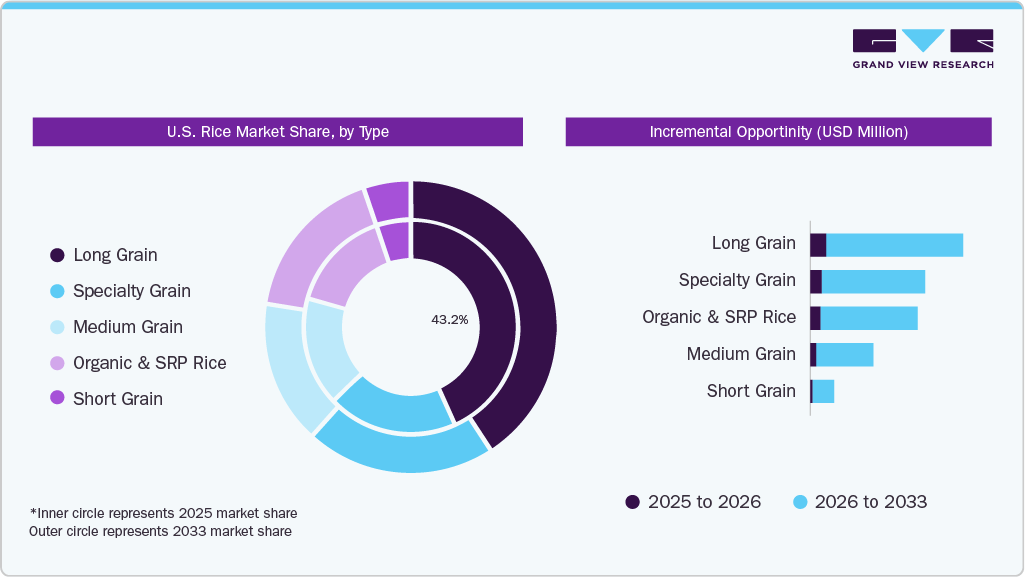
The long grain rice segment in the U.S. accounted for the largest revenue share of 43.2% in 2025. The growth is driven by its widespread use across household consumption, foodservice, and packaged food applications. Long grain rice is preferred for its slender shape, fluffy texture, and ability to remain separate after cooking, making it suitable for everyday meals, rice bowls, pilafs, and various international cuisines. Its availability across supermarkets, hypermarkets, and online retail channels further supports consumer accessibility. Additionally, established domestic rice production and distribution networks contribute to consistent product availability, reinforcing the segment's prominent position in the U.S. rice market.
 To learn more about this report, Download Free Sample Report
 Long-grain rice makes up about 75 percent of U.S. rice production. Medium-grain rice accounts for around 24 percent, while short-grain rice makes up the remaining 1 percent.
Source: USDA, 2025
The organic & SRP rice segment in the U.S. is projected to grow fastest at a CAGR of 4.8% from 2026 to 2033, mainly attributed to the increasing consumer interest in sustainably produced food, organic farming practices, and environmentally responsible sourcing. Growing awareness of pesticide use, soil health, and the environmental impact of agricultural production is encouraging consumers to consider organically cultivated rice. Additionally, the Sustainable Rice Platform (SRP) promotes resource-efficient farming practices, including improved water management and reduced environmental impacts. The availability of organic and sustainably produced rice through supermarkets, specialty food retailers, and e-commerce platforms is further supporting segment growth.
Distribution Channel Insights
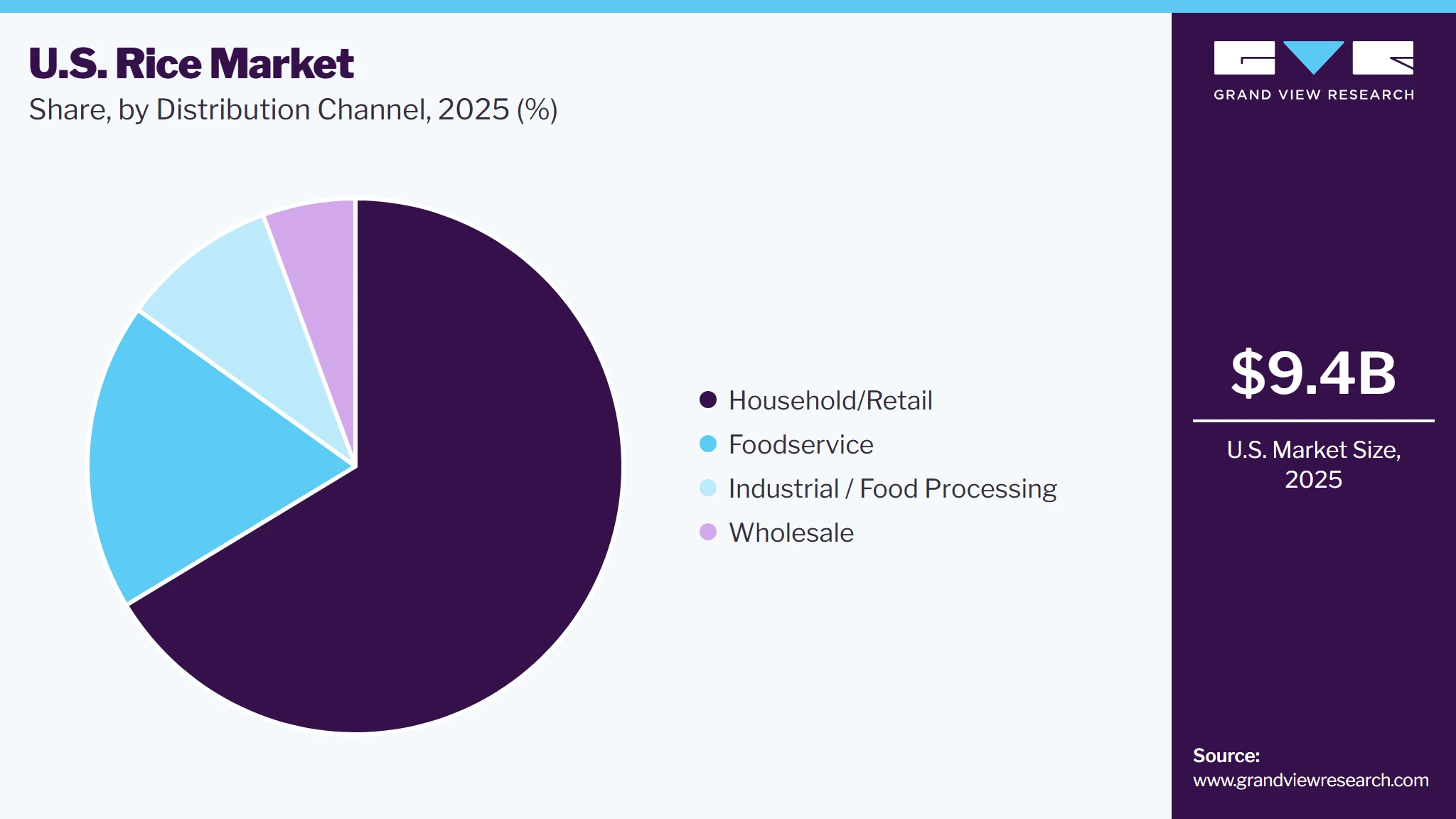
The sales of rice in the U.S. through household/retail accounted for the largest share of 66.3% of the revenue in 2025. Household and retail distribution is an important channel for the U.S. rice market, as it provides consumers with direct access to a wide range of products for everyday consumption. The channel covers hypermarkets & supermarkets, grocery stores, convenience stores, online platforms, and other retail outlets. Product availability varies across these formats, with offerings ranging from conventional white and brown rice to specialty varieties, organic products, flavored rice, and convenient prepared formats. Retailers also provide manufacturers with a broad consumer reach and opportunities to differentiate products through branding, packaging, pricing, assortment, and private-label offerings, supporting continued penetration across diverse household consumption needs.
 To learn more about this report, Download Free Sample Report
 The sale of rice through foodservice channels is projected to grow at the fastest CAGR of 3.5% from 2026 to 2033. Foodservice is one of the principal domestic channels for U.S. rice, encompassing restaurants, catering businesses, institutional kitchens, and other commercial food operators. The USITC 2025 report cited that foodservice represented 29% of direct-food domestic rice shipments in 2021/22, making it the largest direct-food segment ahead of retail outlets and ethnic distributors. Foodservice buyers primarily procure long-grain and parboiled rice, reflecting their suitability across restaurants and institutional menu applications. Continued demand from food-away-from-home establishments supports rice volumes through distributors and direct commercial supply arrangements, while convenience and menu versatility further reinforce rice’s role in foodservice operations. Reflecting this continued focus on foodservice demand, companies are undertaking strategic initiatives, such as in February 2026, Seenergy Foods expanded production by opening its second facility and launching an IQF pasta line, strengthening its ability to supply ready-to-eat grains, beans, rice, and pasta to foodservice operators across North America while addressing growing demand for efficient, plant-forward ingredients.
Regional Insights
The Western U.S. rice market accounted for the largest share of 25.4% of the revenue in 2025, supported by established rice production in California and demand across household and foodservice applications. California's agricultural sector contributes to the regional supply of rice, particularly medium- and short-grain varieties used in Asian cuisines and specialty food applications. The region's diverse consumer base and demand for different rice varieties, including organic and specialty rice, further support market activity. Additionally, the presence of established retail networks, supermarkets, and foodservice operators facilitates product distribution and accessibility, contributing to the West region's prominent position in the U.S. rice market.
With the Asian population representing 17.5% of California’s total population, rice production in the West remained active in 2025, with California recording 533,000 acres of planted rice, the highest amount since 2016. By May 1, 2025, about 25% of the acreage had been planted, marking one of the fastest starts to a season in the last 30 years.
Southeastern region in the U.S. rice market is expected to grow at the fastest CAGR of 3.9% from 2026 to 2033. The growth is supported by established rice production in states such as Arkansas, Louisiana, Mississippi, and Texas, which are major contributors to the U.S. rice supply. Demand from households and foodservice establishments, including restaurants and institutional kitchens, supports regional consumption. Additionally, the popularity of rice in traditional Southern cuisine and its use as an affordable staple across a range of meal preparations contribute to sustained demand. The availability of domestically produced rice through established processing, distribution, and retail networks is expected to further support market growth over the forecast period.
Key U.S. Rice Company Insights
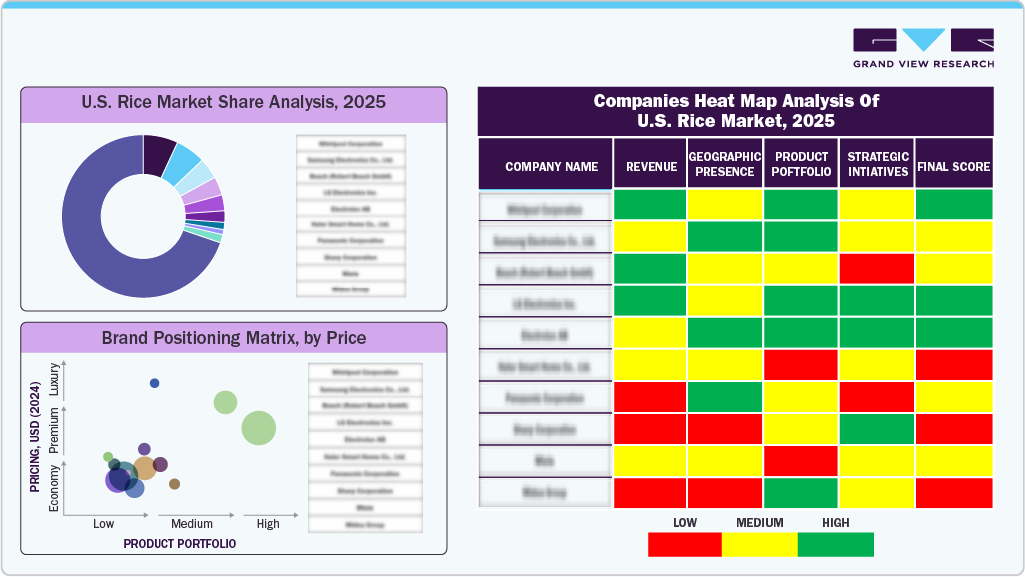
The U.S. rice industry is experiencing increasing competition as established companies and emerging brands expand their product portfolios. The market remains fragmented across product categories, with opportunities for companies to strengthen their share through innovation and geographic expansion.
 To learn more about this report, Download Free Sample Report
 Key U.S. Rice Companies
-
Ebro Foods (Riviana Foods)
-
Riceland Foods
-
Producers Rice Mill, Inc.
-
LT Foods Americas
-
Farmers’ Rice Cooperative
-
American Commodity Company
-
Goya Foods
-
JFC International
-
Lundberg Family Farms
-
TRC Group
-
Supreme Rice LLC
-
Western Foods
-
LaGrande Family Foods Group
-
California Family Foods
-
SunWest Foods
-
Ben’s Original
-
Koda Farms
-
Doguet's Rice Milling Company
Competitive Benchmarking
Category
Operating Strategies
Competitive Edge
Weakness
Established Players (Ebro Foods; Riceland Foods; Producers Rice Mill, Inc.; LT Foods Americas; Farmers’ Rice Cooperative; Lundberg Family Farms; TRC Group; Ben’s Original; Goya Foods, Inc.; JFC International Inc.)
- Coordinate rice sourcing, milling, drying, storage, packaging, and distribution through established processing networks.
- Focus on process efficiency, product development, supply-chain coordination, and broader market coverage to maintain their positions in the U.S. rice industry.
- Established relationships with growers, retailers, distributors, foodservice operators, and international buyers provide broad market access.
- Diverse milling and processing capabilities allow participation across table rice, specialty varieties, prepared rice, and rice-based ingredient applications.
- Exposure to crop conditions, water availability, agricultural costs, and commodity price movements can affect sourcing and processing expenses.
- Large-scale processing, storage, packaging, and distribution operations require considerable maintenance and ongoing investment.
Emerging Players (LaGrande Family Foods Group; California Family Foods; American Commodity Company; Koda Farms; Doguet's Rice Milling Company; Far West Rice; Farmers Rice Milling Company; Montna Farms.)
- Concentrate on regional rice sourcing, farm-linked processing, specialized milling, storage, and targeted distribution activities.
- Develop focused offerings around specialty, organic, premium, and regionally sourced rice varieties to address differentiated customer requirements.
- Close proximity to rice-growing areas supports direct sourcing and closer oversight of cultivation, harvesting, drying, and milling activities.
- Expertise in specific rice varieties and regional culinary applications provides differentiation from broader commodity-oriented suppliers.
- Regional concentration creates exposure to localized weather conditions, water availability, crop performance, and supply disruptions.
- Smaller distribution footprints can make nationwide retail penetration more difficult against larger processors and branded suppliers.
Recent Developments
-
In April 2026, Riviana Foods Inc. announced the launch of Boil-in-Bag Sticky Rice under its brand “Success”, offering restaurant-style sticky rice that cooks in just 12 minutes to meet growing demand for convenient, globally inspired home meals. The product is initially rolling out across the Eastern U.S. and is Non-GMO Project Verified, gluten-free, kosher-certified, and free from preservatives and additives.
-
In April 2026, Riviana Foods Inc. expanded its product portfolio by adding two new flavors, “Garlic Parmesan” and “Veggie Stir-Fry”, to its Minute Rice Cups lineup, designed for quick, microwave-ready meals. The launch focuses on convenient, flavorful options that expand meal occasions such as lunches, sides, and snacks while supporting growth in the rice category.
-
In March 2026, Dainty Foods (based in Canada) announced it will invest up to USD 150 million to build its first U.S. manufacturing facility in Batavia Township near Cincinnati, creating about 240 jobs and expanding production of rice-based ready-to-heat meal products. The 250,000-square-foot plant will begin phased operations in Q1 2027 and is expected to produce up to 250 million units annually, strengthening the company's North American supply chain.
-
In October 2025, South Louisiana Rail Facility announced it will invest USD 2.1 million to expand its Jefferson Davis Parish operations with new bagging and warehouse equipment, boosting rice processing efficiency and export opportunities for Louisiana farmers. The expansion is expected to create 10 direct and 51 indirect jobs, with construction beginning in December 2025 and operations starting by May 2026.
U.S. Rice Market Report Scope
Report Attribute
Details
Market size in 2025
USD 9.4 billion
Estimated market size in 2026
USD 9.7 billion
Projected market size by 2033
USD 12.3 billion
Growth rate (revenue)
CAGR of 3.4% from 2026 to 2033
Actuals
2021 - 2025
Forecast period
2026 - 2033
Quantitative (Revenue & Volume) units
Revenue in USD Billion, Volume in kilotons and CAGR from 2026 to 2033
Report coverage
Revenue forecast, company ranking, competitive landscape, growth factors, and trends
Segments covered
Type, distribution channel, region
Regional scope
Northeast, Southeast, Southwest, West, Midwest
Key companies profiled
Ebro Foods (Riviana Foods); Riceland Foods; Producers Rice Mill, Inc.; LT Foods Americas; Farmers’ Rice Cooperative; American Commodity Company; Goya Foods; JFC International; Lundberg Family Farms; TRC Group; Supreme Rice LLC; Western Foods; LaGrande Family Foods Group; California Family Foods; SunWest Foods; Ben’s Original; Koda Farms; Doguet's Rice Milling Company.
Customization scope
Free report customization (equivalent up to 8 analysts’ working days) with purchase. Addition or alteration to country, regional & segment scope.
Pricing and purchase options
Avail customized purchase options to meet your exact research needs. Explore purchase options
U.S. Rice Market Report Segmentation
This report forecasts revenue growth at the regional levels and provides an analysis of the latest industry trends and opportunities in each of the sub-segments from 2021 to 2033. For this study, Grand View Research has segmented the U.S. rice market report on the basis of type, distribution channel, and region.
-
Type Outlook (Volume, Kilo Tons; Revenue, USD Billion, 2021 - 2033)
-
Long Grain
-
Medium Grain
-
Short Grain
-
Specialty Grain
-
Jasmine
-
Basmati
-
Sushi
-
Other Specialty Grain Rice
-
-
Organic & SRP Rice
-
-
Distribution Channel Outlook (Volume, Kilo Tons; Revenue, USD Billion, 2021 - 2033)
-
Industrial / Food Processing
-
Wholesale
-
Foodservice
-
Household/Retail
-
Hypermarkets & Supermarkets
-
Convenience Stores
-
Traditional Grocery Stores
-
Online
-
Amazon
-
Walmart
-
Other Online Channels
-
-
Other Household/Retail Channels
-
-
-
Regional Outlook (Volume, Kilo Tons; Revenue, USD Billion, 2021 - 2033)
-
Northeast
-
Southeast
-
Southwest
-
West
-
Midwest
-
Research Methodology
The U.S. rice market figures in this report are based on a proven research process that combines executive interviews with secondary research from proprietary databases, company filings, and recognized regulatory and institutional sources. Market size is built through value-chain sizing-reconciling supply-side and demand-side estimates-and triangulated with bottom-up and top-down approaches. Every estimate passes multiple levels of expert validation before publication, with each U.S. rice segment quantified using the revenue-capture definitions in the table below.
Segment Definition
Product
Revenue capture definition
Long Grain
This segment includes the sales of long grain rice.
Medium Grain
This segment includes the sales of medium grain rice.
Short Grain
This segment includes the sales of short grain rice.
Specialty Grain
This segment includes the sales of specialty grain rice.
Organic & SRP Rice
This segment includes the sales of organic & SRP rice.
Estimation Model
Layer Name
Key Question
Description
Consumption Demand Layer
Who consumes rice?
Rice demand is supported by households seeking an affordable, versatile, and convenient staple. Consumption is influenced by dietary preferences, cultural and regional eating patterns, household size, and preferences for specific rice varieties, grain types, and quality characteristics.
Market Reach Layer
Where is rice distributed?
Rice is distributed through industrial / food processing, wholesale, foodservice, and household/retail channels. These channels connect rice producers and millers with different end-use markets and consumer segments.
Quality & Differentiation Layer
How can raw rice be differentiated?
Raw rice can be differentiated through variety, grain size, appearance, aroma, texture, origin, cultivation practices, organic certification, and milling quality. Consistent grain quality, traceability, specialty varieties, and cultivation attributes can further strengthen differentiation.
Value Generation Layer
How is value generated from rice?
Value is generated through efficient cultivation, sourcing, milling, grading, quality control, packaging, branding, and distribution. Premium and specialty rice varieties can support higher price realization, while efficient production and supply-chain management can improve margins for producers and millers.
Delivered Customizations
This report has been delivered with the following In-depth customizations
Client Request
Customization Delivered
Value Adds
Assess consumer demand and purchasing behavior in the U.S. rice market
Evaluated consumer preferences across rice varieties, grain types, quality attributes, price considerations, and purchasing channels, along with key factors influencing rice selection and consumption.
Helps identify high-potential consumer segments and key demand drivers shaping rice consumption and purchasing decisions.
Evaluate the competitive positioning of rice companies
Assessed key rice market participants based on product portfolios, rice varieties, sourcing and production capabilities, distribution channels, brand positioning, and competitive strengths.
Provides a structured competitive benchmark and identifies opportunities for differentiation, market expansion, and stronger positioning.
Identify emerging opportunities and product differentiation in the rice market
Analyzed trends in specialty rice varieties, quality differentiation, cultivation practices, organic and premium rice, traceability, and evolving consumer preferences.
Identifies attractive opportunities for portfolio diversification, premium positioning, and differentiation aligned with changing market demand.
Frequently Asked Questions About This Report
The U.S. rice market size was valued at USD 9.4 billion in 2025 and is estimated at USD 9.7 billion for 2026.
Long grain rice accounted for the largest revenue share in 2025, while the organic & SRP rice are expected to be the fastest-growing segment.
The U.S. rice market is expected to grow at a CAGR of 3.4% from 2026 to 2033, reaching USD 12.3 billion by 2033.
Supported by strong household consumption, established retail and foodservice demand, and rice's role across diverse cuisines.
West region accounted for the largest revenue share in 2025.
Southeast region is expected to grow at the fastest CAGR from 2026 to 2033.
Household/Retail channels accounted for the largest revenue share in 2025, while foodservice channels are expected to be the fastest-growing segment.
Key players include Ebro Foods (Riviana Foods); Riceland Foods; Producers Rice Mill, Inc.; LT Foods Americas; Farmers’ Rice Cooperative; American Commodity Company; Goya Foods; JFC International; Lundberg Family Farms; TRC Group; Supreme Rice LLC; Western Foods; LaGrande Family Foods Group; California Family Foods; SunWest Foods; Ben’s Original; Koda Farms; Doguet's Rice Milling Company.
About the Author(s)
Consumer F&B Research Team
Consumer Goods · Consumer F&BThis report was authored by the consumer f&b research team at Grand View Research - comprising two research analysts, one senior research analyst, and one industry expert - with specialized expertise in the consumer f&b segment of the consumer goods industry. All findings are based on proprietary consumer goods databases, executive interviews, and regulatory analysis, subject to internal peer review prior to publication.
Last Updated:
Speak to Analyst

Customize this report to your needs - add regions, segments, or data points, with 20% free customization.
Or view our licence options:


ISO 9001:2015 & 27001:2022 Certified
We are GDPR and CCPA compliant! Your transaction & personal information is safe and secure. For more details, please read our privacy policy.


