
- Home
- »
- Clothing, Footwear & Accessories
- »
-
U.S. Sleepwear Market Size, Share & Trends Report, 2033GVR Report cover

U.S. Sleepwear Market (2026 - 2033)
Size, Share & Trends Analysis Report By Product (Top Wear, Bottom Wear, Nightwear Dresses & Gowns, Sleepwear Sets), By End-user (Women, Men, Children), By Distribution Channel (Hypermarkets/Supermarkets, Online Stores), Segment Forecasts
Market Size, 2025
$6.6BMarket Estimate, 2026
$7.0BMarket Forecast, 2033
$12.2BCAGR, 2026–2033
8.2%U.S. Sleepwear Market Summary
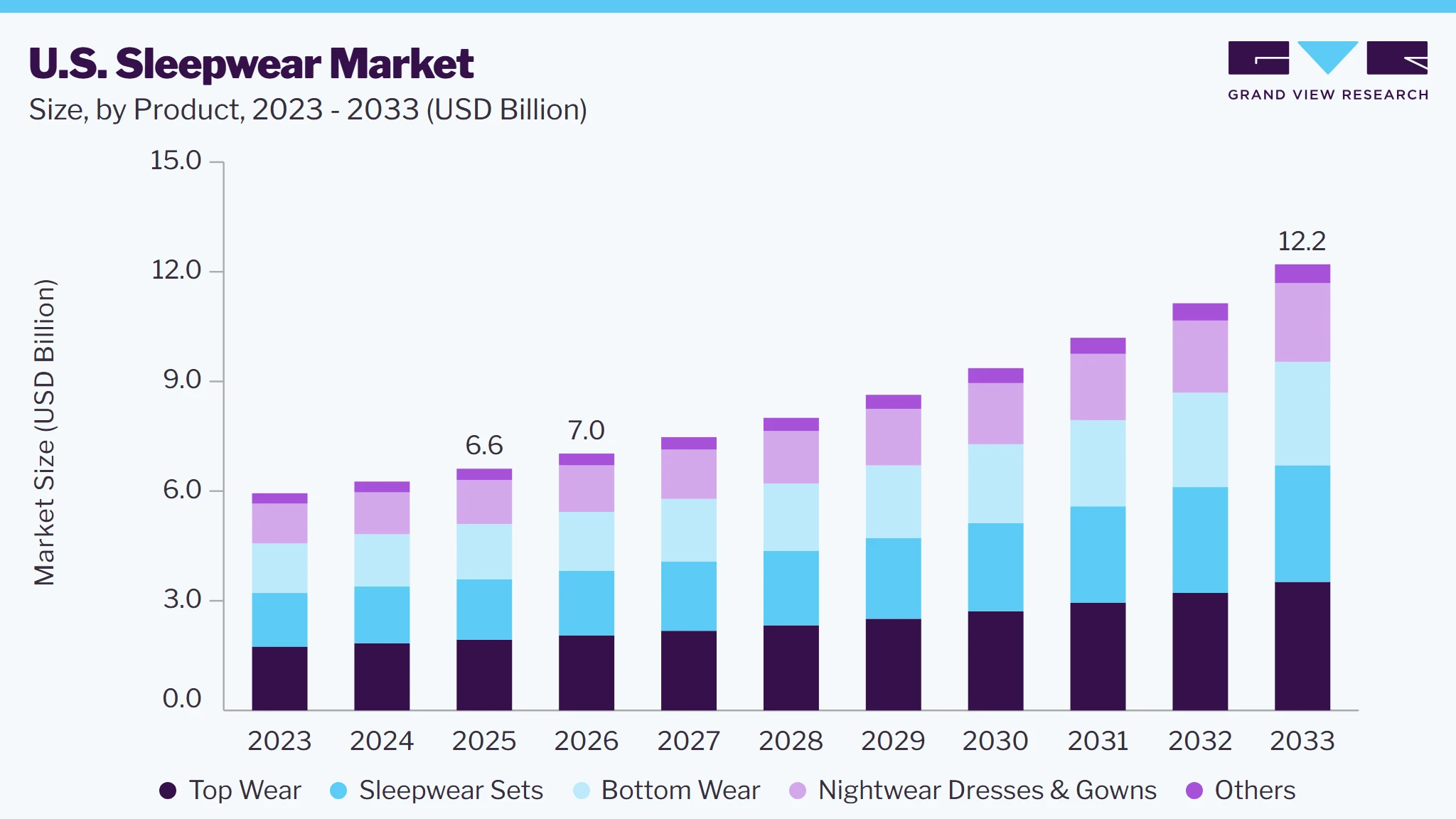
The U.S. sleepwear market size was valued at USD 6.6 billion in 2025 and is projected to grow from USD 7.0 billion in 2026 to USD 12.2 billion by 2033, at a CAGR of 8.2% from 2026 to 2033. The market is being driven by comfort-led purchasing, sleep and wellness awareness, casualization of apparel, demand for breathable/natural fabrics, and the expansion of e-commerce and social-media-led fashion discovery.
Key Market Trends & Insights
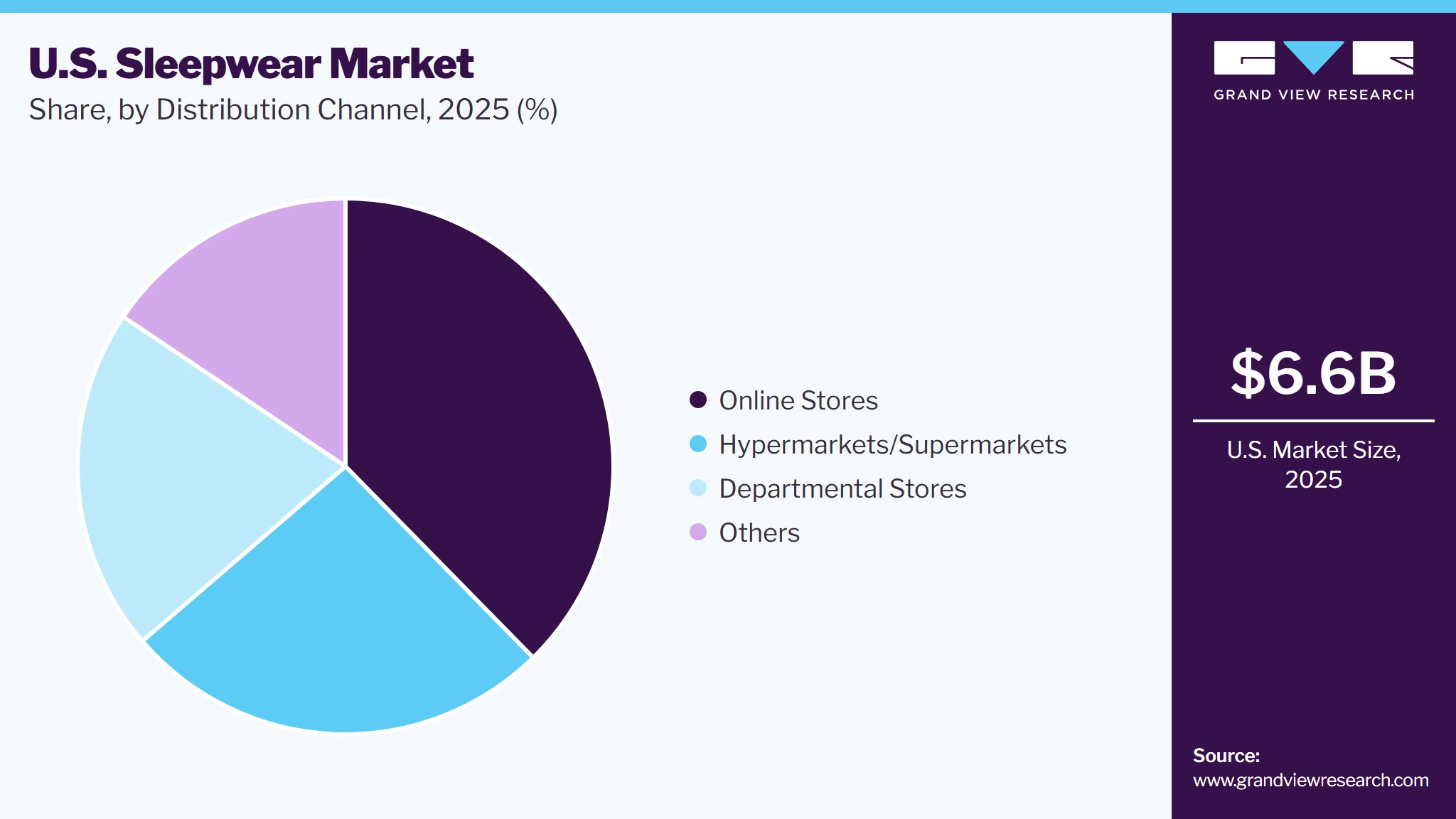
- By distribution channel: Sales of U.S. sleepwear through online stores accounted for a share of 37.7% of the revenue in 2025.
- By product: Top wear accounted for the largest share of 29.3% of the U.S. revenue in 2025.
- By end-user: The women’s sleepwear market accounted for 50.2% of U.S. revenue in 2025.
Market Size & Forecast
- Market Size in 2025: USD 6.6 Billion
- Estimated market size in 2026: USD 7.0 Billion
- Projected Market Size by 2033: USD 12.2 Billion
- CAGR (2026-2033): 8.2%
Prism AI by Grand View Research Free to tryAsk a question about the U.S. sleepwear marketTry asking✓Every figure cited from GVR research Prefer the report? Download free sample →These drivers are shifting pajamas from purely functional nightwear toward products that provide softness, thermal comfort, a relaxed fit, versatility, and aesthetic appeal. Brands are responding with coordinated pajama sets, cotton and modal fabrics, relaxed silhouettes, premium loungewear, and designs that can transition between sleeping and at-home activities.
Comfort and fabric quality are strengthening conversion, particularly as U.S. consumers increasingly evaluate clothing through softness, fit, and material performance rather than price alone. In 2026, Cotton Incorporated’s U.S. Lifestyle Monitor reports that 71% of consumers willing to pay more for cotton cite comfort as a reason, while 66% associate cotton with softness. This is pushing sleepwear brands toward cotton, cotton blends, modal, and other lightweight fabrics that address breathability and tactile comfort. The penetration is evident in premiumization: consumers are increasingly willing to pay higher prices when sleepwear offers a softer hand feel, better temperature regulation, and greater durability, enabling comfort-focused brands to expand beyond basic pajamas.
 Source: Grand View Research, IR Documents, Primary Interviews, Paid DatabasesTo learn more about this report,
 Download Free Sample Report
The growing focus on sleep quality is further broadening the category, positioning rest wear as part of a wider sleep-and-wellness routine rather than simply an apparel purchase. In 2024, the CDC reported that 30.5% of U.S. adults slept fewer than 7 hours, while 15.4% experienced trouble falling asleep most days or every day, indicating a substantial consumer base paying greater attention to sleep conditions. This is increasing interest in sleepwear attributes such as breathability, softness, temperature regulation, and unrestricted fits, making sleepwear a more purposeful purchase rather than simply basic nighttime clothing. The wellness connection is also supporting premiumization, as consumers increasingly associate better-quality sleep environments with comfort-oriented products and are willing to spend more on products perceived to improve their nighttime experience.
Market Dynamics
The expansion of e-commerce is increasing the accessibility and purchase frequency of sleepwear by allowing consumers to browse a much wider range of styles, prices, and sizes without relying on physical stores. U.S. retail e-commerce sales continued to grow strongly in recent years, reaching over USD 300 billion in a recent quarter and maintaining high-single-digit year-over-year growth, while accounting for an increasing share of total retail sales. This broader online shopping behavior is driving demand for sleepwear by making pajamas easier to discover, compare, and purchase alongside everyday apparel.
Social media is simultaneously increasing the occasions in which sleepwear is worn and purchased, particularly among younger consumers. In 2024, Fast Company reported that Five Below’s USD 5.55 pajama pants became a viral trend among U.S. tweens, with children wearing matching pajama pants to school and with friends rather than restricting them to home. This illustrates how TikTok-driven trends and the blending of sleepwear with casualwear are converting pajamas from nighttime essentials into affordable fashion and social-expression products, expanding overall consumption.
The U.S. sleepwear market faces pressure from the wide availability of inexpensive, similar-looking pajama products across mass retailers, department stores, and online marketplaces. This makes it difficult for consumers to justify paying substantially more for sleepwear when basic cotton sets, sleep shirts, and lounge pants can satisfy the same core need. The category is therefore particularly exposed to promotional purchasing and switching between retailers. For instance, in 2024, Macy launched State of Day across a broad USD 8.50-USD 79.50 price range, illustrating the significant spread of price points within the category.
A clear opportunity lies in sleepwear designed around thermal regulation and sleep-specific functionality, rather than aesthetics alone. Research increasingly links sleepwear fabric properties with thermal comfort and sleep outcomes, creating scope for garments engineered around moisture management, breathability, insulation, and temperature regulation. The opportunity is particularly relevant for consumers who experience overheating, night sweating, or discomfort from temperature fluctuations. This also allows sleepwear to move toward functional apparel, where fabric selection and construction directly address nighttime comfort. The category can therefore capture higher-value demand through purpose-built cooling, moisture-wicking, thermoregulating, and season-specific sleepwear rather than competing primarily through prints, silhouettes, or basic fabric choices.
Consumer Insights
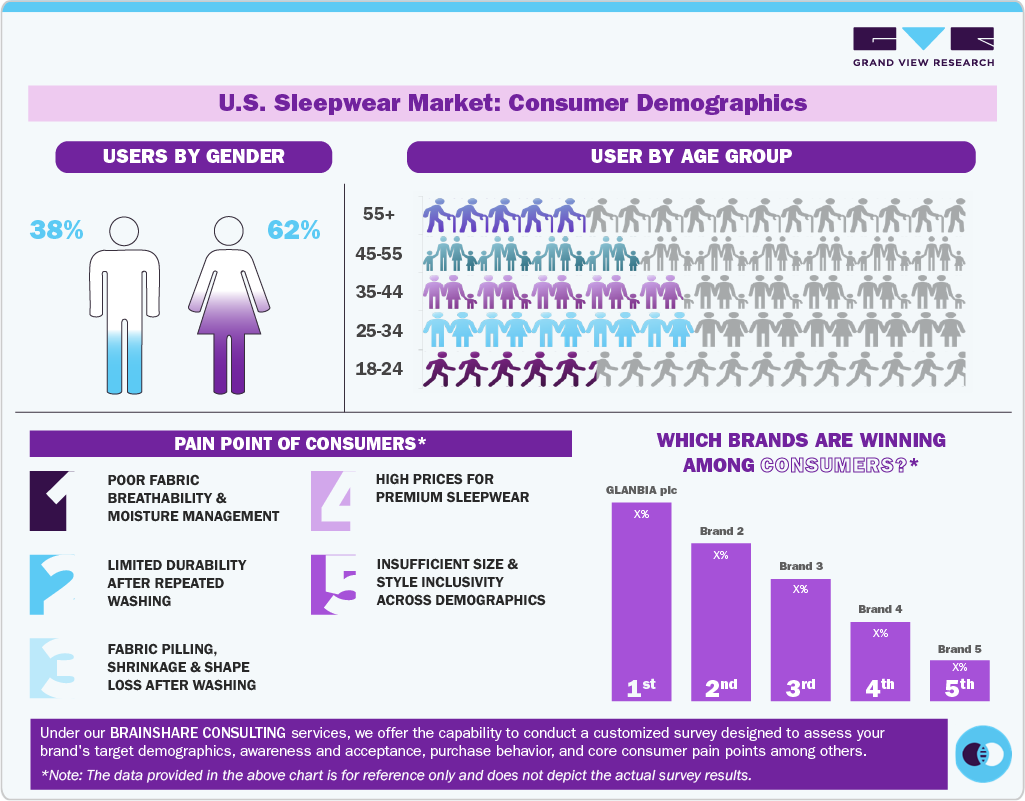
U.S. consumers increasingly prioritize comfort, softness, breathability, fit, and temperature regulation when purchasing sleepwear, while the category continues to overlap with loungewear and casual home apparel. Demand is strengthening for coordinated pajama sets, relaxed silhouettes, lightweight fabrics, and versatile sleep-to-lounge styles, particularly among younger consumers influenced by digital discovery, social-media fashion trends, and wellness-oriented positioning. Seasonal demand also varies across the U.S., supporting lightweight cotton and modal products alongside fleece, flannel, and thermal options for colder regions.
Purchasing decisions are increasingly influenced by fabric quality, durability, inclusive sizing, brand reputation, design variety, sustainability, and perceived value. Cotton remains particularly relevant, while modal, bamboo-derived fabrics, silk, and performance materials support premium and comfort-focused positioning. U.S. consumers are also showing greater interest in personalized, premium, seasonal, holiday-themed, and matching family sleepwear. E-commerce is important for product discovery, assortment breadth, and convenience, while department stores, specialty retailers, and brand stores remain relevant because consumers can assess fit, fabric hand-feel, and garment construction before purchasing.
 To learn more about this report, Download Free Sample Report
Analyst Perspective
The U.S. sleepwear industry is increasingly evolving from traditional nighttime apparel toward rest wear that combines sleep, relaxation, and everyday at-home use, supported by growing demand for softness, breathable fabrics, versatile silhouettes, and inclusive fits. U.S. retail activity is also broadening the category with pajama sets, separates, robes, sleep shirts, and lounge pieces designed for wear from morning through bedtime. Going forward, opportunities are likely to center on functional comfort, premium fabric experiences, multifunctional designs, and occasion-specific sleepwear, while the continued convergence of sleepwear and loungewear expands the category beyond the bedroom and strengthens its role within the broader U.S. comfort-apparel market.
Product Insights
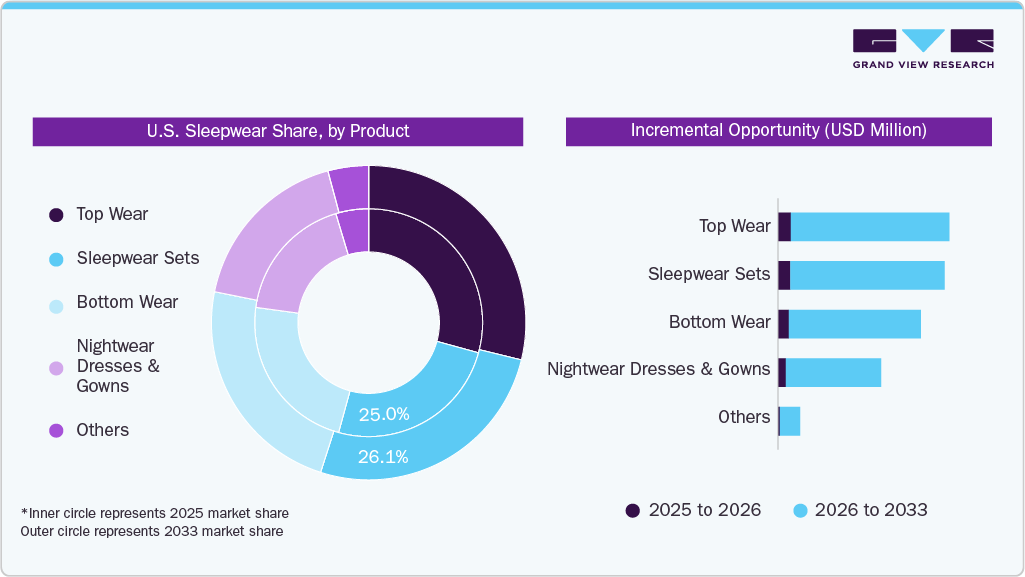
The top wear market accounted for a share of 29.3% of the U.S. revenue in 2025, driven by a strong preference for T-shirts, camisoles, and sleep shirts that provide freedom of movement, temperature comfort, and easy layering across different U.S. climates. Their versatility also supports use beyond sleeping, as consumers can pair sleep tops with pajama bottoms or loungewear for at-home activities. The relatively accessible price of top wear further encourages separate purchases and mix-and-match usage, strengthening its position within the U.S. sleepwear category.
 To learn more about this report, Download Free Sample Report
The U.S. sleepwear sets market is projected to grow at a CAGR of 8.8% from 2026 to 2033, valued for their coordinated appearance, convenience, and complete outfit proposition. Matching tops and bottoms eliminates the need to coordinate separate pieces while providing a polished look that appeals to consumers who increasingly treat sleepwear as part of their overall at-home style. Their versatility also supports use across sleeping, lounging, travel, and casual home activities, strengthening demand beyond traditional bedtime wear.
End-user Insights
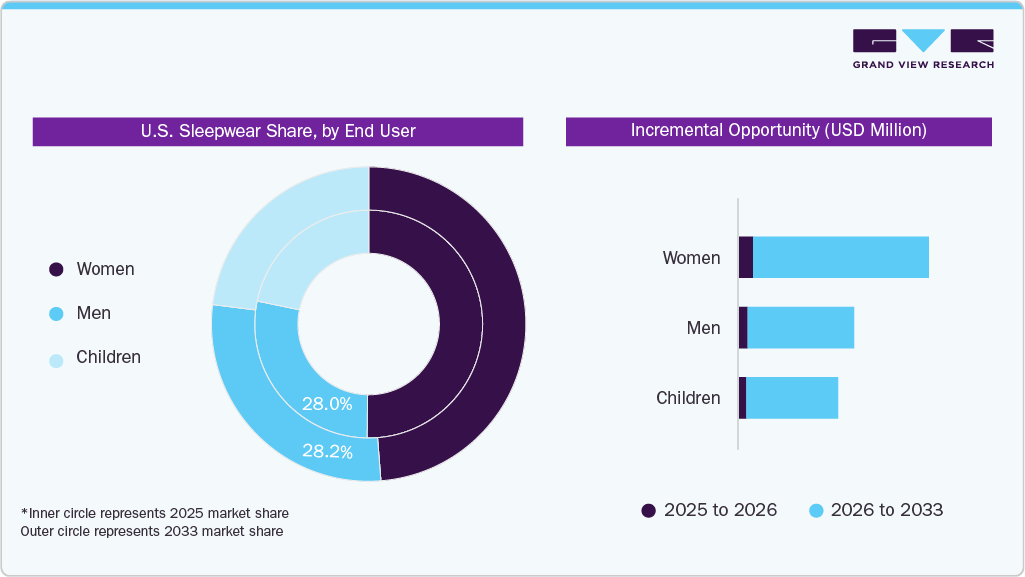
The women’s sleepwear market accounted for 50.2% of U.S. revenue in 2025, driven by women’s broader adoption of sleepwear as both nighttime and at-home apparel, with demand extending to coordinated pajama sets, robes, nightgowns, and versatile restwear. The category is also benefiting from greater emphasis on softness, breathable fabrics, flattering fits, and personal style, while sleepwear increasingly supports self-care and comfort-focused dressing.
 To learn more about this report, Download Free Sample Report
The children’s sleepwear market in the U.S. is projected to grow at a CAGR of 9.0% from 2026 to 2033, supported by parents’ emphasis on safe, snug-fitting, and sleep-appropriate garments rather than using oversized daywear as pajamas. U.S. safety standards specifically distinguish children’s sleepwear from regular apparel, reinforcing demand for purpose-designed pajamas, two-piece sets, and one-piece sleepwear. The category also benefits from established bedtime routines, with 86% of U.S. children having a regular bedtime most or every day in 2024, supporting consistent demand for dedicated nighttime apparel.
Distribution Channel Insights
Sales of U.S. sleepwear through online stores accounted for a share of 37.7% of the revenue in 2025. This channel plays a crucial role in enabling consumers to compare fabrics, fits, sizes, designs, and prices across brands, while broad product assortments allow access to niche offerings such as premium silk, bamboo, personalized, plus-size, and coordinated family U.S. sleepwear. Direct-to-consumer websites and marketplaces also support seasonal collections, customer reviews, size guides, and convenient repeat purchases, thereby strengthening online conversion rates.
 To learn more about this report, Download Free Sample Report
Sales of U.S. sleepwear through hypermarkets/supermarkets are projected to grow at a CAGR of 8.6% from 2026 to 2033, supported by consumers’ preference to physically assess fabric softness, thickness, stretch, and breathability before purchasing garments intended for prolonged skin contact. In-store shopping also allows buyers to check fit, waistband comfort, garment length, and construction, reducing sizing uncertainty, while parents can directly evaluate children’s U.S. sleepwear for fabric feel and overall comfort. Seasonal discounts, promotional displays, and multi-piece pajama packs further encourage consumers to purchase U.S. sleepwear during routine grocery and household shopping trips.
Key U.S. Sleepwear Company Insights
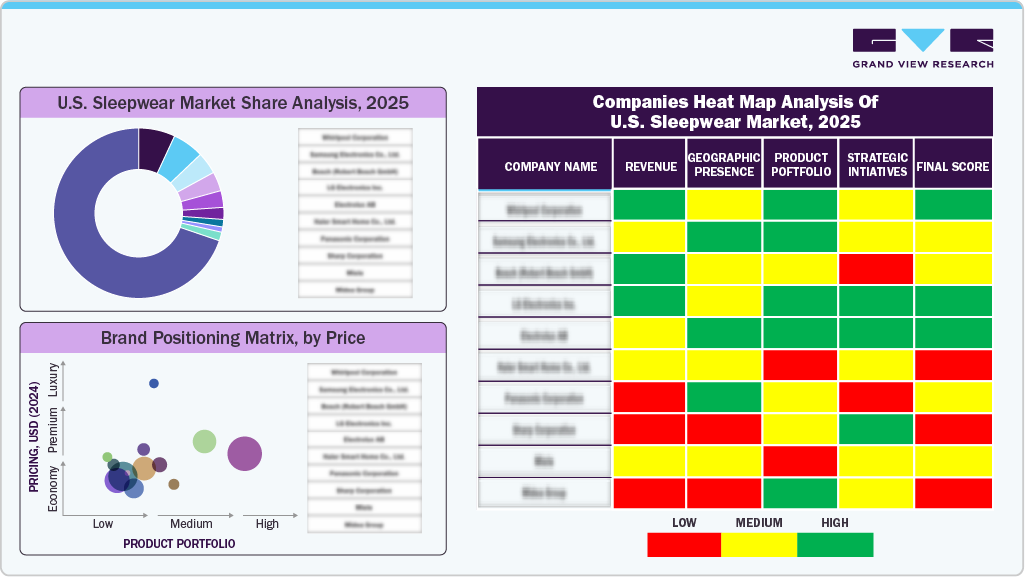
The U.S. sleepwear market is highly competitive, with brands competing on fabric quality, comfort, design innovation, product variety, price positioning, brand recognition, and omnichannel availability. Leading companies are expanding their U.S. sleepwear portfolios through premium fabrics, coordinated pajama sets, loungewear extensions, inclusive sizing, seasonal collections, and digital commerce.
Product differentiation increasingly centers on breathable, sustainable fabrics; premium U.S. sleepwear; fashion-led designs; personalized collections; thermal and functional U.S. sleepwear; and coordinated family offerings. Companies are also strengthening direct-to-consumer channels, expanding e-commerce penetration, and using seasonal launches, collaborations, and lifestyle positioning to increase customer engagement and repeat purchases.
-
Victoria's Secret & Co. is a major player in the U.S. sleepwear industry, offering women's pajamas, pajama sets, sleep shirts, robes, chemises, and sleep accessories through its Victoria's Secret brand. The company differentiates its U.S. sleepwear portfolio through fashion-oriented designs, seasonal collections, premium fabrics, and coordinated intimates and loungewear offerings. Its extensive retail network and e-commerce platform support broad consumer access across North America and international markets, while its strong brand positioning enables premium pricing across women's U.S. sleepwear categories.
-
Jockey International, Inc. is a major U.S. sleepwear and apparel-company offering men's, women's, and children's pajamas, sleep shirts, pajama sets, robes, and loungewear. The company competes through its broad product portfolio, emphasis on comfort-oriented fabrics, accessible pricing, and extensive retail and online distribution. Jockey's established presence across multiple end-user groups allows it to address everyday U.S. sleepwear demand, while its product development increasingly incorporates stretch fabrics, moisture-management properties, seasonal designs, and versatile sleep-to-lounge styles.
 To learn more about this report, Download Free Sample Report
Key U.S. Sleepwear Companies:
-
Victoria’s Secret & Co.
-
Jockey International, Inc.
-
Hanesbrands Inc.
-
Calvin Klein, Inc.
-
Eberjey, Inc.
-
Petit Plume, LLC
-
Lake Pajamas, LLC
-
Natori Company, Inc.
-
Marks and Spencer Group plc.
-
Lunya Company
Competitive Benchmarking
Category
Operating Strategies
Competitive Edge
Weakness
Established Players (Victoria’s Secret & Co.; Jockey International, Inc.; Hanesbrands Inc.; Calvin Klein, Inc.; Marks and Spencer Group plc.; Natori Company, Inc.)
Expand sleepwear collections across pajama sets, separates, nightgowns, robes, and loungewear through broad retail and e-commerce networks. Focus on fabric innovation, seasonal collections, brand extensions, inclusive sizing, and omnichannel distribution.
Strong brand recognition, extensive retail presence, established customer bases, broad product portfolios, and significant sourcing and manufacturing capabilities. Scale supports competitive pricing, frequent product launches, and access to major department stores and digital marketplaces.
Large-scale operations can reduce flexibility in responding to niche U.S. sleepwear trends. Dependence on global apparel supply chains exposes companies to fluctuations in raw materials, manufacturing, freight, and inventory costs, while competition from specialist D2C brands can pressure differentiation.
Emerging Players (Eberjey, Inc.; Petit Plume, LLC; Lake Pajamas, LLC; Lunya Company)
Concentrate on U.S. sleepwear-specific positioning, premium fabrics, comfort-led designs, and distinctive silhouettes. Emphasize D2C e-commerce, curated collections, personalization, limited-edition launches, social-media engagement, and selective wholesale partnerships to build brand loyalty.
Strong specialization in U.S. sleepwear, differentiated brand identities, premium positioning, agile product development, and closer consumer relationships. Focused assortments enable faster response to emerging preferences around comfort, fabric performance, aesthetics, and sleep-to-lounge versatility.
Smaller geographic reach, retail footprint, and operating scale than established apparel groups. Higher exposure to customer-acquisition costs, inventory concentration, supplier dependence, and pricing pressure from vertically integrated mass-market brands and expanding private-label offerings.
Recent Developments
-
In June 2025, Four Seasons launched its Resort Pajamas Collection, expanding its U.S. sleepwear offering beyond its earlier Hotel Pajamas line. The collection features three linen-cotton sets for women, men, and unisex consumers, designed for lightweight summer comfort and inspired by Four Seasons destinations.
-
In July 2024, Raymond launched SleepZ, entering the largely unbranded men’s U.S. sleepwear market with both Indian styles such as kurta-pajama and dhotis, and Western loungewear, including T-shirts, boxer shorts, and track pants.
-
In February 2024, Macy’s launched State of Day, featuring pajama sets and separates, nightgowns, and sleepshirts made with soft cotton, modal blends, and cozy knits. U.S. Sleepwear was offered up to size 4X, emphasizing comfort and inclusivity.
U.S. Sleepwear Market Report Scope
Report Attribute
Details
Market size in 2025
USD 6.6 billion
Estimated market size in 2026
USD 7.0 billion
Projected Market Size by 2033
USD 12.2 billion
Growth Rate
CAGR of 8.2% from 2026 to 2033
Base year for estimation
2025
Historical data
2021 - 2025
Forecast period
2026 - 2033
Quantitative units
Revenue in USD billion and CAGR from 2026 to 2033
Report coverage
Revenue forecast, company ranking, competitive landscape, growth factors, and trends
Segments covered
Product, end-user, distribution channel
Country scope
U.S.
Key companies profiled
Victoria’s Secret & Co.; Jockey International, Inc.; Hanesbrands Inc.; Calvin Klein, Inc.; Eberjey, Inc.; Petit Plume, LLC; Lake Pajamas, LLC; Natori Company, Inc.; Marks and Spencer Group plc.; Lunya Company
Customization scope
Free report customization (equivalent up to 8 analysts’ working days) with purchase. Addition or alteration to country, regional & segment scope.
Pricing and purchase options
Avail customized purchase options to meet your exact research needs. Explore purchase options
U.S. Sleepwear Market Report Segmentation
This report forecasts revenue growth at country levels and provides an analysis of the latest trends and opportunities in each sub-segment from 2026 to 2033. For this study, Grand View Research has segmented the U.S. sleepwear market report by product, end-user, and distribution channel:
-
Product Outlook (Revenue, USD Billion, 2021 - 2033)
-
Top Wear
-
Bottom Wear
-
Sleepwear Sets
-
Nightwear Dresses & Gowns
-
Others
-
-
End-user Outlook (Revenue, USD Billion, 2021 - 2033)
-
Women
-
Men
-
Children
-
-
Distribution Channel Outlook (Revenue, USD Billion, 2021 - 2033)
-
Hypermarkets/Supermarkets
-
Online Stores
-
Departmental Stores
-
Others
-
Research Methodology
The U.S. sleepwear market figures in this report are based on a proven research process that combines executive interviews with secondary research from proprietary databases, company filings, and recognized regulatory and institutional sources. Market size is built through value-chain sizing-reconciling supply-side and demand-side estimates-and triangulated with bottom-up and top-down approaches. Every estimate passes multiple levels of expert validation before publication, with each U.S. sleepwear segment quantified using the revenue-capture definitions in the table below.
Segment Definition
Segment - End User
Revenue capture definition
Women
As the largest end-user segment, revenue is generated from the sale of U.S. sleepwear designed for adult women, including products intended for nighttime sleep, relaxation, lounging, and home use. The segment covers women's U.S. sleepwear purchased through hypermarkets, e-commerce, departmental, and other distribution channels.
Men
Revenue is generated from the sale of U.S. sleepwear designed for adult men, including products intended for nighttime sleeping, relaxation, lounging, and home use. The segment covers men's U.S. sleepwear purchased through hypermarkets, e-commerce, departmental, and other distribution channels.
Children
Revenue is generated from the sale of U.S. sleepwear designed for children, including infants, toddlers, and older children, for nighttime sleeping, relaxation, and home use. The segment covers children's U.S. sleepwear purchased by parents, guardians, or other household buyers through hypermarkets, e-commerce, departmental, and other distribution channels.
Estimation Model
Layer
Key Question
Description
Consumer Base Layer
Who has a need for sleepwear?
Identify consumers requiring dedicated nightwear based on population, age, gender, lifestyle, climate, sleep habits, and replacement needs. Apply sleepwear usage rates to estimate the potential consumer base.
Market Accessibility Layer
Who can be reached through distribution channels?
Filter potential consumers based on retail accessibility across e-commerce, department stores, specialty apparel stores, supermarkets, and brand-owned channels, considering regional retail penetration and purchasing access.
Purchase & Usage Layer
Who actively purchases sleepwear?
Apply sleepwear adoption, purchase frequency, replacement cycles, and average units purchased across women, men, and children to estimate active annual sleepwear buyers globally.
Monetisation Layer
How much revenue is generated?
Multiply active sleepwear buyers by annual spending, incorporating product mix, average selling prices, purchase frequency, and premiumization across top wear, bottoms, sets, nightwear dresses, and other sleepwear.
Delivered Customizations
This report has been delivered with the following In-depth customizations
Client Request
Customization Delivered Value Adds U.S. Sleepwear Retailer & E-commerce Channel Analysis
Mapped sleepwear sales across department stores, mass retailers, specialty retailers, DTC websites, marketplaces, and social commerce.
Identified channel-specific opportunities, supporting distribution strategy, retailer targeting, and online/offline assortment decisions.
U.S. Sleepwear Size & Fit Opportunity Analysis
Evaluated demand for extended sizing, relaxed fits, petite/tall proportions, maternity sleepwear, and adaptive designs across U.S. consumer groups.
Identified underserved fit segments, supporting inclusive product development, sizing architecture, and assortment expansion.
U.S. Sleepwear Occasion & Use-Case Analysis
Examined demand across bedtime, loungewear, travel, gifting, bridal, maternity, seasonal, and coordinated family sleepwear occasions.
Identified incremental consumption occasions, supporting category expansion, product-line extensions, and occasion-specific merchandising.
Frequently Asked Questions About This Report
The U.S. sleepwear market was valued at USD 6.6 billion in 2025 and is estimated at USD 7.0 billion in 2026.
The U.S. sleepwear market is expected to grow at a CAGR of 8.2% from 2026 to 2033, reaching USD 12.2 billion by 2033.
Key factors include growing comfort-focused lifestyles, sleep and wellness awareness, athleisure influence, premiumization, demand for versatile loungewear, seasonal product innovation, and e-commerce growth.
Some of the key players operating in the U.S. sleepwear market include Victoria’s Secret & Co.; Jockey International, Inc.; Hanesbrands Inc.; Calvin Klein, Inc.; Eberjey, Inc.; Petit Plume, LLC; Lake Pajamas, LLC; Natori Company, Inc.; Marks and Spencer Group plc.; and Lunya Company.
Online stores accounted for the largest market share of 37.7% in 2025, while the hypermarkets/supermarkets segment is the fastest-growing segment.
The top wear market accounted for a share of 29.3% of the U.S. revenue in 2025, while the sleepwear sets segment is the fastest-growing product.
The women’s sleepwear market accounted for 50.2% of U.S. revenue in 2025, while the children's sleepwear segment is the fastest-growing end-user.
About the Author(s)
Clothing, Footwear & Accessories Research Team
Consumer Goods · Clothing, Footwear & AccessoriesThis report was authored by the clothing, footwear & accessories research team at Grand View Research - comprising two research analysts, one senior research analyst, and one industry expert - with specialized expertise in the clothing, footwear & accessories segment of the consumer goods industry. All findings are based on proprietary consumer goods databases, executive interviews, and regulatory analysis, subject to internal peer review prior to publication.
Last Updated:
Speak to Analyst

Customize this report to your needs - add regions, segments, or data points, with 20% free customization.
Or view our licence options:


ISO 9001:2015 & 27001:2022 Certified
We are GDPR and CCPA compliant! Your transaction & personal information is safe and secure. For more details, please read our privacy policy.


