
- Home
- »
- Advanced Interior Materials
- »
-
Vacuum Food Packaging Equipment Market Report, 2033GVR Report cover
![Vacuum Food Packaging Equipment Market (2026 - 2033)Report]()
Vacuum Food Packaging Equipment Market (2026 - 2033)
Size, Share & Trends Analysis Report By Type (Chamber Vacuum Packaging Machines, Thermoforming Vacuum Packaging Machines), By End Use (Bakery & Confectionary, Meat, Poultry & Seafood), By Region, And Segment Forecast
Market Size, 2025
$2.5BMarket Estimate, 2026
$2.7BMarket Forecast, 2033
$4.1BCAGR, 2026–2033
6.5%Vacuum Food Packaging Equipment Market Summary
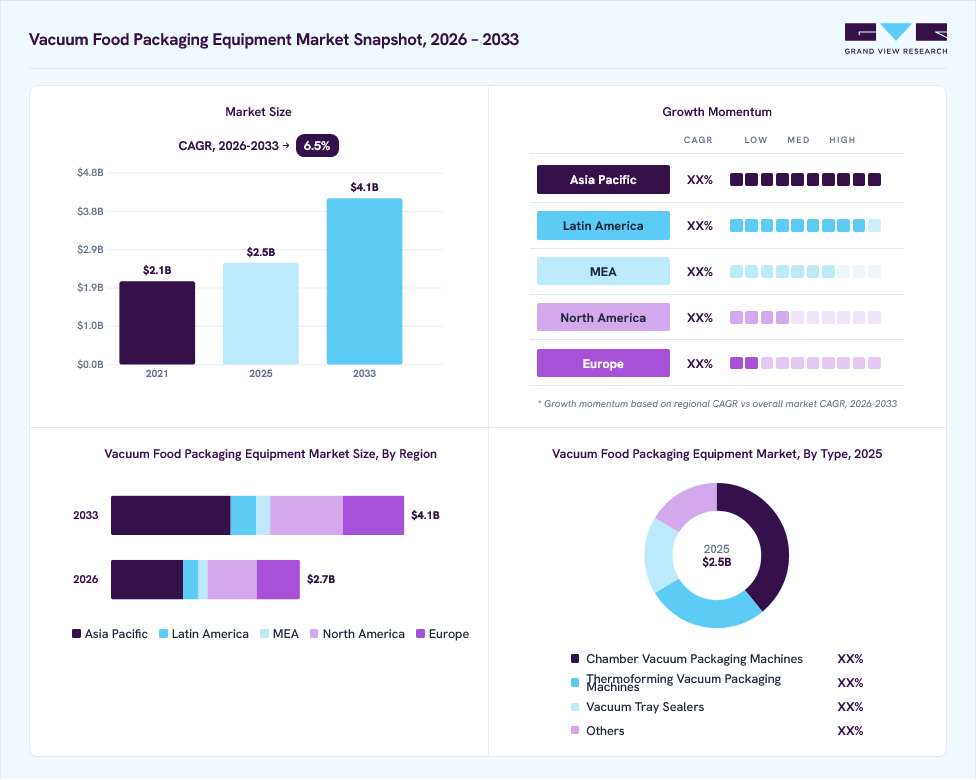
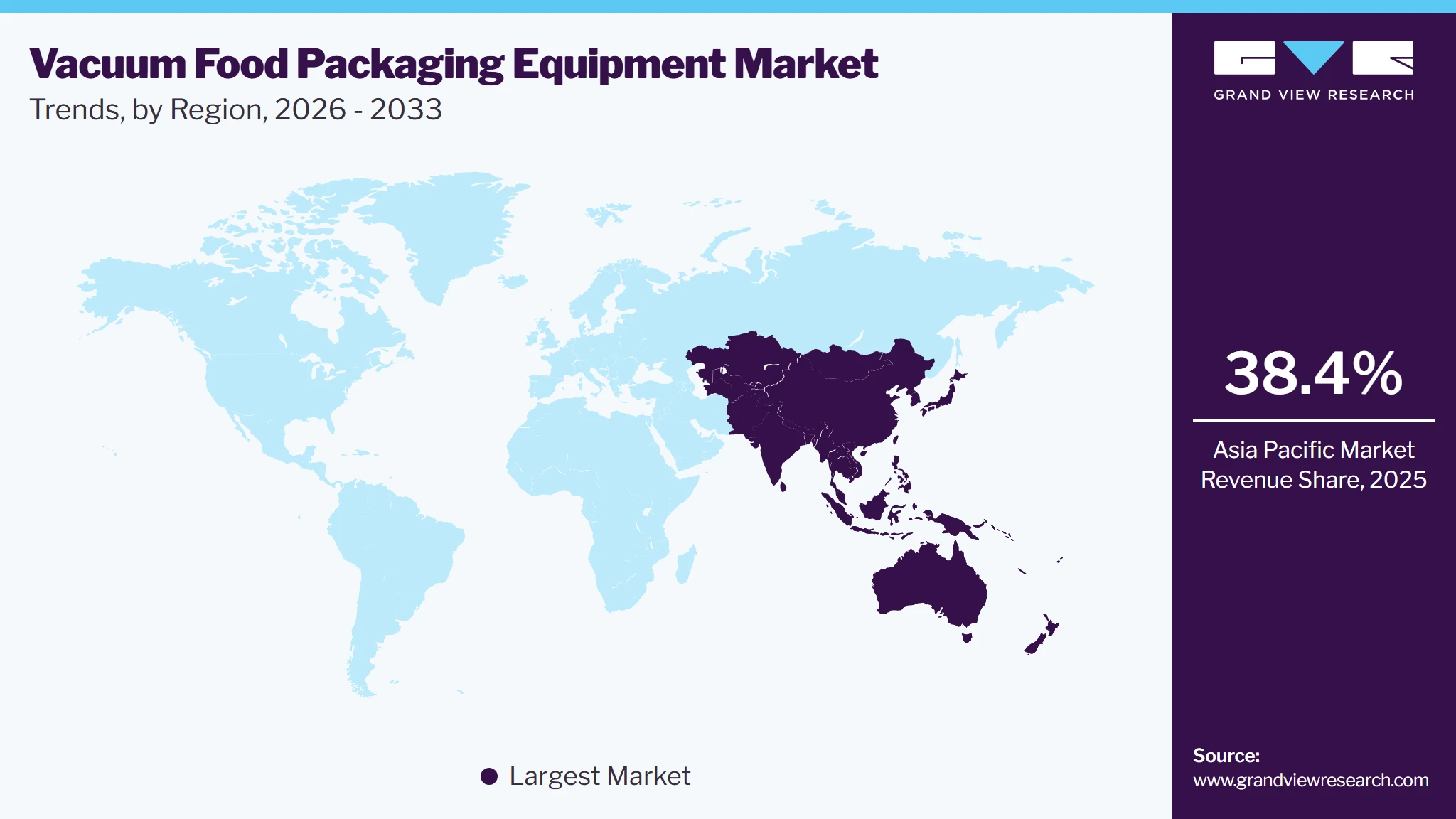
The global vacuum food packaging equipment market size was valued at USD 2.5 billion in 2025 and is projected to grow from USD 2.7 billion in 2026 to USD 4.1 billion by 2033, at a CAGR of 6.5% from 2026 to 2033. Asia Pacific dominated the market, accounting for the revenue share of 38.4% in 2025. The market is driven by increasing demand for longer food shelf life.
Key Market Trends & Insights
- By type: The chamber vacuum packaging machines segment held the largest market share of 39.0% in 2025.
- By end use: The meat, poultry & seafood segment held the largest market share of 34.9% in 2025.
Regional Highlights
- Largest regional market: Asia Pacific (38.4% revenue share, 2025)
- Fastest-growing regional market: Asia Pacific (highest CAGR, 2026-2033)
- By country: China dominated Asia Pacific with the largest revenue share in 2025
Market Size & Forecast
- Market size in 2025: USD 2.5 Billion
- Estimated market size in 2026: USD 2.7 Billion
- Projected market size by 2033: USD 4.1 Billion
- CAGR (2026-2033): 6.5%
Vacuum packaging removes air from the package, slowing oxidation and microbial activity that can cause food deterioration. This helps preserve the freshness, quality, and appearance of perishable products during storage and transportation. Meat, seafood, dairy products, and prepared foods particularly benefit from longer storage periods, reducing product losses and supporting demand for vacuum packaging equipment among food processors and retailers.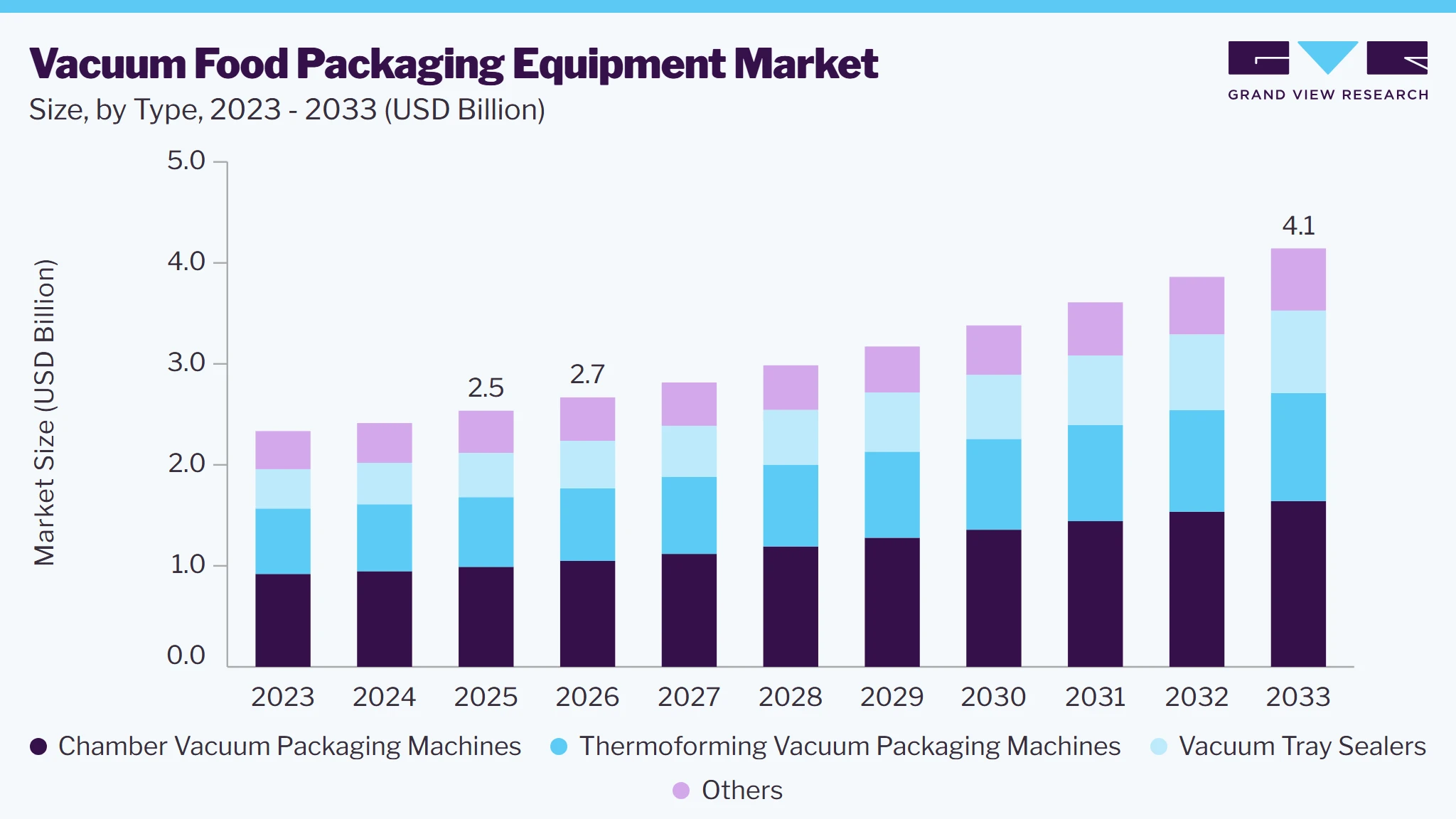
The growing preference for packaged meals, instant food products, and on-the-go food options is driving the adoption of vacuum packaging machinery across the food industry. These products often require controlled packaging conditions to maintain quality during distribution and storage. Food manufacturers are adopting automated vacuum packaging systems to handle increasing production volumes while maintaining consistent sealing and packaging quality.
Market Dynamics
The vacuum food packaging equipment industry is influenced by the expansion of ready-to-eat and convenience food production, as manufacturers increasingly require efficient packaging solutions for processed meals, meat products, cheese, snacks, and other packaged foods. The growth of organized food processing and retail distribution is increasing the need for consistent and high-volume packaging operations. In addition, rising demand for standardized packaging formats and improved product handling across food manufacturing facilities is supporting equipment adoption. However, high equipment costs, maintenance requirements, and the need for trained operators can limit adoption, particularly among smaller food-processing businesses.
Rapid urbanization and a growing global population, particularly across Asia, Africa, and Latin America, are reshaping food consumption patterns toward packaged and processed foods as urban lifestyles reduce time for daily fresh-market shopping and home food preparation. This demographic shift is expanding the overall consumer base for vacuum-packaged meat, dairy, seafood, and ready meals, especially in densely populated emerging cities where cold-chain retail is expanding fastest.
High initial investment can restrain the adoption of vacuum food packaging equipment, particularly among small and medium-sized food processors. Equipment costs vary according to chamber size, automation level, vacuum technology, production capacity, and sealing configuration. Additional expenditure may be required for installation, maintenance, packaging materials, and operator training. Businesses with lower production volumes may find it difficult to justify the investment when manual or lower-cost packaging methods remain available for their operations.
Increasing automation in food processing creates opportunities for vacuum food packaging equipment manufacturers to develop systems that integrate with broader production lines. Automated loading, vacuum control, sealing, inspection, and product handling can reduce manual intervention and improve packaging consistency. Digital controls and programmable operating settings can also simplify product changeovers and process management. Integration with automated food-processing and packaging systems can enhance the suitability of vacuum equipment for manufacturers seeking higher production efficiency and more consistent packaging operations.
Market Concentration & Characteristics
The vacuum food packaging equipment industry is fragmented due to the presence of multiple global, regional, and specialized manufacturers offering different equipment configurations, capacities, and automation levels. Companies compete based on equipment price, packaging speed, sealing performance, customization, and after-sales service. The market serves diverse food processing applications, including meat, seafood, dairy, and prepared foods, creating demand for equipment with varying technical specifications and production capacities.
Manufacturers are focusing on automation, intelligent controls, improved vacuum pumps and sealing systems, energy efficiency, and packaging flexibility to enhance equipment performance and meet evolving food-processing requirements. Automated systems reduce manual intervention and support consistent packaging operations, while intelligent controls enable easier process monitoring and adjustment. Improved vacuum pumps and sealing systems enhance air removal and package integrity, while energy-efficient designs reduce operating costs and flexible configurations accommodate different products and packaging formats.
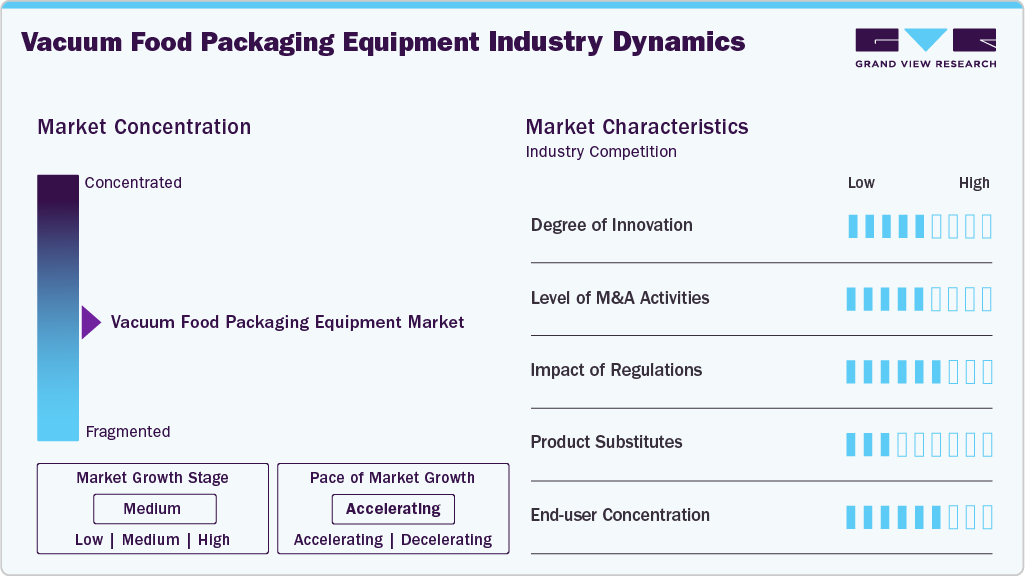
Regulations are shaping the market through requirements related to food safety, packaging materials, hygiene, machinery safety, and energy consumption. Food-contact packaging requirements influence the materials used with vacuum systems, while machinery safety regulations affect equipment design and operation. Hygiene requirements encourage equipment manufacturers to use cleanable designs and suitable materials. Growing attention to packaging waste and sustainability is also influencing the development of equipment and packaging systems.
Type Insights
The chamber vacuum packaging machines segment led the market with the largest revenue share of 39.0% in 2025. Food processors increasingly require reliable air removal, consistent sealing, and longer product shelf life, which increases demand for chamber vacuum packaging machines. These machines are suitable for meat, seafood, dairy, and prepared foods and can accommodate different package sizes. Demand is also supported by semi-automatic and automated systems that improve packaging consistency and reduce manual intervention across small, medium, and large food processing operations.
The vacuum tray sealers segment is projected to grow at the fastest CAGR during the forecast period, driven by increasing demand for packaged fresh and prepared foods that require secure sealing and extended shelf life. These machines remove air from trays before sealing, helping maintain product freshness during storage and distribution. Adoption is supported by growing production of ready-to-eat meals, meat products, and convenience foods, along with increasing requirements for consistent packaging appearance, hygiene, and production efficiency.
End Use Insights
The meat, poultry & seafood segment led the market with the largest revenue share of 34.9% in 2025, driven by rising demand for fresh and processed protein products and the expansion of refrigerated and frozen food distribution, which is driving adoption. Vacuum packaging equipment also provides consistent sealing and efficient packaging for high-volume food processing operations.
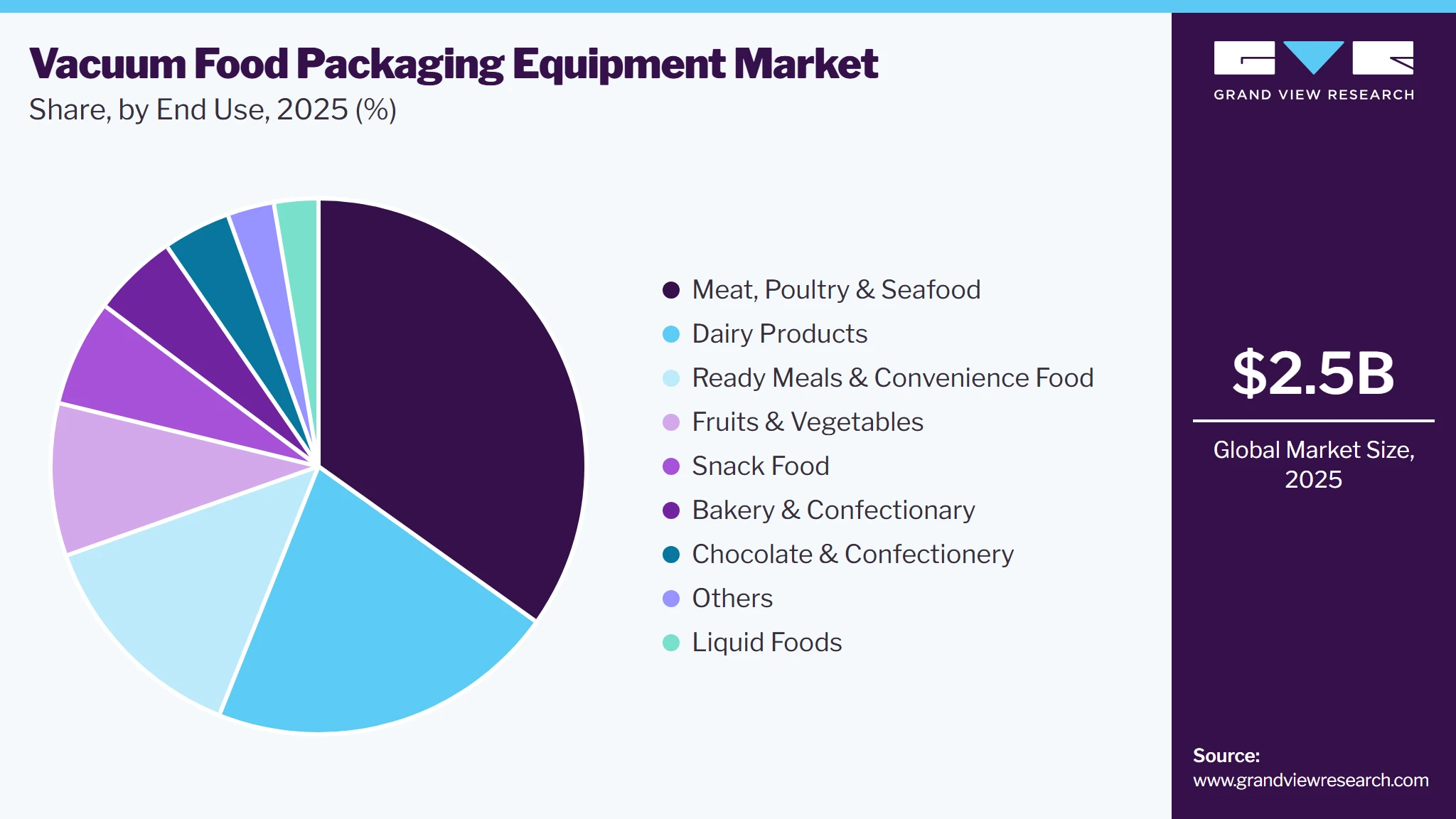
The snack food segment is projected to grow at the fastest CAGR of 8.8% during the forecast period, driven by rising consumption of packaged snacks, including processed meat snacks, cheese-based products, nuts, and other shelf-stable or refrigerated items. Vacuum packaging helps protect products from oxygen and moisture, maintaining quality during storage and transportation. Rising demand for convenient, portion-controlled packaging is also encouraging food manufacturers to adopt efficient vacuum packaging equipment.
Regional Insights
The vacuum food packaging equipment market in North America is witnessing strong demand, driven by the rising consumption of packaged dairy products. The U.S. and Canada have large-scale food processing industries, in which manufacturers are increasingly adopting automated vacuum packaging systems to ensure high-volume production and consistent packaging quality. The expansion of refrigerated food distribution, organized retail, and ready-to-eat food consumption is further increasing demand for equipment. In addition, established meat and poultry processing facilities are replacing or upgrading packaging lines to improve operational efficiency and accommodate growing packaged food production.
U.S. Vacuum Food Packaging Equipment Market Trends
The vacuum food packaging equipment market in the U.S. is expected to remain a major market due to its large food processing industry and high consumption of packaged foods. Demand for prepared meals and refrigerated products is driving the adoption of vacuum packaging. Food manufacturers are increasingly using automated packaging equipment to improve throughput, sealing consistency, and product shelf life.
Europe Vacuum Food Packaging Equipment Market Trends
The vacuum food packaging equipment market in Europe is anticipated to grow at a substantial CAGR during the forecast period. As Europe's largest food-processing economy, Germany also hosts several of the world's leading vacuum-packaging machinery OEMs, making it both a production hub and a demand center. Rising energy costs have pushed manufacturers toward equipment retrofits focused on reducing compressor and pump energy draw. Germany's strict adherence to EU Machinery Directive updates is also accelerating replacement cycles for older packaging lines that no longer meet current safety interlocks and CE certification standards.
The Germany vacuum food packaging equipment market is supported by its established food processing industry and demand for packaged meat. Food manufacturers are increasingly adopting automated packaging equipment to improve production efficiency and maintain consistent packaging quality. The country's strong manufacturing base also supports the integration of packaging machinery with automated processing lines.
The vacuum food packaging equipment market in the UK is positioned for steady growth, driven largely by shifting consumer habits toward time-saving meal solutions and pre-prepared foods. As household routines lean further toward convenience, ready meals, deli-style packaged meats, and portioned seafood have moved from niche to mainstream in everyday grocery baskets, prompting food manufacturers to scale up vacuum-sealing capacity to meet volume and consistency requirements.
Asia Pacific Vacuum Food Packaging Equipment Market Trends
Asia Pacific dominated the global vacuum food packaging equipment market with the largest revenue share of 38.4% in 2025 and is anticipated to grow at the fastest CAGR during the forecast period, fueled by a wave of food processing investment across both established and developing economies in the region. As manufacturing capacity expands to serve both booming domestic populations and export ambitions, processors are increasingly turning to vacuum sealing to meet the quality and consistency demands of scaling production.
The vacuum food packaging equipment market in China accounted for the largest market revenue share in the Asia Pacific in 2025. China stands as one of the most influential markets within Asia Pacific, anchored by the sheer scale of its food processing sector and a consumer base rapidly shifting toward packaged and convenience-oriented eating habits. As China's middle class continues to expand and urban lifestyles leave less time for daily fresh-market shopping, demand for pre-packaged meat and ready-to-eat meals has moved well beyond tier-1 cities into rapidly developing tier-2 and tier-3 urban centers.
The India vacuum food packaging equipment market stands out as one of the fastest-growing, propelled by the rapid expansion of its organized food processing sector and shifting consumer buying habits. The government pushes through initiatives such as the Production Linked Incentive (PLI) scheme for food processing, encouraging domestic manufacturers to scale up automated packaging capacity, particularly among mid-sized processors that were previously reliant on manual sealing methods.
Middle East & Africa Vacuum Food Packaging Equipment Market Trends
The vacuum food packaging equipment market in the Middle East and Africa remains in the early stages but is increasingly promising, with growth largely tied to the region's heavy reliance on food imports and the corresponding need for packaging that withstands long-distance shipping and extended storage. As local food processing capacity gradually expands to reduce dependence on imports, manufacturers are turning to vacuum systems to meet both quality and stability requirements in a region where ambient temperatures make preserving products especially challenging.
The Saudi Arabia vacuum food packaging equipment market has become a standout growth market in the region, driven by the government's Vision 2030 agenda, which prioritizes food security and a reduced reliance on imports by expanding domestic agricultural and food-processing capacity. This policy push translates into new investment in dairy processing facilities that require modern vacuum packaging lines to meet both local retail standards and export ambitions to neighboring Gulf markets.
Latin America Vacuum Food Packaging Equipment Market Trends
The vacuum food packaging equipment market in Latin America is anticipated to grow at a significant CAGR during the forecast period. Retailers are placing greater emphasis on consistent, longer-shelf-life packaging as modern supermarket formats gain ground, while parallel investment in refrigerated distribution is extending the reach of vacuum-packaged products into previously underserved markets. Food processors across the region are also ramping up automation to improve efficiency and reduce spoilage-related losses.
The Brazil vacuum food packaging equipment market is expanding as supermarket chains and wholesale retail formats grow, increasing demand for reliable vacuum packaging solutions that extend shelf life, improve product freshness, and support efficient retail distribution. Foreign direct investment from global food and packaging companies establishing local manufacturing operations is accelerating this shift, introducing higher automation standards that domestic processors are increasingly adopting to stay competitive, both for retail contracts and export eligibility.
Key Vacuum Food Packaging Equipment Company Insights
Some of the key players operating in the market include MULTIVAC, Henkelman, ULMA Packaging, Webomatic, Busch Vacuum Solutions, Promarks Vac, and Minipack-Torre
-
MULTIVAC is a Germany-based packaging and processing technology company that develops equipment and integrated solutions for packaging, food processing, labeling, inspection, and automation. Its portfolio includes packaging machines, processing systems, marking and labeling equipment, quality inspection technologies, and digital solutions.
-
Henkelman is a Netherlands-based manufacturer specializing in vacuum technology and packaging equipment. The company develops vacuum packaging machines and related systems for food, retail, hospitality, medical, industrial, and other applications. Its portfolio includes tabletop, floor-standing, and industrial vacuum machines designed for different operational requirements.
Key Vacuum Food Packaging Equipment Companies
The following key companies have been profiled for this study on the vacuum food packaging equipment market.
-
Multivac
-
Henkelman
-
ULMA Packaging
-
Webomatic
-
Busch Vacuum Solutions
-
Promarks Vac
-
Minipack-Torre
-
Reiser
-
Ishida
-
Sealed Air
-
Sipromac
-
Intervac
-
Technopack Corporation
-
Excell Packaging Machinery
-
Hualian Machinery
Competitive Benchmarking
Category
Operating Strategies
Competitive Edge
Weakness
Established Players (e.g., MULTIVAC, Henkelman, ULMA Packaging, Webomatic, Busch Vacuum Solutions, Promarks Vac, Minipack-Torre)
- Develop chamber vacuum-packaging machines, tray-sealing systems, vacuum-sealing technologies, and automated packaging lines for meat, poultry, seafood, dairy, snacks, and prepared foods.
- Strengthen market reach through distributors, food-processing equipment dealers, OEM relationships, customization, and technical service networks.
- Established expertise in vacuum packaging technology and food-processing applications.
- Broad equipment portfolios, established distribution networks, and after-sales service capabilities support customer retention.
- Higher equipment and customization costs can increase customers' investment requirements.
- Complex automated systems may require installation, operator training, maintenance, and technical support, increasing adoption barriers for smaller food processors.
Emerging & Regional Players (e.g., Reiser, Ishida, Sealed Air, Sipromac, Intervac, Technopack Corporation, Excell Packaging Machinery, Hualian Machinery)
- Develop specialized vacuum packaging machines and integrated packaging solutions for meat, seafood, prepared foods, snacks, and other food applications.
- Expand through regional distributors, OEM integration, food-processing partnerships, customized equipment, and application-specific solutions.
- Flexible product development enables equipment to be adapted to different production capacities, packaging formats, and food-processing requirements.
- Regional presence can support localized customer service and shorter equipment delivery times.
- Smaller regional scale and service networks may limit coverage compared with established suppliers.
- Broader packaging portfolios can result in less specialization in specific vacuum packaging applications or equipment categories.
Recent Developments
-
In December 2025, YPS introduced a semi-automatic vacuum packaging machine designed for small and medium-sized food producers. The equipment supports longer product shelf life, freshness, and food safety by removing air and creating a hermetic seal. This process reduces oxidation and slows bacterial growth, helping maintain product quality during storage and distribution. The machine also supports more efficient packaging operations.
-
In November 2025, Promarksvac Corp. launched its Introvac vacuum packaging sealer machines for businesses in the food packaging and processing sectors. The equipment combines commercial-grade construction with a lower-cost positioning, targeting businesses seeking cost-effective vacuum packaging solutions.
Vacuum Food Packaging Equipment Market Report Scope
Report Attribute
Details
Market size in 2025
USD 2.5 billion
Estimated market size in 2026
USD 2.7 billion
Projected market size by 2033
USD 4.1 billion
Growth rate
CAGR of 6.5% from 2026 to 2033
Base year for estimation
2025
Historical data
2021 - 2024
Forecast period
2026 - 2033
Quantitative units
Revenue in USD billion, and CAGR from 2026 to 2033
Report coverage
Revenue forecast, company ranking, competitive landscape, growth factors, and trends
Segments covered
Type, end use, region.
Regional scope
North America; Europe; Asia Pacific; Latin America; Middle East & Africa
Country scope
U.S.; Canada; Mexico; UK; Germany; France; Italy; Spain; China; Japan; India; Australia; South Korea; Brazil; Argentina; UAE; Saudi Arabia; South Africa
Key companies profiled
Multivac; Henkelman; ULMA Packaging; Webomatic; Busch Vacuum Solutions; Promarks Vac; Minipack-Torre; Reiser; Ishida; Sealed Air; Sipromac; Intervac; Technopack Corporation; Excell Packaging Machinery; Hualian Machinery
Customization scope
Free report customization (equivalent up to 8 analysts working days) with purchase. Addition or alteration to country, regional & segment scope.
Pricing and purchase options
Avail customized purchase options to meet your exact research needs. Explore purchase options
Global Vacuum Food Packaging Equipment Market Report Segmentation
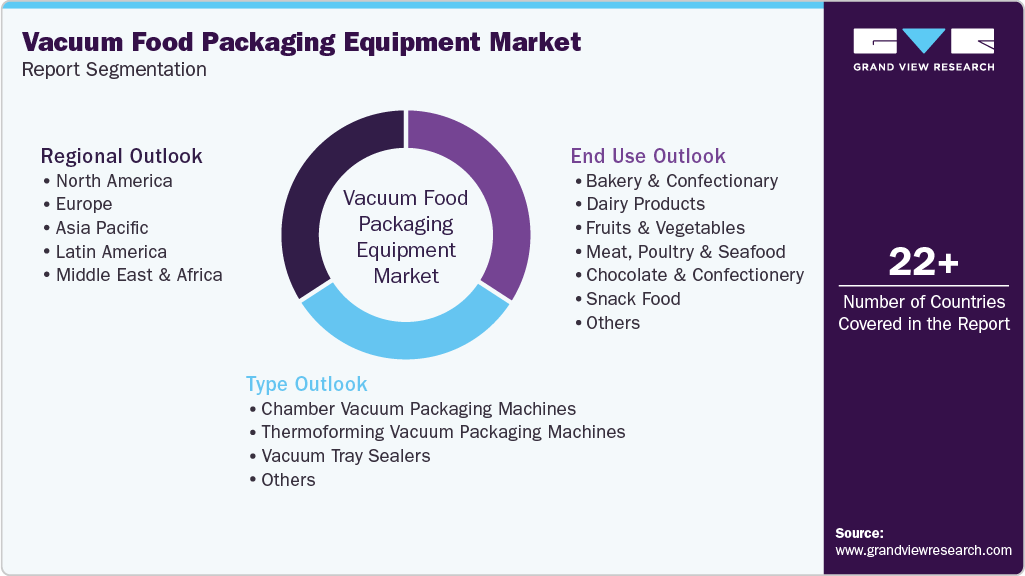
This report forecasts revenue growth at global, regional, and country levels and provides an analysis of the latest industry trends in each of the sub-segments from 2021 to 2033. For this study, Grand View Research has segmented the global vacuum food packaging equipment market report based on type, end use, and region:
-
Type Outlook (Revenue, USD Billion, 2021 - 2033)
-
Chamber Vacuum Packaging Machines
-
Thermoforming Vacuum Packaging Machines
-
Vacuum Tray Sealers
-
Others
-
-
End Use Outlook (Revenue, USD Billion, 2021 - 2033)
-
Bakery & Confectionary
-
Dairy Products
-
Fruits & Vegetables
-
Meat, Poultry & Seafood
-
Chocolate & Confectionery
-
Snack Food
-
Liquid Foods
-
Ready Meals & Convenience Food
-
Others
-
-
Regional Outlook (Revenue, USD Billion, 2021 - 2033)
-
North America
-
U.S.
-
Canada
-
Mexico
-
-
Europe
-
Germany
-
Spain
-
France
-
Italy
-
UK
-
-
Asia Pacific
-
China
-
India
-
Japan
-
Australia
-
South Korea
-
Latin America
-
Brazil
-
Argentina
-
-
Middle East and Africa
-
Saudi Arabia
-
UAE
-
South Africa
-
-
Research Methodology
The vacuum food packaging equipment market figures in this report are based on a proven research process that combines executive interviews with secondary research from proprietary databases, company filings, and recognized regulatory and institutional sources. Market size is built through value-chain sizing-reconciling supply-side and demand-side estimates-and triangulated with bottom-up and top-down approaches. Every estimate passes multiple levels of expert validation before publication, with each vacuum food packaging equipment segment quantified using the revenue-capture definitions in the table below.
Segment Definition
Segment - Type
Revenue Capture Definition
Chamber Vacuum Packaging Machines
Revenue is obtained from the sale of chamber-based machines that evacuate air from packages and seal food products within an enclosed chamber.
Thermoforming Vacuum Packaging Machines
Revenue is generated through sales of automated equipment that forms packaging material, removes air, and seals products in thermoformed packages.
Vacuum Tray Sealers
Revenue comprises sales of tray-sealing systems designed to remove air and hermetically seal food products placed in preformed trays.
Others
Revenue includes sales of external, nozzle-type, suction-type, belt-type, continuous, double-chamber, industrial, and other specialized vacuum packaging equipment
Segment-End Use
Revenue Capture Definition
Bakery & Confectionary
Revenue is derived from vacuum packaging equipment purchased for packaging bread, cakes, pastries, baked goods, and confectionery products.
Dairy Products
Revenue encompasses equipment sales to dairy manufacturers for vacuum packaging cheese, butter, and other dairy-based products.
Fruits & Vegetables
Revenue is attributable to vacuum packaging equipment used by processors and producers for packaging fresh, prepared, and processed fruits and vegetables.
Meat, Poultry & Seafood
Revenue is generated through equipment supplied for vacuum packaging fresh, chilled, frozen, and processed meat, poultry, and seafood products.
Chocolate & Confectionery
Revenue covers vacuum packaging equipment acquired by manufacturers for packaging chocolate, candies, sweets, and other confectionery products.
Snack Food
Revenue is generated by equipment sales for vacuum packaging nuts, processed snacks, meat snacks, and other snack food products.
Liquid Foods
Revenue includes sales of vacuum packaging systems utilized for packaging liquid and semi-liquid food products under controlled packaging conditions.
Ready Meals & Convenience Food
Revenue is obtained from equipment supplied for vacuum packaging prepared meals, ready-to-eat products, and other convenience food items.
Others
Revenue represents equipment sales for vacuum packaging frozen foods, processed foods, pet food, meat alternatives, sauces and condiments, ready-to-cook products, and other specialty food applications.
Estimation Model
Layer No.
Layer Name
Key Question
Description
01
Food Industry Demand Layer
Where is the demand for vacuum food packaging equipment generated?
Assess demand across bakery and confectionery, dairy products, fruits and vegetables, meat, poultry and seafood, chocolate and confectionery, snack food, liquid foods, ready meals and convenience food, and other food applications. Demand is evaluated based on food production volumes, packaged food consumption, shelf-life requirements, packaging formats, processing capacity, automation levels, and replacement requirements.
02
Food Processing & Equipment Demand Layer
Where is the demand for new vacuum food packaging equipment created?
Evaluate investments in food-processing facilities, packaging lines, cold-chain infrastructure, and production capacity across meat, seafood, dairy, bakery, snacks, prepared foods, and other applications. New facility development, production-line expansion, automation upgrades, capacity additions, and replacement of existing packaging equipment are assessed to determine requirements for new vacuum food packaging equipment.
03
Technology & Type Adoption Layer
Which configurations of vacuum food packaging equipment are being purchased?
Analyze equipment demand across Chamber Vacuum Packaging Machines, Thermoforming Vacuum Packaging Machines, Vacuum Tray Sealers, and Others. Adoption is assessed based on production volume, packaging format, product characteristics, required shelf life, sealing requirements, automation level, operating speed, equipment capacity, and suitability for specific food-processing applications.
04
Revenue Conversion Layer
How is market revenue estimated?
Convert estimated vacuum food packaging equipment demand into annual revenue based on the sales value of new equipment across defined type, end-use, and geographic segments. Revenue estimates incorporate equipment sold directly by manufacturers and through distributors, dealers, OEMs, system integrators, and other packaging equipment suppliers.
Delivered Customizations
This report has been delivered with the following In-depth customizations
Client Request
Customization Delivered
Value Adds
Competitive Benchmarking
A comprehensive benchmarking assessment was conducted among vacuum food packaging equipment manufacturers, covering equipment types, vacuum and sealing technologies, automation capabilities, packaging formats, production capacity, suitability for food applications, geographic presence, product development, and market positioning.
Enables comparison of equipment portfolios, technological capabilities, application coverage, customization capabilities, distribution networks, and supplier positioning to support competitive analysis and strategic planning.
Regional Segmentation
A detailed regional assessment was conducted across North America, Europe, Asia Pacific, Latin America, and the Middle East & Africa, examining vacuum food packaging equipment demand across bakery and confectionery, dairy products, fruits and vegetables, meat, poultry and seafood, chocolate and confectionery, snack food, liquid foods, ready meals and convenience food, and other applications. Food processing output, packaged food consumption, automation investment, production capacity, cold-chain development, and equipment replacement requirements were considered.
Helps stakeholders identify regional demand variations, evaluate food-application potential, assess equipment adoption patterns, and identify geographic markets with greater demand for vacuum packaging systems.
Opportunity Assessment
Growth opportunities were evaluated across major food-processing applications, with an emphasis on shelf-life extension, food safety, convenience-food consumption, automation, packaging efficiency, cold-chain expansion, and the adoption of chamber vacuum packaging machines, thermoforming vacuum packaging machines, and vacuum tray sealers.
Supports the identification of addressable growth areas, equipment development priorities, investment opportunities, application expansion potential, and strategies to strengthen competitive positioning in the global vacuum food packaging equipment market.
About the Author(s)
Advanced Interior Materials Research Team
Advanced Materials · Advanced Interior MaterialsThis report was authored by the advanced interior materials research team at Grand View Research - comprising two research analysts, one senior research analyst, and one industry expert - with specialized expertise in the advanced interior materials segment of the advanced materials industry. All findings are based on proprietary advanced materials databases, executive interviews, and regulatory analysis, subject to internal peer review prior to publication.
Last Updated:
Speak to Analyst


Customize this report to your needs — add regions, segments, or data points, with 20% free customization.
Or view our licence options:


ISO 9001:2015 & 27001:2022 Certified
We are GDPR and CCPA compliant! Your transaction & personal information is safe and secure. For more details, please read our privacy policy.


