
- Home
- »
- Advanced Interior Materials
- »
-
Vacuum Furnace Market Size & Share, Industry Report 2033GVR Report cover
![Vacuum Furnace Market Size, Share & Trends Report]()
Vacuum Furnace Market (2025 - 2033) Size, Share & Trends Analysis Report By Furnace Type (Vacuum Brazing Furnaces, Vacuum Heat Treatment Furnaces), By Operating Mode, By Orientation, By Application, By End-use, By Region, And Segment Forecasts
- Report ID: GVR-4-68040-775-3
- Number of Report Pages: 100
- Format: PDF
- Historical Range: 2021 - 2023
- Forecast Period: 2025 - 2033
- Industry: Advanced Materials
- Report Summary
- Table of Contents
- Segmentation
- Methodology
- Download FREE Sample
-
 Download Sample Report
Vacuum Furnace Market Summary
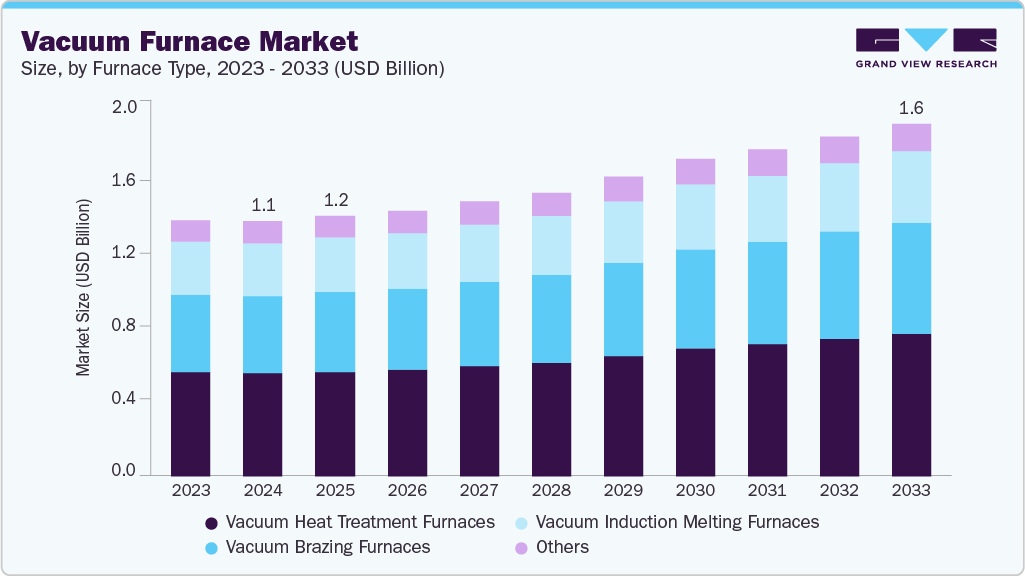
The global vacuum furnace market size was estimated at USD 1,147.1 million in 2024 and is projected to reach USD 1,586.3 million by 2033, growing at a CAGR of 3.9% from 2025 to 2033. Increasing demand for advanced materials in sectors such as aerospace, automotive, and electronics has intensified the need for highly controlled thermal processing environments, which vacuum furnaces provide efficiently.
Key Market Trends & Insights
- Asia Pacific dominated the vacuum furnace market with the largest revenue share of 43.2% in 2024.
- The vacuum furnace industry in China is experiencing growth through aggressive investments in electronics, automotive, and aerospace manufacturing.
- By furnace type, the vacuum brazing furnaces segment is expected to grow at a CAGR of 4.3% from 2025 to 2033.
- By end use, the automotive segment dominated the market in 2024, capturing a share of 30.2%.
- By operating mode, the batch furnace segment dominated the market in 2024 with a share of 72.0%.
Market Size & Forecast
- 2024 Market Size: USD 1,147.1 Million
- 2033 Projected Market Size: USD 1,586.3 Million
- CAGR (2025-2033): 3.9%
- Asia Pacific: Largest market in 2024
The precision and consistency enabled by these systems ensure optimal product quality, especially for components requiring stringent metallurgical properties. In addition, the shift toward miniaturization and complex geometries in manufacturing further necessitates the use of vacuum furnaces for heat treatment and brazing applications, cementing their importance across industries by enabling precise thermal processing that meets the stringent quality and performance requirements of modern components.
Market Concentration & Characteristics
The industry is characterized by moderate-to-high concentration with several prominent global manufacturers holding significant shares, such as Ipsen, ALD Vacuum Technologies, and SECO/WARWICK, INC. Product innovation, particularly in control systems, energy efficiency, and modularity, is a prominent competitive characteristic, with companies frequently investing in R&D and collaborative development projects. Mergers and acquisitions have played a pivotal role in shaping the industry landscape, enabling firms to expand product portfolios and global distribution reach. These transactions often result in the integration of advanced system technologies and new service offerings, increasing competition and fostering further innovation.
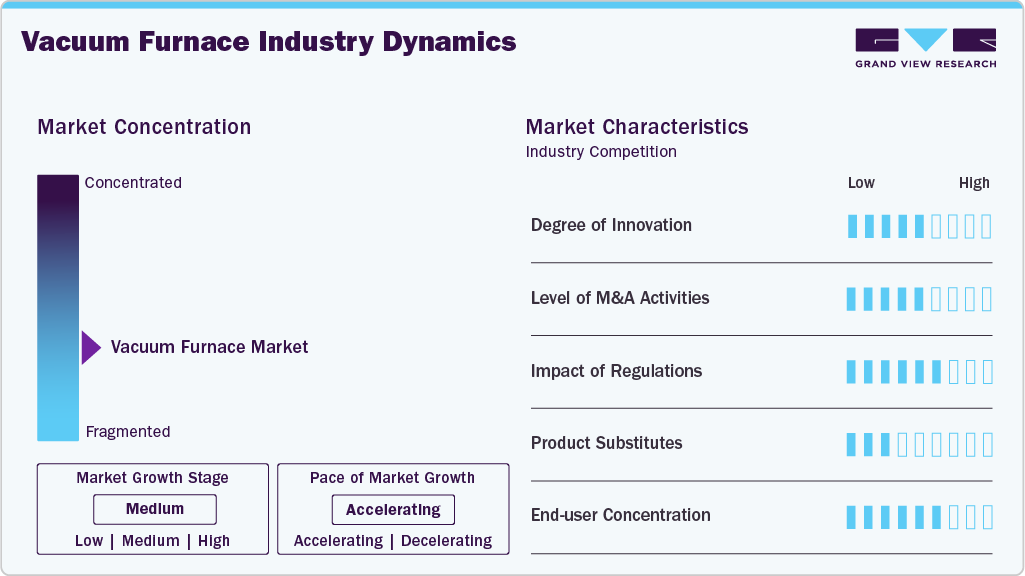
Regulatory influences continue to shape product characteristics and market deployment, driving upgrades for compliance and stimulating new product introductions. Service substitutes such as outsourcing heat treatment or adopting alternative thermal processing methods exert selective pressure, but specialized furnace performance remains irreplaceable in critical applications like aerospace and electronics. End-user concentration is highest in a few key sectors, with automotive, aerospace, and electronics accounting for strong demand, ensuring both stability and targeted competition among manufacturers.
Drivers, Opportunities & Restraints
The vacuum furnace market is driven by growing demand for advanced materials in aerospace, automotive, and electronics, where precise thermal processing is critical for product quality. Technological innovations such as automation, remote monitoring, and energy-efficient designs are enhancing operational efficiency and sustainability. Furthermore, strict regulatory standards on emissions, energy use, and safety are encouraging the adoption of advanced furnace technologies to ensure compliance and competitive advantage.
The global market faces challenges such as the high initial capital investment and maintenance costs, which can be prohibitive for small and medium-sized manufacturers. Complex operation and the need for skilled labor also limit widespread adoption in some regions. Besides, competition from alternative heat treatment technologies that offer lower costs or simpler processes can restrain market growth. Supply chain disruptions and fluctuations in raw material prices may further impact production and availability of vacuum furnace systems.
There are significant growth opportunities driven by increasing demand for vacuum furnaces in emerging sectors such as electric vehicles, renewable energy, and additive manufacturing, where precision and quality are paramount. Advances in digitalization, such as Industry 4.0 integration and IoT-enabled predictive maintenance, provide scope for enhanced efficiency and reduced downtime. Expansion into untapped geographic markets with growing industrial infrastructure, especially in the Asia Pacific and Latin America, also presents substantial potential. Furthermore, ongoing development of modular, energy-efficient, and hybrid vacuum furnace systems aligns with sustainability trends, offering manufacturers competitive advantages.
Furnace Type Insights
The vacuum heat treatment furnaces segment dominated the market in 2024, accounting for a share of 40.4% and driven by widespread adoption across high-precision industries like aerospace, automotive, and tool & die manufacturing. The segment’s dominance is attributed to its ability to provide contamination-free, consistent thermal processing that improves mechanical properties and product reliability.
The vacuum brazing furnaces segment growth is supported by rising demand for high-precision joining processes in industries such as aerospace, automotive, and electronics. Technological advancements like IoT-enabled process controls and enhanced thermal uniformity are improving brazing quality and efficiency, driving adoption..
Orientation Insights
The vertical furnace segment led the market in 2024 holding 60.3% share, driven by increasing demand in industries such as aerospace, automotive, and power generation that require precise and energy-efficient heat treatment processes. Innovations in furnace design, including enhanced automation and multi-chamber configurations, are further boosting adoption rates for vertical furnaces, especially for high-volume and high-performance applications. Technological advancements and a focus on sustainability are also contributing factors, promoting efficient operation and environmental compliance in this expanding market.
The horizontal furnace segment is supported by its capacity to handle larger, heavier components with uniform heat distribution, making it well-suited for industries such as aerospace and automotive. Its design facilitates efficient loading and unloading, enhancing productivity while maintaining high precision during heat treatment processes. The segment’s growth is further driven by rising demand for batch processing and scalability in manufacturing operations requiring consistent quality and throughput.
Application Insights
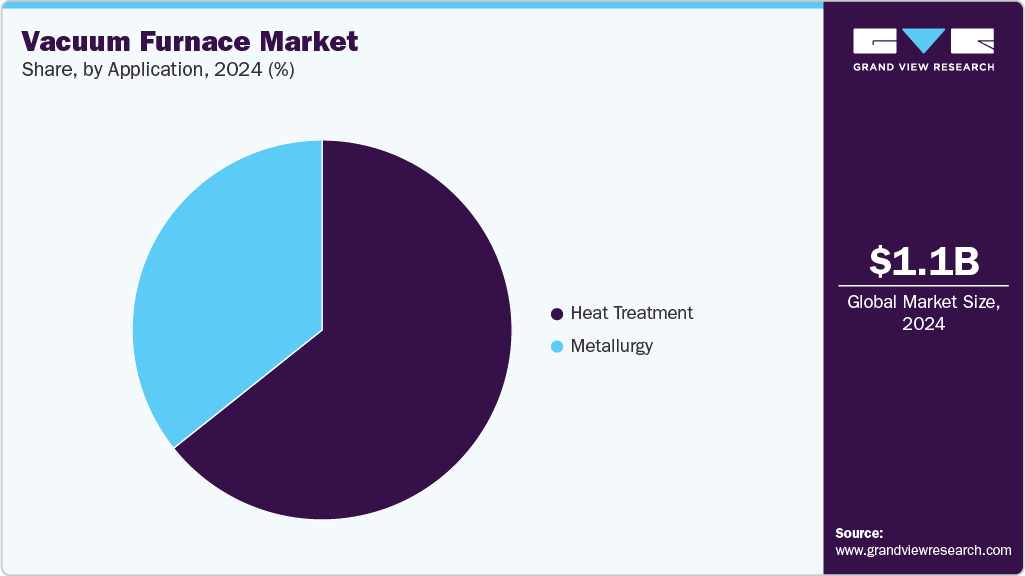
The heat treatment segment dominated the market in 2024, accounting for a share of 64.3% due to its crucial role in delivering precise and clean processing for critical industries such as aerospace, automotive, and medical devices. Robust demand for components with enhanced material properties and stringent quality requirements has driven industries to favor vacuum heat treatment over conventional methods.
The increasing requirement for high-performance alloys and specialty metals across industries such as aerospace, automotive, and electronics is fostering the adoption of vacuum furnaces for heat treatment applications. The use of vacuum furnaces enables contamination-free processing at high temperatures, enabling metallurgical operations to achieve superior material properties and reliability, which is especially critical as metals are increasingly deployed in safety-critical and high-value applications.
Operating Mode Insights
The batch furnace segment dominated the market in 2024 with a share of 72.0%, driven by its suitability for low to medium production volumes requiring high precision and flexibility. This segment benefits from widespread use across diverse industries such as aerospace, automotive, and electronics, where customized thermal processes, including heat treatment, sintering, and brazing, are critical.
The continuous furnace segment is driven by the increasing demand for high-throughput, consistent thermal processing in industries such as automotive, aerospace, and electronics. Continuous furnaces offer advantages in automation, energy efficiency, and process uniformity, which cater well to mass production environments. Moreover, advancements in furnace design and control technologies further enhance performance, making continuous furnaces a preferred choice for large-scale manufacturing applications.
End Use Insights
The automotive segment dominated the market in 2024, capturing a share of 30.2%. The growth is driven by the increasing demand for lightweight, high-strength components and advanced coatings that improve vehicle performance and fuel efficiency. Vacuum furnaces are widely adopted for heat treatment processes like hardening, annealing, and brazing, of automotive parts, which require precision and contamination-free environments.
The aerospace and defense segment is projected to expand due to increasing demand for high-performance, lightweight, and durable materials in aircraft and defense applications. Vacuum furnaces are critical in producing components such as turbine blades and structural parts that require precise heat treatment to ensure strength and reliability under extreme conditions. Technological advancements and stringent regulatory standards further drive the adoption of vacuum furnace technologies in this sector.
Regional Insights
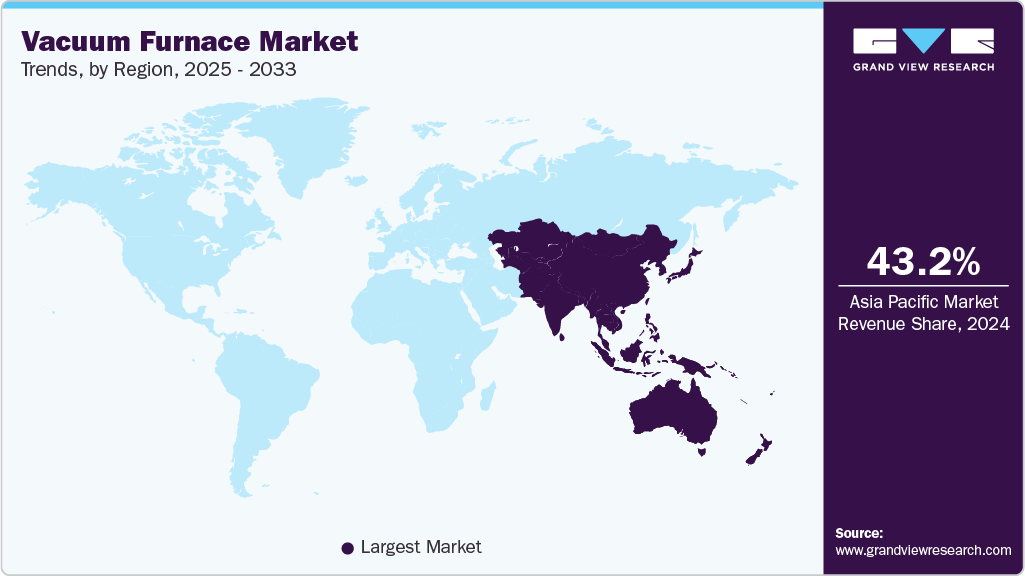
The Asia Pacific vacuum furnace industry dominated the global revenue share in 2024, registering 43.2% share. The regional growth is driven by rapid industrialization, technology upgrades in electronics and semiconductor manufacturing, and strong automotive sector expansion. Government-led investments in high-tech infrastructure and materials science R&D bolster vacuum furnace adoption for diverse applications. Local manufacturers increasingly prioritize modernization to improve competitiveness, contributing to robust market growth and continuous technology evolution in furnace designs.
China Vacuum Furnace Market Trends
The vacuum furnace industry in China is experiencing growth through aggressive investments in electronics, automotive, and aerospace manufacturing. The government’s drive for high-value exports and industrial upgrading fuels widespread adoption of advanced heat treatment equipment. Efforts to achieve higher product quality and meet international standards are other critical growth drivers.
The India vacuum furnace industry is fueled by increasing industrialization, expansion in defense manufacturing, and a focus on developing indigenous advanced manufacturing capabilities. Rising electronics production and automotive sector advancements necessitate modern vacuum furnace installations. In addition, the country’s emphasis on infrastructure and R&D supports ongoing demand in this segment.
North America Vacuum Furnace Market Trends
The North America vacuum furnace industry is driven by sustained investments in aerospace and defense manufacturing, alongside growing demand for high-performance automotive components. The presence of a sophisticated industrial base, strong regulatory framework, and commitment to advanced manufacturing practices support adoption. Regional emphasis on quality assurance, traceability, and compliance with federal standards further compounds demand for precision heat treatment technologies, making vacuum furnaces essential for mission-critical production environments.
The vacuum furnace industry in the U.S. is propelled by the ongoing modernization of aerospace and defense manufacturing, as well as the resurgence of domestic automotive production. There is strong demand from high-tech industries for precision heat treatment, coupled with rising adoption of digitalized, energy-efficient systems. The push for advanced materials and strict adherence to regulatory standards further supports ongoing investment in vacuum furnace technologies.
The Mexico vacuum furnace industry is primarily driven by the country’s expanding automotive industry and increasing integration into global supply chains. Demand for technologically advanced manufacturing processes, including high-performance heat treatment, is prompting wider adoption of vacuum furnaces among local and export-oriented manufacturers. The rise of advanced component manufacturing and repair also encourages upgrades from conventional systems.
Europe Vacuum Furnace Market Trends
The Europe vacuum furnace industry benefits from stringent environmental regulations, robust metallurgical research, and high investment in sustainable manufacturing processes. The automotive and industrial machinery sectors actively seek vacuum furnace solutions to meet rigorous quality standards and support lightweighting initiatives. Collaboration between research institutes and manufacturers enhances the pace of innovation, driving demand for energy-efficient furnace systems and advanced process control capabilities.
The vacuum furnace industry in the UK is influenced by robust activity in advanced engineering, aerospace, and medical device manufacturing. The shift toward lightweight alloys and stringent quality standards has heightened reliance on precise heat treatment technologies. Investments in sustainable manufacturing and energy efficiency are spurring the adoption of next-generation vacuum furnace systems.
The Germany vacuum furnace industry is characterized by innovation in the automotive, machinery, and electronics sectors, where high-quality thermal processing is essential. Regulatory emphasis on environmental impact and process reliability leads manufacturers to upgrade to energy-efficient and automated furnaces. Germany’s strong R&D ecosystem further encourages continuous technology advancement in this market segment.
Latin America Vacuum Furnace Market Trends
The Latin America vacuum furnace industry is influenced by a rising focus on value-added manufacturing and upgrades in industrial infrastructure, particularly within automotive, mining, and energy sectors. The region’s push for export-oriented production has fostered the implementation of advanced heat treatment technologies to meet international quality standards. Regulatory reforms and incentives aimed at process modernization continue to support market expansion.
The vacuum furnace industry in Brazil benefits from gradual modernization of the automotive and aerospace industries, as well as government initiatives for local manufacturing advancement. There is growing demand for high-performance materials processing and export-quality manufacturing standards. The adoption of international quality benchmarks further supports market growth.
Middle East & Africa Vacuum Furnace Market Trends
The Middle East & Africa vacuum furnace industry is driven by ongoing diversification in industrial sectors, including oil & gas equipment, aerospace, and mining. Investments in metallic component manufacturing and repair operations, together with strategic partnerships for technology transfer, stimulate the adoption of vacuum furnace systems. The region’s industrialization agenda and rising quality requirements ensure steady demand for precision thermal processing solutions.
The vacuum furnace industry in Saudi Arabia is expanding due to diversification in the industrial sector and increased investments in non-oil industries such as aerospace, metals, and electronics. Regulatory support for advanced manufacturing and strategic technology partnerships is accelerating the uptake of vacuum furnace systems for critical heat treatment applications.
Key Vacuum Furnace Company Insights
Some of the key players operating in the market include SECO/WARWICK, INC., and PVA TePla AG, among others.
-
PVA TePla AG is a company specializing in advanced process technologies for the semiconductor, metal, electronics, and optical industries. The company operates through two main segments: Semiconductor Systems and Industrial System. The company’s industrial systems segment provides systems for material production, surface treatment, and non-destructive quality inspection using technologies like vacuum heat treatment and ultrasonic testing.
-
SECO/WARWICK, INC., part of the SECO/WARWICK Group, is a global company engaged in the design and manufacturing of heat treatment and thermal processing equipment. The company operates through multiple divisions across North America, Europe, China, and India, catering to industries such as automotive, aerospace, energy, electronics, medical, and metallurgy.
Key Vacuum Furnace Companies:
The following are the leading companies in the vacuum furnace market. These companies collectively hold the largest market share and dictate industry trends.
- SECO/WARWICK, INC
- Ipsen
- ECM Technologies
- Centorr Vacuum Industries
- ALD Vacuum Technologies
- Camco Furnace
- IVA SCHMETZ GmbH
- Thermal Technology
- Shanghai Gehang Vacuum Technology Co., Ltd
- T-M Vacuum Products, Inc
- ULVAC, Inc.
- Shimadzu Corporation
- PVA TePla AG
- Nabertherm GmbH
- Hunan Fengpu Technology Co., Ltd.
Recent Developments
-
In August 2024, PVA TePla AG announced a partnership agreement Scientific Visual SA. This partnership, involving a 25% stake acquisition, aims to enhance the company’s silicon carbide (SiC) quality control capabilities. This collaboration leverages Scientific Visual's advanced inspection technology to improve SiC crystal growth and production yield, benefiting sectors like e-mobility. Potentially, this partnership could positively impact PVA TePla's furnace business by increasing demand for high-quality SiC production equipment, such as CVD furnaces, which are crucial for SiC wafer production.
-
In July 2024, SECO/WARWICK announced it was establishing a new sales and service office in Monterrey, Mexico, to strengthen its presence in Latin America by offering closer support to regional heat treatment partners. The office is reported to be initially operating from about 2,000 square feet and focusing on making sales, field service, and aftermarket support more accessible across Mexico and Central/South America.
Vacuum Furnace Market Report Scope
Report Attribute
Details
Market size value in 2025
USD 1,172.3 million
Revenue forecast in 2033
USD 1,586.3 million
Growth rate
CAGR of 3.9% from 2025 to 2033
Base year for estimation
2024
Historical data
2021 - 2023
Forecast period
2025 - 2033
Quantitative units
Revenue in USD million & CAGR from 2025 to 2033
Report coverage
Revenue forecast, company market position analysis, competitive landscape, growth factors, and trends
Segments covered
Furnace type, orientation, application, operating mode, end use, region
Regional scope
North America; Europe; Asia Pacific; Latin America; Middle East & Africa
Country Scope
U.S.; Canada; Mexico; UK; Germany; France; Spain; Italy; China; India; Japan; Australia; South Korea; Brazil; Argentina; Saudi Arabia; South Africa; UAE
Key companies profiled
SECO/WARWICK, INC; Ipsen; ECM Technologies; Centorr Vacuum Industries; ALD Vacuum Technologies; Camco Furnace; IVA SCHMETZ GmbH; Thermal Technology; Shanghai Gehang Vacuum Technology Co., Ltd; T-M Vacuum Products, Inc; ULVAC, Inc.; Shimadzu Corporation; PVA TePla AG; Nabertherm GmbH; Hunan Fengpu Technology Co., Ltd.
Customization scope
Free report customization (equivalent up to 8 analysts working days) with purchase. Addition or alteration to country, regional & segment scope.
Pricing and purchase options
Avail customized purchase options to meet your exact research needs. Explore purchase options
Global Vacuum Furnace Market Report Segmentation
This report forecasts revenue growth at global, regional & country levels and provides an analysis on the industry trends in each of the sub-segments from 2021 to 2033. For this study, Grand View Research has segmented the global vacuum furnace market report on basis of furnace type, orientation, application, operating mode, end use, and region:
-
Furnace Type Outlook (Revenue, USD Million, 2021 - 2033)
-
Vacuum Brazing Furnaces
-
Vacuum Heat Treatment Furnaces
-
Vacuum Induction Melting Furnaces
-
Others
-
-
Orientation Outlook (Revenue, USD Million, 2021 - 2033)
-
Horizontal Furnaces
-
Vertical Furnaces
-
-
Application Outlook (Revenue, USD Million, 2021 - 2033)
-
Metallurgy
-
Heat Treatment
-
-
Operating Mode Outlook (Revenue, USD Million, 2021 - 2033)
-
Batch Furnaces
-
Continuous Furnaces
-
-
End Use Outlook (Revenue, USD Million, 2021 - 2033)
-
Aerospace & Defense
-
Automotive
-
Electronics
-
Healthcare
-
Energy
-
Oil & Gas
-
Others
-
-
Regional Outlook (Revenue, USD Million, 2021 - 2033)
-
North America
-
U.S.
-
Canada
-
Mexico
-
-
Europe
-
UK
-
Germany
-
France
-
Spain
-
Italy
-
-
Asia Pacific
-
China
-
India
-
Japan
-
South Korea
-
Australia
-
-
Latin America
-
Brazil
-
Argentina
-
-
Middle East & Africa
-
Saudi Arabia
-
South Africa
-
UAE
-
-
Frequently Asked Questions About This Report
b. The global vacuum furnace market size was estimated at USD 1,147.1 million in 2024 and is expected to reach USD 1,172.3 million in 2025.
b. The vacuum furnace market, in terms of revenue, is expected to grow at a compound annual growth rate of 3.9% from 2025 to 2033 to reach USD 1,586.3 million by 2033.
b. The market in Asia Pacific dominated the global revenue share in 2024 accounting for 43.2% driven largely by rapid industrialization, infrastructure investment, and expansion in sectors such as automotive, electronics, and aerospace.
b. Some of the key players operating in the market are SECO/WARWICK, INC, Ipsen, ECM Technologies, Centorr Vacuum Industries, ALD Vacuum Technologies, Camco Furnace, IVA SCHMETZ GmbH, Thermal Technology, Shanghai Gehang Vacuum Technology Co., Ltd, T-M Vacuum Products, Inc, ULVAC, Inc., Shimadzu Corporation, PVA TePla AG, Nabertherm GmbH, and Hunan Fengpu Technology Co., Ltd.
b. Key factors driving growth of the vacuum furnace market include increasing demand from sectors like aerospace, automotive, and electronics for high performance, precision treated components, and rising pressure for energy efficiency and environmental compliance which is pushing adoption of more advanced, vacuum based heat treatment technologies.


Share this report with your colleague or friend.
Need a Tailored Report?
Customize this report to your needs — add regions, segments, or data points, with 20% free customization.


ISO 9001:2015 & 27001:2022 Certified
We are GDPR and CCPA compliant! Your transaction & personal information is safe and secure. For more details, please read our privacy policy.
Trusted market insights - try a free sample
See how our reports are structured and why industry leaders rely on Grand View Research. Get a free sample or ask us to tailor this report to your needs.













