
- Home
- »
- Consumer F&B
- »
-
Vegan Baking Ingredients Market Size Report, 2026-2033GVR Report cover

Vegan Baking Ingredients Market (2026 - 2033)
Size, Share & Trends Analysis Report By Product (Flour, Oils, Sweeteners, Flavoring Agents), By Application (Cakes & Pastries, Breads & Rolls, Biscuits & Cookies), By Region, And Segment Forecasts
Market Size, 2025
$1.6BMarket Estimate, 2026
$1.7BMarket Forecast, 2033
$2.7BCAGR, 2026–2033
6.2%Vegan Baking Ingredients Market Summary
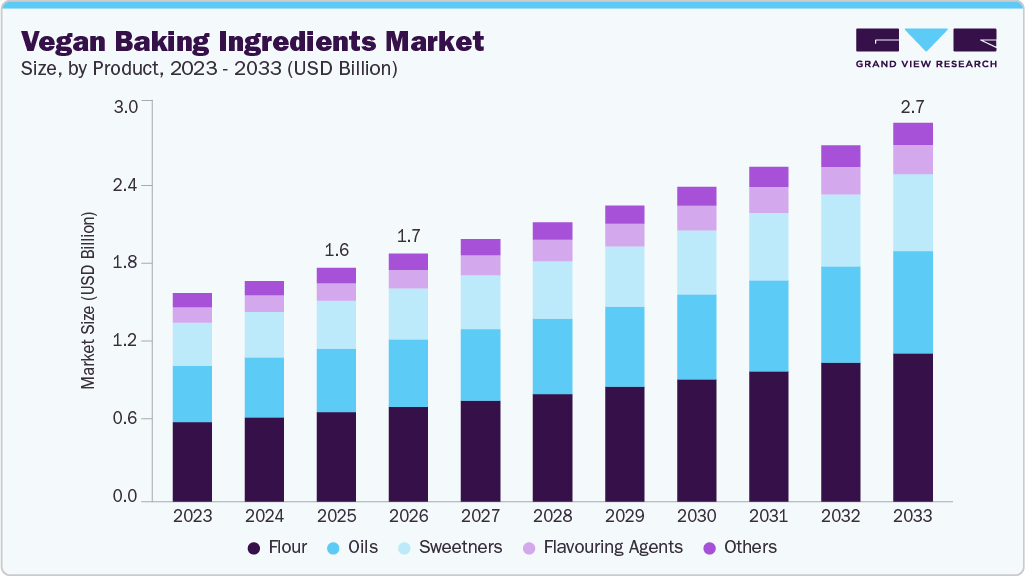
The global vegan baking ingredients market size was valued at USD 1.6 billion in 2025 and is projected to grow from USD 1.7 billion in 2026 to USD 2.7 billion by 2033, at a CAGR of 6.2% from 2026 to 2033. The market in Europe dominated with a revenue share of 33.2% in 2025. The industry is expanding rapidly as plant-based eating moves from niche to mainstream.
 Source: Grand View Research, IR Documents, Primary Interviews, Paid DatabasesTo learn more about this report,
 Download Free Sample Report
 Key Market Trends & Insights
- By product: Flour segment held the largest market share of 38.3% in 2025.
- By application: Breads & rolls segment held the largest market share of 43.9% in 2025.
Regional Highlights
- Largest regional market: Europe (33.2% revenue share, 2025)
- Fastest-growing regional market: Asia Pacific (highest CAGR, 2026-2033)
- By country: UK held the largest market share in 2025
Market Size & Forecast
- Market size in 2025: USD 1.6 Billion
- Estimated market size in 2026: USD 1.7 Billion
- Projected market size by 2033: USD 2.7 Billion
- CAGR (2026-2033): 6.2%
Three ways to get this report
Buy it, customize it, or ask a question.Ask an Analyst
Analyst response in 1 business day
- AccessReport author, directly
- Reply timeWithin 1 working day
- No sales callDirect answer only
- FormatEmail reply
- CostFree, no cost
Get the Full Report
What the study covers
- FormatsPDF · Excel · Dashboard
- Timeline2026–2033 annual, 2025 base
- Coverage20+ countries, 5 regions
- Companies10+ key players profiled
Customize the Report
20% free customization
- IncludeCountries, segments, points
- TailorTo your product definition
- ExtendDeeper competitor detail
- OrA fully bespoke study
- Turnaround5–10 working days
Consumers are increasingly choosing products that exclude dairy, eggs, and other animal-derived ingredients due to ethical concerns about animal welfare, greater awareness of food allergens, and a desire for cleaner nutrition profiles. What once began as a lifestyle trend has now become a structural shift in how households and commercial bakeries formulate cakes, breads, cookies, and pastries.Traditional baking ingredients, especially butter, dairy, and eggs, are associated with cholesterol, lactose, and saturated fats, which many modern buyers actively try to reduce. At the same time, vegan formulations often overlap with broader “free-from” preferences such as lactose-free, gluten-free, non-GMO, and low-sugar alternatives. This convergence allows vegan baking ingredients to attract not only vegans, but also flexitarians, people with dietary sensitivities, and wellness-driven consumers who perceive plant-based substitutes as lighter and more digestible.
 To learn more about this report, Download Free Sample Report
 Sustainability and environmental consciousness are also shaping demand. Baking is a high-frequency category in packaged foods, so ingredient choices have a significant impact on carbon footprint. As awareness grows around issues such as greenhouse emissions from dairy supply chains and industrial farming practices, consumers and bakers alike are prioritizing plant-based flours, oils, sweeteners, and binding agents. This preference reinforces long-term adoption because the purchase decision is often values-driven rather than price-driven alone.
Innovation in ingredient technology has further accelerated acceptance. Functional substitutes such as plant-based binding systems, dairy-free butters and shortenings, alternative proteins, nut- and grain-based flours, and efficient egg replacers have significantly improved performance parity with conventional baking. Modern vegan ingredients now deliver better structure, moisture retention, rise, and mouthfeel, addressing historical barriers such as dry texture or weak binding. These R&D-led improvements give both home bakers and commercial food manufacturers greater confidence to reformulate without compromising taste or shelf appeal.
Consumer Insights
Consumer interest in vegan baking ingredients is rising as food choices increasingly combine indulgence with health, ethics, and sustainability. Many buyers now perceive traditional staples like milk, butter, and eggs as heavy, allergenic, or high in saturated fat and cholesterol, while vegan substitutes feel cleaner, lighter, and easier to digest. This health-led mindset is driving stronger acceptance of plant-based flours, dairy-free fats, and egg-free binders not only among core vegans but also among flexitarians and people experimenting with plant-forward diets. Baking is also becoming more ingredient-transparent as consumers look for recognizable labels, fewer additives, and products that fit dietary restrictions such as lactose or egg intolerance.
 To learn more about this report, Download Free Sample Report
 Taste and texture remain non-negotiable expectations, revealing an important insight: people buy vegan ingredients only when performance comes close to that of conventional baking. Modern buyers expect a good rise, moisture, a soft crumb, and a neutral flavor base that can absorb natural enhancers like cocoa, matcha, or fruit notes. This trend is shaping formulation preferences toward nut-based and gluten-free flours such as almond and coconut blends, plant oils that mimic butter functionality, and functional starches or natural proteins that replace eggs in binding. The acceleration of ingredient innovation has boosted consumer confidence as many now believe vegan baking can deliver sensory parity without compromising wellness-identity goals.
Shopping behavior highlights another shift vegan baking ingredients are no longer limited to niche health stores and are increasingly being trialed via mainstream retail and digital-commerce carts. Supermarkets and pharmacies are enabling visibility, but online platforms are driving product discovery, recipe influence, and routine repurchases, especially in urban and younger demographics.
Product Insights
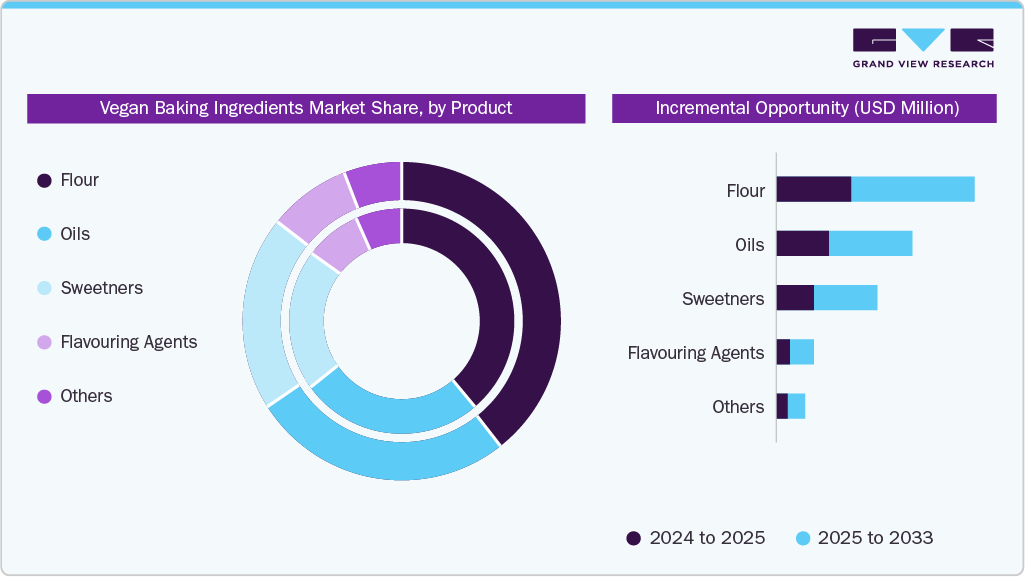
Flour held a market share of 38.3% in 2025 in the global market. Bakers and manufacturers increasingly adopt options like coconut milk powder, oat-based creamers, almond milk powder, and aquafaba to match taste and texture of conventional recipes, without allergens or cholesterol. Flavor innovation has become a key differentiator-natural extracts, cocoa-based blends, fruit essences, vanilla bean infusions, and fermentation-derived buttery or cheesy notes drive higher product usage, particularly in sweet and indulgent bakery categories.
The flavoring agents market is projected to grow at a CAGR of 6.4% from 2026 to 2033. The market is expanding as consumers increasingly favor plant-derived, allergen-friendly, and ethically positioned formulations. Bakers and brands are shifting to dairy-free flavor carriers (coconut, oat, almond bases) and natural taste enhancers (botanicals, spices, extracts) to replace butter, milk solids, and artificial emulsions, aligning with clean-label expectations.
Application Insights
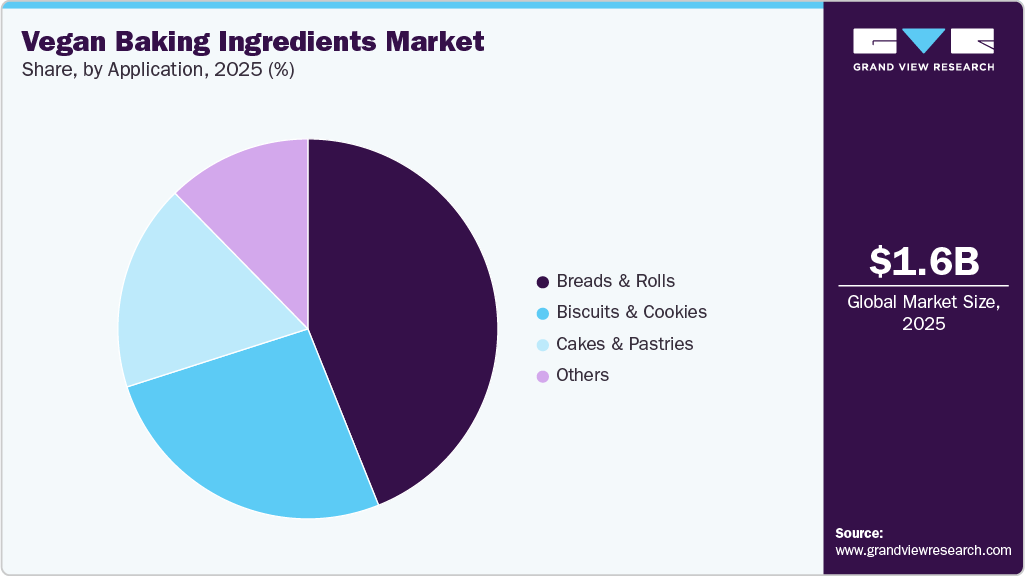
Breads & rolls held a market share of 43.9% in 2025 in the global vegan baking ingredients industry. The demand for vegan baking ingredients in breads and rolls is rising as consumers increasingly favor plant-based, cholesterol-free, and allergen-reduced diets, pushing bakeries to replace traditional dairy, eggs, and butter-based ingredients. Growth is driven by higher penetration of vegan lifestyle choices among urban millennials & Gen-Z, clean-label demands, and the need for sustainable ingredient sourcing that reduces carbon footprint in commercial bakery supply chains. Functional substitutes such as coconut milk powder, aquafaba, pea proteins, and dairy-free emulsifiers improve moisture retention, softness, and dough stability, helping manufacturers match the texture of conventional breads and rolls without animal derivatives.
 To learn more about this report, Download Free Sample Report
 The biscuits & cookies segment is projected to grow at a CAGR of 6.6% from 2026 to 2033. The industry is rising as consumers increasingly shift toward plant-based, lactose-free, and allergen-friendly diets, pushing manufacturers to reformulate mass-market bakery portfolios. Functional dairy and egg replacements such as coconut milk powder, oat flour, soy proteins, almond paste, and emulsifiers like lecithin deliver comparable texture, fat distribution, and moisture retention needed for cookies and biscuits without compromising shelf stability.
Regional Insights
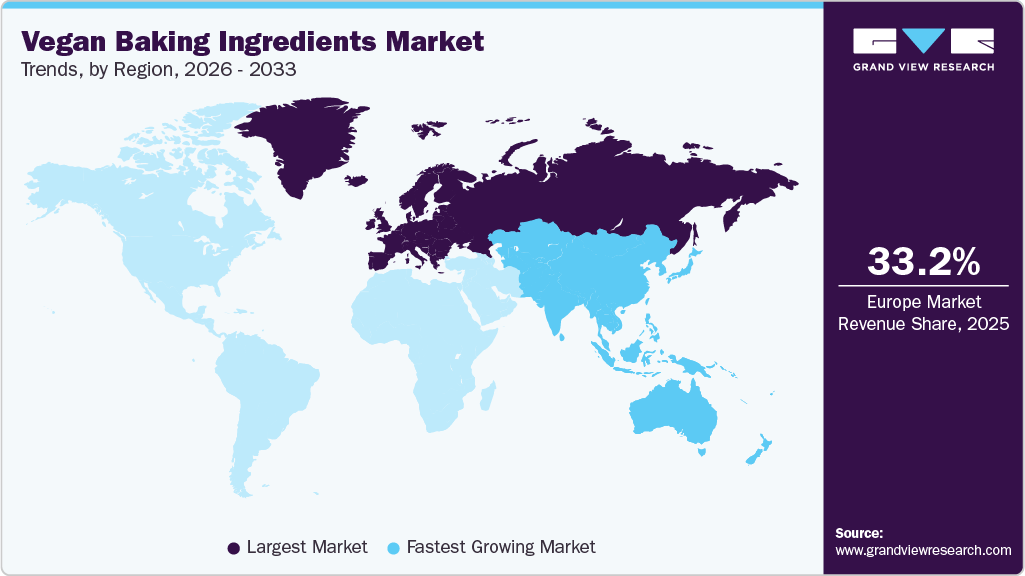
The vegan baking ingredients industry in Europe accounted for a share of 33.2% in 2025. Demand is growing strongly as more consumers shift toward plant-based, dairy-free, and egg-free diets, driven by health, environmental, and animal-welfare concerns. At the same time, Europe’s long-standing baking and dessert culture adapts to these lifestyle changes: traditional breads, cakes, pastries, and baked goods are being reformulated using flours, plant oils, egg replacers, and other vegan-friendly substitutes, making it easier for both home bakers and professional bakers to meet vegan preferences without sacrificing taste or texture.
 To learn more about this report, Download Free Sample Report
 The UK vegan baking ingredients industry is expected to witness a growth rate of 5.2% over the forecast period. Rising demand for vegan baking ingredients in the UK reflects a growing shift toward plant-based diets and ethical, environmental, and health-conscious eating. More consumers, including not just vegans, but flexitarians and mainstream households are opting for plant-based alternatives when baking, driven by concerns over animal welfare, sustainability, and desire for “clean-label” foods. In addition, innovation in vegan bakery formulations such as plant-based butter substitutes, aquafaba for meringues, and gluten-free vegan flours is improving taste and texture, reducing traditional barriers around quality and variety.
North America Vegan Baking Ingredients Market Trends
The vegan baking ingredients industry in North America is expected to grow at a CAGR of 6.2% from 2026 to 2033. The regional market is rising because of evolving consumer preferences toward health, sustainability, and lifestyle-driven dietary choices, particularly among younger generations. As more people in the U.S. and Canada adopt vegan, vegetarian, or flexitarian diets (or just reduce animal products), demand increases for plant-based baking components that replicate dairy, eggs, and other conventional baking ingredients without compromising taste or texture.
Asia Pacific Vegan Baking Ingredients Market Trends
The vegan baking ingredients industry in the Asia Pacific is expected to witness a growth rate of 6.9% over the forecast period. The market is rising rapidly across Asia Pacific as dietary behavior shifts toward plant-based, lactose-free, and allergen-reduced eating patterns, particularly among younger urban consumers. Increased awareness of dairy sensitivity, cholesterol-controlled diets, and sustainability impacts is pushing households and commercial bakeries to replace butter, milk solids, and egg emulsifiers with coconut, soy, oat, and pulse-based alternatives. Countries such as Indonesia, India, China, Thailand, and Australia are seeing a surge in vegan recipe discovery through social platforms, while expanding retail availability of dairy-free mixes, stabilizers, and creamers is reducing trial friction.
Key Vegan Baking Ingredients Company Insights
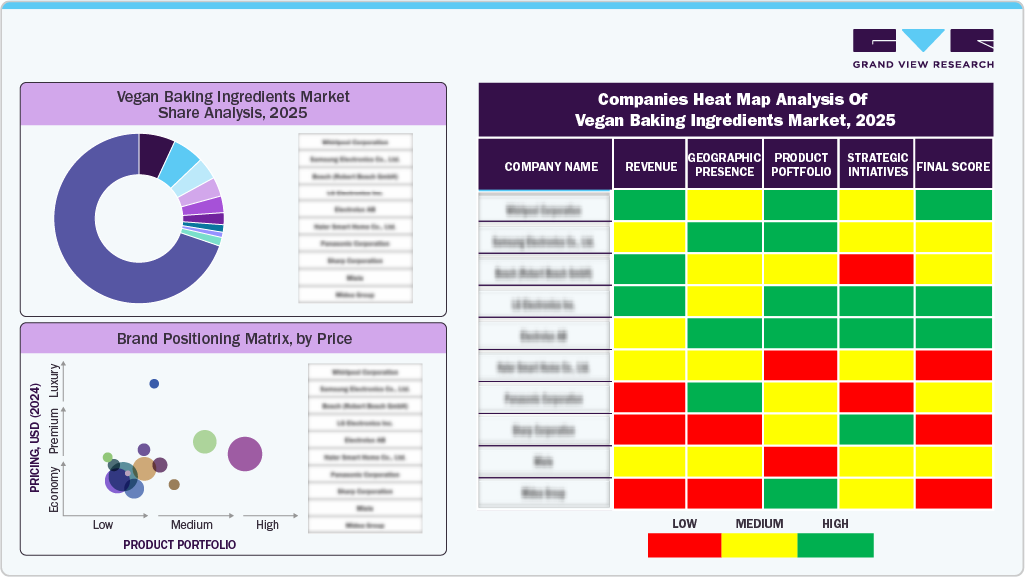
The global market is experiencing strong momentum, driven by evolving consumer and industrial priorities. Demand for plant-based bakery components is rising as households and commercial manufacturers seek dairy-free, egg-free, and clean-label formulations that offer functional parity in texture, foaming, and fat performance. Growth is further accelerated by increasing adoption of vegan premixes, plant creamers, natural sweeteners, and non-GMO structuring agents in mainstream bakery, alongside higher awareness of ingredient transparency on product labels.
 To learn more about this report, Download Free Sample Report
 Key Vegan Baking Ingredients Companies:
The following key companies have been profiled for this study on the vegan baking ingredients market
- Associated British Foods plc
- Cargill
- Archer Daniels Midland Company (ADM)
- Ingredion Incorporated
- Tate & Lyle plc
- IFF, Inc.
- Kerry Group plc
- Koninklijke DSM N.V.
- Corbion N.V.
- Dawn Food Products Inc.
- Bakels Group
Vegan Baking Ingredients Market Report Scope
Report Attribute
Details
Market size in 2025
USD 1.6 billion
Estimated market size in 2026
USD 1.7 billion
Projected market size by 2033
USD 2.7 billion
Growth rate
CAGR of 6.2% from 2026 to 2033
Base year for estimation
2025
Historical data
2021 - 2025
Forecast period
2026 - 2033
Quantitative units
Revenue in USD million/billion and CAGR from 2026 to 2033
Report coverage
Revenue and volume forecast, company ranking, competitive landscape, growth factors, and trends
Segments covered
Product, application, region
Regional scope
North America; Europe; Asia Pacific; Central & South America, Middle East and Africa
Country scope
U.S.; Canada; Mexico; UK; Germany; France; Italy; Spain; China; India; Japan; Australia; South Korea; Brazil; Argentina; Saudi Arabia; UAE
Key companies profiled
Associated British Foods plc; Cargill; Archer Daniels Midland Company (ADM); Ingredion Incorporated; Tate & Lyle plc; IFF, Inc.; Kerry Group plc; Koninklijke DSM N.V.; Corbion N.V.; Dawn Food Products Inc.; Bakels Group
Customization scope
Free report customization (equivalent up to 8 analysts’ working days) with purchase. Addition or alteration to country, regional & segment scope.
Pricing and purchase options
Avail customized purchase options to meet your exact research needs. Explore purchase options
Global Vegan Baking Ingredients Market Report Segmentation
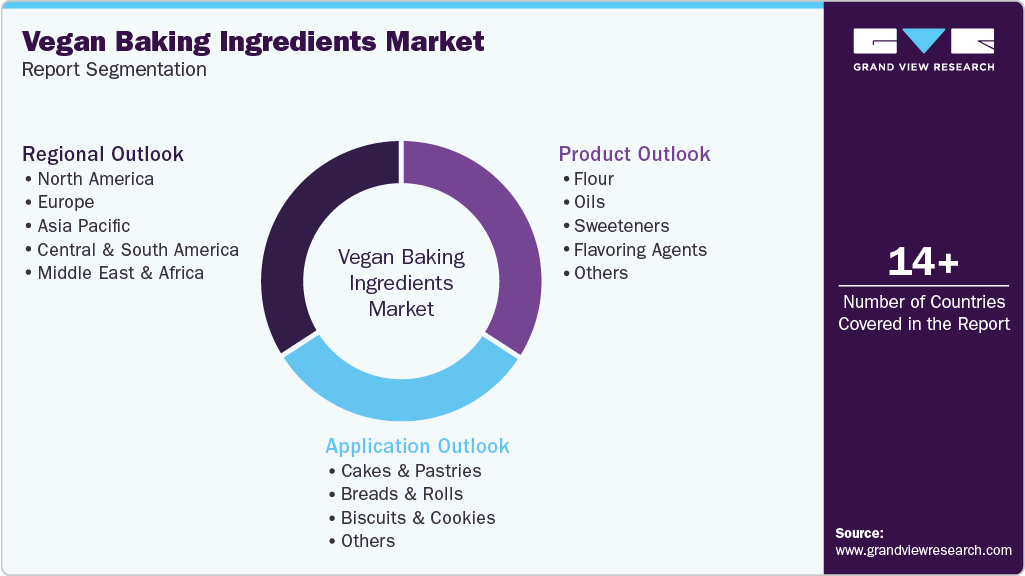
This report forecasts revenue growth at global, regional & country levels and provides an analysis on the latest trends and opportunities in each of the sub-segment from 2021 to 2033. For the purpose of this study, Grand View Research has segmented the global vegan baking ingredients market report on the basis of product, application, and region.
 To learn more about this report, Download Free Sample Report
 -
Product Outlook (Revenue, USD Million, 2021 - 2033)
-
Flour
-
Oils
-
Sweeteners
-
Flavoring Agents
-
Others
-
-
Application Outlook (Revenue, USD Million, 2021 - 2033)
-
Cakes & Pastries
-
Breads & Rolls
-
Biscuits & Cookies
-
Others
-
-
Regional Outlook (Revenue, USD Million, 2021 - 2033)
-
North America
-
U.S.
-
Canada
-
Mexico
-
-
Europe
-
Germany
-
UK
-
France
-
Italy
-
Spain
-
-
Asia Pacific
-
China
-
India
-
Japan
-
Australia
-
South Korea
-
-
Central and South America
-
Brazil
-
Argentina
-
-
Middle East and Africa
-
Saudi Arabia
-
UAE
-
-
Frequently Asked Questions About This Report
Some key players operating in the vegan baking ingredients market include Associated British Foods, BASF SE, Kerry, DuPont, Dohler Group, Kerry, Cargill, Inc. and Dawn Food Products
Key factors that are driving the market growth include increasing number of people adapting to veganism, rise in demand for vegan baking ingredients, and continuous research and development in this market.
The flour segment led with a 38.3% revenue share in 2025.
Europe dominated with a 33.2% revenue share in 2025.
Asia Pacific is the fastest-growing region over the forecast period.
The global vegan baking ingredients market size was estimated at USD 1.6 billion in 2025 and is expected to reach USD 1.7 billion in 2026.
The global vegan baking ingredients market is expected to grow at a compound annual growth rate of 6.2% from 2026 to 2033 to reach USD 2.7 billion by 2033.
Breads & rolls held a market share of 43.9% in 2025 in the global vegan baking ingredients industry. The market for vegan baking ingredients in breads and rolls is rising as consumers increasingly favor plant-based, cholesterol-free, and allergen-reduced diets, pushing bakeries to replace traditional dairy, eggs, and butter-based inputs.
About the Author(s)
Consumer F&B Research Team
Consumer Goods · Consumer F&BThis report was authored by the consumer f&b research team at Grand View Research - comprising two research analysts, one senior research analyst, and one industry expert - with specialized expertise in the consumer f&b segment of the consumer goods industry. All findings are based on proprietary consumer goods databases, executive interviews, and regulatory analysis, subject to internal peer review prior to publication.
Last Updated:
Speak to Analyst

Customize this report to your needs - add regions, segments, or data points, with 20% free customization.
Or view our licence options:


ISO 9001:2015 & 27001:2022 Certified
We are GDPR and CCPA compliant! Your transaction & personal information is safe and secure. For more details, please read our privacy policy.


