
- Home
- »
- Consumer F&B
- »
-
Vegan Cheese Market Size And Share Report, 2026-2033GVR Report cover

Vegan Cheese Market (2026 - 2033)
Size, Share & Trends Analysis Report By Product (Mozzarella, Ricotta, Cheddar, Parmesan, Cream Cheese), By Source (Cashew, Soy, Almond, Coconut), By Application (B2C, B2B), By Region (North America, Europe, Asia Pacific, MEA), And Segment Forecasts
Market Size, 2025
$4.0BMarket Estimate, 2026
$4.5BMarket Forecast, 2033
$9.9BCAGR, 2026–2033
12.1%Vegan Cheese Market Summary
The global vegan cheese market was valued at USD 4.0 billion in 2025 and is projected to grow from USD 4.5 billion in 2026 to USD 9.9 billion by 2033, growing at a CAGR of 12.1% from 2026 to 2033. The market in Europe dominated with a revenue share of 39.3% in 2025. The global shift toward plant-based eating is becoming one of the strongest growth catalysts for the industry.
 Source: Grand View Research, IR Documents, Primary Interviews, Paid DatabasesTo learn more about this report,
 Download Free Sample Report
 Key Market Trends & Insights
- By application: B2C segment held the largest market share of 50.4% in 2025.
- By product: Mozzarella segment held the largest market share of 33.6% in 2025.
Regional Highlights
- Largest regional market: Europe (39.3% revenue share, 2025)
- Fastest-growing regional market: Asia Pacific (highest CAGR, 2026-2033)
- The vegan cheese industry in the U.S. held the largest revenue share in 2025.
Market Size & Forecast
- Market size in 2025: USD 4.0 Billion
- Estimated market size in 2026: USD 4.5 Billion
- Projected market size by 2033: USD 9.9 Billion
- CAGR (2026-2033): 12.1%
Three ways to get this report
Buy it, customize it, or ask a question.Ask an Analyst
Analyst response in 1 business day
- AccessReport author, directly
- Reply timeWithin 1 working day
- No sales callDirect answer only
- FormatEmail reply
- CostFree, no cost
Get the Full Report
What the study covers
- FormatsPDF · Excel · Dashboard
- Timeline2026–2033 annual, 2025 base
- Coverage20+ countries, 5 regions
- Companies10+ key players profiled
Customize the Report
20% free customization
- IncludeCountries, segments, points
- TailorTo your product definition
- ExtendDeeper competitor detail
- OrA fully bespoke study
- Turnaround5–10 working days
As consumers are increasingly prioritizing health, sustainability, and ethical food choices, vegan cheese is moving beyond niche shelves and entering mainstream diets. This trend is further amplified by the rise of flexitarian lifestyles, where individuals actively reduce their dairy intake without fully committing to a vegan lifestyle. Social media, food influencers, and plant-based culinary innovation have further accelerated awareness and acceptance of dairy alternatives. As a result, vegan cheese is no longer viewed as a compromise but as a modern, responsible choice aligned with evolving consumer preferences, driving consistent demand across retail and foodservice channels.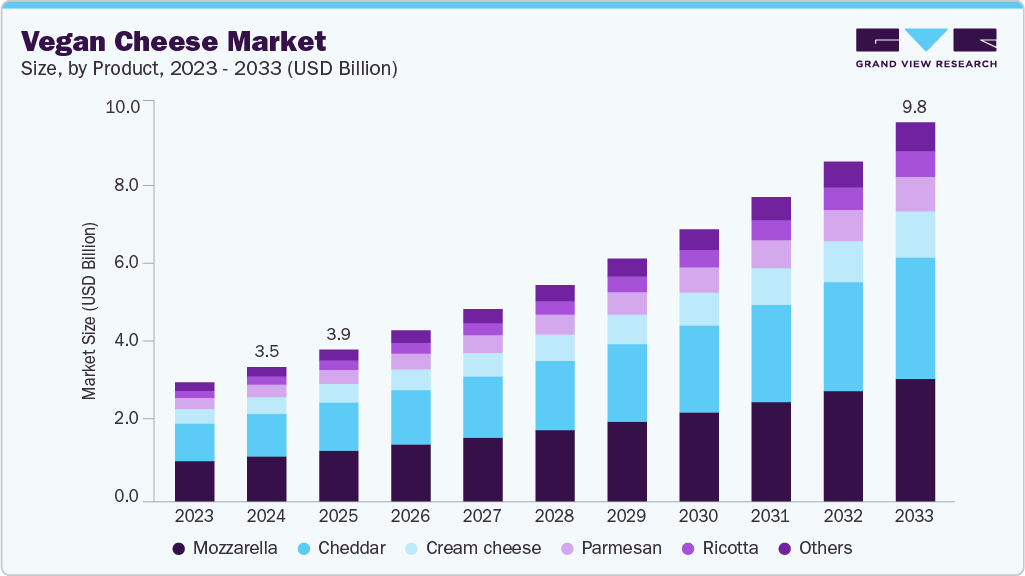 To learn more about this report, Download Free Sample Report
 Rapid advancements in formulation techniques and ingredient innovation are transforming vegan cheese into a competitive alternative to dairy cheese. Producers are leveraging fermentation technology, microbial cultures, and premium plant bases such as cashews, almonds, oats, and coconut to achieve realistic meltability, stretch, and flavor depth. This evolution has reshaped consumer perception, attracting even those who were previously dissatisfied with the quality of plant-based cheese. Unique innovations such as precision fermentation, clean-label formulations, and artisanal-style aging are unlocking new product possibilities, enabling brands to replicate specialty cheeses once exclusive to dairy. These improvements not only broaden the consumer base but also strengthen brand loyalty by offering a more authentic cheese experience.
Market Dynamics
Vegan cheese is gaining increasing consumer acceptance as demand for plant-based, dairy-free, and sustainable food products continues to expand globally. These products offer an alternative to conventional cheese for vegan, flexitarian, lactose-intolerant, and dairy-sensitive consumers while supporting evolving dietary and environmental preferences. Continuous advancements in ingredient formulations and fermentation technologies are improving the taste, texture, and functionality of vegan cheese, enhancing its appeal across retail and foodservice applications. Additionally, growing product availability through supermarkets, specialty stores, e-commerce platforms, and restaurants is contributing to broader market penetration, supporting the continued growth of the vegan cheese market.
The growing prevalence of lactose intolerance across global populations is contributing to the increased adoption of vegan cheese products. Consumers seeking dairy-free dietary alternatives are increasingly incorporating plant-based cheese into their daily consumption patterns to avoid digestive discomfort associated with conventional dairy products. This trend is particularly evident in Asia-Pacific, where lactose intolerance rates are substantially higher than in Western countries. According to the U.S. National Institute of Diabetes and Digestive and Kidney Diseases (NIDDK), nearly 68% of the global population experiences lactose malabsorption, creating a significant consumer base for dairy-free alternatives. As awareness regarding digestive health and food sensitivities continues to rise, manufacturers are expanding their portfolios with lactose-free cheese alternatives to cater to a broader consumer base. In January 2025, RIND launched ALPINE SVVISS, a cashew-based artisanal vegan cheese designed to replicate the rich and savory flavor profile of traditional Swiss cheese. The launch expanded the company's premium plant-based cheese portfolio and reflects the growing focus on innovative, specialty vegan cheese products targeting both vegan and flexitarian consumers. The ability of vegan cheese to address both dietary restrictions and evolving consumer preferences is supporting its penetration across retail and foodservice channels.
The higher retail price of vegan cheese products continues to limit adoption among price-sensitive consumers, particularly in emerging markets. Production costs are elevated due to the use of premium ingredients such as cashews, almonds, coconut oil, and specialized processing technologies. The price differential becomes a barrier to repeat purchases, especially when consumers perceive limited performance advantages over traditional cheese. Furthermore, the relatively smaller scale of production and less mature supply chains within the plant-based dairy sector restrict manufacturers' ability to achieve cost efficiencies comparable to those of conventional dairy producers. As a result, vegan cheese products are often positioned within the premium food category, limiting their accessibility to a broader consumer base. This pricing disparity may slow market penetration and hinder the transition of vegan cheese from a niche offering to a mainstream dairy alternative.
Continuous advancements in fermentation technologies and ingredient innovation are creating significant opportunities within the vegan cheese market. Manufacturers are increasingly utilizing precision fermentation, microbial cultures, and novel plant proteins to improve the taste, texture, meltability, and nutritional profile of vegan cheese products. These technological developments are helping bridge the sensory gap between plant-based and conventional dairy cheese, addressing one of the industry's longstanding challenges. Furthermore, investments in next-generation cheese alternatives are accelerating as food-tech companies seek to develop products that closely replicate the functionality of dairy cheese while maintaining sustainable production practices. As innovation continues to enhance product quality and consumer acceptance, technological advancements are expected to support category expansion across both retail and foodservice channels.
In August 2024, Plonts launched a portfolio of fermentation-enabled plant-based cheeses, including aged cheddar-style products, designed to replicate the taste, texture, and functionality of conventional dairy cheese. The launch highlights the increasing adoption of advanced fermentation technologies to enhance product quality and support innovation within the vegan cheese market.
Analyst Perspective
The vegan cheese market is entering a transition phase in which future market leadership will be determined less by plant-based positioning and more by the ability to replicate the sensory and functional attributes of conventional dairy cheese at a commercially viable cost. While consumer interest in dairy-free alternatives continues to expand, repeat purchase behavior remains heavily dependent on taste, texture, meltability, and price parity with traditional cheese. As a result, the competitive landscape is expected to shift toward manufacturers that can leverage fermentation technologies, advanced protein systems, and scalable production models to close the performance gap with dairy products.
Consumer Insights for Vegan Cheese
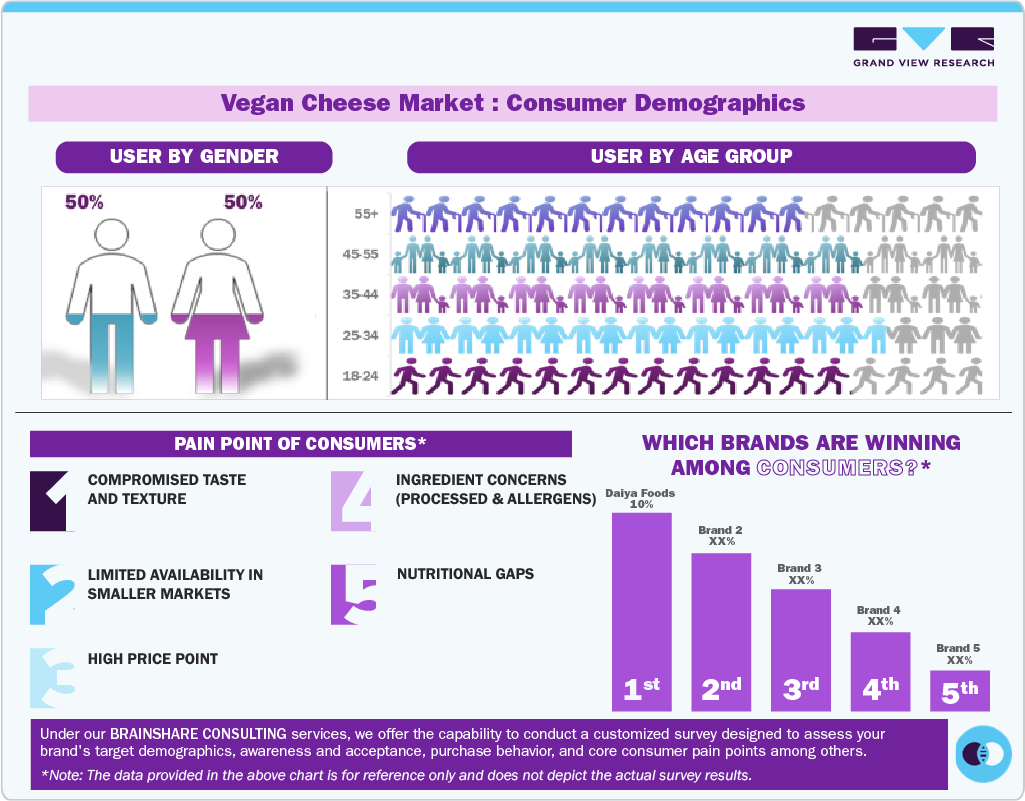
Consumer preferences in the industry are evolving rapidly, driven by a combination of health awareness, culinary curiosity, and improved product availability. Modern buyers, especially millennials and Gen Z, are actively seeking dairy-free options that replicate traditional cheese without compromising on taste or nutritional value. Many consumers now prioritize clean-label ingredients, minimal processing, and allergen-friendly formulas, prompting manufacturers to innovate using more sustainable plant bases and advanced fermentation techniques. In addition, social media plays a significant role, with recipe creators showcasing vegan cheese in pizzas, pasta, and charcuterie boards, reinforcing its mainstream appeal. As awareness grows, consumers increasingly view vegan cheese as a sustainable, ethical, and flavorful alternative.
 To learn more about this report, Download Free Sample Report
 Another key insight is the growing influence of lifestyle segmentation, where motivations vary across groups but collectively drive market expansion. Flexitarians drive volume growth as they diversify their diets with plant-forward choices, while vegans and lactose-intolerant consumers sustain consistent demand. Premium buyers seek artisanal, fermented, or aged vegan cheeses, whereas value-focused consumers prefer convenient slices and shreds. The increasing focus on gut health is also shaping preferences, with probiotic-infused and minimally processed vegan cheeses gaining attention. Convenience remains crucial; ready-to-eat, ready-to-melt, and meal-specific formats attract busy urban consumers. Overall, shifting attitudes toward sustainability and wellness continue to strengthen long-term adoption.
Product Insights
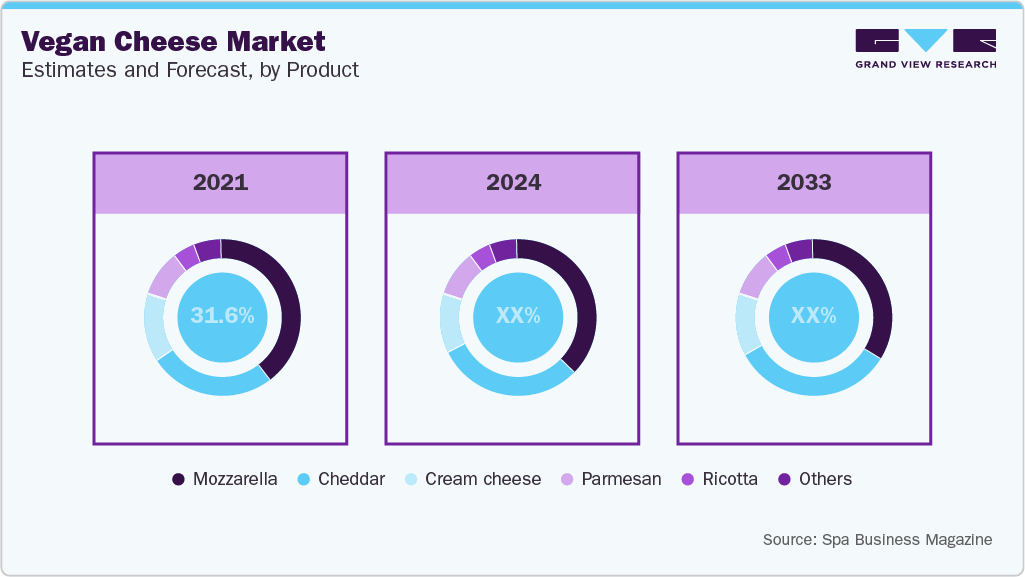
Based on product, the mozzarella segment led the market with the largest revenue share of 33.6% in 2025, due to its universal culinary relevance and superior meltability. Consumers consistently choose mozzarella for pizzas, lasagnas, and everyday cooking, making it a staple in both B2C and foodservice channels. Brands have invested heavily in enhancing stretch, browning, and dairy-like texture using advanced starch blends and fermentation processes, enabling mozzarella to outperform other varieties. Its clean, neutral flavor profile also appeals to first-time buyers exploring plant-based cheese. With rising demand for vegan pizzas and convenience foods globally, mozzarella remains the category’s anchor, driving repeat purchases and high retail turnover.
 To learn more about this report, Download Free Sample Report
 Ricotta segment is expected to grow at a highest CAGR of 13.3% from 2026 to 2033. This growth is fueled by growing interest in specialty and gourmet plant-based products. Ricotta’s smooth, creamy texture makes it ideal for both sweet and savory applications, expanding its relevance across bakery, pasta, and dessert categories. Consumers are increasingly seeking dairy-free alternatives for traditional dishes like ravioli, cannoli, and stuffed shells, pushing foodservice operators to adopt vegan ricotta. Manufacturers are innovating with almond, cashew, and oat bases to replicate authentic creaminess while maintaining clean-label attributes. As culinary experimentation rises globally, vegan ricotta is poised to transition from a niche to a mainstream product faster than other segments.
Source Insights
The cashew-based cheese segment dominated the market and accounted for the largest revenue share of 37.8% in 2024. The dominance is driven by its naturally creamy texture, mild flavor, and superior compatibility with fermentation. Consumers perceive cashew cheese as a premium, minimally processed option, aligning with the rising clean-label and artisanal trends. Brands leverage cashews to produce soft, aged, and spreadable cheeses with enhanced flavor complexity, attracting health-conscious and gourmet buyers. The ingredient’s versatility supports innovation across various formats, including blocks, sauces, and dips. In addition, cashew cheese benefits from strong acceptance in Western markets where consumers associate tree-nut-based alternatives with higher quality. As transparency and authenticity become key purchase drivers, cashew cheese continues to gain dominance.
 To learn more about this report, Download Free Sample Report
 The soy-based cheese segment is expected to register the fastest CAGR of 12.5% during the forecast period 2025 to 2033. The growing need for soy-based cheese is driven by its affordability, protein density, and widespread availability. Soy remains one of the earliest plant-based cheese bases, and modern processing techniques have significantly improved its flavor and texture, making it more competitive with nut-based varieties. Its cost-effectiveness appeals to budget-conscious consumers and large-scale foodservice buyers. In addition, soy’s strong nutritional profile, particularly its protein content, makes it attractive for consumers seeking functional benefits. Emerging markets in Asia also favor soy-based cheeses due to cultural familiarity with soy foods. As price sensitivity increases globally, soy-based cheese is positioned for rapid adoption.
Application Insights
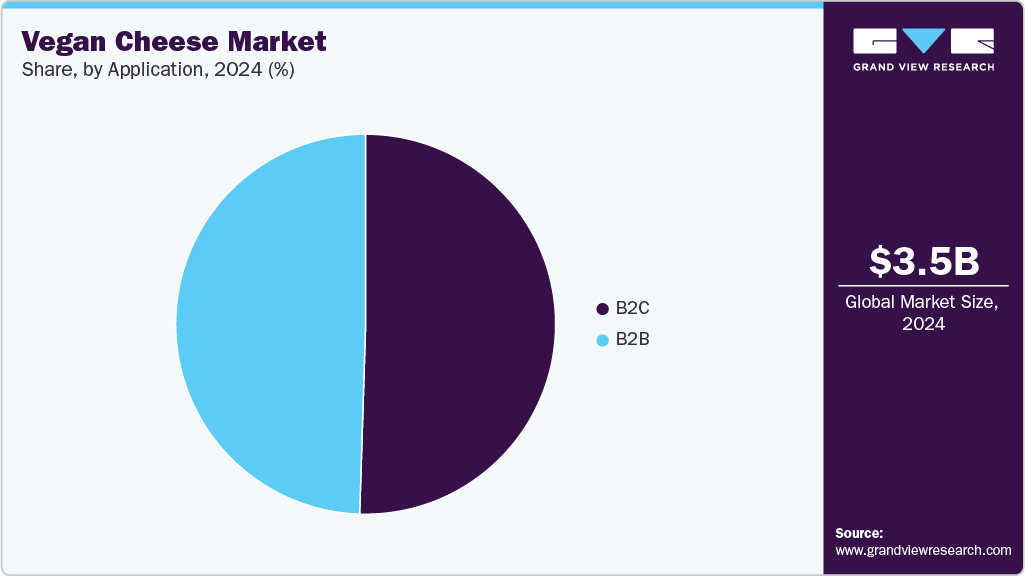
Based on application, the B2C segment led the market with the largest revenue share of 50.4% in 2025, driven by increasing household adoption and enhanced retail visibility. Supermarkets, online grocery platforms, and specialty vegan stores have expanded their offerings, making vegan cheese accessible across a range of price points. Consumers are increasingly using vegan cheese in their daily meals, sandwiches, snacks, and homemade pizzas, driving consistent retail demand. E-commerce growth has further enabled trial purchases, subscription models, and brand discovery. Attractive packaging, flavor innovation, and targeted marketing strategies, such as influencer campaigns, have strengthened consumer trust. As home cooking and plant-forward lifestyles continue to gain popularity, B2C channels remain the dominant force in overall market consumption.
 To learn more about this report, Download Free Sample Report
 The B2B segment is expected to register the fastest CAGR of 12.3% during the forecast period from 2026 to 2033. The rising adoption and usage of vegan cheese across restaurants, quick-service chains, bakeries, and meal-kit providers is driving this segment. Food service operators are increasingly integrating vegan cheese into their menus to appeal to flexitarian and lactose-intolerant customers, making it a strategic offering rather than a niche request. The expansion of vegan pizzas, burgers, and pasta dishes has created sustained demand for high-melt, cost-effective vegan cheese solutions. In addition, institutional buyers, such as airlines, hotels, and corporate cafeterias, are incorporating plant-based options to expand and enhance menu diversity. As vegan offerings become standard in the global foodservice industry, B2B demand is expected to surge rapidly.
Regional Insights
North America vegan cheese market accounted for a revenue share of 23.6% in 2025. The growth of the region is supported by strong consumer awareness, a mature plant-based ecosystem, and high purchasing power. The region has seen a surge in flexitarian lifestyles, with consumers actively reducing their dairy consumption for both health and environmental reasons. Major retailers, including Whole Foods, Walmart, and Costco, have expanded their vegan cheese portfolios, enhancing accessibility across the region. Ingredient innovation, particularly in cashew, oat, and potato starch-based products, has improved product quality, resulting in increased repeat purchases. In addition, the influence of food influencers, celebrity endorsements, and sustainability-focused campaigns continues to shape consumer behavior, positioning North America as a global leader in the adoption of vegan cheese.
U.S. Vegan Cheese Market Trends
The vegan cheese market in the U.S. held the largest share in the North America region in 2025. The U.S. vegan cheese market benefits from a strong consumer emphasis on clean labels, allergen-free foods, and sustainable eating practices. American consumers are increasingly experimenting with dairy alternatives due to lactose intolerance, concerns about gut health, and growing environmental awareness. The country’s vibrant foodservice sector, comprising vegan restaurants, pizza chains, and gourmet eateries, actively incorporates plant-based cheeses, expanding exposure. The U.S. also leads in technological innovation, particularly in precision fermentation, which is enhancing the taste and meltability of products. Retailers prioritize shelf space for premium and functional vegan cheeses, supporting market penetration. With strong media influence and growing cultural acceptance of plant-forward diets, the U.S. remains one of the fastest-evolving vegan cheese landscapes globally.
Europe Vegan Cheese Market Trends
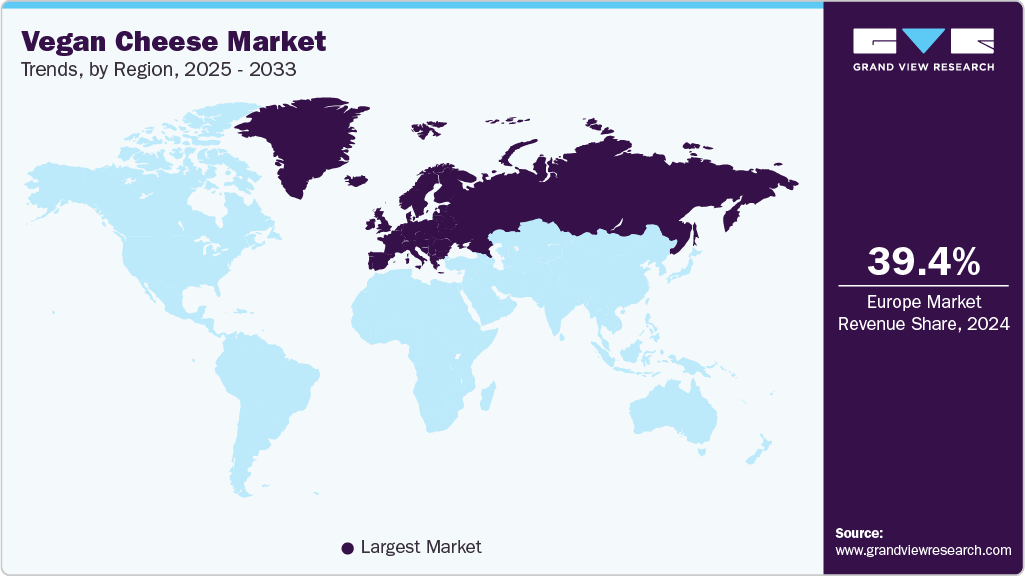
Europe dominated the vegan cheese market with the largest revenue share of 39.3% in 2025. The dominance of the region is attributed to stringent sustainability standards, dairy reduction movements, and rising ethical consumption. European consumers prioritize transparency, favoring products with minimal additives and organic ingredients. Countries such as Germany, France, and the Netherlands are experiencing a strong shift toward flexitarian diets, further boosting demand. The region’s established cheese culture has encouraged manufacturers to innovate with artisanal, aged, and specialty vegan cheeses that appeal to traditional cheese lovers. In addition, government-backed sustainability initiatives and emissions-reduction policies are driving the adoption of plant-based products. Europe’s robust retail infrastructure and high environmental consciousness collectively position it as a powerhouse in global vegan cheese growth.
 To learn more about this report, Download Free Sample Report
 The UK vegan cheese market is expected to grow rapidly in the coming years, as consumers increasingly seek healthier, ethical, and climate-friendly alternatives to dairy. Strong vegan and flexitarian movements, reinforced by campaigns like Veganuary, have normalized plant-based consumption. British retailers such as Tesco, Sainsbury’s, and Marks & Spencer have diversified their vegan cheese offerings, often developing private-label ranges to meet demand. The country’s high rate of lactose intolerance and rising awareness of animal welfare also contribute to adoption. Moreover, the U.K.'s thriving takeaway and delivery ecosystem supports demand for vegan mozzarella and cheddar, which are used in pizzas and sandwiches. Continued innovation in flavor and affordability is propelling market momentum.
Asia Pacific Vegan Cheese Market Trends
The vegan cheese market in Asia Pacific is expected to grow at the fastest CAGR of 13.4% over the forecast period from 2026 to 2033. The rapid growth is driven by rising urbanization, Western food influence, and increasing health consciousness. Younger consumers, particularly in metropolitan areas, are adopting flexitarian and dairy-free lifestyles due to digestive concerns and increasing environmental awareness. International restaurant chains expanding across the APAC region are now including vegan cheese options, which boosts their visibility. Countries like Australia, Japan, and India are emerging as hotspots for premium plant-based foods, while Southeast Asia is seeing momentum in affordable soy- and coconut-based cheeses. E-commerce penetration further enables the discovery of niche brands. As cultural openness to global cuisines increases, the APAC region is transforming into a high-growth opportunity for vegan cheese.
China vegan cheese market is growing significantly and gaining traction as consumer diets shift toward plant-based foods, driven by the prevalence of lactose intolerance, affecting nearly 90% of the population, and increasing interest in Western cuisine. Urban millennials experiment with dairy alternatives for perceived digestive and wellness benefits. The rapid expansion of cafés, bakery chains, and pizza outlets has significantly increased demand for vegan mozzarella and cream cheese. Domestic brands are emerging with soy, oat, and rice-based formulations tailored to local tastes. E-commerce giants like Alibaba and JD.com amplify product access, creating strong online demand. As sustainability awareness grows, the adoption of vegan cheese is expected to accelerate across major Chinese cities.
Central & South America Vegan Cheese Market Trends
The vegan cheese market in Central & South America is growing significantly due to rising health consciousness, growing vegan communities, and increased exposure to global food trends. Countries such as Mexico, Argentina, and Chile are witnessing a higher acceptance of plant-based diets among younger populations. Retailers have begun allocating more shelf space to dairy alternatives, while local artisanal producers experiment with coconut and cashew bases suited to regional flavors. Economic affordability remains important, pushing brands to develop cost-effective vegan cheese options. Social media activism around animal welfare and climate change further influences purchasing decisions. As foodservice outlets incorporate vegan pizzas and sandwiches, demand across the region continues to strengthen.
The Brazil vegan cheese market is fueled by heightened interest in wellness, increasing cases of lactose intolerance, and strong environmental activism. Brazilian consumers are becoming increasingly aware of the ecological impact of dairy, prompting a shift toward plant-based alternatives. Local brands are innovating with cashew and coconut bases, ingredients readily available in the region, creating flavorful, locally inspired vegan cheeses. Food delivery apps and restaurant chains are integrating vegan options, further normalizing the consumption of vegan products. Retail expansion, especially in São Paulo and Rio de Janeiro, has improved accessibility. As sustainability movements and plant-forward diets deepen among urban consumers, Brazil is emerging as a major growth market in Latin America.
Middle East & Africa Vegan Cheese Market Trends
The vegan cheese industry in the Middle East and Africa region is growing, supported by rising health awareness, increasing dairy sensitivities, and the growing presence of Western restaurant chains. Urban consumers in regions such as the GCC are increasingly embracing plant-based foods for wellness and lifestyle reasons. Import-driven retail shelves now offer a wider selection of vegan cheese, while local manufacturers experiment with affordable soy and coconut formulations. Environmental concerns and water scarcity issues also encourage reduced dependence on dairy production. In Africa, expanding middle-class incomes and modern retail infrastructure support early-stage adoption. As awareness spreads, MEA is shaping into a promising frontier for vegan cheese expansion.
The UAE vegan cheese market is driven by its multicultural population, strong tourism sector, and premium food retail landscape. Health-conscious consumers, particularly expatriates, actively seek dairy-free options, while foodservice outlets in Dubai and Abu Dhabi have rapidly integrated vegan pizzas, burgers, and pastries. The government’s sustainability initiatives and carbon-emission reduction goals further encourage the adoption of plant-based consumption. High disposable incomes support demand for premium cashew, almond, and artisanal vegan cheeses. Retailers such as Carrefour and Spinneys now offer a diverse range of vegan cheese brands, making these products widely accessible. With wellness trends accelerating, the UAE is positioned for sustained growth in the vegan cheese segment.
Key Vegan Cheese Company Insights
Key players operating in the vegan cheese market are undertaking various initiatives to strengthen their presence and increase the reach of their products and services. Strategies such as expansion activities and partnerships are key in propelling the market growth.
 To learn more about this report, Download Free Sample Report
  To learn more about this report, Download Free Sample Report
 Key Vegan Cheese Companies
The following key companies have been profiled for this study on the vegan cheese market.
-
Daiya Foods.
-
Miyoko's Creamery
-
Flora Food Group (Violife)
-
Kite Hill
-
Follow Your Heart
-
Treeline Cheese
-
Tofutti Brands, Inc.
-
Parmela Creamery
-
Nush Foods.
-
GOOD PLANeT Foods.
Competitive Benchmarking
Category
Operating Strategies
Competitive Edge
Weakness
Mature Players (Daiya Foods, Follow Your Heart, Flora Food Group (Violife))
Expand multi-format vegan cheese portfolios, strengthen retail and foodservice partnerships, and pursue geographic expansion through product innovation and distribution growth.
Strong brand recognition, established distribution networks, and large-scale production capabilities support broad market reach and product availability.
High competition, premium raw material costs, and ongoing pressure to improve taste, texture, and functionality can impact profitability.
Emerging Players (Miyoko's Creamery, Treeline Cheese)
Focus on fermentation technologies, artisanal offerings, and clean-label formulations to differentiate products and target premium consumer segments.
Agile innovation capabilities and niche positioning enable rapid response to evolving consumer preferences and market trends.
Limited production capacity, lower brand awareness, and restricted distribution networks may constrain market expansion and scalability.
Recent Developments
-
In October 2025, Italian plant-based cheesemaker Dreamfarm launched its nut-based mozzarella (and other vegan cheeses) in around 70 Monoprix stores in Paris, France.
-
In September 2025, the French vegan cheese producer Jay&Joy launched its organic cashew- and soy-based camembert alternative, “Albert”, in the UK.
-
In January 2025, a Brooklyn-based company RIND launched ALPINE SVVISS, a cashew-based vegan cheese, in the United States. The artisan cheese was unveiled at the Specialty Food Association Winter Fancy Food Show in Las Vegas.
-
In March 2023, Indian company PlantWise launched plant-based cheese spreads, shreds, and “cheesy” nuggets across India. Their products, made via natural fermentation, were designed to taste, melt, and spread just like dairy cheese, while remaining clean-label and preservative-free.
Vegan Cheese Market Report Scope
Report Attribute
Details
Market size in 2025
USD 4.0 billion
Estimated market size in 2026
USD 4.5 billion
Projected market size by 2033
USD 9.9 billion
Growth rate
CAGR of 12.1% from 2026 to 2033
Base year for estimation
2025
Historical data
2021 - 2024
Forecast period
2026 - 2033
Quantitative units
Revenue in USD million /billion and CAGR from 2026 to 2033
Report coverage
Revenue forecast, company ranking, competitive landscape, growth factors, and trends
Segments covered
product, source, application, region
Regional scope
North America; Europe; Asia Pacific; Central & South America; MEA
Country scope
U.S.; Canada; Mexico; Germany; UK; France; Italy; Spain; China; Japan; India; South Korea; Australia & New Zealand; Brazil; South Africa
Key companies profiled
Daiya Foods.; Miyoko's Creamery; Flora Food Group (Violife); Kite Hill; Follow Your Heart; Treeline Cheese; Tofutti Brands, Inc.; Parmela Creamery; Nush Foods.; GOOD PLANeT Foods.
Customization scope
Free report customization (equivalent up to 8 analysts' working days) with purchase. Addition or alteration to country, regional & segment scope.
Pricing and purchase options
Avail customized purchase options to meet your exact research needs. Explore purchase options
Global Vegan Cheese Market Report Segmentation
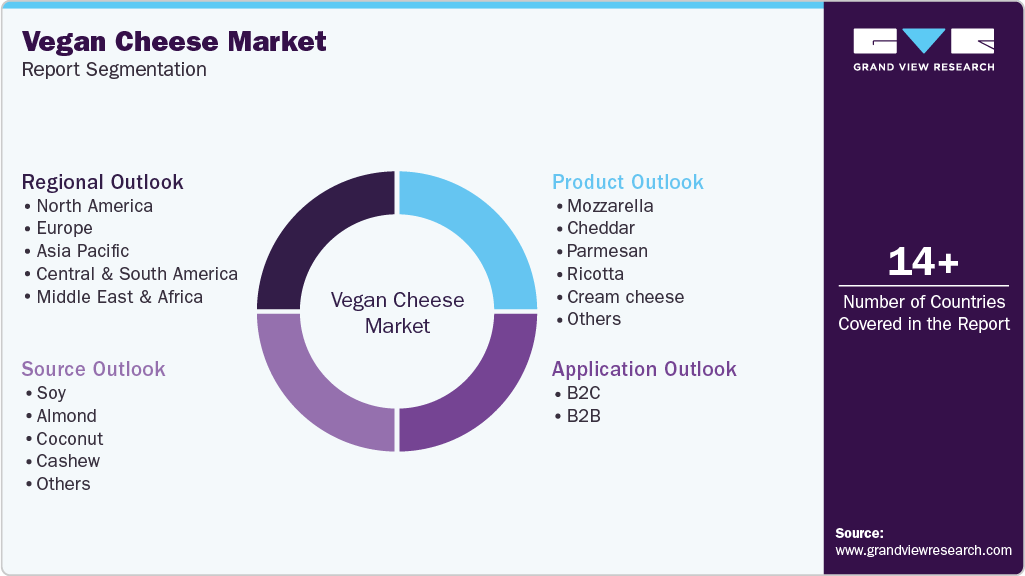
This report forecasts revenue growth at global, regional & country levels and provides an analysis of the latest trends and opportunities in each of the sub-segment from 2021 to 2033. For this study, Grand View Research has segmented the global vegan cheese market report on the basis of product, source, application, and region.
 To learn more about this report, Download Free Sample Report
 -
Product Outlook (Revenue, USD Million, 2021 - 2033)
-
Mozzarella
-
Cheddar
-
Parmesan
-
Ricotta
-
Cream cheese
-
Others
-
-
Source Outlook (Revenue, USD Million, 2021 - 2033)
-
Soy
-
Almond
-
Coconut
-
Cashew
-
Others
-
-
Application Outlook (Revenue, USD Million, 2021 - 2033)
-
B2C
-
B2B
-
-
Regional Outlook (Revenue, USD Million, 2021 - 2033)
-
North America
-
U.S.
-
Canada
-
Mexico
-
-
Europe
-
UK
-
Germany
-
France
-
Italy
-
Spain
-
-
Asia Pacific
-
China
-
India
-
Japan
-
Australia & New Zealand
-
South Korea
-
-
Central & South America
-
Brazil
-
-
Middle East & Africa
-
South Africa
-
-
Research Methodology
Segment Definition
Segment - Product
Revenue capture definition
Mozzarella
This segment includes the sales of plant-based mozzarella cheese alternatives formulated to replicate the taste, texture, stretchability, and melting properties of conventional mozzarella cheese. Revenue is generated through the sale of vegan mozzarella products in formats such as shreds, slices, blocks, and foodservice packs for use in pizzas, pasta dishes, sandwiches, and ready-to-eat meals.
Cheddar
This segment includes the sales of vegan cheddar cheese products designed to mimic the flavor profile and functionality of traditional cheddar cheese. Revenue is generated through retail and commercial sales of cheddar-style slices, blocks, shreds, and snack products used in burgers, sandwiches, wraps, salads, and various culinary applications.
Parmesan
This segment includes the sales of plant-based parmesan cheese alternatives developed for grating, seasoning, and flavor-enhancing applications. Revenue is generated through the sale of vegan parmesan products used in pasta dishes, soups, salads, baked foods, and prepared meals requiring a savory and umami-rich cheese ingredient.
Ricotta
This segment includes the sales of vegan ricotta cheese alternatives formulated to deliver a soft and creamy texture comparable to traditional ricotta cheese. Revenue is generated through the sale of ricotta-style products utilized in baked dishes, pasta fillings, desserts, dips, and specialty culinary preparations.
Cream Cheese
This segment includes the sales of plant-based cream cheese products designed to provide a smooth, creamy, and spreadable texture similar to conventional cream cheese. Revenue is generated through the sale of vegan cream cheese products used in spreads, dips, bakery products, cheesecakes, frostings, and breakfast applications.
Others
This segment includes the sales of specialty vegan cheese products such as feta, gouda, provolone, swiss-style cheese, blue cheese alternatives, and artisanal cultured cheese varieties. Revenue is generated through retail, specialty stores, foodservice establishments, and online channels serving consumers seeking diverse plant-based cheese options beyond mainstream product categories.
Estimation Model
Consumer Preference Layer
Product Accessibility Layer
Purchase Adoption Layer
Revenue Generation Layer
Who is likely to purchase vegan cheese?
Who can access vegan cheese products?
Who actively purchases vegan cheese??
How much revenue is generated?
Identify the target consumer base by assessing the population of vegans, vegetarians, flexitarians, lactose-intolerant individuals, and consumers seeking dairy-free alternatives.
Apply region-specific retail penetration, e-commerce availability, and foodservice distribution rates to the eligible consumer base to determine the addressable market for vegan cheese products.
Assess consumer adoption rates based on purchase frequency, brand awareness, product acceptance, and repeat buying behavior.
Estimate market revenue by applying average annual spending on vegan cheese products across consumer and commercial channels.
Delivered Customizations
This report has been delivered with the following In-depth customizations
Client Request
Customization Delivered
Value Adds
Competitive Landscape & Market Share Evaluation
Performed an in-depth assessment of leading vegan cheese manufacturers, including portfolio analysis, pricing strategies, geographic presence, distribution capabilities, and innovation pipelines. The study benchmarked global brands, regional players, and emerging startups operating within the category.
Helps stakeholders understand competitive dynamics, identify market gaps, evaluate acquisition or partnership opportunities, and formulate effective competitive positioning strategies.
Retail Channel & Distribution Strategy Analysis
Evaluated vegan cheese sales performance across supermarkets, hypermarkets, specialty stores, convenience stores, and e-commerce platforms. The analysis examined shelf-space allocation, private-label activity, retailer partnerships, and regional distribution trends.
Enables clients to optimize channel strategies, identify underpenetrated markets, improve product accessibility, and capitalize on evolving retail purchasing patterns.
Foodservice Penetration & Commercial Opportunity Assessment
Conducted a focused analysis of vegan cheese adoption across restaurants, quick-service restaurants (QSRs), pizza chains, cafés, catering services, and prepared meal manufacturers. The study assessed menu integration trends, supplier partnerships, product requirements, and commercial demand potential.
Supports business development initiatives by identifying high-opportunity foodservice segments, evaluating channel-specific growth potential, and strengthening market entry and partnership strategies.
Frequently Asked Questions About This Report
The global vegan cheese market size was estimated at USD 4.0 billion in 2025 and is expected to reach USD 4.5 million in 2026.
The global vegan cheese market is expected to grow at a compounded growth rate of 12.1% from 2026 to 2033 to reach USD 9.9 billion by 2033.
The global shift toward plant-based eating is becoming one of the strongest growth catalysts for the vegan cheese market.
Asia Pacific region dominated the vegan cheese market with the revenue share of 23.8% in 2025.
Asia Pacific is the fastest growing region over the forecast period.
Ricotta product segment is the fastest growing segment in the vegan cheese market and is expected to grow with the highest CAGR from 2026 to 2033.
Cashew Milk source segment held the largest revenue share in 2025.
The mozzarella cheese dominated the market and accounted for a market revenue share of 33.6% in 2025, due to its universal culinary relevance and superior meltability.
Some key players operating in the vegan cheese market include Daiya Foods.; Miyoko's Creamery; Flora Food Group (Violife); Kite Hill; Follow Your Heart; Treeline Cheese; Tofutti Brands, Inc.; Parmela Creamery; Nush Foods.; GOOD PLANeT Foods.
About the Author(s)
Consumer F&B Research Team
Consumer Goods · Consumer F&BThis report was authored by the consumer f&b research team at Grand View Research - comprising two research analysts, one senior research analyst, and one industry expert - with specialized expertise in the consumer f&b segment of the consumer goods industry. All findings are based on proprietary consumer goods databases, executive interviews, and regulatory analysis, subject to internal peer review prior to publication.
Last Updated:
Speak to Analyst

Customize this report to your needs - add regions, segments, or data points, with 20% free customization.
Or view our licence options:


ISO 9001:2015 & 27001:2022 Certified
We are GDPR and CCPA compliant! Your transaction & personal information is safe and secure. For more details, please read our privacy policy.


