
- Home
- »
- Specialty & Chemicals
- »
-
Vegan Leather Market Size, Share, Growth Report 2026-2033GVR Report cover

Vegan Leather Market (2026 - 2033)
Size, Share & Trends Analysis Report By Material (Synthetic, Natural), By Application (Footwear, Fashion & Apparel, Furniture & Upholstery, Consumer Goods, Automotive), By Region, And Segment Forecasts
Market Size, 2025
$11.6BMarket Estimate, 2026
$12.6BMarket Forecast, 2033
$26.8BCAGR, 2026–2033
11.4%Vegan Leather Market Summary
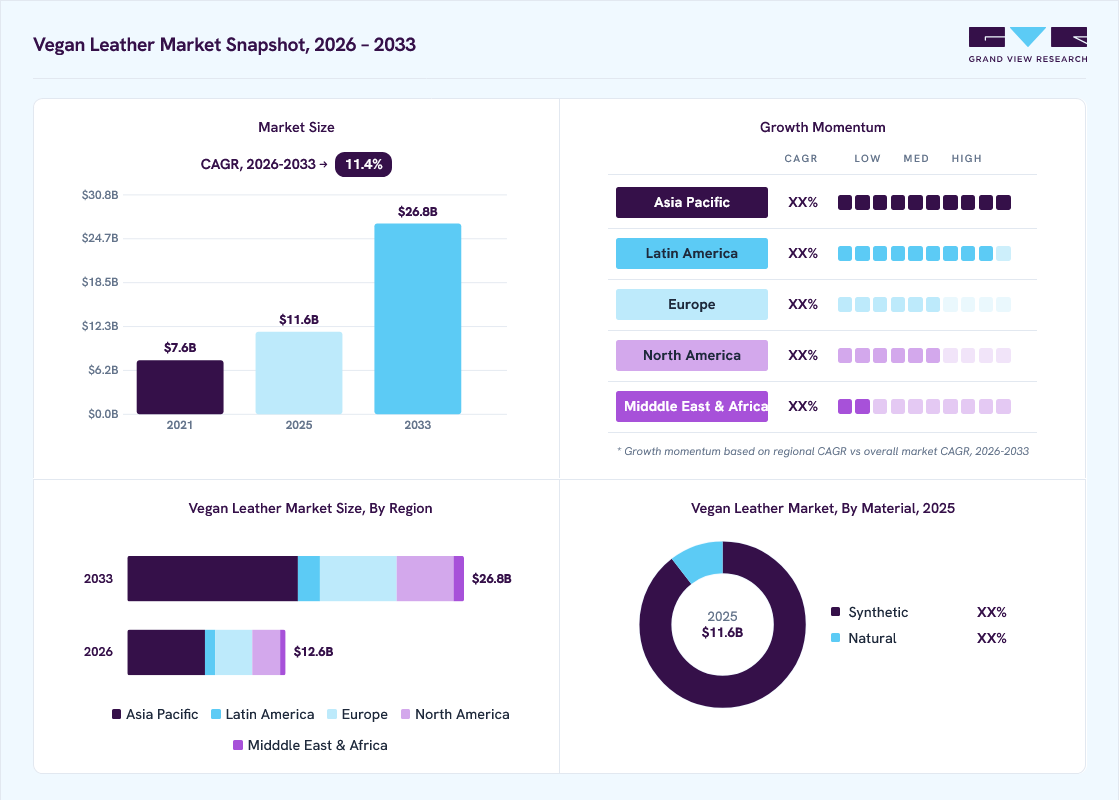
The global vegan leather market size was valued at USD 11.6 billion in 2025 and is projected to grow from USD 12.6 billion in 2026 to USD 26.8 billion by 2033, at a CAGR of 11.4% from 2026 to 2033. Asia Pacific dominated the market, accounting for a revenue share of 48.8% in 2025. Growing demand for animal-free materials is encouraging footwear, fashion, automotive, and furniture manufacturers to incorporate vegan leather into product development. Improvements in texture, flexibility, durability, and finishing are making vegan leather increasingly suitable for application-specific requirements. At the same time, manufacturers are expanding material innovation to provide alternatives to conventional animal-derived leather.
 Source: Grand View Research, IR Documents, Primary Interviews, Paid DatabasesTo learn more about this report,
 Download Free Sample Report
Key Market Trends & Insights
- By material: Synthetic segment held the dominating revenue share of 89.4% in 2025.
- By application: Footwear segment accounted for the largest revenue share of 34.7% in 2025.
Regional Highlights
- Largest Region: Asia Pacific (48.8% revenue share, 2025)
- By country: China led the vegan leather market in 2025
Market Size & Forecast
- Market size in 2025: USD 11.6 Billion
- Estimated market size in 2026: USD 12.6 Billion
- Projected market size by 2033: USD 26.8 Billion
- CAGR (2026-2033): 11.4%
Three ways to get this report
Buy it, customize it, or ask a question.Ask an Analyst
Analyst response in 1 business day
- AccessReport author, directly
- Reply timeWithin 1 working day
- No sales callDirect answer only
- FormatEmail reply
- CostFree, no cost
Get the Full Report
What the study covers
- FormatsPDF · Excel · Dashboard
- Timeline2026–2033 annual, 2025 base
- Coverage20+ countries, 5 regions
- Companies10+ key players profiled
Customize the Report
20% free customization
- IncludeCountries, segments, points
- TailorTo your product definition
- ExtendDeeper competitor detail
- OrA fully bespoke study
- Turnaround5–10 working days
The development of waste-derived, plant-based, and biotechnology-enabled materials creates opportunities for new vegan leather platforms with differentiated sustainability attributes. Agricultural residues, bacterial cellulose, and other renewable feedstocks can support alternative sourcing models while creating additional value from underutilized resources. Scaling these technologies can broaden their commercial use across footwear, fashion, automotive, and interior applications.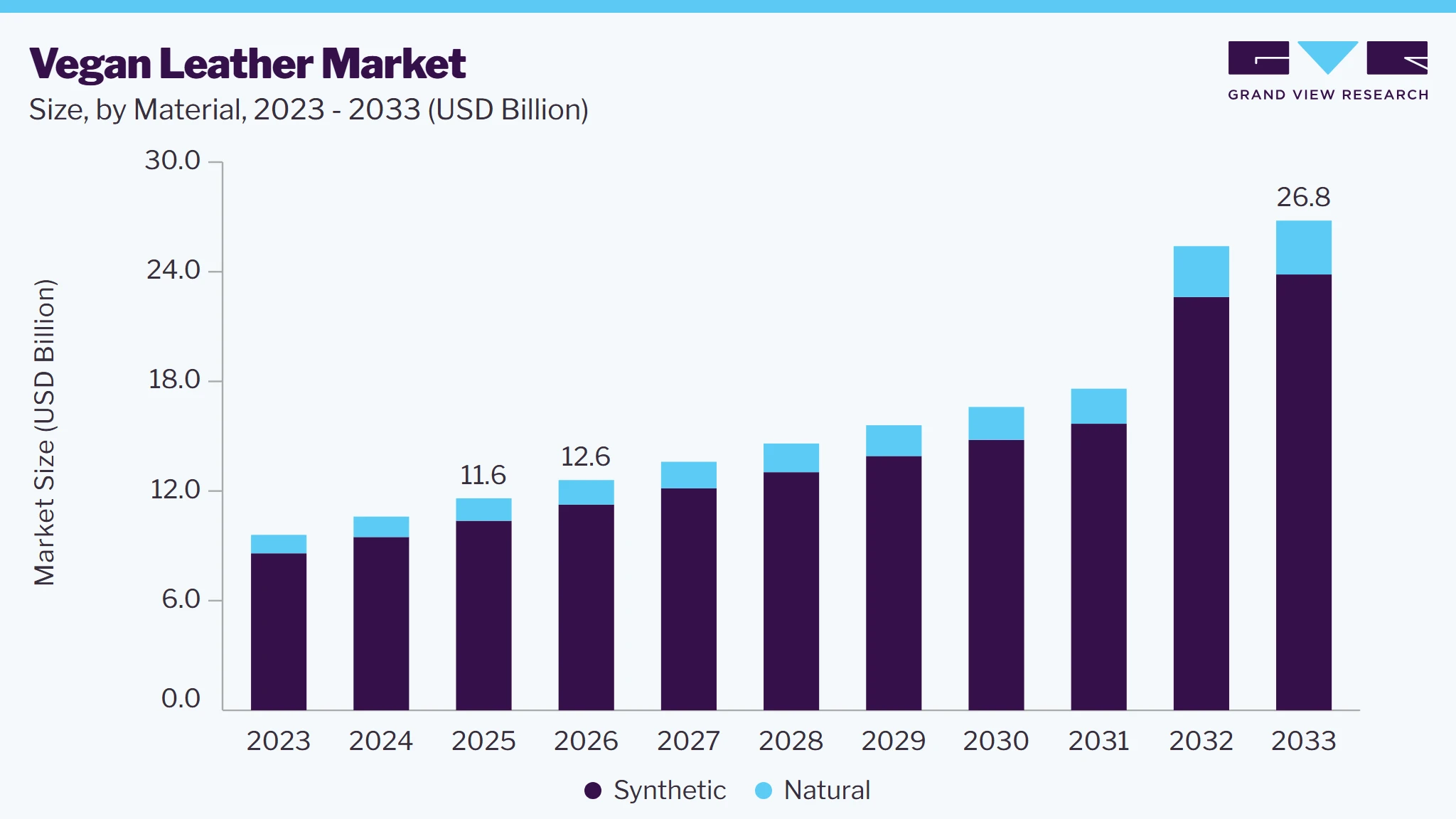 To learn more about this report, Download Free Sample Report
Market Dynamics
The vegan leather market is shaped by material innovation, application-specific performance requirements, sustainability considerations, and production economics. Synthetic materials benefit from established manufacturing capabilities and consistent quality, while natural alternatives are gaining traction through advances in plant-based and biotechnology-derived feedstocks. Demand across footwear, automotive, fashion, furniture, and consumer goods is increasingly influenced by durability, aesthetics, customization, material availability, and cost competitiveness.
Material innovation is shifting beyond conventional PU and PVC toward bio-based polymers, agricultural residues, bacterial cellulose, and other renewable feedstocks. The Fabulose project, for example, is developing bacterial-cellulose and cyanophycin-based alternatives using industrial and food-industry waste streams.
Such technologies can create new product specifications focused on recyclability, biodegradability, and reduced dependence on fossil resources. Continued development of coatings, backing structures, and finishing processes can further improve the suitability of these materials for demanding commercial applications.
Vegan leather manufacturers must balance sustainability attributes with durability, flexibility, abrasion resistance, moisture performance, and appearance. Synthetic alternatives have established industrial processing routes, whereas newer bio-based materials still require further scaling and validation of applications.
Production economics can also constrain adoption where alternative materials require specialized feedstock processing or additional finishing steps. Achieving consistent quality at commercial volumes remains important for broader substitution across price-sensitive applications.
Waste and by-product streams provide a pathway for developing differentiated vegan leather materials while creating additional value from underutilized resources. Piñatex, for example, uses pineapple leaves generated from agricultural activity as its principal fiber source.
Future commercial platforms can similarly combine agricultural residues, industrial side streams, and biotechnology processes with scalable manufacturing. This approach can create new supplier ecosystems around feedstock collection, material conversion, finishing, and downstream product manufacturing.
Market Concentration & Characteristics
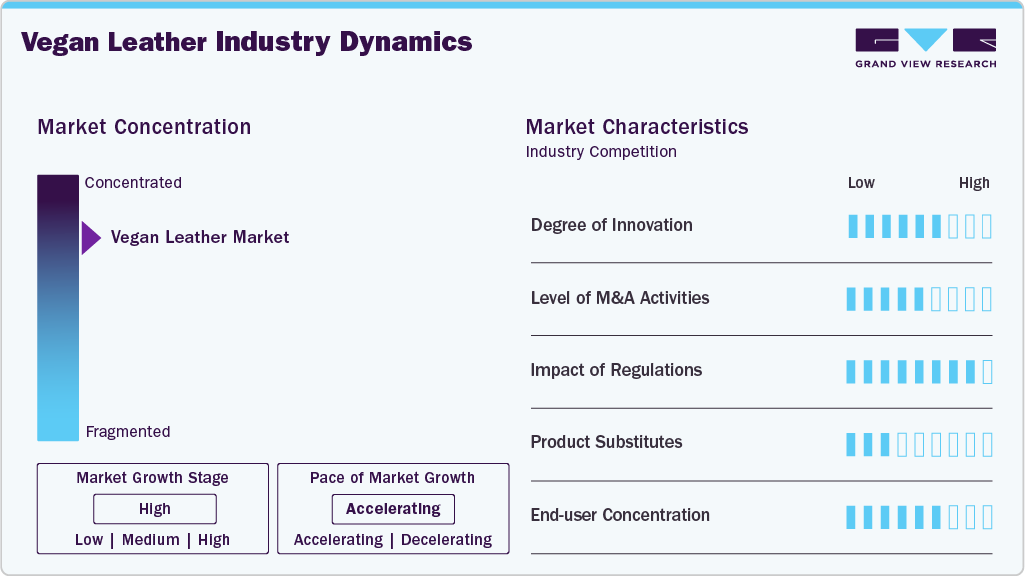
The market comprises large synthetic-material manufacturers and specialized developers focused on plant-based and biotechnology-derived alternatives. Established suppliers benefit from manufacturing scale and established polymer-processing capabilities, while specialized developers differentiate through novel feedstocks and material platforms.
 To learn more about this report, Download Free Sample Report
Product differentiation is increasingly based on material composition, surface finish, durability, circularity attributes, and application performance. The market, therefore, combines volume-oriented synthetic leather production with technology-led development of next-generation bio-based materials.
Analyst Perspective
Vegan leather is transitioning from a niche leather substitute to a broader category of engineered materials. Growth prospects are increasingly linked to application-specific performance and scalable production rather than sustainability positioning alone. Bio-based technologies provide a growing innovation pipeline, while established synthetic materials continue to provide manufacturing scale and consistent performance.
Material Insights
The synthetic segment held the largest revenue share of 89.4% in 2025, due to its established industrial processing base, broad availability of PU/PVC and microfiber constructions, and ability to deliver controlled thickness, surface uniformity, color consistency, and finishing at scale. These characteristics make synthetic materials particularly suitable for standardized, high-volume manufacturing programs where specification consistency and supply reliability are critical.
The natural segment is the fastest-growing segment, with a projected CAGR of 11.9% from 2026 to 2033. The growth is attributed to material developers commercializing agricultural residues, plant fibers, fungal biomass, and other renewable feedstocks into engineered leather alternatives. Increasing technical refinement of backing structures, coatings, and surface treatments is improving their suitability for commercial products while enabling brands to differentiate through material provenance and next-generation product design.
Application Insights
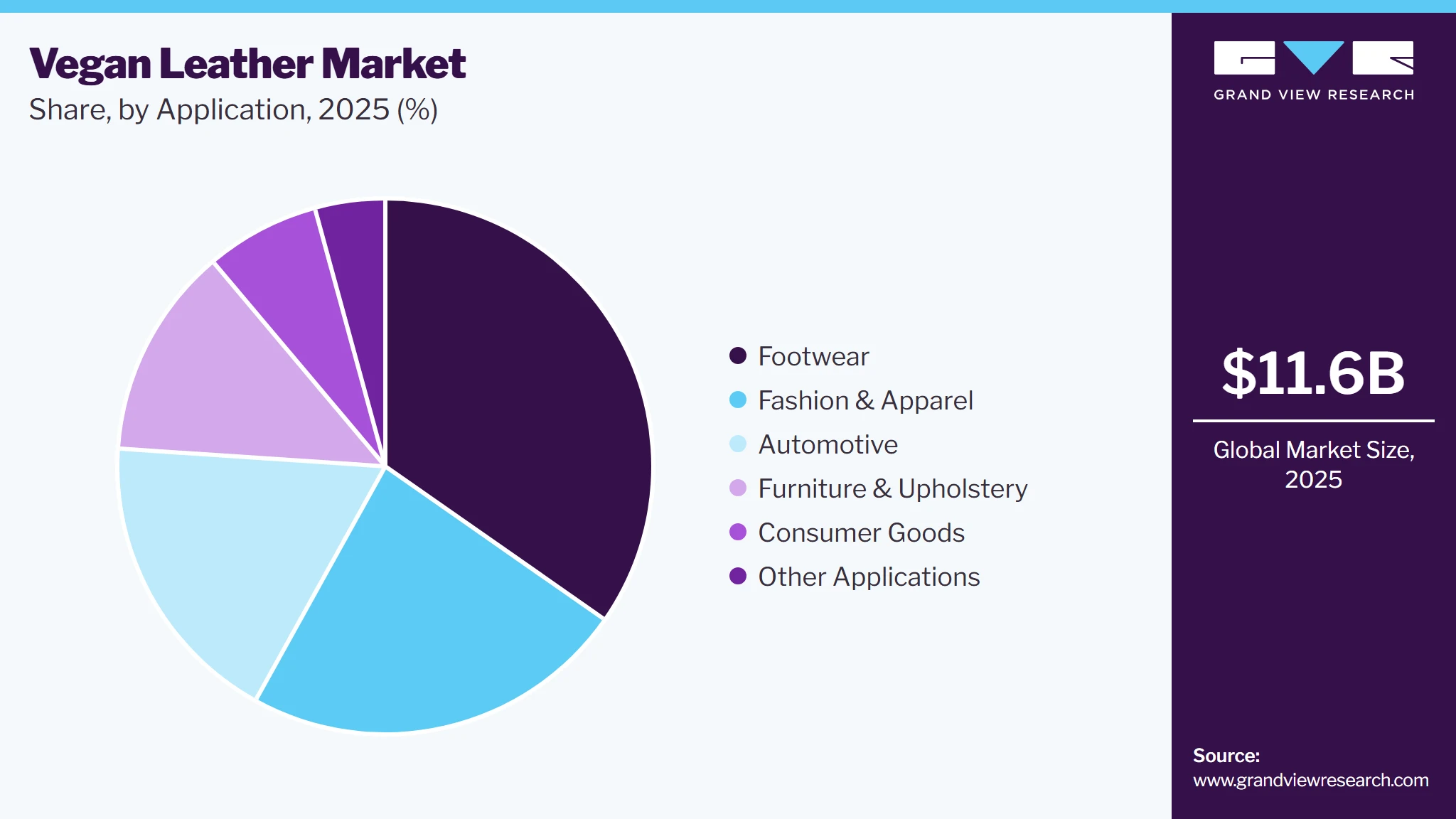
The footwear segment held the largest revenue share of 34.7% in 2025, as vegan leather can be converted into uppers, linings, trims, straps, and other components across multiple footwear constructions. High product turnover, frequent material refresh cycles, and extensive design requirements create recurring demand for materials offering consistent appearance, flexibility, abrasion resistance, and compatibility with established shoe-manufacturing processes.
 To learn more about this report, Download Free Sample Report
The automotive segment is projected to grow at a CAGR of 12.3% from 2026 to 2033, as interior suppliers increasingly evaluate leather alternatives for seating, door panels, dashboards, consoles, and trim components. The application offers higher-value material opportunities because suppliers must satisfy stringent requirements for wear resistance, dimensional stability, tactile quality, temperature performance, and long-term appearance retention.
Regional Insights
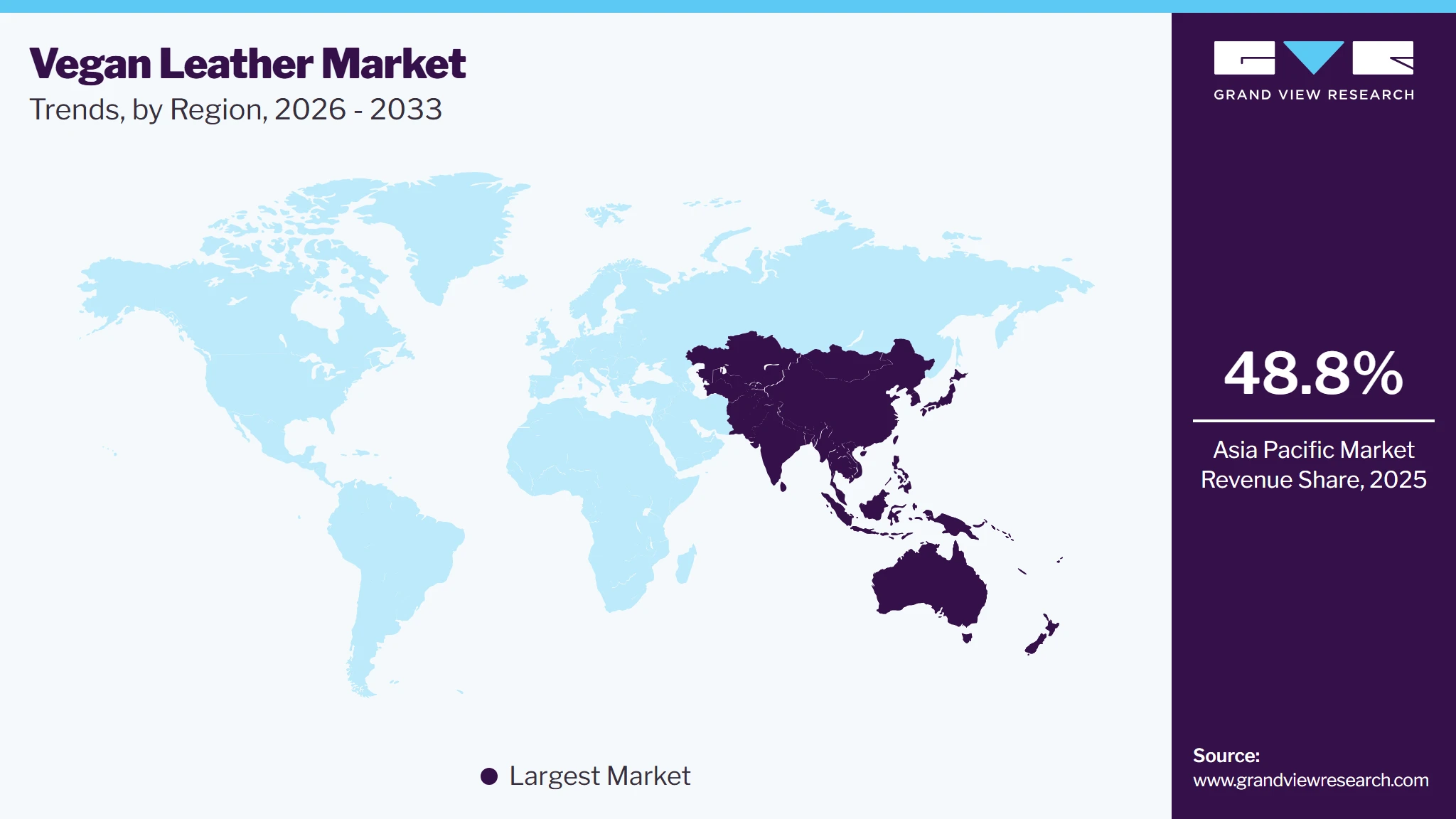
The vegan leather market in the Asia Pacific held the largest revenue share of 48.8% in 2025. The growth comes on the heels of the region combining large-scale synthetic leather manufacturing with extensive downstream footwear, apparel, furniture, electronic accessories, and automotive production. The concentration of converters, material suppliers, and finished-product manufacturers enables shorter supply chains and supports high-volume commercialization.
 To learn more about this report, Download Free Sample Report
The China vegan leather market is expected to grow at an 11.9% revenue CAGR during the forecast period. China functions as a critical production center across the vegan leather value chain, supported by domestic PU/PVC manufacturing, synthetic-material processing capabilities, and extensive footwear, bags, furniture, and automotive supply networks. Its vertically connected manufacturing ecosystem enables rapid conversion of material innovations into commercial products.
North America Vegan Leather Market Trends
The vegan leather market in North American is characterized by higher-value applications and brand-driven material specifications, particularly across automotive interiors, premium accessories, footwear, and furniture. The market provides an important commercialization channel for differentiated materials that combine design performance with traceability, material transparency, and specialized functionality.
U.S. Vegan Leather Market Trends
The vegan leather market in the U.S. benefits from a strong concentration of global consumer brands, automotive manufacturers, material innovators, and design-led companies. This ecosystem supports premium product development and creates opportunities for suppliers capable of delivering application-specific formulations, customized finishes, and consistent commercial-scale supply.
Europe Vegan Leather Market Trends
The vegan leather market in Europe represents a technology- and regulation-driven sector where material suppliers increasingly compete on circularity, renewable content, recyclability, and product lifecycle characteristics. The region's strong fashion, automotive, luxury, and furniture industries provide multiple premium channels for innovative vegan leather materials.
Latin America Vegan Leather Market Trends
The vegan leather market in Latin America offers a differentiated feedstock opportunity due to its substantial agricultural and biomass base. Availability of pineapple, cactus, fruit residues, and other agricultural resources can support localized development of bio-based leather platforms while creating linkages between agricultural production and higher-value material manufacturing.
Middle East & Africa Vegan Leather Market Trends
The vegan leather market in the Middle East and Africa expects opportunities across premium interiors, hospitality, footwear, furnishings, and lifestyle products, with adoption increasingly influenced by architectural and design-led applications. Growth potential is supported by expanding premium construction and hospitality projects requiring durable decorative surface materials.
Key Vegan Leather Company Insights
Leading vegan leather companies are strengthening market positions through capacity expansion, material innovation, application-specific product development, and strategic partnerships. Established manufacturers are leveraging scalable PU, PVC, microfiber, and silicone platforms, while specialized players are advancing plant- and bio-based alternatives. Competitive differentiation is increasingly centered on material performance, manufacturing scalability, sustainability attributes, and the ability to meet specifications across footwear, fashion, automotive, and furniture applications.
-
Anhui Anli Material Technology is a manufacturer specializing in ecological functional polyurethane synthetic leather and polyurethane composite materials. The company operates 44 dry, wet, water-based, and solvent-free production lines, with an annual capacity of approximately 100 million meters of polyurethane composite materials and 70,000 tons of polyurethane resin. Its vegan leather-related portfolio serves footwear, furniture, automotive interiors, handbags, sports equipment, and other applications, while its R&D focus includes functional and lower-impact polyurethane materials.
-
Wanhua New Materials develops and manufactures polyurethane-based synthetic leather and microfiber materials, including water-based synthetic leather, water-based microfiber leather, bio-based microfiber leather, TPU materials, and polyurethane resins and auxiliaries. The company benefits from the broader Wanhua industrial ecosystem and focuses on advanced material technologies that support more environmentally oriented synthetic leather solutions. Its portfolio addresses applications including footwear, automotive, gloves, sports equipment, and other consumer and industrial products.
Key Vegan Leather Companies
The following key companies have been profiled for the study on the vegan leather market.
-
Anhui Anli Material Technology
-
Wanhua New Materials Co., Ltd.
-
Mayur Uniquoters Limited
-
Kuraray Co., Ltd.
-
Teijin Cordley Limited
-
Fujian Polytech
-
Ananas Anam
-
Desserto
-
Foremost Champion Co., Ltd.
-
NAN YA PLASTICS CORPORATION
Competitive Benchmarking
Operating Strategies
Competitive Edge
Weaknesses
Mature Players: Anhui Anli Material Technology, Wanhua New Materials Co., Ltd., Mayur Uniquoters Limited, Kuraray Co., Ltd., Teijin Cordley Limited, Fujian Polytech, NAN YA PLASTICS CORPORATION
- Focus on large-scale production of PU, PVC, microfiber, and other synthetic leather materials; expand application coverage across footwear, automotive, furniture, fashion, and consumer goods; invest in material performance, functional coatings, sustainable processing, and manufacturing efficiency.
- Established production capacity, broad material portfolios, strong technical capabilities, diversified application exposure, established customer relationships, and integrated or large-scale manufacturing infrastructure.
- Greater exposure to petroleum-derived synthetic materials; face increasing pressure from bio-based alternatives and sustainability requirements; large-scale conventional production can limit flexibility compared with specialized material innovators.
Emerging Players: Ananas Anam, Desserto, Foremost Champion Co., Ltd.
- Focus on differentiated vegan leather technologies, bio-based feedstocks, specialized material development, sustainability positioning, application expansion, and partnerships with fashion, footwear, automotive, and consumer brands.
- Differentiated material technologies, strong sustainability positioning, specialized product development, flexibility in customization, and ability to address growing demand for alternative and bio-based leather materials.
- Relatively smaller production scale, narrower material portfolios, higher production costs in some bio-based materials, limited global manufacturing networks, and challenges in achieving cost and performance parity with established synthetic leather suppliers.
Recent Developments
-
In April 2026, Stella McCartney launched a sustainable collection with H&M, including a vegan version of the Falabella bag using recycled polyamide. The collaboration expands access to animal-free and recycled material products through a large-scale fashion retail channel.
-
In September 2026, Fashion brand La Mama launched its LM1 handbag using stamped vegan leather, demonstrating continued incorporation of vegan leather into premium, design-led accessories. The launch expands the use of vegan leather beyond conventional footwear and apparel into structured, luxury-inspired handbags.
Global Vegan Leather Market Report Scope
Report Attribute
Details
Market size in 2025
USD 11.6 billion
Estimated market size in 2026
USD 12.6 billion
Projected market size by 2033
USD 26.8 billion
Growth rate
CAGR of 11.4% from 2026 to 2033
Base year for estimation
2025
Historical data
2021 - 2024
Forecast period
2026 - 2033
Quantitative units
Revenue in USD billion, volume in million square meters, and CAGR from 2026 to 2033
Report coverage
Revenue forecast, volume forecast, company ranking, competitive landscape, growth factors, and trends
Segments covered
Material, application, region
Country scope
U.S.; Canada; Mexico; Germany; UK; France; Italy; Spain; China; India; Japan; South Korea; Brazil; Argentina; Saudi Arabia; South Africa
Key companies profiled
Anhui Anli Material Technology ; Wanhua New Materials Co., Ltd.; Mayur Uniquoters Limited; Kuraray Co., Ltd.; Teijin Cordley Limited; Fujian Polytech; Ananas Anam; Desserto; Foremost Champion Co., Ltd., NAN YA PLASTICS CORPORATION
Customization scope
Free report customization (equivalent up to 8 analysts’ working days) with purchase. Addition or alteration to country, regional & segment scope.
Pricing and purchase options
Avail customized purchase options to meet your exact research needs. Explore purchase options
Global Vegan Leather Market Report Segmentation
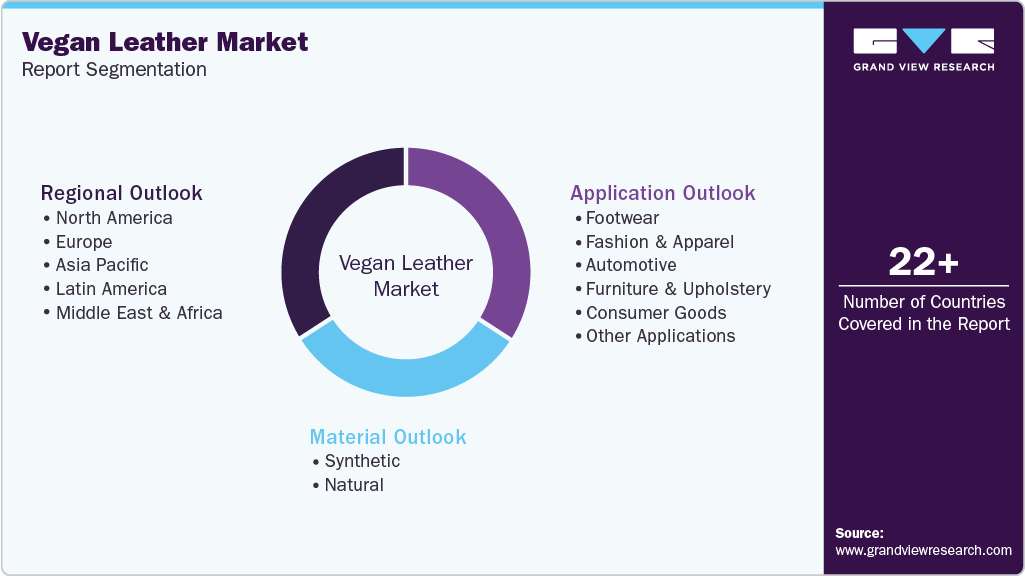
This report forecasts volume & revenue growth at the global, regional, and country levels and provides an analysis of the latest industry trends in each of the sub-segments from 2021 to 2033. For this study, Grand View Research has segmented the global vegan leather market report based on material, application and region:
 To learn more about this report, Download Free Sample Report
-
Material Outlook (Volume, Million Square Meters; Revenue, USD billion, 2021 - 2033)
-
Synthetic
-
Polyurethane (PU) Leather
-
Polyvinyl Chloride (PVC) Leather
-
Silicone Leather
-
Others
-
-
Natural
-
Mushroom-based Leather
-
Cactus-based Leather
-
Pineapple-based Leather
-
Apple-based Leather
-
Others
-
-
-
Application Outlook (Volume, Million Square Meters; Revenue, USD billion, 2021 - 2033)
-
Footwear
-
Fashion & Apparel
-
Bags & Handbags
-
Wallets & Small Leather Goods
-
Apparel & Accessories
-
-
Automotive
-
Seating
-
Interior Trim & Panels
-
Other Automotive Applications
-
-
Furniture & Upholstery
-
Consumer Goods
-
Other Applications
-
-
Regional Outlook (Volume, Million Square Meters; Revenue, USD billion, 2021 - 2033)
-
North America
-
U.S.
-
Canada
-
Mexico
-
-
Europe
-
Germany
-
UK
-
France
-
Italy
-
Spain
-
-
Asia Pacific
-
China
-
India
-
Japan
-
South Korea
-
-
Latin America
-
Brazil
-
Argentina
-
-
Middle East & Africa
-
Saudi Arabia
-
South Africa
-
-
Research Methodology
The vegan leather market figures in this report are based on a proven research process that combines executive interviews with secondary research from proprietary databases, company filings, and recognized regulatory and institutional sources. Market size is built through value-chain sizing - reconciling supply-side and demand-side estimates - and triangulated with bottom-up and top-down approaches. Every estimate passes multiple levels of expert validation before publication, with each vegan leather segment quantified using the revenue-capture definitions in the table below.
Segment Definition
Segment - Material
Revenue capture definition
Synthetic
Revenue generated from the sale of synthetic vegan leather materials manufactured primarily from PU, PVC, silicone, and other synthetic polymer-based materials for use across footwear, apparel, bags, automotive, furniture, and consumer goods applications.
Natural
Revenue generated from the sale of natural and bio-based vegan leather materials derived from sources such as mushrooms, cactus, pineapple, apple, and other plant- or biomass-based feedstocks for commercial applications.
Segment - Application
Revenue capture definition
Footwear
Revenue generated from vegan leather materials supplied for footwear components and finished footwear products, including uppers, linings, trims, and other leather-replacement applications.
Fashion & Apparel
Revenue generated from vegan leather materials used in clothing, fashion accessories, and related apparel products, including jackets, skirts, garments, belts, and other fashion applications.
Automotive
Revenue generated from vegan leather materials supplied for automotive interior applications, including seating, interior trim, panels, door components, dashboards, and other vehicle interior surfaces.
Furniture & Upholstery
Revenue generated from vegan leather materials used in furniture and upholstery applications, including sofas, chairs, seating surfaces, cushions, and other interior furnishings.
Consumer Goods
Revenue generated from vegan leather materials used in consumer products such as wallets, small leather goods, personal accessories, cases, and other non-apparel products.
Other Applications
Revenue generated from vegan leather materials used in applications not classified under footwear, fashion & apparel, automotive, furniture & upholstery, or consumer goods, including specialty and emerging end-use applications.
Estimation Model
Layer No.
Layer Name
Key Question
Description
01
Raw Material & Production Layer
What forms the supply base?
Identify the sourcing and production of vegan leather using synthetic materials such as polyurethane (PU), polyvinyl chloride (PVC), and silicone, along with natural and bio-based materials including mushroom, cactus, pineapple, and apple-based materials. Evaluate manufacturing technologies, raw material availability, production capacities, material properties, supply chain dynamics, and major production hubs supporting the global supply of vegan leather.
02
Application Adoption Layer
Where is vegan leather consumed?
Assess the adoption of vegan leather across major applications, including footwear, fashion & apparel, bags & handbags, wallets & small leather goods, automotive, furniture & upholstery, and consumer goods. Demand is influenced by increasing adoption of animal-free materials, sustainability initiatives, product innovation, and growing use of alternative leather materials across consumer and mobility applications.
03
Consumption Intensity Layer
How much vegan leather is utilized?
Analyze vegan leather consumption by evaluating demand across synthetic and natural material types in key end-use applications. The assessment considers application-specific material requirements, product manufacturing volumes, material usage intensity, surface-area requirements, replacement rates, and regional production patterns to estimate annual vegan leather consumption across global markets.
04
Revenue Layer
How is market revenue generated?
Market revenue is generated through the production, supply, distribution, and commercial sale of vegan leather materials for footwear, fashion & apparel, bags, automotive, furniture, and consumer goods applications. Revenue growth is supported by expanding demand for animal-free materials, advancements in bio-based leather technologies, sustainability-focused product development, and increasing adoption of vegan leather across consumer and industrial applications.
Delivered Customizations
This report has been delivered with the following In-depth customizations
Client Request
Customization Delivered
Value Adds
Cross-Segmentation Analysis
The relationship between material type and application was assessed to evaluate demand across synthetic and natural vegan leather materials. The analysis examined adoption trends across footwear, fashion & apparel, bags & handbags, wallets & small leather goods, automotive, furniture & upholstery, and consumer goods to identify high-value material-application combinations.
Enables identification of the most attractive material-application combinations. Supports material portfolio optimization, product positioning, and commercialization strategies tailored to application-specific performance and sustainability requirements.
Competitive Benchmarking
Leading vegan leather manufacturers and material developers were benchmarked based on material portfolio, production capabilities, technology development, application coverage, manufacturing scalability, sustainability initiatives, and recent strategic developments. Competitive positioning across synthetic and natural leather alternatives was also evaluated.
Helps identify competitive strengths, technology differentiators, application capabilities, and market positioning gaps. Facilitates strategic differentiation, partnership evaluation, product development, and market expansion decisions.
Opportunity Assessment
Growth opportunities were assessed across footwear, fashion & apparel, bags & handbags, automotive, furniture & upholstery, and consumer goods. The analysis also examined opportunities arising from increasing demand for animal-free materials, advancements in bio-based leather technologies, and broader adoption of sustainable material alternatives.
Enables identification of high-potential material and application areas and emerging investment opportunities. Supports innovation planning, portfolio expansion, technology partnerships, and long-term strategic growth initiatives.
Frequently Asked Questions About This Report
The vegan leather market size was USD 11.6 billion in 2025 and is expected to reach USD 12.6 billion by 2026.
The vegan leather market is anticipated to grow at a CAGR of 11.4% from 2026 to 2033 and is projected to reach USD 26.8 billion by 2033.
Based on material, synthetic dominated with a share of 89.4% in 2025.
Asia Pacific held the largest revenue share of 48.8% in 2025, because the region combines large-scale synthetic leather manufacturing with extensive downstream footwear, apparel, furniture, electronic accessories, and automotive production. The concentration of converters, material suppliers, and finished-product manufacturers enables shorter supply chains and supports high-volume commercialization.
Footwear held the largest revenue share of 34.7% in 2025, because vegan leather can be converted into uppers, linings, trims, straps, and other components across multiple footwear constructions. High product turnover, frequent material refresh cycles, and extensive design requirements create recurring demand for materials offering consistent appearance, flexibility, abrasion resistance, and compatibility with established shoe-manufacturing processes.
Growing demand for animal-free materials is encouraging footwear, fashion, automotive, and furniture manufacturers to incorporate vegan leather into product development. Improvements in texture, flexibility, durability, and finishing are making vegan leather increasingly suitable for application-specific requirements. At the same time, manufacturers are expanding material innovation to provide alternatives to conventional animal-derived leather.
Key players include Anhui Anli Material Technology; Wanhua New Materials Co., Ltd.; Mayur Uniquoters Limited; Kuraray Co., Ltd.; Teijin Cordley Limited; Fujian Polytech; Ananas Anam; Loba Chemie Pvt. Ltd; Foremost Champion Co., Ltd.; Fengchen Group Co., Ltd.
Natural is the fastest growing form segment, with a CAGR of 11.9% from 2026 to 2033, as material developers commercialize agricultural residues, plant fibers, fungal biomass, and other renewable feedstocks into engineered leather alternatives. Increasing technical refinement of backing structures, coatings, and surface treatments is improving their suitability for commercial products while enabling brands to differentiate through material provenance and next-generation product design.
Automotive is projected to grow with a CAGR of 12.3% from 2026 to 2033, as interior suppliers increasingly evaluate leather alternatives for seating, door panels, dashboards, consoles, and trim components. The application offers higher-value material opportunities because suppliers must satisfy stringent requirements for wear resistance, dimensional stability, tactile quality, temperature performance, and long-term appearance retention.
About the Author(s)
Specialty & Chemicals Research Team
Research · Specialty & ChemicalsThis report was authored by the specialty & chemicals research team at Grand View Research - comprising two research analysts, one senior research analyst, and one industry expert - with specialized expertise in the specialty & chemicals segment of the research industry. All findings are based on proprietary research databases, executive interviews, and regulatory analysis, subject to internal peer review prior to publication.
Last Updated:
Speak to Analyst

Customize this report to your needs - add regions, segments, or data points, with 20% free customization.
Or view our licence options:


ISO 9001:2015 & 27001:2022 Certified
We are GDPR and CCPA compliant! Your transaction & personal information is safe and secure. For more details, please read our privacy policy.


