
- Home
- »
- Electronic Security
- »
-
Video Surveillance And VSaaS Market Report, 2026-2033GVR Report cover

Video Surveillance And VSaaS Market (2026 - 2033)
Size, Share & Trends Analysis Report By Type (Analog Video Surveillance, IP Video Surveillance, Hybrid Video Surveillance Systems), By Vertical (Commercial, Industrial, Residential), By Region, And Segment Forecasts
Market Size, 2025
$65.8BMarket Estimate, 2026
$71.4BMarket Forecast, 2033
$137.4BCAGR, 2026–2033
9.8%Video Surveillance And VSaaS Market Summary
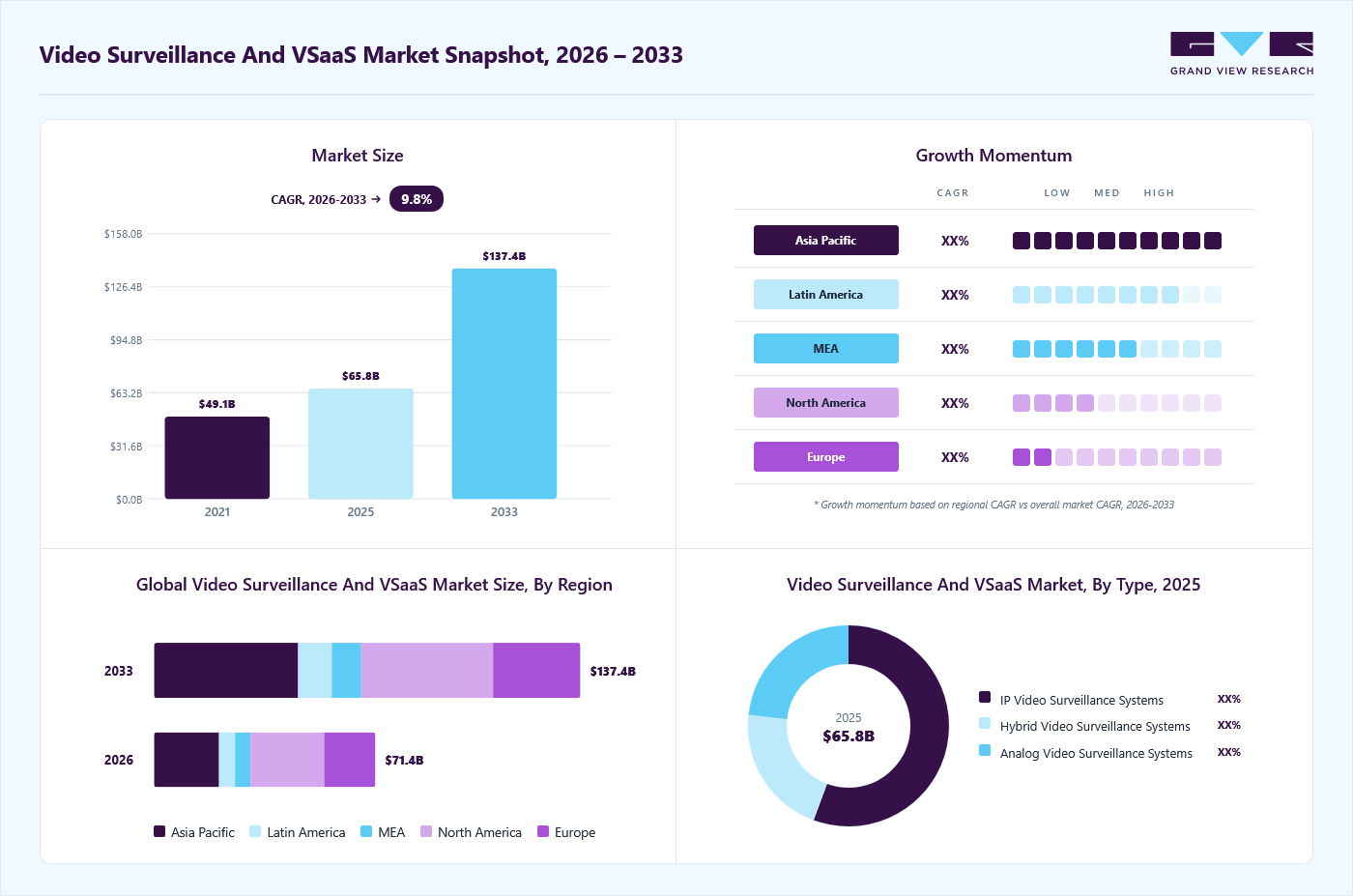
The global video surveillance and VSaaS market size was valued at USD 65.8 billion in 2025 and is projected to grow from USD 71.4 billion in 2026 to USD 137.4 billion by 2033, at a CAGR of 9.8% from 2026 to 2033. North America dominated the market, accounting for the largest revenue share of 33%in 2025. The market is driven by the rising adoption of cloud-based surveillance platforms, increasing deployment of AI-powered video analytics, expanding smart city initiatives, growing demand for remote monitoring solutions, and higher investments in public safety and critical infrastructure protection.
 Source: Grand View Research, IR Documents, Primary Interviews, Paid DatabasesTo learn more about this report,
 Download Free Sample Report
 Key Market Trends & Insights
- By type: IP video surveillance systems segment dominated the market, with a revenue share of over 55% in 2025.
- By vertical: commercial segment held the largest revenue share in 2025.
Regional Highlights
- Largest regional market: North America (over 33% revenue share, 2025)
- Fastest growing regional market: Asia Pacific (highest CAGR, 2026-2033)
- By country: The U.S. held the largest market share in 2025.
Market Size & Forecast
- Market size in 2025: USD 65.8 Billion
- Estimated market size in 2026: USD 71.4 Billion
- Projected market size by 2033: USD 137.4 Billion
- CAGR (2026-2033): 9.8%
Three ways to get this report
Buy it, customize it, or ask a question.Ask an Analyst
Analyst response in 1 business day
- AccessReport author, directly
- Reply timeWithin 1 working day
- No sales callDirect answer only
- FormatEmail reply
- CostFree, no cost
Get the Full Report
What the study covers
- FormatsPDF · Excel · Dashboard
- Timeline2026–2033 annual, 2025 base
- Coverage20+ countries, 5 regions
- Companies10+ key players profiled
Customize the Report
20% free customization
- IncludeCountries, segments, points
- TailorTo your product definition
- ExtendDeeper competitor detail
- OrA fully bespoke study
- Turnaround5–10 working days
The scalability offered by video surveillance-as-a-service to organizations allows them to scale up or down surveillance systems easily. Remote accessibility, cloud-based VSaaS provides remote access to surveillance footage, improving monitoring. Analytics & AI-based VSaaS solutions benefit from integrating analytics and AI, such as facial recognition, object detection, and others.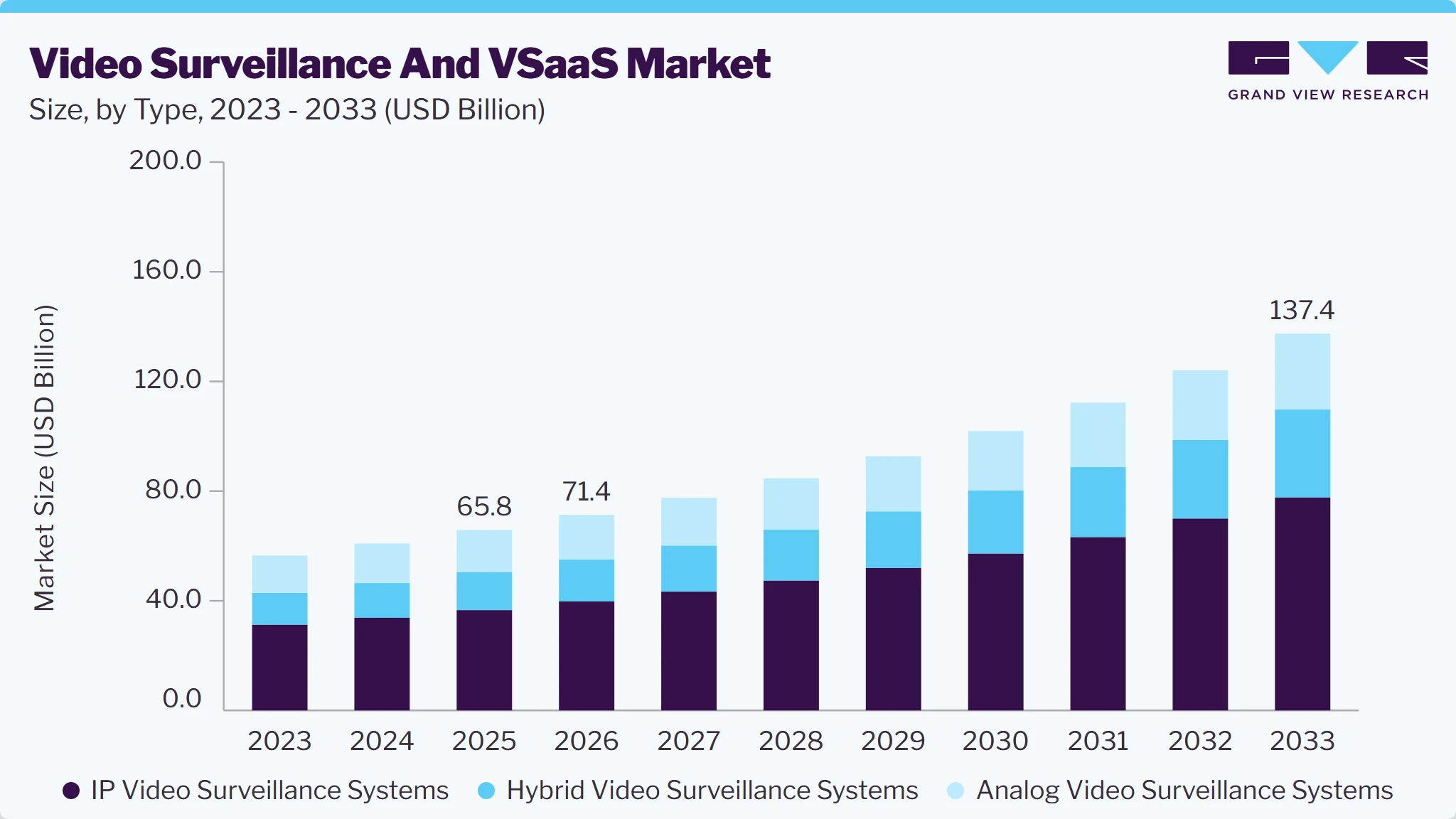 To learn more about this report, Download Free Sample Report
 VSaaS is one of the fastest-growing verticals in the video surveillance market. Technology is advancing rapidly, security threats are increasing, and the demand for cost-effective, scalable video surveillance solutions is rising. Key trends boosting the market growth include Cloud VSaaS, one of the fastest-growing cloud-based software-as-a-service (SaaS) solutions. This is largely due to cloud-based solutions' scalability benefits, remote access capabilities, and low infrastructure costs. Cloud-based software as a service provider offers end-to-end solutions that are easy to deploy and implement for businesses of all sizes.
Market Dynamics
The video surveillance and VSaaS market is driven by the increasing adoption of cloud-based video surveillance, AI-powered video analytics, and IP camera systems as organizations prioritize scalable, intelligent, and cost-effective security solutions. Rising investments in smart city projects, critical infrastructure protection, and public safety are accelerating the deployment of advanced surveillance technologies across government, commercial, industrial, and transportation sectors. The growing demand for remote monitoring, real-time threat detection, and edge-enabled surveillance is further supporting market expansion by enabling faster decision-making and operational efficiency. However, concerns related to data privacy, cybersecurity risks, high initial implementation costs, and regulatory compliance continue to pose challenges to widespread adoption. Continuous advancements in artificial intelligence, machine learning, cloud computing, and video management software (VMS) are expected to create significant growth opportunities by enhancing automation, predictive analytics, and centralized security management throughout the forecast period.
The video surveillance and VSaaS market is primarily driven by the increasing adoption of AI-powered video analytics, cloud-based Video Surveillance as a Service (VSaaS), and IP video surveillance systems across commercial, industrial, and public sectors. Organizations are investing in intelligent surveillance solutions to improve real-time threat detection, incident response, and operational efficiency while reducing infrastructure management costs. The growing implementation of smart city initiatives, critical infrastructure security, and public safety programs is further accelerating the deployment of advanced surveillance technologies. Rising demand for remote monitoring, video management software (VMS), and edge-based surveillance is enabling organizations to monitor distributed facilities through centralized cloud platforms. In addition, continuous advancements in artificial intelligence, machine learning, and high-resolution network cameras are enhancing video intelligence capabilities, supporting sustained market growth.
The expansion of cloud computing infrastructure and high-speed network connectivity is making cloud video surveillance more accessible for enterprises of all sizes. Businesses are increasingly replacing legacy analog systems with IP cameras and subscription-based VSaaS platforms to improve scalability and reduce capital expenditure. The integration of facial recognition, object detection, license plate recognition, and behavioral analytics is increasing the value proposition of intelligent surveillance systems. Growing investments from governments and private enterprises in digital security infrastructure continue to strengthen market demand. These factors collectively position AI-enabled video surveillance as a key growth catalyst for the global market.
The video surveillance and VSaaS market faces challenges despite due to growing concerns surrounding data privacy, cybersecurity, and the protection of sensitive surveillance footage. Cloud-connected surveillance systems generate large volumes of video data that require secure storage, transmission, and access management. Organizations remain cautious about unauthorized access, ransomware attacks, data breaches, and vulnerabilities associated with internet-connected surveillance devices. Compliance with evolving privacy regulations and data protection requirements increases implementation complexity for enterprises operating across multiple jurisdictions. These concerns may slow the adoption of cloud-based surveillance solutions in highly regulated industries.
The increasing sophistication of cyberattacks requires continuous investment in network security, data encryption, and identity and access management for surveillance infrastructure. Legacy surveillance systems often lack advanced security features, making system upgrades both costly and time-consuming. Integration with multiple enterprise security platforms may also create interoperability and cybersecurity challenges. Organizations must balance the benefits of intelligent surveillance with regulatory compliance and risk management requirements. Addressing these security and privacy concerns remains essential for sustaining long-term growth in the Video Surveillance and VSaaS market.
The rapid expansion of smart city initiatives and digital infrastructure projects presents significant opportunities for the Video Surveillance and VSaaS market. Governments worldwide are investing in AI-enabled surveillance, traffic monitoring, public safety systems, and critical infrastructure protection to improve urban security and operational efficiency. The increasing deployment of 5G connectivity, edge computing, and Internet of Things (IoT) technologies is enabling real-time video processing and intelligent decision-making. Enterprises are also adopting cloud-based surveillance platforms to support multi-site monitoring and centralized security operations. These developments are creating strong demand for scalable and analytics-driven surveillance solutions.
The integration of predictive analytics, computer vision, and deep learning into surveillance systems is expanding the use of video intelligence beyond traditional security applications. Emerging opportunities in healthcare, retail, manufacturing, transportation, and education are driving broader adoption of intelligent video monitoring solutions. Growing demand for subscription-based VSaaS models is enabling small and medium-sized enterprises to access enterprise-grade surveillance capabilities with lower upfront investment. Technology providers are introducing advanced video management software, automation features, and cloud-native security platforms to strengthen their competitive positioning. These innovations are expected to accelerate the adoption of intelligent surveillance solutions and create substantial long-term growth opportunities for the global market.
Market Concentration & Characteristics
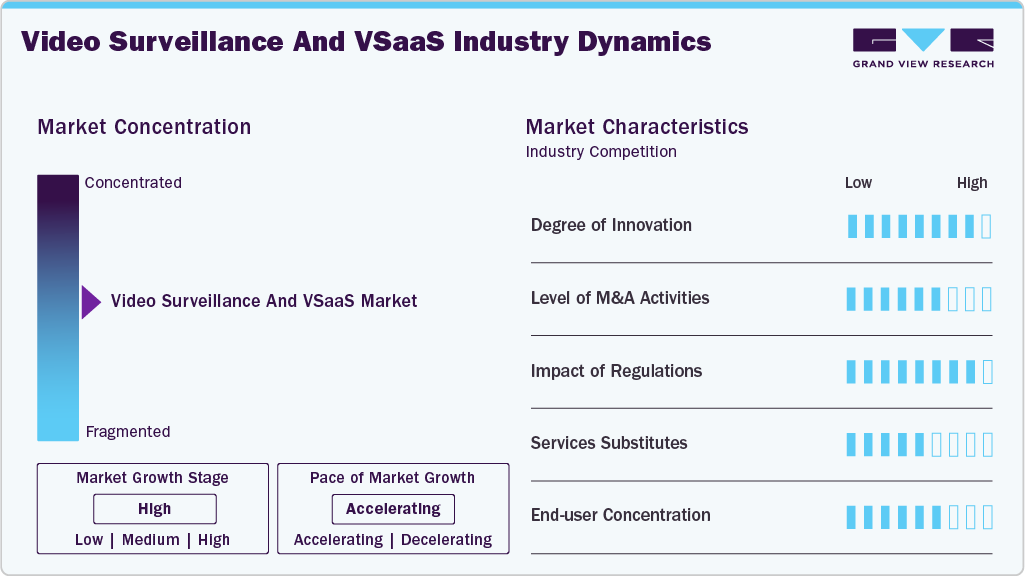
The video surveillance and VSaaS market is moderately consolidated, with established technology providers competing through AI-powered video analytics, cloud-based VSaaS platforms, IP camera solutions, and integrated video management software (VMS). Leading companies emphasize continuous innovation, strategic acquisitions, and partnerships to strengthen their product portfolios and expand their global presence. Increasing investments in edge computing, artificial intelligence, and cloud surveillance infrastructure are intensifying competition among both global and regional vendors. Subscription-based Video Surveillance as a Service (VSaaS) models are further reshaping the competitive landscape by enabling scalable and recurring revenue opportunities.
 To learn more about this report, Download Free Sample Report
 The market is characterized by rapid technological advancements, growing demand for remote monitoring, and increasing integration of IoT-enabled surveillance devices with intelligent security platforms. Vendors are focusing on enhancing cybersecurity, real-time video analytics, and predictive threat detection to address evolving customer requirements across commercial, industrial, residential, and government sectors. Demand for interoperable and cloud-native surveillance solutions is encouraging the development of open-platform architectures and AI-driven automation capabilities. As digital transformation accelerates across industries, the Video Surveillance and VSaaS market is expected to witness sustained innovation, increasing service differentiation, and stronger adoption of intelligent surveillance ecosystems.
Analyst Perspective
The video surveillance and VSaaS market is poised for steady growth as organizations increase investments in advanced physical security and cloud-based surveillance solutions. Rising demand for real-time monitoring, remote access, and AI-powered video analytics is driving the adoption of intelligent surveillance systems across commercial, industrial, and public sectors. The integration of cloud platforms, edge computing, and unified security ecosystems is enhancing operational efficiency and scalability. In addition, advancements in high-definition cameras, 5G connectivity, and low-latency streaming are improving surveillance performance across distributed environments. Growing emphasis on cybersecurity, interoperability, and automated threat detection is further accelerating market expansion. Vendors focusing on AI-driven analytics, flexible cloud deployment, and integrated security solutions are expected to strengthen their market position over the forecast period.
Type Insights
Based on type, the IP video surveillance systems segment led the market with the largest revenue share of over 55% in 2025. Customers' requirements for superior image quality, higher scalability, and flexibility drive the demand for IP video surveillance systems. IP cameras provide more apparent video footage in high definition compared to traditional analog systems, improving evidence collection and identification.
The hybrid video surveillance systems segment is anticipated to register the fastest CAGR over the forecast period. Hybrid systems combine traditional analog cameras with modern IP technology. This enables organizations to utilize their current infrastructure while upgrading digital capabilities. The increasing use of wireless and spy cameras in hybrid systems enhances covert surveillance services and flexibility, driving market growth.
Vertical Insights
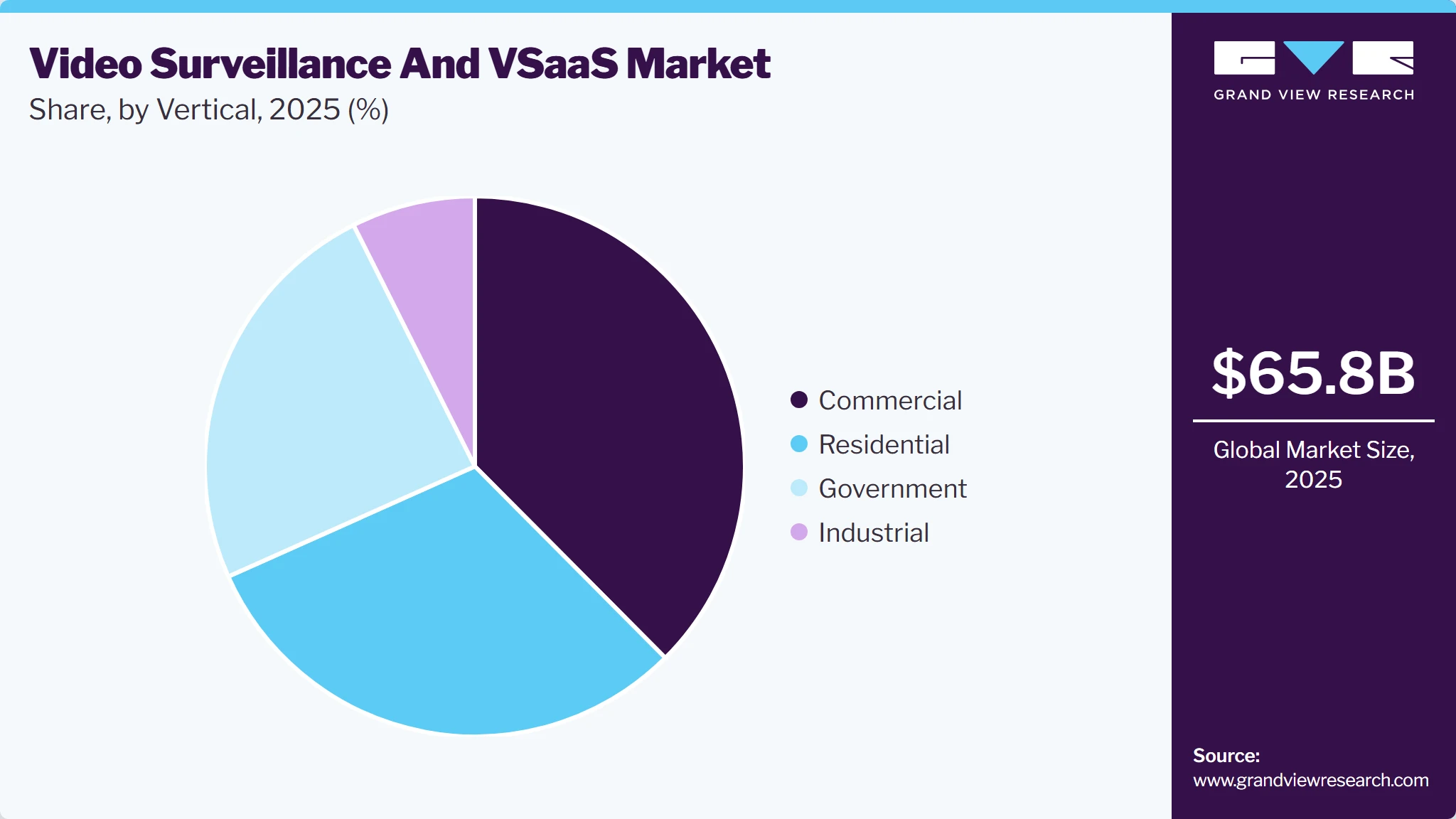
Based on vertical, the commercial segment led the market with the largest revenue share of over 37% in 2025 due to increasing theft, unauthorized access, vandalism, and employee misconduct, and security risk in retail stores, banks, corporations, & other industries. Video surveillance serves as a preventive measure and aids in the examination of incidents. These factors are creating a strong demand for video surveillance solutions within the commercial segment.
 To learn more about this report, Download Free Sample Report
 The industrial segment is anticipated to register the fastest CAGR over the forecast period. The emergence of Industry 4.0 is promoting the merging of video surveillance with other automation systems to foster security and provide a broader operational overview.
Regional Insights
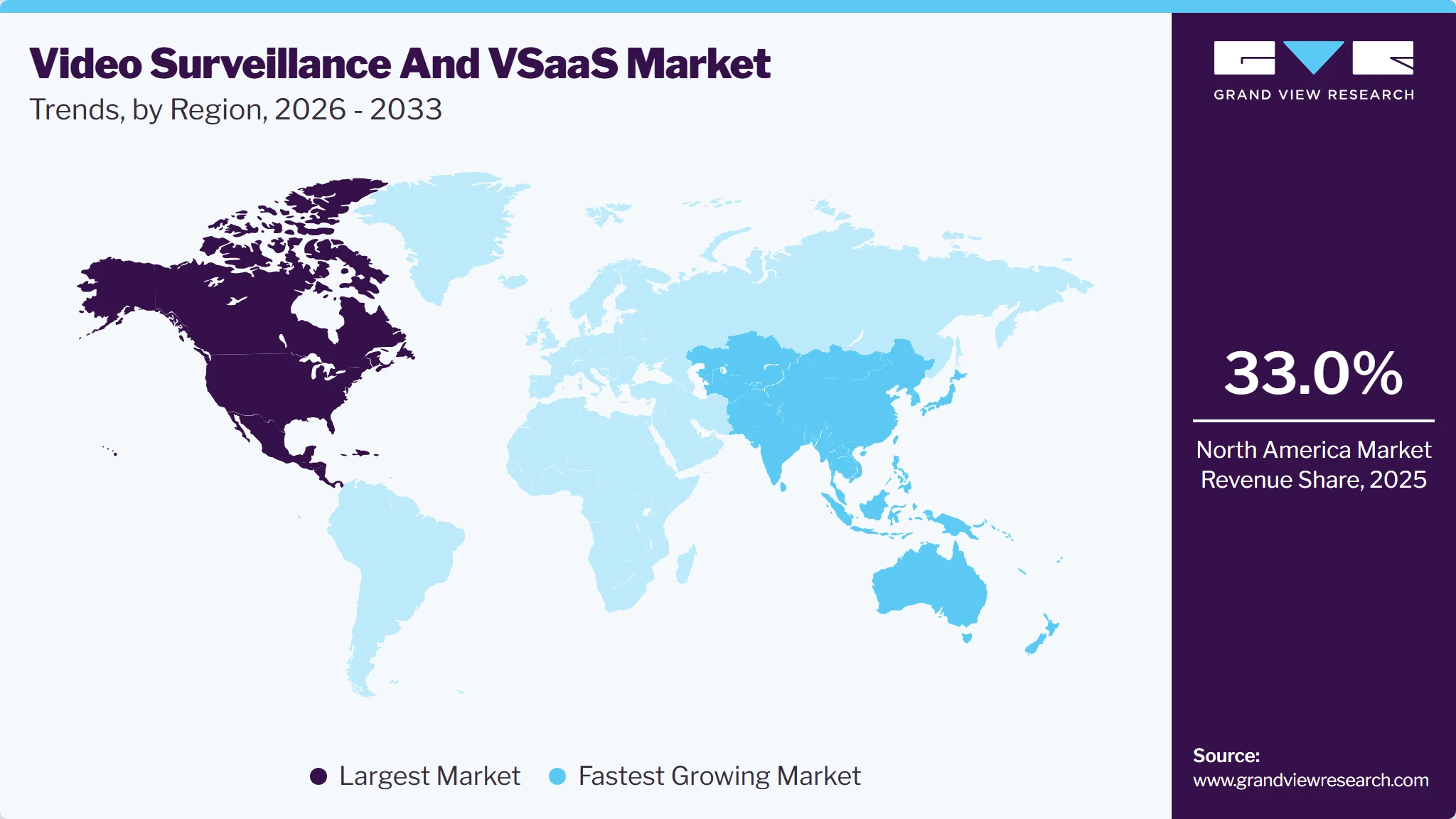
North America dominated the video surveillance and VSaaS market with the largest revenue share of over 33% in 2025. The early adoption of new technologies, rising security concerns, and the presence of major market players in this region are driving the market growth. Various video surveillance and VSaaS firms are based in North America leading to innovative research and development in the video surveillance market.
 To learn more about this report, Download Free Sample Report
 U.S. Video Surveillance and VSaaS Market Trends
The video surveillance and VSaaS market in the U.S. held the largest share in the North America region in 2025. The massive investment by the government in security infrastructure, including video surveillance systems for public spaces and critical infrastructure, is one of the key drivers attributing to the market growth. Moreover, governmental grants or incentives also contribute to expanding the market for security solutions. The commercial sector, including retail, banking, and hospitality, increasingly adopts video surveillance for loss prevention, fraud detection, and customer safety.
Asia Pacific Video Surveillance and VSaaS Market Trends
Asia Pacific is projected to register the fastest CAGR during the forecast period. Rapid urbanization in this region is resulting in the emergence of cities and the development of infrastructure. This expansion requires strong security measures to protect public areas, essential facilities, and companies. Additionally, rising crime rates and security risks in the retail, manufacturing, and transportation industries drive the need for video surveillance solutions. In March 2024, Transline Technologies Limited collaborated with RailTel Corporation of India Ltd and Telecommunications Consultants India Limited (TCIL) to integrate its Integrated Control and Command Center (ICCC) in Indian railway as a part of the video surveillance system project.
The video surveillance and VSaaS market in the China accounted for considerable share in 2023. The imposition of various policies by the government is making it mandatory for customers to incorporate them in their settings.
Key Video Surveillance And VSaaS Company Insights
Some of the key companies in the video surveillance and VSaaS market include Robert Bosch GmbH, Motorola Solutions, Inc., Hangzhou Hikvision Digital Technology Co., Ltd., Axis Communications AB., TKH GROUP, and others. Businesses in the video surveillance and VSaaS sectors are focusing on creating new components and expanding their distribution networks. Strategic partnerships are also utilized to expand business operations.
-
Hangzhou Hikvision Digital Technology Co., Ltd. offers a wide variety of physical security products, including video security, access control, and alarm systems. It offers AI-powered integrated security solutions to aid end-users in safety management and business intelligence with new applications and opportunities.
Key Video Surveillance And VSaaS Companies
The following key companies have been profiled for this study on the video surveillance and VSaaS market.
-
Hangzhou Hikvision Digital Technology Co., Ltd.
-
Dahua Technology Co., Ltd
-
Robert Bosch GmbH
-
Axis Communications AB.
-
Motorola Solutions, Inc.
-
Zhejiang Uniview Technologies Co.,Ltd.
-
Tiandy Technologies Co., Ltd.
-
TKH GROUP
-
Hanwha Vision Co., Ltd.
-
THE INFINOVA GROUP.
Competitive Benchmarking
Operating Strategies
Competitive Edge
Weaknesses
Mature Players: Hangzhou Hikvision Digital Technology Co., Ltd., Dahua Technology Co., Ltd., Robert Bosch GmbH, Axis Communications AB, Motorola Solutions, Inc.
- Mature players focus on expanding AI-powered video surveillance, cloud-based VSaaS, video management software (VMS), and IP surveillance solutions across enterprise, government, and critical infrastructure applications.
- Their competitive advantage lies in strong global presence, comprehensive surveillance portfolios, established distribution networks, and continuous investments in AI, computer vision, and integrated security technologies.
- These companies may face challenges related to legacy system integration, slower product innovation cycles, and higher deployment costs for large-scale surveillance projects.
Emerging Players: Zhejiang Uniview Technologies Co., Ltd., Tiandy Technologies Co., Ltd., TKH Group, Hanwha Vision Co., Ltd., The Infinova Group.
- Emerging players focus on developing cloud-native VSaaS, AI video analytics, remote monitoring, and intelligent surveillance platforms with flexible deployment models.
- Their strength comes from agile product innovation, specialized software capabilities, faster feature deployment, and strong expertise in cloud-based surveillance technologies.
- Limited global presence, smaller partner networks, and comparatively lower financial resources may constrain large-scale market expansion and enterprise adoption.
Recent Developments
-
In July 2024, Arcules and Milestone Systems announced that they would merge, and the deal is anticipated to be finalized by the end of 2024. The deal will unite them in video surveillance as a service (VSaaS), video management software (VMS), and video analytics, thereby offerinf comprehensive video technology solutions.
-
In June 2024, Hanwha Vision Co., Ltd. launched two new high-performance AI PTZ Plus cameras, namely the XNP-C9310R and XNP-C7310R. These cameras use AI technology to quickly zoom and focus, allowing for better awareness of situations and faster response. It ensures cybersecurity, high resolutions offered by the cameras, and easy installation.
-
In October 2023, Milestone Systems announced the upcoming launch of Camera to Cloud Milestone Kite VSaaS software. The new option is projected to offer cost efficiency and simplicity to customers.
Video Surveillance and VSaaS Market Report Scope
Report Attribute
Details
Market size in 2025
USD 65.8 billion
Estimated Market size in 2026
USD 71.4 billion
Projected Market size by 2033
USD 137.4 billion
Growth rate
CAGR of 9.8% from 2026 to 2033
Base year for estimation
2025
Historical data
2021 - 2024
Forecast period
2026 - 2033
Quantitative units
Revenue in USD million/billion and CAGR from 2026 to 2033
Report coverage
Revenue forecast, company ranking, competitive landscape, growth factors, and trends
Segments covered
Type, vertical, region
Regional scope
North America; Europe; Asia Pacific; Latin America; MEA
Country scope
U.S.; Canada; Mexico; Germany; UK; France; China; Japan; India; South Korea; Australia; Brazil; Saudi Arabia; South Africa; UAE
Key companies profiled
Hangzhou Hikvision Digital Technology Co., Ltd.; Dahua Technology Co., Ltd; Robert Bosch GmbH; Axis Communications AB.; Motorola Solutions, Inc.; Zhejiang Uniview Technologies Co.,Ltd.; Tiandy Technologies Co., Ltd. ; TKH GROUP; Hanwha Vision Co., Ltd.; THE INFINOVA GROUP
Customization scope
Free report customization (equivalent up to 8 analysts' working days) with purchase. Addition or alteration to country, regional & segment scope.
Pricing and purchase options
Avail customized purchase options to meet your exact research needs. Explore purchase options
Global Video Surveillance And VSaaS Market Report Segmentation
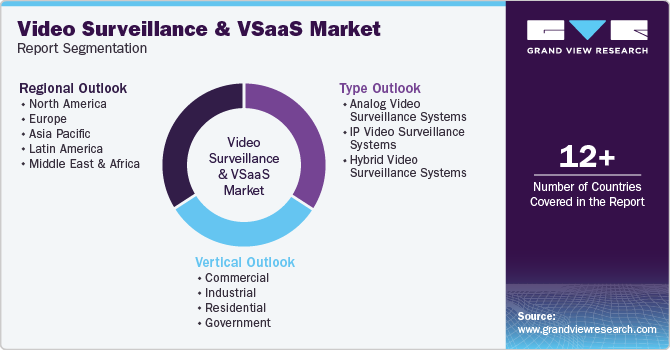
This report forecasts revenue growth at global, regional, and country levels and provides an analysis of the latest industry trends in each of the sub-segments from 2021 to 2033. For this study, Grand View Research has segmented the global video surveillance and VSaaS market report based on type, vertical and region:
 To learn more about this report, Download Free Sample Report
 -
Type Outlook (Revenue, USD Million, 2021 - 2033)
-
Analog Video Surveillance Systems
-
IP Video Surveillance Systems
-
Hybrid Video Surveillance Systems
-
-
Vertical Outlook (Revenue, USD Million, 2021 - 2033)
-
Commercial
-
Industrial
-
Residential
-
Government
-
-
Regional Outlook (Revenue, USD Million, 2021 - 2033)
-
North America
-
U.S.
-
Canada
-
Mexico
-
-
Europe
-
Germany
-
UK
-
France
-
-
Asia Pacific
-
China
-
Japan
-
India
-
South Korea
-
Australia
-
-
Latin America
-
Brazil
-
-
Middle East and Africa (MEA)
-
South Arabia
-
UAE
-
South Africa
-
-
Research Methodology
The video surveillance and VSaaS market figures in this report are based on a proven research process that combines executive interviews with secondary research from proprietary databases, company filings, and recognized regulatory and institutional sources. Market size is built through value-chain sizing - reconciling supply-side and demand-side estimates - and triangulated with bottom-up and top-down approaches. Every estimate passes multiple levels of expert validation before publication, with each video surveillance and VSaaS segment quantified using the revenue-capture definitions in the table below.
Segment Definition
Segment - Type
Revenue capture definition
Analog Video Surveillance Systems
Analog video surveillance systems use traditional analog cameras and coaxial cable infrastructure to capture and transmit video to digital video recorders (DVRs). These systems are primarily deployed in cost-sensitive applications and legacy surveillance environments where basic monitoring capabilities are sufficient.
IP Video Surveillance Systems
IP video surveillance systems utilize network-connected cameras to transmit digital video over Internet Protocol (IP) networks for centralized monitoring and management. They support advanced capabilities such as high-definition imaging, AI-powered analytics, remote access, and seamless integration with cloud-based surveillance platforms.
Hybrid Video Surveillance Systems
Hybrid video surveillance systems combine analog and IP-based surveillance technologies within a single security infrastructure. They enable organizations to modernize existing surveillance networks by integrating legacy analog cameras with advanced IP surveillance solutions.
Segment - Vertical
Revenue capture definition
Commercial
The commercial segment includes video surveillance and VSaaS deployments across offices, retail stores, shopping malls, hospitality facilities, healthcare institutions, and financial establishments. These solutions are implemented to enhance asset protection, employee safety, customer security, and operational monitoring.
Industrial
The industrial segment comprises surveillance solutions deployed in manufacturing plants, warehouses, logistics centers, energy facilities, and other industrial sites. These systems support perimeter security, process monitoring, worker safety, and regulatory compliance across industrial operations.
Residential
The segment includes surveillance systems installed in individual homes, apartment complexes, gated communities, and residential buildings. These solutions provide property monitoring, intrusion detection, remote access, and enhanced home security for homeowners and property managers.
Government
This segment includes surveillance deployments across public infrastructure, transportation hubs, defense facilities, law enforcement agencies, and municipal security projects. These solutions are used to strengthen public safety, monitor critical infrastructure, support crime prevention, and improve emergency response capabilities.
Estimation Model
Layer Name
Key Questions
Description
Video Surveillance Demand & Security Adoption Layer
Who generates demand for Video Surveillance and VSaaS solutions?
Identify demand across commercial enterprises, industrial facilities, government agencies, residential communities, transportation operators, healthcare institutions, educational campuses, and critical infrastructure operators adopting intelligent surveillance technologies. This layer establishes the addressable market by evaluating security modernization initiatives, public safety investments, regulatory compliance requirements, and the increasing need for real-time monitoring and remote surveillance.
Surveillance Infrastructure & Cloud Deployment Layer
Who invests in surveillance infrastructure and cloud-based platforms?
Assess investments in IP cameras, AI-enabled cameras, video management software (VMS), network video recorders (NVRs), cloud storage, edge computing infrastructure, networking equipment, and Video Surveillance as a Service (VSaaS) platforms. This layer measures infrastructure spending supporting video capture, data transmission, cloud deployment, storage, and centralized surveillance management.
AI Video Analytics & Managed Services Adoption Layer
Who deploys AI-powered surveillance and VSaaS services?
Apply adoption rates of AI-powered video analytics, facial recognition, object detection, license plate recognition, behavioral analytics, intrusion detection, remote monitoring, and managed surveillance services across end-use industries. This layer captures the deployment of intelligent analytics, cloud-based monitoring, predictive security capabilities, and managed video surveillance services that improve operational efficiency and threat detection.
Video Surveillance and VSaaS Market Revenue Realization Layer
How much revenue is generated from Video Surveillance and VSaaS solutions?
Estimate market revenue by combining active deployments with spending on surveillance hardware, cloud-based VSaaS subscriptions, video management software (VMS), AI analytics software, managed security services, system integration, consulting, maintenance, and technical support. This layer captures the total revenue generated from the deployment, operation, and lifecycle management of intelligent Video Surveillance and VSaaS solutions across all end-use sectors.
Delivered Customizations
This report has been delivered with the following In-depth customizations
Client Request
Customization Delivered
Value Adds
Video Surveillance and VSaaS Technology Adoption & Growth Assessment
Performed a comprehensive assessment of Video Surveillance and VSaaS market trends, including AI-powered video analytics, cloud-based VSaaS, IP cameras, video management software (VMS), edge computing, computer vision, machine learning, facial recognition, and remote monitoring technologies across major industry verticals.
Enables stakeholders to identify high-growth technology segments, evaluate evolving surveillance trends, prioritize strategic investments, and strengthen competitive positioning within the global Video Surveillance and VSaaS market.
Industry-Specific Video Surveillance and VSaaS Deployment Analysis
Assessed adoption of Video Surveillance and VSaaS solutions across commercial, industrial, residential, and government sectors, including applications such as public safety, critical infrastructure protection, perimeter security, traffic monitoring, asset protection, and workplace surveillance.
Provides actionable insights into industry-specific deployment patterns, security modernization initiatives, investment priorities, and long-term revenue opportunities to support business expansion strategies.
AI Video Analytics & Cloud Surveillance Opportunity Assessment
Evaluated growth opportunities across AI-powered video analytics, cloud surveillance platforms, edge AI cameras, behavioral analytics, license plate recognition, object detection, intrusion detection, predictive surveillance, and intelligent video monitoring solutions across global markets.
Supports product innovation, investment planning, technology differentiation, and market expansion by identifying emerging opportunities and accelerating adoption across high-growth segments of the Video Surveillance and VSaaS market.
About the Author(s)
Electronic Security Research Team
Semiconductors & Electronics · Electronic SecurityThis report was authored by the electronic security research team at Grand View Research - comprising two research analysts, one senior research analyst, and one industry expert - with specialized expertise in the electronic security segment of the semiconductors & electronics industry. All findings are based on proprietary semiconductors & electronics databases, executive interviews, and regulatory analysis, subject to internal peer review prior to publication.
Last Updated:
Speak to Analyst

Customize this report to your needs - add regions, segments, or data points, with 20% free customization.
Or view our licence options:


ISO 9001:2015 & 27001:2022 Certified
We are GDPR and CCPA compliant! Your transaction & personal information is safe and secure. For more details, please read our privacy policy.


