
- Home
- »
- Advanced Interior Materials
- »
-
Vinyl Flooring Market Size And Share Report, 2026-2033GVR Report cover

Vinyl Flooring Market (2026 - 2033)
Size, Share & Trends Analysis Report By Product (Vinyl Sheets, Vinyl Tiles, Luxury Vinyl Tiles), By Application (Residential, Commercial), By Region (North America, Europe, Asia Pacific, Central & South America, MEA), And Segment Forecasts
Market Size, 2025
$44.7BMarket Estimate, 2026
$47.0BMarket Forecast, 2033
$69.1BCAGR, 2026–2033
5.7%Vinyl Flooring Market Summary
The global vinyl flooring market size was valued at USD 44.7 billion in 2025 and is projected to grow from USD 47.0 billion in 2026 to USD 69.1 billion by 2033, at a CAGR of 5.7% from 2026 to 2033. Asia Pacific dominated the global market, with a revenue share of 43.5% in 2025. The demand for vinyl flooring is steadily increasing due to rapid urbanization, rising residential remodeling activity, and the expansion of commercial infrastructure worldwide.
 Source: Grand View Research, IR Documents, Primary Interviews, Paid DatabasesTo learn more about this report,
 Download Free Sample Report
 Key Market Trends & Insights
- By product: Luxury vinyl tile segment held the largest market share of 65.0% in 2025.
- By application: Commercial application segment held the largest market share of 54.2% in 2025.
Regional Highlights
- Largest regional market: Asia Pacific (43.5% revenue share, 2025)
- By country: China held the largest market share in 2025
Market Size & Forecast
- Market size in 2025: USD 44.7 Billion
- Estimated market size in 2026: USD 47.0 Billion
- Projected market size by 2033: USD 69.1 Billion
- CAGR (2026-2033): 5.7%
Three ways to get this report
Buy it, customize it, or ask a question.Ask an Analyst
Analyst response in 1 business day
- AccessReport author, directly
- Reply timeWithin 1 working day
- No sales callDirect answer only
- FormatEmail reply
- CostFree, no cost
Get the Full Report
What the study covers
- FormatsPDF · Excel · Dashboard
- Timeline2026–2033 annual, 2025 base
- Coverage20+ countries, 5 regions
- Companies10+ key players profiled
Customize the Report
20% free customization
- IncludeCountries, segments, points
- TailorTo your product definition
- ExtendDeeper competitor detail
- OrA fully bespoke study
- Turnaround5–10 working days
Consumers increasingly prefer vinyl flooring for its durability, water resistance, affordability, and aesthetic versatility over traditional flooring materials like hardwood and ceramic tiles. The growth of smart homes, modern interior designs, and compact urban housing has further accelerated the adoption of luxury vinyl tiles (LVT) and vinyl sheets. The major drivers of demand include the growing construction industry, rising disposable incomes, and increasing preference for cost-effective interior solutions. Vinyl flooring offers advantages such as easy installation, stain resistance, sound absorption, and compatibility with underfloor heating systems, making it highly attractive for residential and commercial users. The growing popularity of luxury vinyl tiles that replicate natural wood and stone textures is boosting consumer acceptance in premium housing projects. To learn more about this report, Download Free Sample Report
 Government initiatives supporting affordable housing, smart city development, and sustainable construction practices are positively influencing the vinyl flooring market. Several governments across the Asia Pacific, Europe, and North America are investing heavily in infrastructure modernization, public housing, hospitals, and commercial buildings, thereby increasing demand for flooring materials. Energy-efficient building regulations and green building certification programs are encouraging the use of durable and recyclable flooring materials.
Innovations and market trends are transforming the vinyl flooring industry with the introduction of phthalate-free materials, antimicrobial coatings, and digitally printed luxury vinyl products. Manufacturers are increasingly investing in advanced printing technologies that improve texture realism and design customization. Waterproof rigid core vinyl flooring products are gaining popularity for their superior durability and dimensional stability.
Sustainable flooring solutions incorporating recycled content and low-VOC emissions are becoming key differentiators in the market. Additionally, technological advancements such as click-lock installation systems and enhanced wear-layer technologies are improving product convenience and lifespan, supporting broader adoption among consumers and contractors.
Market Dynamics
The growing preference for durable, low-maintenance, and affordable flooring materials is a major factor driving the vinyl flooring market. Residential and commercial consumers are increasingly adopting vinyl flooring due to its resistance to moisture, scratches, stains, and heavy foot traffic. Compared to traditional flooring materials such as hardwood and ceramic tiles, vinyl flooring offers easier installation and lower maintenance costs, making it highly attractive for modern construction and renovation projects. The increasing popularity of luxury vinyl tiles (LVT) featuring realistic wood and stone finishes is also boosting global demand for these products.
Rapid urbanization, rising home renovation activities, and expanding commercial infrastructure projects are further accelerating market growth. Sectors such as healthcare, hospitality, retail, and education are increasingly adopting vinyl flooring for its durability, hygiene benefits, and long product lifespan. Additionally, advancements in waterproof rigid-core flooring technologies and sustainable low-VOC vinyl products are strengthening consumer confidence and supporting broader adoption across both developed and emerging economies.
Environmental concerns related to the use of polyvinyl chloride (PVC) and chemical additives in vinyl flooring are a major restraint on the market. The production and disposal of PVC-based flooring materials can generate environmental pollution and raise concerns regarding recyclability and carbon emissions. Increasing consumer awareness of sustainable construction materials is driving a shift toward eco-friendly alternatives, such as bamboo, cork, hardwood, and natural stone flooring. Regulatory scrutiny regarding volatile organic compound (VOC) emissions and the use of phthalates is also creating compliance challenges for manufacturers.
Market Concentration & Characteristics
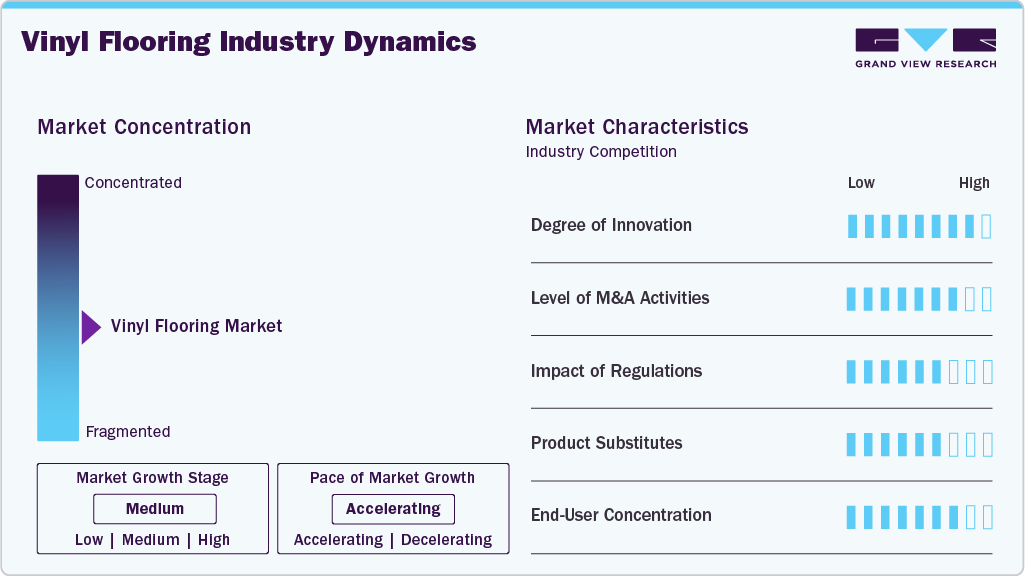
The vinyl flooring market is moderately fragmented, with several multinational corporations and regional manufacturers competing on pricing, design innovation, durability, and distribution networks. Large players dominate premium luxury vinyl tile segments through strong brand recognition, advanced manufacturing capabilities, and global supply chains, while regional firms focus on cost competitiveness and localized product offerings.
Strategic partnerships, acquisitions, and investments in sustainable flooring technologies are becoming increasingly common among key participants. The market also witnesses intense competition in commercial flooring applications, where durability and performance standards are critical purchasing factors. Continuous product innovation and expansion into emerging markets remain major competitive strategies.
 To learn more about this report, Download Free Sample Report
 The vinyl flooring industry faces competition from substitutes such as ceramic tiles, hardwood flooring, laminate flooring, carpets, and engineered stone materials. Hardwood flooring remains popular in premium residential applications for its natural appearance and long-term value, while ceramic tiles dominate moisture-prone environments for their high durability. Laminate flooring offers similar visual appeal at competitive prices, creating substitution pressure in mid-range housing projects. Environmental concerns regarding PVC-based products may also encourage consumers to shift toward eco-friendly alternatives such as bamboo and cork flooring. However, vinyl flooring maintains a strong competitive position due to its affordability, water resistance, ease of maintenance, and wide range of designs.
Product Insights
The luxury vinyl tile (LVT) segment dominated the vinyl flooring market, accounting for the largest revenue share of 65.0% in 2025, and is expected to grow at a CAGR of 6.2% over the forecast period. LVT, also known as wide plank vinyl flooring, is becoming increasingly popular among consumers for residential and commercial applications due to its ease of installation, durability, and water resistance. Higher LVT benefits, such as stain, dent, and scratch resistance, as well as comfort underfoot, are replacing industry staples such as engineered wood and solid wood flooring, as well as porcelain, which is expected to drive segment revenue growth.
Vinyl sheets are expected to exhibit a CAGR of 3.5% in terms of revenue over the forecast period, owing to their ease of maintenance and durability, which are the primary factors contributing to the growth of vinyl-based products. Moreover, color and texture customization offered by the manufacturers is further propelling the product demand. These sheets are used as substitutes for natural stone, ceramic tiles, hardwood, and other flooring materials. Vinyl sheets are used for flooring in moisture-susceptible areas such as kitchens, bathrooms, and laundry rooms. In addition, these floorings are used in indoor playgrounds for their cushioning effect, reducing the risk of injury.
During the forecast period, revenue growth in the vinyl sheets segment is expected to be moderate. This floor covering, made of PVC, stabilizers, and pigments, is coated with UV-cured urethane to resist scratches, stains, and scuffs. Because of its water-resistance, this sheet is used in kitchens, laundry rooms, and bathrooms.
The vinyl tiles segment accounted for 22.3% of the market in 2025 and is projected to grow significantly over the forecast period. During the forecast period, revenue growth in the vinyl tiles segment is expected to be consistent. Because of their water resistance and traffic handling, these tiles are widely used in commercial applications. Vinyl tiles used in dining, drawing, bedrooms, kitchens, playrooms, and bathrooms provide a quiet, comfortable underfoot feel, moisture resistance, and a wide range of designs and colors on the market, which is expected to support demand for vinyl tiles in flooring.
Application Insights
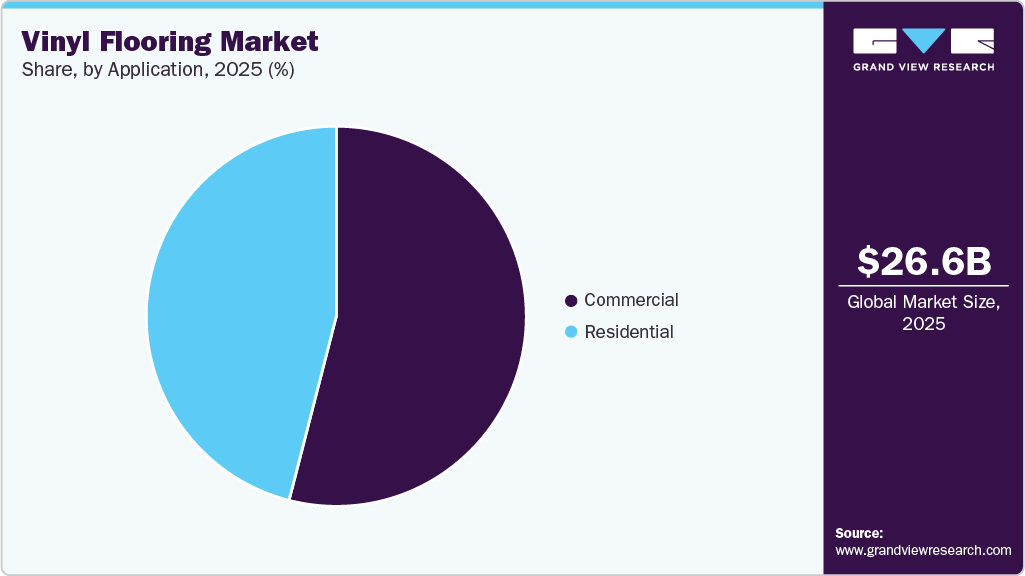
The commercial application segment dominated the vinyl flooring industry, accounting for the largest share of 54.2% in 2025, and is expected to witness a significant CAGR over the forecast period. Due to its adaptability, affordability, durability, and ease of maintenance, vinyl flooring is becoming increasingly popular in commercial settings, including offices, residences, and hospitality venues. Because this flooring can withstand heavy foot traffic, demand for vinyl flooring for commercial use is anticipated to rise.
Commercial applications such as hotels and shopping malls are the primary users of these tiles due to the tiles’ cost-effectiveness and superior aesthetics. The growing influence of designers and architects on the use of vinyl flooring is predicted to accelerate the demand for the product. The features like easy cleaning & sterilization, stylish designs, and slip & water resistance are boosting the demand for the products in the commercial application.
 To learn more about this report, Download Free Sample Report
 The residential application segment is estimated to grow at a 6.1% CAGR over the forecast period. The residential application segment includes residential buildings, apartments, complexes, and small houses. Vinyl flooring is primarily used in residential applications due to its low cost, high durability, and resistance to shock, stains, and dirt. The flooring is available in various patterns and shades, making it a perfect choice for creating patterns resembling natural stone or wood.
Regional Insights
Asia Pacific dominated the vinyl flooring market, with the largest revenue share of 43.5% in 2025, driven by rapid urbanization, robust growth in residential construction, and expanding commercial infrastructure projects in countries such as China, India, Japan, and South Korea. Rising middle-class populations, increasing disposable incomes, and government-backed housing initiatives are supporting strong flooring demand across the region. Manufacturers are also benefiting from low production costs, abundant availability of raw materials, and expanding export capabilities. The region is witnessing increasing adoption of luxury vinyl tiles in modern apartments, offices, and hospitality facilities. Rapid industrialization and investments in smart city development continue to strengthen regional market leadership.
 To learn more about this report, Download Free Sample Report
 The China vinyl flooring market is expected to grow during the forecast period. China is one of the largest producers and consumers of vinyl flooring globally, driven by its massive construction sector and strong manufacturing ecosystem. The country is experiencing growing demand for luxury vinyl tiles and waterproof flooring solutions across residential and commercial projects. Domestic manufacturers are increasingly focusing on environmentally friendly and low-emission flooring products to comply with tightening environmental regulations. Investments in automation, digital printing technologies, and export-oriented production facilities are further supporting market expansion.
North America Vinyl Flooring Market Trends
North America is witnessing strong demand for vinyl flooring, driven by residential remodeling, commercial renovation projects, and an increasing preference for luxury vinyl tiles. Consumers in the region are increasingly adopting premium flooring solutions that combine durability, aesthetic appeal, and low maintenance requirements.
The U.S. and Canada are experiencing growth in the healthcare, education, retail, and hospitality construction sectors, which is supporting demand for commercial flooring. Sustainable, phthalate-free vinyl flooring products are becoming increasingly important as environmental standards evolve and consumer awareness grows. Technological innovations in rigid core flooring and digital texture printing are also driving market competitiveness.
U.S. Vinyl Flooring Market Trends
The U.S. market is expanding steadily due to rising home renovation expenditures and increasing consumer preference for waterproof and scratch-resistant flooring materials. Luxury vinyl tile products are gaining substantial popularity because they offer the appearance of natural wood and stone at lower costs. Commercial sectors such as healthcare and retail are increasingly utilizing vinyl flooring for its hygiene benefits, durability, and ease of maintenance.
Europe Vinyl Flooring Market Trends
Europe is experiencing steady growth in the vinyl flooring industry, driven by rising renovation activity, stringent energy-efficiency building regulations, and growing demand for aesthetically advanced flooring materials. Consumers across Germany, France, Italy, and the UK are increasingly adopting luxury vinyl flooring in residential and commercial interiors. Sustainable construction practices and circular economy initiatives are encouraging manufacturers to introduce recyclable and low-VOC flooring products.
The Germany vinyl flooring market is growing. Germany is one of the key markets in Europe due to its strong construction sector, advanced manufacturing capabilities, and emphasis on sustainable building materials. Demand for premium vinyl flooring products is increasing across residential renovation and commercial infrastructure projects. German consumers are showing a strong preference for eco-friendly, energy-efficient flooring solutions that offer enhanced durability and aesthetic appeal. Manufacturers are investing in recycled PVC technologies and environmentally compliant production processes to align with regional sustainability regulations.
Central & South America Vinyl Flooring Market Trends
The Central & South America vinyl flooring industry is growing steadily due to an increase in urban housing projects, improving economic conditions, and rising investment in commercial infrastructure. Countries such as Brazil and Mexico are witnessing growing adoption of affordable and moisture-resistant flooring materials in residential and retail applications. The expanding hospitality and tourism industries are also driving demand for aesthetically appealing, durable flooring products. International manufacturers are strengthening regional distribution networks to capitalize on emerging construction opportunities.
Middle East & Africa Vinyl Flooring Market Trends
The Middle East & Africa vinyl flooring industry is witnessing gradual growth, driven by expanding construction activities, rising hospitality investments, and infrastructure modernization projects. Countries such as the UAE, Saudi Arabia, and South Africa are increasingly adopting vinyl flooring in commercial buildings, hotels, airports, and residential complexes. Demand for luxury vinyl tiles is rising due to their durability under extreme climatic conditions and ease of maintenance. Government initiatives related to tourism development, smart cities, and urban infrastructure are creating favorable market opportunities. Increasing penetration of international flooring brands and premium interior design trends is further contributing to regional market expansion.
Key Vinyl Flooring Company Insights
Some of the key players operating in the market include Armstrong Flooring, Inc., and Mohawk Industries, Inc.
-
Armstrong Flooring is a flooring brand in the AHF Products portfolio, serving residential and commercial markets. In July 2022, AHF Products acquired selected assets of the former Armstrong Flooring, Inc., including rights to license the Armstrong Flooring brand. The brand offers flooring products for commercial applications, including healthcare, education, retail, workplace, multifamily, and hospitality environments, as well as residential applications. Its portfolio includes resilient flooring products, such as luxury vinyl tile (LVT), as well as other solutions designed for residential and commercial use.
-
Mohawk Industries, Inc. was incorporated in 1992. The company is headquartered in Georgia, U.S., and is primarily engaged in the production of flooring components. It designs, sources materials, manufactures, and distributes various flooring materials to markets including residential new construction, residential replacement, and commercial construction. The company operates its business through segments: Global Ceramics, Flooring North America, and Flooring Rest of the World.
Some of the key players operating in the market include Gerflor and Fatra A.S.
-
Gerflor was established in 1937 and is headquartered in Villeurbanne, France. The company designs, manufactures, and markets flooring solutions and wall finishes for the construction sector. The company’s floor business has a global presence. It offers its products under various brands, including Mipolam, DLW, Taraflex, Tarabus, Connor Sports, Sport Court, and Gradus. It mainly serves indoor flooring applications, including healthcare, schools, retail, sports, housing, office, hospitality, and transport vehicles.
Key Vinyl Flooring Companies
The following key companies have been profiled for this study on the vinyl flooring market.
-
Armstrong Flooring
-
Forbo Flooring Systems
-
Mohawk Industries, Inc.
-
Tarkett S.A.
-
Mannington Mills, Inc.
-
Shaw Industries Group, Inc.
-
LG Hausys
-
Gerflor
-
Fatra A.S.
-
Beaulieu International Group
-
Polyflor Ltd.
Company Categorization
Operating Strategies
Competitive Edge
Weakness
Mature Players: Forbo Flooring Systems; Mohawk Industries, Inc.; Tarkett S.A.; Mannington Mills, Inc.
- Focus on acquisitions and strategic partnerships to expand global market presence
- Investment in sustainable and recyclable vinyl flooring technologies
- Expansion of luxury vinyl tile (LVT) and rigid core flooring portfolios
- Strong global distribution and dealer networks
- Advanced manufacturing capabilities with high production capacity
- Strong brand recognition in commercial and residential flooring markets
- High operational and regulatory compliance costs
- Dependence on raw material price fluctuations
- Slower penetration in highly localized niche markets
Emerging Players: Fatra A.S.; Beaulieu International Group; Polyflor Ltd.
- Focus on regional expansion and cost-competitive product offerings
- Development of customized and design-oriented vinyl flooring solutions
- Partnerships with local distributors and construction companies
- Greater flexibility in responding to regional customer preferences
- Competitive pricing strategies in developing markets
- Faster adoption of innovative textures and decorative designs.
- Limited global brand visibility and distribution reach
- Lower investment capabilities in R&D and advanced technologies
- Smaller production capacities compared to established multinational players
Recent Developments
-
In November 2025, AHF Products acquired a manufacturing facility in Cartersville, Georgia, to expand rigid-core LVT and glue-down vinyl flooring production capacity.
-
In October 2024, Shaw Industries Group, Inc. announced the completion of a USD 90 million expansion at its Ringgold, Georgia, facility to increase production capacity for Stone Plastic Composite (SPC) and Luxury Vinyl Tile (LVT) in North American markets.
Vinyl Flooring Market Report Scope
Report Attribute
Details
Market size in 2025
USD 44.7 billion
Estimated market size in 2026
USD 47.0 billion
Projected market size by 2033
USD 69.1 billion
Growth rate
CAGR of 5.7% from 2026 to 2033
Base year for estimation
2025
Historical data
2021 - 2024
Forecast period
2026 - 2033
Quantitative units
Volume in million square meters, revenue in USD million/billion, and CAGR from 2026 to 2033
Report coverage
Revenue forecast, competitive landscape, growth factors, and trends
Segments covered
Product, application, region
Regional scope
North America; Europe; Asia Pacific; Central & South America; Middle East & Africa
Country scope
U.S.; Canada; Mexico; Germany; UK; France; Spain; Italy; Russia; China; India; Japan; South Korea; Singapore; Australia; Brazil; Argentina; Saudi Arabia; UAE
Key companies profiled
Armstrong Flooring; Forbo Flooring Systems; Mohawk Industries, Inc.; Tarkett S.A.; Mannington Mills, Inc.; Shaw Industries Group, Inc.; LG Hausys; Gerflor; Fatra A.S.; Beaulieu International Group; Polyflor Ltd.
Customization scope
Free report customization (equivalent up to 8 analysts working days) with purchase. Addition or alteration to country, regional & segment scope.
Pricing and purchase options
Avail customized purchase options to meet your exact research needs. Explore purchase options
Global Vinyl Flooring Market Report Segmentation
This report forecasts volume and revenue growth at the global, regional, and country levels and provides an analysis of the latest industry trends in each of the sub-segments from 2021 to 2033. For this study, Grand View Research has segmented the global vinyl flooring market report based on product, application, and region:
 To learn more about this report, Download Free Sample Report
 -
Product Outlook (Volume, Million Square Meters; Revenue, USD Million/Billion, 2021 - 2033)
-
Vinyl Sheets
-
Vinyl Tiles
-
Luxury Vinyl Tiles
-
-
Application Outlook (Volume, Million Square Meters; Revenue, USD Million/Billion, 2021 - 2033)
-
Residential
-
Commercial
-
-
Regional Outlook (Volume, Million Square Meters; Revenue, USD Million/Billion, 2021 - 2033)
-
North America
-
U.S.
-
Canada
-
Mexico
-
-
Europe
-
Germany
-
UK
-
France
-
Spain
-
Italy
-
Russia
-
-
Asia Pacific
-
China
-
India
-
Japan
-
South Korea
-
Singapore
-
Australia
-
-
Central & South America
-
Brazil
-
Argentina
-
-
Middle East & Africa
-
Saudi Arabia
-
UAE
-
-
Delivered Customizations
We have successfully delivered the following deep-dive customizations
Client Request
Customization Delivered
Value Adds
Regional Demand Analysis
Detailed region-wise and country-wise demand analysis for vinyl flooring across residential, commercial, healthcare, retail, hospitality, and industrial sectors. The customization includes construction spending trends, analysis of renovation activity, assessment of the housing project pipeline, and identification of high-growth urban clusters.
Helps clients prioritize expansion markets, identify untapped regional opportunities, optimize manufacturing and distribution strategies, and allocate sales resources efficiently. Enables companies to align product offerings with regional consumer preferences and construction trends.
Sustainability Assessment
Comprehensive evaluation of environmental and sustainability trends impacting the vinyl flooring market, including recyclable flooring adoption, low-VOC product demand, phthalate-free materials, carbon footprint analysis, and circular economy initiatives.
Assists clients in developing environmentally compliant product portfolios, improving ESG positioning, strengthening sustainability branding, and meeting evolving customer and regulatory expectations. Supports long-term risk mitigation and helps companies capitalize on the growing demand for eco-friendly flooring solutions.
Competitive Landscape
In-depth competitive benchmarking of global and regional vinyl flooring manufacturers based on production capacity, product portfolio strength, pricing strategies, distribution networks, geographic presence, innovation capabilities, mergers & acquisitions, sustainability initiatives, and financial performance.
Enables clients to understand competitor positioning, identify market gaps, evaluate partnership or acquisition targets, and refine pricing and product differentiation strategies. Supports strategic decision-making related to expansion, product innovation, branding, and long-term competitive positioning in the global vinyl flooring market.
Frequently Asked Questions About This Report
The global vinyl flooring market size was valued at USD 44.7 billion in 2025 and is projected to grow from USD 47.0 billion in 2026.
The global vinyl flooring market is expected to grow at a CAGR of 5.7% from 2026 to 2033, reaching USD 69.1 billion by 2033.
Asia Pacific dominated with a 43.5% revenue share in 2025.
Key players include Armstrong Flooring, Forbo Flooring Systems, Mohawk Industries, Inc., Tarkett S.A., Mannington Mills, Inc., Shaw Industries Group, Inc., LG Hausys, Gerflor, Fatra A.S., Beaulieu International Group, and Polyflor Ltd.
Growth in construction spending across emerging Middle Eastern and Asia-Pacific economies, supported by industrial and economic development and population growth, is expected to increase demand for vinyl flooring.
The luxury vinyl tile segment led with a 65.0% revenue share in 2025.
The commercial application segment led with a 54.2% revenue share in 2025, while the residential application segment is the fastest-growing.
About the Author(s)
Advanced Interior Materials Research Team
Advanced Materials · Advanced Interior MaterialsThis report was authored by the advanced interior materials research team at Grand View Research - comprising two research analysts, one senior research analyst, and one industry expert - with specialized expertise in the advanced interior materials segment of the advanced materials industry. All findings are based on proprietary advanced materials databases, executive interviews, and regulatory analysis, subject to internal peer review prior to publication.
Last Updated:
Speak to Analyst

Customize this report to your needs - add regions, segments, or data points, with 20% free customization.
Or view our licence options:


ISO 9001:2015 & 27001:2022 Certified
We are GDPR and CCPA compliant! Your transaction & personal information is safe and secure. For more details, please read our privacy policy.


